Senin, 13 Desember 2010

Heaven's Bride and the Sexologist's Secret


Paul Harvey


Ida Craddock was a dreamy, driven autodidact who was in her own strange way more American than the persecuting agent of the state, Anthony Comstock. Heavenly bride, free-speech martyr, full-blown American eccentric, Craddock is reanimated by Mr. Schmidt's biography.


Heaven’s Bride is a brilliant work of intellectual reclamation. Schmidt calls Craddock “an escape artist of the imagination,” who ”tried to lift herself free on the paired wings of Eros and divine love.” If her story skews perilously close to the ridiculous at times, he never for a moment allows us to forget that it is fundamentally a tale of thwarted genius, of boundless courage, and, ultimately, of visionary splendor.

On the Study of Evangelicalism in the Chronicle

Timothy Beal, "Among the Evangelicals: Inside a fractured movement," Chronicle Review, December 12, 2010
.
. . . academic studies of American evangelicalism and related movements have been fairly few and far between compared with those of other religious subjects—such as early American religious history and religion and politics—and their authors have written primarily for audiences of their disciplinary peers. More recently, however, there appears to be a growing intellectual interest in the subject among nonevangelical readers and outside academe. Some of the most popular trade books on the subject are first-person accounts of non-Christians who have immersed themselves in particular evangelical or fundamentalist communities. Most notable are Jeff Sharlet's remarkable exposé, The Family: The Secret Fundamentalism at the Heart of American Power (HarperCollins, 2008), and Kevin Roose's The Unlikely Disciple: A Sinner's Semester at America's Holiest University (Grand Central, 2009), that is, Jerry Falwell's Liberty University. Sharlet is a religion scholar and journalist, and Roose is a former Brown University undergraduate and now a writer. >>>

Sabtu, 11 Desember 2010

Premillennialists and Their Charts

Randall Stephens

It's hard to narrate the history of millennialism to a general audience without losing the plot in a thicket of obscure Bible verses, dispensational disorientation, and premill fatigue. Sure, there's a rage to explain. But how many paragraphs should a historian of American millennialism devote to "Armageddon," "tribulation," "Gog," "Magog," "Mark of the Beast"? (Paul Boyer navigated this well in his classic When Time Shall Be No More. That's a wonderful guide.)

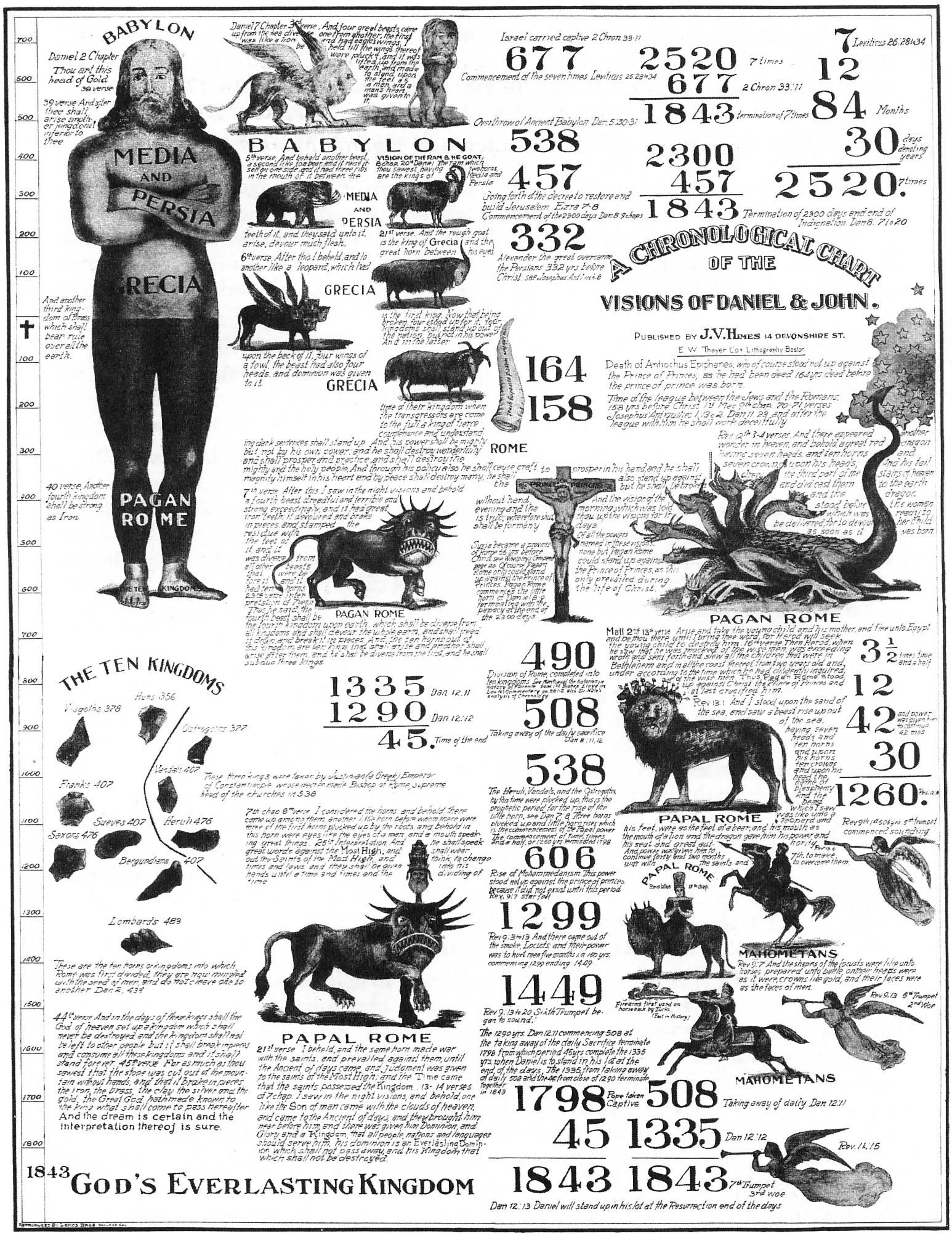
What better illustration of the Babel of premill confusion than the charts, diagrams, and cartoons premill experts used. The gleeful focus on minutiae, sidetracks, and the like dominates so much premill writing from the 19th and 20th centuries. It must not have been too difficult for a superfan of Star Trek to have turned his/her attention to the second advent in the 1970s or 80s.

So, I paste here some of my favorite confusing charts and illustrations. Try explaining any one of these to a room full of the uninitiated. It would be easier to wax eloquent about the distinguishing characteristics of the Klingons, Romulans, Ferengi, Vulcans, and Cardassians.

From William E. Blackstone's wildly popular Jesus Is Coming (1878). Degree of difficulty: 6 out of 10.


Click to enlarge this iconic Millerite poster from 1843, which deciphers prophetic math from Daniel and Revelation. Would like to see a black light version of it. Degree of difficulty: 9 out of 10.


From Isaac Cummings Wellcome, History of the Second Advent Message and Mission, Doctrine and People (1874). Degree of difficulty: 7 out of 10.


And finally, this one from a copy I picked up back in seminary days, Clarence Larkin, The Dispensational Truth: God's Plan and Purpose in the Ages (1920). This handsome text has some real mind-blowing charts in it. Degree of difficulty: 8 out of 10.


Related Posts Plugin for WordPress, Blogger...