Paul Harvey Pardon the self-promotion interruption, but you're used to it. Now and then I post reviews from the helpful library periodical Choice of books of interest in our field. Today I'm going to seize the blog to post this review of my new book Through the Storm, Through the Night, especially for those of you contemplating your book choices for next semester's classes. Harvey, Paul. Through the storm, through the night: a history of African American Christianity. Rowman & Littlefield, 2011. 217p bibl index afp; ISBN 9780742564732, $35.00; ISBN 9780742564756 e-book, $34.99. Reviewed in 2012jan CHOICE. |
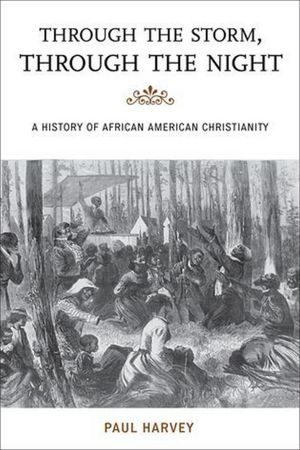 Books abound on the African American religious experience in the US, but Harvey's work is a welcome addition and succinct summary of its 400-year history. Typically in such short monographs, detail is sacrificed for brevity, but Harvey (history, Univ. of Colorado, Colorado Springs) packs great substance through insightful biographies and aptly summarized historical events. He argues against any uniform African American church or religious experience, as African Americans experienced varied contacts with Christianity and often mixed traditional African spiritualism and animistic beliefs. Unquestionably, religious beliefs infused the African American community with hope as they struggled through slavery, Jim Crow legislation, segregation, race-oriented violence, and the civil rights movement. Harvey concludes that though the church is still relevant and Christian denominations are still predominant in the African American community, 21st-century immigrants continue to challenge this narrative, as the Orisha traditions of West and Central Africans, Cuban Santería, Haitian Catholicism and Voodoo, Ethiopian Eastern Orthodoxy, and Islamic influences further heighten diversity. The author notes that clannish and local community traditions among these immigrants overshadow any presumed unity based on skin color. In summary, Harvey creates a broad panoramic of the African American religious experience and challenges future scholars to increase scholarly attention to this field. Summing Up: Highly recommended. All levels/libraries. -- M. S. Hill, Gordon College Books abound on the African American religious experience in the US, but Harvey's work is a welcome addition and succinct summary of its 400-year history. Typically in such short monographs, detail is sacrificed for brevity, but Harvey (history, Univ. of Colorado, Colorado Springs) packs great substance through insightful biographies and aptly summarized historical events. He argues against any uniform African American church or religious experience, as African Americans experienced varied contacts with Christianity and often mixed traditional African spiritualism and animistic beliefs. Unquestionably, religious beliefs infused the African American community with hope as they struggled through slavery, Jim Crow legislation, segregation, race-oriented violence, and the civil rights movement. Harvey concludes that though the church is still relevant and Christian denominations are still predominant in the African American community, 21st-century immigrants continue to challenge this narrative, as the Orisha traditions of West and Central Africans, Cuban Santería, Haitian Catholicism and Voodoo, Ethiopian Eastern Orthodoxy, and Islamic influences further heighten diversity. The author notes that clannish and local community traditions among these immigrants overshadow any presumed unity based on skin color. In summary, Harvey creates a broad panoramic of the African American religious experience and challenges future scholars to increase scholarly attention to this field. Summing Up: Highly recommended. All levels/libraries. -- M. S. Hill, Gordon College |
Tampilkan postingan dengan label textbooks. Tampilkan semua postingan
Tampilkan postingan dengan label textbooks. Tampilkan semua postingan
Selasa, 20 Desember 2011
Choice Reviews Through the Storm, Through the Night
Rabu, 22 September 2010
New Year, New You, New Books … Already?
by Edward J. Blum
We’ve only just begun the fall semester, but it won’t be long until book orders are due for the spring. So, as you’re putting in orders for old faithfuls like The Kingdom of Matthias (IBSN: 0195098358) or new loves like Freedom’s Coming (ISBN: 0807858145), you may want to consider the third editions of Major Problems in American History (ISBN: 0495915130). If you’re not familiar with my blog posts, then you need to know that most of them are self-promotional. If you are not familiar with this series, the Major Problems, then you should really get your hands on them. The collections match 8-10 primary documents from a given period or topic with 2-3 scholarly essays that debate the key points. I have used just about every one and students seem to love them. It’s high-quality one-stop shopping (more like Target than Walmart) for primary and secondary sources!
Sadly, the new edition for Major Problems in American History began with a loss. Just before revisions started, editor Jon Gjerde passed away, professor of history at UC Berkeley and author of some amazing books on the West, ethnicity, and rural life,. I joined my colleague Elizabeth Cobbs Hoffman (author of the fantastic book on the Peace Corps, All You Need is Love) to edit the new editions. Professor Gjerde did an incredible job establishing the main contours for the first volume and it’s his strong architecture I built upon.
The two new volumes highlight the role of religion and culture in significant, entertaining, and critical ways. Volume 1 (through Reconstruction) now has poems from Anne Bradstreet and court testimony from Tituba; it follows the emergence of American civil religion with patriot songs from the Revolution and odes to Washington; it careens into the antebellum period with new doctrines from the Church the Church of Latter-day Saints and salacious exposés on the Kingdom of Matthias. It has prophetic visions from Native Americans, new biblical interpretations from feminists locating egalitarianism in the Bible, and heavenly images of emancipation. For secondary documents, Volume I now has snippets from David Hall’s Worlds of Wonder, Days of Judgment on the colonial era and Nell Painter’s Sojourner Truth on antebellum religion and reform, where Truth’s adventures are matched with the analysis of Finneyite revivalism in Paul Johnson’s Shopkeepers’ Millennium.
Volume II amped up its religious coverage as well. Lost Cause ministers lionize the South, Brigham Young battles anti-Mormon ballads, Mark Twain satirizes the Battle Hymn of the Republic, Sister Aimee Semple McPherson uses new technology to defend the old-time religion, Father Coughlin denounces FDR, Vance Packard laments the religion of America in the Cold War, and Jerry Fallwell calls for the nation to return to the Bible.
Langganan:
Postingan (Atom)
