Tampilkan postingan dengan label religion and the american revolution. Tampilkan semua postingan

Jumat, 21 Oktober 2011

History Now Features Colonial American Religion

Paul Harvey

The below is taken from an entry on John Fea's blog, featuring a new issue of History Now that is devoted to religion in colonial America; it should be of interest to many, so I'll repost here.
____________________________________________

"History Now" Explores Religion in Colonial America
The current issue of History Now, the online journal of the Gilder-Lehrman Institute of American History, is featuring articles, lesson plans, and activities related to religion in the colonial world. The articles include:

The Puritans and Dissent: The Cases of Roger Williams and Anne Hutchinson by Francis J. Bremer

Early America’s Jewish Settlers by Eli Faber

The Origins and Legacy of the Pennsylvania Quakers by Barry Levy

Thomas Jefferson and Deism by Peter S. Onuf

The issue also includes a very cool interactive map tracing the concentrations of various religious groups in different parts of the British colonies.

Kamis, 20 Oktober 2011

The Founding Fathers and the Debate Over Religion in Revolutionary America

Paul Harvey

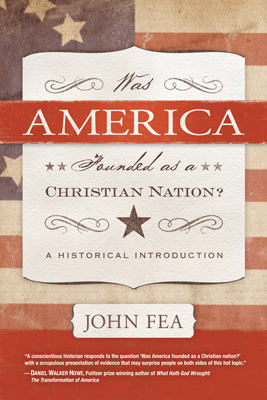
Several times on this blog we've discussed and reviewed John Fea's Was America Founded as a Christian Nation: A Historical Introduction. I'm presently using this in a class, to excellent results, as the students are very engaged with the material (and curious about the author!). Ed Blum's post on using the book in his Historiography course produced a series of blog comments which suggests that he must have had a vigorous class discussion coming out of the work.

Here's a very new primary source volume which should serve many as an eminently usable accompaniment for those wanting to dig into this era further or do a "compare the historian's work to the original sources" kind of exercise: Thomas Kidd and Matthew Harris, eds., The Founding Fathers and the Debate Over Religion in Revolutionary America, just published with Oxford. Click on the link and it will take you to the Amazon page for the book, where you can go through the table of contents and see if the work is right for your class.

Even better might be combining this collection of documents with students searching out those from the kinds of revolutionary Americans discussed by Gary Nash in The Unknown American Revolution or some similar text which incorporates voices reaching beyond "the founders." Ed's students discuss precisely this point in their comments on his post (linked above).

The editors include a number of the old standbys on the subject (Jefferson's Danbury letter, the Treaty of Tripoli, various fast day proclamations, and some of the Founders' musings on the subject) as well as some other material less frequently invoked (some state constitutions, the Northwest Ordinance, and some others). Below is a bit more about the book from its website; it looks like a good bet to be a classroom staple for those who teach in this era, much as is Kidd's volume with Bedford books The Great Awakening: A Brief History with Documents, which I used to excellent results last summer in leading a group of K-12 educators in a Teaching American History program in thinking about how to integrate religion in their American history lesson plans.

Whether America was founded as a Christian nation or as a secular republic is one of the most fiercely debated questions in American history. Historians Matthew Harris and Thomas Kidd offer an authoritative examination of the essential documents needed to understand this debate. The texts included in this volume - writings and speeches from both well-known and obscure early American thinkers - show that religion played a prominent yet fractious role in the era of the American Revolution.

In their personal beliefs, the Founders ranged from profound skeptics like Thomas Paine to traditional Christians like Patrick Henry. Nevertheless, most of the Founding Fathers rallied around certain crucial religious principles, including the idea that people were "created" equal, the belief that religious freedom required the disestablishment of state-backed denominations, the necessity of virtue in a republic, and the role of Providence in guiding the affairs of nations. Harris and Kidd show that through the struggles of war and the framing of the Constitution, Americans sought to reconcile their dedication to religious vitality with their commitment to religious freedom.

Selasa, 27 September 2011

Including "Religious Others" in the Christian Nation "Debate"

by Edward J. Blum

Amid the culture wars of the 1990s, Isaac Kramnick and R. Laurence Moore published a slim volume. It had a provocative title and a silly subtitle: The Godless Constitution: The Case against Religious Correctness. Thankfully, the subtitle was later changed to A Moral Defense of

the Secular State (although, of course, the “a” before “moral” could cause some confusion). Kramnick and Moore argued that the founders of the United States purposefully created a secular nation and that waves of evangelicals throughout the nineteenth and twentieth centuries added religious appendages to the secular framework. This left many Americans confused, frustrated, and bitter. Thank goodness Kramnick and Moore could show us the right (and by right, I mean left) way. Reviewing the first edition, UNC’s John E. Semonche concluded that The Godless Constitution was “not an unworthy entry into a debate that has never verged on the profound.”

Wow. If that doesn’t make you chuckle, then you haven’t read enough reviews that essentially end, “makes a significant contribution to many significant fields.”

“Profound” is such a tricky word. Semonche certainly wasn’t referring to Madison’s and Jefferson’s discussions of church-state relations – so profoundly analyzed in David Sehat’s The Myth of American Religious Freedom. Perhaps Semonche was thinking of Jerry Falwell and Francis Schaeffer, but their acolytes certainly took their works to be profound.

Thanks to John Fea, historians now have a profound tool to use in the debate. I have been teaching Was America Founded as a Christian Nation? in my historiography class, and we’re having a blast. Fea shares at least one commonality with Kramnick and Moore. All write from a shared frustration with the simplistic histories of the nation presented by the religious right. Unlike Kramnick and Moore, however, who wish to defend a secular state, Fea wants to teach about history. He wants students and interested readers to think in terms of change over time, context, causality, contingency, and complexity. And as a teaching device, this book is without doubt profound. There is so much to commend in Was America Founded as a Christian Nation?, especially Fea’s examination of the history of the idea that the United States was a Christian nation.

When I hold The Godless Constitution and Was America Founded as a Christian Nation? side-by-side, I’m left with a few questions. First, where are the women? If “American religious history is women’s history” (or is it women’s history is religious history … I can never remember; thank goodness for google), as Ann Braude so famously put it, how are we still able to write histories like this without women playing prominent roles? Second, do the voices of African Americans or Native Americans or immigrant Americans trouble the discussion? Years ago, I published an essay on African American uses of “Christian nation” rhetoric and others have done similar work, such as Joanna Brooks in American Lazarus or Eddie Glaude in Exodus! Have we abandoned “religious outsiders” in this debate?

Third, and finally, is there any difference in historical and theological opinion among conservative evangelicals and anti-liberal evangelicals? Jason Bivins published an amazing book several years ago on “anti-liberalism” (meaning animosity for the large state and liberal norms, but not necessarily pro-Republican Christians) where he showed how home schoolers and the Berrigan brothers shared a political sensibility of frustration. If we consider the contemporary political terrain as complex and variegated (even among conservatives who are so easily made into caricatures rather than understood on their own terms), then what are the differences of opinion among the anti-liberals and anti-secularists?

My point from these questions would be this: to understand historically the Christian nation debate, we need to expand the parameters of inclusion and more richly think about the political fabric of the nation. Without doing so, we’re left thinking antebellum Whigs dominated American politics (they didn’t!), that Martin Luther King, Jr., was the only one to use Christian nationalism for moral politics (he wasn’t), and that contemporary conservatives are convinced antichrist is among us (many don’t and many think those who do are nuts).

I’m off to the East Coast with a satchel full of new books … so I’ll be back with some reviews from 35,000 feet. You can expect several “unworthy” entries.

Minggu, 18 September 2011

Back to the Future: Christianity and the American Founding

I'm looking forward a bit later this semester to using John Fea's Was America Founded as a Christian Nation in my "Theory and Methods of History" class. Aside from the precise subject matter, Fea has much to teach about thinking historically, on any subject. Below is my review of the book published several months ago at Christian Century, which is freely available online so I'll repost here, particularly for those of you who would be interested in using the book next semester or some other time in the future.

Paul Harvey

Was America founded as a Christian nation? No, is John Fea's answer to the question posed in his title. But the answer is yes if we consider how Americans (especially from 1789 to 1865) understood themselves as a Christian nation. And then again, maybe it's just a bad question, Fea concludes, because it arises not from a rich understanding of the past but from present-day polemics. Only when we remove it from that context can we begin to make sense of it.

As chair of the history department at Messiah College, a professing Christian, author of an outstanding book on an 18th-century figure of the "rural Enlightenment" (Philip Vickers Fithian), a frequent public speaker and a tireless blogger at The Way of Improvement Leads Home, Fea is rapidly making a name for himself as a public intellectual who brings the virtues of scholarly humility, patience and objectivity to highly controversial questions of religion and the founding era of American history. This book is a model of scholarly restraint, of patiently working one's way through the sources and of historicizing the questions and terms with which one works.

America was not "founded as a Christian nation," Fea suggests, because its founding documents were those of a fledgling nation-state and not intended as religious statements. The Declaration of Independence was a document of foreign policy aimed at persuading other nations of our independence, and the Constitution was a secular document of governance aimed at shoring up a national government that had proven far too weak during the era of the Articles of Confederation.

Moreover, present-day proponents of the Christian nation thesis (notably self-styled scholars such as David Barton and writers such as Peter Marshall, author of The Light and the Glory) depend heavily on documents that are taken out of context. Fea points out that while some founding fathers (such as John Jay) held recognizably evangelical Christian beliefs, most of the major founders held a range of beliefs that positioned them as either lukewarm high-church Christians who mainly talked about Providence or rational theists such as Thomas Jefferson, who actively rejected and even ridiculed central Christian doctrines such as the resurrection of Christ.

Then again, yes, America was founded as a Christian nation, Fea argues. For example, nearly every individual state (but not Virginia) enacted a state constitution that made it "very clear that they were Christian societies, placing Protestant qualifications on office holding and allowing government to tax citizens for the purpose of promoting the Christian religion." Moreover, Ameri­cans of the founding era, even including those far outside the bounds of Christian orthodoxy, trusted that "religion was necessary in order to sustain an ordered and virtuous republic."

During the Second Great Awakening in the 19th century, when evangelicalism rose to become a dominant form of religious expression, many Americans assumed a Protestant base to American culture. In the words of historian David Sehat, they created an informal but powerful "moral establishment" that in some ways wielded more power than any national legal establishment of religion would have. The religion clauses of the First Amendment ("Congress shall make no law respecting an establishment of religion, or prohibiting the free exercise thereof") ruled out any legal establishment at the national level. But Americans exercised the free-exercise clause freely, inventing a bewildering array of new denominations, missionary societies, publication boards and religions throughout the 19th century, making America a Christian nation in demography if not in law.

Thomas Jefferson had dreamed of a rationalist republic; what he got instead was a Methodist millennium. In many ways, the idea of America as a Christian nation, as put forward by its current proponents, was an invention not of the founding era but of the 19th century. In other words, the phrase Christian nation as used in Fea's title itself has a history, one that underwent significant changes and transformations between the era of Franklin and the era of Falwell.

But most important, Fea suggests, the question "Was America founded as a Christian nation?" is badly posed. The question is ahistorical because it presupposes a stable set of terms (such as nation, founding and Chris­tian) that in fact are historically contingent and must be understood within the context of their own time and place. Fea's most important original intention is to give readers a lesson in historical thinking—a lesson on the strangeness and distantness of the past in relation to our own preconceptions and concerns.

For example, the famous Treaty of Tripoli in 1797 assured the Muslim states of the Barbary Coast that "the Government of the United States of America is not, in any sense, founded on the Christian religion"; no religious differences between the United States and Tripoli would come between a necessary and important trade agreement protecting American ships from piracy. The treaty stated a historical truth about the Constitution. Americans, however, viewed the contest between the United States and the Barbary nations as a holy war, avidly read captivity narratives describing Christians being forced to convert to Islam and characterized Muslims as "children of Ishmael" who threatened Christian civilization. In short, in spite of the secularism of the founding documents, many Americans from the Revolution to the Civil War did understand themselves to be citizens of a Christian nation.

Of course, those same Americans disagreed vehemently on what constituted a Christian nation, hence the denominational splits, religious vituperation and the bloody Armageddon of the Civil War. And since then Amer­icans have continued their disagreements.

Fea tells this story with consummate skill and evenhandedness. However, his evenhandedness sometimes seems to suggest points of controversy where there aren't any (not unlike the Obama "birther controversy"). In the present day, even advocates of the "godless Constitution" viewpoint (such as historians Isaac Kramnick and R. Laurence Moore) fully understand the deep religious base of American history. They suggest not an exclusion of religion from the public square but simply an avoidance of any special privileges for it. The Christian nationalists, by contrast, have some legitimate points (fully credited by Fea), but they also actively and unapologetically use and distort history in precisely the ways that Fea warns against in his introductory chapter, titled "How to Think His­torically."

The Christian nation debate is not really an intellectual contest between legitimate contending viewpoints; it is instead a manufactured controversy akin to the global warming debate. On one side are purveyors of a rich and complex view of the past (including most historians who have written about the founding era). On the other side is a group of ideological cranks who have created an alternate intellectual universe based on a historical fundamentalism. In their drive to create a usable past, they show little respect for how the past is a "foreign country."

Sabtu, 04 Juni 2011

Faith of the Founders (My Review of John Fea in the Christian Century)

Paul Harvey

I was very happy that the Christian Century asked me to review John Fea's Was America Founded as a Christian Nation: A Historical Introduction -- and even more glad they gave me relatively ample space (over 1200 words anyway, better than the average review) to develop some thoughts on John's book. The review is here. Here is an excerpt, and then continue at the jump:

Faith of the founders

Was America founded as a Christian nation? No, is John Fea's answer to the question posed in his title. But the answer is yes if we consider how Americans (especially from 1789 to 1865) understood themselves as a Christian nation. And then again, maybe it's just a bad question, Fea concludes, because it arises not from a rich understanding of the past but from present-day polemics. Only when we remove it from that context can we begin to make sense of it.

Continue <<<

Senin, 25 April 2011

A Cheerful and Comfortable Study of Colonial Material Religion

Paul Harvey

Since yesterday I mentioned Lauren Winner's essay in the Sunday Times book review, which reflected on Rob Bell and American conceptions of hell (and heaven), seems like a good time to showcase this review of her new book A Cheerful and Comfortable Faith, recently published by Yale -- the review is from Choice.

Winner, Lauren F. A cheerful and comfortable faith: Anglican religious practice in the elite households of eighteenth-century Virginia. Yale, 2010. 272p bibl index afp ISBN 0-300-12469-4, $45.00; ISBN 9780300124699, $45.00. Reviewed in 2011may CHOICE.

This study by Winner (Duke Divinity School) of the domestic religious life of elite families in Colonial Virginia both builds upon and modifies earlier work, including Dell Upton's Holy Things and Profane (1986). As Upton did, Winner focuses primarily on material objects as evidence; however, she deals not with public, male-dominated church buildings but rather with articles found in and around the home: needlework, baptismal bowls, prayer books, articles related to food preparation and consumption, and garments and rings worn in times of mourning. Winner's argues that although their roles were circumscribed, Anglican women nevertheless carved out a sphere in which they subtly contested the authority over religious matters claimed by clergy and male relatives and that their religious life, though not as dramatic as that of their Puritan counterparts, was an authentic appropriation of Anglican tradition in a Colonial setting. Winner's work is thoroughly and imaginatively researched, informed but not overwhelmed by theory, adequately illustrated, and accessibly written. This book is an important contribution to Anglican, elite, Colonial, material, and gendered dimensions of American religious life. Summing Up: Highly recommended. Upper-level undergraduates through researchers/faculty.
-- P. W. Williams, Miami University

Rabu, 16 Februari 2011

An Interview with Chris Beneke on The First Prejudice

Randall Stephens

About a week ago Paul blogged on Chris Beneke and Christopher S. Grenda's, The First Prejudice: Religious Tolerance and Intolerance in Early America (Univ. Pennsylvania Press, 2011). The edited volume, "presents a revealing portrait of the rhetoric, regulations, and customs that shaped the relationships between people of different faiths in seventeenth- and eighteenth-century America. It relates changes in law and language to the lived experience of religious conflict and religious cooperation, highlighting the crucial ways in which they molded U.S. culture and politics." I recently caught up with Chris by email and asked him some questions about the project and the work being down on tolerance/intolerance.

Randall Stephens: What is the unifying theme of The First Prejudice: Religious Tolerance and Intolerance in Early America?

Chris Beneke: Our title, The First Prejudice, plays on the popular understanding of religious liberty as the nation’s “First Freedom.” It also draws on the proposition that religion was initially the source of the deepest prejudice to afflict early Americans and the object of the first large-scale efforts to mitigate prejudice. We asked our contributors to be attentive to the distinguished and extensive historiography on church and state, but not beholden to it. The idea was to create a history of religious tolerance and intolerance that took into account a broader range of religious and cultural interaction than histories of religious liberty have traditionally done. For us, it presented an opportunity both to build a compelling new narrative of early American religious history-where religious differences are at center stage-and to develop a common set of reference points and questions that would frame more useful conversations about tolerance and intolerance in America.

Stephens: Why did religious tolerance develop in the West when and where it did?

Beneke: In a sense, it depends on what you mean by tolerance (I know it’s annoying when historians say that, but there, I’ve gone and done it). If you mean what Willem Frijhoff calls “everyday ecumenism,” or at least everyday cooperation and non-violence, then it’s very old indeed. Historians have been hard at work in the archives over the past two-plus decades, discovering that sort of tolerance in surprising places across medieval and early modern Europe. But as a commonly accepted ideal, as a stated commitment to some form of equality, and a legal practice that guaranteed a modicum of protection, tolerance is something that developed in the intellectual capitals of northern Europe during the late seventeenth and eighteenth centuries. And though I risk irritating my intrepid co-editor and some contributors by saying this, I think that it took hold in a much more fundamental and irrevocable way in the early national United States.

Stephens: When it comes to religious tolerance did the early United States differ all that much from Great Britain and western Europe?

Beneke: Here's the very short answer: official church establishments persisted across most of Europe into and beyond the twentieth century. In the United States, they did not. The U.S. may have maintained an unofficial Protestant establishment for many decades (via instruments such as the common law, public education, state religious tests.), but the fact that it was un-official and the fact that it was accompanied by substantive protections for free exercise, was critically important. For all the disingenuity involved, an un-official establishment was surely more hospitable toward religious minorities than almost any official establishment might have been. Maybe just as importantly, the commitment to disestablishment and religious liberty meant that the religiously intolerant had to explain themselves and find ways to wrap bigotry in the mantle of tolerance.

These factors have always kept American religious intolerance in check.

Stephens: How did particular religious groups or individuals "wrap bigotry in the mantle of tolerance"? Are you referring to anti-Catholic crusading in the mid-19th century?

Beneke: That’s a very good example. One common theme in American religious history is the excoriation and the marginalization of the allegedly intolerant, a point that John Corrigan and Lynn Neal have recently made well. Roman Catholicism is a prime example. Mormonism is another. More recently, it’s been Islam. Of course, as the controversies over burqas in France illustrate, we aren’t alone in this. In general, however, if you want to limit religious violence and religious discrimination, it’s better to have strong public norms in favor of tolerance, than not.

Stephens: It seems that the scholarly literature of tolerance/intolerance and the religious/irreligious roots of America's founding can't help but be tied to contemporary debates about church and state. Could you say something about the connection between the history being written on these subjects and the current debates about religion in American public life?

Beneke: I really hope that people who have a say in the decisions on these issues today-including judges and law clerks-will read The First Prejudice. But it would be a poorly prepared judge or law clerk that read only our book. As much as we sought to engage the literature on church-state relations, our conclusions were about seventeenth and eighteenth-century people who lived in a very different world.

Having said that, I think there are some scholars-notably Sarah Barringer Gordon and Tisa Wenger-whose recent books connecting religious studies and religious history to church-state issues resemble ours and do speak directly to larger questions about religion in modern public life. Steven K. Green and David Sehat have also expanded our appreciation for the subtle ways in which freedom can be limited, even under conditions of formal disestablishment. But our collective, comparative attention was focused on early modern Europe. It’s partly for this reason that The First Prejudice supplies a broader (if I were immodest, Randall, I would say “essential”) context for historians who are looking at the intentions of the founders and the political, cultural, and juridical legacies that developed thereafter. It’s just not possible to understand the reasoning behind the First Amendment, and similar provisions made in the states, without knowing a good deal about the contemporary meaning of religious liberty, the contours of religious interaction, the landscape of different faiths, and the social conditions that regulated relations between them. That’s what our contributors provided. Brilliantly.

Minggu, 30 Januari 2011

Was America Founded as a Christian Nation?

Paul Harvey

The question is badly posed, our contributor John Fea points out in his new book, to be available in just a couple of weeks, Was America Founded as a Christian Nation: A Historical Introduction.

Publishers' Weekly has a nice note on the book:

Fea, history professor at Messiah College, does not answer the title query because, he says, “it’s a bad question.” Instead, Fea urges, think like a historian. Turns out, history is not about picking the best fruit off the vine to support your opinion--or the opinions of TV talkers--it’s about doing your homework. He does just that to produce this primer, as he calls it, which defines “history,” “nation,” and “Christian.” Fea studied current position papers of proponents and opponents of the title’s question, and he read from the past: the Federalist papers, John Adams and Jefferson’s writings, state constitutions, debate resolutions. In part one, the author traces the concept of a Christian nation from 1789 to today; part two focuses on the American Revolution, from the British colonies’ points of view to the constitutional “wall of separation between church and state.” Part three, the most fluid and fascinating, profiles specific founders, their orthodoxy vs. their orthopraxy, especially concerning the topic of complex, un-Christian slavery. Fea’s style, clean and simple, persuades by history, not histrionics. (Feb.)

John has some more thoughts on defining the terms of the book here; his speaking schedule on behalf of the book over the next couple of months is here.

This is a book meant for a broad audience, and also (one hopes) will help public rhetoric turn it down a notch by introducing some sense of historical complexity and contingency. Congratulations to John, and we wish his book a most successful launch.

Sabtu, 08 Januari 2011

Constitutional Fundamentalism, Minus Some of the Fundamentals

Paul Harvey

My piece at Religion Dispatches, posted yesterday, reflects on the meaning of "original intent" after the reading of the Constitution in the House of Representatives Thursday. What does it mean to treat the Constitution as "sacred," but skip over the parts in which the original intent of an entirely different era leaves us uncomfortable, not unlike reading passages from any number of other sacred scriptures? Read it here. A short taste here:

No Person held to Service or Labour in one State, under the Laws thereof, escaping into another, shall, in Consequence of any Law or Regulation therein, be discharged from such Service or Labour, but shall be delivered up on Claim of the Party to whom such Service or Labour may be due.

As the 112th Congress convened on Thursday, January 6, 2011, the first order of business was a religious ritual designed to underscore the import of a historic transition of power: a reading of the US Constitution. Or rather, a reading of it without some of its ickier original parts, such as the original fugitive slave provision quoted above. It was constitutional fundamentalism without some of the fundamentals.

Julie Ingersoll's post, also at Religion Dispatches, reflects in a similar fashion on the reading. John Fea weighs in here.

Rabu, 27 Oktober 2010

Of Tea Parties, Historical Fundamentalism, and Antihistory

Linford D. Fisher


It’s always nice when academic and pleasure reading coincide. Jill Lepore’s The Whites of Their Eyes: The Tea Party’s Revolution and the Battle over American History (Princeton, 2010) is a bit like that—fun to read, informative, insanely timely, and likely to generate excitement in certain circles for a variety of reasons.


The book is essentially a commentary on the twenty-first century Tea Party by way of the 1970s and the 1770s and is—by Lepore’s own admission—a strong argument against “historical fundamentalism,” which, as she describes it, is "marked by the belief that a particular and quite narrowly defined past—'the founding'—is ageless and sacred and to be worshipped; that certain historical texts—'the founding documents'—are to be read in the same spirit with which religious fundamentalists read, for instance, the Ten Commandments; that the Founding Fathers were divinely inspired; that the academic study of history (whose standards of evidence and methods of analysis are based on skepticism) is a conspiracy and, furthermore, blasphemy; and that political arguments grounded in appeals to the founding documents, as sacred texts, and to the Founding Fathers, as prophets, are therefore incontrovertible."


The Tea Party folks, she contends, promote not just “kooky history” in their appropriation of Revolutionary themes and employment of Founding rhetoric; they practice antihistory, that is, they conflate the then and the now. The Founders are not just in the eighteenth century, they are here with us now; their struggles are our struggles. “In antihistory,” Lepore muses, “time is an illusion.”


The core of the book is a lively retelling of the Revolutionary Era from the 1760s through the late 1790s. The 1773 Boston Tea Party, ironically, gets precious little play; ditto for the 1775 Battle of Bunker Hill (invoked in her title; for the Tea Party proper, you’d have to turn to Ben Carp’s Defiance of the Patriots: The Boston Tea Party and the Making of America [Yale, 2010]). Juxtaposing the messy, contested, exhilarating world of the late eighteenth century with the projection of an idealized past created by the Tea Party is both jarring and effective. Framed this way, the story almost tells itself, or so it seems. Regular readers of Lepore’s New Yorker essays will find familiar discussions of Benjamin Franklin, Thomas Paine, and Phillis Wheatley, although there is loads of new material, too, like the delightful sections on Jane (Franklin) Mecom (on whom a biography is forthcoming at some point). Along the way, the reader learns a great deal about the rise of the present Tea Party and how its antihistory came to be in the first place, namely, the historical profession's failure in the wake of the bicentennial of the 1970s to craft a responsible and satisfying historical narrative for the American populace to call their own. Into this lacuna, the Tea Party gladly stepped. In a sense, then, the Tea Party’s (mis)use of history is partially our fault.


As is the case with most books like this, those who should read it, won’t. The book is clearly pitched toward the reading “public”—however defined—who may, in the end, be convinced by the pleasant mix of first-person narrative, historical storytelling, and trenchant analysis, all while hopscotching Lepore-ishly between the eighteenth century and the present. Most obviously, the book is bound be dismissed by the Tea Partiers and their sympathizers as yet another blathering rant by the liberal elites who not only drink the Kool-Aid but help to mix it as they conspire against the American people. The Whites of Their Eyes, however, is hardly that. In many ways it is rather a plea for a particular kind of public discourse and a more accurate use of history. And—in surprising ways—Lepore has spent far more time than you or I with Tea Party folks, trying to understand their rhetoric, concerns, and use of history. Each chapter opens with a fascinating first-person account of attending a Tea Party meeting or rally, before zipping to the eighteenth century and back again.


This book provoked all kinds of questions for me: about the use of history; the decision to write a book like this; and—most of all—what it was like hanging with Tea Party folks. I had to know. And so, over steak salads by the open windows of the Grafton Street Pub perched on the corner of the unseasonably humid Harvard Square, I hijacked the final minutes of a previously-scheduled luncheon with Jill to talk about her book.


LF: In a sense, portions of this book read like an ethnography of the Tea Party. How did—if at all—the experience of attending rallies and meetings in pubs affect your perspective (positively or negatively) of the Tea Party folks and their aims?


JL: My ideas definitely shifted as a result of spending time with the Tea Party people. From the beginning, I always outed myself as a Harvard historian who was writing an article (for The New Yorker; the book idea grew over time) and that I was interested in how people view the Revolution. Most people at the Tea Party meetings didn’t ask more about me. They wanted to talk about themselves. So I listened. Most people felt misrepresented by the mainstream media; everyone I talked to said this. Everyone in the left-wing press was saying the Tea Party was all about race; but for these people I talked to it was not about race. People were upset about that. Austin Hess was offended at being called a racist; he said we lived in a post-racial world. I took him at his word and wanted to be sympathetic with him. I’m not saying it has nothing to do with race. But that’s why they love the American Revolution, because they see it as a white, pre-racial movement, which of course it wasn’t. But that’s sort of the point of the book, and why I gave it the title it has [The Whites of Their Eyes].


LF: This must have taken a lot of intellectual discipline to go and only listen.


JL: I had a lot of fun, actually. Like with the Egan brothers; they were hilarious—exactly like my family. Being at the meetings was pretty much like every family dinner I’ve had since I was eight—was never a Thanksgiving dinner without a pitched political battle. We were family and yet we disagreed. So rather than these meetings being a foreign experience, it was familiar. I never tried to persuade people; I always wanted them to persuade me. People called me “Jane Goodall” because I took notes furiously and furrowed my brow. It’s not a move that a lot of scholars would make, to go and just listen. I did come to think that I understood better, but I still disagreed. For example, I was really trying to figure out people’s position on healthcare. I pressed George Egan on this point, and he told me this heartbreaking story of his three-year-old daughter who was sick and hospitalized and the hospital sent him a bill for ten thousand dollars. He had no insurance, but he got a second job and paid it off over time. And then—this is what surprised me—at the end he said something like, “That’s why I’m against Obamacare. Because I had to pay for it and others should, too.” The same story could be used as an argument for universal healthcare, but that’s not how he was using it. In the end, I think I did become more sympathetic to what they were about. I got to know them. I found myself in the position of defending the Tea Party to my colleagues and friends. I grew to like these people; I didn’t think they were crazy, even though I still disagree with them.


LF: What do you hope that people take away from this book? And have you felt that people are “getting” what you are trying to do?


JL: I’d like people to have a different vision for what political discourse could be like in this country, one that is based on historical evidence and respectful dialog. Argument and evidence are important. Often I need to preface my talks around the country with a plea for restraining emotions and practicing a more evidence-based, measured discourse that is generally lacking in political life today.


I have gotten a lot of positive feedback from various people—schoolteachers, politicians. My colleagues have been uniformly supportive. Same with people I see at events. I was at an event in Washington D.C., on a panel at the National Press Club with Dick Armey (Freedom Works), someone from Fox News, and a person from the New York Times. And a whole group of Freedom Works folks walked in holding—to a man, each woman—color photocopies of my New Yorker essay on the Tea Party. They came to fight. But after the session, a lot of the Freedom Works people came up and said they appreciated what I said. These people really wanted to talk to a real history professor who was taking them seriously. I met a guy in Texas who told me: “You’re the first liberal I’ve talked to that made any sense.” After one talk, a conservative Christian couple approached me and wanted to convince me that the Constitution grants only god-given rights. Neither of us convinced the other, but they appreciated that I was willing to talk. I’m not sure those people “get” me or will like the book, but they are willing to talk to me.


LF: Is this a new direction for you—tackling present issues, arguing for a particular kind of public engagement in the historical profession?


JL: I’ve always thought there should be places to talk about shared concerns, which is why I started Common-Place with Jane Kamensky. It is a place where academics, librarians, teachers, can all share ideas. I appreciate all kinds of historians—we need both Gary Nash and Gordon Wood, for example. I think debate is important; recently in my seminars I’ve set up a series of debates where students read historical speeches and essays and spend time making the case for the historical person they have been assigned. And it works. Students get all animated and put on southern accents or whatever. But of course the next day they are slouched back in their chairs. But it is still worth it.

Selasa, 12 Oktober 2010

God In America, Part One: An Exercise in the Evangelical Whig View of Early American Religious History

 By John Fea

Cross-posted at The Way of Improvement Leads Home

I just got done watching Part 1 of the PBS series "God in America." I know I am behind (Part 2 aired tonight), but such is the life of a blogger, professor, and a new department chair.

The series begins with the Franciscan attempts to convert the Pueblo Indians to Christianity in the 17th century.  This, of course, is a sad chapter in American history.  The Spanish friars were militant.  Their evangelistic zeal led to the destruction of Pueblo sacred sites and all sorts of brutality.  The high point of this story is the Pueblo revolt of 1680, the Indian rebellion that put an end to the Spanish presence in the west and proved that Christianity would not come to America unchanged.

This is a nice way to begin, but it has absolutely no connection to the rest of Part One's narrative.  One gets the impression that this was just tacked on to the beginning of the program because SOMETHING needed to be said about native Americans.  The story line of the native Americans, and the Spanish for that matter, are quickly dropped in favor of what I call in the title of this post the "evangelical Whig view" of American history.  This script could have been written by George Bancroft.

And where is slave religion?  (Let's hope it is discussed later in the series).

The Puritans are next. Steven Prothero of Boston University establishes himself as our guide through this history, but we also hear from a star-studded lineup of historians that include Michael Winship, Frank Lambert, Mary Beth Norton, Stephen Marini

Much time is spent on Anne Hutchinson. Too much time.  Prothero is very good at showing the Protestant individualism of the Puritans and how Hutchinson, in some ways, seemed more Protestant than the Puritans.  Hutchinson is clearly the star.  There is more time spent on her story than on the Puritans who removed her from the colony.  Was the Hutchinson trial really the most important moment in 17th century New England history? Would the people living in Puritan New England have seen it this way?  Absolutely not. The Halfway Covenant, King Philips War, the Salem Witch Trials, and a host of other events would have been more important to the Puritan "city on a hill," but these events do not fit easily into the Whig narrative.

The portrayal of the Hutchinson trial is well-acted and the trial transcript is used as the script.  Winship claims that during this trial Hutchinson "rips him (John Winthrop) to shreds."  Norton celebrates the rebellious spirit of Hutchinson.  Prothero concludes that Hutchinson is the future of America--she represents liberty of conscience and religious freedom.

The documentary then jumps to George Whitefield. Marini stresses the individualism of evangelical religion. (By the way, I would love to take a class with Marini--so much passion and energy!)  Harry Stout mentions Whitefield's appeal to the emotions and the imagination.  Lambert connects Whitefield's evangelical, individualistic Protestantism to that of Hutchinson.  A clear intellectual and spiritual genealogy is developing here.

The discussion of the First Great Awakening does a great job of explaining evangelicalism as a real and powerful religious movement that impacted people's lives.  The documentary uses a host of quotes from the diaries of Whitefield converts to make this point.  Very well done.

But overall the treatment of the Great Awakening is blatantly Whig. One is left with the impression that the Great Awakening was more of a political movement than it was a religious movement. Stout talks about the way Whitefield's evangelicalism challenged "the old aristocratic order" and even suggests that the Great Awakening led to the popular idea that "we are the people."  Then Daniel Driesbach talks about the way that the Great Awakening brought the colonies together.  One clearly gets the impression that these historians are setting us up for the American Revolution.  I tell my students that the Great Awakening created a transatlantic religious network that made the colonies more British and Protestant.  "God in America" would prefer to see it as the seedbed of individual liberty, revolution, and American identity.

And then, in the last three minutes of Part One, we get the triumph of the evangelical Whig narrative or, what Jon Butler has called "Born Again History."

The narrator states that people began to insist that it was their right to worship in the church of their choice.  Evangelical religion is said to have provided the American Revolution with a sense of "moral" urgency. Prothero says that following the First Great Awakening, the Revolution was "inevitable" and "perfectly logical."

In the end, the story of "God in America"--at least early America-- is best told by following a direct line between Hutchinson and Whitefield, culminating in the American Revolution.  At times I thought I was sitting in a lecture at Glenn Beck University.

Thomas Kidd Lecture, Fri, Oct 15, Eastern Nazarene College

Randall Stephens

A note for any of y'all who live near Boston.

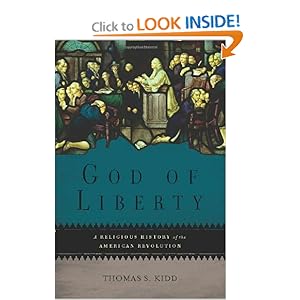
FRIDAY, OCTOBER 15, at 3:00pm, Shrader Lecture Hall, Eastern Nazarene College, Quincy, Mass: Thomas S. Kidd (Baylor University), "God of Liberty: A Religious History of the American Revolution." The Donald S. Metz Lecture in American Christian History.

Thomas Kidd is the author of a variety of books and article on American religion in the colonial and revolutionary eras. His The Great Awakening: The Roots of Evangelical Christianity in Colonial America was published by Yale in 2007. University of Notre Dame historian Mark Noll described the book as “Well researched, clearly written and authoritatively argued. There is no book of comparable breadth, either chronologically or geographically.” Kidd also published The Great Awakening: A Brief History with Documents, with Bedford Books in 2007. His American Christians and Islam: Evangelical Culture and Muslims from the Colonial Period to the Age of Terrorism was published by Princeton University Press in 2008. Walter Russell Mead thus praised American Christians and Islam in Foreign Affairs: “This concise and well-organized study offers readers an excellent summary of American popular attitudes toward Islam from the eighteenth century onward.”

Kidd will be speaking on his new book God of Liberty: A Religious History of the American Revolution (Basic Books, 2010), which Harry Stout described as "a history of religion and the American Revolution that addresses the revolutionary war in substantial detail. Thomas Kidd brilliantly examines the role of religion in the Revolution, and explores the intersection of religion and the Republic, neither of which can be fully understood without reference to the other. Kidd demonstrates in persuasive detail how the idea of religious liberty informed the meaning of the Republic at its deepest level."

The lecture is part of a series on colonial America. Gordon Wood and Jill Lepore will speak on campus in November.

Jumat, 08 Oktober 2010

God of Liberty: BookTV

To follow up on Paul Harvey's earlier post about Thomas Kidd's God of Liberty: A Religious History of the American Revolution, this weekend BookTV is airing a lecture Kidd delivered recently at Indiana Wesleyan University. (Incidentally, as Paul also posted, Indiana Wesleyan is hosting a conference organized by religion scholar Rusty Hawkins, Divided by Faith: A Decade Retrospective, next week.)

Find additional information and show times of Kidd's lecture here.

Rabu, 06 Oktober 2010

Glenn Beck, Methodism, and "Black Founders"

by Christopher Jones

Glenn Beck initially drew my interest because of his Mormonism—I sensed in Beck’s conspiratorial approach to politics something reminiscent of an earlier generation of Mormon public figures. The pervading fear of socialist subversion, combined with the particularly Mormon interpretations and understandings of human agency, the methods and aims of satanic opposition, and the divinely-inspired nature of America’s Founding documents, were reminders both that the influence of Cleon Skousen and Ezra Taft Benson’s religio-political views still loomed large among a certain segment of the Mormon population and that in them lay a narrative that had the power to appeal to not only conservative Mormons but other embittered Americans as well, suspicious of the government and intent on rescuing the nation from secularism and immorality (and make no mistake,
perceived secularism and immorality are as central to Beck’s movement as is some vague libertarian notion of fiscal responsibility). These topics have been discussed, analyzed, and reanalyzed at least a hundred times over by now (though some commentators rehash them anew and claim such discoveries for their own, all while butchering the identities of key people and ideas in Mormon history), and to be honest, I’ve grown weary of thinking about Beck, his Mormonism, and his agenda in general. In fact, I’d sworn off posting anything more on Beck here or at the Juvenile Instructor.

But one of Beck’s more recent forays into early American history has forced me to reconsider. It touched a nerve not because of Beck’s subtle invocation of Mormon themes, but rather because they addressed the subject of my current research—early American Methodism. Sandwiched in between Beck’s recent assertion that race relations in America were (with the exception of some unidentified “racists”) fairly harmonious before the years immediately preceding the Civil War and that provisions for Revolutionary War soldiers and veterans operated on a sort of colorblind basis is an intriguing discussion of what Beck oddly refers to as “the first real megachurch … a white and black megachurch.” The "megachurch" in question (which goes unidentified) is St. George's Methodist Episcopal Church in Philadelphia and the central figure is Richard Allen, eventual founder of the AME Church.

“Richard Allen,” Beck explains, “was a preacher at a white church—a megachurch. … And Richard Allen, this megapreacher, he tried to segregate.” Beck’s go-to guy for all matter historical, David Barton, chimes in, noting that “In the 1790s [Allen] proposed having a black denomination. And both whites and blacks said, ‘we don’t want that. We want the integrated stuff. We don’t want separate denominations.’ There was finally an overt act of racism in one church that kind of gave him the impetus to go ahead and start a black denomination. But for years, neither blacks nor whites wanted a separate denomination ‘cause they worshipped together in those churches, in Philadelphia and elsewhere.”

Rather than focusing on each of the several problematic points raised (the insightful scholarship of Albert Raboteau, Dee Andrews, and Richard Newman is recommended for those interested), I’d like to ruminate on the meanings and implications of two particular points.

First, I was struck by Beck and Barton omitting entirely any mention of Methodism. Richard Allen is simply “a black preacher” and St. George’s is simply a generic “megachurch.” Considering that Methodist theology and worship were so central to Allen’s identity as a Christian (and as a black man), and that his "black denomination" remained within Methodist Episcopal tradition, this seems as especially odd omission. This not only simplifies and distorts the history of St. George’s (and Methodism more generally) by ignoring the complex dynamics of early American religion, but also serves as a useful means of locating this supposed bastion of interracial harmony within the tradition so many of Beck’s listeners and viewers claim as there own today—conservative evangelical Christianity. This rhetorical maneuver, then, allows these conservatives to co-opt the legacy of interracial evangelicalism in early America (in much the same way that Beck has co-opted the legacy of Martin Luther King, Jr. and the Civil Rights Movement of the twentieth century).

Second, this conversation between Beck and Barton took place during a recurring segment of Beck’s show called “Founder’s Friday.” This particular episode was devoted to “Black Heroes in American History,” and was part of Beck’s stated effort to “spend more time learning about our black founders, and restoring this part of history” (a worthwhile effort, no doubt—at least theoretically). I was immediately reminded of Richard Newman’s biography of Richard Allen, Freedom’s Prophet, in which Newman sought to place Allen squarely within the tradition of America’s Founding Fathers. Echoing others, Newman reinforced the notion that Allen was a black founder, but moved beyond previous assessment by declaring that Allen was deserving of such a title not only because he founded black institutions but also because he “was essentially the forerunner of modern civil rights activists” and because “his belief in nonviolent but confrontational reform offered lessons for virtually every black leader who followed in his wake” (p. 4). As Alan Taylor summarized in his review of the book, “Allen was a Founder for all Americans. He emphasized a prophetic vision of America as a multi-racial democracy of equal rights and equal opportunity. His egalitarian vision was far more daring than anything considered by the more famous white Founders.”

In Beck’s vision of “black founders,” however, Richard Allen in cast as a foil to the interracial harmony he earlier enjoyed as a “mega-preacher” to “2,000 whites” by promoting “segregation.” Tellingly, then, what Beck sees as antithetical to his imagined ideal of American society, Newman see as admirable and daring. The implication of Beck’s narrative—that this “black preacher” and the black church he pioneered, are mere distractions to the real story of this Christian nation—serves as an interesting contrast to those who “seek a sense of authenticity” in black institutions and raises important questions about the place of the black church in the conservative white mind today.

Surveying Religious Knowledge: The Founding Fathers, and the Pew Poll

Paul Harvey

For anyone interested, an announcement from History News Network:

Join Thomas Kidd, author of
God of Liberty: A Religious History of the American Revolution for a live Q&A on HNN's Ning Network at 3 p.m. Eastern on Wednesday, October 13.

Kidd's take on the poll of Americans' religious knowledge, which Chris Jones blogged about here a few days ago, may be found at "
The Founding Fathers Would be Shocked at Our Religious Ignorance." He makes the point that the relatively high degree of religious knowledge evinced by skeptics, noted by the recent pollsters, is not new.

Over at Immanent Frame, a variety of other scholars offer their views on, and take a number of shots, at, the Pew Poll:
Surveying Religious Knowledge. In her contribution, Kathryn Lofton asks, if a person is polled about rock and roll history and is unable to identify Big Mama Thornton, does this make them ignorant of rock and roll history? She continues:

For now, I can only observe that a survey which pits religious groups against one another in a Quiz Bowl, and which imagines that praying Protestants ought to know the authority of Martin Luther, tell me very little about religious knowledge, and tell me even less about what the humanities do to serve such a surveyed public. It may be that we live in a budgetary time that begs for base descriptions of our basic (un)knowing. I would only warn that the minute we believe the answers we offer begin with multiple choice questions is the same minute when we cede our complexity to that formation of ignorance.
Related Posts Plugin for WordPress, Blogger...