“Get anything good for Christmas?” a friend nonchalantlyasked several days after J.C.’s birthday. My enthusiastic response, “Oh yeah, abook on the Klan; was actually reading it Sunday morning listening to acousticsunrise,” was met with irritation in the form of disinterest. The friend didn’treally care what I had received, and he didn’t really want to entertain aconversation about the Klan. He shot back, “weird.” I, of course, was blind tohis hopes for distance and pressed in. “It’s really neat, the author takesseriously the religious ideas of the Klan – from their white robes to theirsense of American history and exceptionalism.” Sadly, the conversation went theway most of mine go with non-academics. The harder I tried for him to see how fascinatingthis was, he just didn’t care, and once again retorted, “yeah, just soundsweird.” At this point, I got it and turned the conversation to a religiousinterest everyone seemed to share: Tim Tebow and the magical run of the DenverBroncos.
Selasa, 03 Januari 2012
Who Has a Religion? Baker and Wenger on Definitions of Religion in the 1920s
“Get anything good for Christmas?” a friend nonchalantlyasked several days after J.C.’s birthday. My enthusiastic response, “Oh yeah, abook on the Klan; was actually reading it Sunday morning listening to acousticsunrise,” was met with irritation in the form of disinterest. The friend didn’treally care what I had received, and he didn’t really want to entertain aconversation about the Klan. He shot back, “weird.” I, of course, was blind tohis hopes for distance and pressed in. “It’s really neat, the author takesseriously the religious ideas of the Klan – from their white robes to theirsense of American history and exceptionalism.” Sadly, the conversation went theway most of mine go with non-academics. The harder I tried for him to see how fascinatingthis was, he just didn’t care, and once again retorted, “yeah, just soundsweird.” At this point, I got it and turned the conversation to a religiousinterest everyone seemed to share: Tim Tebow and the magical run of the DenverBroncos.
Jumat, 02 Desember 2011
The Anointed, the Cross, and the Lynching Tree

by Edward J. Blum
When W. E. B. Du Bois remembered his time as a student at Harvard University in the late nineteenth century, he recalled an unsettled feeling toward science. It was there than he “began to face scientific race dogma” in the form of “evolution and the ‘Survival of the Fittest.’” Beyond the classroom, he walked into a museum and stood before a demonstration of humankind’s supposed development. He witnessed, “a series of skeletons arranged from a little monkey to a tall well-developed white man, with a Negro barely outranking a chimpanzee.” Needless to say, Du Bois wasn’t happy with what he saw. He spent the rest of his career trying to undermine the “scientific” evidence that placed people of color below whites, and Du Bois saw it as his religion to destroy white supremacy.
I was reminded of Du Bois’s museum experience at the American Academy of Religion. On the way there and then home, I read two new books on the power and place of religion in twentieth and twenty-first century America, beginning with The Anointed: Evangelical Truth in a Secular Age by Randall J. Stephens and Karl W. Giberson. Although for very different reasons, the characters studied here shared Du Bois’s displeasure with modern science and especially its focus on evolution. Evangelical experts hate The Anointed, even though many of them haven’t even read the book yet. Some who did thought Stephens and Giberson should have published with another press, one that evangelicals would pay attention to and respect. Liberals seem to love it, even though many of them acknowledge having only read the New York Times piece on it and not the entire book.
Having actually read each page, I can say that this is a terrific book of American religious history. Stephens and Giberson take the reader through the “parallel culture” of many contemporary evangelicals. We tour Ken Ham’s creation museum in Kentucky; we read primary sources with David Barton as he searches for any and all connections between the founding generation and Christianity. We struggle with James Dobson on how to raise children in a multicultural, pluralistic, media-driven world that seems to accept homosexuality as never before. And we rambunctiously and anxiously await Christ’s return with Hal Lindsey and Tim La Haye. We search with Paul Miller, an earnest Christian in New England, to find the right kind of ideas to satisfy evangelical souls.
Sure, evangelical readers won’t like the tone of the book. Stephens and Giberson don’t pull punches. They think Creation Science is “weak science”; they think David Barton is an “amateur.” They think Dobson is “strangely obsessed with homosexuality.” And they wonder about the credibility of some Christian colleges. It strikes me that there is a problem with the tone of the book, but not for the same reason that evangelicals dislike it.
I think the tone issue could have been transformed by a more sophisticated analysis. Stephens and Giberson seem so intent to pull the curtain back from these so-called experts that they miss when and where their expertise becomes a civic problem: their parallel cultures are fine, interesting, indeed even fascinating, until they run into the public, civic, and legal spheres of classrooms and courtrooms. If Stephens and Giberson had clarified when and where “experts” become social problems, then perhaps the authors could have embraced the ingenuity of many of these “evangelical entrepreneurs” or "holy mavericks" (as Shayne Lee and Phil Sinitiere refer to some other leading evangelicals) on their own terms but then challenged them when the issue became the “common good.”
Let me give one farcical example, but other, more realistic ones, are easily imaginable. As scholars, we can think deeply about the meaning of bumper stickers that read: “In case of rapture, this car will be unmanned.” On one hand, this is an inventive commodification of theology; it is a humorous display of one’s faith – a kind of missionary effort that subtly cajoles others to consider that at any moment Jesus could come back. This theology becomes a problem, though, if this individual is so certain of his end times theology that he doesn’t pay taxes, that he refuses to vaccinate his child yet sends her to public schools, or that he refuses to wear a condom when having sex with an individual and hides his knowledge that he has a sexually transmitted disease. At this point, his claim, “trust me, the end is near” is a major problem. It directly impacts the lives and well beings of others. It would have been nice if Stephens and Giberson worked out how and why the distinct contexts where “expertise” is deployed matter.
The Anointed may not convince a lot of evangelicals to abandon their experts, but I fully expect it to work well in US religious history classrooms. Each chapter could be the focus of a particular historical theme: David Barton could be used to discuss how historians have characterized the place of religion and the role of God; Ken Ham could be used to discuss the intersections of religion and science that would include the Scopes trial; James Dobson could get a class into religion, family, and sexuality; and Hal Lindsey can bring us into notions of prophecy, millennialism, and the end times. I imagine teaching this book by developing historical narratives to get to each chapter’s character, have students locate documents in the genre, and then debate the histories, what students found, and what they think of the folks Stephens and Giberson discuss. I think it will lead to a vigorous dialogue, where hopefully no evangelical in the class would feel threatened or discriminated.
After a wonderful time at the AAR, which each year should commission a team of ethnographers to detail the enigmatic people, events, and performances that make it the New Orleans of conferences, I flew home with a treasure in hand: James Cone’s The Cross and the Lynching Tree. It’s a book I’ve been long waiting for, since Professor Cone and I had many e-conversations about how to consider lynching as a fundamental religious problem in American history. The book is simply marvelous. Part autobiography, part history, and all cutting theology, The Cross and the Lynching Tree argues that in the United States neither the cross, nor the lynching tree can be understood independent of one another. Individual chapters detail the centrality of lynching to the spiritual core of black American faiths, the failure of Reinhold Niebuhr and his Christian realism to deal with lynching and racial violence, the brilliance of King’s theological vision for his ability to live his theology of the cross, the creative renderings from African American writers and artists of black lynch victims as Christ figures, and some particular ways black women have grappled spiritually with racial violence. Cone concludes that the lynching tree “is the window that best reveals the religious meaning of the cross in our land.”

The Cross and the Lynching Tree is terrific book. Readable, short, and to the point, it re-paints our thinking about race, religion, violence, and theology in the twentieth century. When it came to racial violence, Reinhold Niebuhr stands out neither as ideologically prophetic nor as intellectually powerful. He stood by as his former church in Detroit refused to integrate; he wallowed in self and group pity when African Americans died. Black writers and artists, in contrast, take on the “wild beast” of white supremacy and “fight it” with poetry, paintings, and prose. I couldn’t agree more with the wonderful theologian Shawn Copeland’s endorsement of the book: “At the heart of Cone’s critique lies a passionate quest and challenge for the beloved community. James Cone teaches us still. Will we finally learn?”
After finishing Cone’s wonderful book, I felt grateful that I had learned so much from him over the years. And then I looked back at The Anointed and I thought about all the fuss and fury it has and will evoke. I thought about the earnest Paul Miller and his search for a “secular” friend. I wondered if he had any African American friends. I thought about evangelicals pouring millions of dollars into a Creation Museum, but bristling at any reference to reparations for past wrongs. I thought about end-times theology and how it so often justified white “realism." Billy Graham responded to Martin Luther King Jr.’s “I Have a Dream” speech by saying that only after Jesus returned would white and black children play together. Almost a century earlier, Dwight Moody told revival stories of African Americans knowing that their “freedom” and “liberty” would only be true in heaven. Given the other forces evangelicals have been willing to fight with fiery speeches, bloody battles, and billions of dollars – Communism, secular humanism, abortion – why they were so unwilling to put power and military might to work against racism makes them sound either as cowards or as liars.
The white evangelicals in The Anointed and those who so militantly attack Stephens and Giberson for analyzing them without kid gloves may be blind to the world Cone discusses and the work race does. Evangelicals can obsess over issues of museums, child-rearing manuals, and the Founders relationship to religion because they have not and do not suffer as African Americans have or as gays, lesbians, and transgendered individuals have. All individuals suffer – to be alive is to suffer at some point. But white evangelicals don’t suffer from structures; they don’t suffer from systems. They may not like certain venues in American society, but no water fountains have been designated “liberal only” and no evangelical has been murdered in the United States because he or she was evangelical. Cone ends where white evangelicals refuse to begin, the places where they never have to go: racial realities of everyday life.

Where is “the gospel of Jesus’ cross revealed today”? Cone asks at the end of his work. His answer is specific and off the radar of the anointed evangelicals: “the criminal justice system where nearly 1/3 of black men between ages of 18 and 28 are in prisons, jails, on parole, or waiting for their day in court.” If one really believes that the age of the dinosaurs, or the private letters of the founders, or the possibility of their sons coming out as gay, or the possibility that Obama may be the Antichrist, are the most pressing moral problems of our age, then a bunch of black men in prison will concern them about as much as the history of enslavement, the plethora of violated land treaties, the brutal past and present of American colonialism, and the lynching of black America. They probably won’t read Cone’s book, but we can wonder. Why do they cry so loudly about The Anointed when they could sob softly and humbly about The Cross and the Lynching Tree?
Sabtu, 05 November 2011
Our Gentle Whisper: The Religious Life and Times of Elijah James Blum

This post is to announce a new memorial fund to honor the life of Elijah James Blum.
The History Department at San Diego State University would like to announce its fundraising efforts to create the “Elijah James Blum Memorial Fund." Elijah, son of Associate Professor Edward J. Blum and Jennifer Blum, passed away on August 31, 2011, from complications related to a mitochondrial disorder. After developing cataracts in his eyes and degenerating muscularly such that his eating and breathing were impaired, Elijah died peacefully at home with his family. His favorite game was peek-a-boo and he laughed far more in life than he cried. He was just over eight months old.
Elijah did not live long, but the religious whirlwind that was his life had stories to tell. He was a member of Al-Anon, a brother to more than twenty men who met each Saturday morning at a park to share their experience, strength, and hope through the spiritual journey of the twelve steps. He listened to men discuss their “higher power” and joined the generations who have found freedom through a program forged from the pains of alcoholism and the Great Depression in the 1930s. Elijah was known as the “littlest man at the park,” and in a group that cherished “principles over personalities,” it was clear that he was everyone’s favorite person. As Elijah’s ability to eat withered, we prayed that the words of the Alcoholics Anonymous “Big Book” would hold true today, that the “age of miracles is still with us.” Sadly, we all had to learn new depths of what it meant to admit our powerlessness. We now choke our way through the “serenity prayer” and hope that by repeatedly claiming that we “accept the things we cannot change” that we would actually find some peace.

As doctors scratched their heads trying to determine what was making it so hard for Elijah to eat and then to breathe, the line between “religion” and “science” blurred and then dissolved. When preparing to take Elijah to the hospital for the fourth or fifth time, his pediatrician mumbled “he’s in God’s hands now.” Increasingly, doctors and nurses started invoking prayer and hope for a world beyond what we could see. These moments brought hope to Jen, but left me hoping simply in hope. At those moments, I didn’t want an allegiance of religion and science. When I couldn’t tell the difference between the doctors of medicine and the doctors of divinity, it felt like both were admitting that their arts were not up to the task.
Then as it all fell apart and it became a question of not if Elijah would stop breathing, but when, there was the makeshift baptism at the hospital. It was a congregation of three where “we” took precedence over “me.” The childhood development people tell us that we’re “we, before we’re me,” but we had heard so many evangelical preachers say all the time that “God has no grandchildren.” But Elijah couldn’t have a conversion moment; he wouldn’t have the opportunity to tell a story of his wickedness, the power of God’s intervention, and the progress of a new pilgrim (if he would have even traveled that route). We had to make a choice, and there would be no Puritan half-way about it. Elijah’s baptism began with an apology. “We’re sorry, Elijah, that we are deciding this for you. We wish you could decide this on your own, but since you cannot and since our family follows Christ of whom the stories say he healed women, men, and children, we baptize you in the name ….” It was a baptism of anguish, but one nonetheless.
And there were a few of our last ditch efforts. When Elijah’s breathing failed and he had to have a tube and a machine work air into his small frame, we tried our own religious invention: the “power of positive breathing.” We snuggled beside him and breathed deeply. We let his body feel our muscles move as we whispered to him, “this is how we breathe Elijah; easy in, and easy out. This is how we breathe.” And when we removed the tube, I believed that maybe, just maybe, his body would have heard. It didn’t, or at least not as we wished.
Through all of these struggles, our enduring image of Elijah is by far the most striking. He developed cataracts and his vision was impaired to the point that he could only see bright lights. But his favorite game was peek-a-boo. Every time Jen popped up with “peek-a-boo,” Elijah laughed and rocked and shouted with delight. Watching him transformed how I and his Uncle Paul revised our manuscript on Jesus. All of a sudden, there was a new spirit in our writing about people who longed to see what had no visible form, who searched for salvation in the dark of night, who laughed amid terrible loss, and who generated meaning from the deaths of their children through the supposed death of God’s son. Every sentence of the book became a testament to Elijah’s saga and the joys we experienced with him. Thank you for letting me share these little bits of his and our spiritual journey.
The “Elijah James Blum Memorial Fund” will be used to support teaching and learning in the History Department at San Diego State University. Tax-deductible contributions to the fund may be made by writing a check to “The Campanile Foundation,” referencing the Elijah James Blum Memorial Fund on the memo line and sending it to Bonnie Akashian, SDSU Dept. of History, 5500 Campanile Dr., San Diego, CA 92182-6050. Please contact Beth Pollard (Associate Prof. of History, epollard@mail.sdsu.edu) or Nancy Lemkie (Senior Director of Development in CAL at SDSU, nlemkie@mail.sdsu.edu or 619-594-8569), if you have any questions.
Selasa, 01 November 2011
Skeptics and Soul Sisters: Beautiful Art by Amanda Porterfield and Janet McKenzie
In my other hand, I cradled Holiness and the Feminine Spirit: The Art of Janet McKenzie. It’s a beautiful and inspiring book that pairs McKenzie’s art with personal, poetic, and scholarly reflections. She gained national and international fame when she was won the “Jesus 2000” competition from the National Catholic Reporter’s contest for her painting “Jesus of the People.” Although her most famous, this painting was but one of her many accomplishments. Her others feature Mary with Gabriel, the Holy Family, and even a touching homage to 9/11. Her art is visually stunning, and it induces for many an avalanche of spiritual reflection. McKenzie’s work is borne of religious conviction, and she, in her own words, strives “to reflect in my art … that sacred and inherent place within that connects us all beyond race and gender where no judgment exists.”
As I thumb through the pages, I see images of Mary next to Gabriel. The sacred wings, as Mary E. Haddad (a former Toyota sales-woman from Detroit and now pastor in California), writes, “enclose and embrace Mary.” Heaven and earth “stand side by side” and the distance that former artists had put between the two figures is dissolved in a fellowship of foreseen terror. The book has poetic responses to McKenzie’s “Holy Mother of the East” and “Magna Mater.” The amazing theologian Diane Hayes works from “Woman Offered #5,” a startling image of a black woman being crucified. For Hayes, it is time for women who have suffered, have had pain, have carried the “weight of the world on their shoulders” to “come down from the cross” and to “choose for themselves the paths they should take, the lives they should lead, the tapestries they will weave.” And finally, McKenzie’s “Homage to 9/11” portrays the Twin Towers as two women who support one another. An essay by educator Sally Goodrich follows. Goodrich lost her eldest son in the 9/11 attacks, but inspired by McKenzie’s art, Goodrich joined her grief to giving: she ventured to Afghanistan and help the young there. What amazing stories, reflections, and images. For scholars, McKenzie’s book offers tremendous insight into how individuals respond to the visual arts, and for the spiritually inclined, it offers a vibrant array of considerations.
Senin, 24 Oktober 2011
Race and Religion at the American Studies Association: Ed's Reflections
I only went to two ASA panels in Baltimore, and both were fantastic. One was on “performative black Christianity” and it had papers on the sacred and the sonic in James Baldwin’s novel Just Above My Head by Ashon T. Crawley, on sexuality, sensuality, and virginity in the preaching and performance of Juanita Bynum by Terrion L. Williamson, and on Tyler Perry’s “guardian” masculinity by Ronald Neal. Fred Moten, the author of In the Break: The Aesthetics of the Black Radical Tradition, of Duke University commented, and Daphne Brooks of Princeton chaired. Her book Bodies in Dissent should be known by more in American religious history. Her emphasis on corporeal spectactularity in performances of race and freedom is a rich and innovative (such as Henry “Box” Brown using his body – its presence and absence – to dramatize his freedom narrative, and how demonstrations of race and freedom resonated with other cultural performances of “magic” and “spiritualism”). As I heard the terrific papers and the outstanding comments, I kept reflecting on Anthony Pinn’s work on how we make sense of spaces where silence and sound collide and where bodies and no-bodies stand side-by-side. Whether in Terror and Triumph,Why Lord? or in Embodiment and the New Shape of Black Theological Thought, Pinn examines historically and tries to make sense theologically of the complexities of sounds, spaces, and bodies.
The other panel I attended was on race and religion during the 1920s and 1930s. It was an all-star gang of Stephen Tuck, the author of two amazing books on the “long civil rights movement”, Suzanne Smith, also the author of two wonderful monographs – one on Motown, one on funerals and funeral directors … try explaining that one to family and friends who wonder what it is we scholars do (and if Phil Sinitiere is listening, I’d love to see an interview with Smith and with Tuck on their latest books from Harvard) …, and the final one by Alison Collis Greene, whose
Selasa, 27 September 2011
Including "Religious Others" in the Christian Nation "Debate"
Amid the culture wars of the 1990s, Isaac Kramnick and R. Laurence Moore published a slim volume. It had a provocative title and a silly subtitle: The Godless Constitution: The Case against Religious Correctness. Thankfully, the subtitle was later changed to A Moral Defense of

the Secular State (although, of course, the “a” before “moral” could cause some confusion). Kramnick and Moore argued that the founders of the United States purposefully created a secular nation and that waves of evangelicals throughout the nineteenth and twentieth centuries added religious appendages to the secular framework. This left many Americans confused, frustrated, and bitter. Thank goodness Kramnick and Moore could show us the right (and by right, I mean left) way. Reviewing the first edition, UNC’s John E. Semonche concluded that The Godless Constitution was “not an unworthy entry into a debate that has never verged on the profound.”
Wow. If that doesn’t make you chuckle, then you haven’t read enough reviews that essentially end, “makes a significant contribution to many significant fields.”
“Profound” is such a tricky word. Semonche certainly wasn’t referring to Madison’s and Jefferson’s discussions of church-state relations – so profoundly analyzed in David Sehat’s The Myth of American Religious Freedom. Perhaps Semonche was thinking of Jerry Falwell and Francis Schaeffer, but their acolytes certainly took their works to be profound.
Thanks to John Fea, historians now have a profound tool to use in the debate. I have been teaching Was America Founded as a Christian Nation? in my historiography class, and we’re having a blast. Fea shares at least one commonality with Kramnick and Moore. All write from a shared frustration with the simplistic histories of the nation presented by the religious right. Unlike Kramnick and Moore, however, who wish to defend a secular state, Fea wants to teach about history. He wants students and interested readers to think in terms of change over time, context, causality, contingency, and complexity. And as a teaching device, this book is without doubt profound. There is so much to commend in Was America Founded as a Christian Nation?, especially Fea’s examination of the history of the idea that the United States was a Christian nation.
When I hold The Godless Constitution and Was America Founded as a Christian Nation? side-by-side, I’m left with a few questions. First, where are the women? If “American religious history is women’s history” (or is it women’s history is religious history … I can never remember; thank goodness for google), as Ann Braude so famously put it, how are we still able to write histories like this without women playing prominent roles? Second, do the voices of African Americans or Native Americans or immigrant Americans trouble the discussion? Years ago, I published an essay on African American uses of “Christian nation” rhetoric and others have done similar work, such as Joanna Brooks in American Lazarus or Eddie Glaude in Exodus! Have we abandoned “religious outsiders” in this debate?

My point from these questions would be this: to understand historically the Christian nation debate, we need to expand the parameters of inclusion and more richly think about the political fabric of the nation. Without doing so, we’re left thinking antebellum Whigs dominated American politics (they didn’t!), that Martin Luther King, Jr., was the only one to use Christian nationalism for moral politics (he wasn’t), and that contemporary conservatives are convinced antichrist is among us (many don’t and many think those who do are nuts).
I’m off to the East Coast with a satchel full of new books … so I’ll be back with some reviews from 35,000 feet. You can expect several “unworthy” entries.
Minggu, 14 Agustus 2011
Blum's Blogging: Teaching the United History History Survey
School’s Back From Summer
by Edward J. Blum
This marks the beginning of my second decade of teaching, and I wanted to try something new not just within my classes, but about my classes. So, I’ve decided to start an interactive blog about teaching the United States history survey. I wanted to work through the changes that I’ve made, give my fellow teachers a platform to post and to discuss their teaching strategies, and to give students an opportunity to see behind the process of teaching and to participate in what is taught. I grabbed one of my favorite colleagues and teachers, Kevin Schultz from the University of Illinois, Chicago, author of a great survey textbook, Hist, and author of the tremendous new monograph Tri-Faith America, to help with the endeavor, and away we go. I invite you to join us over there with your own posts, reflections, thoughts, and considerations.
Religious history has been one of the ways my classes have transformed dramatically – not just the religious content of the course, but also the religious composition of the classroom. When I first taught in Kentucky, it seemed everyone knew what the Bible was. I don’t think that’s the case of my San Diego students. All of our classrooms and contents will be distinct, and I hope you’ll make your way to the blog to help me and others to teach better (or at the very least have some zany fun in the process). Like it or not, school’s back from summer.
http://teachingunitedstateshistory.blogspot.com
Jumat, 17 Juni 2011
The Future of American Religious History Monographs

Her title alone reminds me of a little section in Matt Sutton’s book on Sister Aimee where on a church survey form, one congregant wrote down for occupation: “Chief Klansman.” Way to go, Kelly, and what a striking cover!

Then Art Remillard’s Southern Civil Religions: Imagining the Good Society in the Post-Reconstruction Era should be out by December. Not only a blogger, Art is an editor at the terrific online Journal of Southern Religion. Doyen of southern religious history Charles Reagan Wilson claims of Art’s book, “anyone wanting to understand how a variety of people in the South have understood its spiritual and moral meanings will like this book.” I think he’s right, and my guess is that reviewers will read it in comparison with Paul Gaston’s New South Creed and John David Smith’s terrific Old Creed for the New South. Art’s book may also be read as a kind of prequel to Andrew Manis’s Southern Civil Religions in Conflict: Civil Rights and the Culture Wars (2002).
Speaking of J. D. Smith … he’s blurbed another forthcoming book that looks fascinating: W. Scott Poole’s Monsters in America: Our Historical Obsession with the Hideous and the Haunting (out in October). Smith writes, "Poole brings to life American horror stories by framing them within folk belief, religion, and popular culture, broadly unraveling the idea of the monster. Thanks to Poole's insights we see the ubiquity of the monster lurking in and around us." Scott is one of my favorite historians of religion and culture – whether we’re talking South Carolina during Reconstruction or Satan in comic books. This is sure to be another path-breaking book.
And look out early Americanists. Amanda Porterfield’s study of religion and politics in the early Republic – Doubt – should be published soon too, and I think given her work and David Sehat’s Myth of American Religious Freedom we’re going to have to rethink Nathan Hatch’s democratization thesis pretty seriously.
Congratulations to Kelly, Art, Scott, and Amanda.
Minggu, 05 Juni 2011
The Beautiful Mind and Life of Jen Lindell
by Edward J. Blum
You’ve never heard of her, but you would have. She had earned a doctoral fellowship to the Religious Studies department at the University of Pennsylvania and in the fall would have begun her apprenticeship under Anthea Butler and Sarah Barringer Gordon. She had just finished a Master’s Thesis on Mormon-Indian interactions beginning with the initial publication of the Book of Mormon in 1830 and ending with the Mountain Meadow Massacre of 1857. She was my star student who taught me so much about race and religion, helped with my own projects even amid her own routine trips to the hospital, and died far too earlier

.Jen Lindell wrote a Master’s Thesis that easily could have been expanded into an award-winning dissertation. Her broad interest was in the dynamic ways religion influenced the lives of everyday people and on how religious ideas influenced racial perceptions and vise-versa. She fixated on early Mormons and their conceptions of and interactions with Native Americans. She wanted to understand how white people who weren’t considered white by others (in large part because of their distinct faith) at first reached out to non-white people (Native Americans) as potential brothers and sisters, but then years later treated those people with disdain and violence. Lindell refused to take a “top down” approach – which would focus principally on Joseph Smith and Bringham Young – and instead looked to the laity. Reading deeply and widely through diaries, letters, memoirs, and local newspapers, she found epic encounters and love and betrayal, missions and murder, friendship and violence.
Soon, Lindell’s thesis will be deposited in the San Diego State University library and will be available online. I hope scholars interested in Mormonism and race will check it out. She’s got some rich material and fascinating insights. Even more, anyone who reads it will get to know in a small way the brilliant mind that I had the pleasure of learning from for a season. We miss you, Jen, and we’re so glad we got to be a part of your beautiful life.
Kamis, 06 Januari 2011
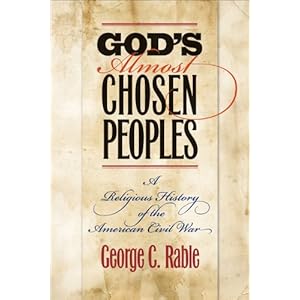
Something More: Secondhand Reflections on George Rable's Religious History of the Civil War
Congratulations to our contributor Ed Blum for the birth of his son Elijah James Blum! What do the birth of his son, some pop music from Secondhand Serenade, and George Rable's religious history of the Civil War have to do with each other? Nothing, you're thinking? Au contraire; read on.Secondhand Reflections on George Rable’s Religious History of the Civil War
by Edward J. Blum
There’s one and only one book I’m reading closely these days: What to Expect: The First Year. With Elijah James Blum joining our crazy world on December 12, it has been indispensable. Through this bible of all things baby, I’m learning how to feel, how to act, and how to speak a whole new vocabulary: bilirubin; snurgles; meconium are but a few of the words in my new lexicon. For me, fatherhood is a reactive art. My days and nights are mostly encompassed by Elijah acting, Jen responding, and me trying to keep up with the whirlwind.

In addition to an album that transformed the music of the Beatles into soothing lullabies, one other album and one history book have become my regular companions. Between feedings, changings, and tummy time, I’ve found a few minutes to soak in Secondhand Serenade’s Something More and George Rable’s God’s Almost Chosen People: A Religious History of the American Civil War. The two may seem worlds apart, but they’ve come together in my rocking-chair imagination, and I think for good reason.
Secondhand Serenade is named for the nature of their music. Songs first written, sung, and experienced in private are transformed into ballads purchased on i-tunes, thrust too quickly into commercials, and discarded in a matter of weeks. We encounter the music secondhand, distanced from original intent and expression. By far, their best song is “Something More” (also the name of the album). It’s a power ballad to rival the finest of Celine Dion’s, and we only need a “king of the world” cinematic scene for it to become part of our national consciousness. Like most power ballads, “Something More” is about love and pain, desire and disgust. The singer is confused, angry, lost, and ashamed: “I lie awake again, my bodies feeling paralyzed / I can’t remember when / I didn’t live through this disguise.” The singer is “paying for his sins” and thinks that no words can “set him free.” He’s at war with another and within himself. He repeatedly admits and asks: “I’m stuck here in this life I didn’t ask for, / There must be something more, / Do we know what we’re fighting for?” The only answer – the only way to live amid his frustration – is to breathe and to believe: “breathe in, breathe out, / breathe in, breathe out. … There must be something more.”
George Rable’s characters from the 1860s had such similar feelings and asked such similar questions. What were Americans fighting for in the Civil War, and why did they continue to fight for so long? What sins were they paying for? And what was the “something more” that they all seemed to believe in, but couldn’t quite nail down? Like Abraham Lincoln in his Second Inaugural Address, the belief in a shared “something more” failed to stop the fighting, and they couldn’t understand why.
By reading thousands of primary and secondary sources, Rable (far and away one of America’s greatest Civil War scholars living or dead) offers the biggest, most comprehensive religious history of the Civil War ever produced. He tackles the North and the South, men and women, Protestants, Catholics, Mormons, and Jews. He travels with chaplains, tents with privates, and eavesdrops on presidents. More descriptive than argumentative, God’s Almost Chosen People considers so many sources that it is almost impossible to provide one or two central arguments. Yet Rable does. He finds that throughout the war, all sorts of Americans turned to providence to explain what was happening around them. The “something more” they knew they were fighting for was only explainable by looking to the heavens and believing that somehow, someway, God truly had the whole world (or at least the United States or Confederate States) in his hands.
The brilliance of Rable’s book – and what differentiates it in many ways from Harry S. Stout’s Bellah-inspired Upon the Altar of the Nation – is its secondhand nature. Although Rable claims in his introduction that religion could be both “wind and weathervane,” he more often than not renders it as weathervane. Battles happen; women and men die; political documents are signed; legal decisions are rendered; slavery is abolished; and then Americans reflect on the events religiously. They seek God’s providence in response to other events, constantly playing catch up just as I play catch up to Elijah’s needs at home. With this approach, Rable is able to show how widely and diversely religion suffused American society in the 1860s. Whatever the problem, whatever the event, whatever the circumstance, Americans turned to God and God’s providence for answers. By rendering religion secondhand, Rable has shown in epic proportion the omnipresence of the supposedly omnipotent.
And for Rable, the secondhand quality of religion emanates from his approach to religion itself – that it can only be studied secondhand. In this way, Rable wonderfully acknowledges the limits of his study. He (and we) cannot know the firsthand experiences of the women who lost loved ones, the privates who accepted new testaments after losing a hand of cards, or the presidents and generals who anguished (or relished) every death. When he analyzes a diary, a fast sermon, or a newspaper story (all of which Rable read in abundance), he recognizes that he interprets from afar. In this way, Rable demonstrates an incredible respect for his subjects and the gravity of the events.
Yet there are other seconds to consider. When W. E. B. Du Bois turned to seconds, he conjured the idea of “second sight.” He claimed that African Americans could see themselves and their surroundings with a sacred vision that whites could not. And Du Bois thought that the religious expressions of those with second sight could reveal the deepest elements of the soul – the “spiritual strivings” of individuals and communities. When Du Bois turned to the slave spirituals, he found not secondhand expressions, but expressions that revealed the most intimate parts of longing, feeling, and expression. This type of religious history of the war – one that approaches religious creation as a prime mover in historical change – could compel other approaches to the war.
That was not Rable’s project, though, and he shouldn’t be criticized for the book he wrote. God’s Almost Chosen Peoples is outstanding. Scholars of American religious history and the Civil War will have to engage it. And I’m glad that it’s so voluminous that I couldn’t lose it amid the diapers and the onesies.
Senin, 11 Oktober 2010
How Faith Transformed America: Blum on God in America
Your final reminder for God in America, to be shown starting tonight on your local PBS station. I've posted a few early press reviews of it in recent posts here. But for the most substantive review and critique to date, check out Ed Blum's take on the series over at Patheos. Ed summarizes some of the major themes, characters, and scholarly trends represented in the series, and then imagines what a series of this sort would look like if done ten or twenty years from now -- in other words, what scholarly work is emerging that will find its way into synthetic narratives meant for a more general audience. He finds three in particular:
Minggu, 26 September 2010
Academic Blogging: Some Reservations and Lessons
by Edward J. Blum
Last summer, I was chatting with a collection of amazingly talented graduate students and newly minted PhDs in American religious history about the role of blogging. They all agreed that blogging was a godsend for those new to the profession, for it let them “be known.” Blogging offered an instant opportunity to present ideas, critique other works, and sound off publicly on any number of issues. Time and again, these brilliant scholars expressed their belief in the blogosphere: that it was the place to gain recognition.
I was worried. I wondered if the perils outweighed the possibilities. Paul Harvey’s American Religious History blog was created after I was finished with graduate school and had two monographs published. I was just at that moment becoming an associate professor and so “making a name for myself” had less immediate importance. I saw his blog and others as a place to promote and to play – not a place to stake a reputation.
I’ve been thinking long and hard about the academic turn to the blog, and my gravest concern is for junior scholars – knowing full well that by avoiding blogs, junior scholars may be missing out on many important opportunities. But here are my reservations and lessons:
1) Why would you give away for free the primary commodity you create? Your ideas are your intellectual property; when you publish them in a book, you and the press own them. You can make money off of them (sure, not a lot, but sometimes a nice chunk of change). You can receive credentials from them that include a job, promotion, and tenure. Just as much as publishers may benefit from a blog-inspired recognition, they may also not want to print concepts that can be found already on websites. I haven’t asked, but I wonder.
2) Peer review matters. Academic disciplines will lose all credibility without peer review; it is essential to what we do – as protection for the author and publisher, and as a way to get the best out of your work. When the five or ten or twenty reviewers (I can’t remember) for the Journal of American History sounded off on one of my dissertation chapters, I was shell-shocked. I could never have imagined there were so many problems with my essay. But those criticisms made it a better chapter, and my dissertation a stronger book. The JAH didn’t publish my essay, but the reviews transformed my approach to the topic. After graduate school, the number of people available to read your work may shrink. My experience is that there are fewer and fewer people who have the time to read my ramblings. Peer review allows the geniuses in our fields to challenge us, push us to new sources, and help with our prose. I’m grateful to have friends like Katie Lofton, who will read my essays and tell me what’s wrong with them – but it’s hard to make friends that brilliant and as the years pass on, we all seem to have less time for it. Blogs do not, as of yet, offer such a system of peer review and hence do not aid in that capacity in our development as scholars.
3) Post-publication review matters. Blog posts don’t get reviewed in the Journal of American History or the Journal of Southern History – books do. They are reviewed there and in other journals as another stage of peer review. It’s where we sound off – not just to say that this or that book “makes a significant contribution to” … whatever topic the book is on. It’s a place where real debates and real problems can be addressed. Comment sections in blogs aren’t the same, and they probably can’t go in your tenure file. Professional book reviews can and do.
4) Blog posts could hurt your reputation just as much (if not more) than help it. Fascinating blog posts probably won’t get you an interview or a job, although they may make your name noteworthy enough so the committee looks at your application (although I doubt this for most positions). Articles will, solid dissertations will, fantastic conference papers will. Blog posts are far more likely to hurt you in any number of ways: perhaps you write something that is too outlandish; perhaps you come off as too political (guess what, not all academics vote Democrat – some are more leftist, some are to the right – I learned this when one colleague of mine explained to me that even though I study and teach African American history, he hoped I didn’t vote as “they” did – an odd thing to say to a new colleague, but whatever). I’ve written a number of posts that I wish I could take back (usually the ones praising Matt Sutton’s work – and this, right here, is a joke, that could backfire if I didn’t point out it was a joke. And by this point, the joke is dead because I had to explain it so no one is even grinning). More honestly, I have in blog posts been rough and curt with some essential and important works (namely Barbara Dianne Savage’s very interesting Your Spirits Walk Beside Us), and I was wrong. I should have been more careful and thoughtful. Could that hurt me professionally – you betcha!
5) Blogs often function like the current American media: extreme, partisan, and amnesiac. Jon Stewart recently told Bill O’Reilly that all the messianic love for President Obama in 2008 set Americans up for heartache. Guess who said this in a Religion Dispatches blog essay in 2008? I did. Guess who remembers? Only me. As I see it, the current media is in the business of producing ideas each and every minute and there can be no regard for past claims, words, or interests. Stories and sound bites must be made new constantly. This is not how the scholarly world has functioned or should. We must take the time to think ideas through, to hash them out, to consider alternatives, and to weigh various other texts. Reacting to every new media story is not the path of most scholarly work; it’s the domain of the journalist.
6) Finally, and this is most apropos for our blog – this is a blog about religion and religions, the most powerful ideas, rituals, concepts, and communities that exist. As I understand the spiritual, it is the deepest core of people, ideas, organizations, and communities. Writing about it flippantly or without review or without consideration can be extremely damaging. I have done my fair share of rough handling with religion in these blogs, and I wonder at what cost. More and more, I think Robert Orsi is right when he calls us to be worry about our presentations of religion, especially of how those presentations get into the mass media. We’re observant to religious damages of the past, and certainly do not want to perpetuate them in the present and future (at least I do not).
So those are my concerns. I recognize the incredible work that blogs have done in American religious history. The Juvenile Instructor gang is amazing. The essays here are fantastic. Religion Dispatches is entertaining, insightful, and provocative. It’s not that we shouldn’t keep taking blog and technological leaps: it’s that, I think, we should look first.
Rabu, 22 September 2010
New Year, New You, New Books … Already?
by Edward J. Blum
We’ve only just begun the fall semester, but it won’t be long until book orders are due for the spring. So, as you’re putting in orders for old faithfuls like The Kingdom of Matthias (IBSN: 0195098358) or new loves like Freedom’s Coming (ISBN: 0807858145), you may want to consider the third editions of Major Problems in American History (ISBN: 0495915130). If you’re not familiar with my blog posts, then you need to know that most of them are self-promotional. If you are not familiar with this series, the Major Problems, then you should really get your hands on them. The collections match 8-10 primary documents from a given period or topic with 2-3 scholarly essays that debate the key points. I have used just about every one and students seem to love them. It’s high-quality one-stop shopping (more like Target than Walmart) for primary and secondary sources!
Sadly, the new edition for Major Problems in American History began with a loss. Just before revisions started, editor Jon Gjerde passed away, professor of history at UC Berkeley and author of some amazing books on the West, ethnicity, and rural life,. I joined my colleague Elizabeth Cobbs Hoffman (author of the fantastic book on the Peace Corps, All You Need is Love) to edit the new editions. Professor Gjerde did an incredible job establishing the main contours for the first volume and it’s his strong architecture I built upon.
The two new volumes highlight the role of religion and culture in significant, entertaining, and critical ways. Volume 1 (through Reconstruction) now has poems from Anne Bradstreet and court testimony from Tituba; it follows the emergence of American civil religion with patriot songs from the Revolution and odes to Washington; it careens into the antebellum period with new doctrines from the Church the Church of Latter-day Saints and salacious exposés on the Kingdom of Matthias. It has prophetic visions from Native Americans, new biblical interpretations from feminists locating egalitarianism in the Bible, and heavenly images of emancipation. For secondary documents, Volume I now has snippets from David Hall’s Worlds of Wonder, Days of Judgment on the colonial era and Nell Painter’s Sojourner Truth on antebellum religion and reform, where Truth’s adventures are matched with the analysis of Finneyite revivalism in Paul Johnson’s Shopkeepers’ Millennium.
Volume II amped up its religious coverage as well. Lost Cause ministers lionize the South, Brigham Young battles anti-Mormon ballads, Mark Twain satirizes the Battle Hymn of the Republic, Sister Aimee Semple McPherson uses new technology to defend the old-time religion, Father Coughlin denounces FDR, Vance Packard laments the religion of America in the Cold War, and Jerry Fallwell calls for the nation to return to the Bible.
Kamis, 19 Agustus 2010
New Scholarship: Opposition to Polygamy in the Postbellum South
by Edward J. BlumFor those of you still living in the present, I know this is a hard and confusing time. Reports of President Obama as a Muslim, debates over Ground Zero, and the start of the semester can trouble our souls. Perhaps you need an intellectual refuge. If you do, grab the current edition of the Journal of Southern History and read Patrick Q. Mason’s fantastic article on anti-Mormonism in the South <“Opposition to Polygamy in the Postbellum South,” Journal of Southern History 76, no. 3 (August 2010): 541-578)>. It’s a terrific study of how white southerners rallied against polygamy from the end of the Civil War to the beginning of the twentieth century. Sure, it’s not a fun story (it involves murder and mayhem just like most aspects of American history), but the essay offers a lot to think about from the past.