 Paul Harvey
In the previous post about recent scholarship on Mormonism, Elesha wondered, in a facetiously self-interested sort of way, "what it would take to generate a mainline moment in scholarship" (earlier twentieth-century Protestantism being the topic she's working on). A cynic might flippantly say, "well, they had their 'moment,' and it lasted many decades," and I might say that we had a classic product of mainstream Protestantism (the UCC) run for President, and win, in 2008, and it produced not a "moment" but instead hysterical cries about the radical agenda. Can't wait for Round II of that next year.
But Curtis Evans answered more seriously and helpfully in the comments section, by by pointing to some significant moves in that direction, including David Hollinger's OAH Presidential Address, discussed with wonderful insight by David Stowe on our blog here.
And even more seriously, I'm starting to think the moment may be here, albeit focused more on the middle of the century, from the Depression through the Vietnam War, than the earlier part of the century which excellent younger scholars such as Elesha, Curtis, and Matt Hedstrom are investigating.
I was thinking this over as I recently read through Jill Gill's mammoth work of scholarship Embattled Ecumenicism: The National Council of Churches, the Vietnam War, and the Trials of the Protestant Left. Students: if you want to know how to mine the archives effectively, check out the footnotes to this doorstopper.

This is a work that deserves to be called “definitive.” Gill’s comprehensive study of the National Council of Churches and the Vietnam War covers the subject exhaustively. But more than that, the book is a re-examination and, in part, a rehabilitation of mainstream Protestantism in the middle years of the twentieth century. Historians recently have focused attention on close studies of the origins, rise, and politicization of the religious right. Gill’s work counters that trend with a sympathetic, although certainly not uncritical, examination of Protestants who were at once part of “the establishment” but increasingly distanced themselves from it because of the bitter disillusionment of the Vietnam War. Gill also explores the meanings and purposes of “ecumenism,” an ancient Christian ideal that the author finds worthy of a deep reconsideration. The irony is that ecumenism splintered in the face of a conflict where religious leaders managed to unite many mainstream Protestants against the war while serving as “generals without armies” (in the cynical but fairly accurate words of Dean Rusk) and being manipulated first by LBJ and then Nixon. The Vietnam War fractured the Protestant center-left, and helped pave the way for the rise of a resurgent religious right.
In some ways, Gill's book helps explain how we get from John Foster Dulles (a paragon of the mainline Protestant establishment in the 1950s), to the embattled ecumenicists of the 1960s -- in but no longer of the establishment -- to the prophetic but increasingly ignored or irrelevant voices of the 1970s, and the "radical preachers" which Obama-haters promise to resurrect from the dead in 2012, there to play a walk-on part in their war.
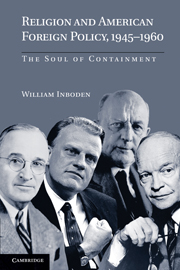
Reinforcing my view of a new generation of rising scholarship on the "mainstream," this evening I flipped through a recent edition of Reviews in American History, containing a really thoughtful exploration of William Inboden's Religion and American Foreign Policy, 1945-1960: The Soul of Containment. Inboden's work is also reviewed nicely, closer to the time of its publication, here.
Pretty much unbeknownst to me, apparently the pages of the journal Diplomatic History and other scholarly venues have been full of debates about the causal links (if any) between "cultural" factors such as religion and foreign policy decision-making. The reviewer asks, "How does one demonstrate conclusively that cultural phenomena do more than merely condition, or provide context for, the actions of foreign policy-makers?" He cites some skeptics of the "cultural turn" in foreign policy studies, asking skeptical questions to that effect. He then suggests that "more adeptly than any other product of the 'cultural turn' in foreign relations history, Inboden's book demonstrates this causative link between religion and diplomacy." The father of containment, George Kennan, wasn't much for any of this, but once it took hold his idea quickly moved far beyond the intentions of its creator, much to his dismay and exasperation.
These are all works about the "mainstream" from the inception of the high period of the Cold War through the trials of the 1960s -- a period when mainstream Protestants (with considerable sprinkling of folks from other parts of "tri-faith America," of course) were, to a sizable degree, the people who ran everything. I might add that I've just skimmed through another recent work, The Spiritual-Industrial Complex: America's Religious Battle Against Communism in the Early Cold War, recently out with Oxford, in which the mainliners are the central actors. We'll have more extensive coverage of this book on the blog a bit down the road; in the meantime, click the link for interesting coverage and analysis of the book. The review linked above begins:
IN A LETTER to the Vatican in 1947, Harry Truman characterized the United States as a “Christian nation.” For Truman this was likely a statement of fact, an obvious description of what America was and would long remain. For Jonathan Herzog, Truman’s phrase explicates an entire epoch in American politics. The title of his book, The Spiritual-Industrial Complex, inverts Dwight Eisenhower’s warning about a military-industrial complex, suggesting instead a fusion of governmental power and religious zeal.
Darren Dochuk's piece for Perspectives, "Searching Out the Sacred in U.S. Political History," summarizes much of what I'm saying here. After a discussion of the plethora of scholarship on evangelicals and fundamentalists, he goes on to add that
But religion was not just for the downtrodden or embattled; at mid-century it still dictated the dreams of the political elite too. Perhaps no other subset of political history has undergone a more profound shift lately than diplomatic history. Rendered too conventional by some in the 2000s, diplomatic history has emerged in the 2010s as a dynamic field revitalized by new interests in gender, NGOs, globalization, "soft power"…and religion. One exemplary byproduct of this renaissance is William Inboden's Religion and American Foreign Power, 1945–1960, which argues that Protestant notions of liberty and freedom informed U.S. officials' efforts to construct a "godly" front against "atheistic Communism." Once Dwight Eisenhower molded them into a more inclusive, civil religion of American exceptionalism, these notions also came to inspire Jews and Catholics around the world in a broad offensive against the Red Menace. Such was the spiritual essence of U.S. containment strategies, and as Inboden, Andrew Preston, Jason Stevens, Mark T. Edwards, and others emphasize, America's most powerful emissaries never took this essence lightly.
In their minds, America's fight against foreign evils was God's fight against foreign evils, rendering any clean distinction between faith and international relations artificial. If public theology was a wedge for American hegemony abroad, it could also be a subversive influence at home, something historians now stress when talking about the civil-rights era. As Joseph Kosek has shown in Acts of Conscience, even while many public intellectuals championed American imperialism, some spoke out against the prevailing orthodoxy. Reconciliation and brotherhood rather than conquest grounded their creed, fusing their interests with a broader crusade for human rights. These same principles enlivened the "prophetic" strand of Protestantism that bound the southern civil rights movement together. Rooted in an Old Testament tradition that roused black and white activists alike, this prophetic theology, David Chappell shows in A Stone of Hope, sacralized self-sacrifice for social justice and paved the way for nonviolent revolt throughout the South. Chappell's conclusions are now being enriched by studies of civil rights activism in the West. Scott Kurashige, Shana Bernstein, and Mark Brilliant have all shown that multiethnic religious agencies in 1940s California helped trigger the assault on American apartheid.Inspired by this state's rich but contested religious pluralism, they helped marshal local resources and resolve for a nationwide war against Jim Crow and all its intolerances, one they would win in the 1960s.
But religion was not just for the downtrodden or embattled; at mid-century it still dictated the dreams of the political elite too. Perhaps no other subset of political history has undergone a more profound shift lately than diplomatic history. Rendered too conventional by some in the 2000s, diplomatic history has emerged in the 2010s as a dynamic field revitalized by new interests in gender, NGOs, globalization, "soft power"…and religion. One exemplary byproduct of this renaissance is William Inboden's Religion and American Foreign Power, 1945–1960, which argues that Protestant notions of liberty and freedom informed U.S. officials' efforts to construct a "godly" front against "atheistic Communism." Once Dwight Eisenhower molded them into a more inclusive, civil religion of American exceptionalism, these notions also came to inspire Jews and Catholics around the world in a broad offensive against the Red Menace. Such was the spiritual essence of U.S. containment strategies, and as Inboden, Andrew Preston, Jason Stevens, Mark T. Edwards, and others emphasize, America's most powerful emissaries never took this essence lightly.
In their minds, America's fight against foreign evils was God's fight against foreign evils, rendering any clean distinction between faith and international relations artificial. If public theology was a wedge for American hegemony abroad, it could also be a subversive influence at home, something historians now stress when talking about the civil-rights era. As Joseph Kosek has shown in Acts of Conscience, even while many public intellectuals championed American imperialism, some spoke out against the prevailing orthodoxy. Reconciliation and brotherhood rather than conquest grounded their creed, fusing their interests with a broader crusade for human rights. These same principles enlivened the "prophetic" strand of Protestantism that bound the southern civil rights movement together. Rooted in an Old Testament tradition that roused black and white activists alike, this prophetic theology, David Chappell shows in A Stone of Hope, sacralized self-sacrifice for social justice and paved the way for nonviolent revolt throughout the South. Chappell's conclusions are now being enriched by studies of civil rights activism in the West. Scott Kurashige, Shana Bernstein, and Mark Brilliant have all shown that multiethnic religious agencies in 1940s California helped trigger the assault on American apartheid.Inspired by this state's rich but contested religious pluralism, they helped marshal local resources and resolve for a nationwide war against Jim Crow and all its intolerances, one they would win in the 1960s.
So what say you, Elesha and others -- is there another mainline moment being born? Perhaps the center could not hold, but its few decades of remarkable power and then fragmentation mark mid-twentieth century American history in ways historians are still fruitfully investigating.


