Tampilkan postingan dengan label conferences. Tampilkan semua postingan

Rabu, 04 Januari 2012

Guest Review of Seitz's No Closure and an Invitation

Today's guest review is from Matthew J. Cressler, a doctoral candidate in Religious Studies at Northwestern University. His work combines African American and Catholic histories as they intersect with conceptions of the American nation. Matt is also the recipient of the American Catholic Historical Association's fourteenth annual John Tracy Ellis Dissertation Award. Please join Matt and his colleagues at the round table on Seitz's book at AHA this Saturday, January 7, 9:00 a.m. – 11:00 a.m, Scandal, Resistance, and Practice: A Roundtable on John Seitz’s No Closure, ROUNDTABLE, Chicago Marriott Downtown, Purdue Room.

A Review of John Seitz’s No Closure (2011) and an Invitation to Join the Conversation
Matthew J. Cressler

In May 2004, the Archdiocese of Boston announced that a number of parishes would be closed across the city. The decision to shutdown nearly eighty parishes across the Boston area was a consequence of the immense financial burden of the Catholic sex abuse crisis, as well as longstanding shifts in urban demographics and church attendance. However, by August, it became clear that some groups of Catholics refused to accept the process of parish shutdown. Parishioners across Boston moved into their closed churches and occupied them in “perpetual vigil” – “with their physical and, they repeatedly insisted, 'prayerful' presence they were going to keep the church open despite the decree against it" (10). John Seitz's No Closure: Catholic Practice and Boston's Parish Shutdowns is an ethnographic study of those resisting communities that sets out to answer two fundamental questions: why did Catholics resist the closure of their parishes and what does this resistance tell us about contemporary American Catholicism? In the course of answering these questions, Seitz illustrates the contours of what many resistors experienced as a “spiritual abuse” that followed, and was a continuation of, the sexual abuse of the Church. Resisting Catholics were forced to reexamine the lines and limits of their engagement with the Church, to reconsider the Catholic past and its meanings in their lives, and to take up the responsibilities of everyday church management and theology.

But if No Closure is specifically about this small community of Boston Catholics resisting church shutdowns in the wake of scandal, I’m much more interested in how it also serves as an incisive exploration into American Catholicism at the turn of the 21st century. Though the decision to occupy parishes certainly wasn't the norm amidst parish shutdowns, religious life in the liminal space of occupied churches sheds light on contemporary American Catholic life in ways oftentimes invisible to scholars. To name just two of the broader theoretical interventions of Seitz’s work, No Closure examines the particularity of the Catholic parish in American religious history and the problem of modernity in the narratives of American Catholic history.
By considering what happens when a diocese takes away a parish – effectively an exploration of the unmaking of sacred space – Seitz illuminates the peculiar relationship Catholics have with religious places. The pain felt by parishioners at the loss of their spiritual home indicates the distinctive significance of the parish in American religious history, wherein the parish served as a site for the creation of a particular kind of American religious subject with a particular orientation toward places and the sacred presences that populate them. Calling attention to the habituation of the ways Catholics experience sacred spaces and presences – he talks about the ways Catholics “practice” the parish and presence – Seitz powerfully argues that “inherited and internalized narratives of sacred presence, not simply unreflective attachment, kept these Catholics in their parishes” (160).

Though narratives of American Catholic history often assume that Catholics progressively modernized over the course of the twentieth century, moving more and more toward a lay-led democratic style of congregational Catholicism, Seitz suggests an alternative model of American Catholic modernity. Far from having shed their attachments to specific sacred spaces and the real presence of the supernatural – things presumed passé to the modern religious subject – resisting Catholics struggled over the sacredness of their own parish spaces against an institutional Church that argued churches were merely brick and mortar. Resistors adopted the postconciliar image of themselves as the "living stones" of the Church at the same time that they defended the physicality of the sacred contained in the stone walls of their parish. No Closure thus breaks down the binary map of American Catholicism after Vatican II, demonstrating that many Catholics continued to experience the upheavals of the conciliar era and developed their own interpretations of the Catholic past that do not map neatly onto the postconciliar liberal-conservative map.

Early on in the book Seitz says "this book is not the end of a conversation, but the opening of one" (20). In the spirit of this invitation, I want to invite everyone interested not only to read this compelling book, but also to literally join the conversation this January. Those of you planning on attending the American Historical Association’s winter meeting this January in Chicago, or any of the various related groups like the American Society of Church History or the American Catholic Historical Association, are invited to “Scandal, Resistance, and Practice: A Roundtable on John Seitz’s No Closure.” John McGreevy, Kristy Nabhan-Warren, John Seitz, and my fellow Northwestern doctoral candidate Brian Clites, will join me in a discussion that will use Seitz’s book to open a conversation on themes such as power dynamics between laity and clergy, the construction of Catholic identities, the sacralization of place, and the many ways Catholics have related to their own past at the turn of the twenty-first century.


Senin, 02 Januari 2012

Teaching, Playing, and Praying: Evangelical Networking and Community Building in Modern America

Paul Harvey

One more AHA/ASCH session for you all to consider, especially for those of you interested in contemporary evangelical subcultures, home schoolers, and prayer warriors:


Teaching, Playing, and Praying: Evangelical Networking and Community Building in Modern America

AHA Session 48
Friday, January 6, 2012: 9:30 AM-11:30 AM
Chicago Ballroom D (Chicago Marriott Downtown)
Chair:
Matthew Avery Sutton, Washington State University
Papers:
Comment:
Randall Balmer, Barnard College, Columbia University
Session Abstract
Violence in public schools, anonymous neighborhoods that lack a sense of community, and legalized abortion all represent social, economic, spatial, and demographic changes that threatened the evangelical ideal of Christian schools, Christian neighborhoods, and Christian nation in the late twentieth century. Rather than attacking these problems head-on, many evangelicals built dynamic networks in an effort to realize their ideals outside the mainstream. In this effort evangelicals participated in a paradoxically mainstream American tradition of self-identifying as “outsiders” while endeavoring to create utopias. This panel addresses three such networks in the form of homeschooling, megachurches, and prayer marches. Yet even as evangelicals’ attempts to construct ideal communities are part of a longstanding American tradition, the three papers presented here also reveal the innovative ways in which evangelicals are building networks and communities today.    
            First, Rachel Coleman’s study of Christian homeschoolers in Delaware County, Indiana, demonstrates the successes and challenges of local evangelical networking in an era of technology. While Coleman’s homeschool subjects, eager to protect their children from ungodly influences, originally created a “homeschool community” that shut out non-Christian homeschoolers, the Internet soon served to decentralize and democratize homeschooling, offering greater opportunities but less social control. By focusing on the mechanics of this local network’s evolution, Coleman reveals a pattern that sheds light on national homeschooling’s creative solution to the isolation of the digital age.
            Second, and in contrast to the democratizing forces at work in Coleman’s homeschoolers, Lauren Beaupre’s study of Bellevue Baptist Church reveals the increasingly insular communities of modern megachurches. Replacing intimate neighborhoods with religious centers that provided education, recreation, and entertainment, Bellevue and other megachurches holistically attended to a dispersed Christian community. In response to large-scale reorganizations of metropolitan space, community became a religious product for sale in enormous religious complexes that were more like small towns than traditional parishes.  Buying into the product was easy, but Beaupre also reveals the challenges created by one-stop shopping for the broader local community.
            Finally, where Coleman sees a Christian alternative to public education and Beaupre highlights a Christian alternative to restoring residential neighborhoods, David McConeghy shows how prayer became a Christian alternative to public policy or legislation. Prayer was both a weapon to be wielded in the “culture war” against secularism and the olive branch shared among divided Christian churches. American communities could be redeemed if they could either be purged of sin or united by revival, and new spatial and geographic prayer techniques emerged to facilitate God’s intercession for spiritual breakthroughs on secular obstacles.
            The three networks examined here affirm the creativity and resourcefulness of evangelicals in attempting to recreate their ideal of Christian schools, Christian neighborhoods, and Christian nation. Yet while education, church, and prayer had long been important to evangelicals, the alternative communities they formed in the late twentieth century differed from previous efforts in their use of communications technologies, economies of scale, and critical geographies. Together these networks show evangelicals adeptly balancing the past and present in order to save American communities.

AHA/ASCH Sessions of Interest

Paul Harvey

2012 LogoIn addition to our session "Reassessing the Significance of Religion in the Twentieth Century United States"  this Saturday afternoon at the American Historical Association, which I blogged about previously, here are a few more sessions for you to consider, ranging from a reconsideration of Harry Stout's New England Soul to papers on religious networks in the early modern Atlantic world. See some of you in Chicago! If you have a session that you particularly want to promote here, contact me and we should be able to put it up.

Also, and by the way, if you need something to do Saturday morning but you figure going to our session Saturday afternoon will suffice for your religious history needs, here's a cool session on digital history (follow the link for info), featuring some of the leading lights in presenting history in new ways, including Philip Ethington (who will be talking about geo-historical visualization), Katrina Gulliver (who will discuss her podcasts "Cities in History"), and Jennifer Serventi from the National Endowment for the Humanities.

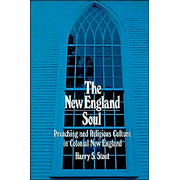
New England Soul: Preaching and Religious Cultures in Colonial New England  -             By: Harry S. Stout    Harry Stout’s The New England Soul after 25 Years

American Society of Church History 9
Friday, January 6, 2012: 9:30 AM-11:30 AM
Promenade Ballroom A (Westin Chicago River North)
Chair:
Mark A. Noll, University of Notre Dame
Catherine A. Brekus, University of Chicago , James Byrd, Vanderbilt University , Thomas Kidd,Baylor University and Kenneth P. Minkema, Yale University

Comment: Harry S. Stout, Yale University
_______________________________________________
A Place for Grace: Religion and Contests of Identity in theMississippi River Valley, 1812–45

American Society ofChurch History 13
Friday, January 6,2012: 2:30 PM-4:30 PM
Jackson Park Room (Westin Chicago River North)
Chair:
Amanda Porterfield, FloridaState University
Papers:
Comment:
Comment: Amanda Porterfield, Florida StateUniversity
___________________________________________________________

Religious Networks, Alliances, and Friendship in the EarlyModern Atlantic World
AHA Session 109
Saturday, January 7,2012: 9:00 AM-11:00 AM
Los Angeles Room (Chicago Marriott Downtown)
Chair:
Ned C. Landsman, StonyBrook University
Papers:
"A Part ofOne's Soul": Spiritual Friendship and Evangelical Networks in EarlyAmerica
Janet M. Lindman, Rowan University

Comment: John Fea, Messiah College

Kamis, 29 Desember 2011

Literature and Secularization: At MLA and in Print


by Everett Hamner

For any of you blog readers who might be at MLA (program is linked here) rather than AHA in a few days(gasp!), there's a session you won't want to miss. Several of the mostprovocative, insightful scholars at the intersection of religion and literaturewill be participating on a panel entitled "Literature andSecularization" (Friday, 3:30-4:45, WSCC 617). Facilitated by SusannahBrietz Monta (Notre Dame, and editor of Religionand Literature), this roundtable will feature Lori Branch (Iowa, author of Rituals of Spontaneity); John Cox (HopeCollege, Seeming Knowledge: Shakespeareand Skeptical Faith); Tracy Fessenden (Arizona State, Culture and Redemption); William Franke (Vanderbilt, Poetry and Apocalypse); Colin Lovell Jager(Rutgers, New Brunswick, The Book of God);and Michael W. Kaufmann (Temple, coordinator of recent Religion and Literature forum, "Locating thePostsecular").

While I'm in advertising mode, many of you--religious studies and history typesincluded--might well enjoy Amy Hungerford's PostmodernBelief: American Literature and Religion Since 1960 (Princeton, 2010). Ireviewed this for Religion and Literaturerecently (43.1, Spring 2011), and here's the opening paragraph:

Atfirst glance, Amy Hungerford’s second book might seem literary criticism’sanswer to Robert Wuthnow’s After Heaven:Spirituality in America Since the 1950s, which shows how Americans havedrifted away from institutional religious commitments and toward more informal,syncretistic spiritualities. However, Hungerford reveals not just a looseningand recombination of doctrines and practices, but the return of a “belief inmeaninglessness” (xiii) rooted in transcendentalism and Romanticism. Postmodern Belief is an examination offaith without content, trust in the nonsemantic, belief as itself a form ofritual, all as discerned primarily through the work of writers rarelyidentified as religious themselves, but who still “live in oblique relation tothe structures and discourses of institutional religion” (xvi). Rather thanconcerning herself with these authors’ theologies, Hungerford investigatestheir convictions about literature. In fact, “their literary beliefs areultimately best understood as a species of religious thought, and theirliterary practice as a species of religious practice” (xvi).

Senin, 26 Desember 2011

Reappraising the Significance of Religion in the Modern U.S.: 2012 AHA Session

Paul Harvey

Some of you blog readers may be getting ready for the 2012 American Historical Association meeting in sunny Chicago Jan. 5-8 2012. Because the AHA meets in conjunction with the American Society of Church History and the Catholic Historical Association, there are really too many sessions on American religion to list usefully. So instead I'll feature a few sessions of interest that particularly catch my eye in the coming days here, and invite the rest of you to promote sessions of interest to you, either in the comments section or by sending me a guest post.

To start with, here's hoping you'll drop by our session, pasted in below, on "The Evangelical Century: Reappraising the Significance of Religion in the Modern United States." Details below.


Saturday, January 7,2012: 2:30 PM-4:30 PM
Kansas City Room (Chicago Marriott Downtown)
Chair:
Anthea Butler, Universityof Pennsylvania
Papers:
World War II andthe Birth of Modern American Evangelicalism
Matthew Avery Sutton, Washington State University
Comment:
Paul W. Harvey, Universityof Colorado Colorado Springs
Session Abstract
The twentieth century United States, according to the standardnarratives, was defined by growing secularism and pluralism. Heavy immigrationof Jews and Catholics in the progressive era, and of Hindus, Buddhists, andMuslims since the 1960s, created what scholar Diana Eck calls “a new religiousAmerica,” one in which no single group has a monopoly on power. The members ofthis panel are not so sure. While there is no doubt that the United States isfar more diverse today than it was in 1900, American evangelicals havenevertheless managed to shape the nation’s trajectory in important ways in thelast one hundred years. Building on new archival research, these papers seek toreappraise the significance of American evangelicalism in the modern UnitedStates.

Alison Greene focuses on an important shift that began in the1930s. Until the Great Depression, the nation’s established churches were on anupward trajectory in both numbers and influence. But the Great Depressioncrippled the Protestant establishment. At the same time, the economic crisismade room for evangelical and pentecostal churches that emphasized individualsalvation and authentic religious experience. While the established churchesstruggled to maintain programming and participation, upstart evangelicals andpentecostals employed creative techniques and a core of committed volunteers tokeep church operations afloat and expand membership. While it would be decadesbefore evangelicals and pentecostals rivaled their established counterparts in numbersand national influence, the Great Depression marked the beginning of a gradualtransition of power from the mainline to its upstart rivals.

Matthew Sutton's paper (revised since the original proposal) discusses the reaction of fundamentalists to World War One, tracing that era as one of the creation of a religious movement that grew to be hyper-patriotic and suspicious of government at the same time.

Steven Miller examines more recent expressions of evangelism. Heargues that the growing prominence of Reagan-era evangelicalism produced twometaphors that profoundly informed subsequent discussions of faith and publiclife: Richard John Neuhaus’ “naked public square” and James Davison Hunter’s“culture war.” Neuhaus argued that secular elites had “systemically excludedfrom policy consideration the operative values of the American people, valuesthat are overwhelmingly grounded in religious belief,” while Hunter described aconflict between “progressive” and “orthodox” forces in American society. Inthe end, neither metaphor could transcend a defining characteristic of latetwentieth-century America: the complex, often ironic influences ofevangelicalism on U.S. politics and culture.

Kamis, 15 Desember 2011

WW II and Religion: CFP

The Institute on World War II and the Human Experience and the Department of Religion
Florida State University


“World War II and Religion”

November 30-December 1, 2012

Call for Papers

The Institute on World War II and the Human Experience and the Department of Religion of Florida State University seek paper proposals for a two-day conference in Tallahassee, Florida focusing on Religion and World War II. Conference organizers G. Kurt Piehler and John Corrigan seek papers that touch on the institutional, theological, and human impact of religion in World War II. We are interested in the global dimension of this conflict and encourage scholars whose work focuses on Africa, Asia, Latin America, Middle East, and the Soviet Union, as well as Europe and North America.

We are interested in addressing the ways that combatants and civilians drew upon religious ideals and institutions to sustain them in an age of total war, and especially how soldiers, sailors, and aviators behaved religiously in the course of their service. Additionally we solicit papers that consider the roles religious organizations and values played in fostering ethical conduct during the war, providing humanitarian relief, and protecting non-combatants and conscientious objectors, as well as analyses of various kinds of religious justifications for violence, including genocide. Among the questions we seek to address: did religious leaders and institutions foster a climate that encouraged rather than retarded the drift to total war? Are there really no atheists in foxholes? What was the legacy of the war for religious institutions and ideals, especially in the defeated Axis Powers? How did religious institutions discredited by their support of the Axis Powers seek to regain their legitimacy? What kinds of compromises did persons negotiate with their religious beliefs in wartime? In what way was pre-existent religious rhetoric deployed to characterize enemies as evil? How did the war diminish and exacerbate the perception of religious differences?

We encourage contributions from a variety of disciplinary perspectives. The conference organizers hope to provide travel funding to graduate students and junior scholars to encourage their participation. Plans call for the publication of an anthology drawn from the conference proceedings edited by John Corrigan and G. Kurt Piehler.

Those seeking to participate in the conference should submit a 750 word abstract along with a short 3-5 page c.v. via Microsoft word attachment or PDF File to G. Kurt Piehler at kpiehler@fsu.edu by March 15, 2012. For further information about the conference, please contact John Corrigan at jcorrigan@fsu.edu or G. Kurt Piehler at kpiehler@fsu.edu

Jumat, 09 Desember 2011

AAR Redux (Part 2) from Jeremy Rapport!

Here's part two of Jeremy's reflections on AAR, in which he discusses legitimation, spirituality, individuals, nature, appropriation and so much more. Part 1 is available here.

“Individuals, Communities, and Religious Authenticity: An AAR Redux”
Jeremy Rapport

The process by which adherents and potential adherents judge religious claims credible is of great interest to new religions scholars. The three papers on Sunday afternoon’s “Strategies of Legitimation in New Religions” focused on authoritative claims-making in three different new religions: a Chinese Buddhist new religion, Erik Hammerstom’s “The Heart of Mind Method”; a neo-pagan Asatru group, Carrie Dohe’s “Jungian Archetypes, Metagentics, and Kenniwick Man”; and a Christian new religion, Spencer Allen’s “Tony Alamo and His New Testament Brand of Christian Polygyny.” The issues these presenters discussed and the questions they raised about the ways discourses of legitimacy function are critical to understanding new religions as well as to thinking through the ways religions work in people’s lives. A community becomes credible and possesses religious legitimacy, all three of the presenters at least implicitly insisted, through a complex mix of appeals to cultural norms, religious traditions, and charismatic claims.

Monday morning I presided at “Religious Appropriations of Secular Culture.” In many ways, this was a fun-filled panel. Highlights included Darryl Victor Caterine’s paper, “Haunted Ground,” based on his recent book of the same name, which examined the role of nature in the gatherings of several metaphysical religions; Ann Duncan’s research on an Edgar Cayce inspired summer camp, “Summer Camp and New Paradigms of Sacred Space in New Religious Movements”; Shannon Harvey’s paper, “Eat Your Way Back to the Godhead” looked at ISKCON cookbooks; and Martha Smith Roberts’ and Jenna Gray-Hildenbrand’s “Hoop Spiritualities,” described their research on hula hoopers who believe the exercise inspires spiritual experiences. Despite the variety of the topics, it would have been impossible to miss the theme of people using conventionally secular forms to facilitate experiences they believe to be religious. Spiritual experiences are everywhere, if you know where to look.

The Sunday afternoon panel on Frequencies, an experimental project on spirituality developed by Kathryn Lofton and John Lardas Modern, was jam packed, despite starting late due to room arrangement problems. The project solicits short pieces on the diverse subjects that the authors think of when they think of the term, “spirituality,” and publishes them on its web site. For me, Frequencies is fascinating in much the same way that AAR is—as way to indulge rapidly one’s varied interests in sometimes ill-defined and/or poorly understood phenomena. Many of the essays on the web site are thought provoking examinations of their topics, and Sunday afternoon’s speakers, all contributors to the project, took to the spirit of the event and the project with full gusto. Julie Byrne performed her remarks on the project in an entirely appropriate, funny, confusing, and thoughtful spoken word piece. Susan Hardin spoke about the genealogy of Frequencies itself. Jeffrey Kripal pointed out the cool factor in the project and in the people involved in it. But what really struck me were Ari Kelman’s remarks. Kelman discussed the project’s apparent lack of the overtly religious (at least to date, contributions are still coming in). Kelman’s comments struck a chord. As much as I enjoy what I have seen of it, I worry that Frequencies is doing nothing to address an overly simplistic dichotomy in popular discussions of the religious and the spiritual, a dichotomy that misrepresents the complex relations among individuals, institutional religions, and cultures. In fairness, Martin Marty’s recent contribution to Frequencies addresses this exact concern, and pieces on more conventionally religious topics are now more commonly appearing. Nonetheless, it seems to me that Frequencies is in danger of metaphorically recreating the tropes and practices of a particular form of spiritual seeking in vogue right now and in the process also risks ignoring a vital reality of the more conventionally religious world, namely that many religious people do not think their lives are devoid of the immediacy and presence of something they understand to be spirituality. I really do not want a project that strikes me as both innovative and insightful to pigeon-hole spirituality as a concept limited to people who understand it to indicate the primary authority of individuals to mediate and create their worlds.

Our investigations of religion have been moving toward a greater interest in the individual’s expression of religious life for the past several decades, with the lived religion approach exemplifying the trend. While that shift toward focusing on the individual as the primary mediator of authentic religious life reflects previously overlooked factors in our study of religion and recent developments in American religious life and thought, scholars must remain cognizant of the vital role of community in religious life. Individuals may indeed be the primary mediators of religious authenticity, but they learn to do that mediation in the context of communities that shape them and how they understand the world.

Kamis, 08 Desember 2011

AAR Redux (Part 1) from Guest Poster Jeremy Rapport

Today's guest post on the recent AAR meeting in November comes Jeremy Rapport, a visiting Assistant Professor of Religious Studies at The College of Wooster. Jeremy's most recent publications are on New and Alternative Religious Movements in America and American Metaphysical Religions, specifically Christian Science and the Unity School of Christianity. Other attendees of AAR are welcome to send me (Kelly) posts detailing the conference too. The more, the merrrier!

“Individuals, Communities, and Religious Authenticity: An AAR Redux”
Jeremy Rapport

For me, as I suspect is the case for many in our guild, one of the most satisfying parts of AAR is the chance to be intellectually promiscuous for a few days. Briskly and purposively walking from panel to panel belies the strolling and staring my mind is doing as I hear new ideas, interpretations, and accounts of the religious life and thought of people from vastly different times and places. This academic flitting and sipping is reinforced for me because as a member of the New Religious Movements steering committee, I attend the diverse panels our group sponsors. New Religious Movements is a sub-discipline that engages ethnographic, historical, and sociological approaches to studying religion as well as examining religious phenomena from across time and cultures. I can satisfy my intellectual curiosity while also fulfilling my committee obligations.

This year in San Francisco, I attended panels on the Japanese new religion Shinnyo-en, the concept of legitimizing new religions, and a panel discussion with Jonestown survivors. A meeting of the seminar on food and eating and the panel on the experimental project Frequencies were on my agenda. I also presided at a panel on religious appropriations of secular culture. All of the meetings were fascinating and engaging, and many of the papers would be of interest to scholars of religion in America. However, as I thought about the experience over Thanksgiving what really struck me was the emphasis on the authority of the individual in many of the papers. Religion may be a community endeavor, but at least as scholars in contemporary America, we seem to be more and more interested in how individuals shape religious groups and in how groups are trying to satisfy individuals.

Saturday morning began with a session co-sponsored by the Japanese Religions Group and the New Religious Movements Group. Shinnyo-en is a Japanese Buddhist movement that uses a form of medium-guided meditation. With several temples outside of Japan, including in Honolulu, San Francisco, Los Angeles, Chicago, and New York state, it is now both an international and American movement. What grabbed my attention here was Victoria Rose Pinto’s paper, “Floating Prayer: Syncretism, Symbolism, and Ritual in the Lantern Floating Ceremony in Hawai’i.” Shinnyo-en introduced this version of an Obon ancestor ceremony to Hawai’i. People write personal messages and decorate floating lanterns to send out to sea as memorials to significant people and events in their lives. Shinnyo-en still sponsors the event, but as Pinto pointed out, the ceremony has grown well beyond the confines of the single Japanese Buddhist movement that introduced it, and it is now one of the most popular public religious rites in the state. Most of the participants have no formal affiliation with Shinnyo-en. Yet the movement, by creating and facilitating a rite that allows individual expressions of faith, feeling, and connection to a larger world, now has an important role in Hawai’ian public religious life.
It is certainly not news that the complex relationship of food and eating with religion is of great interest to scholars. Meeting now for its fourth year, Saturday afternoon’s seminar “Religion, Food, and Eating in North America” has been discussing papers on this wide-ranging topic with goal of producing an edited volume aimed primarily at undergraduates. I contributed a paper to the seminar at the 2010 meeting in Atlanta. Studies of food and religion invite the inspection of the public and the private, the individual and the community. Looking at how a person’s diet helps to structure his or her religious life shows us that the material has never been as far removed from the spiritual as many Protestants wish it were. Moreover, food is perhaps the most accessible of the roads to teaching undergraduates lived religion, thus this is welcome work on many levels, including as a potential teaching resource and as work that systematically examines how food mediates between individuals and communities, creates identities, structures group practices, and reflects religious principles.

For me, the most powerful event of the AAR was the panel discussion featuring Jonestown survivors on Sunday morning. The terrible and tragic events at Jonestown continue to inspire thoughtful and important work on religion, and justly so since the predominant stereotypes about alternative religions today owe a great deal to those 914 deaths in Guyana in 1978. Tropes about the power of brainwashing administered by a diabolical cult leader developed largely in response to the horrific end of the Peoples Temple. Yet the individual human stories are frequently overlooked, so this panel where survivors shared their stories served as a useful addition to thinking about the meaning and significance of the events. Among the many emotionally moving and fascinating stories, I could not help but be struck by how many of the survivors insisted on the idea that reclaiming their humanity and their dignity involved reclaiming their individuality. Many of those present on Sunday morning declared that Jonestown was not made up of homogenous people, that the takeaway message of the tragedy should be that the only true master is within, that Jones had become an impediment to the functioning of the community, and that people should think very carefully about the degree to which they are willing to sacrifice themselves to pursue their principles. I could not help but wonder if part of the process of the survivors reincorporating themselves into American culture involved relearning how to think about the status and authority of the individual.

To be continued.

Senin, 21 November 2011

The AAR Left Its Heart in San Francisco

Paul Harvey

So many friends and colleagues gathered in San Francisco this weekend for the American Academy of Religion meeting, highlighted by a reunion dinner yesterday evening for those lucky enough to be part of the Young Scholars in American Religion program.

As you will have seen already from Kelly's roundup post last week, the conference was full of intellectual fare. Our bloggers here were on panels discussing everything from twentieth-century fundamentalism, to religion and the AIDS crisis, to the famous self-taught artist and street evangelist Sister Gertrude Morgan (hope you'll blog about that here, Emily!), to subjects in Mormon studies, to "narrativity" in the construction of our American religious history courses and survey writings-- and much more besides. You can survey a lot of reactions/experiences at panels at the twitter hashtag #sblaar.

My friends and colleagues took care of cogitating over these important subjects. As for myself, I spent more time re-indulging the delights of Korean tacos and kimchee fried rice from the Namu food cart at Ferry Point Plaza at the Saturday farmer's market, which surely ranks as one of the best 2 or 3 places in the United States (especially for foodies). On a chilly and rainy weekend, nothing conjures up a pre-Thanksgiving weekend of food and intellectual fun like kimchee fried rice.

Blogging will resume tomorrow, I hope, sorry for the silence, and thanks to many at AAR who said kind things to me about the blog. And finally, congratulations to RAndall, who is very soon, in just a couple of weeks, off to Norway for 6 months as a visiting lecturer/scholar as a Fulbright Fellow in Norway!

Selasa, 15 November 2011

AAR 2011: Religion in America Round Up

Kelly Baker

For those of you headed to San Francisco later in the week, here's a guide to AAR sessions (and NAASR sessions) about religion(s) in American history, life, and culture. My list is likely not exhaustive, though I tried to be. So, please panels that I might have missed in the comments section. Additionally, Mike Altman (@MichaelJAltman), Ben Brazil (@bbrazil), and I (@kelly_j_baker)will be live-tweeting the conference (under the hashtag #sblaar) as well as posting a discussion after the conference similar to the ASA discussion. AAR has a mobile app this year that might come to good use for those of you (like me!) who don't want to lug around a program book.

(Editor update 11/17: Also, for the owners of the brand new Kindle Fire, my tech savvy spouse made the AAR mobile app downloadable for you too. There's a quick note about installation in the comments section.)

We welcome any guest blog posts about AAR. Please feel free to send them to Paul or me, and we'll post them. As you can tell from the list, any help to cover AAR this year would be more than helpful.

Happy conferencing!

Saturday, November 19, 9:00-11:30 am

A19-109, Religion and the Social Sciences Section
Marie Marquardt, Agnes Scott College, Presiding

Theme: Rematerializing Religion: Critical Applications of Manuel A. Vásquez’s More than Belief: A Materialist Theory of Religion (Oxford University Press, 2010)

Chad Seales, University of Texas
Keep Clean, and Sweet, and Pure: From Material Religion to Material Morality

Sean McCloud, University of North Carolina, Charlotte
Toward a Materialist Theory of Metanoia: Reconsidering an "Impoverished Theory of Religious Change"

Elaine Peña, George Washington University
The Materiality of Guadalupan Devotion: Micropractices, Embodied Action, and Space Production

Responding: Manuel A. Vasquez, University of Florida


A19-123, African Diaspora Religions Group
Maha Marouan, University of Alabama, Presiding

Theme: From "Double Consciousness" to the "Black Atlantic": Theorizing the African Diaspora and African Diaspora Subjectivities

Torin Alexander, Saint Olaf College
African Diaspora Subjectivities and Religious Experience: The Pursuit of Wholeness

Karyna Do Monte, Boston University
Brazilian Candomble Meets Ecology: A Samba Plot in the Rio de Janeiro Carnival

Michelle Gonzalez Maldonado, University of Miami
Translator of the Afro-Cuban Religious World: Lydia Cabrera

Mary Diggin, Pacifica Graduate Institute
Damballah and Maman Brigitte: The Irish Influence on Vodou Lwas

Responding: Charles H. Long, Chapel Hill, NC


A19-129 Latina/o Critical and Comparative Studies Group
Lara Medina, California State University, Northridge, Presiding

Theme: Religion at the Corner of Bliss and Nirvana: Politics, Identity, and Faith in New Migrant Communities (Duke University Press, 2009), Authors Meet Critics

Panelists: Carolyn Chen, Northwestern University
Rudy V. Busto, University of California, Santa Barbara

Responding: Lois Ann Lorentzen, University of San Francisco
Kevin Chun, University of San Francisco
Jay Gonzalez, University of San Francisco
Luis Leon, University of Denver


A19-130 Mormon Studies Group
Colleen McDannell, University of Utah, Presiding

Theme: Mormon Women and Modernity

Ann Duncan, Goucher College
The Mommy Wars, Mormonism, and the "Choices" of American Motherhood

Jennifer Meredith, University of Utah
Western Pioneer Mythos in the Negotiation of Mormon Feminism and Faith

Jill Peterfeso, University of North Carolina, Chapel Hill
Scripting, Performing, Testifying: Giving Faithful "Seximony" through The Mormon Vagina Monologues

Doe Daughtrey, Arizona State University
"Further Light and Knowledge": Ways of Knowing in Mormonism and the New Spirituality

Responding: R. Marie Griffith, Washington University, St. Louis


NAASR Panel 3
Saturday, November 19, 9-11:30 a.m. Room: Hilton Union Square-Yosemite A
Thomas Tweed, University of Texas at Austin, Presiding

Theme: The ‘Evidence’ of Religion in North America: A Round Table
Kelly J. Baker, University of Tennessee, Knoxville: “The Good, the Bad, the (Un)Dead: The Klan, Zombies and the Problem of Legitimate Evidence”

Lauren F. Winner, Duke Divinity School: “Reading Recipes for Religion: Cookbooks and the Sensory History of American Religion”

Jennifer Hughes, University of California, Riverside: “The Object as Evidence in American Religion”

Laura Levitt, Temple University: “Juridical Evidence and the Question of History, Or Justice and Empiricism”

Saturday, November 19, 11:30 am–1:00 pm

M19-110 Society for Mormon Philosophy and Theology
HI-Sutter B

Theme: Mormonism and Peace
James McLachlan, Western Carolina University, Presiding

Patrick Mason, Claremont Graduate University
"Religion, Violence, and the State: A Mormon Argument"

Responding: Robert Rees, Graduate Theological Union


Saturday, November 19, 1:00-3:30pm

A19-205 North American Religions Section
Jon Butler, Yale University, Presiding

Theme: Narrativity in the Study of North American Religions

Panelists: Thomas Tweed, University of Texas, Austin
Janet R. Jakobsen, Barnard College
R. Marie Griffith, Harvard University
Mark Hulsether, University of Tennessee, Knoxville

A19-236 Religion, Food, and Eating in North America Seminar
Reid L. Neilson, Latter-Day Saints Church, Presiding

Theme: Religion, Food, and Eating in North America

Leonard Norman Primiano, Cabrini College
"The Abundance of the Fullness": Mother Divine's Theology of Food

Todd LeVasseur, University of Florida
Koinonia Partners: A "Demonstration Plot" for Food, Fellowship, and Sustainability

Nora L. Rubel, University of Rochester
The Feast at the End of the Fast: The Emergence of a New American Jewish Practice

Benjamin Zeller, Brevard College
Quasireligious American Foodways: The Cases of Vegetarianism and Locavorism

Sarah Robinson, Claremont Graduate University
Refreshing the Concept of Halal Meat in Muslim American Context in Taqwa Ecofood Cooperative

Derek Hicks, Lancaster Theological Seminary
An Unusual Feast: Gumbo and the Complex Brew of Black Religion

Saturday, November 19, 4:00-6:30 pm

A19-305 North American Religions Section
Jeff Wilson, University of Waterloo, Presiding

Theme: Rethinking Key Paradigms in American Religion: "Black Church," "Queering Religion," "Nature Religion," and "Material Culture"

Josef Sorett, Columbia University
The Problem of the "Black Church": Church and Spirit(s) in the American Religious Imaginary, 1923–1940

Megan Goodwin, University of North Carolina, Chapel Hill
Captive Bodies, Queer Religions: Scripting North American Religious Difference

Bron Taylor, University of Florida
Gaian Earth Religion: Vanishing Divine Being(s) and the Mod-God of Nature

Jennifer Scheper Hughes, University of California, Riverside
Material Religion: On the Agency of Objects

Responding: Linda L. Barnes, Boston University
A19-307 Religion and the Social Sciences Section Ann B. McClenahan, Washington, D.C., Presiding Theme: Neoliberal Religiosities: Globalization and New Modes of Religious Practice Panelists: Kevin O'Neill, University of Toronto Kathryn Lofton, Yale University Tanya Erzen, Ohio State University Daromir Rudnyckyj, University of Victoria


A19-309 Teaching Religion Section and Native Traditions in the Americas Group
Michael Zogry, University of Kansas, Presiding

Theme: Teaching about Native Traditions: Pedagogical Insights for Specialists and Nonspecialists Alike

Panelists: Michelene Pesantubbee, University of Iowa
Michael McNally, Carleton College
Ines Hernandez-Avila, University of California, Davis
Philip P. Arnold, Syracuse University
Ines M. Talamantez, University of California, Santa Barbara
A19-321 Roman Catholic Studies Group
Amy DeRogatis, Michigan State University, Presiding

Theme: Finding a Place for Spatial Theory in American Catholic Studies

Panelists: Katie Oxx, St Joseph's University
Catherine Osborne, Fordham University
Arthur Remillard, Saint Francis University
Michael Pasquier, Louisiana State University
James Deutsch, Smithsonian Institution

Responding: Vincent J. Miller, University of Dayton

Saturday, November 19, 6:00-8:00 pm

A19-337, Special Topics Forum
Steven Barrie-Anthony, University of California, Santa Barbara, Presiding

Theme: Religion Beyond the Boundaries — American Religious and Spiritual Innovation: Marketing, the Law, and Marriage

Donald Westbrook, Claremont Graduate University
“I am a Mormon” and “I am a Scientologist”: Recent Marketing Efforts in Mormonism and Scientology

Andrew Ventimiglia, University of California, Davis
Circulating Religion, Owning Belief: Intellectual Property in the American Spiritual Marketplace

Erika Seamon, Georgetown University
Redefining Religion through the Lens of Interfaith Marriage


Sunday, November 20, 9:00-11:30

A20-104 North American Religions Section and Body and Religion Group
Ann M. Burlein, Hofstra University, Presiding

Theme: The Past, Present, and Future of Body Studies

Adam Park, Florida State University
Body Studies: A Nature/Culture Problem

Adam Ware, Florida State University
In the Air There’s a Feeling of Christmas: On the Discursive Deafness of Body Studies

Joshua Fleer, Florida State University
Spectator versus Participant: The Gaze of the Historian in the Field of Sports and Religion

Lauren Gray, Florida State University
On Embodiment and Lived Religion

Responding: Martha Finch, Missouri State University


A20-110 Afro-American Religious History Group
Rosemary R. Hicks, Tufts University, Presiding

Theme: New Research in African American Islam

Spencer Dew, Iowa State University
“This Nationalistic Topic”: Internal Debates about the Nationality and Citizenship in the Moorish Science Temple of America, 1925–1935

Andrew Polk, Florida State University
The Best Knower: Mythmaking, Fard Muhammad, and the Lost-Found Nation of Islam

Emily S. Clark, Florida State University
Noble Drew Ali’s “Clean and Pure Nation”: The Moorish Manufacturing Corporation and Identity

Responding: Edward E. Curtis, Indiana University-Purdue University, Indianapolis
A20-118 Native Traditions in the Americas Group
Gabrielle Tayac, Smithsonian National Museum of the American Indian, Presiding

Theme: Landscapes of Identity: Native Traditions of the Pacific

Suzanne J. Crawford O'Brien, Pacific Lutheran University
"Salmon is Our Sacrament": The Revival of First Salmon Ceremonies in the Pacific Northwest

Regina Pfeiffer, Chaminade University, Honolulu
More than Language: The Similarity of Hawai'ian and Maori Indigenous Religions

Mary Louise Stone, California Institute of Integral Studies
Sacred Female Authority Among the Inkas: Hurin Moiety

Matthew Casey, University of California, Davis
Indigenismo and the "Reindianization" of Cusco, Peru

Responding: Fritz Detwiler, Adrian College


A20-121 Religion in Latin America and the Caribbean Group
Jill DeTemple, Southern Methodist University, Presiding

Theme: Saints, Stones, and Bones: Material Religion in Latin America

Todd Ramón Ochoa, University of North Carolina, Chapel Hill
A Materiality for Sorcery in Central Cuban Bembé

Karin Velez, Macalester College
“Casas a la Santissima Virgen": The Multiplying and Refracting Seventeenth Century Holy Houses of Loreto Conchó (Baja California) and Loreto Moxos (Bolivia)

Michelle Gonzalez Maldonado, University of Miami
The Quinceañera and the Traje Tipico: Religion, Ritual, and the Mercado

Jalane D. Schmidt, University of Virginia
The Effigy's Emotion: Cuban Interpretations of the Virgin of Charity

Jennifer Scheper Hughes, University of California, Riverside
Cradling and Presentation: Affection and Tenderness for the Object in Meso-American Religion

Responding: Colleen McDannell, University of Utah
A20-125 Religion in the American West Seminar
James B. Bennett, Santa Clara University, Presiding

Seminar attendees are asked to read the four papers in advance; they will be posted on the Seminar’s website (http://www.yale.edu/relwest/) a month before the session convenes.

Theme: Land, Identity, and Transnational Wests

Sarah Imhoff, Indiana University
City Jew, Country Jew: Immigration, Masculinity, and American Zionism

Konden Smith, Arizona State University
Civilizing the American Frontier: Utah, Kansas, Nicaragua, and American Millenarianism 1856–1858

Brandi Denison, University of North Carolina, Chapel Hill
"Playing Indian": Defining American Religion through Ute Land Religion, 1910–1940

Katherine Moran, University of Wisconsin, Stevens Point
Faith, Place, and Power: Catholicism and the Making of the United States Pacific

Responding: Greg Johnson, University of Colorado, Boulder

Sunday, November 20, 1:00-2:30

A20-206 History of Christianity Section
Karen Bruhn, Arizona State University, Presiding

Theme: Negotiating Identities in the Early Modern Christian Americas

Adrian Weimer, Providence College
The “Worke of Cain's Offspring": Elizabeth Hooten and Provocation of Identity in Early New England

Brandon Bayne, Harvard University
“The Chalice of His Suffering”: Martyred Identity, Nostalgia, and the Jesuit Expulsion from New Spain

Veronica Gutiérrez, University of California, Los Angeles
“Que me Entierren con el Hábito del Bienaventurado San Francisco": A Nahua Woman Negotiates a Medieval Spanish Death Ritual

Mary Corley Dunn, Saint Louis University
"But an Echo"?: Claude Martin, Marie de l'Incarnation, and Female Religious Identity in Seventeenth Century New France

Responding: Constance Furey, Indiana University


A20-208 Religion and the Social Sciences Section and Afro-American Religious History Group
Jane Naomi Iwamura, University of Southern California, Presiding

Theme: Theory and Method in the Study of Race and Religion in Twentieth Century America

Panelists:Andre Key, Temple University
John L. Jackson, University of Pennsylvania
Judith Weisenfeld, Princeton University

Responding:Rebecca Alpert, Temple University


Sunday, November 20 3:00 pm-4:30 pm
A20-25 Wildcard Session
Lerone Martin, Eden Theological Seminary, Presiding

Theme: Race, Religion, and the Military

Robert Green, College of the Holy Cross
Black United States Army Chaplains in the Pacific: Race and Religion during the Philippine–American War, 1898–1902

Chih-Yin Chen, Saint Louis University
Soldier–Monks: Vincent Lebbe and His Little Brothers of Saint John the Baptist

Niccole L. Coggins, University of California, Santa Barbara
“Onward Christian Soldiers!”: The United States Military's Religious Identity in the Territory of Hawai’i, 1898–1959

A20-266 Asian North American Religion, Culture, and Society Group
Courtney T. Goto, Boston University, Presiding

Theme: Evangelism, Education, and Leadership: Transnational Strategies and Local Adaptations in Asian North American Religious Communities

Justin Tse, University of British Columbia
Evangelism, Eternity, and the Everyday: Ambivalent Reconciliation in a Chinese Canadian Christian Church in Metro Vancouver, BC

Michele Verma, Rice University
How Transnational Education Shapes Indo-Caribbean Hindu Traditions in the United States

Sharon A. Suh, Seattle University
New Euro-American Dharma Protectors: Jodoshinshu in Transition

Responding: Russell Jeung, San Francisco State University

A20-280 Roman Catholic Studies Group
James McCartin, Seton Hall University, Presiding

Theme: American Catholic Women: Engagement, Resistance, Transformation

Karen Park, Saint Norbert College
"Gather the Children in this Wild Country": Boundaries and Borders at a Frontier Marian Apparition Site

Rebecca Davis, Graduate Theological Union
"More than a Hyphen": The Contributions of E. Charlton Fortune, California Liturgical Artist of the Early Twentieth Century Liturgical Movement

Jennifer Naccarelli, Claremont Graduate University
Crossing Borders: The Triumphs and Trials of Two Catholic Suffragists

Responding: Tracy Fessenden, Arizona State University

Sunday, November 20, 5:00 pm-6:30 pm

A20-306 North American Religions Section
S. Brent Plate, Hamilton College, Presiding

Theme: Artifacts of Crisis: Religion and the Material Culture of Cataclysm

Jennifer Graber, College of Wooster
Between Two Worlds: Kiowa Ledger Art and the Narration of Cultural Calamity

Heather D. Curtis, Tufts University
"Famine Horrors": North American Missionary Photographs and the Visual Culture of Cataclysmic Suffering

Jonathan Ebel, University of Illinois, Urbana-Champaign
Monumental Failures: Visual Culture, War Memories, and the Limits of American Civil Religion

Responding: Sally M. Promey, Yale University


A20-331 North American Hinduism Group
Shreena Gandhi, Kalamazoo College, Presiding

Theme: Constructions of Hindu Selves and Hindu Others in North America

Michele Verma, Rice University
Indo-Caribbeans in the United States: Cracking the Conflation of “Hindu” and “Indian”

Anya Pokazanyeva, University of California, Santa Barbara
Faith on the Mat: Hindus, Protestants, and the Construction of Yoga

Michael Altman, Emory University
Sightings and Blind Spots: The "Protestant Lens" and the Construction of Hinduism

Responding: Steven W. Ramey, University of Alabama


NAASR Panel 4
Rosalind I. J. Hackett, University of Tennessee, presiding

Theme: Editors Meet Critics: After Secular Law by Winnifred Sullivan, Robert Yelle, and Mateo Taussig-Rubbo” (Stanford U.P. 2011)
Room: Moscone Center 2024.

Panelists: Jason Bivins, North Carolina State University
Elizabeth Castelli, Barnard College
Janet Jakobsen, Barnard College
Randall Styers, University of North Carolina

Response: Winnifred Fallers Sullivan, University at Buffalo Law School, and Robert A. Yelle, University of Memphis

Monday, November 21, 9:00 am-11:30 am
A21-107 Religion and the Social Sciences Section

D. Michael Lindsay, Rice University, Presiding

Theme: Responses to Robert D. Putnam's and David E. Campbell's American Grace: How Religion Divides and Unites Us (Simon and Schuster, 2010)

Panelists:Jean Bethke Elshtain, University of Chicago
Michael Hout, University of California, Berkeley
Charles Mathewes, University of Virginia

Responding:Robert Putnam, Harvard University
David Campbell, University of Notre Dame

A21-109 Study of Judaism Section
Sarah Imhoff, Indiana University, Presiding

Theme: American Judaisms

Robert Erlewine, Illinois Wesleyan University
From Exclusivity to Partnership: Abraham Joshua Heschel and the Legacy of Liberal Judaism

Rachel Gordan, Harvard University
The Judeo-Christian Tradition In the Post-World War II Years: A Spur to Jewish Distinctiveness

Yaakov Ariel, University of North Carolina, Chapel Hill
What's in a City?: San Francisco as a Hub of New Jewish Religious Movements

Kristen Tobey, University of Pittsburgh
An Identity Project in Flux: Rhetorical Negotiation of Gentile Involvement in the Nineteenth Century Jewish Agrarian Movement


A21-104 History of Christianity Section
Matthew A. Sutton, Washington State University, Presiding

Theme: State of the Field: Fundamentalism

Panelists: David Harrington Watt, Temple University
Randall Stephens, Eastern Nazarene College
Mary Beth Mathews, University of Mary Washington
Tona Hangen, Worcester State University

Monday, November 21 1:00 pm-3:30 pm

A21-207 History of Christianity Section
Virginia Burrus, Drew University, Presiding

Theme: The Invention of Early Church History in Nineteenth Century America: Elizabeth Clark's Founding the Fathers: Early Church History and Protestant Professors in Nineteenth Century America (University of Pennsylvania Press, 2011)

Panelists: Derek Krueger, University of North Carolina, Greensboro
Susanna K. Elm, University of California, Berkeley
Sheila Briggs, University of Southern California
Kathryn Lofton, Yale University
Leigh E. Schmidt, Harvard University

Responding: Elizabeth A. Clark, Duke University


A21-208 North American Religions Section

Aaron Hahn Tapper, University of San Francisco, Presiding

Theme: Muslims and Jews in America: Commonalities, Contentions, and Complexities

Panelists: Aysha Hidayatullah, University of San Francisco
Ebrahim Patel, Interfaith Youth Core
Michael Lerner, Beyt Tikkun Synagogue and Tikkun Magazine
Judith Plaskow, Manhattan College

Responding: Reza Aslan, University of California, Riverside


A21-221 Evangelical Theology Group and Religion and Sexuality Group
Amy DeRogatis, Michigan State University, Presiding

Theme: Contemporary Evangelical Sexualities

Erin E. Dufault-Hunter, Fuller Theological Seminary
“Porn Again”: What Pornography Can Teach Christians about Good Sex

Sara Moslener, Augustana College
Saving Civilization: Sexual Purity and American Apocalypse

Emily Linthicum, University of California, Santa Barbara
AIDS and American Evangelicalism: Franklin Graham and the Reshaping of Evangelical Discourse on HIV/AIDS

Elizabeth Young Barstow, Harvard University
“You, Your Friend, and God”: Dating as a Means of Developing Spiritual Maturity for Evangelical Young Adults

Responding: R. Marie Griffith, Washington University, Saint Louis


A21-223 Native Traditions in the Americas Group
Natalie Avalos Cisneros, University of California, Santa Barbara, Presiding

Theme: Resilience and Revitalization in Indigenous California

Cutcha Risling Baldy, University of California, Davis
Xoc-itch’iswhalte (They Will Beat Time with Sticks Over Her): The Hupa Flower Dance Ceremony and Elements of Spirituality in Song

Melissa Leal, University of California, Davis
Asumpa (To Flow): Native American Language and Cultural Revitalization through Hip Hop

Dennis Kelley, University of Missouri
Religion, American Indians, and Ecocriticism: Conceptualizing Indigenous Spirituality through Environmental Activism

Responding: Chris Peters, Seventh Generation Fund for Indian Development
Ines M. Talamantez, University of California, Santa Barbara


A21-232 North American Hinduism Group and Yoga in Theory and Practice Group
Jeffery D. Long, Elizabethtown College, Presiding

Theme: Mother India Meets the Golden State: California Gurus and West Coast Yoga

Panelists:F. X. Charet, Goddard College
Philip Goldberg, Spiritual Wellness and Healing Associates
Donnalee Dox, Texas A & M University
Ann Gleig, Millsaps College
Lola L. Williamson, Millsaps College

Responding: Stefanie Syman, Brooklyn, NY


A21-203 Arts, Literature, and Religion Section
Kelly J. Baker, University of Tennessee, Knoxville, Presiding

Theme: Explorations of the Religious in Contemporary Art

Ronald Bernier, Wentworth Institute of Technology
Screening God: Video, Viola, and the Theological Sublime

Leonora Onarheim, University of Oslo
Sites of Memory and Transcendence: Reflections on the Sculptures of Ruins by Anselm Kiefer

Emily S. Clark, Florida State University
New World, New Jerusalem, New Orleans: The Apocalyptic Art of Sister Gertrude Morgan

Brett Potter, Toronto School of Theology
Mystical Embrace: Barnett Newman, Primal Desire, and Apophasis

Monday, November 21, 4:00 pm-6:30 pm

A21-300 Special Topics Forum Religion, Media, and Culture Group
Sarah M. Pike, California State University, Chico, Presiding

Theme: Who Speaks for Us?: Responses to Representations of Islam and Christianity in America

Panelists: Stewart M. Hoover, University of Colorado, Boulder
Jeffrey H. Mahan, Iliff School of Theology
Nabil Echchaibi, University of Colorado, Boulder
John Blake, CNN.com
A21-303 American Religion in the Age of AIDS Cluster
Randall Miller, Evelyn and Walter Haas Jr. Fund and Pacific School of Religion, Presiding

Theme: American Religion in the Age of AIDS

Lynne Gerber, University of California, Berkeley
“Is Everyone Healed but Me?”: AIDS at Thirty in a Queer San Francisco Church

Ezer Kang, Wheaton College
Ethnic Churches, Chinese Immigrants, and HIV in New York City: Inconvenient but Necessary Bedfellows

Debra Levine, New York University
The Four Questions and the Disintegrating Glue of Community

Amy Koehlinger, Florida State University
Passionate Play: Catholicism and Damien Ministries

Anthony Petro, New York University
After the Wrath of God: American Christians and the Biopolitics of AIDS

Responding: Mark Jordan, Harvard University


Tuesday, November 22, 9:00 am-11:30 am

A22-106 North American Religions Section
Randall Styers, University of North Carolina, Chapel Hill, Presiding

Theme: Industrial Effervescence: Manufacturing Economic Selves and Producing Religious Collectivity in American History

Merinda Simmons, University of Alabama
Colonizing Religion: Faith as Market Force in the American South

Lisle Dalton, Hartwick College
Gilded Age Railroad Brotherhoods as Industrial Religion

Chad Seales, University of Texas, Austin
Mechanics of Communication: Corporate Chaplaincy and the Discursive Formation of Industrial Religion

Evan Berry, American University
Parts of a Whole: Ecological Consumerism in a Global Age

Responding: Jason C. Bivins, North Carolina State University


A22-115 Afro-American Religious History Group
Curtis Evans, University of Chicago, Presiding

Theme: Out of Place: African American Religious Lives in Catholic, Mormon, and Orthodox Spaces

Matthew John Cressler, Northwestern University
Black Priest for a Black Church: Race and Catholicism at the Turn of the Twentieth Century

Max Mueller, Harvard University
Jane Manning James: Reenacting and Reclaiming the "Black" and "Mormon" Past

Tshepo Morongwa Chéry, University of Pennsylvania
Racial (Un)Belonging and the Ethereal Homeland: South African Coloured Identity, Travel, and the Practices of Black Nationalism in the African Orthodox Church in America

Responding: Marla Frederick, Harvard University


A22-123 North American Hinduism Group
Vijaya Nagarajan, University of San Francisco, Presiding

Theme: California Dreaming: South Asian Religions Encounter the Counterculture

Smriti Srinivas, University of California, Davis
Utopian Settlements, Californian Vedanta, Huxley, Isherwood, and Friends

Michael Stoeber, University of Toronto
The Reception of Kundalini Yoga in California and Its Relation to Sikh Dharma/3H0

Eliza Kent, Colgate University
California Hinduism: The Shiva Lingam of Golden Gate Park, 1989–1994

Responding: Jeffrey J. Kripal, Rice University
Shana Sippy, Carleton College
Related Posts Plugin for WordPress, Blogger...