Paul Harvey
By popular demand, I feel compelled to post this link to
today's New York Times piece about the political influence of self-styled historian David Barton,
and to this link to Barton 's appearance on the Jon Stewart show (and for a critique of it, see
here). He puts on his best public face for Stewart, but sheds it when throwing out the red meat about the Terrible Oppression Visited on American Christians for his WallBuilders' radio audience and other friendly venues, as discussed
here and
here among many other places. Perhaps most to the point here, his relentlessly entrepreneurial streak has elevated him from fringe to center, and given him an impressive political power base as the house historian for any number of potential presidential candidates. To which I can only say: that is
so not awesome!
Forthcoming soon will be my co-blogmeister Randall Stephens' book
The Anointed: Evangelical Truth in a Secular Age (co-authored with Karl Giberson), in which a series of evangelical experts in "history" (Barton), "science" (Ken Ham) and other fields, who collectively constitute one of those mathematically possible alternative universes that the string theorists are always theorizing and talking about, are analyzed and set within context.
But in truth, Barton's ideological entrepreneurialism, and the pointless debates on trivialities that he has provoked (did Washington say so help me God -- who the hell cares, and who knows, maybe Jesus actually said "blessed are the cheesemakers'" as Monty Python speculated, is my answer), has just kind of worn me out, and I'd much rather call attention to real historians working on matters of scholarly/intellectual interest who also have a public voice and cache, and who engage the deepest and most transcendent issues with scholarly substance.
To that end,
here's a story about historian and Harvard President Drew Gilpin Faust's Jefferson Lecture, about war and its fascinations from Homer to Bin Laden.
 Ms. Faust traced what she called "the seductiveness of war" to its location on the "boundary of the human, the inhuman, and the superhuman," and the possibility it offers of transcending "the gray everyday" of life. "Stories of war are infused with the aura of the consequential," she said in her talk, "Telling War Stories: Reflections of a Civil War Historian."They're also as difficult to tell as they are compelling. She described how writers and soldiers throughout history have tried to describe the experience of war, only to find it slipping away from them. "There remains a fundamental untellability and unintelligibility about war," she said, which only makes it more powerful as a subject.
For American History readers, Faust will be best known most recently for her work
This Republic of Suffering: Death and the American Civil War, discussed on our blog and reviewed
here. Historian David Blight provides a fuller context for and a wonderful appreciation of Faust's scholarly career
here.
Partly my attention to Faust's work came from the immediate political context of the jingoism of the Bin Laden celebrations set alongside the massive death and destruction of the last ten years -- a seemingly inevitable, if unsettling, part of how war stories unfold.
But more of it came from thinking of selecting works for next year's Civil War/Reconstruction class, as we enter the 150th anniversary. Over at
Civil War Memory, Kevin Levin
reflects on Faust's address, expresses his ambivalent feelings about war re-enactments, and quotes from part of Faust's address:
And yet. Two months from now, we will again witness a reenactment of the Battle of Bull Run. Tens of thousands of participants and spectators are expected, for the enthusiasm to refight the Civil War has only grown in the fifty years since the centennial observances. Most of the costumed soldiers and camp followers will have read extensively about the war; they will wear garments accurate to the last button and stitch; they will use period weapons and canteens and knapsacks, for authenticity is the watchword of the thriving reenactor culture. They will in these myriad details get history just right. But what will they understand of war? Will this reenactment do any more to acknowledge the war’s purposes and politics and their continuing significance than did the reenactments of fifty years ago? Will its celebratory mood and mode acknowledge what Frederick Douglass declared he would never forget: “the difference between those who fought for liberty and those who fought for slavery”? Will the reenactors tell only an old “battle piece” of courage and glory and how sweet and proper it is to die? Will we in this historic sesquicentennial — to be observed at a time when Americans are involved in real conflicts in three sites across the globe— forget what a heavy responsibility rests on those whoseek to tell the stories of war?
The last time I did this course, I paired Faust's
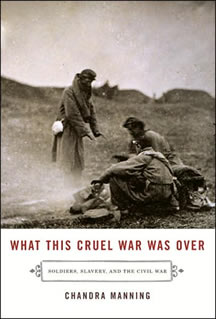
Republic of Suffering with another powerful book, Chandra Manning's
What This Cruel War Was Over: Soldiers, Slavery, and the Civil War Kevin Levin usefully
reviews it here; a useful contrast is his take on Gary Gallagher's
The Union War, posted
here); taking the two works together (Manning and Gallagher, I mean) gives one a good rundown on recent debates on how Americans of the time gave meaning to the war.
The result of the pairing of Faust and Manning -- one about the impossibility of a "good death" during the war, and the other about the larger socio-political meanings people gave to the sacrifices on both sides, was some of the most powerfully engaged student discussions I had ever seen, because the works compelled a profound consideration of the question Edward J. Blum raised in his review of Faust: was there ultimately a transcendent meaning in all this death? Was there life that emerged from the death-haunted republic of suffering? Was war a force that gave Civil-War era people meaning, and if so, how does that affect our perceptions of contemporary wars?
Eric Foner raises many of these same questions
in his review of Gary Gallagher's new book
The Union War in last Sunday's
New York Times Book Review. In some contrast to Manning and a number of other contemporary historians, who see a significant shift in soldiers' attitudes through the course of the war, Gallagher argues that emancipation "always 'took a back seat' to the paramount goal of saving the Union. Most Northerners, he says, remained indifferent to the plight of the slaves. They embraced emancipation only when they concluded it had become necessary to win the war. They fought because they regarded the United States as a unique experiment in democracy that guaranteed political liberty and economic opportunity in a world overrun by tyranny." In effect, this was a war about the nation-state, with emancipation a somewhat accidental by-product. Gallagher and Manning both rely on an extensive body of research (including in the regimental newspapers, not often used by other historians) which brings in first-hand evidence from the soldiers (and their homefront supporters). Weighing that evidence, and trying to determine what represents the views of "many" or "most" soldiers, becomes one of the central points of contention here. I'm no expert on any of this, but the discussion raised has been terrific.
Foner challenges Gallagher's view by asking, essentially, what was this cruel war over? He concludes:
Before the war, slavery powerfully affected the concept of self-government. Large numbers of Americans identified democratic citizenship as a privilege of whites alone — a position embraced by the Supreme Court in the Dred Scott decision of 1857. Which is why the transformation wrought by the Civil War was so remarkable. As George William Curtis, the editor of Harper’s Weekly, observed in 1865, the war transformed a government “for white men” into one “for mankind.” That was something worth fighting for. The "something" that was worth fighting for became the crux of the student discussions in my class (and countless other Civil War classes around the country, of course), and provided some moments of intellectual transcendence (and fierce debate). Barton et al aside, there's hope yet for the public presentation of serious history, including those which which centrally involve religious themes of meaning, purpose, violence, and the sacred.