Tampilkan postingan dengan label religion and the civil war. Tampilkan semua postingan

Senin, 30 Mei 2011

Forgetting Why We Remember: David Blight on Memorial Day in Charleston, May 1, 1865

Paul Harvey

From historian David Blight (HT John Fea), an essay on Memorial Day in Charleston, South Carolina, on May 1, 1865, an event of enormous symbolic significance at the time but forgotten afterwards in the "national reconciliation" mode of late 19th-century Memorial Days following their semi-official beginnings in 1868. Blight begins by describing how the "Lost Cause tradition thrived in Confederate Memorial Day rhetoric; the Southern dead were honored as the true 'patriots,' defenders of their homeland, sovereign rights, a natural racial order, and a 'cause' that had been overwhelmed by 'numbers and resources" but never defeated on battlefields."

But before the Civil War was over, black soldiers had established a meaning for that day consonant with their experience of fighting for freedom:

But for the earliest and most remarkable Memorial Day, we must return to where the war began. By the spring of 1865, after a long siege and prolonged bombardment, the beautiful port city of Charleston, S.C., lay in ruin and occupied by Union troops. Among the first soldiers to enter and march up Meeting Street singing liberation songs was the 21st United States Colored Infantry; their commander accepted the city’s official surrender.

Whites had largely abandoned the city, but thousands of blacks, mostly former slaves, had remained, and they conducted a series of commemorations to declare their sense of the meaning of the war.

The largest of these events, forgotten until I had some extraordinary luck in an archive at Harvard, took place on May 1, 1865. During the final year of the war, the Confederates had converted the city’s Washington Race Course and Jockey Club into an outdoor prison. Union captives were kept in horrible conditions in the interior of the track; at least 257 died of disease and were hastily buried in a mass grave behind the grandstand.

After the Confederate evacuation of Charleston black workmen went to the site, reburied the Union dead properly, and built a high fence around the cemetery. They whitewashed the fence and built an archway over an entrance on which they inscribed the words, “Martyrs of the Race Course.”

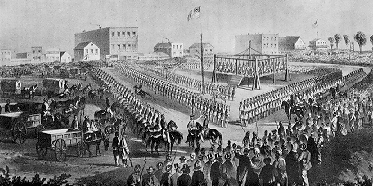
The symbolic power of this Low Country planter aristocracy’s bastion was not lost on the freedpeople, who then, in cooperation with white missionaries and teachers, staged a parade of 10,000 on the track. A New York Tribune correspondent witnessed the event, describing “a procession of friends and mourners as South Carolina and the United States never saw before.”

The procession was led by 3,000 black schoolchildren carrying armloads of roses and singing the Union marching song “John Brown’s Body.” Several hundred black women followed with baskets of flowers, wreaths and crosses. Then came black men marching in cadence, followed by contingents of Union infantrymen. Within the cemetery enclosure a black children’s choir sang “We’ll Rally Around the Flag,” the “Star-Spangled Banner” and spirituals before a series of black ministers read from the Bible.

After the dedication the crowd dispersed into the infield and did what many of us do on Memorial Day: enjoyed picnics, listened to speeches and watched soldiers drill. Among the full brigade of Union infantrymen participating were the famous 54th Massachusetts and the 34th and 104th United States Colored Troops, who performed a special double-columned march around the gravesite.

The war was over, and Memorial Day had been founded by African-Americans in a ritual of remembrance and consecration. The war, they had boldly announced, had been about the triumph of their emancipation over a slaveholders’ republic. They were themselves the true patriots.

Despite the size and some newspaper coverage of the event, its memory was suppressed by white Charlestonians in favor of their own version of the day. From 1876 on, after white Democrats took back control of South Carolina politics and the Lost Cause defined public memory and race relations, the day’s racecourse origin vanished....

Kamis, 05 Mei 2011

Glory Hallelujah: While Barton Marches On, Historians Live to Fight Another Day

Paul Harvey

By popular demand, I feel compelled to post this link to today's New York Times piece about the political influence of self-styled historian David Barton, and to this link to Barton 's appearance on the Jon Stewart show (and for a critique of it, see here). He puts on his best public face for Stewart, but sheds it when throwing out the red meat about the Terrible Oppression Visited on American Christians for his WallBuilders' radio audience and other friendly venues, as discussed here and here among many other places. Perhaps most to the point here, his relentlessly entrepreneurial streak has elevated him from fringe to center, and given him an impressive political power base as the house historian for any number of potential presidential candidates. To which I can only say: that is so not awesome!

Forthcoming soon will be my co-blogmeister Randall Stephens' book The Anointed: Evangelical Truth in a Secular Age (co-authored with Karl Giberson), in which a series of evangelical experts in "history" (Barton), "science" (Ken Ham) and other fields, who collectively constitute one of those mathematically possible alternative universes that the string theorists are always theorizing and talking about, are analyzed and set within context.

But in truth, Barton's ideological entrepreneurialism, and the pointless debates on trivialities that he has provoked (did Washington say so help me God -- who the hell cares, and who knows, maybe Jesus actually said "blessed are the cheesemakers'" as Monty Python speculated, is my answer), has just kind of worn me out, and I'd much rather call attention to real historians working on matters of scholarly/intellectual interest who also have a public voice and cache, and who engage the deepest and most transcendent issues with scholarly substance.

To that end, here's a story about historian and Harvard President Drew Gilpin Faust's Jefferson Lecture, about war and its fascinations from Homer to Bin Laden.

Ms. Faust traced what she called "the seductiveness of war" to its location on the "boundary of the human, the inhuman, and the superhuman," and the possibility it offers of transcending "the gray everyday" of life. "Stories of war are infused with the aura of the consequential," she said in her talk, "Telling War Stories: Reflections of a Civil War Historian."They're also as difficult to tell as they are compelling. She described how writers and soldiers throughout history have tried to describe the experience of war, only to find it slipping away from them. "There remains a fundamental untellability and unintelligibility about war," she said, which only makes it more powerful as a subject.

For American History readers, Faust will be best known most recently for her work This Republic of Suffering: Death and the American Civil War, discussed on our blog and reviewed here. Historian David Blight provides a fuller context for and a wonderful appreciation of Faust's scholarly career here.

Partly my attention to Faust's work came from the immediate political context of the jingoism of the Bin Laden celebrations set alongside the massive death and destruction of the last ten years -- a seemingly inevitable, if unsettling, part of how war stories unfold.

But more of it came from thinking of selecting works for next year's Civil War/Reconstruction class, as we enter the 150th anniversary. Over at Civil War Memory, Kevin Levin reflects on Faust's address, expresses his ambivalent feelings about war re-enactments, and quotes from part of Faust's address:

And yet. Two months from now, we will again witness a reenactment of the Battle of Bull Run. Tens of thousands of participants and spectators are expected, for the enthusiasm to refight the Civil War has only grown in the fifty years since the centennial observances. Most of the costumed soldiers and camp followers will have read extensively about the war; they will wear garments accurate to the last button and stitch; they will use period weapons and canteens and knapsacks, for authenticity is the watchword of the thriving reenactor culture. They will in these myriad details get history just right. But what will they understand of war? Will this reenactment do any more to acknowledge the war’s purposes and politics and their continuing significance than did the reenactments of fifty years ago? Will its celebratory mood and mode acknowledge what Frederick Douglass declared he would never forget: “the difference between those who fought for liberty and those who fought for slavery”? Will the reenactors tell only an old “battle piece” of courage and glory and how sweet and proper it is to die? Will we in this historic sesquicentennial — to be observed at a time when Americans are involved in real conflicts in three sites across the globe— forget what a heavy responsibility rests on those whoseek to tell the stories of war?

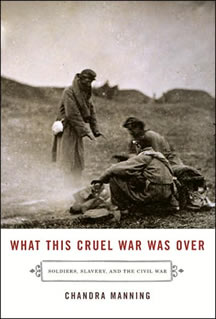
The last time I did this course, I paired Faust's Republic of Suffering with another powerful book, Chandra Manning's What This Cruel War Was Over: Soldiers, Slavery, and the Civil War Kevin Levin usefully reviews it here; a useful contrast is his take on Gary Gallagher's The Union War, posted here); taking the two works together (Manning and Gallagher, I mean) gives one a good rundown on recent debates on how Americans of the time gave meaning to the war.

The result of the pairing of Faust and Manning -- one about the impossibility of a "good death" during the war, and the other about the larger socio-political meanings people gave to the sacrifices on both sides, was some of the most powerfully engaged student discussions I had ever seen, because the works compelled a profound consideration of the question Edward J. Blum raised in his review of Faust: was there ultimately a transcendent meaning in all this death? Was there life that emerged from the death-haunted republic of suffering? Was war a force that gave Civil-War era people meaning, and if so, how does that affect our perceptions of contemporary wars?

Eric Foner raises many of these same questions in his review of Gary Gallagher's new book The Union War in last Sunday's New York Times Book Review. In some contrast to Manning and a number of other contemporary historians, who see a significant shift in soldiers' attitudes through the course of the war, Gallagher argues that emancipation "always 'took a back seat' to the paramount goal of saving the Union. Most Northerners, he says, remained indifferent to the plight of the slaves. They embraced emancipation only when they concluded it had become necessary to win the war. They fought because they regarded the United States as a unique experiment in democracy that guaranteed political liberty and economic opportunity in a world overrun by tyranny." In effect, this was a war about the nation-state, with emancipation a somewhat accidental by-product. Gallagher and Manning both rely on an extensive body of research (including in the regimental newspapers, not often used by other historians) which brings in first-hand evidence from the soldiers (and their homefront supporters). Weighing that evidence, and trying to determine what represents the views of "many" or "most" soldiers, becomes one of the central points of contention here. I'm no expert on any of this, but the discussion raised has been terrific.

Foner challenges Gallagher's view by asking, essentially, what was this cruel war over? He concludes:

Before the war, slavery powerfully affected the concept of self-government. Large numbers of Americans identified democratic citizenship as a privilege of whites alone — a position embraced by the Supreme Court in the Dred Scott decision of 1857. Which is why the transformation wrought by the Civil War was so remarkable. As George William Curtis, the editor of Harper’s Weekly, observed in 1865, the war transformed a government “for white men” into one “for mankind.” That was something worth fighting for.


The "something" that was worth fighting for became the crux of the student discussions in my class (and countless other Civil War classes around the country, of course), and provided some moments of intellectual transcendence (and fierce debate). Barton et al aside, there's hope yet for the public presentation of serious history, including those which which centrally involve religious themes of meaning, purpose, violence, and the sacred.

Rabu, 27 April 2011

Rituals of Violence, War, and Death Among the Wendat/Huron and the Dakotas: Two New Studies

Paul Harvey

War, violence, and rituals of death have been central to American history, nowhere more so than among Native Americans. Here, just wanted to alert you to a couple of new works that advance new understandings of religious rituals surrounding war, violence, and death.

First, last week Historiann called my attention to a new book which I have yet to see but looks hugely promising, especially as a classroom-usable text. I'll quote from her here:

Erik Seeman’s The Huron-Wendat Feast of the Dead: Indian-European Encounters in Early North America (Johns Hopkins University Press, 2011). From the book jacket:

“Two thousand Wendat (Huron) Indians stood on the edge of an enormous burial pit… they held in their arms the bones of roughly seven hundred deceased friends and family members. The Wendats had lovingly scraped and cleaned the bones of the corpses that had decomposed on the scaffolds. They awaited only the signal from the master of the ritual to place the bones in the pit. This was the great Feast of the Dead.”

Witnesses to these Wendat burial rituals were European colonists, French Jesuit missionaries in particular. Rather than being horrified by these unfamiliar native practices, Europeans recognized the parallels between them and their own understanding of death and human remains. Both groups believed that deceased souls traveled to the afterlife; both believed that elaborate mortuary rituals ensured the safe transit of the soul to the supernatural realm; and both believed in the power of human bones.

Appreciating each other’s funerary practices allowed the Wendats and French colonists to find common ground where there seemingly would be none. Erik R. Seeman analyzes these encounters, using the Feast of the Dead as a metaphor for broader Indian-European relations in North America. His compelling narrative gives undergraduate students of early America and the Atlantic World a revealing glimpse into this fascinating — and surprising — meeting of cultures.

Anyone who has poked around at all in The Jesuit Relations will recognize descriptions of the feasts of the dead in these documents to be some of the most immediately compelling and gripping (if, as always with the Jesuits, problematic) primary sources for 17th-century Native American religious practices. Weighing in a a svelte 176 pages, this book looks like an effort to use these kinds of sources in a way that opens them up and makes discussion of cross-cultural religious encounters in early America accessible for classroom discussion.

And here's a powerful new article of interest to many of you, by our friend and colleague Jennifer Graber, whose first book The Furnace of Affliction has received attention at our blog before.

The article, based on some outstanding research in the American Board of Commissioners for Foreign Missions papers at the Minnesota Historical Society, is "Mighty Upheaval on the Minnesota Frontier: Violence, War, and Death in Dakota and Missionary Christianity," Church History 80 (March 2011): 76-108.

The piece begins by asking "If . . . war is the norm rather than the aberration in American national life, how are we to understand the transformations experienced in 1862 by missionaries and Dakotas as part of a larger American story . . . [and how do we] understand how violence worked to reshape the participants' religious lives?" Graber considers the effects both on missionaries from the ABCFM and the Dakotas of the Dakota War in Minnesota in the late summer of 1862, a horrific outbreak of violence which resulted in the deaths of several hundred settlers and later the mass public execution of over 300 Indians, particularly focused on non-Christian Indians and "medicine men" who were thought to be the ringleaders of the revolt. Graber makes effective use of concepts of Christianity and violence drawn from Emma Anderson's Betrayal of Faith, Jill Lepore's The Name of War, and Harry Stout's "Religion, War, and the Meaning of America" (from Religion and American Culture, Summer 2009, 275-89).

In one section, Graber considers the religious responses of Dakotas to this signal event in their history, including the "conversion" of many of those awaiting execution. She provides a complex portrayal difficult to summarize here but well worth the read. Alongside this, Graber considers also the effect that the trauma of war had on the missionaries, and concludes that "these men underwent their own transformation. Their encounter with violence and devastation, punishment and incarceration caused them to mitigate and complicate the revivalist Calvinism they brought to the frontier. Their vision of missions made up of churches and schools became something else altogether, one of reservations and prisons that God used to make Indian converts."

Despite its short length, this sobering piece had me reflecting in ways which inspired some previous blogging about Emma Anderson's Betrayal of Faith. Highly recommended reading, especially after our last continuous decade of religion, violence, war, and death.

Kamis, 10 Februari 2011

More on Rable, God's Almost Chosen Peoples

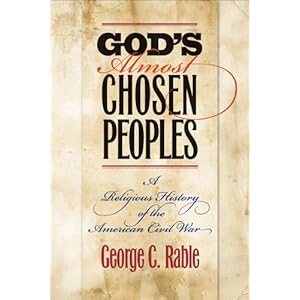
The outstanding Civil War Book Review, which has been a bellwether of scholarship on the topic for more than a decade, just posted their new issue for Winter 2011. Readers of this blog will be especially interested to read (or listen to) an interview conducted by editor Nathan Buman with George Rable about his new book, God's Almost Chosen Peoples: A Religious History of the American Civil War.

Following Paul and Ed, who have already given the book some attention here on the blog—and in good RiAH self-promotional style—I'll also draw reader's attention to my own review of Rable's book, just published in Civil War Book Review.

Here is an excerpt:


One of Rable’s major themes concerns the overwhelming significance of civil-religious providential understandings of the course of conflict. For his subjects the hand God was seemingly everywhere, guiding and shaping events in accordance with his will. All too frequently, that providential outlook was conflated—in ways consistent with patterns throughout American religious history to that time—with southern and northern nationalist aspirations. Perhaps this idea was stated most clearly in language approved by one northern Methodist conference in 1862: “Patriotism is a Christian virtue” (153).

Because of deep commitments to providentialism in the Civil War era, “religious faith could be both wind and weathervane,” where success or failure in battles showed adherents the ways in which they had met or fallen short of divine expectations, thus incurring God’s favor or wrath (7). Throughout the war, Union and Confederate officials, as well as local leaders and ministers, called routinely for days of fasting and thanksgiving in an attempt to make sure the public properly aligned itself with God’s will. Furthermore, despite innumerable difficulties, Rable contends that belief in providence maintained a remarkable resiliency. Not only did the religious “line between ‘loyalty’ and ‘disloyalty’” grow “ever-sharper” as the war dragged on, but after Appomattox, believers in the Union continued to understand their cause sanctioned by God (354). In the same way, defeated Confederates did not give up the belief in the righteousness of the cause lost.

Given the impressive amount of research displayed, the single most curious thing about God’s Almost Chosen Peoples is its self-professed lack of an overarching argument—in Rable’s words, it “is not a thesis-driven work” (6). Instead, he opts for a “broad narrative” that shows the centrality of religious belief for nineteenth-century Americans who needed to make sense out of the warring world they found themselves in (6). Rable’s choice will no doubt leave some readers grasping to impose coherence on an unwieldy and intimidating subject. However, because religious values were by no means uniform or monolithic in the Civil War era, and because Rable intends to cover the sweep of religious engagement with the myriad dilemmas that the sectional conflict raised, his broad narrative approach leads to a remarkable inclusivity with regard to topics and subjects.

Rabu, 02 Februari 2011

Civil War and Emancipation Blogs: First African Baptist and Benjamin Morgan Palmer


Paul Harvey

A note on a new blog of interest to many of you: Civil War Emancipation, established by Donald Shaffer, author of After the Glory: The Struggles of Black Civil War Veterans and other publications. He writes the following of the blog:

The purpose of this blog is: 1) to commemorate important milestones in emancipation in the Civil War as their 150th anniversary arrives in the Sesquicentennial; 2) to discuss noteworthy publications on this subject; 3) to comment on current events related to the Civil War and Emancipation; 4) plus write on whatever else comes to mind that is appropriate. I intend to blog regularly on emancipation throughout the Civil War Sesquicentennial.

A recent post at the new blog discusses and points to the full text to Benjamin Morgan Palmer's famous Thanksgiving Day sermon in Nov. of 1860 in New Orleans, a key text in summarizing the "providential trust" given to southerners to "conserve and to perpetuate the institution of domestic slavery."

The new blog also accompanies the ongoing series going on at the New York Times, Disunion, which is following, in day-by-day format, the sesquicentennial of the secession winter. One entry from Jan. 24th, by Lois Leveen, features an outstanding discussion of the unusual place of the First African Baptist Church of Richmond, the largest black congregation in antebellum America.. The church took shape in the early 1840s and was pastored by a white man appointed to oversee the congregation, Robert Ryland, who (among other things) encouraged slave literacy. The church often rented out its sizable auditorium for citywide political events and entertainments (including minstrel shows). On Jan. 23, 1861, the church opened its doors for white workingmen of Richmond (including a sizable proportion of foreign-born men) to discuss "the alarming state of our beloved country." The meeting adjourned without resolving the sentiments of white locals, who were largely Unionist but starting a slow and agonizing move towards secession.

Normally I teach a course each spring in Civil War/Reconstruction. By happenstance I'm not doing so now, but wish I was so I could take advantage of these exciting new resources, which allow an "in the moment" feeling for the dramatic events of the period. For religious historians, the resources are rich, as well, as evidenced by the extensive discussion linked above to the role of First African Baptist in Richmond.

Congratulations to Prof. Shaffer for his new blog; I look forward to following it.

Jumat, 07 Januari 2011

Baptists and the Civil War

Paul Harvey

While we're on the subject of the religious history of the Civil War, here's a new resource of interest. I received an email today from Bruce Gourley, Executive Director of the Baptist History and Heritage Society, on a new site he has constructed on Baptists and the Civil War, featuring an abundance of essays, documents, daily journal entries, and other resources on that subject. He writes:

"Baptists and the American Civil War: In Their Own Words" is a day-by-day journal of the Baptist experience, North and South, during the Civil War. Each day a new journal entry is published, corresponding with that date 150 years earlier.

This digital project began as an outgrowth of research done for my dissertation-turned-upcoming book, Diverging Loyalties: Baptists in Middle Georgia During the Civil War (due in the fall from Mercer University Press).

A quick survey of this website shows it to be a terrific resource for scholars working on all sorts of subjects, as well as those interested in Baptist history of the religious history of the Civil War, in particular. The daily journal features short bits of information and analysis on the events of that day 150 years ago -- this entry from Jan. 2, 1861, for examples, describes the process of voting for secession in Georgia.

Congratulations to Bruce Gourley on making his research and interests available in this wonderfully accessible way, and in incorporating the best scholarship in doing so.

Kamis, 06 Januari 2011

Something More: Secondhand Reflections on George Rable's Religious History of the Civil War

Congratulations to our contributor Ed Blum for the birth of his son Elijah James Blum! What do the birth of his son, some pop music from Secondhand Serenade, and George Rable's religious history of the Civil War have to do with each other? Nothing, you're thinking? Au contraire; read on.

Secondhand Reflections on George Rable’s Religious History of the Civil War
by Edward J. Blum

There’s one and only one book I’m reading closely these days: What to Expect: The First Year. With Elijah James Blum joining our crazy world on December 12, it has been indispensable. Through this bible of all things baby, I’m learning how to feel, how to act, and how to speak a whole new vocabulary: bilirubin; snurgles; meconium are but a few of the words in my new lexicon. For me, fatherhood is a reactive art. My days and nights are mostly encompassed by Elijah acting, Jen responding, and me trying to keep up with the whirlwind.

In addition to an album that transformed the music of the Beatles into soothing lullabies, one other album and one history book have become my regular companions. Between feedings, changings, and tummy time, I’ve found a few minutes to soak in Secondhand Serenade’s Something More and George Rable’s God’s Almost Chosen People: A Religious History of the American Civil War. The two may seem worlds apart, but they’ve come together in my rocking-chair imagination, and I think for good reason.

Secondhand Serenade is named for the nature of their music. Songs first written, sung, and experienced in private are transformed into ballads purchased on i-tunes, thrust too quickly into commercials, and discarded in a matter of weeks. We encounter the music secondhand, distanced from original intent and expression. By far, their best song is “Something More” (also the name of the album). It’s a power ballad to rival the finest of Celine Dion’s, and we only need a “king of the world” cinematic scene for it to become part of our national consciousness. Like most power ballads, “Something More” is about love and pain, desire and disgust. The singer is confused, angry, lost, and ashamed: “I lie awake again, my bodies feeling paralyzed / I can’t remember when / I didn’t live through this disguise.” The singer is “paying for his sins” and thinks that no words can “set him free.” He’s at war with another and within himself. He repeatedly admits and asks: “I’m stuck here in this life I didn’t ask for, / There must be something more, / Do we know what we’re fighting for?” The only answer – the only way to live amid his frustration – is to breathe and to believe: “breathe in, breathe out, / breathe in, breathe out. … There must be something more.”

George Rable’s characters from the 1860s had such similar feelings and asked such similar questions. What were Americans fighting for in the Civil War, and why did they continue to fight for so long? What sins were they paying for? And what was the “something more” that they all seemed to believe in, but couldn’t quite nail down? Like Abraham Lincoln in his Second Inaugural Address, the belief in a shared “something more” failed to stop the fighting, and they couldn’t understand why.

By reading thousands of primary and secondary sources, Rable (far and away one of America’s greatest Civil War scholars living or dead) offers the biggest, most comprehensive religious history of the Civil War ever produced. He tackles the North and the South, men and women, Protestants, Catholics, Mormons, and Jews. He travels with chaplains, tents with privates, and eavesdrops on presidents. More descriptive than argumentative, God’s Almost Chosen People considers so many sources that it is almost impossible to provide one or two central arguments. Yet Rable does. He finds that throughout the war, all sorts of Americans turned to providence to explain what was happening around them. The “something more” they knew they were fighting for was only explainable by looking to the heavens and believing that somehow, someway, God truly had the whole world (or at least the United States or Confederate States) in his hands.

The brilliance of Rable’s book – and what differentiates it in many ways from Harry S. Stout’s Bellah-inspired Upon the Altar of the Nation – is its secondhand nature. Although Rable claims in his introduction that religion could be both “wind and weathervane,” he more often than not renders it as weathervane. Battles happen; women and men die; political documents are signed; legal decisions are rendered; slavery is abolished; and then Americans reflect on the events religiously. They seek God’s providence in response to other events, constantly playing catch up just as I play catch up to Elijah’s needs at home. With this approach, Rable is able to show how widely and diversely religion suffused American society in the 1860s. Whatever the problem, whatever the event, whatever the circumstance, Americans turned to God and God’s providence for answers. By rendering religion secondhand, Rable has shown in epic proportion the omnipresence of the supposedly omnipotent.

And for Rable, the secondhand quality of religion emanates from his approach to religion itself – that it can only be studied secondhand. In this way, Rable wonderfully acknowledges the limits of his study. He (and we) cannot know the firsthand experiences of the women who lost loved ones, the privates who accepted new testaments after losing a hand of cards, or the presidents and generals who anguished (or relished) every death. When he analyzes a diary, a fast sermon, or a newspaper story (all of which Rable read in abundance), he recognizes that he interprets from afar. In this way, Rable demonstrates an incredible respect for his subjects and the gravity of the events.

Yet there are other seconds to consider. When W. E. B. Du Bois turned to seconds, he conjured the idea of “second sight.” He claimed that African Americans could see themselves and their surroundings with a sacred vision that whites could not. And Du Bois thought that the religious expressions of those with second sight could reveal the deepest elements of the soul – the “spiritual strivings” of individuals and communities. When Du Bois turned to the slave spirituals, he found not secondhand expressions, but expressions that revealed the most intimate parts of longing, feeling, and expression. This type of religious history of the war – one that approaches religious creation as a prime mover in historical change – could compel other approaches to the war.

That was not Rable’s project, though, and he shouldn’t be criticized for the book he wrote. God’s Almost Chosen Peoples is outstanding. Scholars of American religious history and the Civil War will have to engage it. And I’m glad that it’s so voluminous that I couldn’t lose it amid the diapers and the onesies.

Senin, 27 Desember 2010

Citizens of a Christian Nation, Redux

Paul Harvey

Several months ago Ed Blum posted his thoughts on Derek Chang's Citizens of a Christian Nation: Evangelical Missions and the Problem of Race in the Nineteenth Century (and some other books dealing with religion and war) here. My review of Chang's fine book has just come out in the Journal of American History, and I'm posting it in below.
________________________________________

White northern Baptists in post-Civil War America perceived themselves as “emissaries of the Christian nation.” They carried the gospel of Christ and of American civilization to the freedpeople of the South and to Chinese immigrants in the West. They sought to create a “conduit for the inclusion of alien populations into the brotherhood of Christianity and the nation.” For them, this was part of the new birth of freedom. In doing so, however, they also produced “discourse of difference that made that inclusion yet more difficult.” In seeking to “uplift” African Americans and Chinese, they perpetuated “racial difference through culture and religion” (68-69). The heathen black and the heathen Chinese could be transformed, but they also had to be transformed. In return, the African American and Chinese immigrant subjects turned the language and institutions of uplift and nationalism to their own benefit. Especially by working to establish independent institutions and find leadership roles within them, “their example undermined a significant part of the ideological foundation on which white evangelical uplift was based” (125).

So Derek Chang argues in this engaging study of the work of the American Baptist Home Mission Society in North Carolina (mostly in Raleigh, focused on the building of what became Shaw University) and in Portland among the Chinese community there. Chang gives the evangelicals their due. In the face of Klan violence in the South and anti-Chinese hooliganism in the Northwest, American Baptists worked to develop institutions that would incorporate the freedpeople and the Chinese into a Christian brotherhood.

Ultimately, neither the well-intentioned evangelicals nor their freedom-seeking African American and Chinese subjects fulfilled their dreams and goals as they wished, for “acts of racial terror limited the radical hopes of the home mission project and frustrated the attempts of evangelicals, blacks, and Chinese to fashion an inclusive nation through such interracial enterprises” (157). In the end, while the white Baptists took refuge in a “strain of evangelical nationalism that emphasized orderly hierarchy and stability over redemptive quality and democracy,” African Americans and Chinese “continued to fight for the transformation they desired, using mission resources to “position themselves in the larger battle over their place in the civic order” (158).

Focusing on freedpeople in and around Raleigh, North Carolina and Chinese immigrants in Portland Oregon, Chang’s comparative research and theoretical reflections shed fresh light on the subject of post-war religious reconstruction. Specialists will enjoy the endnotes, where Chang dialogues at length with fellow scholars. More general readers likely will be surprised by the efforts of white elites in Portland to restrain anti-Chinese violence. Despite being “permanent aliens,” for a time the Chinese in the Northwest enjoyed a degree of social inclusion never experienced by African Americans, who theoretically were included in the nation through the postwar constitutional amendments. In the end, both groups suffered at the hands of the virulent racial terrorism of the last two decades of the nineteenth century. Their American century would have to wait.

Rabu, 24 November 2010

Commie Pinko Pilgrims and Peaceful (?) Puritans

Paul Harvey

A little Thanksgiving history blogging for you. I hadn't quite realized how much of a cottage industry peddling the anachronistic "Socialist Pilgrims" thesis had become, but this piece from the New York Times explores the spread of this myth. I was shocked -- SHOCKED -- to learn how much of a role Glenn Beck and his historical henchman W. Cleon Skousen have played in marketing this story, My favorite part: the time when Rush Limbaugh added in the bit about how they grew organic vegetables, after they had learned that capitalism worked and produced an abundance which they could share with the Indians.

In "Peace, Love, and Puritanism," David Hall, of Harvard Divinity School, defends the Puritans against generations of Hawthornian and Menckenian scorn (and adds that, yes, wild turkeys probably appeared on the original menu). He writes:

Why does it matter whether we get the Puritans right or not? The simple answer is that it matters because our civil society depends, as theirs did, on linking an ethics of the common good with the uses of power. In our society, liberty has become deeply problematic: more a matter of entitlement than of obligation to the whole. Everywhere, we see power abused, the common good scanted. Getting the Puritans right won’t change what we eat on Thanksgiving, but it might change what we can be thankful for and how we imagine a better America.

Historiann has no problem with Hall's conclusion, but points out some of the darker underside to the history of feasting and fasting in America -- in particular, its long connection to war and tribalism:

Both fasts and feasts were opportunities to reaffirm tribalism, of a world view of us versus them. The history of fasting and feasting in the English communities of New England in the seventeenth and eighteenth centuries should be written in blood–both blood in the sense of kinship ties, and in the sense of the shedding of outsiders’ blood in war.

The history of fasting and feasting is "more complicated and much darker than Americans would like to remember," she reminds us. Reading the many pages on this subject in George C. Rable's God's Almost Chosen Peoples: A Religious History of the American Civil War, reinforces this point. About every five pages, it seems, someone from North or South is calling for a fast day, or preaching a fast day sermon. There was a lot of ostensible bowing, scraping, and humility, but ultimately it was all about killing. With all these fast days during the war, it's a wonder anyone ever ate.

John Fea reflects on what he would teach about the original Thanksgiving here, at his new column over at Patheos, and what it meant for the Pilgrims and the Wampanoag, who both had been through some brutal times, to share a brief celebration together. I hope your celebration goes well.

Jumat, 05 November 2010

God's Almost Chosen Peoples

Paul Harvey

Some of you blog readers are probably hanging at the Southern Historical Association meeting today and through the weekend in Charlotte; sorry I'm not there with you, afraid that the AAR maxed out my personal travel/alcohol budget. In the meantime, though, hope you'll drop by the University of North Carolina Press booth and check out George Rable's very promising looking new book, God's Almost Chosen Peoples: A Religious History of the American Civil War. Skip Stout and others have given the lengthy work a hearty endorsement on the book jacket, and I hope to get to it over Christmas break when 600 pp. books seem a little less daunting. Information on the book below, from the UNC Press website.

God's Almost Chosen Peoples

A Religious History of the American Civil War

By George C. Rable


Throughout the Civil War, soldiers and civilians on both sides of the conflict saw the hand of God in the terrible events of the day, but the standard narratives of the period pay scant attention to religion. Now, in God's Almost Chosen Peoples, Lincoln Prize-winning historian George C. Rable offers a groundbreaking account of how Americans of all political and religious persuasions used faith to interpret the course of the war.

Examining a wide range of published and unpublished documents--including sermons, official statements from various churches, denominational papers and periodicals, and letters, diaries, and newspaper articles--Rable illuminates the broad role of religion during the Civil War, giving attention to often-neglected groups such as Mormons, Catholics, blacks, and people from the Trans-Mississippi region. The book underscores religion's presence in the everyday lives of Americans north and south struggling to understand the meaning of the conflict, from the tragedy of individual death to victory and defeat in battle and even the ultimate outcome of the war. Rable shows that themes of providence, sin, and judgment pervaded both public and private writings about the conflict. Perhaps most important, this volume--the only comprehensive religious history of the war--highlights the resilience of religious faith in the face of political and military storms the likes of which Americans had never before endured.

Related Posts Plugin for WordPress, Blogger...