Tampilkan postingan dengan label religion and scholarship. Tampilkan semua postingan

Selasa, 03 Januari 2012

Who Has a Religion? Baker and Wenger on Definitions of Religion in the 1920s


by Edward J. Blum

“Get anything good for Christmas?” a friend nonchalantlyasked several days after J.C.’s birthday. My enthusiastic response, “Oh yeah, abook on the Klan; was actually reading it Sunday morning listening to acousticsunrise,” was met with irritation in the form of disinterest. The friend didn’treally care what I had received, and he didn’t really want to entertain aconversation about the Klan. He shot back, “weird.” I, of course, was blind tohis hopes for distance and pressed in. “It’s really neat, the author takesseriously the religious ideas of the Klan – from their white robes to theirsense of American history and exceptionalism.” Sadly, the conversation went theway most of mine go with non-academics. The harder I tried for him to see how fascinatingthis was, he just didn’t care, and once again retorted, “yeah, just soundsweird.” At this point, I got it and turned the conversation to a religiousinterest everyone seemed to share: Tim Tebow and the magical run of the DenverBroncos.
Book cover image 
I’ve had enough conversations with non-academics who seem togo into snooze mode when I invade their worlds with the past, but I still feltsad that my pal would rather talk about a mediocre quarterback for a mediocreteam than about heritages of hate and what they mean for our nation. But evenmore, I was bummed that my friend did not want to understand that what we thinkabout “religion” influences even stories like that of young man Tebow.

Of course, the book I was trying to tell my friend about wasKelly Baker’s Gospel According to theKlan: The KKK’s Appeal to Protestant America, 1915-1930. I don’t want torehearse its main arguments here – how GospelAccording to the Klan looks not just at what the Klan was against, but alsoat what they were for, how it showcases the ways in which their whiteProtestant nationalism pervaded their sense of manliness, femininity, andhistory, or how the Klan’s print culture was so crucial to their sense ofidentity and imagination. Those are all excellently fleshed out in the book andshown so nicely through the Klan’s public writings.

CoverWhat I would like to draw our attention to is how ProfessorBaker’s study and a slightly older book, Tisa Wenger’s fantastic We Have a Religion: The 1920s Pueblo Indian Dance Controversy and American Religious Freedom (2009), provide anotherlayer of religious division and redefinition during the 1920s. Wenger showsthat the 1920s conflicts over Pueblo dances became moments when notions of“religion” collided. For the United States government, religion was somethingdistinct and somewhat separable from other spheres of life, but many Pueblo hadno sense of that division. As white modernists who were sympathetic to thePueblo rallied to their side, they helped create the idea that the Indian danceswere “religious” and hence should be protected against federal legislation bythe First Amendment. Yet by forcing American governmental approaches toreligion upon the issue and by defining one aspect of Pueblo behavior asreligious, they helped sever the totality of Pueblo life into supposedlydiscreet parts (religion, land, politics, society, etc.) Thereafter, Nativeclaims to land, remains, or treaty recognitions have been battled on the legaland religious terrain established by the American government.

We all know the 1920s as a time of religious dissension anddebate. Modernists and Fundamentalists raged against one another; Bryan andDarrow battled at the “trial of the century” in a small Tennessee town; SisterAimee Semple McPherson polarized the West with flappers and Pentecostals on oneside and liberals and the mainline on the other. Together, Baker and Wenger addanother layer – the layer of religion itself. In both cases, the verydefinition of “religion” was up for grabs. In Baker’s case, contemporaries ofthe Klan tried to demolish them as non-Christian or as makers of a false faith.The Klan tried hard to create a viable religious worldview, and for an“Invisible Empire,” they sure made it visible in their print culture and publicperformances. For Wenger’s folks, Native American life had to be atomized sothat certain elements could be construed as religious. By obtaining a“religion,” the Pueblo had to give up some of their definitional control.

So to my friend who would rather talk Tebow than Klan robes,I understand. It is less mentally strenuous to debate the case of Tim Tebow –whether accuracy is as important as admiration, whether completion percentagesmatter more than charismatic personhood, or whether we should privilegecomebacks over Christian being. But if we want to get to the core of Tebow orany other fascination rendered “religious” in America, we can get a little helpfrom our friends Kelly Baker and Tisa Wenger. See you all in Chicago.

Jumat, 23 Desember 2011

Revival of Religion and American Culture Book Series from University of Alabama Press

Paul Harvey

Over the last few months, my friends Charles Israel (Auburn University) and John Giggie (University of Alabama) have been making plans to revive the Religion and American Culture series of books published by the University of Alabama Press -- in years past luminaries such as Wayne Flynt, Ed Harrell, and Edith Blumhofer edited this series. You senior scholars and graduate mentors out there, please keep them in mind to send promising dissertations-soon-to-be-book-manuscripts their way.

I received the following email from John recently, and got his permission to repost it here, as an advertisement for this series and as a call for those of you, junior and senior scholars alike, with book manuscripts that you're shopping around to contact the editors, who are aggressively recruiting authors for the series. Here's a bit more information; use the links above to contact Charles and/or John if you have a manuscript or a book project idea for them that you want to discuss:

I wanted to thank you again for agreeing to serve on the editorial advisory board for the new incarnation of the "Religion and American Culture" book series that is sponsored by the University of Alabama Press.
As you may remember, I am co-editing the series with Charles Israel and we are in the process of aggressively recruiting new work for publication in the series. We are preparing to formally announce the series launch in late 2012 and want to be able to make a splash with some very strong first titles. We're asking now for your guidance and help. If you know of any scholars who are working on promising projects that you believe we should consider, or of scholars both junior and senior who are looking for a home for their work, please be so good as to let us know. We're happy to follow up with them by email, phone, or otherwise to extend an open invitation to submit their work for publication consideration.

I want to emphasize that we have every assurance from the editor-in-chief at the University of Alabama Press, who sponsors the series, that we can offer contractual terms that are every bit as competitive as any other press in the country, both for first-time authors submitting revised dissertations and for senior scholars, accordingly. We're also in the favorable position of being able to offer advance publication contracts
when appropriate or necessary.

Senin, 12 Desember 2011

The Mainline Protestant Moment? Or Embattled Ecumenicists?

Paul Harvey

In the previous post about recent scholarship on Mormonism, Elesha wondered, in a facetiously self-interested sort of way, "what it would take to generate a mainline moment in scholarship" (earlier twentieth-century Protestantism being the topic she's working on). A cynic might flippantly say, "well, they had their 'moment,' and it lasted many decades," and I might say that we had a classic product of mainstream Protestantism (the UCC) run for President, and win, in 2008, and it produced not a "moment" but instead hysterical cries about the radical agenda. Can't wait for Round II of that next year.

But Curtis Evans answered more seriously and helpfully in the comments section, by by pointing to some significant moves in that direction, including David Hollinger's OAH Presidential Address, discussed with wonderful insight by David Stowe on our blog here.

And even more seriously, I'm starting to think the moment may be here, albeit focused more on the middle of the century, from the Depression through the Vietnam War, than the earlier part of the century which excellent younger scholars such as Elesha, Curtis, and Matt Hedstrom are investigating.

I was thinking this over as I recently read through Jill Gill's mammoth work of scholarship Embattled Ecumenicism: The National Council of Churches, the Vietnam War, and the Trials of the Protestant Left. Students: if you want to know how to mine the archives effectively, check out the footnotes to this doorstopper.

This is a work that deserves to be called “definitive.” Gill’s comprehensive study of the National Council of Churches and the Vietnam War covers the subject exhaustively. But more than that, the book is a re-examination and, in part, a rehabilitation of mainstream Protestantism in the middle years of the twentieth century. Historians recently have focused attention on close studies of the origins, rise, and politicization of the religious right. Gill’s work counters that trend with a sympathetic, although certainly not uncritical, examination of Protestants who were at once part of “the establishment” but increasingly distanced themselves from it because of the bitter disillusionment of the Vietnam War. Gill also explores the meanings and purposes of “ecumenism,” an ancient Christian ideal that the author finds worthy of a deep reconsideration. The irony is that ecumenism splintered in the face of a conflict where religious leaders managed to unite many mainstream Protestants against the war while serving as “generals without armies” (in the cynical but fairly accurate words of Dean Rusk) and being manipulated first by LBJ and then Nixon. The Vietnam War fractured the Protestant center-left, and helped pave the way for the rise of a resurgent religious right.

In some ways, Gill's book helps explain how we get from John Foster Dulles (a paragon of the mainline Protestant establishment in the 1950s), to the embattled ecumenicists of the 1960s -- in but no longer of the establishment -- to the prophetic but increasingly ignored or irrelevant voices of the 1970s, and the "radical preachers" which Obama-haters promise to resurrect from the dead in 2012, there to play a walk-on part in their war.

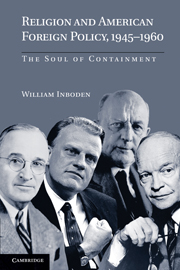
Reinforcing my view of a new generation of rising scholarship on the "mainstream," this evening I flipped through a recent edition of Reviews in American History, containing a really thoughtful exploration of William Inboden's Religion and American Foreign Policy, 1945-1960: The Soul of Containment. Inboden's work is also reviewed nicely, closer to the time of its publication, here.

Pretty much unbeknownst to me, apparently the pages of the journal Diplomatic History and other scholarly venues have been full of debates about the causal links (if any) between "cultural" factors such as religion and foreign policy decision-making. The reviewer asks, "How does one demonstrate conclusively that cultural phenomena do more than merely condition, or provide context for, the actions of foreign policy-makers?" He cites some skeptics of the "cultural turn" in foreign policy studies, asking skeptical questions to that effect. He then suggests that "more adeptly than any other product of the 'cultural turn' in foreign relations history, Inboden's book demonstrates this causative link between religion and diplomacy." The father of containment, George Kennan, wasn't much for any of this, but once it took hold his idea quickly moved far beyond the intentions of its creator, much to his dismay and exasperation.

These are all works about the "mainstream" from the inception of the high period of the Cold War through the trials of the 1960s -- a period when mainstream Protestants (with considerable sprinkling of folks from other parts of "tri-faith America," of course) were, to a sizable degree, the people who ran everything. I might add that I've just skimmed through another recent work, The Spiritual-Industrial Complex: America's Religious Battle Against Communism in the Early Cold War, recently out with Oxford, in which the mainliners are the central actors. We'll have more extensive coverage of this book on the blog a bit down the road; in the meantime, click the link for interesting coverage and analysis of the book. The review linked above begins:

IN A LETTER to the Vatican in 1947, Harry Truman characterized the United States as a “Christian nation.” For Truman this was likely a statement of fact, an obvious description of what America was and would long remain. For Jonathan Herzog, Truman’s phrase explicates an entire epoch in American politics. The title of his book, The Spiritual-Industrial Complex, inverts Dwight Eisenhower’s warning about a military-industrial complex, suggesting instead a fusion of governmental power and religious zeal.

Darren Dochuk's piece for Perspectives, "Searching Out the Sacred in U.S. Political History," summarizes much of what I'm saying here. After a discussion of the plethora of scholarship on evangelicals and fundamentalists, he goes on to add that

But religion was not just for the downtrodden or embattled; at mid-century it still dictated the dreams of the political elite too. Perhaps no other subset of political history has undergone a more profound shift lately than diplomatic history. Rendered too conventional by some in the 2000s, diplomatic history has emerged in the 2010s as a dynamic field revitalized by new interests in gender, NGOs, globalization, "soft power"…and religion. One exemplary byproduct of this renaissance is William Inboden's Religion and American Foreign Power, 1945–1960, which argues that Protestant notions of liberty and freedom informed U.S. officials' efforts to construct a "godly" front against "atheistic Communism." Once Dwight Eisenhower molded them into a more inclusive, civil religion of American exceptionalism, these notions also came to inspire Jews and Catholics around the world in a broad offensive against the Red Menace. Such was the spiritual essence of U.S. containment strategies, and as Inboden, Andrew Preston, Jason Stevens, Mark T. Edwards, and others emphasize, America's most powerful emissaries never took this essence lightly.

In their minds, America's fight against foreign evils was God's fight against foreign evils, rendering any clean distinction between faith and international relations artificial. If public theology was a wedge for American hegemony abroad, it could also be a subversive influence at home, something historians now stress when talking about the civil-rights era. As Joseph Kosek has shown in Acts of Conscience, even while many public intellectuals championed American imperialism, some spoke out against the prevailing orthodoxy. Reconciliation and brotherhood rather than conquest grounded their creed, fusing their interests with a broader crusade for human rights. These same principles enlivened the "prophetic" strand of Protestantism that bound the southern civil rights movement together. Rooted in an Old Testament tradition that roused black and white activists alike, this prophetic theology, David Chappell shows in A Stone of Hope, sacralized self-sacrifice for social justice and paved the way for nonviolent revolt throughout the South. Chappell's conclusions are now being enriched by studies of civil rights activism in the West. Scott Kurashige, Shana Bernstein, and Mark Brilliant have all shown that multiethnic religious agencies in 1940s California helped trigger the assault on American apartheid.Inspired by this state's rich but contested religious pluralism, they helped marshal local resources and resolve for a nationwide war against Jim Crow and all its intolerances, one they would win in the 1960s.

So what say you, Elesha and others -- is there another mainline moment being born? Perhaps the center could not hold, but its few decades of remarkable power and then fragmentation mark mid-twentieth century American history in ways historians are still fruitfully investigating.

The Mormon Moment in Scholarship

Paul Harvey

Everyone is discussing the "Mormon moment" thanks to Romney and national politics, and Max Mueller's piece for Religion Dispatches discusses why non-expert pontificators feel free to pontificate on Mormonism's "weirdness" where they would do no such thing about other religious traditions. Don't miss his article.

But it may actually be more the Mormon moment in the scholarly world than anywhere else. Our own John Turner's biography of Brigham Young will be out in a little over a year or so (and scroll down for John's recent post on Joseph Smith's Journals), with Harvard University Press, and the big biography of Parley Pratt by Terryl Givens and Matthew Grow will be reviewed here at the blog in just a little while. And don't forget Patrick Mason's The Mormon Menace, reviewed here at the blog a while back. The world awaits J. Spencer Fluhman's forthcoming study of nineteenth-century anti-Mormon rhetoric, coming out next fall with the University of North Carolina Press; the parts I've seen represent scholarship at its best.

The efflorescence of scholarship in the field is pretty astonishing, keeping up with it impossible. For a little assistance in the latter, I recommend Ben Park's "2011 in Retrospect: A Look at Important Books and Articles in Mormon History," over at Juvenile Instructor. Here are Ben's personal award winners for the year, but go over to his post for a much fuller and more extensive discussion of the variety of recent scholarship in the field.

My picks for a handful of MHA’s awards are as follows. (Drumroll please…)

  • Best Book: Sam Brown, In Heaven as it Is on Earth
  • Best Biography: Terryl Givens and Matthew Grow, Parley P. Pratt
  • Best First Book: Patrick Mason, The Mormon Menace
  • Best Article: Stapley and Wright, “Female Ritual Healing in Mormonism” (Stapley also gets recognition for “Adoption Sealing Ritual,” which is equally deserving of the award)
  • Awards of Excellence (2 Articles): Patrick Mason, “God and the People”; Chris Jones, “The Power and Form of Godliness”
  • Silver Award for Women’s History: Catherine Brekus, “Mormon Women and the Problem of Historical Agency”

Kamis, 01 Desember 2011

Barbara Savage Wins Grawemeyer Award

Paul Harvey

Congratulations to Barbara Savage, whose recent work Your Spirits Walk Beside Us: The Politics of Black Religion has received the 2012 Grawemeyer Award in Religion. Here is the announcement:

Book with insights on black politics, religion wins Grawemeyer Award

A book filled with fresh insights on the relationship between black politics and religion has earned its author the 2012 Louisville Grawemeyer Award in Religion.

Barbara D. Savage, a professor of history and American social thought at the University of Pennsylvania, is receiving the prize for the ideas set forth in her book, “Your Spirits Walk Beside Us: The Politics of Black Religion,” published in 2008 by Harvard University Press.


“Besides explaining why it is misleading to speak of ‘the black church’ given the enormous diversity among African American congregations, Savage challenges the popular belief that black churches have been prophetic and politically active throughout history,” Garrett said.The book introduces important new perspectives on the study of black religion and the political role of African American churches, said award director Susan Garrett.

Savage also shows how black women excluded from religious leadership and the formal study of black religion became leaders outside their churches, including Nannie Helen Burroughs, who founded one of the nation’s first vocational schools for women.

A Penn faculty member since 1995, Savage teaches courses on American religious and social reform, 20th Century African American history and the relationship between media and politics. She has held administrative posts at Penn’s Center for Africana Studies and previously worked as a staff member in the U.S. Congress.

The University of Louisville presents four Grawemeyer Awards each year for outstanding works in music composition, world order, psychology and education. The university and Louisville Presbyterian Theological Seminary jointly give a fifth award in religion. This year’s awards are $100,000 each.

Rabu, 23 November 2011

U.S. Intellectual History in the New York Times

Paul Harvey

Congratulations to our friends over at U. S. Intellectual History, whose recent 4th Annual Intellectual History conference, which I very much regretted to have to miss due to my previous commitment to the AAR meeting, got some nice coverage at the New York Times. The conference lineup is very impressive (click the link above for it). A brief excerpt from the piece; much of what is described below could be applied to the field of American religious history as well.

Today, however, a new breed of young intellectual historian is aiming to integrate the spirit of “history from below” with an approach that doesn’t chop American history off at the neck. Young intellectual historians, scholars at the conference were quick to emphasize, have fully absorbed the lessons of the profession’s increased attention to questions of race, class and gender, without losing hold of the premise that ideas matter, even in a culture that still considers “intellectual” a term of abuse.

“We still want to talk about ideas, but we see ideas everywhere,” said Andrew Hartman, a professor at Illinois State University and president of the newly formed Society for U.S. Intellectual History, which sponsored the conference. “Big ideas affect everybody. It’s not elitist to talk about them.”

The conference hardly neglected high culture, with papers on the artists Robert Rauschenberg and Barnett Newman, the philosopher Stanley Cavell, and the history of the reception of “Moby-Dick.” . . .

But the lineup tilted markedly toward postwar political history, with discussions of charged topics like the economist Friedrich von Hayek’s writings on the rule of law, Daniel Patrick Moynihan’s infamous 1965 report on the black family, and the art-historical theories of the evangelical thinker Francis Schaeffer, who has been much in the news in recent months because of his supposed influence on Michele Bachmann.

Opening of the Evangelical Mind?

Paul Harvey

My co-blogmeister and most excellent historian Randall Stephens and his co-author Karl Giberson have recently been called (among other things), wolves in sheep's clothing, dangerous menaces to evangelicalism, and, best of all, unethical attack-dog researchers and writers -- the later from famed ethicist Charles Colson, in a matchless self-parody of old-time fundamentalist fury. As John Turner noted here recently, after Randall and Karl's book The Anointed, some have felt there is no hope left for America. (It bears mentioning that most of the above noted did not actually read the book but scanned, and that inaccurately, Randall and Karl's New York Times editorial). As a writer for the always thoughtful and temperate National Review opined, "once left-wing values enter the evangelical bloodstream, there is almost no hope for America."

You might have noticed that some of these initial reactions are an eensy-weensy bit overwrought. Fortunately, we have a good antidote today in Scott McLemee's Inside Higher Ed column. As McLemee points out, "Neither an expose nor a screed, The Anointed is the work of educated evangelical Christians who reject the kitsch and anti-intellectualism that outsiders tend to equate with faith itself." Read the rest here.

Selasa, 22 November 2011

A Reforming People: Puritanism and Public Life in New England

Paul Harvey

For you colonial America/Puritan New England/David Hall fans out there, here's a brief review, from Choice, of David Hall's newest, sure to be on oral exam reading lists soon if not already. More info is at the book's website.

Hall, David D
. A reforming people: Puritanism and the transformation of public life in New England. Knopf, 2011. 255p index ISBN 0-679-44117-4, $29.95; ISBN9780679441175, $29.95. Reviewed in 2011dec CHOICE.
Whenever Harvard Divinity School professor Hall, one of the premier scholars of American Puritanism, writes books and articles, those interested in early American history and culture should pay heed. This lucidly written, clearly organized work on New England "social practices and the workings of politics" from 1630 to 1650 argues convincingly that the members of New England's founding generation "brought into being churches, civil governments, and a code of laws that collectively marked them as the most advanced reformers of the Anglo-colonial world." The chief comparison is with English puritan reform efforts during the same era, concluding that the American Puritans nearly succeeded in implementing the Leveller program for transforming society and politics, hence the subtitle. The argument develops by describing the application of such concepts as participation, consent, and equity to practical questions of land distribution, legal procedures, church governance, and political action. Hall considers all New England colonies and uses Cambridge, Massachusetts, as a local illustration of both successes and tensions. This nuanced analysis of the Puritan reform impulse avoids both liberal and authoritarian stereotypes of Puritanism. As expected, a fine book. Summing Up: Essential. All academic levels/libraries.

Rabu, 26 Oktober 2011

Awards and Prizes for our Bloggers and Friends: The Hits Just Keep on Coming

Paul Harvey

On my way soon to the Southern Historical Association this coming weekend in Baltimore, where I will have the distinct pleasure (if my plane isn't delayed, if God wills it) of giving a tremendous award to one of our blog contributors, Darren Grem (Deg), who has been named one of the co-winners of this year's C. Vann Woodward Dissertation Prize, given to the best dissertation in Southern History in any given year. Deg's dissertation is entitled "The Blessings of Business: Corporate America and the Rise of Conservative Evangelicalism." As one of the judges for this year's contest, I had the rare opportunity to survey a large number of dissertations in the field that came out in 2010 (and you wonder where my summer went), and was happy to see southern history in such great shape. There were a LOT of deserving contenders and any number of them could have been named winners -- indeed, I anticipate many will win prizes given out by other professional associations.

A description of Deg's dissertation may be found here. Since most folks reading this won't be at the awards ceremony Friday, here's part of what I will read on behalf of the selection committee:

Dr. Grem’s dissertation “follows the money” of American evangelicalism through the twentieth century, focusing on the relationship between corporate capitalism, southern entrepreneurs, and the rise of evangelical institutions. Individual chapters trace the innovations in funding and Christian entrepreneurship from figures as diverse as Billy Graham, R. G. LeTourneau, the founder of Chic-Fil-A and Hobby Lobby, and evangelists such as Billy Graham and the Wycliffe Bible Translators. The result is a rich and complex analysis which places corporate capitalism squarely within the world of southern evangelicals through the twentieth century, much like C. Vann Woodward himself did with the world of the “Redeemers” and the New South movement. It’s one of the finest and most important works in American religious, intellectual, and economic history that I’ve read in a considerable time, and the fact that it combines all three of those fields I’m sure is one of the things that made it so attractive to Oxford University Press.

Just a couple of other notes here. First, congratulations to blog friend Alison Greene, whose dissertation "No Depression in Heaven: Religion and Economic Crisis in Memphis and the Delta, 1929-1941," was one of the three finalists for the prize, and her work will soon be an oustanding book.

And, I might add, if you survey the list of recent winners of the C. Vann Woodward dissertation prize, you'll find the makings of some of the most important works in southern history published in recent years. Three in particular I'll note. The 2003 winner was our blog contributor and my co-author and co-editor Edward J. Blum, whose dissertation became the landmark work Reforging the White Republic: Race, Religion, and American Nationalism. In 2004 the selection committee picked Chandra Manning's dissertation, which a few years later became a book that has become a staple of my classroom, What This Cruel War Was Over: Soldiers, Slavery, and the Civil War. Then in 2007, Bethany Moreton won the prize for her groundbreaking work that has since become the book To Serve God and Wal-Mart: The Makings of Christian Free Enterprise (Bethany then went on to be one of Deg's mentors at UGA, so the baton has been passed). In short, the C. Vann Woodward prize, both for the recipients as well as for the remarkable list of works that have been named as finalists for the award, has served to bring attention to books that have fundamentally shaped the field of southern history -- and it's no coincidence that religion has been central to a sizable number of the finalists and winners of the award since its establishment.

Just a quite note of irony, as befits the modern founder of the field and the author of The Irony of Southern History: C. Vann Woodward was, of course, one of the greatest historians of the 20th century, and all students of American history will be familiar with landmark works such as Origins of the New South and The Strange Career of Jim Crow. Woodward's focus, as was true of his generation more largely, was usually economic and political history; no one will ever best his scathing portrayal of the "Redeemers" in Origins. Woodward knew little, and probably (as far as I know) cared less for religious history, which is given a reasonable but somewhat perfunctory treatment in Origins. That makes it ironic in many ways how many of the recent winners of the award named after him feature religion centrally in their work; it speaks also to a larger transformation of the field of American history too, I think.

And the same note of congratulations for my partner in crime Philip Goff, whose Center for the Study of Religion and American Culture at IUPUI remains central to the enterprise of American religious history in so many ways. Phil's Center has just received a sizable grant from the Lilly Endowment for a three-year project on "The Bible in American Life," which has many aspects to it and will culminate in a national conference in 2014. Read all about it here. So shout out to Phil for yet another success for the Center.

Jumat, 14 Oktober 2011

Five Scary Things Religious Studies Should Be Researching

Today's guest post is from W. Scott Poole, a friend of our blog and author of the now available Monsters in America (follow Scott on twitter @monstersamerica) as well as one of my personal favorites, Satan in America. According to Baylor Press, the book charts the prevalence and persistence of monsters as the "concoctions of the public imagination--reactions to cultural influences, social change, and historical events." Scott, then, points out how scholarship on monsters can be fruitful to the study of religion.

Five Scary Things Religious Studies Should be Researching
W. Scott Poole

“Note to Self: Religion, creepy.”-Buffy the Vampire Slayer

I think historians of American religion might agree with Buffy. Sometimes the research paths we pursue end us up in the darkest parts of the forest.

Some may think it odd that I began my career working on memory and religion in the Reconstruction South, moved to work on the Devil and am now working on Monsters. I think most of my religion and American history colleagues find this perfectly explicable.

And yet, I do think that we need more history of religion scholars thinking about these frightening topics, especially in relation to American history. There are some good studies out there on horror narratives and how they intersect with media, the religious impulse and the human psyche, but they often don’t focus in on American culture or historical experience.

So, for your Halloween pleasure (did you hear, by the way, about Jesus-ween?), I’ve compiled a short list of some topics worth examining.

Here are five areas where I think American religious historians need to get scary:

1.) Zombies: Ok, maybe this is a monster whose time has crested and, more importantly, maybe Kelly J. Baker has the zombie apocalypse under control with her new work on the relationship between apocalyptic ideas and zombie-mania. At the same time, there are so many religious narratives about the end of the world, purity/corruption and resurrection embedded in the zombie story that we need to engage this one from a lot of angles.

By the way, I’m a big fan of religious studies scholar, and fellow Baylor author, Kim Paffenroth’s Gospel of the Living Dead. Great with students and not a bad place to begin with your reading on zombies and religious studies.

2.) Alien visitation narratives: The Cold War and the sci-fi genre seemed to come together in the 50s and 60s to produce the narrative of “invaders/saviors” from beyond the stars. Many of these stories functioned as conversion narratives with messianic overtones. Some of these narratives even created religious movements that remain with us. A good place to begin is Christopher D. Bader. F. Carson Menken and Joseph D. Baker’s Paranormal America.

3.) The new spiritualism: The interest in paranormal encounters is driving (and of course being driven by) the popularity of the Ghosthunters franchise. When considering this phenomenon, I think most scholars of religious history automatically will think the tradition of American spiritualism. How does this new American spiritualism compare to earlier versions? Is it driven primarily by pop culture or are their deeper sources?

4.) Posthuman terrors: I prognosticate a bit in Monsters in America that our next terror will be posthuman monsters, a category that I think includes everything from the killer androids, to dark things waiting for us on the digital frontier, to the human body finding something horrible on the other side of transcendence, to disease creating a posthuman world.

One possible path into this area is the one taken by Myra Seaman, a friend in medieval literary studies and an editor of Postmedieval. Seaman has written of how medieval conceptions of transcendence through mystical union with Christ bears some resemblance to posthuman narratives like the Matrix.

Come on Americanists, surely there are similar connections to be made between these ideas and various kinds of American conversion narratives? Moreover, what does it tell us about American apocalyptic narratives that there are so many “godless apocalypses” out there…and that there have been for thirty-to forty years now?


5.) The Devil himself: Mark Twain once complained that, “all the churches issue bibles against him…but no one wants to listen to his side of the story.” The history of the development of beliefs about the Devil, crucial to understanding American religious consciousness over time, needs further study. Most works have dealt with the European Devil or focused on the witchcraft trials (and mainly Salem, of course).

Yes, I did write a book about Satan in America: The Devil We Know. But, like most first books on a new area of study it is a.) limited, b.) flawed, and c.) really a call to further study as much as anything. Colonial witchunts beyond Salem, slavery and conceptions of Satan, the history of exorcism in America, all of these are wide-open fields in diabolical studies.

I should add that I’m very excited about Sean McCloud’s work on evangelical demonology and how it also points us in some new directions in considering the Prince of Darkness.

Final note, for religion scholars interested in walking on the dark side, let me recommend to you John W. Morehead’s Theofantastique site. John is both a great guy and a great scholar who has created a real nexus of study for these topics. His blog is on my regular reading list and it’s really how I keep up with new books and scholars I need to know in my freaky little subfield.


Rabu, 14 September 2011

the cuts, the rents, and the wounds: religion in everyday life

This post is not entirely normal fare for RiAH, rather it is a collection of my reflections on both a book, Clear Light of Day, that I assign for one of my "global" classes paired with Julie Byrne's recent piece "Saint February" at freq.uenc.ies, which Paul blogged about last week, and a little Johnny Cash to think about what makes us as scholars and people. (Additionally, mea culpa to the Nine Inch Nails fans, I now amended my mistake and have attributed the lyrics to Reznor, though the Cash cover is what interests me.)


Kelly Baker

I wear this crown of thorns
Upon my liar's chair
Full of broken thoughts
I cannot repair
Beneath the stains of time
The feelings disappear
You are someone else
I am still right here
--Johnny Cash


What might surprise is that the run-ins pierce and balm in so many ways. The neighborhood does this to some bodies and not others, I guess. But if you have a body that feels like the skin does not hold things in or keep them out, if you are made partly of memories of cuts and sutures, it might do this to you.--Julie Bryne (emphasis mine).

Nights ago in a rush of class preparation, I finished Anita Desai's Clear Light of Day (originally published in 1980, the year I was born) for Hinduism unit of my Gender in Global Religions course. The book is as starkly beautiful as it is wrenching. The prose matches the blunt social realism. Desai writes about adult siblings in Old Delhi both before and after the partition of India into India and Pakistan. Unflinchingly, she details the wounds of childhood that each siblings carry with them, which haunt as well as taunt them as they grow old and gray. The wounds remain, even in the lightness of forgiveness, and Desai creates ambivalent characters who the reader can admire in a moment and despise the next. In her study of family life, Desai communicates the miscommunications, the snubs, the love, and the pain of the ordinary. She documents the ways in which gender, class, and religion mark the siblings differently and set them in opposition.

The headstrong, and sometimes cruel Bimla, sacrifices herself upon the altar of family, even as she dreams of something more than marriage and domesticity. Her dreamer of a brother, Raja, pines to be a hero or a poet as he abandons his family in the pursuit of higher status and position. And the youngest, Tara, imagines that she will be a mother, and a mother she becomes as well as the wife of a civil servant. Yet she is not the ideal, and she wants more for her daughters than traditional domestic roles. The novel springs forward and back to show how the characters were formed by early experiences, some traumatic and others mundane, and Desai conjures the joy as well as the pain and disappointment of family. The yearning of childhood dreams thwarted by realities of adulthood. But, the wounds she catalogs carefully and lovingly. The siblings harm often without intention, and the pain lingers. Tara feels guilt at running away while Bim was attacked by bees, and she imagines it as a prime accounting of her character, her lack of heroism. Tara carries this wound, until finally, her courage rushes forth from her in confession and apology. Bim shakes off the apology and anguish by pointing out that something that so defined Tara did not even exist firmly in her own memory.

In Desai's characterization of Bim, the sense of frustration is palpable. Bim wanted more than nursing her sick family members, and she achieves a career as a teacher. Yet, she remains in the painful home of her youth, haunted by dead parents, a dead aunt, and memories of youth. Even in a world she made bend to her will, her wounds are starkly present for reader's view. Desai writes:
Bim could see as well as by the clear light of day that she felt only love and yearning for them all, and if there were hurts, these gashes and wounds in her side that bled, then it was only because her love was imperfect and did not encompass them thoroughly enough, and because it had flaws and inadequacies and did not extend to all equally....All these would have to be mended, these rents and tears, she would have to mend and make her net whole so that it would suffice her in her passage through the ocean....These were great rents torn in the net that the knife of love had made. Stains of blood that the arrow of love had left. Stains that darkened the light that afternoon. She laid her hands across her eyes again (165-166, emphasis mine).

While reflecting on how to discuss Desai and wounding with my students, a colleague passed along a link to freq.uenci.es: a collaborative genealogy of spirituality, curated by the fabulous Kathryn Lofton and John Lardas Modern. The project seeks to find out what happens when one asks artists, writers, and academics to describe, inscribe, and define spirituality. I like many others have eagerly waited to the launch of this genealogy, and Julie Bryne's "Saint February" is a piece, an invocation really, which should not be missed. Byrne's personal experience of an inexplicable illness, a wound, serves as her place to mediate both her physicality and spirituality. "Saint February" is a spiritual meandering from the neighborhood and personal interaction to a sore throat to Catholicism and the sensory to past trauma to the academy. We wander with Byrne as she evokes the complexity of everyday life, the place of memory, and importantly, the purported place of the scholar. Her wounded body, her throat, is blessed by Saint Blaise alongside medical treatment as an art more than a science. She writes:
So, as you see, were it not for St. Blaise, I would not be here to tell you this story. I would not have returned to my classes that semester, would not be chewing over the meaning of spirituality for an online collection, would not be remembering waiting in lines, would not be walking home from Tony’s in Bed-Stuy with good broth for a sore throat.

The blessing matters, and the existence of blessing complicates Byrne's position as a scholar. She continues:
But wait … this is no way to end the story. Don’t mess with people, people in the guild, my guild, my people. Don’t mess with my head. Leave out suggesting that St. Blaise was actually involved. Leave out hinting that without St. Blaise I would be dead. It was doctors who operated and sewed me whole. If St. Blaise supposedly saved my life, then why didn’t all those blessings years earlier work? If I am having a fit of wanting to thank a saint, I can do it on my own time. Would I say this stuff in the classroom? Do I really believe … ? (Emphasis mine).

Her queries, her positioning, conjures again the difficulty of religious studies, the ephemeral, the ineffable, and the (un)believable. How do we manage the rents, the cuts, and the wounds? How do we explain to our peers and our students not only the embeddness of religion in history and culture but also its deep embeddness in human bodies and lives? We make our bodies, Byrne notes. She alludes to the longer chains of history too. Our bodies bear memories and cuts of a longer history too. We can walk around the religious, but how do particular traditions, rituals, beliefs become parts of these bodies? Do I really believe is complicated by scars and sutures rather than explained away. By including St. Blaise in her invocation, Byrne highlights the complex place of religion in one individual's life and documents strongly that belief is always about bodies. While Bim's love wrenches her both emotionally and physically, Bryne's throat causes the queries of belief. Emotion to body. Body to belief. Belief back to body. Memories remain.

Johnny Cash sings, "I hurt myself today," in a gravelly voice, and his invocation of pain lingers. His video of his cover of "Hurt", penned by Trent Reznor and performed by Nine Inch Nails originally, includes images of a crucified Christ juxtaposed with images of younger Cash, the empty museum dedicated to him, and his aged body. This song places me dramatically in a chain of memory: a young widow, a funeral for her husband in which this song echoed and lingered, an altar call, my grandmother's stacks of haphazard CDs with Cash and Merle Haggard among them, clouds of cigarette smoke, and her t-shirt with Cash on the front. The pain it invokes. My body cannot hear the song without a rush of something ineffable and uncomfortable, a rent to the gut and the mind. A reminiscing I don't want to make. Cash's hurt becomes my own, and I cannot shake it from my skin, my own body. It lingers. It doesn't bounce off.

And yet, I listen, and I think. I ponder how our wanderings, bodily, spiritual, religious, emotional, make us the scholars, the people, who we are. Chains of memory and history bind us clearly; they are inescapable. As scholars of religions, we *walk* around religions that bump and shuffle us all the time. What about those that Julie notes "don't bounce off"? And what would our scholarship look/sound like if we invoke/evoke our positions, our chains, our memories? Would it truly be more art than science? Or would it be more honest and haunting? Would we have to admit Cash's hurt, Bim's tortured love, and Julie's sutures?

Rabu, 31 Agustus 2011

Kevin Schultz's Tri-Faith America at Religion Dispatches

Paul Harvey


Kevin Schultz's new book Tri-Faith America has received extensive attention here before, including a review by Chris Beneke. Over at Religion Dispatches, Ed Blum has just posted a lengthy and excellent discussion of Kevin's book, beginning with the immortal lines: "I was David Barton once." I was tempted to say, "yes, and I was Wilt Chamberlain once," but read the rest of his intro and you'll see what he means. Here's another little excerpt, and then follow the rest at the break:


Kevin Schultz’s new book, Tri-Faith America: How Catholics and Jews Held Postwar America to Its Protestant Promise, explains my story and so much more. This tremendous study examines how the belief that Protestantism, Catholicism, and Judaism defined the United States and defeated the nativist vision of America as a “Christian nation,” how the concept of “Judeo-Christian values” were created to express the tri-faith belief, how tri-faith became standard operating procedure during World War II as the nation battled European totalitarianism and Nazi genocide, how it created new struggles in America’s suburbs, fraternal organizations, schools, and courts, and how it created a rhetoric for both the Civil Rights Movement and the rise of the new religious right. Through it all, Schultz brilliantly shows that between the labor-capital divide of the 1930s and the racial divide of the 1960s was an ideological contest over the religious composition of the nation.


Continue reading here . . .


CFP: Love and Romance

International Association for the Study of Popular Romance

The Journal of Popular Romance Studies is looking for essays, interviews, and pedagogical materials on love and religion in global popular culture, for a special issue guest-edited by Lynn S. Neal (Romancing God: Evangelical Women and Inspirational Fiction). How do film, fiction, popular music, and other media represent the complex relationships between love and religion? How do these representations compare across national, cultural, and theological divides, and what happens when they cross those boundaries? How have they changed over time? What can a sophisticated understanding of love in religious discourse—from whatever tradition—teach us about individual songs, films, novels, or other popular texts?

Topics of particular interest include:

  • Theologies of love in popular song: Leonard Cohen, U2, Richard Thompson, Al Green, Nusrat Fateh Ali Khan, Niyaz, Shye Ben-Tzur, etc.
  • Sacred and secular love in popular culture: drawing boundaries, blurring distinctions
  • Interfaith romance (Jewish / Christian, Hindu / Muslim, etc.) in popular culture
  • Love, Religion, and Politics in popular culture
  • Romance vs. Religion: warnings, advice literature, debates over idolatry, etc.
  • Romantic love as a surrogate or secular religion
  • Christian inspirational romance fiction, and its non-Christian equivalents: studies of individual novels, publishing lines, reader behavior, etc.
  • Crossover texts and figures: Rumi, the Song of Songs, etc.
  • God as lover and beloved in popular culture
  • Sacred love stories in popular culture (Krishna / Radha, Majnun / Layla, Adam / Eve, etc.)
  • One Love, or many? Rastafari, Wiccan, and other traditions of love in popular culture

Published by the International Association for the Study of Popular Romance (IASPR), the peer-reviewed Journal of Popular Romance Studies is the first academic journal to focus exclusively on representations of romantic love across national and disciplinary boundaries. Our editorial board includes representatives from English, Comparative Literature, Ethnomusicology, History, Religious Studies, African American Studies, and other fields. JPRS is available without subscription at http://jprstudies.org.

Please submit scholarly papers of no more than 10,000 words by June 1, 2012, to An Goris, Managing Editor managing(dot)editor(at) jprstudies(dot)org. Longer manuscripts of particular interest will be considered on a case-by-case basis. Submissions should be Microsoft Word documents, with citations in MLA format.

Rabu, 24 Agustus 2011

Moral Ambition

Kelly Baker


Last year, I had the pleasure of meeting and hearing Omri Elisha speak about his field work on evangelical Christians and megachurches conducted in Knoxville, Tennessee. Elisha's book, Moral Ambition: Mobilization and Social Outreach in Evangelical Megachurches is now available in paperback and Kindle versions. This book is taunting me from my Kindle as we speak, and I'll blog more about my impressions of the book soon. What was striking to me is Elisha's discussion of social engagement among evangelicals and the tensions that arise in megachurches over how socially involved congregations should be. Socially engaged evangelicals were a small and vocal minority, and Elisha traces the struggles of individuals within megachurches to elicit social change. Marie Griffith describes Elisha as "a wonderfully talented ethnographer—‘empathetic’ in the very best sense: critically engaged, attentive, and clearly committed to forming genuine relationships." The University of California Press describes Moral Ambition in this way:


In this evocative ethnography, Omri Elisha examines the hopes, frustrations, and activist strategies of American evangelical Christians as they engage socially with local communities. Focusing on two Tennessee megachurches, Moral Ambition reaches beyond political controversies over issues such as abortion, same-sex marriage, and public prayer to highlight the ways that evangelicals at the grassroots of the Christian Right promote faith-based causes intended to improve the state of social welfare. The book shows how these ministries both help churchgoers embody religious virtues and create provocative new opportunities for evangelism on a public scale. Elisha challenges conventional views of U.S. evangelicalism as narrowly individualistic, elucidating instead the inherent contradictions that activists face in their efforts to reconcile religious conservatism with a renewed interest in compassion, poverty, racial justice, and urban revivalism.


Additionally, the press includes an excerpt on their site. Here's a sample:

In order to get their messages across despite such hindrances, the socially engaged evangelicals I observed in Knoxville-not unlike Christian social reformers of the nineteenth and early twentieth centuries-always portrayed charitable social outreach as a legitimate and necessary component of evangelism. They demonstrated that ministries of social outreach were basically meant to achieve the same goals as most highly regarded revivalist and missionary enterprises, namely, to spread the Word of God and "make disciples" by religious conversion. The discourse of outreach mobilization was rife with tales of personal, cultural, and spiritual transformation, filled with alluring tropes of faith, compassion, redemption, and sacrifice. The tendency among many conservative Protestants to insist on a firm distinction between humanitarian effort and religious proselytization (privileging the latter) was rejected by those who favored a more integrative, holistic approach, the kind that prioritizes "words and deeds" and regards both as equally crucial for effective evangelism among society's poor, distressed, and marginalized populations. Making the case for holistic evangelism in the evangelical churches of Knoxville-whether this meant arguing for broader conceptions of the church's role in society or simply arguing that, as one pastor put it, "You can't talk to an empty stomach"-was a vital strategy by which the socially engaged evangelicals I observed appealed to their conservative base (Elisha 2008b). Their appeals consistently upheld religious virtues that are commonly valued among conservative evangelicals, drawing on existing cultural repertoires informed by authoritative theological and pastoral discourses within the evangelical movement. Yet the socially engaged evangelicals in my study represented a surprisingly small and frustrated minority relative to the megachurches they belonged to-I encountered barely more than one or two dozen such individuals in each congregation-and the local evangelical community as a whole.

Part of the aim of this book is to explore what happens when religious actors of a certain aspirational persuasion-people like Paul Genero-pursue moral ambitions that are recognized as virtuous by others and simultaneously regarded with ambivalence and aversion. I examine how such moral ambitions are shaped within specific cultural and institutional milieus that define, authorize, and constrain their actual potential. Moreover, I analyze the mobilization strategies employed by those who, in claiming these moral ambitions, seek to inspire others to follow suit. The strategies usually involved identifying and critiquing deficiencies in the faith community, and then proposing socially relevant methods of counteracting those deficiencies. My ethnography works alongside other recent ethnographies in exploring the role of institutionalized narratives, concepts, and motifs in framing religious interventions in the modern world (Coleman 2000; Harding 2000), the ways that everyday religiosity is shaped by disciplines of ethical self-cultivation, especially in urban settings (Deeb 2006; Mahmood 2005; O'Neill 2010), and the significance of religious activism as a form of social action and cultural critique (Coutin 1993; Ginsburg 1989). All told, this book portrays a localized cultural arena where I found conservative evangelicals engaged in modest yet meaningful activities akin to what Sherry Ortner has called "serious games": a concept that helps us think about "the way in which people are defined and constrained by the intersections of culture, power, and history in which they find themselves, and yet at the same time are active players in making (and sometimes remaking) those worlds that have made them" (1999: 35).


For those of you interested in evangelicals, evangelicalism, social reform, and/or megachurches, this book is a must-read.

Senin, 01 Agustus 2011

Mean Things Happening: Gospel of the Working Class

Paul Harvey

I'm pleased today and in a couple of posts soon to be up here to devote attention to an extraordinarily readable and compelling book about religion and the economic struggles of ordinary people in difficult times, as well as about the forces arrayed against them. Today I'll post a few thoughts and reflections on Jarod Roll and Erik Gellman's new book Gospel of the Working Class: Labor's Southern Prophets in New Deal America, which I've mentioned and blogged about before (and we've blogged also about some of Jarod's previous work). Very shortly, we will post a two-part interview that Heath Carter has done with the authors.

Sometimes historians are timely in spite of themselves, and in spite sometimes of their own wishes not to be. Earlier, just as I was going over reports of my Congressman Doug Lamborn (R, Colorado Springs), saying that he didn't "want to be associated with him [Obama]. It's like touching a tar baby and you get it, you're stuck,"
I opened the front door to see a box containing the first copies, hot off the press, of my new book Through the Storm, Through the Night: A History of African American Christianity. The coincidence of an old term from the junkpile of racist popular culture garbage (even if the Congressman was unaware of its meaning and was using it in a more generic sense, as he claimed while apologizing for the misunderstanding) and a book exploring the long struggles of African Americans from the 16th century to the present through the lens of religion proved a painful contrast.

One of the results of that long struggle was to produce cadres of black leaders and ministers who transformed America through the great civil rights struggles of the nineteenth and twentieth centuries – what historians call the “long civil rights movement.” There is controversy in the historiography about the use of that term, and I don’t propose to get into all that here, but simply to make a more general point about the long relationship of black religious institutions to the struggle for equality and justice in American society

.For the twentieth century, the interwar years, and especially the 1930s, has proved to be fertile ground for historians seeking to excavate the deeper roots of the better-known struggles of the post WWII era. Recently, for example, Tom Sugrue’s Sweet Land of Liberty: The Forgotten Struggle for Civil Rights in the North dwells at considerable length on the urban North, and on the remarkable figure of Anna Arnold Hedgeman. Glenda Gilmore’s Defying Dixie: The Radical Roots of Civil Rights questions the entire vein of interpreting the civil rights struggle through a religious or spiritual vein, focusing instead on secular radicals and feminist pioneers such as Pauli Murray.

Jarod Roll and Erik Gellman’s The Gospel of the Working Class: Labor’s Southern Prophets in New Deal America, fresh off the press from the University of Illinois, calls our attention back to the religious roots of the struggle, or at least of some part of that struggle. And its appearance just now is all too timely, too, coincident with a national debate over the distribution of resources that ended up, at least in this round, with a decided victory for those who want to preserve the maximum possible inequality of wealth. It’s a conclusion that the main subjects of Roll and Gellman’s terrific book would well have understood, and would have condemned with the righteous voice of prophets. More than condemning, or mourning, they would have been organizing. As the authors suggest of the main subjects of this book, Claude Williams and Owen Whitfield, “they fought a culture of working-class exploitation and racial degradation that was so habitual to their fellow Americans that it seemed as normal and unchangeable as waking up each morning.”

Roll and Gellman’s book is in part a dual biography of Claude Williams, a white Presbyterian self-described redneck from Tennessee, and Owen Whitfield, a black Baptist native of Mississippi and a Garveyite with deep-rooted (and well-founded) distrust of whites for much of his early life. The fact that these two came to work together during a time when mean things were happening throughout the Southland during the Depression is remarkable; the fact that it was these particular two individuals, whose backgrounds could not have been more dissimilar in some ways, is even more interesting.

Owen Whitfield liked to tell a story of a conversation with God about his daughter, whom he was unable to feed and clothe adequately, his ceaseless hard work unavailing of enough resources even for a minimally acceptable life.

“ ‘I done worked, behaved myself, kept Your precepts,’ he cried out to the Lord, ‘and those that haven’t is getting along much better.’ And Whitfield heard God reply: ‘I bless you with enough product to fill many barns. Somebody’s getting’ it. If you ain’t, that your fault. Not mine.’”

Roll and Gellman conclude of Whitfield’s philosophy from this vision: “religion was not about waiting for blessings to occur; it was about crying out against injustice, and challenging people to make their world anew.”

The bulk of this work juxtaposes the stories of Whitfield and Williams. Whitfield came up within a tradition of Garveyism in the rural South; Claude Williams arose from the Cumberland Presbyterian Church, a small branch of Presbyterianism centered in in East Tennessee which rejected the more strict Calvinism of historic mainstream Presbyterianism. Interestingly, Harry Emerson Fosdick’s Modern use of the Bible, which Williams read around the same time he enrolled in correspondence courses at the Moody Bible Institute’s offerings on “Practical Christian Work” (by which the Moody Institute surely did not mean organizing sharecroppers in Arkansas to better their own lives), led Williams away from the white supremacist milieu that had been a part of his upbringing. (I never knew that anybody south of the Mason Dixon line except fundamentalists anxious to condemn Fosdick read that book). Around the same time, Owen Whitfield was broadening his view to understand the common problems facing ordinary poorer black and white farmers in the same region. When first introduced to Williams, a meeting initiated by the black Baptist preacher and tenant farming organizer E. B. McKinney, Whitfield originally had thought “What can that white pecker wood say to me?” The two soon learned they had much to say to each other, for both held a “growing conviction that the gospel of Christ should overturn southern orthodoxies of gender, race, and class.”

Much of the rest of the book traces the dramatic story of their work with the Southern Tenant Farmers’ Union in the 1930s (where they – especially Williams – clashed heatedly with the more agnostic or atheist organizers). They were, as one chapter title goes, “prophets in the storm.” And through the storm, their families suffered. One typical sentence expresses this: “Williams found his family suffering from cold, hunger, and sickness when he returned from the Fort Smith convention.” Organizing sharecroppers was not, to say the least, very well-paid work, especially when one had a lot of children to feed (as Whitfield did). I spent a lot of this book just wondering how these two kept home and hearth together. The answer may be found in the stories of their wives, Joyce Williams and Zella Whitfield, also told effectively in this book.

Another theme that runs through the middle of the book is the incredible violence that met any attempts at organizing poor people in the rural South. In early 1935, to cite one of many stories related through the book, police attacked a STFU rally, apparently angered that one of the activists there had informed the crowd that the state of Arkansas spent more money to feed the mules on its country farms ($9 a month) than it provided in relief to workers on the farms. As Williams and others sang the national anthem and bowed their heads, police rushed in and hauled him away. Joyce Williams rushed to his side but was shoved aside; the police later “told Williams that he ought to be lynched for using Christianity to incite a riot.” The police later came (one of many such occasions where they did so) to the Williams’ house, confiscated all the printed material they could find, and told Joyce Williams “You won’t live in this house long.” That level of intimidation, moreover, paled in comparison to more violent instances of repression which are detailed throughout the book.

The example of Williams inspired Whitfield, who decided to stop “ ‘whoopin’ and hollerin’ at God’ and start preaching the gospel of the STFU—economic and spiritual renewal through collective action.” Whitefield became best known for leading the nationally known roadside demonstration in the Bootheel of Missouri in 1939, part of his efforts to dramatize the effects of the displacement of rural working people off the land. Around this time Williams and Whitefield began communicating their ideas through what they called the People’s Institute of Applied Religion; the authors provide wonderful illustrations from some of that material in the book. Whitefield’s efforts, they make clear, “were not just about poverty or racism but also about making right the broken promise of Reconstruction that had overshadowed the lives of his parents’ generation." There's the long civil rights movement for you, right there.

It won’t be any great “spoiler” to indicate that, in the end, their efforts had but modest success in the face of the powerful forces facing them (as well as their own foibles and eccentricities, typical of "prophets" who are inspirational but sometimes less than practical). Indeed, one of the most striking parts of their story is how little of it is generally known – and I don’t mean to the general public, but to scholars, present company most notably included, who’ve spent time researching this era but had only a limited understanding of (in my case) Williams, and nothing at all of Whitfield (I first heard of Whitfield through the article Jarod and Erik did for the Journal of Southern History a few years back, and then through Jarod’s book Spirit of Rebellion: Labor and Religion in the New Cotton South). Historical forgetting is something that historians do like everyone else, and it happens even when we fight against it. It was humbling indeed to learn so much new in this book about an era/region/topic that I had spent so much time researching previously. I spent an entire chapter of Freedom's Coming focused on southern religious progressives and radicals from the end of Reconstruction to World War II, and somehow missed Owen Whitfield entirely, while spending a lot more time on individuals that I now perceive as less significant. My bad.

The book concludes by following Whitfield and Williams later in their lives. The Cold War affected both deeply, forcing Whitfield effectively to withdraw from the field, and destroying much of the work that Williams had been trying to do with the People’s Institute of Applied Religion. I find in teaching courses that students give quick and simple responses to questions about the Cold War and the civil rights movement. Of course the Cold War was great, they nearly always say, because it forced the government to make needed changes so they wouldn’t be embarrassed by Communist propaganda about segregation. That’s not untrue, but it’s not entirely, or even all that much, true either, and this book provides poignant examples of the devastating effect of the early Cold War on civil rights organizing at precisely the moment – just after World War II – when it might have seemed most promising. And never mind how the Cold War more or less forced the movement to move away from issues of economic inequality to issues of more narrowly defined "civil" rights.

Whitfield survived until 1965; Williams made it until 1979, and was still active enough in the late 1950s/early 1960s to involve himself in a civil rights movement that he and many others fought for in the 1930s, including speaking to Freedom Summer Volunteers in 1964. He advised them that they needed “to learn the rural cadence. Listen to a man’s problems, [and] don’t anticipate him with the answers.” Word.

Update: I meant above to include references to a couple of article-length essays that anticipated some of the material in this book, including the Journal of Southern History piece mentioned above. Here are those references:

Jarod Roll, "Garveyism and the Eschatology of African Redemption in the Rural South, 1920-1936," Religion and American Culture: A Journal of Interpretation 20 (January 2010): 27-56.

Jarod Roll and Erik S. Gellman, "Owen Whitfield and the Gospel of the Working-Class in New Deal America, 1936-1946," Journal of Southern History 72 (May 2006): 303-48.

Update #2: I also meant to include this hilarious link for your edification, from [In]Accuracy in Academia, the agitprop site of Malcolm Kline, which says of Roll and Gellman's book: Class warfare may have little appeal to the masses but academics, who are mostly in the upper class, can’t get enough of it. Jarod wrote in response: "I dropped my monocle into my caviar when I read this."

Related Posts Plugin for WordPress, Blogger...