Tampilkan postingan dengan label native american religion. Tampilkan semua postingan

Selasa, 03 Januari 2012

Who Has a Religion? Baker and Wenger on Definitions of Religion in the 1920s


by Edward J. Blum

“Get anything good for Christmas?” a friend nonchalantlyasked several days after J.C.’s birthday. My enthusiastic response, “Oh yeah, abook on the Klan; was actually reading it Sunday morning listening to acousticsunrise,” was met with irritation in the form of disinterest. The friend didn’treally care what I had received, and he didn’t really want to entertain aconversation about the Klan. He shot back, “weird.” I, of course, was blind tohis hopes for distance and pressed in. “It’s really neat, the author takesseriously the religious ideas of the Klan – from their white robes to theirsense of American history and exceptionalism.” Sadly, the conversation went theway most of mine go with non-academics. The harder I tried for him to see how fascinatingthis was, he just didn’t care, and once again retorted, “yeah, just soundsweird.” At this point, I got it and turned the conversation to a religiousinterest everyone seemed to share: Tim Tebow and the magical run of the DenverBroncos.
Book cover image 
I’ve had enough conversations with non-academics who seem togo into snooze mode when I invade their worlds with the past, but I still feltsad that my pal would rather talk about a mediocre quarterback for a mediocreteam than about heritages of hate and what they mean for our nation. But evenmore, I was bummed that my friend did not want to understand that what we thinkabout “religion” influences even stories like that of young man Tebow.

Of course, the book I was trying to tell my friend about wasKelly Baker’s Gospel According to theKlan: The KKK’s Appeal to Protestant America, 1915-1930. I don’t want torehearse its main arguments here – how GospelAccording to the Klan looks not just at what the Klan was against, but alsoat what they were for, how it showcases the ways in which their whiteProtestant nationalism pervaded their sense of manliness, femininity, andhistory, or how the Klan’s print culture was so crucial to their sense ofidentity and imagination. Those are all excellently fleshed out in the book andshown so nicely through the Klan’s public writings.

CoverWhat I would like to draw our attention to is how ProfessorBaker’s study and a slightly older book, Tisa Wenger’s fantastic We Have a Religion: The 1920s Pueblo Indian Dance Controversy and American Religious Freedom (2009), provide anotherlayer of religious division and redefinition during the 1920s. Wenger showsthat the 1920s conflicts over Pueblo dances became moments when notions of“religion” collided. For the United States government, religion was somethingdistinct and somewhat separable from other spheres of life, but many Pueblo hadno sense of that division. As white modernists who were sympathetic to thePueblo rallied to their side, they helped create the idea that the Indian danceswere “religious” and hence should be protected against federal legislation bythe First Amendment. Yet by forcing American governmental approaches toreligion upon the issue and by defining one aspect of Pueblo behavior asreligious, they helped sever the totality of Pueblo life into supposedlydiscreet parts (religion, land, politics, society, etc.) Thereafter, Nativeclaims to land, remains, or treaty recognitions have been battled on the legaland religious terrain established by the American government.

We all know the 1920s as a time of religious dissension anddebate. Modernists and Fundamentalists raged against one another; Bryan andDarrow battled at the “trial of the century” in a small Tennessee town; SisterAimee Semple McPherson polarized the West with flappers and Pentecostals on oneside and liberals and the mainline on the other. Together, Baker and Wenger addanother layer – the layer of religion itself. In both cases, the verydefinition of “religion” was up for grabs. In Baker’s case, contemporaries ofthe Klan tried to demolish them as non-Christian or as makers of a false faith.The Klan tried hard to create a viable religious worldview, and for an“Invisible Empire,” they sure made it visible in their print culture and publicperformances. For Wenger’s folks, Native American life had to be atomized sothat certain elements could be construed as religious. By obtaining a“religion,” the Pueblo had to give up some of their definitional control.

So to my friend who would rather talk Tebow than Klan robes,I understand. It is less mentally strenuous to debate the case of Tim Tebow –whether accuracy is as important as admiration, whether completion percentagesmatter more than charismatic personhood, or whether we should privilegecomebacks over Christian being. But if we want to get to the core of Tebow orany other fascination rendered “religious” in America, we can get a little helpfrom our friends Kelly Baker and Tisa Wenger. See you all in Chicago.

Minggu, 01 Januari 2012

Roger Williams and the Creation of the American Soul

Paul Harvey

Roger Williams and the Creation of the American Soul: Church, State, and the Birth of LibertySome of you may have seen reviewed in the New York Times Book Review today (or in the Wall Street Journal, less insightfully, yesterday) John Barry's new book Roger Williams and the Creation of the American Soul: Church, State, and the Birth of Liberty. Barry has been best known for hugely popular works of twentieth-century history, including my favorite Rising Tide: The Great Mississippi Flood of 1927 and How It Changed America. Evidently, according to the introduction to this new book, he had set out to write another work on early twentieth-century religion, but he kept pressing backwards to get to the origins of what he was studying, and he ended up at Roger Williams.

Down the road a bit Linford Fisher will be discussing this work in more detail at our blog, along with some thoughts on the founding of what is now his home state (Rhode Island). Until then, for those interested in this work, Barry has an extensive piece up at the Smithsonian magazine, which serves as something as a precis for this work. A brief excerpt:

Williams believed thatpreventing error in religion was impossible, for it required people tointerpret God’s law, and people would inevitably err. He therefore concludedthat government must remove itself from anything that touched upon humanbeings’ relationship with God. A society built on the principles Massachusettsespoused would lead at best to hypocrisy, because forced worship, he wrote,“stincks in God’s nostrils.” At worst, such a society would lead to a foulcorruption—not of the state, which was already corrupt, but of the church.

The dispute definedfor the first time two fault lines that have run through American history eversince. The first, of course, is over the proper relation between government andwhat man has made of God—the church. The second is over the relation between afree individual and government authority—the shape of liberty.

In her New York Times Book Review piece on the book, Joyce Chaplin notes the contrast between the "visions of America" of Williams in Rhode Island and Father Serra in California (and one could easily come up with numerous other examples here):

Consider the 18th-century Catholic missionary, FatherJunípero Serra. He assumed that Spaniards had the right to take up land inCalifornia and that the church had the duty to reorganize Indians intoChristian settlements, by force if necessary. Three thousand miles fromProvidence, at a rest stop on Interstate 280 in Northern California, alarger-than-life image of Serra faces the Pacific. Its back is turned againstWilliams’s far-off statue, as if also against his radical example of what NewWorld societies might represent.

The United States is part Serra,part Williams. A “hedge or wall of Separation” between church and state wasaffirmed by the Constitution; rights for Indians were not. Williams would haveconsidered it a battle half-won. He did not think an “American soul” needed tobe created — such souls already existed within Indians. By largely confiningWilliams’s story to the establishment of liberties for America’s adoptedpopulations, without equal attention to the defense of its indigenousinhabitants, Barry has perhaps underestimated his remarkable subject.

On that subject, as a side note/interview to the Smithsonian piece, Barry has some further thoughts on precisely this issue, posted in interview format.

We'll look forward to Lin's more expert thoughts on this subject and Barry's book in the near future.  

Rabu, 21 Desember 2011

The Lily of the Mohawks and the Boom in American Sainthood

by Kathy Cummings

When a friend of Flannery O'Connor's complained of sexism in theCatholic Church in the 1950s, the novelist dismissed the accusation, pointingout that "the Church would just as soon canonize a woman as aman."  A keen observer ofCatholicism, O'Connor was uncharacteristically off the mark in this instance,as women make up only about one-fourth of the Church's canonized saints. Thismakes yesterday's announcement all the more remarkable: in authenticating asecond miracle for Kateri Tekakwitha and for Mother Marianne Cope, PopeBenedict has essentially added two more female U.S. saints to the Catholiccanon (a papal bull of canonization will almost certainly be forthcoming, mostlikely within a year).  At present thereare nine canonized saints who lived in the United States or territory thatlater became part of the United States; five of them are women. The imminentaddition of Tekakwitha and Cope tilts the balance of power heavily in women'sfavor, a phenomenon not often witnessed in Catholic circles.

            As Linford Fisherdiscussed in this space Monday, Tekakwitha has long been considered a patronsaint of Native Americans and will be the first of their number canonized bythe Catholic Church. She will also be the first American saint who was not amember of a religious community.  In thisrespect American saints do correspond with universal patterns. Men and women religious are overrepresented in thecanon of the saints for good reason; religious congregations have thepersonnel, the funding and the institutional memory to sustain a cause forcanonization through the decades or even centuries it takes for a cause tosucceed.

            U.S. Catholicsbegan lobbying for a saint of their own in the 1880s.  Half a century later, the Catholic Churchcanonized the North American martyrs, eight Jesuit missionaries who were killedin New France in the seventeenth century. Two of those had died in territorythat later became part of upstate New York, and thus they technically countedas U.S. saints. But most American Catholics held off from celebrating until1946, when Frances Cabrini became the first U.S. citizen to be canonized. Thefirst native-born saint, Elizabeth Ann Seton, was canonized in 1975, followedtwo years later by the the canonization of John Neumann, a Bohemian-bornRedemptorist missionary and bishop of Philadelphia. Since then pace ofcanonizations has increased dramatically, with the canonization of Mother RosePhilippine Duchesne (1988) Mother Katharine Drexel (2000), Mother TheodoreGuerin (2006) and Father Damien de Veuster (2009), who like Marianne Cope,served a leper community in Molokai.

            We can expect thatTekakwitha and Cope represent the beginning of an even more dramatic uptick inthe total number of American saints. There are over fifty American causes atvarious stages in the process, and many of them made significant progressduring the pontificate of John Paul II. He canonized more people than all of his predecessors combined, in partby streamlining the complicated process. John Paul II was in particularcommitted to canonizing people from among national and ethnic groups that werewithout patron saints. This explains, in part, his decision to waive therequired miracle for Kateri Tekakwitha, which paved the way for her 1980beatification. John Paul II also made a concerted effort to canonize more laypeople.  And while he is not oftenregarded as a hero to Catholic feminists, it is worth pointing out that roughlyone-third of the 482 saints he canonized were women, lending, belatedly and perhapsfleetingly, a certain credence to Flannery O'Connor's observation. 

Senin, 19 Desember 2011

A Step Closer to a Mohawk Saint

Linford D. Fisher

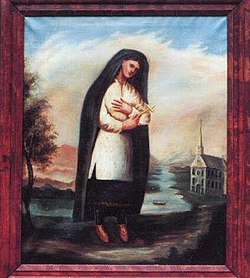
Amidst the hustle and bustle of this holiday season—and virtually guaranteed to be overlooked following the exodus of U.S. troops from Iraq and the death of Kim Jong II—a little extra Christmas spirit just emanated from Vatican City. Today Pope Benedict XVI certified the second miracle for Kateri Tekakwitha (1656-1680), the “Mohawk Saint” from Kahnawake on the banks of the Saint Lawrence River near Montreal. All that remains to complete her long journey to sainthood (which began with her beatification in 1980) is an official papal bull, which is likely to come next year.

Tekakwitha’s interesting story was brought to a wider audience by Allan Greer’s Mohawk Saint (2004)—a terrific book for undergrads, by the way. Having just used this volume in a course this fall (the class included a non-Native student who swears his mother’s name is…wait for it…Kateri Tekakwitha; he said his grandmother was enamored with her life), and having spent a large amount of the class discussion on the various appropriations of her by North American Native Catholics and the ongoing attempts towards her canonization, this news feels especially timely, even if it is not entirely surprising. Nonetheless, it is worthwhile to ponder how the effects of colonial-era evangelism continue to play out in the present, sometimes in surprising ways. As is often the case, the papal certifications and forthcoming bull only give “official” legitimacy to a following that is centuries old. Tekakwitha will not be the first Native from the Americas to be named a saint, but she is perhaps the most important one, at least for North American Native Catholics. As Greer and others have pointed out, Tekakwitha has long served as the unofficial patron saint for Native Catholics.

Read more here.

Senin, 22 Agustus 2011

Black Robes and Buckskin

Paul Harvey


Just a brief addendum to yesterday's posts. As long as we're talking books suited for the classroom, here's an alternative for you. For years, I have periodically used an excellent "greatest hits" anthology from The Jesuit Relations, this one being Allen Greer's edition for Bedford Books: The Jesuit Relations: Natives and Missionaries in Seventeenth-Century North America. There are many wonderful things about that volume -- the inexpensive price, the fine introduction provided by Greer, and a great selection of docs -- but just for your interest's sake, here's another possibility of a volume along the same lines, but with an updated translation provided by the editor that doesn't rely on the older, creakier one of Reuben Thwaites' original full-length edition of the volumes. So check out Black Robes and Buckskin below, reviewed for Choice; it will doubtless interest some of you. The volume includes some previously unpublished material, so I gather, as well as an important essay by the editor reprinted in the book.


Randall, Catharine. Black robes and buckskin: a selection from The Jesuit relations. Fordham University, 2011. 212p bibl afp; ISBN 9780823232628, $35.00. Reviewed in 2011sep CHOICE.
The Jesuit Relations is a unique set of documents, approximately 73 volumes, critical to understanding the history of New France. Written by Jesuit missionaries in New France between 1632 and 1673, the documents constitute a running commentary on colonial life and particularly on the culture of the Indians whom the Jesuits were trying to convert to Christianity. As important as they are to historians, it should be noted that they were also invaluable as a source for generating interest and income for New France in the mother country. Hence, the field reports of the Jesuits were edited several times before their publication. In these brief selections, Randall (French, Fordham Univ.) concentrates on what she terms "inculturation"--in essence, the Jesuits' toleration of Native culture and their attempts to understand it to further the conversion process. Her translation is more readable than Reuben Thwaites's monumental The Jesuit Relations and Allied Documents, first published in 1925. The present work includes 16 pages of illustrations, the author's own article, "Cathedrals of Ice: Translating the Jesuit Vocabulary of Conversion," previously published in the International Journal of Canadian Studies, 23 (2001): 17-34, and a brief bibliography. Summing Up: Recommended. All levels/libraries. -- P. T. Sherrill, emeritus, University of Arkansas at Little Rock

_____________________________________________


And fyi, a little more information about the book, from Fordham U. Press website. And hey, Fordham Press, after a decent interval has passed could you think about getting this in paper so we can assign it? We would appreciate that; merci. .


The Jesuits approached the task of converting the native peoples, and the formidable obstacles it implied, in a flexible manner. One of their central values was “inculturation,” the idea of “coming in by their door,” to quote a favorite saying of Ignatius, via a creative process of syncretism that blended aspects of native belief with aspects of Christian faith, in order to facilitate understanding and acceptance. The
Relations thus abound with examples of the Jesuits’ thoughtfully trying to make sense of native— and female—difference, rather than eliding it.


The complete text of the Jesuit Relations runs to 73 volumes. Catharine Randall has made selections from the Relations, some of which have never before appeared in print in English. These selections are chosen for their informative nature and for how they illustrate central tenets of Ignatian spirituality. Rather than provide close translations from seventeenth-century French that might sound stilted to modern ears, she offers free translations that provide the substance of the Relations in an idiom immediately accessible to twenty-first-century readers of English.


An extensive introduction sets out the basic history of the Jesuit missions in New France and provides insight into the Ignatian tradition and how it informs the composition of the Relations. The volume is illustrated with early woodcuts, depicting scenes from Ignatius’s life, moments in the history of the Jesuit missions, Jesuit efforts to master the native languages, and general devotional scenes.


Minggu, 08 Mei 2011

After the Historical Revolutions: Or, When the Tree Falls in the Historical Paradigm Forest, Does Anyone Listen?

Paul Harvey

A review of (and an announcement of) some challenging new works in earlier American History, and the history of the American West, got me to thinking about the changing of the historical paradigm guard -- or whether those guards get changed at all by scholarly revolutions. These are questions which affect the course of American religious history, but bear with me for a short detour before discussing that further.

These thoughts first came from reading Charles Mann’s review of Daniel K. Richhter’s new book Before the Revolution: America’s Ancient Past (Harvard Press) in Saturday’s Wall Street Journal (yes, Virginia, I do read the Wall Street Journal! But I'm not sure if the link will let in non-subscribers; if it doesn't and you want to read, I'm happy to send it to you).

I know nothing about this book other than this review, but I am a big fan of Richter’s earlier work Facing East from Indian Country: A Native History of Early America, a favorite of mine to use in class for its wonderful illustrations of how changing one’s angle of vision creates an entirely different historical sense of a period. Richter also engages in some deft analyses of early American documents of religious history from the European-Native encounter, including John Eliot’s bizarre but fascinating Indian Dialogues, of course the Jesuit Relations, Indian conversion narratives, and various ceremonial encounters at treaty negotiations.

In his review of Richter’s new book, Mann writes:

“Every few decades, historians develop a new way of looking at the past. I am not talking about ‘revisionism’ but unifying conceptual schemes, the sort of mental framework that Frderick Jackson Turner created in his argument for the importance of the frontier to our history or that Bernard Bailyn established in his studies of the American Revolution’s ideological orgins. Historians debated Turner for a long time and continue to debate Mr. Bailyn. I wouldn’t be surprised if they were arguing with Mr. Richter a decade from today.”

When I become King of the World I will permanently ban the word "revisionism" and its variant "historical revisionism" (as I have already banned the words "bias" and "politically correct" in my classrooms, since they have become barriers to thought and discussion), since they have been rendered meaningless for precisely the reason Mann explains there.

But the revolution in understanding is not just in the early America of Richter. My longtime friend Anne Hyde, Professor of History at my sister institution Colorado College, is about to publish her magnum opus for the West of the first half of the nineteenth century, Empires, Nations, Families: A History of the North American West, 1800-1860, part of University of Nebraska’s outstanding series History of the American West series. If this this means anything to you, as it will to some of you, the immediate predecessor to Anne’s book is Colin Calloway’s monumental work One Vast Winter Count: The Native American West Before Lewis and Clark.

(As a brief aside, when Anne and I were in graduate school, she always made it to the library at 8:00 a.m. sharp, while I was lucky to drag myself, half hungover and ears still ringing from some too-loud jazz concert the night before, by 10:00 or 11:00 at best, which explains a lot about the great scholarly discipline it took for Anne to finish this huge work, while I was busy watching the Mavs beat the Lakers).

Anne’s work may suggests a paradigm for understanding the history of the West in that era, in a way such as Richter and Colin Calloway have done for earlier American history. Her work also features chapters fully integrating the Mormon West into the larger picture, and too much else of interest besides to even begin to summarize here.

All of this is exciting as an historian. But all of it also makes me wonder how, whether, and when any of this affects public consciousness of earlier American history. Lately we’ve been talking about Barton et al., and of course the bookshelves at your Barnes & Noble are full of everything Founding Father related. I understand that, but considering the impact of the works above – great on historians, perhaps little on anyone else – makes me wonder about similar questions for religious history.

The older paradigm of American religious history will be familiar to many blog readers here, and most are familiar with its more recent challengers, summarized in works such as Tweed’s edited volume Retelling U.S. Religious History. I once saw Elizabeth Fox-Genovese, God rest her soul, blast away at that book at a Young Scholars in American Religion conference, with most of the authors in that book in attendance; it quickly became clear she was itching for a fight with a group that had no interest in fighting with her on the alleged evils of “postmodernist” history, since that debate was long since old and tired at that point; at the end of it, Diana Butler Bass got up and urged her to give up swinging at phantoms since none of us were in the ring with her. Sitting in the back row with Diana, I gave her a big high-five for trying to extricate us all from such an unproductive conversation.

Much of the newer paradigm seems to come from removing religious history from the specific story of the American nation-state, and using categories that engage religious experience at its own level rather than as some proxy for political parties or current day culture wars. We've blogged here extensively about some recent classics that move American religious history/studies well down this path -- by Leigh Schmidt, Robert Orsi, Kathryn Lofton, and numerous others.

Again, however, for religious history as for the studies of earlier American history mentioned above, one wonders whether and how this affects any sort of public consciousness or discussion, and whether it’s the job of religious historians to evangelize for these perspectives that challenge or disrupt how we perceive the American religious past (and present). Or maybe scholars should just do their work, let popularizers who are good at popularizing disseminate this stuff to the general public (like happens in science all the time -- neuroscientists do their thing, and then someone like Oliver Sacks explains a little bit of it to us), and trust that over a generation or two it will find its way into the more general understandings. That's a comforting and easy role to take, but it leaves not much excuse for complaining about why some pseudo-historians advise presidential candidates while the rest of us get to advise freshmen how to raise their grade from a D to a C.

As usual, I have no answers, only questions. You're welcome.

[Sutton -- sorry about your Lakers. Not].

Rabu, 27 April 2011

Rituals of Violence, War, and Death Among the Wendat/Huron and the Dakotas: Two New Studies

Paul Harvey

War, violence, and rituals of death have been central to American history, nowhere more so than among Native Americans. Here, just wanted to alert you to a couple of new works that advance new understandings of religious rituals surrounding war, violence, and death.

First, last week Historiann called my attention to a new book which I have yet to see but looks hugely promising, especially as a classroom-usable text. I'll quote from her here:

Erik Seeman’s The Huron-Wendat Feast of the Dead: Indian-European Encounters in Early North America (Johns Hopkins University Press, 2011). From the book jacket:

“Two thousand Wendat (Huron) Indians stood on the edge of an enormous burial pit… they held in their arms the bones of roughly seven hundred deceased friends and family members. The Wendats had lovingly scraped and cleaned the bones of the corpses that had decomposed on the scaffolds. They awaited only the signal from the master of the ritual to place the bones in the pit. This was the great Feast of the Dead.”

Witnesses to these Wendat burial rituals were European colonists, French Jesuit missionaries in particular. Rather than being horrified by these unfamiliar native practices, Europeans recognized the parallels between them and their own understanding of death and human remains. Both groups believed that deceased souls traveled to the afterlife; both believed that elaborate mortuary rituals ensured the safe transit of the soul to the supernatural realm; and both believed in the power of human bones.

Appreciating each other’s funerary practices allowed the Wendats and French colonists to find common ground where there seemingly would be none. Erik R. Seeman analyzes these encounters, using the Feast of the Dead as a metaphor for broader Indian-European relations in North America. His compelling narrative gives undergraduate students of early America and the Atlantic World a revealing glimpse into this fascinating — and surprising — meeting of cultures.

Anyone who has poked around at all in The Jesuit Relations will recognize descriptions of the feasts of the dead in these documents to be some of the most immediately compelling and gripping (if, as always with the Jesuits, problematic) primary sources for 17th-century Native American religious practices. Weighing in a a svelte 176 pages, this book looks like an effort to use these kinds of sources in a way that opens them up and makes discussion of cross-cultural religious encounters in early America accessible for classroom discussion.

And here's a powerful new article of interest to many of you, by our friend and colleague Jennifer Graber, whose first book The Furnace of Affliction has received attention at our blog before.

The article, based on some outstanding research in the American Board of Commissioners for Foreign Missions papers at the Minnesota Historical Society, is "Mighty Upheaval on the Minnesota Frontier: Violence, War, and Death in Dakota and Missionary Christianity," Church History 80 (March 2011): 76-108.

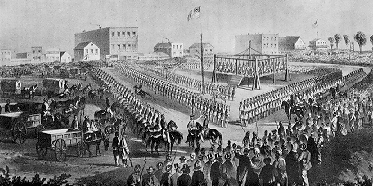
The piece begins by asking "If . . . war is the norm rather than the aberration in American national life, how are we to understand the transformations experienced in 1862 by missionaries and Dakotas as part of a larger American story . . . [and how do we] understand how violence worked to reshape the participants' religious lives?" Graber considers the effects both on missionaries from the ABCFM and the Dakotas of the Dakota War in Minnesota in the late summer of 1862, a horrific outbreak of violence which resulted in the deaths of several hundred settlers and later the mass public execution of over 300 Indians, particularly focused on non-Christian Indians and "medicine men" who were thought to be the ringleaders of the revolt. Graber makes effective use of concepts of Christianity and violence drawn from Emma Anderson's Betrayal of Faith, Jill Lepore's The Name of War, and Harry Stout's "Religion, War, and the Meaning of America" (from Religion and American Culture, Summer 2009, 275-89).

In one section, Graber considers the religious responses of Dakotas to this signal event in their history, including the "conversion" of many of those awaiting execution. She provides a complex portrayal difficult to summarize here but well worth the read. Alongside this, Graber considers also the effect that the trauma of war had on the missionaries, and concludes that "these men underwent their own transformation. Their encounter with violence and devastation, punishment and incarceration caused them to mitigate and complicate the revivalist Calvinism they brought to the frontier. Their vision of missions made up of churches and schools became something else altogether, one of reservations and prisons that God used to make Indian converts."

Despite its short length, this sobering piece had me reflecting in ways which inspired some previous blogging about Emma Anderson's Betrayal of Faith. Highly recommended reading, especially after our last continuous decade of religion, violence, war, and death.

Jumat, 08 April 2011

Whose Story is American Religious History?

By Heath Carter

I'm here in Grand Rapids, Michigan, where I'm attending the American Society of Church History's spring meeting, organized around the theme of "Christianity and Migrations." There are any number of interesting panels and I hope to post another update before all is said and done, but for now a brief report on Rachel Wheeler's stimulating plenary address this morning entitled, "Whose Story is American Religious History? The Parallel Lives of Daniel Boone and Joshua, the Mohican." Wheeler is an associate professor of religious studies at IUPUI whose work has come up often on this blog [those interested in reading up on her first book, To Live Upon Hope, might check out fellow blogger Lin Fisher's conversation with her back in 2009].

Her talk today engaged big questions about how we should narrate the story of European-Indian encounter in the Americas, which has ramifications of course for how we tell the story of American religious history. She argued that the life of Joshua, an Indian convert to Moravianism, highlights the difficulties with both triumphalist and revisionist accounts of conflict on the frontier. The problems with triumphalism, a view summed up in Horatio Greenough's mid-nineteenth century sculpture, The Rescue, need not be elaborated here. There is a reason why the statue, an image of which Wheeler incorporated into her talk, was removed from the steps of the U.S. capitol building in the late-1950s.
But Wheeler persuasively showed that Joshua's story also complicates the revisionist narrative, which lacks the categories to see his conversion as anything other than collusion with the oppressor; and lacks, moreover, the flexibility to allow for Moravian missionaries who - unlike some of their Protestant counterparts in the late-18th century - were not virulently anti-Indian but were in fact open to some of the ways that Indian converts made Christianity their own.

In elaborating the fascinating comparison between Boone and Joshua, Wheeler followed themes of migration, war, and conversion. All of these will be central to her next book, a biography of Joshua which will put him belatedly on more religious historians' radar (I confess that before Wheeler's talk I had not heard of him). If her second book makes the same kind of splash as her first, it may be that we'll all soon be required to take what she called the "Joshua test" - do our accounts of American religious history shed light upon the experience of this Mohican-Moravian martyr, or will we continue to relegate those like him to the margins? For the profession's sake, let's root for passing grades for all.

Kamis, 17 Februari 2011

Native Americans, Christianity, and the Reshaping of the American Religious Landscape

Paul Harvey

Here's a review from Choice of a new anthology/essay collection of tremendous value to those interested in the relationship of Native Americans and Christianity. Below the review I'm pasting in a table of contents, as well; as you will see, a number of the top scholars in this field -- Joanna Brooks, Hilary Wyss, Emma Anderson, Rachel Wheeler, Michael McNally, Steven Hackel, and others -- are represented here. So, first the brief review, and then more detail below that; the link below in the title takes you to the book's website at UNC Press. For those not as familiar with this topic, this is a great way to introduce yourself, in bite-sized portions, to some of the best recent scholarship.

Native Americans, Christianity, and the reshaping of the American religious landscape, ed. by Joel W. Martin and Mark A. Nicholas. North Carolina, 2010. 325p index afp; ISBN 9780807834060, $75.00; ISBN 9780807871454 pbk, $27.95. Reviewed in 2011mar CHOICE.

Martin and Nicholas's valuable essay collection addressing Native American interactions with European/European-American Christianity during the Colonial period and into the 19th century incorporates multiple disciplines, including history, religious studies, Native American studies, anthropology, and literary studies. Collectively, the authors illustrate Native agency in interactions with non-Native Christians. Rather than presenting Native experiences from a Eurocentric perspective, the authors show how Natives embraced Christian symbols and ideas, using them in ways that benefitted themselves and their fellow Natives and showing that, for those who chose to embrace Christian faiths, it was possible to be both Native and Christian. The essays also show that even when interaction with non-Natives brought Native communities hardship, Native peoples shaped Christianity in such a way as to benefit themselves and their communities. Each essay is well researched, eloquently written, and significant to the understanding of Native experiences in and with Christianity. An important contribution to a variety of disciplines, most importantly US Christianity, Native peoples, and US history. Summing Up: Highly recommended. Upper-division undergraduates and above


Table of Contents:

Hard feelings : Samson Occom contemplates his Christian mentors / Joanna Brooks -- Eager partners in reform : Indians and Frederick Baylies in Southern New England, 1780-1840 / Daniel Mandell -- Crisscrossing Projects of Sovereignty and conversion : Cherokee Christians and New England missionaries during the 1820s / Joel W. Martin -- Native American popular religion in New England's Old Colony, 1670-1770 / Douglas L. Winiarski -- Blood, fire, and "baptism" : three perspectives on the death of Jean de Brébeuf, seventeenth-century Jesuit "martyr" / Emma Anderson -- The Catholic rosary, gendered practice, and female power in French-Indian spiritual encounters / Tracy Neal Leavelle -- The souls of Highlanders, the salvation of Indians : Scottish mission and eighteenth-century British empire / Laura M. Stevens -- Print culture and the power of native literacy in California and New England Missions / Steven W. Hackel and Hilary E. Wyss -- Hendrick Aupaumut : Christian-Mahican prophet / Rachel Wheeler -- To become a chosen people : the missionary work and missionary spirit of the Brotherton and Stockbridge Indians, 1775-1835 / David J. Silverman -- Conclusion : turns and common grounds / Mark A. Nicholas -- Coda : naming the legacy of native Christian missionary encounters / Michael D. McNally

Minggu, 16 Januari 2011

Woman in the Wilderness: Letters of Harriet Wood Wheeler

Paul Harvey

Here's a very nice primary source book for your collection or for your university library, that adds much to the literature on nineteenth-century missionaries, especially female missionaries, and white-Native interactions: Nancy Bunge, ed., Woman in the Wilderness: Letters of Harriet Wood Wheeler, Missionary Wife, 1832-1892.

In this volume, Bunge has collected the most significant letters and writings of a missionary and her family, who worked among the Ojibwe from the 1840s through the 1860s, including during the period of the removal of the Ojibwe from their lands in northern Wisconsin; the collection also includes a newspaper article from Julia Wheeler in 1862 which condemns government policy for leading to the 1862 Sioux uprising in Minnesota, which culminated in the hangings of 38 Sioux in December 1862. In this volume, Wheeler begins with fairly conventional Protestant attitudes from her home area near Lowell, Massachusetts, but during her years as a "missionary wife" becomes an advocate for her subjects.

The editor, Michigan State University professor Nancy Bunge, discusses the process of collecting the material for this compilation here. The result of her work is a letter collection that allows the reader to watch the evolution of the subject over a quarter century or more, and to understand in a more intimate way the lives and interactions of white and natives on the midwestern frontier.

Senin, 03 Januari 2011

Review: Anetso, the Cherokee Ball Game

Art Remillard

Michael Zogry first learned of the Cherokee precursor to lacrosse, called “anetso,” in a class with Raymond Fogelson of the University of Chicago. The dearth of scholarship on the game surprised Zogry, who saw it as a fascinating blend of athletics and religious ritual. He read carefully the two major treatments of anetso—Fogelson’s 1962 dissertation and James Mooney’s 1890 article “Cherokee Ball Play”—and realized that there was more to the story. So when Zogry began his doctoral work, he aspired to offer a new perspective. This culminated in his innovative, compelling, and thoroughly researched, Anetso, the Cherokee Ball Game: At the Center of Ceremony and Identity.

Zogry spent four years studying anetso before seeing it in person in 1997. He arrived at the fairgrounds in Cherokee, North Carolina armed with a video camera and an intellectual suitcase stuffed with names like Bourdieu, Bell, Grimes, Geertz, Lévi-Strauss, Smith, Turner, and others. Theories raced through Zogry’s head, when suddenly reality struck—literally. As the game progressed, Zogry watched the tiny white ball float toward him and the players following closely behind. Unable to evade the rush, Zogry was knocked to the ground. This collision, the author recalls, “has continued to assert itself as a strong memory. I now think of it as a metaphor for describing my process of grappling with the relevant issues, and frankly, the limitations of my scholarly perspective to apprehend even this bit of culture in anything but a fleeting way” (15).

Specifically, Zogry came to realize that he needed a new vocabulary to discuss this game, which is more than “just a game.” In The Savage Mind, Lévi-Strauss said that a game has a set of rules and ends when one side prevails. In contrast, a ritual, which bears resemblance to a game, aims to produce, in Lévi-Strauss’s words, “a particular type of equilibrium between two sides.” While perhaps a useful point of departure, and certainly still influential, Zogry insists that anetso does not fit neatly within this conceptual framework. It is a game, to be sure. But Zogry demonstrates that anetso connects to the most significant dimensions of Cherokee religious identity. As a result, the game "resists and problematizes" the classifications of Lévi-Strauss and the likeminded (1).

Zogry starts by looking at anetso’s relation to Cherokee cultural narratives. Among the stories he retells is one of a pre-human contest between the birds and animals, where, interestingly enough, two small animals approach the bird team and request to join their side. The team captain, an eagle, accepts the defectors and fits them with wings, making one a bat and the other a flying squirrel. When the game begins, the retrofitted rodents lead the birds to victory. According to Zogry, the Cherokee still recount this narrative, particularly to the youth, to warn against boastfulness and to emphasize the importance of “inclusiveness” and “adaptability” (48). This sense of tribal solidarity was essential during the “Era of Great Change” (1799-1838). Then, missionaries criticized the game for its perceived “heathenish” underpinnings, and calls for removal became louder and louder. Meanwhile, Zogry shows how the Cherokee defiantly played anetso, using it as “a vehicle for expression of Cherokee identity” (105).

In addition to detailing the broad narrative and social meanings of anetso, Zogry also examines rituals directly associated with the game. Preparation begins weeks in advance with public and private rituals. Ball teams hire conjurers, who enlist assistance from “other-than-human persons.” Players avoid sexual contact, while abiding by a strict dietary code that prohibits consumption of young birds, small animals, or frogs. Zogry finds that most of these traditions have carried into contemporary performances of anetso. And while most players are active Christians, few see any conflict between their Cherokee and Christian practices. This is a perspective that has developed with time, just as anetso has changed over the ages. But Zogry insists that the game is still vital, despite claims from informants that it's not. “The ethic of participation,” he retorts, “the way the players carry themselves and acquit themselves on the field, the honor of performing to the best of their ability in a contest that their ancestors once played on the same land, these remain meaningful reasons to participate for Cherokee adults and teenagers” (145).

In the book's closing pages, Zogry considers the broader implications of his findings. For example, he takes aim at Allen Guttmann, who in From Ritual to Record, argues that in the modern sporting world “the attachment to the realm of the transcendent has been severed.” Guttmann maintains that a priest or minister at a football game does not serve the same function as a shaman at an Indian ball game. Without the minister, the football game will go on. Without the shaman, there is no ball game. Zogry is unconvinced. “Football, like anetso, provides a cultural locus for a range of activities, some that can be termed ‘ritual’ and some ‘religious.’ Preliminary and postgame activities, propitiatory activities, community involvement, even gambling serve to weave the experience of this game into the social lives of players and spectators” (221). To be clear, Zogry does not advocate collapsing religion and sports. Rather, he seems comfortable with ambiguity and open to “rethinking the categories in a manner that hopefully is more accurate” (235).

Specialists in Cherokee religion, ritual studies, and religion and sports will appreciate this book. Zorgy uses an impressive array of sources, from his own fieldwork, to newspapers, manuscripts, personal journals, and travel accounts. The book is thoroughly interdisciplinary, drawing insights from historians, anthropologists, and theorists of religion, ritual, sports, and culture. Additionally, Zogry hints at possibilities for more study. He mentions that women presently play anetso, a new development in the game’s history and “a fruitful area of future research” (184). I hope that Zogry explores this "fruitful" terrain, perhaps making it part of a broader treatment of Native American women and sports. I wonder how female performances of anetso would compare with the Navajo and Apache “Sunrise Ceremony.” In this rite-of-passage ceremony, young women arise early in the morning and run out toward the rising sun and back, thereby recreating the myth of the “White Painted Woman,” a deity who reversed the aging process by moving toward the sun and melding with her younger self. The ritualized running also emphasizes strength and health, in contrast to tribal plagues such as alcoholism and type-2 diabetes. Zogry has done the intellectual work to examine this and other religious/athletic performances, and I'm eager to see where he takes us next.

Selasa, 28 Desember 2010

After Pluralism


Paul Harvey

For those (looking in the mirror here) inclined to refer to "pluralism" a little too easily as an unqualified good, standing apart from history, here's an important new work calling for attention to the concept, and to what come after what was supposed to be the end of history: Courtney Bender and Pamela Klassen, ed., After Pluralism: Reimagining Religious Engagement. It's an edited collection of essays from across nations and disciplines, and features some top-flight folks in American religious studies; Table of Contents is here, excerpt of the book is here. Winnifred Sullivan is featured in the work, discussing de facto "naturalized" religious establishments and the law; Tracy Leavelle and Michael McNally weigh in with contributions on the complexities and perils of pluralism and Native American "religious freedom." A brief excerpt from the intro suggests some of the challenges the book takes on:

The details of European and North American cases reveal greater complexity and complication, if not contradictions, in the formations of pluralism. In the United States, for example, a secular state that is presumed to neither encourage nor discourage religious identity unites some variants of religious plurality as admissible under law while excluding other religious groups as insufficiently tolerant. At the same time, the idioms of tolerance, multicultural or religious celebrations, simultaneously depoliticize and depublicize particular religious interests. In the face of these normative paths to “religious” recognition, scholars must acknowledge and inquire further into the processes by which gaining religious recognition in the United States requires that groups take a seat at a multireligious table. The stories told in this volume call attention to a growing recognition that the varying cultures of religious pluralism in which we live are always directed toward and galvanized by multiple fields of knowledge and power.

Selasa, 19 Oktober 2010

Seneca Possessed

Paul Harvey

From Choice, a quick hit review of a new book that should be of interest to many:

Dennis, Matthew. Seneca possessed: Indians, witchcraft, and power in the early American republic. Pennsylvania, 2010. 313p bibl index afp; ISBN 9780812242263, $45.00. Reviewed in 2010nov CHOICE.
This fascinating study examines how the Senecas struggled to maintain their community, autonomy, and land between 1780 and 1825. Dennis begins by describing the dangerous chaos that shook western New York in the wake of the Revolutionary War. He then analyzes the message and effects of the Seneca prophet Handsome Lake, including connections to the Second Great Awakening, and provides a nuanced view of how witch hunting before, during, and after served as "a unified defense of Seneca integrity and sovereignty." Next, the author examines the connections that the tribe developed with Quaker missionaries, who proved useful partly by providing needed technology and education and partly by acting as a "firebreak" against other, less compliant missionaries, but mostly by supporting the Senecas in their fight against efforts by the Ogden Land Company and the State of New York to take their land and autonomy. The book seems disjointed because of the separate Handsome Lake and Quaker-focused sections, but that is outweighed by its analysis of Seneca social and cultural change and continuity, and its examination of the connections between the tribe and the surrounding US culture. Summing Up:Recommended. All levels/libraries. -- D. R. Mandell, Truman State University

Senin, 23 Agustus 2010

Frankly, my dear, I don’t give a Franciscan

Linford D. Fisher

It used to be a bad word. “Franciscan.” Well, for colonial historians, at least. I mean, really, with a full-out colonial missions program to American Indians that was inescapably ethnocentric at best (even if well intended) or disturbingly malevolent at worst, Franciscans have usually been at the religious center of the so-called Black Legend with their forced labor and corporeal punishment of Natives in Florida, New Mexico, and California. This is particularly true vis-à-vis the typical scholarly praise concerning the relatively tolerant, culturally sensitive missionizing undertaken by the Jesuits in the colonial period. The classic, “recent” touchstone on the depredations of the Franciscans in the New Mexico context is, of course, Ramon Gutierrez’s When Jesus Came, the Corn Mothers Went Away (1991). Despite the various criticisms that have subsequently emerged, this text is seemingly here to stay. It is a gripping narrative, to be sure. Who couldn’t help but cringe at his lengthy recounting of the eighty years of Franciscan evangelization prior to the Pueblo Revolt in 1680 that included overt sexual exploitation and humiliation?

When David J. Weber—the leading scholar in borderland studies—sadly passed away earlier this week, I pulled out his classic, The Spanish Frontier in North America (1992) to remind myself of what Weber contributed to all of this. Surprisingly, his account is comparatively even-keeled, even though he did label Franciscan missions as “but one of the oppressive frontier institutions of the Spanish state” (121).

But is this view changing? Of course. It has to. This is the historical profession, after all, and many tenure cases are hanging on the successful revisioning of the minutiae of every field. A book I just finished while on a research vacation (an oxy-moron if there ever was one) with the family reminds me that the historical view of Franciscans is slowly changing: Joseph M. Hall, Jr., Zamumo’s Gifts: Indian-European Exchange in the Colonial Southeast (2009). To be sure, the book is really about the importance of Native conceptions of exchange in trumping and shaping European notions of commercial trade well into the eighteenth century. Nonetheless, the Franciscans take center stage in at least one chapter, since their missions among the Apalachees in the 1600s open up avenues for Spanish exchange and trade with inland Natives. Hall seems to almost minimize the effect of the Franciscans, essentially arguing that the missionaries had little control over the Timicuan and Guales as a whole: “The simple fact remained that Indians in and beyond the missions remained in control of the region. Although missionaries introduced a host of new coercive forms into Guale and Timicuan life during the early seventeenth century, including restrictions on their movements, a greater regimentation of diet, and more frequent corporal punishment, such impositions weighed relatively lightly on most of their charges” (61). This was in part due to the enormous numerical differential that often gets overlooked: in 1630 there were 27 missionaries for 50,000 Timicuans and Guales. For myself, I wonder if his assessment does not take into account the practical, on the ground imperial weight and presence the missionaries and their regional military and trade counterparts represented. In the end, however, Hall still agrees with archaeologist Jerald Milanich that “missions were colonization” (53).

Nonetheless, Hall is not alone. Franciscan pacification/colonization is looking far different in various geographical regions. Steven W. Hackel in Children of Coyote, Missionaries of Saint Francis (2005) was surprised to find that Indians in southern California had far more autonomy in Franciscan mission towns than he expected—even producing surplus crops for their own economic benefit. Another study that will be soon forthcoming by my colleague at Brown, Amy Remensnyder, on the various uses of the Madonna in late medieval and early modern conquests in the Old World and New, also highlights the Franciscans in the New World context. And, somewhat similarly, she is more interested in what Franciscans and the Spanish do and how they operate than she is in taking them to task, once again, for the many injustices that historians have rightly pointed out.

Then again, perhaps the Jesuits’ fortunes are changing, too, but for the worse. Emma Anderson’s The Betrayal of Faith (featured here on this blog) turns historiographical wisdom concerning the Jesuits on its head. In her retelling, the Jesuits (and Paul LeJeune in particular) come across as just as intolerant and demanding as their Franciscan/Recollet counterparts.

These developments, of course, are part of a much larger re-casting of missionaries among Native Americans in the wake of earlier and important ethnohistorians like Francis Jennings and James Axtell. David Silverman, Rachel Wheeler, and Richard Cogley are just a few examples of the ways in which historians have increasingly asked different, native-centered questions to provide a more nuanced emphasis on Natives’ creative agency instead of cataloguing the sins of the European evangelists. A terrific-looking book that is due out in a month will likely add to this ongoing conversation: Joel Martin and Mark A. Nicholas, eds., Native Americans, Christianity, and the Reshaping of the American Religious Landscape (UNC, Sept. 2010).

All of this simply serves as a reminder that history is, first and foremost, an interpretive enterprise, and that how we view things, people, movements, and events can—and must—change over time. In the meantime, thanks for a terrific corpus of scholarship, David J. Weber. RIP.


Sabtu, 21 Agustus 2010

The Past is Never Dead . . . Religious Leaders in Virginia on Local Tribes

Randall Stephens

I was just thinking about a new idea for the blog. Maybe a series of posts? "The Past is Never Dead . . ." It could entail news items or books that deal with contemporaries who are wrestling with history. To paraphrase Carl Becker "everyman/woman his/her own religious historian." Many Americans come to grips with the nation's religious identity be resorting to the past. (Isn't this Glenn Beck's big campaign?) Perhaps history has a greater resonance right now. Some questions: How do believers and non-believers use history to describe what America is or has been? Who owns American religious history? Why is it so important for citizens to put religious history, or just American history in general, to use for the present?

Robert Dilday, "Baptist executives urge federal recognition of Virginia tribes," Associated Baptist Press, 19 August 2010.

RICHMOND, Va. (ABP) -- The top executives of two Virginia Baptist groups have joined other religious leaders in calling for federal recognition of six Native American tribes in the state.

In an open letter released Aug. 17, about 30 Christian, Jewish and Muslim leaders asked Virginia’s Republican governor and two Democratic senators to support congressional legislation giving to Virginia’s tribes the same status held by more than 560 other Native American tribes across the United States.

Among the signers were John Upton, executive director of the predominantly white Baptist General Association of Virginia, who also was recently elected president of the Baptist World Alliance, and Cessar Scott, executive minister of the historically black Baptist General Convention of Virginia. . . .

History erased by racist official

Walter Plecker, registrar of Virginia’s Bureau of Vital Statistics from 1912-1946, replaced “Indian” with “black” on every birth and death certificate in his office. Plecker, a white supremacist, said Native Americans had become a “mongrel” mixture. >>>
Related Posts Plugin for WordPress, Blogger...