Paul Harvey Pardon the self-promotion interruption, but you're used to it. Now and then I post reviews from the helpful library periodical Choice of books of interest in our field. Today I'm going to seize the blog to post this review of my new book Through the Storm, Through the Night, especially for those of you contemplating your book choices for next semester's classes. Harvey, Paul. Through the storm, through the night: a history of African American Christianity. Rowman & Littlefield, 2011. 217p bibl index afp; ISBN 9780742564732, $35.00; ISBN 9780742564756 e-book, $34.99. Reviewed in 2012jan CHOICE. |
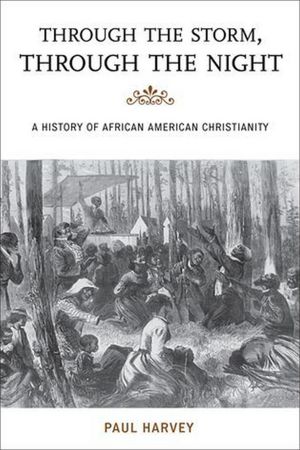 Books abound on the African American religious experience in the US, but Harvey's work is a welcome addition and succinct summary of its 400-year history. Typically in such short monographs, detail is sacrificed for brevity, but Harvey (history, Univ. of Colorado, Colorado Springs) packs great substance through insightful biographies and aptly summarized historical events. He argues against any uniform African American church or religious experience, as African Americans experienced varied contacts with Christianity and often mixed traditional African spiritualism and animistic beliefs. Unquestionably, religious beliefs infused the African American community with hope as they struggled through slavery, Jim Crow legislation, segregation, race-oriented violence, and the civil rights movement. Harvey concludes that though the church is still relevant and Christian denominations are still predominant in the African American community, 21st-century immigrants continue to challenge this narrative, as the Orisha traditions of West and Central Africans, Cuban Santería, Haitian Catholicism and Voodoo, Ethiopian Eastern Orthodoxy, and Islamic influences further heighten diversity. The author notes that clannish and local community traditions among these immigrants overshadow any presumed unity based on skin color. In summary, Harvey creates a broad panoramic of the African American religious experience and challenges future scholars to increase scholarly attention to this field. Summing Up: Highly recommended. All levels/libraries. -- M. S. Hill, Gordon College |
Tampilkan postingan dengan label American religious history survey. Tampilkan semua postingan
Tampilkan postingan dengan label American religious history survey. Tampilkan semua postingan
Selasa, 20 Desember 2011
Choice Reviews Through the Storm, Through the Night
Selasa, 01 Februari 2011
Questions for Research Projects
Randall Stephens
As the snow fell outside our classroom window today, the students in my Religion and American Culture class and I talked about research papers. A good paper can always use a good question. But what makes for a good question? Should the question be broad enough to lend itself to a sweeping assessment of a period? Or, should it be more narrow? What are the marks of a good question?
Hear are some of the questions we came up with as we brainstormed. (We're up to the early 19th century, which is reflected here):
What are the connections between religious belief and war in American history?
Why did utopian communities flourish as they did in the first half of the 19th century?
How did abolitionists and proslavery advocates use the Bible in the years leading up to the Civil War?
Was the women's rights movement a religious movement?
What were the political and social ramifications of the Second Great Awakening?
How has millennialism influenced American religious groups?
How have religion and politics been intertwined in American history? And how does the American context differ from the European context?
Are Americans more or less religious in 2011 as they were in 1961?
As the snow fell outside our classroom window today, the students in my Religion and American Culture class and I talked about research papers. A good paper can always use a good question. But what makes for a good question? Should the question be broad enough to lend itself to a sweeping assessment of a period? Or, should it be more narrow? What are the marks of a
good question?Hear are some of the questions we came up with as we brainstormed. (We're up to the early 19th century, which is reflected here):
What are the connections between religious belief and war in American history?
Why did utopian communities flourish as they did in the first half of the 19th century?
How did abolitionists and proslavery advocates use the Bible in the years leading up to the Civil War?
Was the women's rights movement a religious movement?
What were the political and social ramifications of the Second Great Awakening?
How has millennialism influenced American religious groups?
How have religion and politics been intertwined in American history? And how does the American context differ from the European context?
Are Americans more or less religious in 2011 as they were in 1961?
Jumat, 21 Januari 2011
In the Beginning...What?
by Heath Carter
For the second spring in a row, I am teaching "History of Religion in the United States" at Loyola University Chicago. The class meets once a week on Thursdays from 4:15-6:45pm, meaning that I am working against not only short attention spans but also serious hunger pains and wish-it-was-Friday already syndrome.
 Nevertheless, things got off to a promising start yesterday. I gave a lecture that focused on life in Pueblo New Mexico on the eve of Spanish arrival, the experience of conquest, the establishment of Franciscan doctrinas, the possibilities of resistance, etc (based mostly off of Ramon Gutierrez's When Jesus Came, The Corn Mothers Went Away (1991)). We followed that up with a discussion of Lauren Maffly-Kipp's essay, "Eastward, Ho! American Religion from the Perspective of the Pacific Rim," which can be found in Retelling U.S. Religious History (1997), edited by Thomas Tweed (I imagine most readers know of this book already, but for those who don't, it's full of provocative essays, perfect for stirring up conversation in class). You could see the wheels turning as students struggled to re-imagine American religious
 history outside the trope of westward expansion, which is so pervasive in high school history classrooms.
And I will admit, often in mine. While I am committed to starting somewhere other than aboard the Arbella (we get there toward the end of week 2) and was generally very pleased with the conversation yesterday, I haven't yet figured out how to weave this initial class meeting seamlessly into the rest of the course. This is mainly because I go on to foreground the nation. By dealing extensively with themes of race, class, and gender I try to move beyond the confines of older grand narratives, with their "confessional pitfalls," to borrow Maffly-Kipp's phrase. But in exploring questions about the way religion has historically shaped - and been shaped by - national political and economic currents, I do end up spending a lot of time on Christianity (both Catholic and Protestant). In this way my approach is certainly more traditional.
All this brings me to a question: where do others begin when teaching the American religious history survey? Many of the contributors to this site have participated at one time or another in IUPUI's seminar for young scholars in American religion, which you can learn more about here. Over the past twenty years this program has produced a treasure trove of syllabi for courses in American religious history, which are invaluably cataloged on the same site. For those of you who have posted syllabi there in years past, do you still begin your courses the same way? Or have you changed things up as you've gone along?
For the second spring in a row, I am teaching "History of Religion in the United States" at Loyola University Chicago. The class meets once a week on Thursdays from 4:15-6:45pm, meaning that I am working against not only short attention spans but also serious hunger pains and wish-it-was-Friday already syndrome.
 Nevertheless, things got off to a promising start yesterday. I gave a lecture that focused on life in Pueblo New Mexico on the eve of Spanish arrival, the experience of conquest, the establishment of Franciscan doctrinas, the possibilities of resistance, etc (based mostly off of Ramon Gutierrez's When Jesus Came, The Corn Mothers Went Away (1991)). We followed that up with a discussion of Lauren Maffly-Kipp's essay, "Eastward, Ho! American Religion from the Perspective of the Pacific Rim," which can be found in Retelling U.S. Religious History (1997), edited by Thomas Tweed (I imagine most readers know of this book already, but for those who don't, it's full of provocative essays, perfect for stirring up conversation in class). You could see the wheels turning as students struggled to re-imagine American religious
 history outside the trope of westward expansion, which is so pervasive in high school history classrooms.
And I will admit, often in mine. While I am committed to starting somewhere other than aboard the Arbella (we get there toward the end of week 2) and was generally very pleased with the conversation yesterday, I haven't yet figured out how to weave this initial class meeting seamlessly into the rest of the course. This is mainly because I go on to foreground the nation. By dealing extensively with themes of race, class, and gender I try to move beyond the confines of older grand narratives, with their "confessional pitfalls," to borrow Maffly-Kipp's phrase. But in exploring questions about the way religion has historically shaped - and been shaped by - national political and economic currents, I do end up spending a lot of time on Christianity (both Catholic and Protestant). In this way my approach is certainly more traditional.
All this brings me to a question: where do others begin when teaching the American religious history survey? Many of the contributors to this site have participated at one time or another in IUPUI's seminar for young scholars in American religion, which you can learn more about here. Over the past twenty years this program has produced a treasure trove of syllabi for courses in American religious history, which are invaluably cataloged on the same site. For those of you who have posted syllabi there in years past, do you still begin your courses the same way? Or have you changed things up as you've gone along?
Langganan:
Postingan (Atom)
