Tampilkan postingan dengan label american historical association. Tampilkan semua postingan

Rabu, 04 Januari 2012

Guest Review of Seitz's No Closure and an Invitation

Today's guest review is from Matthew J. Cressler, a doctoral candidate in Religious Studies at Northwestern University. His work combines African American and Catholic histories as they intersect with conceptions of the American nation. Matt is also the recipient of the American Catholic Historical Association's fourteenth annual John Tracy Ellis Dissertation Award. Please join Matt and his colleagues at the round table on Seitz's book at AHA this Saturday, January 7, 9:00 a.m. – 11:00 a.m, Scandal, Resistance, and Practice: A Roundtable on John Seitz’s No Closure, ROUNDTABLE, Chicago Marriott Downtown, Purdue Room.

A Review of John Seitz’s No Closure (2011) and an Invitation to Join the Conversation
Matthew J. Cressler

In May 2004, the Archdiocese of Boston announced that a number of parishes would be closed across the city. The decision to shutdown nearly eighty parishes across the Boston area was a consequence of the immense financial burden of the Catholic sex abuse crisis, as well as longstanding shifts in urban demographics and church attendance. However, by August, it became clear that some groups of Catholics refused to accept the process of parish shutdown. Parishioners across Boston moved into their closed churches and occupied them in “perpetual vigil” – “with their physical and, they repeatedly insisted, 'prayerful' presence they were going to keep the church open despite the decree against it" (10). John Seitz's No Closure: Catholic Practice and Boston's Parish Shutdowns is an ethnographic study of those resisting communities that sets out to answer two fundamental questions: why did Catholics resist the closure of their parishes and what does this resistance tell us about contemporary American Catholicism? In the course of answering these questions, Seitz illustrates the contours of what many resistors experienced as a “spiritual abuse” that followed, and was a continuation of, the sexual abuse of the Church. Resisting Catholics were forced to reexamine the lines and limits of their engagement with the Church, to reconsider the Catholic past and its meanings in their lives, and to take up the responsibilities of everyday church management and theology.

But if No Closure is specifically about this small community of Boston Catholics resisting church shutdowns in the wake of scandal, I’m much more interested in how it also serves as an incisive exploration into American Catholicism at the turn of the 21st century. Though the decision to occupy parishes certainly wasn't the norm amidst parish shutdowns, religious life in the liminal space of occupied churches sheds light on contemporary American Catholic life in ways oftentimes invisible to scholars. To name just two of the broader theoretical interventions of Seitz’s work, No Closure examines the particularity of the Catholic parish in American religious history and the problem of modernity in the narratives of American Catholic history.
By considering what happens when a diocese takes away a parish – effectively an exploration of the unmaking of sacred space – Seitz illuminates the peculiar relationship Catholics have with religious places. The pain felt by parishioners at the loss of their spiritual home indicates the distinctive significance of the parish in American religious history, wherein the parish served as a site for the creation of a particular kind of American religious subject with a particular orientation toward places and the sacred presences that populate them. Calling attention to the habituation of the ways Catholics experience sacred spaces and presences – he talks about the ways Catholics “practice” the parish and presence – Seitz powerfully argues that “inherited and internalized narratives of sacred presence, not simply unreflective attachment, kept these Catholics in their parishes” (160).

Though narratives of American Catholic history often assume that Catholics progressively modernized over the course of the twentieth century, moving more and more toward a lay-led democratic style of congregational Catholicism, Seitz suggests an alternative model of American Catholic modernity. Far from having shed their attachments to specific sacred spaces and the real presence of the supernatural – things presumed passé to the modern religious subject – resisting Catholics struggled over the sacredness of their own parish spaces against an institutional Church that argued churches were merely brick and mortar. Resistors adopted the postconciliar image of themselves as the "living stones" of the Church at the same time that they defended the physicality of the sacred contained in the stone walls of their parish. No Closure thus breaks down the binary map of American Catholicism after Vatican II, demonstrating that many Catholics continued to experience the upheavals of the conciliar era and developed their own interpretations of the Catholic past that do not map neatly onto the postconciliar liberal-conservative map.

Early on in the book Seitz says "this book is not the end of a conversation, but the opening of one" (20). In the spirit of this invitation, I want to invite everyone interested not only to read this compelling book, but also to literally join the conversation this January. Those of you planning on attending the American Historical Association’s winter meeting this January in Chicago, or any of the various related groups like the American Society of Church History or the American Catholic Historical Association, are invited to “Scandal, Resistance, and Practice: A Roundtable on John Seitz’s No Closure.” John McGreevy, Kristy Nabhan-Warren, John Seitz, and my fellow Northwestern doctoral candidate Brian Clites, will join me in a discussion that will use Seitz’s book to open a conversation on themes such as power dynamics between laity and clergy, the construction of Catholic identities, the sacralization of place, and the many ways Catholics have related to their own past at the turn of the twenty-first century.


Senin, 02 Januari 2012

AHA/ASCH Sessions of Interest

Paul Harvey

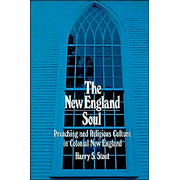
2012 LogoIn addition to our session "Reassessing the Significance of Religion in the Twentieth Century United States"  this Saturday afternoon at the American Historical Association, which I blogged about previously, here are a few more sessions for you to consider, ranging from a reconsideration of Harry Stout's New England Soul to papers on religious networks in the early modern Atlantic world. See some of you in Chicago! If you have a session that you particularly want to promote here, contact me and we should be able to put it up.

Also, and by the way, if you need something to do Saturday morning but you figure going to our session Saturday afternoon will suffice for your religious history needs, here's a cool session on digital history (follow the link for info), featuring some of the leading lights in presenting history in new ways, including Philip Ethington (who will be talking about geo-historical visualization), Katrina Gulliver (who will discuss her podcasts "Cities in History"), and Jennifer Serventi from the National Endowment for the Humanities.

New England Soul: Preaching and Religious Cultures in Colonial New England  -             By: Harry S. Stout    Harry Stout’s The New England Soul after 25 Years

American Society of Church History 9
Friday, January 6, 2012: 9:30 AM-11:30 AM
Promenade Ballroom A (Westin Chicago River North)
Chair:
Mark A. Noll, University of Notre Dame
Catherine A. Brekus, University of Chicago , James Byrd, Vanderbilt University , Thomas Kidd,Baylor University and Kenneth P. Minkema, Yale University

Comment: Harry S. Stout, Yale University
_______________________________________________
A Place for Grace: Religion and Contests of Identity in theMississippi River Valley, 1812–45

American Society ofChurch History 13
Friday, January 6,2012: 2:30 PM-4:30 PM
Jackson Park Room (Westin Chicago River North)
Chair:
Amanda Porterfield, FloridaState University
Papers:
Comment:
Comment: Amanda Porterfield, Florida StateUniversity
___________________________________________________________

Religious Networks, Alliances, and Friendship in the EarlyModern Atlantic World
AHA Session 109
Saturday, January 7,2012: 9:00 AM-11:00 AM
Los Angeles Room (Chicago Marriott Downtown)
Chair:
Ned C. Landsman, StonyBrook University
Papers:
"A Part ofOne's Soul": Spiritual Friendship and Evangelical Networks in EarlyAmerica
Janet M. Lindman, Rowan University

Comment: John Fea, Messiah College

Jumat, 14 Januari 2011

New Books on Religion in Postwar America

Randall Stephens

A recent email from Darren Dochuk about work on postwar American religious history got me thinking about what has been rolling off the presses in recent years. Judging from this year's AHA program--which Michael Atlman reflects on below--there's much good work being done on 20th-century American religion. So, with little effort, and with the knowledge that there are too many good books out there, I paste here some recent-ish and forthcoming titles that deserve attention. (For what it's worth, I completely nerded out on the last day of the AHA book exhibit. I think I did permanent damage to what passes for muscles in my arms. So many books, so little time to read them!) Some of the books below range over a wider period of time, but cover the 20th century nonetheless. Quite a few of these have been covered in some fashion on this site. Please add more . . .

Fay Botham, Almighty God Created the Races: Christianity, Interracial Marriage, and American Law (UNC, 2009)

Peter Goodwin Heltzel, Jesus & Justice: Evangelicals, Race, and American Politics (Yale, 2009)

Gary R. Bunt, iMuslims: Rewiring the House of Islam (UNC, 2009)

Paul D. Numrich, The Faith Next Door: American Christians and Their New Religious Neighbors (Oxford, 2009)

Darren Dochuk, From Bible Belt to Sunbelt: Plain-Folk Religion, Grassroots Politics, and the Rise of Evangelical Conservatism (Norton, 2010)

Bryan N. Massingale, Racial Justice and the Catholic Church (Orbis, 2010).

Philip Goff, ed., The Blackwell Companion to Religion in America (Blackwell, 2010)

David S. Bovée, The Church and the Land: The National Catholic Rural Life Conference and American Society, 1923–2007 (Catholic University of America, 2010)

Charles W. Dunn, The Future of Religion in American Politics (Kentucky, 2009)

Randall Balmer, The Making of Evangelicalism: From Revivalism to Politics and Beyond (Baylor, 2010)

Kathryn Lofton, Oprah:The Gospel of an Icon (California, 2011)

Andrew Finstuen, Original Sin and Everyday Protestants: The Theology of Reinhold Niebuhr, Billy Graham, and Paul Tillich in an Age of Anxiety (UNC, 2009)

Mark Noll, God and Race in American Politics: A Short History (Princeton, 2008)

Timothy Stanley, Kennedy vs. Carter: The 1980 Battle For the Democratic Party’s Soul (Kansas, 2010)

David Edwin Harrell, Jr., Pat Robertson: A Life and Legacy (Eerdmans, 2010)

Gary S. Selby, Martin Luther King and the Rhetoric of Freedom: The Exodus Narrative in America's Struggle for Civil Rights (Baylor, 2008)

Daniel Williams, God's Own Party: The Making of the Christian Right (Oxford, 2010)

David P. Gushee, Jillian Hickman Zimmer, and J. Drew Zimmer, eds., Religious Faith, Torture, and Our National Soul (Mercer, 2010)

Monica Weis, The Environmental Vision of Thomas Merton (Kentucky, 2011)

Jason W. Stevens, God-Fearing and Free: A Spiritual History of America's Cold War (Harvard, 2010)

Steven P. Miller, Billy Graham and the Rise of the Republican South (UPenn, 2009)

David W. Stowe, No Sympathy for the Devil: Christian Pop Music and the Transformation of American Evangelicalism (UNC, 2011)

Alan Petigny, The Permissive Society: America, 1941–1965 (Cambridge, 2009)

Hugh McLeod, The Religious Crisis of the 1960s (Oxford, 2010)

Kamis, 13 Januari 2011

My Notes from the 2011 AHA and ASCH meetings

By Michael J. Altman

I've seen more snow at home in Atlanta than I did up in Boston. Weird. I spent a whirlwind two days up in Boston for the meetings of the American Historical Association and its smaller, more religious cousin, the American Society of Church History. There was plenty of religious history goodness to be had, but alas, I was on a time crunch. I flew in early Friday, stayed the night and flew back late Saturday. Here are my random thoughts, observations, and notes from the various panels I attended and things I found to occupy my time drawn from scattered marginalia in my conference book.

Friday afternoon's panel on cosmopolitanism and the religious left at the turn of the 20th century was very good. John Pettegrew (Lehigh University) offered an interesting argument for Mark Twain as a religious liberal and for Twain's belief in empathy as a force that bound humanity together. For Twain, argued Pettegrew, empathy was war's opposite and it allowed for a universal humanity. Emily Mace's paper (Princeton) analyzed some intriguing ritual festivals in the life of New York's Ethical Culture School. These festivals organized around civic values of democracy and equality, as respondent Leigh Eric Schmidt pointed out, were anything but Durkheimian collective effervesance. Nonetheless, Mace's point that we must not neglect ritual in the study of liberal religions is well founded. Finally, my favorite paper--if only because it was closest to my own research--was that of Ann Marie Kittelstrom (Sonoma State University). Kittlestrom traced the history of the National Federation of Religious Liberals in the wake of the 1893 World's Parliament of Religion. In the NFRL and its successors, Kittlestrom sees the beginning of a real cosmopolitan pluralism that appreciated differences while still holding onto shared universals. Leigh Eric Schmidt (Harvard University) responded to all three papers in turn but for me his big take away was the importance of sympathy--in contrast to Pettegrew's empathy. Sympathy, according to Schmidt, was a rich moral/social sentiment for bridging differences and imaging a cosmopolitan sensibility in the 19th century among religious liberals. Sympathy could be found in the subjects of all three of the papers presented

Friday night the American Society of Church History held a reception for graduate students at the Congregational Library on Beacon Hill. It is a beautiful library and it was a nice chance to talk to colleagues also along the graduate school path. Kudos to the ASCH for doing this! What was even better was that the ASCH arranged for a small group of graduate students to have lunch or dinner with some great historians on Friday and Saturday--for free! So, after the reception at the library a few of us went to dinner with the great historian of Mormonism Jan Shipps. We had a wonderful dinner and Jan was truly delightful to spend time with. She can tell some amazing stories. On Saturday lunch was arranged with Charles Lippy and dinner with Keith Francis. Again, kudos to the ASCH for setting up these meals. I wasn't able to take part in any of them on Saturday but they were great opportunities and only available within a smaller society like the ASCH.

By the way, I do love the smaller and more intimate setting of the ASCH in the midst of the glitz and glamor of the AHA. It's really the best of both worlds. Sort of like Mayberry and Manhattan at the same time.

Saturday morning, I got up and headed to a roundtable chaired by our very own Randall Stephens on "Bracketing Faith and Historical Practice." The panel featured Randall Balmer, Margaret Bendroth from the Congregational Library, Jon Roberts, Grant Wacker, and Lauren Winner. I won't say much in case Randall wants to post something later. The main question the panelists addressed was whether or not (or even if) historians should bracket their religious beliefs when practicing their craft. Balmer and Winner seemed confused that this was even a question. For them, it was impossible not to bracket one's faith and so historians should be upfront about where they are coming from. Roberts disagreed and argued for "norms" that guide the practice of history and call for objective "historical natuarlism." Grant Wacker offered what I thought was the best argument. Wacker pointed out that there is no hard and fast rule and that various political and social situations will guide a historians decisions about what to disclose and what to use in their interpretation of historical events and agents. Randall Stephens did a good job as chair in relating the various comments and furthering the conversation but I kept getting the sneaking feeling that Roberts and Balmer/Winner were just talking past one another and really arguing about the value of reflexive methodology and not the role of belief in history writing. It was a good conversation, however, and one that will hopefully continue.

After the roundtable I rushed over to the Westin, where the ASCH panels were meeting. It was my turn. I was part of a panel on Methodist Media. The panel began with a paper from Erika K. R. Hirsch (Boston University) who analyzed the role of worship in early Methodism. Hirsch argued that the personal experiences afforded in hymn singing and corporate prayer provided authentication of genuine piety. She tied this desire for authenticity to an early modern emphasis on empirism and verification by the senses. My take away from Hirsch was that we need to pay more attention to the role of practice in British and American Methodism. Elizabeth Georgian (University of Delaware) also emphasized the role of practice in Methodism in her paper on Methodist print culture in the early nineteenth century. Georgian argued that practice, not theology, was the source of debates between Methodists and Presbyterians in their respective periodicals. David Scott (Boston University) brought in a transnational element with his paper on Methodist educational missions in Asia during the nineteenth century. Scott argued that Methodist missions focused on education overseas because they were so focused on education already on the home front. Educational missions were a key part of Methodist identity at home and abroad. Finally, I kept the missionary theme going with my own paper on the Methodist Christian Advocate. I argued that the Christian Advocate allowed Methodist readers to map out the distant land of India, make contact with Indian Hindus (especially women), and travel to the mission field alongside missionaries. The full paper is available here. Russell Richey dispensed with the usual "5th paper" style response, as he put it, and instead posed some refining questions to each paper. Overall, I thought the panel went well but it's always hard to tell when you're the one up there.

After my panel I ate lunch at California Pizza Kitchen and headed to airport. A few final thoughts on the overall conference. As Tenured Radical has noted, it was weird going to a conference in a mall. There was also a ridiculous number of Starbucks shops within the bounds of the conference. I also struggled to find WiFi all weekend, but that could have been my own ineptitude. In the end, it was a fun trip that involved little sleep and a lot of running around in glass walled skywalks.

Minggu, 02 Januari 2011

AHA's American Religion Sessions, Saturday-Sunday

Randall Stephens

I've copied and pasted below and the majority of the AHA sessions on American religion. The previous post covered Thursday and Friday. This one, much longer, has all the rest. The problem: too many great sessions in the same time slots. I suppose that's a good problem, right? (Apologies for the nutty formatting and the length of this!)

American Historical Association, Boston, MA, Saturday Jan. 8 - Sunday January 9

****Saturday, Jan. 8, 9:00–11:00 A.M.****

Rites and Rights of Passage: Enslaved Girls and
Women in the United States South and Barbados
Hynes Convention Center, Room 204
Sponsored by the AHA Committee on Minority Historians

Chair: Daina R. Berry, University of Texas at Austin
Papers: Badge of Slavery: Pubescent Female Slaves and Clothing
Courtney Moore, University of Florida
“Hanging Matters”: Enslaved Women, Bodily Punishments,
Death, and “Sacred Terror” in Urban Barbados
Marisa J. Fuentes, Rutgers University-New Brunswick
A Woman’s War Revised: Slave Women on the Civil
War’s Battlefi elds
Thavolia Glymph, Duke University
Comment: Jennifer L. Morgan, New York University

A Temple without Walls: Environmentalism as
“Secular Religion”
Marriott Boston Copley Place, Exeter Room
Joint session with the American Society for Environmental History

Chair: John L. Larson, Purdue University
Topics: Agnostic Gospels: Divining Nature in the Work of
Julian and Aldous Huxley
Richard Samuel Deese, Northeastern University
The Public Reception of Rachel Carson’s Silent Spring:
Rationality, Spirituality, and Interpretations of Nature
Michelle Mart, Pennsylvania State University at Berks
Parareligion, Earth Nationalism, and the Quest for the
Sacred in Nature
Bron Taylor, University of Florida
Environmental Morality and Artisanal Pork: Local
Food to Save the Planet
Thomas R. Dunlap, Texas A&M University
Comment: Sarah T. Phillips, Boston University

Words and Deeds: New Perspectives on Catholic
Laywomen in Twentieth-Century America
Marriott Boston Copley Place, Clarendon Room
Joint session with the American Catholic Historical Association

Chair: Carol Coburn, Avila University
Papers: “What a Blessing it is to be Fond of Reading Good
Books”: Reading Circles and Catholic Women in Turnof-
the-Century America
Monica Mercado, University of Chicago
“Up against a Stone Wall”: Gender, Power, and the
National Catholic Community Houses
Jeanne Petit, Hope College
The Ladies in Hats Have Their Say: The National
Council of Catholic Women, Vatican II, and the
Women’s Movement, 1962–75
Mary Henold, Roanoke College
Comment: Mel W. Piehl, Valparaiso University


Faithful Narratives: The Challenge of Religion in History
Hynes Convention Center, Room 209
Joint session with the American Society of Church History

Chairs: Andrea Sterk, University of Florida
Nina Caputo, University of Florida
Panel: Carlos Eire, Yale University
Susanna Elm, University of California at Berkeley
Phyllis Mack, Rutgers University-New Brunswick
Mark A. Noll, University of Notre Dame
John H. Van Engen, University of Notre Dame

Social and Political Utilizations of Gender and
Sexuality in African American Religion and
the Black Church
Marriott Boston Copley Place, Wellesley Room

Chair: Houston Roberson, Sewanee: University of the South
Papers: The Press and the Pulpit: Black Newspapers, Ministers,
and Sexuality, 1925–35
Kim Teresa Gallon, Muhlenberg College
“Guilty Partners”: Black Churches, Black Freedom, and
Black Sexuality in Postemancipation Virginia
Nicole Myers Turner, University of Pennsylvania
“Nothing Is Too Good for the Youth of Our Race”:
Black Nuns and the Struggle for Catholic Education in
the Jim Crow South
Shannen Dee Williams, Rutgers University-
New Brunswick
Comment: Tracey E. Hucks, Haverford College

American Catholic Historical Association Session 6
Cultural Conflicts, Cultural Change: Catholic
Higher Education in Twentieth-Century America
Marriott Boston Copley Place, Falmouth Room

Chair: David J. O’Brien, College of the Holy Cross
Papers: Surviving a Hostile Time: Catholic Higher Education
and the Second Ku Klux Klan in the 1920s
Bill Trollinger, University of Dayton
Advancing Christian Culture: Catholic Higher
Education and the Engendering of Theology
Sandra Yokum, University of Dayton
“A General Cultural Education Prior to Marriage”: The
Little-Known History of Catholic Junior Colleges
Fernanda Perrone, Rutgers University-New Brunswick
Comment: David J. O’Brien

American Society of Church History Session 21
Religion in the Great Depression: Global
Collapse, Local Crises
The Westin Copley Place, St. George Room D

Chair: Jon Butler, Yale University
Papers: In Every Cup of Bitterness, Sweetness: California
Christianity in the Great Depression
Jonathan Ebel, University of Illinois
The Redemption of Souls and Soils: Religion and the
Rural Crisis in the Mississippi Delta
Alison Collis Greene, Yale University
“God Is Not Affected by the Depression”: Pentecostal
Missions during the 1930s
Heather D. Curtis, Tufts University
Comment: Jon Butler

American Society of Church History Session 22
Retelling the History of American Christianities
The Westin Copley Place, Essex Ballroom Northwest

Chair: David G. Hackett, University of Florida
Papers: American Christianity in the Plural
Catherine A. Brekus, University of Chicago
Redeeming Modernity: Christian Theology in America
W. Clark Gilpin, University of Chicago
Christianity, National Identity, and the Contours of
Religious Pluralism
Tracy Fessenden, Arizona State University
Comment: David G. Hackett

Conference on Faith and History
Bracketing Faith and Historical Practice:
A Roundtable
Marriott Boston Copley Place, Maine Room

Chair: Randall J. Stephens, Eastern Nazarene College
Panel: Randall Balmer, Barnard College, Columbia University
Margaret Bendroth, Congregational Library (Boston)
Eugene B. McCarraher, Villanova University
Jon H. Roberts, Boston University
Grant Wacker, Duke University Divinity School
Lauren Winner, Duke University Divinity School
Comment: The Audience

****Saturday, Jan. 8, 11:30 A.M.–1:30 P.M.****

American Empire in Africa: Colonization,
Liberia, and a Benevolent Empire
Hynes Convention Center, Room 201

Chair: Ronald G. Walters, Johns Hopkins University
Papers: W.N. Lewis vs. Rev. John Seys: Power, Ideology, and
Race in Colonial Liberia
Matthew P. Spooner, Columbia University
“Benevolence” Abroad: The American Colonization
Society’s New Agenda, 1892–1964
Jennifer Walton-Hanley, Western Kentucky University
America in Africa: African Colonization and American
Empire, 1815–1925
Matthew J. Hetrick, University of Delaware
Comment: David Kazanjian, University of Pennsylvania

Suffering and the Sacred in American Society:
Protestant Debates about Faith and Affl iction
from the Puritans to the Present
Marriott Boston Copley Place, Grand Ballroom Salon A

Chair: Tracy Fessenden, Arizona State University
Papers: “Our Brethren lay bleeding”: Early New England
Responses to European Protestant Suffering
Adrian Weimer, University of Mississippi
The Question of Suffering: Debating Religion in the
American Prison, 1830–50
Jennifer Graber, College of Wooster
“The Whole Gospel for the Whole Man in the Whole World”:
Holiness Missionaries and the Healing of “Heathen” Suffering
Heather D. Curtis, Tufts University
Saving the World from Suffering: The Development of the
Christian Humanitarian Organization, World Vision
David King, Emory University
Comment: W. Clark Gilpin, University of Chicago

A Retrospective on the Scholarship
of Richard L. Bushman
Hynes Convention Center, Room 304
Joint session with the American Society of Church History
and the Mormon History Association

Chair: Grant Underwood, Brigham Young University
Panel: Catherine Kelly, University of Oklahoma
Laurie Maffl y-Kipp, University of North Carolina at
Chapel Hill
Harry S. Stout, Yale University
Gordon S. Wood, Brown University
Comment: Richard L. Bushman, Claremont Graduate University

Modernizing the Secular City:
Urban Planning and Social Identity
in the Americas, 1850–1950
Hynes Convention Center, Room 203
Joint session with the Conference on Latin American History

Chair: Mark A. Healey, University of California at Berkeley
Topics: El río Mapocho: espacio público e intervención
urbana en Santiago de Chile, 1885–1915
Simon Castillo Fernandez, Universidad de Chile
Migrantes andinos y esfera pública: el surgimiento
de los clubes regionales, Perú, 1850–1900
Jose Ragas, University of California at Davis
Transporte colectivo y políticas públicas: intervención,
nacionalización, estatización en Santiago de Chile,
1941–53
Marcelo Mardones Penaloza, Pontifi cia Universidad
Catolica de Chile
White Space, Black Place: The Transnational Imagined
Community of the Black Press in São Paulo and Chicago,
1900–50
Cristian Castro, University of California at Davis

Entering by the Narrow Gate: Catholicism and
American Identity in the Early Republic
Marriott Boston Copley Place, Tremont Room

Chair: Nancy L. Schultz, Salem State College
Papers: “This wretched set of people, the Catholics”: Harriett
Low’s Unitarian Bookshelf, China, 1829–34
Kimberly Alexander, Strawbery Banke Museum
American Slavery, American Freedom, American Catholicism
Maura Jane Farrelly, Brandeis University
Manifest Destinations: Contesting Catholicism in Early
American Travelogues
Dane A. Morrison, Salem State College
Comment: The Audience

American Society of Church History Session 26
Methodist Media: Comparing Means of Communicating the Message
The Westin Copley Place, St. George Room C

Chair: Richard P. Heitzenrater, Duke University
Papers: Evangelical Encounters: Authenticity in Early
Methodist Worship
Erika K. R. Hirsch, Boston University
An Evangelical Public Relations Campaign: The
Methodist Episcopal Church and Print Culture,
1792–1834
Elizabeth A. Georgian, University of Delaware
“The Spirit-Filled Teacher”: Methodist Educational
Missions in Nineteenth-Century Asia
David W. Scott, Boston University
Methodists and India: Mapping, Contact, and Travel
in the Christian Advocate, 1860–90
Michael J. Altman, Emory University
Comment: Russell E. Richey, Emory University

American Society of Church History Session 27
Christianity and Global Sociopolitical Action
The Westin Copley Place, St. George Room D

Chair: J. Michelle Molina, Northwestern University
Papers: The First Reactions to the World Council of Churches’
Program to Combat Racism
Antti Laine, University of Helsinki
The Political Vision of Latin America’s Catholic Youth,
c. 1900–50
Stephen Andes, St. Antony’s College, Oxford
Ties That Bind: The International Sister Church
Movement among American Christians, 1980–2008
Janel Kragt Bakker, Catholic University of America
Comment: J. Michelle Molina

****Saturday, Jan. 8, 2:30–4:30 P.M.****

Transplanting the Sacred: Missionary and
Immigrant Uses of Religion in Foreign Lands
Marriott Boston Copley Place, Exeter Room

Chair: Rick Kennedy, Point Loma Nazarene University
Papers: Women and the Sacred in the Transatlantic Religious
Marketplace of the Nineteenth Century: An Exploration of
Catholic, Jewish, and Protestant Women’s Religious Societies
Loretta Long Hunnicutt, Pepperdine University
Roman Catholics in the Wild West: Immigrant
Missionary Priests in Gold Rush California
Bryan J. Lamkin, Azusa Pacifi c University
Building and Rebuilding the African Church: French
Catholic Missionaries in Interwar Colonial Algeria
Bradley R. Hale, Azusa Pacifi c University
Syncretistic Americanism: Evangelical Missions and the
Reconstruction of Postwar Japan
Jon P. DePriest, San Diego Christian College
Comment: Erik C. Maiershofer, Hope International University

Sacred Mountains: How Science, Medicine, and Leisure Transformed Alpine Spaces into Spiritual Places
Hynes Convention Center, Room 308

Chair: Susan Schrepfer, Rutgers University-New Brunswick
Papers: Holy Mountains and Hollow Men: The Search for
Sanctuary in the Eastern Alps
Tait Keller, Rhodes College
Medicinal Mountains and Curative Climates: How
Physicians Made the Andes Sacred
Mark Carey, University of Oregon
Claiming Nature through Risky Behavior: How the
Leisure Class Appropriated the Rocky Mountains and
Found Transcendence in the Process
Diana Di Stefano, Bucknell University
Comment: Michael F. Robinson, University of Hartford

Sacralizing Rebels, Riots, and Rituals: Early Veneration of the American Revolution
Marriott Boston Copley Place, Grand Ballroom Salon A

Chair: Simon Finger, McNeil Center for Early American Studies
Panel: Zara Anishanslin, College of Staten Island,
City University of New York
Katherine Jorgensen Gray, Johns Hopkins University
Elizabeth Milroy, Wesleyan University
Comment: Simon Finger

Why Study Religion in the American West?
Hynes Convention Center, Room 311

Chair: Tisa J. Wenger, Yale University
Topics: A Western Theme to American Religious History?
David W. Wills, Amherst College
Taking the West Seriously in American Religious History
Quincy D. Newell, University of Wyoming
Borderlands Religion and the American West
Roberto Lint Sagarena, Middlebury College
Sacred but Not Religious: Finding Religion in the West
and the West in Religion
James B. Bennett, Santa Clara University
Getting Religion: New Themes for the Study of the
American West
Tisa J. Wenger

Women and Electoral Politics in the Long 1920s: Race, Gender, and Political Culture
Marriott Boston Copley Place, Orleans Room

Chair: Alison M. Parker, The College at Brockport (State
University of New York)
Topics: “Too Pure for Politics?”: Women, Nonpartisanship, and
the Hughes Campaign Train of 1916
Laurie Kozakiewicz, University at Albany
(State University of New York)
“Scared from the Polls”: Boston African American
Women, Disenfranchisement, and the 1920
Massachusetts Legislative Elections
Julie de Chantal, University of Massachusetts Amherst
Mapping Black Women’s Local and National Politics in
1920s Washington, D.C.
Mary-Elizabeth B. Murphy, University of Maryland
at College Park
Racial Uplift Is Not Enough: Nannie Helen Boroughs
and “Gender Uplift”
Courtney Lyons, Baylor University
Comment: Gayle Gullett, Arizona State University

American Society of Church History Session 29
Faith in the City: Urban Religions and the
Narratives of Modernity
The Westin Copley Place, St. George Room B

Chair: Wallace Best, Princeton University
Papers: Doers of the Word: Adult Bible Classes and Urban
Reform in the Progressive Era
Christopher D. Cantwell, Cornell University
“Official Host of the Son of God”: Visions of a Catholic
America at Chicago’s International Eucharistic Congress
Matthew John Cressler, Northwestern University
“Thy Neighbor as Thyself ”: Religious Uplift and the
Reform Work of Lugenia Burns Hope in Atlanta
James R. Young Jr., Princeton University
Comment: Kathryn Lofton, Yale University

American Society of Church History Session 30
Things True and Useful: Writing History in
the Mormon Tradition
The Westin Copley Place, St. George Room C

Chair: Susanna Morrill, Lewis and Clark College
Papers: History Thrown into Divinity: Faith, History, and the
Founding Events of Mormonism
Matthew Bowman, Georgetown University
“A New Order of Things”: Polygamy, Faith, and Scholarship
John G. Turner, University of South Alabama
“We’re Not the Mormons”: Alterity and Church History
in the Community of Christ
David J. Howlett, Kenyon College
Comment: Susanna Morrill

American Society of Church History Session 31
Religious Intolerance in American History
The Westin Copley Place, St. George Room D

Chair: Heather D. Curtis, Tufts University
Panel: Chris Beneke, Bentley College
John Corrigan, Florida State University
Jon F. Sensbach, University of Florida
Rachel Wheeler, Indiana University-Purdue
University Indianapolis
Comment: The Audience

****Sunday, Jan. 9, 8:30–10:30 A.M.****

Exploiting the Fear of Violence: Creating Solidarity during the Revolutionary and Post-Revolutionary Era
Marriott Boston Copley Place, Exeter Room

Chair: Robert M. Calhoon, Journal of Backcountry Studies
Papers: The Use of Violence in Revolutionary Boston
Benjamin L. Carp, Tufts University
Religious Violence and Religious Liberty in the Early
National United States
Chris Beneke, Bentley College
Loyalist Lessons from the “Unnatural Rebellion”
Ruma Chopra, San Jose State University
Comment: Pauline Maier, Massachusetts Institute of Technology

Beyond the Protestant Nation: Religion and the Narrative of American History
Hynes Convention Center, Room 110

Chair: Christopher D. Cantwell, Cornell University
Panel: Catherine L. Albanese, University of California at
Santa Barbara
Lila Corwin Berman, Temple University
Wallace Best, Princeton University
Richard L. Bushman, Claremont Graduate University
Robert Orsi, Northwestern University

Refugee Politics: New Research on European Jewish Refugees in the 1930s and 1940s
Marriott Boston Copley Place, Berkeley Room
Joint session with the Conference Group for Central
European History

Chair: Jeffry M. Diefendorf, University of New Hampshire
Papers: Refugee Status and Immigration Law before and after
the Evian Conference
Diane Afoumado, United States Holocaust
Memorial Museum
Emigration of Elderly Jews from Vienna to the United
States, 1938–41
Melissa Jane Taylor, Offi ce of the Historian, U.S.
Department of State
The Voyage of the St. Louis Revisited
C. Paul Vincent, Keene State College
Comment: Jeffry M. Diefendorf

Boundaries of Bondage, Frontiers of Freedom: Mobility and Slavery, Race, Nation, and Religiosity in the Atlantic World
Marriott Boston Copley Place, Grand Ballroom Salon A
Joint session with the Conference on Latin American History

Chair: Stephanie M. Camp, Rice University
Papers: Uncommon Winds: Race, Passports, and the Legal
Culture of Travel in Cuba
David A. Sartorius, University of Maryland at
College Park
Across the Miles: Slavery, Mobility, and the Law in
Nineteenth-Century Cuba
Camillia Cowling, University of Nottingham
“Where I Can Show Myself to Be a Man”: Christianity,
Colonization, and Gender Conventions among African
American Emigrants to Liberia, 1830–60
Jessica Millward, University of California at Irvine
“A New Canada”: A Maritime Route to Freedom in
Northeastern Brazil
Celso Castilho, Vanderbilt University
Comment: The Audience

Locating the Origins of the Second Vatican Council: Global Transformations, Spatial Shifts, and Refashioning
the Sacred in Twentieth-Century Catholicism
Hynes Convention Center, Room 102
Joint session with the American Catholic Historical Association

Chair: Terence Fay, Toronto School of Theology for St.
Augustine’s Seminary and the University of St.
Michael’s College at the University of Toronto
Topics: The Dynamic 1950s: The American Laity before Vatican II
Timothy Kelly, Saint Vincent College
From Mothers to Experts: Catholic Women’s
Contribution to the Second Vatican Council
Agnès Desmazières, Sciences Po Paris
In the Shadow of the Vatican: Producing and Defi ning
the Spirit of the Second Vatican Council in a Florentine
Parish, 1954–69
Trevor Kilgore, University of Michigan
Repositioning the Sacred: Roman Catholic Church
Architecture in Britain and the Second Vatican Council
Robert Proctor, Mackintosh School of Architecture,
Glasgow School of Art
Decolonization of the Filipino Church
Terence Fay

An Imperial Gaze at the Sacred Myth of American Exceptionalism
Hynes Convention Center, Room 204

Chair: Elizabeth Mancke, University of Akron
Panel: Daniel Byrne, University of Evansville
Lisa K. Jarvinen, La Salle University
Timothy Roberts, Western Illinois University
Patricia Rogers, Michigan State University
Comment: Cary Fraser, Pennsylvania State University

Responses of Native Americans and African Slaves to Atlantic Missions
Marriott Boston Copley Place, Simmons Room

Chair: Erik R. Seeman, University at Buffalo (State University of New York)
Papers: A Seventeenth-Century French Capuchin Mission among
the Tupinambá Indians of Brazil: Atlantic Perspectives
and Comparative Insights
Celine Carayon, Utah Valley University
Reassessing the Beginnings of Evangelical Protestantism
among Slaves in the Carolina Lowcountry
Aaron Fogleman, Northern Illinois University
“Translated from the Dominions of Darkness”: Native
Missionaries, Language, and Scientifi c Authority in the
Nineteenth Century
Sean P. Harvey, Seton Hall University and American
Antiquarian Society
Comment: Rachel Wheeler, Indiana University-Purdue
University Indianapolis

‘Au‘a ‘Ia: Native Hawaiian Remembering
Hynes Convention Center, Room 303

Chair: Momi Kamahele, University of Hawai‘i-Leeward
Community College
Topics: Sacred Text: The Power of Oli
Momi Kamahele
Kamehameha the Great’s Spiritual Conquest
Genai Keli‘ikuli, University of Hawai‘i-Leeward
Community College
The Kumulipo: Chanting Power and Knowledge
Luukia Archer, University of Hawai’i-Leeward
Community College
Comment: Mansel Blackford, Ohio State University

Unconventional Virtues: Ecstasy, Quilts, and Food in American Society and Culture
Hynes Convention Center, Room 306

Chair: J. C. Burnham, Ohio State University
Papers: Sacred Ecstasy: Revivals, Reproduction, and Salvation
in America
Kathy J. Cooke, Quinnipiac University
“Conserve Food to Save Yourselves”: The Politics of
Religion in World War I Food Conservation
Helen Veit, Michigan State University
Preserving Virtue: Quilts as Symbols of Lost Values
Karin E. Gedge, West Chester University

American Catholic Historical Association Session 12
Twentieth-Century American Catholicism
Addresses the Social Question: Three Vignettes
Marriott Boston Copley Place, Hyannis Room

Chair: Jeffrey M. Burns, Academy of American
Franciscan History
Papers: Father Nelson Baker’s Fight with the State of New York
Richard Gribble, Stonehill College
Get[ting] a Clean Victory? The Nonviolent Spirituality
of Dorothy Day and Cesar Chavez
Anne Klejment, University of St. Thomas
In the Matter of Karen Ann Quinlan: Catholicism and
the Ethics of Life and Death in the 1970s and Beyond
James P. McCartin, Seton Hall University
Comment: Jeffrey M. Burns

American Society of Church History Session 35
Alternative Social Gospels: Unconventional
Sources of Protestant Reform in a Transatlantic
Context, 1877–1930
The Westin Copley Place, St. George Room C

Chair: Bill Trollinger, University of Dayton
Papers: Abraham Kuyper’s Social Gospel
James Bratt, Calvin College
“Non-Partisan Christians”: The Moral Imperative of
Social Reform and the Power of Unexpected Alliances in
Chicago, 1893–1925
Sarah Miglio, University of Notre Dame
The Social Gospel in Pittsburgh, 1916–30
Tyler B. Flynn Jr., Eastern University
Comment: Bill Trollinger

****Sunday, Jan. 9, 11:00 A.M.–1:00 P.M.****

No Sacred Story: Reframing Abraham Lincoln in Historical Memory
Hynes Convention Center, Room 103

Chair: W. Fitzhugh Brundage, University of North Carolina
at Chapel Hill
Papers: “Man Up, Lincoln”: Gender and Image in Civic Life
Leslie J. Lindenauer, Western Connecticut
State University
Martha E. May, Western Connecticut State University
Was Abraham Lincoln Gay? A History of Intense Identifi cations
Christopher Castiglia, Pennsylvania State University
“Serving the Lord and Abe Lincoln’s Spirit”: Lincoln
and Memory in the WPA Narratives
David A. Silkenat, North Dakota State University
Comment: David W. Blight, Yale University

In Life and Death: The Sacred Ties of Friendship in the Early United States
Hynes Convention Center, Room 109

Chair: Jan E. Lewis, Rutgers University-New Brusnwick
Papers: Faithful Friends: The Sacred Ties of Heterosocial
Friendship in the Early American Republic
Cassandra A. Good, University of Pennsylvania
Burn This: Preserving Private Papers in the Early
United States
Alea R. Henle, University of Connecticut
Spirit Politics: Antebellum Reform and the Shape of
American Spiritualism
Robert K. Nelson, University of Richmond
Comment: Mary L. Kelley, University of Michigan

Uncovering the “Religious” in Religious History
Marriott Boston Copley Place, Clarendon Room

Chair: Mark McGarvie,
University of Richmond
Topics: Why is Religion Always About Something Else?
Richard Schaefer, Plattsburgh
(State University of New York)
Religious History as Religious Studies
Kathryn Lofton, Yale University
Religious History as Intellectual History
Mark McGarvie
Using Religion to Teach History Teachers
John White, University of Dayton

Therese Neumann: Modern Stigmatic, International Cult Figure, and Anti-Nazi Symbol
Hynes Convention Center, Room 204
Joint session with the American Catholic Historical Association

Chair: Kevin P. Spicer, Stonehill College
Papers: Konnersreuth, USA: American Catholics and the Cult
of Therese Neumann
Paula M. Kane, University of Pittsburgh
The Issue of Resistenz: Therese Neumann and Her
Circle During the Era of National Socialism
Ulrike Wiethaus, Wake Forest University
Sacred, Secular, or Fraudulent: Competing Representations
of the Therese Neumann Phenomenon in Germany
Michael E. O’Sullivan, Marist College
Comment: Thomas A. Kselman, University of Notre Dame

Martyrs, Memorials, Pageants, and Parades: Race and the Politics of Remembering (and Forgetting) in Nineteenth-Century America
Marriott Boston Copley Place, Simmons Room

Chair: David Glassberg, University of Massachusetts at Amherst
Papers: Race, Empire, and the Forgotten War: Why
Nineteenth-Century Americans Had So Much Trouble
Remembering Their 1846 War with Mexico
Amy Greenberg, Pennsylvania State University
“Here Triumphed in death ninety Christian Indians”:
Commemorating the Massacre of Moravian Indians at
Gnadenhutten, Ohio, 1782
Karin L. Huebner, Early Modern Studies Institute,
Huntington Library and University of Southern
California
A Pure and Sublime Monument to Washington: Race,
National Identity, and the Washington National
Monument in the Antebellum Era
Jeffrey A. Kosiorek, Hendrix College
Comment: Sarah J. Purcell, Grinnell College

The Influences of Slavery on Colonial Christianity
Hynes Convention Center, Room 308

Chair: Christine Leigh Heyrman, University of Delaware
Papers: The Politics of Conversion: The International
Moravian Baptismal Controversy in the 1750s
Katherine Gerbner, Harvard University
“In the time of war no French Negroes ever run away
from their Masters”: British Discourses of Slave Religion
and Loyalty Following the Seven Years’ War
Maria Alessandra Bollettino, Framingham State College
“God’s Just Judgment”: The Infl uence of Slave Resistance
on the Religious Discourses of the First Great Awakening
Justin James Pope, George Washington University
Comment: Jon F. Sensbach, University of Florida

American Catholic Historical Association Session 16
American Catholics and Print Culture
Marriott Boston Copley Place, Hyannis Room

Chair: Carrie T. Schultz, Boston College
Papers: The Making of “Ours”: Religious Life as Described in
Jesuit Custom Books
Casey C. Beaumier S.J., Boston College
Januarius De Concilio and the American Catechism:
New Evidence Questioning the Authorship of the
Baltimore Catechism
Biff Rocha, Benedictine College
Indiana’s Catholic Print Culture and Anti-Catholic
Movements in the 1920s
Joseph White, Catholic University of America
Comment: Carrie T. Schultz

American Society of Church History Session 36
The Formation of Protestant Identities through Book Selling (and Burning)
The Westin Copley Place, St. George Room A

Chair: Katherine Carté Engel, Texas A&M University
Papers: One Prophecy, Three Sybils: How Booksellers Shaped
the Literary Culture of Ursula Shipton, 1641–49
Joshua A. Kercsmar, University of Notre Dame
“Justly Offencive”: Banning Books in Puritan
Massachusetts
David Powers, independent scholar
Printing a Public: Evangelical Book Publishers and
the Emergence of the Twentieth-Century Evangelical
Coalition
Daniel Vaca, Columbia University
Comment: Katherine Carté Engel

American Society of Church History Session 37
Strangers in an Ever-Stranger Land: Evangelicals Confront New England, 1834–1937
The Westin Copley Place, St. George Room B

Chair: Dana L. Robert, Boston University
Papers: Fifty-Six Years of Circuit Riding in New England:
William Gordon and the Vicissitudes of Nineteenth-
Century Methodism
Brian Curtis Clark, Hartford Seminary
Charles Cullis, Gaetano Conte, and the Reconfi guration of
the Evangelical Holiness Movement in Boston, 1860–1905
Benjamin Hartley, Palmer Theological Seminary,
The Seminary of Eastern University
“It Is a Battle-Royal”: A. Z. Conrad’s Preaching at Park
Street Church, Boston, during the Fundamentalist-
Modernist Controversy
George W. Harper, Asia Graduate School of
Theology, Philippines
Comment: John G. Turner, University of South Alabama

American Society of Church History Session 38
Authors Meet Critics: Christian Nonviolence in the Twentieth Century
The Westin Copley Place, St. George Room C

Chair: Leilah Danielson, Northern Arizona University
Panel: A. J. Ballou, Boston University
Dan McKanan, Harvard University
Comments: Patricia Appelbaum, Springfield College
Joseph Kip Kosek, George Washington University

Conference on Latin American History Session 57
Franciscans, Indigenous Peoples, and the Battle for the Sacred in Colonial New Spain
The Westin Copley Place, North Star Room

Chair: Jeffrey M. Burns, Academy of American
Franciscan History
Papers: Spiritual Re-Conquests: The Franciscan Order and the
Continued Extirpation of Maya Idolatry, 1570–1670
John F. Chuchiak IV, Missouri State University
Religion and Trade: The Native Revolt of 1790 Against
the Franciscans in the Upper Amazon Frontier
Rick Goulet, Lock Haven University of Pennsylvania
One God, One Faith, One Baptism
Mark Zinn Christensen, Pennsylvania State University
Comment: Karen Melvin, Bates College

Selasa, 28 Desember 2010

AHA Interviewing Advice and Some More Sessions of Note

Paul Harvey

Randall posted a few days ago about some sessions of note in religious history at the upcoming American Historical Association/American Society of Church History meeting, Jan. 6-9 in Boston. I thought I would note in addition, first, that for you graduate students who follow the blog here, Tenured Radical and John Fea both have posted excellent suggestions for job interviewing at the AHA, no one's favorite thing to do for sure but the suggestions here are valuable (I think I made every single mistake that Tenured Radical warns you against back in my day; wish someone had told me this then).

Also, a couple of our commentators here added a couple more sessions of interest in addition to those which Randall posted, and I thought I would repost those here for those who didn't see the comments on that post so wouldn't have seen those sessions noted.

1. The Black Women's Intellectual History Project is sponsoring a session on Friday morning (Jan. 7) from 9:30-11:30 on transnational perspectives on black women's religious leadership. Jon Sensbach, Natasha Lightfoot, and Eve Troutt Powell will be giving papers.

2. Cosmopolitanism and Religion in the Turn of the Twentieth Century U.S. Left
AHA Session 102
Society for Historians of the Gilded Age and Progressive Era 3
Friday, January 7, 2011: 2:30 PM-4:30 PM
Orleans Room (Marriott Boston Copley Place)

Chair:
Elisabeth Lasch-Quinn, Syracuse University

Papers:
“Has He Paused and Taken Thought?” Mark Twain's "War Prayer," Pacifism, and the Impact of Empathy
John Pettegrew, Lehigh University
Spiritual Unity, Social Progress: The National Federation of Religious Liberals and the Legacy of the 1893 World's Parliament of Religions
Amy Marie Kittelstrom, Sonoma State University
Holidays for Humanity's Future: Festivals at New York's Ethical Culture School, 1890–1920
Emily Mace, Princeton University

Comment:
Leigh Eric Schmidt, Harvard University

Rabu, 15 Desember 2010

Thur and Fri Sessions on American Religion at the Jan 2011 AHA

Randall Stephens

I think it would be safe to say that the American Historical Association annual meeting has never featured as many panels on religious history (with loads devoted to American religious history) as the 2011 conference does. I paste many of these below, though I've probably missed some. I was unable to get the "chair" and "comment" notes on here. But, you can get a general picture of the range of panels. I've only gone through Thursday and Friday. Will post the rest later.

THURSDAY, JAN 6, 3:00-5:00pm


The Ku Klux Klan of the 1920s: Activist Protestants or Intolerant Americans? Hynes Convention Center, Room 103

Joint session with the Immigration and Ethnic History Society Evelyn Sterne, University of Rhode Island
“We Put the Bible in the Schools”: The Ku Klux Klan on Minnesota’s Mesabi Iron Range David J. LaVigne, College of St. Benedict and St.
John’s University
The Ku Klux Klan Confronts New England Catholics in the 1920s Mark P. Richard, Plattsburgh (State University of New York)
The Hooded Schoolhouse: School Reform, State- Building, and Cultural Intolerance in the 1920s Thomas R. Pegram, Loyola University Maryland
Leonard Moore, McGill University

The Righteous Fast: Nation of Islam, Mormon, Jewish, and Christian Perspectives Marriott Boston Copley Place, Fairfield Room

Amy Bentley, New York University
The Role of Public Humiliation and Fasting in Sixteenth- and Seventeenth-Century Disaster Ken Albala, University of the Pacific
The Interplay of Scientific and Religious Authorities in Mormon and Nation of Islam Fasting Practices Kate Holbrook, Boston University
The Feast at the End of the Fast: Yom Kippur’s Break Fast Rituals and American Judaism Nora Rubel, University of Rochester
R. Marie Griffith, Harvard Divinity School

The State of Abolition Studies: From the Sacred to the Secular? Hynes Convention Center, Room 306

Chair:David B. Davis, Yale University Panel: Christopher L. Brown, Columbia University
Stephen Kantrowitz, University of Wisconsin-Madison James Sidbury, University of Texas Manisha Sinha, University of Massachusetts at Amherst John W. Stauffer, Harvard University

Keywords in American Religious History: Diaspora, Sexuality, Liberalism, Pentecostalism, Martyr
Hynes Convention Center, Room 303

David Harrington Watt, Temple University
Diaspora
Elizabeth McAlister, Wesleyan University
Sexuality
Kathryn Lofton, Yale University
Liberalism
Matthew S. Hedstrom, University of Virginia
Pentecostalism
Randall J. Stephens, Eastern Nazarene College

American Society for Eighteenth-Century Studies
Religion, War, and Nation: Philadelphian Quakers in the Revolutionary Atlantic Marriott Boston Copley Place, MIT Room

Jenna Gibbs, Florida International University
Cowards, Cheats, Conspirators: The Anti-Quaker Campaign in Philadelphia, 1775–1800 Sarah Crabtree, Fairleigh Dickinson University
Reading, Writing, Working, and Sailing: Finding the Haitian Revolution in a Quaker Household James Alec Dun, Princeton University
Richard Godbeer, University of Miami

American Society of Church History Session 4 Mormon History Association Session 1
Women’s Ritual and Religious Authority in Early Mormonism
The Westin Copley Place, St. George Room D

Philip Barlow, Utah State University
Nineteenth-Century LDS Marital Rites and the Not- So-Patrilineal Family Kathleen Flake, Vanderbilt University
Eliza R. Snow and the Expression of Female Authority in Nineteenth-Century Mormonism Jill M. Derr, Brigham Young University
Women’s Birth and Death Rituals in the Lived Religion of Mormonism, 1870s–1920s Susanna Morrill, Lewis and Clark College
James Hudnut-Beumler, Vanderbilt University

FRIDAY, JAN 7, 9:30-11:30am

Sanctifying Social Struggles across the Mid-Twentieth-Century South
Hynes Convention Center, Room 311

Lisa McGirr, Harvard University
The Christian Left, Agricultural Labor Unions, and the Sacralization of Rural Life in the 1930s Alison Collis Greene, Yale University
Prophetic Front: New Era School of Social Action and Prophetic Religion and the Fight Against Jim Crow in the 1930s Jarod Roll, University of Sussex
Restructuring, Religion, and Antiunionism in the Post- World War II Upland South Ken Fones-Wolf, West Virginia University Elizabeth Fones-Wolf, West Virginia University
James R. Green, University of Massachusetts at Boston

Same-Sex Marriage in Historical and Transnational Perspective
Hynes Convention Center, Room 111
Joint session with the Committee on Lesbian, Gay, Bisexual, and Transgender History

Kenneth Sherrill, Hunter College, City University of New York
“Out of the closets and into the chapels!”: Same-Sex Weddings and the Battle for Marriage Equality Karen M. Dunak, Muskingum University
“Don’t Forget that Matrimony is a Holy Act, Even When It Is a Civil Ceremony”: Changes in Sexual Norms and the Conceptualization of Gay Families in Scandinavia Since the 1990s
Jens Rydstrom, Centre for Gender Studies, Lund University
Marriage and American Citizenship: Polygamy and Same-Sex Marriage Christine Talbot, University of Northern Colorado
Felicia A. Kornbluh, University of Vermont

Sacred Politics: Rethinking the Rise of the Religious Right
Marriott Boston Copley Place, Tremont Room
Joint session with the American Society of Church History R. Marie Griffith, Harvard Divinity School

Carl McIntire and the Anticommunist Origins of the Religious Right Markku Ruotsila, University of Helsinki
God’s New Grand Narrative: The Intellectual Mobilization of the Religious Right, 1970–2000 Molly Worthen, Yale University
When the Religious Right Almost Turned Left: Born- Again Activism before the Moral Majority Darryl G. Hart, Temple University
Leo P. Ribuffo, George Washington University

American Society of Church History Session 8
Religion and the Reforming Spirit in America
The Westin Copley Place, St. George Room C

Dan McKanan, Harvard University
Subcultural Expertise and the Limits of Reform in America
Dana Logan, Indiana University
Profits of Religion: Anticlericalism and the Labor Movement
Kip Richardson, Harvard University
Reforming Sex: C. Everett Koop and the Moral Politics of Public Health Anthony Petro, New York University
Dan McKanan

FRIDAY, JAN 7, 2:30-4:30pm

Sacred Belief, Secular Action: The Politics of African American Religions in the Early Anglo-Atlantic World Hynes Convention Center, Room 101

Gregory T. Knouff, Keene State College
“We Expect Great Things”: Puritanism, Black Petitioning, and the Origins of American Abolitionism Christopher Cameron, The University of North
Carolina Charlotte
“Has God appointed us as their slaves?” Black Reformers and Sacred Politics, 1787–1807 Dianne W. Cappiello, Cornell University
“The Bad Thing”: Obeah and the Politics of Afro-Caribbean Religion among Slaves in Berbice (British Guiana) Randy M. Browne, University of North Carolina at
Chapel Hill
Jason R. Young, University at Buffalo (State University of New York)

Revisiting the Teaching of Religious History Hynes Convention Center, Room 103

Janet Bordelon, New York University
Teaching Sacred Literature in Secular Spaces
Janet Bordelon
Teaching American Religion at a State University in the Bible Belt, Part 1 Keith A. Pacholl, University of West Georgia
Teaching American Religion at a State University in the Bible Belt, Part 2 Daniel K. Williams, University of West Georgia
Wanting to Be Standardized: State Standards, Standardized Tests, and the Teaching of Buddhism Thomas W. Barker, University of Kansas

Publishing the Sacred: The Religious Uses of Popular Print in Early America Hynes Convention Center, Room 311

Robert A. Gross, University of Connecticut
The Neo-Platonist of New Jersey: Daniel Leeds, Mystic, Schismatic Sara S. Gronim, Long Island University,
C.W. Post Campus
“Heavens” and “Firmament”: Popular Science and “Declaring the Glory of the Lord” in Christian Periodicals in the Early American Republic Lily Santoro, University of Delaware
Debunking Denominationalism in Early American Religious History T. J. Tomlin, University of Northern Colorado
Daniel A. Cohen, Case Western Reserve University

American Society of Church History Session 14
Rethinking American Slavery and the History of Christianity
The Westin Copley Place, St. George Room D

John W. Stauffer, Harvard University
From Slave Trader to Abolitionist: “Quaker Tom” Robinson of Newport, Rhode Island Elizabeth Cazden, independent scholar
Francis Wayland, Religion, and Antislavery in America, 1830–65 Matthew Hill, Gordon College
“These Silken Ties”: Ecclesiastical Compromise and the Problem of Slavery in the Presbyterian Schism of 1837–38 Adam Borneman, independent scholar
The 1857–58 Businessmen’s Revival and Slavery, the Elephant in the Room Mark Draper, Trinity International University
John W. Stauffer

American Society of Church History Session 16
Narratives of Contemporary Christian Expansion
The Westin Copley Place, Essex Ballroom Northeast

Ann D. Braude, Harvard Divinity School
The Other Camp of the Saints: Comparing Christian and Muslim Narratives of Global Expansion in the Modern Era Philip Jenkins, Pennsylvania State University
What Happens Beyond Christendom?
Mark A. Noll, University of Notre Dame
Twentieth-Century Mission Studies and the Narrative of “World Christianity” Dana L. Robert, Boston University
The Audience

Jumat, 03 Desember 2010

CFH Session at the 2011 AHA

Randall Stephens

If you're heading up to Boston for the AHA in early January, make time for the Saturday morning Conference on Faith and History affiliate session:

Bracketing Faith and Historical Practice: A Roundtable

Saturday, January 8, 2011: 9:00 AM-11:00 AM

Marriott Boston Copley Place, Maine Room

Chair: Randall J. Stephens, Eastern Nazarene College

Speaker(s):
Randall Balmer, Barnard College, Columbia University
Margaret Bendroth, Congregational Library (Boston)
Eugene B. McCarraher, Villanova University
Jon H. Roberts, Boston University
Grant Wacker, Duke University Divinity School
Lauren Winner, Duke University Divinity School

Comment: The Audience

More on the session: The question of the appropriate relationship between a historian's belief and the craft of history has received much recent attention. It is a question that has occupied the Conference on Faith and History since its inception in the late 1960s, with much of the CFH's conversation focusing on how to integrate faith and historical practice to avoid compartmentalization. At this year's CFH/AHA session we continue the conversation but from a different point of entry: the value of and reasons for bracketing out religious commitments. What is gained (or lost) when believing historians bracket out matters of faith? Is it best (or even possible) for historians--of whatever faith or no faith at all--to shelve religious belief and metaphysics when writing history? What is lost (or gained) when the religious commitments of historians are reflected in their work?

Passages like the following might serve as jumping off points for the discussion:

"[Anglo-Hegelian philosopher Francis Herbert] Bradley identified the will to truth in history with anti-supernaturalism and viewed our scientific standards as naturalistic. He believed that our norms must regulate our understanding of the past. But, he also presumed, historians had permanently discarded norms that allowed for supernaturalism. 'Critical history' methodologically centered on the will to truth, and the will to truth would also inevitably rule out the supernatural. . . . Historians of faith abide by the professional rules, but as Christians they have their own private outlook on what was going on when the Romans brought Jesus down from the cross." Bruce Kuklick, "Religion, Progress, and Professional Historians," Historically Speaking (September/October 2007): 18.

"One may say, therefore, that religion appears in history both as a world-maintaining and as a world-shaking force. . . . In all its manifestations, religion constitutes an immense projection of human meanings into the empty vastness of the universe--a projection, to be sure, which comes back as an alien reality to haunt its producers. . . . Within this frame of reference, the religious projections can be dealt with only as such, as products of human activity and human consciousness, and rigorous brackets have to be placed around the question as to whether these projections may not also be something else than that (or, more accurately, refer to something else than the human world in which they empirically originate). In other words, every inquiry into religious matters that limits itself to the empirically available must necessarily be based on a 'methodological atheism.'" Peter L. Berger, The Sacred Canopy: Elements of a Sociological Theory of Religion (1967; reprint, New York: Anchor, 1990), 100.

"The historian is certainly interested in Sankara's or Guadapada's view of non-dual reality, Tillich's ground of Being, the view of the Buddha in the Lankavatara Sutra. But, historically speaking, these are all men's views of Ultimate Reality. While it is undoubtedly true that
all views of Ultimate Reality are human in the sense that it is men who hold them, to ask 'What is the nature of ultimate Reality?' is a different level question from 'What is Sankara's view of Ultimate Reality?' . . . . When we state that the history of religions is the study of man rather than the study of God we are making a methodological stipulation and not a theological proposal." Robert D. Baird, Category Formation and the History of Religions (1971; reprint, Berlin: Walter de Gruyter), 19, 20.

“We need to move away from two of the ontological assumptions entailed in secular conceptions of the political and the social. The first is that the human exists in a frame of a single and secular historical time that envelops other kinds of time . . . . The second assumption running through modern European political thought and the social sciences is that the human is ontologically singular, that gods and spirits are in the end ‘social facts,’ that the social somehow exists prior to them.” Dipesh Chakrabarty, Provincializing Europe: Postcolonial Thought and Historical Difference (Chicago: University of Chicago Press, 2000), 16. See also, this sample chapter from Provincializing Europe.

"The problem is that we have no idea what to make of the bonds between humans and the spirits really present to them within the limits of our critical theories. . . . The question I want to pursue is how it is possible to study abundant events without translating them immediately
into the safe categories of modernist historiography and without yielding to the understandable frustration and despair that there is no way to think outside the modernist historical categories. . . . [T]here are people everywhere in the modern world who live in ways beyond the conceptual range of modernist epistemology and historiography, and at an angle askew to normative modernity (while at the same time they function quite well amid the ordinary challenges of life, let it be added)." Robert A. Orsi, "Abundant History: Marian Apparitions as Alternative Modernity," Historically Speaking (September/October 2008): 14, 15.
Related Posts Plugin for WordPress, Blogger...