Rabu, 21 Desember 2011
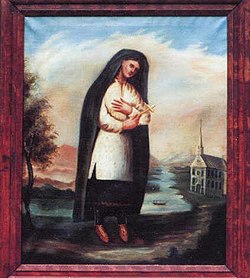
The Lily of the Mohawks and the Boom in American Sainthood
Selasa, 01 November 2011
Skeptics and Soul Sisters: Beautiful Art by Amanda Porterfield and Janet McKenzie
In my other hand, I cradled Holiness and the Feminine Spirit: The Art of Janet McKenzie. It’s a beautiful and inspiring book that pairs McKenzie’s art with personal, poetic, and scholarly reflections. She gained national and international fame when she was won the “Jesus 2000” competition from the National Catholic Reporter’s contest for her painting “Jesus of the People.” Although her most famous, this painting was but one of her many accomplishments. Her others feature Mary with Gabriel, the Holy Family, and even a touching homage to 9/11. Her art is visually stunning, and it induces for many an avalanche of spiritual reflection. McKenzie’s work is borne of religious conviction, and she, in her own words, strives “to reflect in my art … that sacred and inherent place within that connects us all beyond race and gender where no judgment exists.”
As I thumb through the pages, I see images of Mary next to Gabriel. The sacred wings, as Mary E. Haddad (a former Toyota sales-woman from Detroit and now pastor in California), writes, “enclose and embrace Mary.” Heaven and earth “stand side by side” and the distance that former artists had put between the two figures is dissolved in a fellowship of foreseen terror. The book has poetic responses to McKenzie’s “Holy Mother of the East” and “Magna Mater.” The amazing theologian Diane Hayes works from “Woman Offered #5,” a startling image of a black woman being crucified. For Hayes, it is time for women who have suffered, have had pain, have carried the “weight of the world on their shoulders” to “come down from the cross” and to “choose for themselves the paths they should take, the lives they should lead, the tapestries they will weave.” And finally, McKenzie’s “Homage to 9/11” portrays the Twin Towers as two women who support one another. An essay by educator Sally Goodrich follows. Goodrich lost her eldest son in the 9/11 attacks, but inspired by McKenzie’s art, Goodrich joined her grief to giving: she ventured to Afghanistan and help the young there. What amazing stories, reflections, and images. For scholars, McKenzie’s book offers tremendous insight into how individuals respond to the visual arts, and for the spiritually inclined, it offers a vibrant array of considerations.
Selasa, 11 Oktober 2011
“Visiting Scholar Kelly Baker is Patient Zero”
Kelly Baker was all over facebook yesterday. The Florida State University facebook page was full of updates about the “FSU Zombie Apocalypse” in
anticipation of Kelly’s public lecture yesterday afternoon hosted by FSU’s Department of Religion entitled “’There’s us and the dead’: The Zombie Apocalypse in American Culture.” One of these updates identified Kelly as “patient zero,” or the origin of the “zombie outbreak.” On our way to the auditorium yesterday to set up Kelly’s lecture, we passed some students filming brief interviews with others who participate in the popular “Humans vs. Zombies” tag-oriented game. The Tallahassee Democrat (city paper) ran a story on the lecture to encourage attendees, and there was even an extra from AMC’s “The Walking Dead” in attendance. This picture was posted live to the FSU facebook page.Kelly has extensively investigated zombie genre movies, television, and fiction in order to identify the underlying themes of this genre and their ramifications beyond just “zombies are cool” and “blowing up zombies is fun.” Popular culture is not a neutral something that we consume; rather, zombie pop culture reflects larger cultural assumptions, visible, invisible, and everything inbetween. And Kelly has smartly identified how zombies are dangerous is ways far beyond the token zombie bite reference I could make here.
Kelly notes four “distinct thematic moves” in zombie eschatology: “a working through of what it means to be human, an uplift of survival-at-all-cost ethics, a celebration of necessary violence, and a vision of the American nation in which the sweeping social reforms of the 20th century (the Civil Rights movements and the women’s right movement) are swept away by zombies.” In short, she wants to know what is at stake in the recurring tropes of zombie eschatology. Sure, the presence of survivors could denote a hopeful end where humanity has bonded together to survive together. But, Kelly asked, at what costs? And even more importantly, who survives? Some humans do endure the post-apocalyptic world, but they do so surrounded by mounds of mangled human and formerly-human zombie corpses and much of this destruction was done by their own hands.
What particularly struck me about Kelly’s lecture was what race and gender have to do with zombie apocalypses – the “who survives” question. Again and again, the survivors of a zombie apocalypse are white, normatively heterosexual, and perform tired gender roles. The men are protecting, gun-slinging saviors of humanity. Woody Harrelson’s character “Tallahassee” from Zombieland is hardly an oddball is this post-apocalyptic, zombie-infested world. The women become damsels in distress whose rescue becomes part of the main action, and even if they fight zombies alongside the men, romantic involvement domesticates them.
Not only do the survivors re-inscribe stereotypical gender roles, they often re-inscribe the disturbing assumed normativity of
whiteness. The shambling, moaning zombies typically portray a wide range of racial and gender identities, which draws even more attention to white gun-slinging male and white emotionally-taxing female survivors. Racial and gender diversity defines the attacking force that needs to be dispatched. In a RAAC forum on “American Religion and ‘Whiteness,’” Tracy Fessenden and Edward Blum both identify how whiteness is an “unmarked” category and “taken-for-granted” in American religious history. The same can be said for zombie apocalypses. When the survivors are white, what does this say about the way we envision those who can “save the world?” Furthermore, if the survivors are inevitably the ones who will remake the world, then what does this say about an American popular culture that repeatedly selects whites to construct the post-apocalyptic world? Kelly raised other questions as well – as did attendees in the Q&A – about weapons, commodities, and fetishes; violence, war, and globalization; and the relationship between individualism and what it means to be human. The bottom line, zombies can tell us a lot.
Jumat, 02 September 2011
So, You Think You Can Live "Biblically?"
That's the question that writer and blogger Rachel Held Evans is trying to answer. The author of a memoir about growing up in conservative evangelical circles (and with one of the best titles ever), Evans is addressing the issues raised in her first book about what it actually means to live fundamentalistically. As this Slate article details, this is not done for the sake of satire. Rather, she's attempting to answer what it actually means to live as a woman "by the book," following as closely as possible Old Testament and New Testament dictates concerning hair, dress, hygiene, and so on.
As the article demonstrates, she's only a month into the experiment and has already caught the attention of theological conservatives and biblical literalists. Though certainly intended to toss down the gauntlet on the "roles" of women in the church, the book will dive into issues of sex and the sacred that evangelicals all down the spectrum continue to debate, especially in and through their cultural and political activism. Regardless, it will hopefully make for a good read for courses on religious life, conservatism, and gender.
Postscript: Seth Dowland will certainly fill in the historical context for all this with his forthcoming book on manhood and womanhood in conservative evangelical politics. So, get your credit cards ready!
Rabu, 31 Agustus 2011
CFP: Love and Romance
International Association for the Study of Popular Romance
The Journal of Popular Romance Studies is looking for essays, interviews, and pedagogical materials on love and religion in global popular culture, for a special issue guest-edited by Lynn S. Neal (Romancing God: Evangelical Women and Inspirational Fiction). How do film, fiction, popular music, and other media represent the complex relationships between love and religion? How do these representations compare across national, cultural, and theological divides, and what happens when they cross those boundaries? How have they changed over time? What can a sophisticated understanding of love in religious discourse—from whatever tradition—teach us about individual songs, films, novels, or other popular texts?
Topics of particular interest include:
- Theologies of love in popular song: Leonard Cohen, U2, Richard Thompson, Al Green, Nusrat Fateh Ali Khan, Niyaz, Shye Ben-Tzur, etc.
- Sacred and secular love in popular culture: drawing boundaries, blurring distinctions
- Interfaith romance (Jewish / Christian, Hindu / Muslim, etc.) in popular culture
- Love, Religion, and Politics in popular culture
- Romance vs. Religion: warnings, advice literature, debates over idolatry, etc.
- Romantic love as a surrogate or secular religion
- Christian inspirational romance fiction, and its non-Christian equivalents: studies of individual novels, publishing lines, reader behavior, etc.
- Crossover texts and figures: Rumi, the Song of Songs, etc.
- God as lover and beloved in popular culture
- Sacred love stories in popular culture (Krishna / Radha, Majnun / Layla, Adam / Eve, etc.)
- One Love, or many? Rastafari, Wiccan, and other traditions of love in popular culture
Published by the International Association for the Study of Popular Romance (IASPR), the peer-reviewed Journal of Popular Romance Studies is the first academic journal to focus exclusively on representations of romantic love across national and disciplinary boundaries. Our editorial board includes representatives from English, Comparative Literature, Ethnomusicology, History, Religious Studies, African American Studies, and other fields. JPRS is available without subscription at http://jprstudies.org.
Please submit scholarly papers of no more than 10,000 words by June 1, 2012, to An Goris, Managing Editor managing(dot)editor(at) jprstudies(dot)org. Longer manuscripts of particular interest will be considered on a case-by-case basis. Submissions should be Microsoft Word documents, with citations in MLA format.
Sabtu, 27 Agustus 2011
End-of-Summer Beach Read for Religious Historians
Heaven’s Bride: An End-of-Summer Beach Read for Religious Historians (and everyone else) -- except during the hurricane please don't read it at the beach per se.
In addition to being a great read, Schmidt offers a useful reminder that evangelicalism is only one part of the religious history of America. Though Anthony Comstock, the inspiration behind federal and state laws suppressing vice, and his evangelical allies presented an almost unstoppable force in the late 19th-century, Craddock associated with a loosely organized group of transatlantic secularists, religious liberals, Quakers, spiritualists, occultists, and yogis, who rejected evangelical domination of American life."
A brief synopsis: Schmidt views Craddock as a leading example of a time when sexual expression and American religion did not necessarily clash. Craddock and her associates advocated more liberated, pleasurable sex in monogamous heterosexual relationships, preferably marriage. Despite little or no direct experience with intercourse, Craddock set up shop as a pre-marital and marriage counselor, advising husbands how to please their wives (like Oneida Community founder John Humphrey Noyes, she separated sex and procreation, advocating a longer sex act with no male ejaculation) and instructing wives how to please their husbands (move their hips during intercourse). Craddock viewed the sex act as a form of worship, an experience of the divine on earth. In her physical and emotional marriage to a spirit husband, she practiced what she preached. Unsurprisingly, Craddock’s mother placed her in an institution. Comstock charged her with obscenity.
Contextualizing Craddock’s personal religious journey “from Methodist holiness to Unitarian individuality right on through spiritualist séances and South Asian traditions,” Schmidt examines the notices for religious services in the Chicago Tribune. In the 1870s, the announcements were predictably Protestant, calling Chicagoans to services at Episcopal, Presbyterian, Congregationalist, Baptist, and Methodist churches. By 1900, as Schmidt observes, “all hell was breaking loose,” with announcements for Jewish, Spiritualist, Christian Scientist, Ethical Culture, and Hindu services. Craddock advertised her own combination of spiritual and sexual education at her Church of Yoga with a Bible talk titled “Man and Woman as They Were, as They Are, as They ought to Be.”
One aspect of Ida Craddock’s thought naturally caught my attention: she viewed Quaker minister and pioneering feminist Lucretia Mott as a foremother, quoting her famous line “Truth for Authority, not Authority for Truth” in her death match with Anthony Comstock. This intellectual connection is not as farfetched as it seems. Craddock attended Friends Central School in Philadelphia, founded in part by Mott’s Cherry Street Meeting. Craddock also served as secretary for the American Secular Union, an offshoot of the Free Religious Association, an organization established in 1867. Before her death, Mott traveled to Boston regularly to attend meetings. In 1900, the Free Religious Association memorialized Mott, along with Roger Williams, Hindu reformers Ram Mohun Roy and Keshub Chunder Sen, Ralph Waldo Emerson, Theodore Parker, and Octavius Brooks Frothingham , as “Prophets of Liberalism.”
Schmidt expands our understanding of this heady religious period through the life of the fascinating Ida Craddock. In her work with the American Secular Union, Craddock urged members to ally with “Free religionists, Quakers, Progressive Jews and Liberal Christians” against religious intolerance. Though she failed in her efforts to rally these groups, it is important to note that Comstock also viewed them as linked in their committed defense of the rights of accused pornographers, sexologists, and free lovers. Under the guise of religion, he argued, liberal Protestants were “champions of obscenity.”
Sabtu, 06 Agustus 2011
From Muscular Christianity to Tim Tebow
Paul HarveyArt's has posted here many times before on his current research interests in religion and sports (no, Sutton, fantasy football does not count). Over at the Historical Society blog, Art has reflected on "Building Bridges from 'Muscular Christianity' to 'The Tebow Thing,'" which stems in part from his current research and work in religion and sports in the South from the Civil War to World War II. A little excerpt, and then click the link for all of it:
So on "opening day," I invite students to cross a bridge from their hometown YMCA to "muscular Christianity." I cite Luther Gulick, his efforts to institute athletics at the Y, and his lifelong quest to understand "the relation of good bodies and good morals." I then turn to his colleague, James Naismith. On January 20, 1892, the Presbyterian minister gathered eighteen young men at a YMCA gym in Springfield, Massachusetts, to play his newly invented game called "basketball." Practically, Naismith hoped that basketball would give restless young men a suitable indoor activity for the long winter months. More importantly, as theologian Michael Novak summarizes, "The idea behind the game was moral, Christian, and hygienic: active clean living through vigorous exercise." Right from the gun, then, students discover the religious roots of a familiar game. Later in the course, drawing mostly from Bill Baker's Playing With God, I locate Gulick, Naismith, and other "muscular Christians" within the social gospel tradition, and discuss how they sought to Christianize all corners of society, from the schoolhouse to the gymnasium.
Rabu, 03 Agustus 2011
Gender and the American Religious Historian: Seneca Falls Edition
Today please welcome our newest blog contributor Carol Faulkner, who documents the contentious place of religion in first women's rights convention in America at Seneca Falls. She is an Associate Professor and Chair of the History department at Syracuse University. Her most recent book Lucretia Mott’s Heresy: Abolition and Women’s Rights in 19th-Century America evaluates the important place of Mott in both campaigns for women's rights and abolition. Additionally, she was kind enough to take up the call for more posts on gender and religion, so this post is an addition to the Gender and the American Religious Historian series as well. Welcome to Carol, and many happy posts!Early Women's Rights and Religion
Carol Faulkner
On July 16, Women's Rights National Historical Park in Seneca Falls, NY, held a grand re-opening of the Wesleyan Chapel, the site of the first women's rights convention in American history. The previous structure had been an artistic interpretation of the chapel, based on the two remaining walls of the original building. The new brick building reconstructs the stately yet modest Wesleyan Methodist Church, still retaining the original walls (see views of the old and new structures here). The new Wesleyan Chapel is definitely worth a visit to Seneca Falls (even in winter!), and its rededication offers an opportunity to consider the close yet tumultuous relationship between early women's rights activists and their churches.
Americans engage in a perpetual and vigorous debate over the religious beliefs of the male founders, but, with some important exceptions, such as books by Kathi Kern and Nancy Isenberg, we know little about the religious views of the women who adapted Thomas Jefferson's Declaration of Independence to state that “all men and women are created equal” (the text of the Declaration of Sentiments is available on the Women's Rights Historical Park website). The convention organizers chose the Wesleyan Chapel out of necessity; it was the only building in Seneca Falls open to reform meetings of all persuasions. Still, the Wesleyan Chapel illuminates the close connection between the anti-slavery and early women's rights movements, and, more importantly, the religious non-conformity of those who attended the Seneca Falls Convention.
As Judith Wellman tells us in The Road to Seneca Falls, the Wesleyan Methodist Church was founded in 1843, when the Methodist Church in Seneca Falls split over the issue of slavery. Like many of their abolitionist sisters and brothers, the anti-slavery convictions of sixty Seneca Falls Methodists created conflict with the national church, which welcomed slaveholders into their spiritual fold. As a result, these dissenters left their church to begin one based in shared values, including opposition to slavery, intemperance, and war, part of a larger movement of abolitionist come-outers across the north.
Though none of the five principal organizers of the Seneca Falls convention were Wesleyan Methodists--in fact, all of the women, except for Elizabeth Cady Stanton, had Quaker origins--many of the convention's Quaker participants had just survived a similar schism in the Society of Friends. Approximately one month before the Seneca Falls Convention, a group of reformers, led by Thomas M'Clintock, whose wife Mary Ann M'Clintock helped draft the Declaration of Sentiments, walked out of the Hicksite Genesee Yearly Meeting, outraged that the Quaker leadership had tried to limit their abolitionist activities.
This religious context is hidden in the familiar egalitarian language of the Declaration of Sentiments. Called to discuss the “social, civil, and religious condition of woman,” the declaration contains religious as well as political grievances against the tyranny of man:
“He allows her in Church as well as State, but a subordinate position, claiming Apostolic authority for her exclusion from the ministry, and with some exceptions, from any public participation in the affairs of the Church.”
“He has usurped the prerogative of Jehovah himself, claiming it as his right to assign for her a sphere of action, when that belongs to her conscience and her God.”
As Nancy Isenberg points out, antebellum feminists viewed the church as an obstacle to equal citizenship, offering ministerial and scriptural justification for women's inequality. These grievances in the Declaration of Sentiments might be interpreted as calls for integration into America's Protestant churches: the right to study theology, train for the ministry, and to interpret the word of God. Certainly, many nineteenth-century women's rights activists embraced these goals. The Congregrational Friends, formed after the schism in Genesee Yearly Meeting, equalized men's and women's meetings. But the women and men at Seneca Falls wanted something more: a revolution in American churches.
Lucretia Mott, the “moving spirit” of the Seneca Falls Convention, a Quaker minister, and one of the “exceptions” mentioned in its Declaration of Sentiments, offers one important example of convention's radical religious views. Though many of her beliefs had their roots in the Society of Friends (for example, she deplored an educated and paid ministry, which she and other Quakers disparaged as “hireling”), other beliefs brought her into conflict with Quakers. Since 1842, her Monthly Meeting had refused to give her a minute to travel (she did anyway). In 1847, one year before the Seneca Falls Convention, normally mild-mannered Indiana Quakers had verbally attacked and shunned her.
What was so offensive about Lucretia Mott? Mott embraced an activist stance that she provocatively named heresy. Invoking the early Quakers, she saw it as a duty to agitate, particularly on the issue of slavery. And she argued that, “ecclesiastical power is always to be opposed, whether it appeared in the Pope of Rome or an Elder of a Quaker meeting” (quoted here). What made her so obnoxious to her Quaker and non-Quaker opponents, however, was that she refused to leave the Society of Friends, no matter how much they wanted her gone. Ironically, then, at the Seneca Falls Convention, held at a come-outer chapel, and attended by many anti-slavery come-outers, Mott was one of the few activists present who had not left her church.
Reflecting on the summer of 1848, Mott celebrated “agitation” in all the churches as well as the “recent movement for the enlargement of Woman's Sphere.” (see Beverly Wilson Palmer ed., Selected Letters of Lucretia Coffin Mott). Lucretia Mott, and the women and men at Seneca Falls, prioritized individual conscience over religious hierarchy, doctrine, ritual, and the physical churches that contained them. The plain Wesleyan Chapel, originally built by a faith community dedicated to overthrowing the institution of slavery, and rebuilt by the National Parks Service, is an appropriate way to honor and remember these early women's rights activists.
Rabu, 27 Juli 2011
“Sick of Your Dancing, Sick of Your Chanting”: Shannon and the Clams, Indonesian Throat Singing, and Emotive Religion
by Charity Carney
My husband and I celebrated our second anniversary in San Francisco last week and discovered that Oakland can be awesome. It’s produced one of the most interesting music scenes on the West Coast in my estimation, with Berkeley radio pumping out track after track of whacked-out punk rock (like Hunx and the Punx) as well as some interesting international music. Other stations in the area seem bound to the round-the-clock beach music or CCR, but 90.2 FM is taking risks and putting out sounds that are at once seemingly disjointed but also deeply connected in the sources that they tap.
Two songs (Shannon and the Clams’ “The Cult Song” and a track from Arrington De Dionyso’s “Malaikat Dan Singa”) immediately followed each other on the station and served as the impetus for a new masculinity post. Crazy, but true. Shannon and the Clams are an Oakland-based group that blend Buddy Holly with the Ramones with a girl-group vibe. Their “The Cult Song” can be heard here. The lyrics reference some of the most infamous moments in American cult history (“sick of your Nikes, sick of your Kool-Aid”) and declare a defiance of radical religion. At the same time, the chorus includes a chanting “ooga booga” background that is some sort of cartoonish impression of stereotyped African religious intonations. It’s a mish mash of racism, rejection of religion, and female empowerment, with the female lead vocalist repeating “I Don’t Wanna Be in Your Cult No More!”
Backed up next to this track was Arrington De Dionyso’s throat singing—not an Oakland product but shipped in from Indonesia. “Malaikat Dan Singa” is an example of this rather dark spiritual vocal styling and the video for it (watch it here) includes imagery of an art gallery with the artist drawing figures of women and men that are sexually charged and bizarrely childish and violent. The music is connected to De Dionyso’s past band (aptly titled “Old Time Relijun”) that was rooted in “shapeshifting, shamanic practices, animal possession, and magnetism” (according to this excellent article at Tiny Mix Tapes) and this new record continues to follow these spiritual obsessions, with de Dionyso blaring out the Indonesian words in a deep, masculine, trance-like drone.
What came to mind as I listened to these two tracks was the power of spiritual emoting and the gendered differences that exist in various cultures and religious groups when it comes to evoking religious feelings/power. The Indonesian throat singer has no hesitation in his voice as he forces the notes out of his throat, almost sounding like he’s ripping his vocal chords to shreds. Shannon (and her Clams) give us another sense of spiritual power—they remind us of the male-led cults of the 20th century United States. Even as the song rejects these movements, it also uses them and forces us to collectively remember the pop power of these radical religious groups. I see in both songs and both traditions (if I can use that to describe the American cult tradition) the tendency for masculine control of many spiritual practices and the feminine following of male religious leaders. I also see a disturbing connection that the radio station may or may not have meant to make between cults and Indonesian religious practices. The “ooga boogas” mock “Malaikat Dan Singa” in a way and force a connection where there was not one in the first place.
Minggu, 17 Juli 2011
What do the Pope, Obama, and Johnny Rotten Have in Common?: Observations on Gender and the Antichrist

Thanks to Kelly Baker for suggesting a series on masculinity and religion during Paul's hiatus. Here's the first of my installment.
Americans’ fascination with the Antichrist has only grown over the past decade with an increasing number of pop culture references and politicized rhetoric surrounding the evil symbol of a coming Armageddon. Obama was/is accused by some as being the Antichrist—Obama beginning as relatively unknown politician who rose to power swiftly and won the hearts of many Americans with a message of hope. He made promises that were too good to be true, many said, and some accused him of acting like a messiah to lure unsuspecting Americans into his trap. (Google “Obama and Antichrist” if you haven’t before. It’s amazing what people can do with Photoshop.) The racialized overtones of this depiction of the president cannot be overlooked. Many Americans were terrified of Obama’s candidacy and election because he was an “other” in their worldview and so their fear blossomed into anger and denouncements of the “Yes We Can” Man as evil. Racist motivations aside, Antichrist accusations and personas have power (to scare, to motivate, and to actually empower) and much of that power resides in the masculine meme of the position.
White Women, Rape and the Power of Race in Virginia, 1900-1960 as well as cultural works on more recent America like Michelle Alexander’s thought-provoking new book, The New Jim Crow). But beyond the masculine world of racialized sexuality and crime there are other gendered factors that contribute to the current Antichrist discourse.
An alternative view of the Antichrist is that promoted by the Wisconsin Evangelical Lutheran Synod (WELS). Current Republican presidential candidate contender Michelle Bachman once belonged to this group but recently demanded a written statement from the synod about a year ago asserting that she was no longer affiliated with them or their anti-Catholic beliefs.
The WELS doctrine regarding the Antichrist states:
“Since Scripture teaches that the Antichrist would be revealed and gives the marks by which the Antichrist is to be recognized, and since this prophecy has been clearly fulfilled in the history and development of the Roman Papacy, it is Scripture which reveals that the Papacy is the Antichrist.”
The Pope is perhaps the most powerful religious figurehead alive in the Western world and by imbuing him with the religious authority of the Antichrist, the WELS has given him even more influence, although that is obviously not their intention (see http://www.theatlantic.com/ for the full story). The Pope and Catholics and many other Christians (including Lutherans) certainly do not view the Papal position as connected to the Antichrist, but the debate alone grants the Papacy more power because it is simply being debated. The Pope and the Catholic leadership, too, have a preponderance of masculine authority despite their sworn celibacy. The Church has maintained its commitment to male authority since its founding and continues to rely on an all-male cast of Pope, Cardinals, and priests, etc., giving nuns duties that reflect a more maternal role (teaching and nursing, for instance). The Pope, I contend, would not be accused of being the Antichrist if it was not necessarily a male occupation and if the Catholic Church did not imbue it with masculine power.
And it is here where I will play “devil’s advocate” (pun, sadly enough, intended): Antichrist imagery can also be used as a hyper-masculine badge of honor. Take, for example, the role that Antichrist played in the punk music scene of the 1970s. The Sex Pistols’ lead singer, Johnny Rotten, even went so far as to declare himself an antichrist in “Anarchy in the UK”:
“I am an anti-christ
I am an anarchist
Don't know what I want but
I know how to get it
I wanna destroy the passerby caus’ I
I wanna BE anarchy!”
The Sex Pistols might have been Nietzsche’s favorite band. In The Antichrist, the nihilist wrote: “What is good?—Whatever augments the feeling of power, the will to power, power itself, in man.” Ultimately, the concept of an Antichrist is a positive one to Nietzsche because it empowers man to challenge a blundering God whom impedes science and knowledge. Although Nietzsche is not speaking directly of the biblical Antichrist, he is pressing the notion that anti-Christian, anti-God, anti-religious views are what give men control and intellect. The Antichrist may be the supremely masculine symbol—with power and virility and ferocity representing his most cited characteristics.
The dangers of this discourse, however, are immense. As seen with Obama, declaring a public personality to be the Antichrist only engages widespread animosity and fear, which, when combined, can lead to vehement and violent reactions. So maybe the WELS should reconsider its charged doctrine concerning the Pope as well as those who have labeled the president as the Antichrist.
Minggu, 10 Juli 2011
Motherhood, Morality, and, Ultimately, Madness: My Thoughts on the Casey Anthony Case
by Charity Carney
Will it never end?! Not the Casey Anthony media craze. There’s no hope there. But the complete lack of awareness on the part of the American public of their obsession with motherhood, proper familial relations, and these moral boundaries that so many claim exist but cannot agree on what they are and what they mean. I have to admit, I’ve been watching my fair share of Nancy Grace's commentary lately—the subtle movements in Anthony’s face, the ridiculous analysis of her hairdo (to ponytail or not to ponytail?)—and I keep watching because I have become entranced with the concepts of proper American motherhood AND fatherhood situated so squarely in our television sets. What this case has elicited is more than talk of mob rule and justice for a murdered child. It has revealed how the American mainstream views modern motherhood and family life and how their commitment to those ideals often trumps the mandates of the justice system and Constitution.
Casey Anthony is pretty. She is young. She is white. And all of these are reasons that she has captured the country’s attention for so long. But alongside these factors runs a strain of judgment based on maternal standards that have made themselves extremely clear over the past few months. Dubbed “Tot Mom” by Nancy Grace, Anthony has been criticized for not “acting” like a mother should (a penalty that many have said warrants death in and of itself), for being a liar (the temptress that she is, fooling policemen and her parents alike), and for even living with her parents after the birth of her child (unsure of who the father was and unable to take care of her daughter herself as a 22-year-old single mother). Despite the gruesome facts surrounding the court case, there is something to be learned about American morality when it comes to gendered subjects: even within a “modern” society where many women defy maternal stereotypes, the court of public opinion still retains a very conservative understanding of what moral parents do.
Pitted against Casey Anthony’s “immoral” behavior are the accusations against and defenses of her father, George Anthony, of child abuse and molestation. When Casey’s defense attorney’s brought this accusation to light and used it as a central part of the explanation of “Tot Mom”’s (ugh, it hurts to write it) actions, the media had a field day. The majority of newscasters, analysts, lawyers, and interviewed citizens rejected the idea that any father could do that to his daughter or cover up the death of his granddaughter. Not casting personal blame on any person, I simply observe that our patriarchal system is still firmly in place, you’ll be happy to know. In case anyone was worried, it’s doing just fine. The stark contrast of the moral questions cast upon Casey Anthony’s motherhood and George Anthony’s fatherhood is an indicator of the gendered status of ethical parenting.
Not that we did not realize this already, but I have not seen in recent times a more clear example of gendered judgment of moral/immoral behavior. I do think that the fact that the O.J. Simpson verdict has been held up as a comparison to the Anthony case only encourages this idea but the difference is that the Simpson trial was held up as a race-based incident and the Anthony trial is stuck in American psyches when it comes to any kind of higher gender analysis.
Rabu, 04 Mei 2011
The Religious and Fraternal Underpinnings of Sci-Fi Fandom
By John CrowThe semester is over at Florida State and next week begins the summer semester. I have already begun my summer reading which continues my interest in fraternalism, religion, gender, and the body. In that vein I have begun with Mark Carnes’ Secret Ritual and Manhood in Victorian America (Yale UP 1989). In the beginning of the volume, he notes the significant changes that occurred to fraternalism after the antimasonic movement of the 1830s. Between the 1840s and 1860s, there was a move to upgrade fraternalism, to make it more palatable for the middle-classes, and to re-center the fraternal orders on ritual performance. While social interaction remained important, to some degree, it was the performance and belonging that mattered. Thus antebellum orders such as Freemasonry and the Odd Fellows swelled to significant numbers with the Odd Fellows having over 800,000 members in 1896 and the Freemasons not far behind with 750,000. For many of them, it was the performance in the rituals that cemented their involvement. They were able to reconnect with an imagined past and so-called ancient wisdom that was universally available.
Not surprisin
gly, these fraternal orders took the place of organized religion and church for many men. The rituals offered a universal morality couched in allegory that they performed. Members assumed costumes, imaginatively entering Solomon’s Temple in the Royal Arch Degree, discovering the lost word and Ark of the Covenant, or sitting around faux camp fires, connecting to an imagined primitive American past in the Order of the Red Men. In the Knight of Pythias, degrees were placed in Ancient Greece and the Medieval Europe. In many cases the degrees where anachronistic, combining historical figures and time periods in ways that were impossible. In response to non-historical claims, noted Masonic scholar, Albert Mackey, stated that the setting may be “true or false,” but the “lesson is still there, and the symbolism teaches it exclusive of the history.” All these movement promised connections to a world separate from the one the men knew, although it was imbued with symbols and allegories that pointed to a familiar Protestant morality. During these rituals, wearing masks and costumes, these men took on new identities imbued with deep and mystical meaning, though never straying too far from standard social conventions. As I read these lines, I wondered if today’s sci-fi fandom operates in a similar way for many in our modern culture.Being from Atlanta, I thought of the largest fandom convention that takes place every Labor Day, DragonCon, and its cadre of costume wearing participants, reenacting sci-fi scenes from comic books, movies and television shows. These sci-fi conventions, or “cons” as they are called, occur somewhere in America every weekend. During these cons, fans step into their imaginative worlds similar to the masons and Odd Fellows. Instead of playing Hiram Abif, one may play to role of Obi-Wan Kenobi, similarly struck down by the forces of evil, only to be resurrected, not by the lost word, but by a universal “force,” which stresses a morality similar to that professed by masons. In fact, for many Jediism takes the place of more established religion. Some Jedi practitioners claim ancient pedigrees, not unlike many fraternal o
rders. Of course I could have picked Star Trek, with its secular humanism based Prime Directive, or some other vampire or anime series. In all these cases, the fans step into another world, assuming new identities. Carnes suggests that these new identities assist the performers in addressing anxieties. They certainly allow the creation of worlds that the members regulate and control. Ritual is a big part of that, as is social control. Just as masons can “black ball” and prohibit the membership of others, fandom groups police their boundaries in a variety of ways. Whether one must know the lines of a movie, the histories or genealogies of characters, or the proper conduct for the mythos or game, the boundaries can be stark and the participants unforgiving of violators.
Looking specifically at gender and the body, these imaginative worlds allow participants to explore and recast their bodies and gender in a variety of ways. While Victorian fraternal orders may have allowed men to adapt and re-inscribe gender roles in society, responding to the much discussed feminization of Victorian America, sci-fi fandom allows modern participants the ability to explore issues of gender and the body in complex ways. Cross dressing is common, as is the assumption of costumes that obscure gender altogether. Participants can have wings, become cyborgs, add additional limbs, or don non-gendered, non-human costumes, or even non-biological roles such as those of robots. Similarly, bodily extensions and modifications are common. In the oppo
site direction, participants may take on exaggerated gender features such is common in Japanese anime costume play, or “cosplay” as it is called. Another vibrant scene is the anachronistic steampunk movement, which attempts to fuse modern or futuristic technology with eighteenth century aesthetics.
The reasons men participate in fraternal orders now, as well as in the past, are complex and changing. Yet I think they give us some clues into modern worlds like sci-fi fandom, worlds in which religion and fraternalism manifest in very predictable ways. Capturing the religiosity of these participants can be difficult. They often fall into the ambiguous spiritual-but-no-religious segment of American society. Yet if we look for older models, such as Victorian fraternalism, we may be able to glean certain similarities which open possibilities for study. Though, on the surface, a mason dressed as Moses, participating in an initiation seems completely unrelated to a woman dressed as a Sith lord, wielding a light-saber, the underlying motivations may not be that different. Fraternal orders during the Victorian era addressed anxieties while simultaneously stressed conventional morality and middle-class virtues. While the sci-fi fandom world may seem completely unrelated, it too may be performing the same functions.
Rabu, 13 April 2011
Nancy Hardesty (1941-2011) and Biblical Feminism
Sabtu, 26 Maret 2011
Gender and American Religious Historian, Part III

By Kelly Baker
And the beat goes on (and on and on). As I continue to put together the list of my favorite scholarship/scholars on gender, women's history, and masculinity for NWHM, I find that hesitate more and more about my choices, their inclusivity/exclusivity, and what they say about me as a scholar: What have I read? What do I need to read? What do I leave out? Why do I like Protestants so much? (That one has an easy answer). What is my lingering fascination with American Catholics? How might I find the good gender scholarship beyond my own research interests?
As commentators have noted, my list is primarily filled with scholarship about white Protestants and Catholics, which is certainly true. I write primarily about white Protestant men and women, so my list does skew that way. This does not give me a free pass, but our readers should know that the list is my favorite hits in gendering American religious history, and thus, it is not a universal, or even close to canonical, list nor should it be viewed as such. These are works that I have deeply respect, admire and even love. They urge me to be a better gender historian. Their questions become my lingering questions. As I write about masculinity and femininity, I reflect on these as lessons on how to do gender analysis, as models for emulation, and as nourishment and encouragement in my own attempts to make gender a primary category of analysis within my religious studies training. Overall, the series functions for me to highlight what I consider to be good work on gender and religion (often Christianity) and encourage you to enjoy the scholarship I list.
What this means is that I hope our readers will continue to list their choices in the comments section. Several folks have already contributed via comments and email, so THANK YOU! I will post your suggestions as an addendum to the Gender and the American religious historian series (available here and here). Please continue to list your favorites or email me your picks.
11. Tracy Fessenden is one of my favorite American religious historians, hands down. Her Culture and Redemption was an inspiring work that challenged the secularization thesis by showcasing how secular can functions as “stealth” Protestantism. She is also the co-editor of the The Puritan Origins of American Sex. In my classes, I assign her “The Convent, the Brothel, and the Protestant Woman’s Sphere,” from Signs, in she argues that anti-Catholicism functioned as tool to maintain the Protestant domestic sphere, so enforcing boundaries on nuns and prostitutes became a way to preserve pure, white womanhood.
12. Marie Pagliarini’s “The Pure American Woman and the Wicked Catholic Priest: An Analysis of Anti-Catholic Literature in Antebellum America,” from Religion and American Culture documents how analyzing gender helps us understand historical practices of intolerance. Moreover, religious intolerance works best when historical actors seek to protect innocent womanhood from some dangerous, religious threat. I cannot wait to read her article entitled, 'And the Word was Made Flesh': Divining the Female Body in Nineteenth-Century American and Catholic Culture" in the same journal.
13. Julie Byrne’s O God of Players is a cultural history of Catholic women’s basketball, which emphasizes the physicality and joy of play for these Catholic girls. The Immaculate Mighty Macs negotiated their identities as young Catholic women in the physicality of the sport but also understood the game as a Catholic enterprise. Byrne’s work showcases the fluidity of religious identity as well as the ways in which basketball problematized as well as reinforced notion of Catholic womanhood. I’ve blogged about the book previously here.
14. Heather Hendershot’s Shaking the World for Jesus is not only a good primer for those of you interested in evangelical use of media, but also contains one of the best interrogations of evangelical chastity programs for teens. Using Focus on the Family’s teen magazines for boys and girls, Hendershot shows the dangers of “eruptive” male bodies and “contained” female bodies, and importantly, documents how teens negotiate chastity in their own lives. Chastity events prove to be some of the only co-ed excursions, but the emphasis on purity for teenage women is a larger burden to bear than their male counterparts.
15. Kristy Nabhan-Warren’s The Virgin of El Barrio appears often of my Religions in the U.S. syllabus. It is an ethnography of Estela Ruiz, her vision of the Virgin Mary, and her activism and missionizing. Nabhan-Warren documents Ruiz to showcase not only her life and her visions, but also the blending of Catholicism and evangelicalism in Ruiz’s ministry. Moreover, Nabhan-Warren doesn’t shy away from gender dynamics of the ministry, and she illuminates the complicated relationship between Ruiz, the Virgin Mary, and her family.
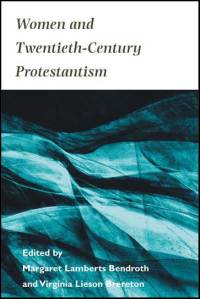
16. Margaret Bendroth’s Fundamentalism and Gender was one of my earliest endeavors into understanding the relationship between Christian women and fundamentalism. Her work traces the idea of female subordination in fundamentalist practice, and she demonstrates how the idea of subordination, which seems so necessary to fundamentalism, oscillates between a mandate placed upon all women to loosely enforced dictate, especially when women are needed to fulfill quasi-leadership roles. Moreover, she stresses the fundamentalist attachment to masculinity as necessary to the Christian doctrine as well as the masculine nature of recruiting. This book was one of the first to make me realize how gender is a necessary category of analysis in religious studies. In addition to this work, she is also the co-editor of Women in Twentieth Century Protestantism and the author “Why Women Loved Billy Sunday: Urban Revivalism and Popular Entertainment in Early Twentieth Century America” in Religion in American Culture.
17. Janet Moore Lindman’s “Acting the Manly Christian: White Evangelical Masculinity in Revolutionary Virginia” in William and Mary Quarterly is an excellent discussion of how white evangelical men in the South redefined masculinity in Christian terms. Southern manhood did not necessarily fit with the evangelical norms of piety, and thus, these evangelical men redefined themselves as suffering saints rather than gambling toughs. Evangelical manhood was defined in negative terms, in the ability to abstain rather than give in to worldly pleasures. Moreover, Lindman documents how evangelicalism, however, embraced the hegemonic power of white manhood despite the emphasis on suffering and Christian soldiers.
Also, on another NWHM note, go check Historiann's review of Telling Histories: Black Women Historians in the Ivory Tower. Here's an excerpt:
White and her contributors explain the many struggles that black women faced as they began to enter the profession in the 1960s and 1970s–the obligation placed on many to serve their communities rather than their intellectual ambitions; the scoffing and disbelief they faced in white and black male mentors who were mostly hostile to their interest in women’s history; the stresses of entering work environments in which the other people who look like them are all secretaries or janitorial staff; the racism and sexism of students who walk out of their classes and refuse to recognize their intellectual and professional authority; the cluelessness or plain old racism of overwhelmingly white feminist scholarly communities; and the never-ending suspicion of other historians that black women’s history can never be “objective” if it’s written by black women.