[Cross-posted from the HS blog]
Randall Stephens
I first read David D. Hall's work when I was a grad student at the University of Florida. David Hackett taught a wonderful course on Religion and American Culture, which familiarized students with the big themes in religious history.
Hall's study of the religious world of 17th-century American Puritans challenged my uniformed ideas of what it meant to be a "puritan." His writing on "lived religion," especially intrigued me. He described it as "a shorthand phrase that has long been current in the French tradition of the sociology of religion (la religion veçue) but is relatively novel in the American context." It was "rooted less in sociology than in cultural and ethnographical approaches to the study of religion and American religious history that have come to the fore in recent years." It involved "the study of 'daily life,' especially among Protestant laity [and a] reflection on 'practice' as the center or focus of the Christian life." (Hall, ed., Lived Religion in America: Toward a History of Practice [Princeton University Press, 1997], vii.)
Hall has edited and authored a number of books and articles on American religious history, including: The Faithful Shepherd: A History of the New England Ministry in the Seventeenth Century (Omohundro Institute, 1972); Worlds of Wonder, Days of Judgment: Popular Religious Belief in Early New England (Harvard University Press, 1990); Puritans in the New World: A Critical Anthology (Princeton University Press, 2004); Ways of Writing: The Practice and Politics of Text-Making in Seventeenth-Century New England (University of Pennsylvania Press, 2008); and, most recently, A Reforming People: Puritanism and the Transformation of Public Life in New England (Knopf, 2011).
Hall has had a major impact on the fields of religious history and religious studies in recent decades. As such, he's a great fit for the new HS blog series "Why I Became a Historian." I caught up with him last week at the American religious history group meeting at Boston University. In the video embedded here I ask Hall why he was drawn to history and he responds by describing his early interest in the past, his reading of history at a young age, and his later college and grad school pursuits.
Hall's comments make me wonder if most historians had an early affinity for history through family, location, and a curiosity about all those things that had come before us.
Tampilkan postingan dengan label historians of religion. Tampilkan semua postingan
Tampilkan postingan dengan label historians of religion. Tampilkan semua postingan
Senin, 03 Oktober 2011
Rabu, 14 September 2011
the cuts, the rents, and the wounds: religion in everyday life
This post is not entirely normal fare for RiAH, rather it is a collection of my reflections on both a book, Clear Light of Day, that I assign for one of my "global" classes paired with Julie Byrne's recent piece "Saint February" at freq.uenc.ies, which Paul blogged about last week, and a little Johnny Cash to think about what makes us as scholars and people. (Additionally, mea culpa to the Nine Inch Nails fans, I now amended my mistake and have attributed the lyrics to Reznor, though the Cash cover is what interests me.)
Kelly Baker
I wear this crown of thorns
Upon my liar's chair
Full of broken thoughts
I cannot repair
Beneath the stains of time
The feelings disappear
You are someone else
I am still right here--Johnny Cash
What might surprise is that the run-ins pierce and balm in so many ways. The neighborhood does this to some bodies and not others, I guess. But if you have a body that feels like the skin does not hold things in or keep them out, if you are made partly of memories of cuts and sutures, it might do this to you.--Julie Bryne (emphasis mine).
Nights ago in a rush of class preparation, I finished Anita Desai's Clear Light of Day (originally published in 1980, the year I was born) for Hinduism unit of my Gender in Global Religions course. The book is as starkly beautiful as it is wrenching. The prose matches the blunt social realism. Desai writes about adult siblings in Old Delhi both before and after the partition of India into India and Pakistan. Unflinchingly, she details the wounds of childhood that each siblings carry with them, which haunt as well as taunt them as they grow old and gray. The wounds remain, even in the lightness of forgiveness, and Desai creates ambivalent characters who the reader can admire in a moment and despise the next. In her study of family life, Desai communicates the miscommunications, the snubs, the love, and the pain of the ordinary. She documents the ways in which gender, class, and religion mark the siblings differently and set them in opposition.
The headstrong, and sometimes cruel Bimla, sacrifices herself upon the altar of family, even as she dreams of something more than marriage and domesticity. Her dreamer of a brother, Raja, pines to be a hero or a poet as he abandons his family in the pursuit of higher status and position. And the youngest, Tara, imagines that she will be a mother, and a mother she becomes as well as the wife of a civil servant. Yet she is not the ideal, and she wants more for her daughters than traditional domestic roles. The novel springs forward and back to show how the characters were formed by early experiences, some traumatic and others mundane, and Desai conjures the joy as well as the pain and disappointment of family. The yearning of childhood dreams thwarted by realities of adulthood. But, the wounds she catalogs carefully and lovingly. The siblings harm often without intention, and the pain lingers. Tara feels guilt at running away while Bim was attacked by bees, and she imagines it as a prime accounting of her character, her lack of heroism. Tara carries this wound, until finally, her courage rushes forth from her in confession and apology. Bim shakes off the apology and anguish by pointing out that something that so defined Tara did not even exist firmly in her own memory.
In Desai's characterization of Bim, the sense of frustration is palpable. Bim wanted more than nursing her sick family members, and she achieves a career as a teacher. Yet, she remains in the painful home of her youth, haunted by dead parents, a dead aunt, and memories of youth. Even in a world she made bend to her will, her wounds are starkly present for reader's view. Desai writes:
Bim could see as well as by the clear light of day that she felt only love and yearning for them all, and if there were hurts, these gashes and wounds in her side that bled, then it was only because her love was imperfect and did not encompass them thoroughly enough, and because it had flaws and inadequacies and did not extend to all equally....All these would have to be mended, these rents and tears, she would have to mend and make her net whole so that it would suffice her in her passage through the ocean....These were great rents torn in the net that the knife of love had made. Stains of blood that the arrow of love had left. Stains that darkened the light that afternoon. She laid her hands across her eyes again (165-166, emphasis mine).
While reflecting on how to discuss Desai and wounding with my students, a colleague passed along a link to freq.uenci.es: a collaborative genealogy of spirituality, curated by the fabulous Kathryn Lofton and John Lardas Modern. The project seeks to find out what happens when one asks artists, writers, and academics to describe, inscribe, and define spirituality. I like many others have eagerly waited to the launch of this genealogy, and Julie Bryne's "Saint February" is a piece, an invocation really, which should not be missed. Byrne's personal experience of an inexplicable illness, a wound, serves as her place to mediate both her physicality and spirituality. "Saint February" is a spiritual meandering from the neighborhood and personal interaction to a sore throat to Catholicism and the sensory to past trauma to the academy. We wander with Byrne as she evokes the complexity of everyday life, the place of memory, and importantly, the purported place of the scholar. Her wounded body, her throat, is blessed by Saint Blaise alongside medical treatment as an art more than a science. She writes:
So, as you see, were it not for St. Blaise, I would not be here to tell you this story. I would not have returned to my classes that semester, would not be chewing over the meaning of spirituality for an online collection, would not be remembering waiting in lines, would not be walking home from Tony’s in Bed-Stuy with good broth for a sore throat.
The blessing matters, and the existence of blessing complicates Byrne's position as a scholar. She continues:
But wait … this is no way to end the story. Don’t mess with people, people in the guild, my guild, my people. Don’t mess with my head. Leave out suggesting that St. Blaise was actually involved. Leave out hinting that without St. Blaise I would be dead. It was doctors who operated and sewed me whole. If St. Blaise supposedly saved my life, then why didn’t all those blessings years earlier work? If I am having a fit of wanting to thank a saint, I can do it on my own time. Would I say this stuff in the classroom? Do I really believe … ? (Emphasis mine).
Her queries, her positioning, conjures again the difficulty of religious studies, the ephemeral, the ineffable, and the (un)believable. How do we manage the rents, the cuts, and the wounds? How do we explain to our peers and our students not only the embeddness of religion in history and culture but also its deep embeddness in human bodies and lives? We make our bodies, Byrne notes. She alludes to the longer chains of history too. Our bodies bear memories and cuts of a longer history too. We can walk around the religious, but how do particular traditions, rituals, beliefs become parts of these bodies? Do I really believe is complicated by scars and sutures rather than explained away. By including St. Blaise in her invocation, Byrne highlights the complex place of religion in one individual's life and documents strongly that belief is always about bodies. While Bim's love wrenches her both emotionally and physically, Bryne's throat causes the queries of belief. Emotion to body. Body to belief. Belief back to body. Memories remain.
Johnny Cash sings, "I hurt myself today," in a gravelly voice, and his invocation of pain lingers. His video of his cover of "Hurt", penned by Trent Reznor and performed by Nine Inch Nails originally, includes images of a crucified Christ juxtaposed with images of younger Cash, the empty museum dedicated to him, and his aged body. This song places me dramatically in a chain of memory: a young widow, a funeral for her husband in which this song echoed and lingered, an altar call, my grandmother's stacks of haphazard CDs with Cash and Merle Haggard among them, clouds of cigarette smoke, and her t-shirt with Cash on the front. The pain it invokes. My body cannot hear the song without a rush of something ineffable and uncomfortable, a rent to the gut and the mind. A reminiscing I don't want to make. Cash's hurt becomes my own, and I cannot shake it from my skin, my own body. It lingers. It doesn't bounce off.
And yet, I listen, and I think. I ponder how our wanderings, bodily, spiritual, religious, emotional, make us the scholars, the people, who we are. Chains of memory and history bind us clearly; they are inescapable. As scholars of religions, we *walk* around religions that bump and shuffle us all the time. What about those that Julie notes "don't bounce off"? And what would our scholarship look/sound like if we invoke/evoke our positions, our chains, our memories? Would it truly be more art than science? Or would it be more honest and haunting? Would we have to admit Cash's hurt, Bim's tortured love, and Julie's sutures?
Kelly Baker
I wear this crown of thorns
Upon my liar's chair
Full of broken thoughts
I cannot repair
Beneath the stains of time
The feelings disappear
You are someone else
I am still right here--Johnny Cash
What might surprise is that the run-ins pierce and balm in so many ways. The neighborhood does this to some bodies and not others, I guess. But if you have a body that feels like the skin does not hold things in or keep them out, if you are made partly of memories of cuts and sutures, it might do this to you.--Julie Bryne (emphasis mine).
Nights ago in a rush of class preparation, I finished Anita Desai's Clear Light of Day (originally published in 1980, the year I was born) for Hinduism unit of my Gender in Global Religions course. The book is as starkly beautiful as it is wrenching. The prose matches the blunt social realism. Desai writes about adult siblings in Old Delhi both before and after the partition of India into India and Pakistan. Unflinchingly, she details the wounds of childhood that each siblings carry with them, which haunt as well as taunt them as they grow old and gray. The wounds remain, even in the lightness of forgiveness, and Desai creates ambivalent characters who the reader can admire in a moment and despise the next. In her study of family life, Desai communicates the miscommunications, the snubs, the love, and the pain of the ordinary. She documents the ways in which gender, class, and religion mark the siblings differently and set them in opposition.
The headstrong, and sometimes cruel Bimla, sacrifices herself upon the altar of family, even as she dreams of something more than marriage and domesticity. Her dreamer of a brother, Raja, pines to be a hero or a poet as he abandons his family in the pursuit of higher status and position. And the youngest, Tara, imagines that she will be a mother, and a mother she becomes as well as the wife of a civil servant. Yet she is not the ideal, and she wants more for her daughters than traditional domestic roles. The novel springs forward and back to show how the characters were formed by early experiences, some traumatic and others mundane, and Desai conjures the joy as well as the pain and disappointment of family. The yearning of childhood dreams thwarted by realities of adulthood. But, the wounds she catalogs carefully and lovingly. The siblings harm often without intention, and the pain lingers. Tara feels guilt at running away while Bim was attacked by bees, and she imagines it as a prime accounting of her character, her lack of heroism. Tara carries this wound, until finally, her courage rushes forth from her in confession and apology. Bim shakes off the apology and anguish by pointing out that something that so defined Tara did not even exist firmly in her own memory.
In Desai's characterization of Bim, the sense of frustration is palpable. Bim wanted more than nursing her sick family members, and she achieves a career as a teacher. Yet, she remains in the painful home of her youth, haunted by dead parents, a dead aunt, and memories of youth. Even in a world she made bend to her will, her wounds are starkly present for reader's view. Desai writes:
Bim could see as well as by the clear light of day that she felt only love and yearning for them all, and if there were hurts, these gashes and wounds in her side that bled, then it was only because her love was imperfect and did not encompass them thoroughly enough, and because it had flaws and inadequacies and did not extend to all equally....All these would have to be mended, these rents and tears, she would have to mend and make her net whole so that it would suffice her in her passage through the ocean....These were great rents torn in the net that the knife of love had made. Stains of blood that the arrow of love had left. Stains that darkened the light that afternoon. She laid her hands across her eyes again (165-166, emphasis mine).
While reflecting on how to discuss Desai and wounding with my students, a colleague passed along a link to freq.uenci.es: a collaborative genealogy of spirituality, curated by the fabulous Kathryn Lofton and John Lardas Modern. The project seeks to find out what happens when one asks artists, writers, and academics to describe, inscribe, and define spirituality. I like many others have eagerly waited to the launch of this genealogy, and Julie Bryne's "Saint February" is a piece, an invocation really, which should not be missed. Byrne's personal experience of an inexplicable illness, a wound, serves as her place to mediate both her physicality and spirituality. "Saint February" is a spiritual meandering from the neighborhood and personal interaction to a sore throat to Catholicism and the sensory to past trauma to the academy. We wander with Byrne as she evokes the complexity of everyday life, the place of memory, and importantly, the purported place of the scholar. Her wounded body, her throat, is blessed by Saint Blaise alongside medical treatment as an art more than a science. She writes:
So, as you see, were it not for St. Blaise, I would not be here to tell you this story. I would not have returned to my classes that semester, would not be chewing over the meaning of spirituality for an online collection, would not be remembering waiting in lines, would not be walking home from Tony’s in Bed-Stuy with good broth for a sore throat.
The blessing matters, and the existence of blessing complicates Byrne's position as a scholar. She continues:
But wait … this is no way to end the story. Don’t mess with people, people in the guild, my guild, my people. Don’t mess with my head. Leave out suggesting that St. Blaise was actually involved. Leave out hinting that without St. Blaise I would be dead. It was doctors who operated and sewed me whole. If St. Blaise supposedly saved my life, then why didn’t all those blessings years earlier work? If I am having a fit of wanting to thank a saint, I can do it on my own time. Would I say this stuff in the classroom? Do I really believe … ? (Emphasis mine).
Her queries, her positioning, conjures again the difficulty of religious studies, the ephemeral, the ineffable, and the (un)believable. How do we manage the rents, the cuts, and the wounds? How do we explain to our peers and our students not only the embeddness of religion in history and culture but also its deep embeddness in human bodies and lives? We make our bodies, Byrne notes. She alludes to the longer chains of history too. Our bodies bear memories and cuts of a longer history too. We can walk around the religious, but how do particular traditions, rituals, beliefs become parts of these bodies? Do I really believe is complicated by scars and sutures rather than explained away. By including St. Blaise in her invocation, Byrne highlights the complex place of religion in one individual's life and documents strongly that belief is always about bodies. While Bim's love wrenches her both emotionally and physically, Bryne's throat causes the queries of belief. Emotion to body. Body to belief. Belief back to body. Memories remain.
Johnny Cash sings, "I hurt myself today," in a gravelly voice, and his invocation of pain lingers. His video of his cover of "Hurt", penned by Trent Reznor and performed by Nine Inch Nails originally, includes images of a crucified Christ juxtaposed with images of younger Cash, the empty museum dedicated to him, and his aged body. This song places me dramatically in a chain of memory: a young widow, a funeral for her husband in which this song echoed and lingered, an altar call, my grandmother's stacks of haphazard CDs with Cash and Merle Haggard among them, clouds of cigarette smoke, and her t-shirt with Cash on the front. The pain it invokes. My body cannot hear the song without a rush of something ineffable and uncomfortable, a rent to the gut and the mind. A reminiscing I don't want to make. Cash's hurt becomes my own, and I cannot shake it from my skin, my own body. It lingers. It doesn't bounce off.
And yet, I listen, and I think. I ponder how our wanderings, bodily, spiritual, religious, emotional, make us the scholars, the people, who we are. Chains of memory and history bind us clearly; they are inescapable. As scholars of religions, we *walk* around religions that bump and shuffle us all the time. What about those that Julie notes "don't bounce off"? And what would our scholarship look/sound like if we invoke/evoke our positions, our chains, our memories? Would it truly be more art than science? Or would it be more honest and haunting? Would we have to admit Cash's hurt, Bim's tortured love, and Julie's sutures?
Kamis, 09 Juni 2011
The best part of "Believe' is the 'Lie'
by Kelly Baker
Continuing the conversations that Elesha and Janine started on the biennial conference on Religion and American Culture, here are my reflections on the issue of authenticity, belief, and the place of the scholar in American religions via road tripping and Fall Out Boy, sometimes we get what we pay for:
Are we growing up or just going down?
It's just a matter of time until we're all found out
Take our tears, put them on ice
Cause I swear I'd burn this city down to show you the light-- Fall Out Boy
Perhaps, I need better road trip music, or a better taste in music altogether, but my weekend at the Religion and American Culture biennial conference was defined by my aesthetics and my sensory experiences as much as the conversation and provocation that occurred. To make my way to Indianapolis from Tennessee, I plowed down the interstate surrounded by lovely green, falling rock signs, and the artifacts of Christianity in the South. A billboard proclaiming Harold Camping's May 21st prediction remained as an artifact of the possibility of the Rapture. Crosses reminded drivers to be safe on hazardous roadways as well as worked in giant form to counteract interstate porn shops that pop up all along the South. Other billboards documented Jesus’s stance on abortion, when life begins, and consumerism and commodity writ large.
Before I even started my standard road trip musical rotation, let’s say that I was primed for a conference to discuss the place of religion in American culture and see some of my favorite folks all in the same place. As I still mull over the presentations and conversation, Fall Out Boy became my downfall. My favored band of my grad school days with guy liner, spiky hair, and angst placed to infectious music. (Pete Wentz still makes me want to swoon, only sort of.) This means that my whole conference experience was framed, primed if you will, by songs that I cannot remove from my mental queue. In the song, “Sophomore Slump of Comeback of the Year,” Fall Out Boy vocalist Paul Stump belts out: “The best part of "Believe" is the "Lie"/I hope you sing along and you steal a line/I need to keep you like this in my mind/So give in or just give up…Are we growing up or just going down?” This song echoed in my head from the first session on academic assumptions about the study of religion until the final salvo with the future of American religions. It seemed fitting that I wanted to hum “the best part of ‘Believe’ is the ‘Lie’” as some of the best scholars in our field circled around the questions of our assumptions about religion, religious people, power, consciousness, and narrative because of the continual reflections (hand-wringing?) about the study of religion.
Continuing the conversations that Elesha and Janine started on the biennial conference on Religion and American Culture, here are my reflections on the issue of authenticity, belief, and the place of the scholar in American religions via road tripping and Fall Out Boy, sometimes we get what we pay for:
Are we growing up or just going down?
It's just a matter of time until we're all found out
Take our tears, put them on ice
Cause I swear I'd burn this city down to show you the light-- Fall Out Boy
Perhaps, I need better road trip music, or a better taste in music altogether, but my weekend at the Religion and American Culture biennial conference was defined by my aesthetics and my sensory experiences as much as the conversation and provocation that occurred. To make my way to Indianapolis from Tennessee, I plowed down the interstate surrounded by lovely green, falling rock signs, and the artifacts of Christianity in the South. A billboard proclaiming Harold Camping's May 21st prediction remained as an artifact of the possibility of the Rapture. Crosses reminded drivers to be safe on hazardous roadways as well as worked in giant form to counteract interstate porn shops that pop up all along the South. Other billboards documented Jesus’s stance on abortion, when life begins, and consumerism and commodity writ large.
Before I even started my standard road trip musical rotation, let’s say that I was primed for a conference to discuss the place of religion in American culture and see some of my favorite folks all in the same place. As I still mull over the presentations and conversation, Fall Out Boy became my downfall. My favored band of my grad school days with guy liner, spiky hair, and angst placed to infectious music. (Pete Wentz still makes me want to swoon, only sort of.) This means that my whole conference experience was framed, primed if you will, by songs that I cannot remove from my mental queue. In the song, “Sophomore Slump of Comeback of the Year,” Fall Out Boy vocalist Paul Stump belts out: “The best part of "Believe" is the "Lie"/I hope you sing along and you steal a line/I need to keep you like this in my mind/So give in or just give up…Are we growing up or just going down?” This song echoed in my head from the first session on academic assumptions about the study of religion until the final salvo with the future of American religions. It seemed fitting that I wanted to hum “the best part of ‘Believe’ is the ‘Lie’” as some of the best scholars in our field circled around the questions of our assumptions about religion, religious people, power, consciousness, and narrative because of the continual reflections (hand-wringing?) about the study of religion.
What is at stake in the study of religion-as-belief seemed to be an undercurrent of the proceedings, and how might we breach the difference between the whom and what we study and our positions as scholars. Can we believe/imagine/analyze alongside without the question of authenticity? Robert Orsi, in the first session, argued for approaches that understand how the gods become real and to develop an empiricism that allows for a study of shared religious consciousness. How can we develop a language that encompasses these experiences and make them intelligible to fellow scholars and a larger public?
If the scriptures session showed collective unease, I would note that unease was also apparent earlier in the conference in the questions and discussion that followed the first panel. How do we manage the collective experiences of visions of Joseph Smith, for example? At a pivotal moment in the discussion, Jan Shipps noted that she discussed experience as a “to them,” which Orsi stated might lead to the corollary “because they are crazy.” How do we discuss the real in religion? Why is "they are crazy" such a common refrain when we discuss some types of religious people? How do we manage the lie within believe? How do we research and write religion without reference to our own assumptions about religion?
While Janine noted that some scholars were nervous about staking their personal identity in relationship to their subjects, especially regarding personal religion, I would argue that my experiences vary because no one could possibly fathom that I could believe what my subjects do from Klansmen to Tim LaHaye to folks prepping for the zombie apocalypse. Of course, I couldn’t possibly believe X is the assumption. The unasked question is “could I?” The most important part of Believe is the Lie in this case. Luckily for me, most scholars-in-arms don’t think that I am (actively) furthering the agenda of my subjects. They might scratch their heads and wonder why I am even interested in such religion or by extension such people. Rhy Williams asked, “What about the Nazis?” And as always I find myself wondering, what is at stake in our assumptions about religion? Authenticity? Lie? Helpful? Harmful? Ambivalent? Human? Suprahuman? Supernatural? Natural? What do we bring to our studies? And why are we nervous about this?
In his review of Katie Lofton’s Oprah: The Gospel of an Icon at Immanent Frame, Jason Bivins documents that the book is about Oprah but it also about how we practice religious studies. He writes:
On the one hand, scholars no longer have the comfort of a kind of shallow critique (which Lofton identifies as either reflexive anti-consumerism or blunt constructions of Oprah’s “trap”). Neither, however, can we afford the luxury of scrutinizing these things forever at a distance—always Hegel watching Napoleon’s armies from Jena’s hills. The implications are great here, because of the way the field is haunted by one chief identitarian assumption, rooted equally in the old politics of representation and in methodological caution: authenticity. Lofton is concerned that “in our scholarly ambition to translate our subjects—to, as the phrasing often goes, take our subjects seriously—we have become sycophants to our subjects, reframing every act as an inevitably creative act.” In this she is part of a growing, and welcome tendency in the field.
Are we indeed sycophants to our subjects? Yes. No. Perhaps. Maybe. Is this what becomes of the question of the real? In her Lift High the Cross, Ann Burlein argues masterfully for “seeing with” to construct the religion, no matter how offending, of our subject. Yet the lingering notion from Bivins-via-Lofton is “that no method or tone, however fervently defended, can avoid the fact that we are always, already, from the moment we begin, complicit with our subject.” Perhaps, the unease is about our own complicity. Perhaps, it doesn’t matter. In her comments in the final session, Julie Bryne eloquently noted that no matter how we understand our study, it is ours. She described the “ethnographic uncertainty principle” in which we change what we study inalterably in our study. Our assumptions about religion inform how and what we do. We are complicit, but maybe, we should be less nervous about it. Or in the mortal words of Fall Out Boy: “We're the lifers here till the bitter end/Condemned from the start/Ashamed of the way/The songs and the words own the beating of our hearts.”
Deconstructing the Tension in the Room: Disciplinary Taboo
Janine Giordano Drake
Thank you, Elesha for your excellent post on debates regarding the importance of Scripture at the Religion and American Culture Colloquium. This post is intended as a continuation of that discussion.:
Academic conferences are a bit like first dates. We look forward to them in the abstract so much, and try hard to absorb and recall all the details of the important moments, but our long term memories often emphasize the visceral feelings, smells and impressions over supporting details of the content. One impression from this weekend's Religious Studies conference that I will probably never forget was the look on a fellow scholar's face when she tried to convey to me that my question to her was absolutely out-of-bounds. We were alone in a hallway, and she didn't know what to say, so she just looked at me, mouth agape, and speechless. "I'm so sorry for asking," I fumbled after a few seconds. "You really don't have to answer that question--in fact, please accept my apologies," I continued. But the silence persisted, probably because the other scholar honestly did not know what to say. Then I changed the subject, said a few words about my project, and tried to transition to a subject my new acquaintance felt more comfortable discussing. But the deed was done, and I had learned my lesson. I learned that it is not generally appropriate to inquire about the personal religious background of a scholar of Religious Studies.
As things happened, I would learn by the end of the conference that this was a real, live taboo among many in the field of Religious Studies. For, what struck me most in the tension-filled discussion about whether or not conference attendees had read the Bible thoroughly was the fact that several scholars felt personally attacked by such a question. What stirred the room was not just the insistence that it is unnecessary for all scholars to study the Scriptures. Many made the great points that Elisha's commenters have put forth: some traditions do not emphasize personal interactions with Scriptures; many believers do not study the Scriptures themselves; the Bible is a compilation and not meant to be studied "cover to cover;" and Scripture is only one small window into the challenge of understanding a living religion. All these points were very apt, and if I recall correctly, they were well-taken by all sides.
The real provocation was whether or not it was academically out-of-bounds to ask a question that draws lines between those with "Sunday School educations" and/or personal Scriptural devotional practices, and those whose personal faith does not emphasize the Scriptures. As one prominent scholar, put it (my paraphrase), "Well, I'm a liberal protestant, and we don't read the Bible like that." Another added, "Catholics don't read the Bible." Each of these comments revealed something in what they did not reveal. That is, they covered a large territory between implying "Therefore, why should Religious Studies scholars read the Bible, if we are merely shadowing the world of a-scriptural religious subjects?" and "That is not my devotional tradition, so please do not ask me to follow your devotional practices in my Christian tradition," at the same time. The debate was not really about whether reading the Scriptures may be a worthwhile cause. What was in tension in this interdisciplinary gathering was whether scholars of religion should be required to out themselves about their personal encounters with these holy books.
If we take social theoreticians at their word, taboos help define and cohere a particular group of seekers. The live taboo all weekend, as I understood it at least, was the question, "How do your personal experiences with faith and faith formation education inform how you study--and what you study--about religion?" My impression was that Professor Flake knew how provocative her question would be, for she never ended up taking the poll but instead making an argument that such a poll would be worthwhile. It seemed like she was intentionally encouraging us to examine this taboo, even if she was not entirely comfortable violating it. To the extent Professor Flake was challenging us to empathy for believing subjects who revere and know Scripture very well, I really admired--and really saw the value in--this provocation.
I suppose this taboo was more visible to me because I come from a field (US social history) where talking about personal identity politics at conferences is much more welcome. I study Christian Socialism, and have been asked about every time I present my work if I attend church, and if so where. One older scholar came up to me after a presentation in April, saying, "I get the feeling Christian nonviolence is very important to you... It's very important to me, too; your work is heartening--keep up the good fight." At this particular conference, the Midwest Labor and Working Class Colloquium, we ended our day of panels with a discussion on the future of organizing and then by holding hands and singing labor/ freedom songs together. This seemed like the perfect end to a weekend that had highlighted the venerable Staughton and Alice Lynd, whose keynote address shared reflections of what they had learned from a lifetime of engagement in the Black Freedom Movement and liberation movements more generally. Staughton talked about how the Student Nonviolent Coordinating Committee, of which he was part, had the goal of organizing to make themselves irrelevant, but he has since learned from Catholic liberation theologians that a life of struggle means coming alongside the poor and oppressed for something more like a lifetime. Discussing his (Quaker) personal faith was permissible at this terrific academic conference because labor historians are always discussing our faith and the faith of our subjects--usually not faith in the terms of religion, but faith in different strategies for social and political change alongside the faith of the historical subjects whose life projects we study.
I get the sense that in the field of labor/social history, we assume each other's academic projects are an extension of our personal politics and that the scholar is happy to discuss how the two relate. My faith--in politics, religion, and churches--has been fruitfully challenged by scholars many times. One professor I met at an archive last summer boldly tried to convince me that Rerum Novarum was right--socialism is a Christian heresy. Though his critique challenged the very heart of my project, it also forced me to examine so many of my assumptions about class and its importance within the Christian faith. Because it sharpens me, my project, and (dare I say?) my faith, I am so grateful that taboos on discussing "Truth" and one's personal beliefs were broken. We in social history learn from the discipline of anthropology that it is important for personal biases to be visible, legitimate grounds for discussion and critique, and essential to keep us humble before any analysis of others peoples' lives. It fascinates me how the interdisciplinary field of Religious Studies, apparently more rooted in the Social Sciences than the Humanities, comes at many of these questions of religious devotion and belief so differently from that of my home discipline.
I left the conference thinking that interdisciplinarity is hard, but it is still worthwhile. The act of putting together in one room Religious Studies folks, sociologists, historians, political scientists, scholar clerics, and scholars of literature is in itself a bold statement on the need for one another's help to understand the function and practice of religion within American culture. In this sense, the fact that we managed to maintain these taboos despite very different backgrounds meant we were reading from the same holy book more than we might have realized. Without our common culture of taboos, we might not know where or how to begin meaningful discussions on the subjects we each hold so dear.
Thank you, Elesha for your excellent post on debates regarding the importance of Scripture at the Religion and American Culture Colloquium. This post is intended as a continuation of that discussion.:
Academic conferences are a bit like first dates. We look forward to them in the abstract so much, and try hard to absorb and recall all the details of the important moments, but our long term memories often emphasize the visceral feelings, smells and impressions over supporting details of the content. One impression from this weekend's Religious Studies conference that I will probably never forget was the look on a fellow scholar's face when she tried to convey to me that my question to her was absolutely out-of-bounds. We were alone in a hallway, and she didn't know what to say, so she just looked at me, mouth agape, and speechless. "I'm so sorry for asking," I fumbled after a few seconds. "You really don't have to answer that question--in fact, please accept my apologies," I continued. But the silence persisted, probably because the other scholar honestly did not know what to say. Then I changed the subject, said a few words about my project, and tried to transition to a subject my new acquaintance felt more comfortable discussing. But the deed was done, and I had learned my lesson. I learned that it is not generally appropriate to inquire about the personal religious background of a scholar of Religious Studies.
As things happened, I would learn by the end of the conference that this was a real, live taboo among many in the field of Religious Studies. For, what struck me most in the tension-filled discussion about whether or not conference attendees had read the Bible thoroughly was the fact that several scholars felt personally attacked by such a question. What stirred the room was not just the insistence that it is unnecessary for all scholars to study the Scriptures. Many made the great points that Elisha's commenters have put forth: some traditions do not emphasize personal interactions with Scriptures; many believers do not study the Scriptures themselves; the Bible is a compilation and not meant to be studied "cover to cover;" and Scripture is only one small window into the challenge of understanding a living religion. All these points were very apt, and if I recall correctly, they were well-taken by all sides.
The real provocation was whether or not it was academically out-of-bounds to ask a question that draws lines between those with "Sunday School educations" and/or personal Scriptural devotional practices, and those whose personal faith does not emphasize the Scriptures. As one prominent scholar, put it (my paraphrase), "Well, I'm a liberal protestant, and we don't read the Bible like that." Another added, "Catholics don't read the Bible." Each of these comments revealed something in what they did not reveal. That is, they covered a large territory between implying "Therefore, why should Religious Studies scholars read the Bible, if we are merely shadowing the world of a-scriptural religious subjects?" and "That is not my devotional tradition, so please do not ask me to follow your devotional practices in my Christian tradition," at the same time. The debate was not really about whether reading the Scriptures may be a worthwhile cause. What was in tension in this interdisciplinary gathering was whether scholars of religion should be required to out themselves about their personal encounters with these holy books.
If we take social theoreticians at their word, taboos help define and cohere a particular group of seekers. The live taboo all weekend, as I understood it at least, was the question, "How do your personal experiences with faith and faith formation education inform how you study--and what you study--about religion?" My impression was that Professor Flake knew how provocative her question would be, for she never ended up taking the poll but instead making an argument that such a poll would be worthwhile. It seemed like she was intentionally encouraging us to examine this taboo, even if she was not entirely comfortable violating it. To the extent Professor Flake was challenging us to empathy for believing subjects who revere and know Scripture very well, I really admired--and really saw the value in--this provocation.
I suppose this taboo was more visible to me because I come from a field (US social history) where talking about personal identity politics at conferences is much more welcome. I study Christian Socialism, and have been asked about every time I present my work if I attend church, and if so where. One older scholar came up to me after a presentation in April, saying, "I get the feeling Christian nonviolence is very important to you... It's very important to me, too; your work is heartening--keep up the good fight." At this particular conference, the Midwest Labor and Working Class Colloquium, we ended our day of panels with a discussion on the future of organizing and then by holding hands and singing labor/ freedom songs together. This seemed like the perfect end to a weekend that had highlighted the venerable Staughton and Alice Lynd, whose keynote address shared reflections of what they had learned from a lifetime of engagement in the Black Freedom Movement and liberation movements more generally. Staughton talked about how the Student Nonviolent Coordinating Committee, of which he was part, had the goal of organizing to make themselves irrelevant, but he has since learned from Catholic liberation theologians that a life of struggle means coming alongside the poor and oppressed for something more like a lifetime. Discussing his (Quaker) personal faith was permissible at this terrific academic conference because labor historians are always discussing our faith and the faith of our subjects--usually not faith in the terms of religion, but faith in different strategies for social and political change alongside the faith of the historical subjects whose life projects we study.
I get the sense that in the field of labor/social history, we assume each other's academic projects are an extension of our personal politics and that the scholar is happy to discuss how the two relate. My faith--in politics, religion, and churches--has been fruitfully challenged by scholars many times. One professor I met at an archive last summer boldly tried to convince me that Rerum Novarum was right--socialism is a Christian heresy. Though his critique challenged the very heart of my project, it also forced me to examine so many of my assumptions about class and its importance within the Christian faith. Because it sharpens me, my project, and (dare I say?) my faith, I am so grateful that taboos on discussing "Truth" and one's personal beliefs were broken. We in social history learn from the discipline of anthropology that it is important for personal biases to be visible, legitimate grounds for discussion and critique, and essential to keep us humble before any analysis of others peoples' lives. It fascinates me how the interdisciplinary field of Religious Studies, apparently more rooted in the Social Sciences than the Humanities, comes at many of these questions of religious devotion and belief so differently from that of my home discipline.
I left the conference thinking that interdisciplinarity is hard, but it is still worthwhile. The act of putting together in one room Religious Studies folks, sociologists, historians, political scientists, scholar clerics, and scholars of literature is in itself a bold statement on the need for one another's help to understand the function and practice of religion within American culture. In this sense, the fact that we managed to maintain these taboos despite very different backgrounds meant we were reading from the same holy book more than we might have realized. Without our common culture of taboos, we might not know where or how to begin meaningful discussions on the subjects we each hold so dear.
Sabtu, 04 Juni 2011
Richard Bushman, Robert Orsi, and Mormonism's "Abundant History"
Christopher Jones
(cross-posted at Juvenile Instructor)
Over at the website for Dialogue: A Journal of Mormon Thought, the editors have posted a discussion (moderated by Susanna Morrill, associate professor of religious studies at Lewis and Clark College) between noted historians and scholars of religion Richard Lyman Bushman and Robert Orsi. Bushman and Orsi reflect on the potential Orsi's approach to "supernatural presence" and "abundant events" in modern Catholicism holds for scholars of Mormonism.
The conversation between these two seasoned scholars, which touches on the relationship between the scholar and her subjects, how to make sense of revelatory visions and the writing of the Book of Mormon, and the vocabulary used to describe such occurrences, deserves to be read in its entirety, but I'm including a brief excerpt below:
Over at the website for Dialogue: A Journal of Mormon Thought, the editors have posted a discussion (moderated by Susanna Morrill, associate professor of religious studies at Lewis and Clark College) between noted historians and scholars of religion Richard Lyman Bushman and Robert Orsi. Bushman and Orsi reflect on the potential Orsi's approach to "supernatural presence" and "abundant events" in modern Catholicism holds for scholars of Mormonism.
The conversation between these two seasoned scholars, which touches on the relationship between the scholar and her subjects, how to make sense of revelatory visions and the writing of the Book of Mormon, and the vocabulary used to describe such occurrences, deserves to be read in its entirety, but I'm including a brief excerpt below:
Richard: You also speak of the routes of influence radiating from such events. That’s a nice way of putting it; the word “routes” suggests an approach to what happens in consequence. Where do the abundant events lead? But it occurs to me that some of the responses of the Marian groups, which taken together could be thought of as a morphology of an abundant event, take a different form in the case of Joseph Smith. Rather than the abundant event dissolving the boundaries of subjectivity and establishing intimacies, in Joseph Smith’s case it leads to structure and organization. The people who are converted take on priesthood offices and go on missions; they have council meetings. As the influence radiates still further, you get minutes of the meetings and letters and all the paraphernalia of organization. I thought it would be interesting to talk about how events that are so similar at the core lead in different directions in the aftermath.Go here to read the rest of the interview.
Robert: I appreciate the difference. I was thinking about that concept as I read the very powerful final chapter of Rough Stone Rolling, in which the people left behind at Nauvoo after Joseph’s murder continued to work on building the temple, though they knew they weren’t going to be using it after it was done because they would be leaving Nauvoo. It seemed to me that we needed some word to get at what happens between Max Weber’s idea of initial charismatic leadership of a new religion and its eventual institutionalization. It seems as if something else is going on there, almost as if the stones themselves were charismatic–the stones of this sacred building that would otherwise signify the routinization of Mormonism. So I take your point. It does lead in different directions, which might have to do with the specific peculiarities of modern Catholicism and modern Mormonism. I was struck by–as you want to put it–the radiation outwards of Joseph’s spirit and his vision through the organization.
Sabtu, 28 Mei 2011
Jesus and Jefferson: Mark Noll Reviews Dochuk and Williams in The New Republic
 Paul Harvey
Here's a discussion of interest to many: Mark Noll reviews Daniel Williams, God's Own Party, and Darren Dochuk, From Bible Belt to Sunbelt, in the most recent New Republic -- a teaser is online, but you'll have to get the magazine for the rest (or, email me and I'll send to you). Here's a small excerpt:
Recent studies have begun to do better, with two of the best being these books by Daniel K. Williams and Darren Dochuk. Williams, who works from the top down in attempting a broad national perspective, does as well as any writer to date in answering the basic questions of what went into making up the religious right and specifying when the movement coalesced. Dochuk, who works from below in a superbly researched study of grassroots political mobilization, goes far to answer the question of where it came from. The solid history in these volumes should be applauded by all as a welcome alternative to the frenzy of earlier efforts. Yet neither Williams nor Dochuk addresses directly what should be one of the most compelling questions about the political history they describe so well: what exactly is Christian about the Christian right

You will remember we have posted extensively about these important new works, and have put up interviews with Williams here and Dochuk here. Noll adds to the discussion with an interesting conclusion reflecting on historians' own moral evaluations. Noll writes: "neither of these writers carries out the moral evaluation, that, especially, in tandem, their volumes make possible," and then a bit further down,
The merger of Jesus and Jefferson that propelled the New Christian Right was neither made in heaven, as in the eyes of its proponents, nor was it a cynical exercise in hypocritical self-interest, as often portrayed by its opponents. It was rather a historically constructed contingency that, judged from a broad Christian perspective, deserves to be both applauded and denounced."
And he concludes:
Theirs [evangelicals'] is not the tradition of Rerum Novarum, Quadragesimo Anno, or Mater et Magistra. It is instead the tradition of Charles G. Finney, who in the 1830s declared that the problem of slavery could be resolved “in three years’ time” if only slaveholders would recognize that slaveholding was a sin. It is the lineage of Billy Sunday, who in 1919 predicted that Prohibition would empty American prisons and transform the country into a heaven on earth.
The flourishing of conservative evangelical politics in recent American history has done considerable good through the exercise of instinct, anger, energy, and zeal. It would have done much more good, and also drawn nearer to the Christianity by which it is named, if it had manifested comparable wisdom, honesty, self-criticism, and discernment.
The flourishing of conservative evangelical politics in recent American history has done considerable good through the exercise of instinct, anger, energy, and zeal. It would have done much more good, and also drawn nearer to the Christianity by which it is named, if it had manifested comparable wisdom, honesty, self-criticism, and discernment.
Senin, 23 Mei 2011
Women, Vatican II, and the Remaking of American Catholicism

I'm very happy today to post this guest contribution from Julie Ingersoll, well known for her contributions to Religion Dispatches, where lately she's been following the doings of Christian Reconstructionists and Tea Party Patriots (and the connection between the two). Julie is the author of Evangelical Christian Women: War Stories in the Gender Battles, and is currently writing a book on Christian Reconstructionism.
But today's post is about something very different. Below, Julie gives some thoughts on Colleen McDannell's new book The Spirit of Vatican II: A History of Catholic Reform in America. Colleen will be well known to many blog readers here for previous works such as Material Christianity: Religion and Popular Culture in America, and Picturing Faith: Photography and the Great Depression. Colleen's new book is both an academic as well as a very personal reflection on the role of Vatican II in the lives of American Catholics. Also, for some other reflections on the book (and interviews with the author), see here, here, and (from the Salt Lake Tribune paper) here. A bit down the road on the blog, our contributor Kathleen Sprows Cummings will give us her thoughts on the book as well, but for now, thanks to Julie for these reflections.
_______________________________________________________
_______________________________________________________
Women, Vatican II and the remaking of American Catholicism
by Julie Ingersoll

“Where are the people?”
That’s the question historian Colleen McDannell always asks. In her new book, The Spirit of Vatican II: A History of Catholic Reform in America, (Basic Books, 2011) she gives us a distinctly new view of those reforms to America’s largest denomination. Part institutional history, part social history, part family memoir—and in places strikingly funny-- McDannell’s story has a very special person at its center: her mom, Margaret.
Instead of a traditional “church history” that explores the history of doctrine and the conflicts and negotiations among church leaders --all of them male—McDannell traces the impact of Vatican II on the people in the pews. This shift in focus gives us a glimpse into the religious lives of laypeople, especially women.
None of the reporters who covered the opening of the Council noted the irony of the crowd of over two thousand men dressed in lace and silk solemnly striding into St. Peter’s on the feast day of the Maternity of the Virgin Mary without being accompanied by a single woman.
Vatican II brought an emphasis on lay leadership; the priest now faces the congregation; the Mass, in the US, is said in English. Women serve as lay leaders and the roles permitted to lay leaders, whether male or female, are greatly expanded. Traditional hymns are now often replaced with contemporary music and church architecture represents these changes materially.
With this shift in authority toward laypeople, Vatican II empowered women and created in them a sense of the significance of their own voices in terms of parish life, religious practice, and even political issues. While remaining conservative, Margaret’s views on issues like the anti war movement and the civil rights movement were tempered by her church life. Catholics came to see themselves, as McDannell describes them, as “deciding people” even on official church positions on issues such as birth control:
“As father Bill was finishing up Mass with a list of announcements, he looked out at his uncomfortable flock. “Well…regarding…and then came a pause and a big smile; “Big Daddy says no!”
Nancy (one of McDannells’ interviewees) never forgot the moment. “The place roared and everyone clapped and laughed,” she reported. Pope John Paul VI had just announced that artificial birth control would remain off limits. “that was the sign of the times,” Nancy observed, that so few at St. Jude’s took the pontiff’s conclusion seriously that day.”
This is a great book on the impact of Vatican II in the daily lives of American Catholics’ as well as changes in the Catholic influence on American culture and politics (there’s so much more than what I can include here).
McDannell also raises important questions about what counts as “religion.” We often privilege the ideas of leaders without even realizing that those make up the religion of only a few. And religious leaders are all too happy for us to consider them the sole authorities on what counts in their traditions. But, in de-centering religion to examine the cultures, practices and material dimensions, McDannell gives a much more complete picture—a picture that includes real life Catholicism.
Selasa, 17 Mei 2011
History Lessons: Creation of American Jewish Heritage
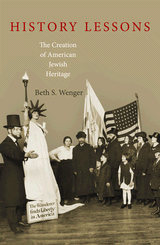
Paul Harvey
A bit later today or early tomorrow Chris Beneke will be posting his thoughts on Kevin Schultz's new and very important book Tri-Faith America. Before we get there, I thought I would call your attention to this new work on American Jewish history from Beth Wenger, reviewed in this month's Choice: History Lessons: The Creation of American Jewish Heritage. This book is about the creation of history and meaning in American Judaism, about how "memory" becomes "history" and "heritage" within this religious community, and about how history creates identity. I'll post a brief bit from the book's website first, and then the review from Choice.
From the book's website:
Most American Jews today will probably tell you that Judaism is inherently democratic and that Jewish and American cultures share the same core beliefs and values. But in fact, Jewish tradition and American culture did not converge seamlessly. Rather, it was American Jews themselves who consciously created this idea of an American Jewish heritage and cemented it in the popular imagination during the late nineteenth and mid-twentieth centuries. History Lessons is the first book to examine how Jews in the United States collectively wove themselves into the narratives of the nation, and came to view the American Jewish experience as a unique chapter in Jewish history.
Beth Wenger shows how American Jews celebrated civic holidays like Thanksgiving and the Fourth of July in synagogues and Jewish community organizations, and how they sought to commemorate Jewish cultural contributions and patriotism, often tracing their roots to the nation's founding. She looks at Jewish children's literature used to teach lessons about American Jewish heritage and values, which portrayed--and sometimes embellished--the accomplishments of heroic figures in American Jewish history. Wenger also traces how Jews often disagreed about how properly to represent these figures, focusing on the struggle over the legacy of the Jewish Revolutionary hero Haym Salomon.
History Lessons demonstrates how American Jews fashioned a collective heritage that fused their Jewish past with their American present and future
And now, the review from Choice:
| . History lessons: the creation of American Jewish heritage. Princeton, 2010. 282p bibl index afp ISBN0-691-14752-3, $35.00; ISBN 9780691147529, $35.00. Reviewed in 2011jun CHOICE. | ||
| American Jews created narratives about Jews in US history in order to establish a collective heritage. Wenger (Pennsylvania) demonstrates that these stories related a Jewish past to US histories in ways that were sometimes celebratory and sometimes critical, but they always sought to establish a place for Jews within US myths and thereby the US present. Wenger analyzes a "dual agenda" in which Jews both "wrote themselves into the narratives of American history" and narrated their own lives as hopeful endings to the "long history of the Jewish people." In exploring these narratives and counternarratives, Wenger provides fascinating primary sources, from didactic Yiddish poetry to letters hotly contesting the erection of a statue. The volume includes examinations of the particular political and cultural facets of US life that allowed Jews to "create" their own heritage and identity; the representation of US Jewish soldiers; children's literature; efforts at memorializing the Revolutionary financier Haym Solomon; and a standout chapter on Jews' relationships to US national holidays. Although Wenger's conclusions may not be surprising for those familiar with US Jewish history, her readings are subtle and compelling. Summing Up: Recommended. All academic levels/libraries. -- S. E. Imhoff, Indiana University / Bloomington |
Jumat, 18 Maret 2011
Is it Religious Belief or Charlatanism?
by John L. Crow
Wednesday evening the ARH graduate students at FSU had its monthly colloquium and during the lively discussion, the issue of fraud and charlatanism came up. In particular, how do we address the beliefs and practices of the historical actors we study? What about claims of healing and medicinal products? When a religious leader sells a product, such as a patent medicine or an herbal remedy, which they claim cures diseases, do we assume they believe in the product, or can we question whether their beliefs are true, raising the possibility of fraud? What if they claim they can heal by the laying on of hands, or from afar? Should we mention this possibility of fraud when there is no direct evidence?
Yesterday afternoon, in a seminar discussing the Sehat and Sullivan volumes Emily Clark blogged about, we discussed the relationship between the courts, religious intolerance, term definition, and the precarious position courts are in when they have to make judgment calls regarding religious belief and practice. While having this discussion, the previous question about charlatanism came to mind and putting these two issues together, I remembered the 1944 Supreme Court case of United States v. Ballard. While this case was not mentioned in Sehat, it would have fit his narrative well, especially in the chapter where he discusses the Supreme Court’s “radical” shift in the 1940s when “the court entered an entirely different world…[b]y acting as a guarantor of rights” (226).
 Guy and Edna Ballard, along with their son Donald, were the heads of the “I AM” movement founded in 1930. According to Guy Ballard, while he was hiking on Mt. Shasta in California, he encountered the ascendant master Saint Germain. With roots in Theosophy, Ballard claimed that Beloved Saint Germain, the current master overseeing the Earth, chose Ballard and his family to be the mouth piece for the “I AM” movement. Through the Ballards, the masters, including Jesus, dictated new teachings which would grant immortality to those who accepted the teachings. The masters also claimed their wisdom would save the United States from destruction. Most importantly, because of his special position as the spokesperson of the masters, Ballard had attained a supernatural state of immortality. This enabled him to heal disease and conquer death and old age. He claimed he could do these things for others both in person and from afar if the followers sent the Saint Germain Foundation love offerings via mail. Ballard made these claims in printed literature created by the Saint Germain Press, on radio shows, which had a broad audience, and through correspondence courses.
 Ballard unexpectedly died in 1939 causing a crisis within the movement. His death obviously refuted his claims of immortality. A number of his former adherents and students used this opportunity to challenge the movement and complained to the federal government about Ballard’s statements. In 1941, the United States filed a lawsuit against Edna and Donald Ballard, claiming that they were guilty of mail fraud, accepting money for products and services which they knew were fraudulent. Eighteen counts were brought against the Ballards. These claims of the Ballards included:
At the end of the case, both Edna and Donald Ballard were found guilty of twelve counts of fraud. The significant thing about the case, though, is that the district court judge gave certain instructions to the jury to not consider the religious claims made by the Ballards. The language of the judge is so specific I quote the passage in full:

In looking at the case of the Ballards, one might wonder how nineteenth century religious figures such as Andrew Jackson Davis would fair. After Davis was visited by Swedenborg and Galen while in a mesmeric trance and given his staff of healing, he then claimed to be a trance medium and that he could heal people. Phineas Parkhurst Quimby and Mary Baker Eddy also made claims related to curing disease. Healing is a significant aspect of various Christian movements, including Pentecostalism and Primitive Baptistism, to name just a couple. As scholars of religion, how do we engage the issue of fraud? Is it fraud only when remuneration is involved? Or is it only a problem when the alleged cure fails to work? Many say that as historians of religion we should adopt the stance of the Supreme Court and assert we are not in the business adjudicating any religious claims regarding belief and practice.
The United States v. Ballard set a precedent that, as Winnifred Fallers Sullivan points out, is impossible for the United States courts to follow. In a detailed study of Warner v. Boca Raton (1999), Sullivan shows that the court is routinely placed in the position of deciding what is a religion and thus protected belief and practice under the establishment clause in the Constitution. She notes, “legal protection for ‘religion’ anywhere demands a definition of religion” (151). I think we, as scholars of religion, are more aware than most about the difficulty of defining religion, and all the implicit and explicit baggage that comes with definition. But this, then, brings me back to my first question, how do we address the beliefs and practices of the historical actors we study? Of course there is no one answer and scholars must decide based on the data and claims of the historical actors. But what these books and court cases demonstrate is that our discipline is not alone in the struggle to answer these questions.
Wednesday evening the ARH graduate students at FSU had its monthly colloquium and during the lively discussion, the issue of fraud and charlatanism came up. In particular, how do we address the beliefs and practices of the historical actors we study? What about claims of healing and medicinal products? When a religious leader sells a product, such as a patent medicine or an herbal remedy, which they claim cures diseases, do we assume they believe in the product, or can we question whether their beliefs are true, raising the possibility of fraud? What if they claim they can heal by the laying on of hands, or from afar? Should we mention this possibility of fraud when there is no direct evidence?
Yesterday afternoon, in a seminar discussing the Sehat and Sullivan volumes Emily Clark blogged about, we discussed the relationship between the courts, religious intolerance, term definition, and the precarious position courts are in when they have to make judgment calls regarding religious belief and practice. While having this discussion, the previous question about charlatanism came to mind and putting these two issues together, I remembered the 1944 Supreme Court case of United States v. Ballard. While this case was not mentioned in Sehat, it would have fit his narrative well, especially in the chapter where he discusses the Supreme Court’s “radical” shift in the 1940s when “the court entered an entirely different world…[b]y acting as a guarantor of rights” (226).
 Guy and Edna Ballard, along with their son Donald, were the heads of the “I AM” movement founded in 1930. According to Guy Ballard, while he was hiking on Mt. Shasta in California, he encountered the ascendant master Saint Germain. With roots in Theosophy, Ballard claimed that Beloved Saint Germain, the current master overseeing the Earth, chose Ballard and his family to be the mouth piece for the “I AM” movement. Through the Ballards, the masters, including Jesus, dictated new teachings which would grant immortality to those who accepted the teachings. The masters also claimed their wisdom would save the United States from destruction. Most importantly, because of his special position as the spokesperson of the masters, Ballard had attained a supernatural state of immortality. This enabled him to heal disease and conquer death and old age. He claimed he could do these things for others both in person and from afar if the followers sent the Saint Germain Foundation love offerings via mail. Ballard made these claims in printed literature created by the Saint Germain Press, on radio shows, which had a broad audience, and through correspondence courses.
 Ballard unexpectedly died in 1939 causing a crisis within the movement. His death obviously refuted his claims of immortality. A number of his former adherents and students used this opportunity to challenge the movement and complained to the federal government about Ballard’s statements. In 1941, the United States filed a lawsuit against Edna and Donald Ballard, claiming that they were guilty of mail fraud, accepting money for products and services which they knew were fraudulent. Eighteen counts were brought against the Ballards. These claims of the Ballards included:
- That the Ballards had attained a supernatural state of self-immortality, which enabled them to be entirely free from ailments common to man and to conquer disease, death, old age, poverty and misery, and that they could and would transmit that supernatural state to others willing to pay therefor.
- That the Ballards had, by reason of supernatural attainments, the power to heal persons of ailments, diseases and injuries and the power to cure persons of diseases normally classified as curable and of diseases normally classified as incurable, and had in fact cured hundreds of persons.
- That the Ballards had a divine and supernatural ability to bring forth from a supernatural state money, riches and other things necessary to mankind and could transmit that ability to others willing to pay therefor.
At the end of the case, both Edna and Donald Ballard were found guilty of twelve counts of fraud. The significant thing about the case, though, is that the district court judge gave certain instructions to the jury to not consider the religious claims made by the Ballards. The language of the judge is so specific I quote the passage in full:
Now, gentlemen, here is the issue in this case: First, the defendants in this case made certain representations of belief in a divinity and in a supernatural power. Some of the teachings of the defendants, representations, might seem extremely improbable to a great many people. For instance, the appearance of Jesus to dictate some of the works that we have had introduced in evidence or shaking hands with Jesus. To some people that might seem highly improbable. I point that out as one of the many statements. Whether that is true or not is not the concern of this court and is not the concern of the jury. As far as this court sees the issue, it is immaterial what these defendants preached or wrote or taught in their classes. They [the jury] are not going to be permitted to speculate on the actuality of the happening of those incidents. The issue is: Did these defendants honestly and in good faith believe those things? If they did, they should be acquitted. If these defendants did not believe those things, [if] they did not believe that Jesus came down and dictated, or that Saint Germain came down and dictated, did not believe the things that they wrote, the things that they preached, but used the mail for the purpose of getting money, the jury should find them guilty.When the case was appealed (Ballard et. al. v. United States, 138 F.2d 540, (C.A. 9 1943)), the United States Court of Appeals for the Ninth Circuit overturned the ruling, claiming that the judge should not have excluded the issue of religious belief. The majority wrote, regarding the claims of meeting the masters and the powers of healing, “Whether such representations were false or true was a question which should have been submitted to the jury.” The case was appealed to the Supreme Court which sided with the district court and overturned the Ninth Circuit Court of Appeals. The significant point is that this opinion established the precedent that the United States government is not in the business of deciding which religious claims were true and which were false. The Supreme Court’s majority opinion states:
The Fathers of the Constitution were not unaware of the varied and extreme views of religious sects, of the violence of disagreement among them, and of the lack of any one religious creed on which all men would agree. They fashioned a charter of government which envisaged the widest possible toleration of conflicting views. Man's relation to his God was made no concern of the state. He was granted the right to worship as he pleased and to answer to no man for the verity of his religious views. The religious views espoused by respondents might seem incredible, if not preposterous, to most people. But if those doctrines are subject to trial before a jury charged with finding their truth or falsity,then the same can be done with the religious beliefs of any sect. When the triers of fact undertake that task, they enter a forbidden domain. The First Amendment does not select any one group or any one type of religion for preferred treatment. It puts them all in that position.With the Supreme Court’s decision, the Ballards were retried. This new case also went to the Supreme Court (Ballard v. United States, 329 U. S. 187 (1946)) and was vacated because in the second trial women were illegally excluded from the jury. The end result was that Edna and Donald Ballard were never convicted of fraud.

In looking at the case of the Ballards, one might wonder how nineteenth century religious figures such as Andrew Jackson Davis would fair. After Davis was visited by Swedenborg and Galen while in a mesmeric trance and given his staff of healing, he then claimed to be a trance medium and that he could heal people. Phineas Parkhurst Quimby and Mary Baker Eddy also made claims related to curing disease. Healing is a significant aspect of various Christian movements, including Pentecostalism and Primitive Baptistism, to name just a couple. As scholars of religion, how do we engage the issue of fraud? Is it fraud only when remuneration is involved? Or is it only a problem when the alleged cure fails to work? Many say that as historians of religion we should adopt the stance of the Supreme Court and assert we are not in the business adjudicating any religious claims regarding belief and practice.
The United States v. Ballard set a precedent that, as Winnifred Fallers Sullivan points out, is impossible for the United States courts to follow. In a detailed study of Warner v. Boca Raton (1999), Sullivan shows that the court is routinely placed in the position of deciding what is a religion and thus protected belief and practice under the establishment clause in the Constitution. She notes, “legal protection for ‘religion’ anywhere demands a definition of religion” (151). I think we, as scholars of religion, are more aware than most about the difficulty of defining religion, and all the implicit and explicit baggage that comes with definition. But this, then, brings me back to my first question, how do we address the beliefs and practices of the historical actors we study? Of course there is no one answer and scholars must decide based on the data and claims of the historical actors. But what these books and court cases demonstrate is that our discipline is not alone in the struggle to answer these questions.
Gender and American Religious Historian, Part II

By Kelly Baker
This is my humble attempt to document those scholars who use gender as a category of analysis in American religious history. The first four on my list were the scholars whose work has most deeply influenced my own. The rest of my list includes scholarship I love as well as scholarship that I need to know (and you do too!). My current goal is to list 31 scholars for the 31 days of NWHM. Let's see if I can do it!
So, the list continues on:
5. Catherine Brekus, the editor of The Religious History of American Women: Reimagining the Past and author of Strangers & Pilgrims: Female Preaching in America, 1740-1845, is one of the strongest voices about the inclusion of women in American religious history. Her introductory piece to The Religious History of American Women pulls no punches. She writes:
More than thirty years after the rise of women's history alongside the feminist movement, it is still difficult to 'find' women in many books and articles about American religious history...[M]any seem to assume that women's stories are peripheral to their research topics, whether Puritan theology or church and state. They do not seem hostile to women's history as much as they are dismissive of it, treating it as a separate topic that they can safely ignore. Since 'women's historians' are devoted to writing women's history, those who simply identify themselves as 'American religious historians' can focus on topics that seem more important to them (1).
Brekus makes it clear that American religious history needs to attend to gender and her contributors showcase how studying the lives of women change the tenor, strategies and narration of American religious history. I reread her introductory essay, whenever I need a kick in the pants to do good gender analysis as a method to improve my scholarship. Women's history is not just the purview of women's historians.
6. Evelyn Higginbotham is the author of Righteous Discontent:The Women's Movement in the Black Baptist Church: 1880-1920(1993). While I am not the most familiar with her work, I should be. Harvard University Press describes this ground-breaking and award-winning work:
In her account, we see how the efforts of women enabled the church to build schools, provide food and clothing to the poor, and offer a host of social welfare services. And we observe the challenges of black women to patriarchal theology. Class, race, and gender dynamics continually interact in Higginbotham’s nuanced history. She depicts the cooperation, tension, and negotiation that characterized the relationship between men and women church leaders as well as the interaction of southern black and northern white women’s groups.
Righteous Discontent finally assigns women their rightful place in the story of political and social activism in the black church. It is central to an understanding of African American social and cultural life and a critical chapter in the history of religion in America.
7. Amy Koehlinger, a contributor to The Religious History of American Women, the author of The New Nuns: Racial Justice and Religious Reform in the 1960s (2007), and one of my mentors, helped me wrestle with Judith Butler's Gender Trouble as well as informed my approach to 1920s Klan femininity and masculinity. Amy's work on Catholic nuns and their struggles in the Civil Rights movement analyzes race and gender in tandem and demonstrates how nuns negotiated their new roles during the advent of Vatican II. Her new project, titled Rosaries and Rope Burns, explores importance of boxing for Catholic men as well as examines how the sport influenced performances of masculinity. This isn't first time she's tackled masculinity. Her essay, "Let Us Live for Those Who Love Us': Faith, Family, and the Contours of Manhood among the Knights of Columbus in Late Nineteenth-Century Connecticut" in the Journal of Social History, takes to task Mark Carnes's work on fraternities in the Victorian era for focusing solely on Protestant men's attempts to move away from domesticity. The Knights of Columbus, on the other hand, imagined their fraternal work as an extension of their family life.
8. Lynn Neal is the author of Romancing God: Evangelical Women and Inspirational Fiction (2006) and a co-conspirator when it comes to all things religious intolerance. Romancing God explores the relationships of evangelical fiction to evangelical romance novels, and Lynn takes seriously the piety and devotional reading of these Christian women. Rather than disparage the romance novel, she explores the complicated relationships evangelical women have with the books that they read and how this genre influenced their practices of Christianity. (I've blogged about Lynn and Amy's work long ago.)
8. Kathleen Sprows Cummings is the associate director of the Cushwa Center for the Study of American Catholicism, author of New Women of the Old Faith: Gender and American Catholicism in the Progressive Era (2009), and contributor to The Religious History of American Women. Kathy also blogs at with outr much beloved crew at Religion in American History. Her work employs case studies of Catholic women to demonstrate how debates over Catholic identity during the Progressive era were also negotiations of gender roles. She has written deftly about the place of women religious in Catholic infrastructure.
9. Anthea Butler, who I follow at Religion Dispatches, is the author of Women in the Church of God in Christ: Making a Sanctified World (2007). Butler's work engaged me as soon as she cataloged the fashion of the women of COGIC and discussed the ways in which fashion cleared up the problem of sanctified women's bodies. Here's what I said about her book at the Journal of Southern Religion:
Moreover, fashionable dress might present a gender-confused body. For members, "the Spirit could not move into a body that was 'confused' about its gender identity," which meant that women policed the clothing of other women to guarantee one could become sanctified (79). Additionally, dress was the preferred method of controlling men's sexual behavior. By dressing modestly, COGIC women differentiated themselves from prostitutes and appeared "respectable" (80-81). For Butler, dress is also the signal for changes within the denomination. Restrictions of dress emphasized the importance of self-sanctification, and the embrace of more fashionable attire signaled the engagement of church mothers with the larger world. To become civically engaged, these women had to retire plain dress and be "a smartly dressed, well-coiffed and well versed church mother with a vocabulary steeped in scripture yet attuned to the social realities on earth, rather than heaven" (136). The evolution of the Women's Department from 1911 to the 1960s could be traced sartorially. Their dress signaled their spiritual concerns, and their clothing shifted from a material artifact representing inner purity to smart clothing that symbolized a concern with the larger world. For Butler, by the 1970s, clothing had been stripped of much of its religious meaning, and well-dressed women were no longer engaged, but submissive to the commands of male leadership.
Her careful attention to the sartorial and the complexity of gender performance for COGIC women makes this one of my beloved examples of Pamela Klassen's assertion that the history of religion is a history of clothing.
10. Bret Carroll's article on the mediumship of John Shoebridge Williams is one my favorite academic articles, which is not a title I pass around lightly. Carroll uses the diaries of Williams to show how the medium faced conflicting norms of masculinity in Spiritualism but also larger 19th century American culture. Williams had a peculiar dilemma, in that he believed he was growing breasts because his daughter, Eliza, possessed him. I recently taught this article in my gender seminar, and my students were a bit flabbergasted. Yet, the complexity of masculinity, femininity and the problem of androgyny appear in this well-written and humorous article about one male medium's struggle with his gender performance. Feel free to rush to JSTOR for your reading pleasure.
Note: The University of North Carolina press is not influencing my choices with any monetary gains. They just rock when it comes to gender scholarship in American religious history.
Rabu, 16 Maret 2011
Gender and American Religious Historian, Part I
 By Kelly Baker
As mentioned in my post recently, I want to highlight the scholars who take gender and women seriously in American Religious History for National Women's History Month. Below, I have provided my first four scholars, and these are the folks that I find most pivotal when I think about the power of gender history to inform and change American religious history. As one might tell, I have favorite pieces of scholarship from each, and each has a large body of scholarship to draw from. The ones I highlight are the ones that influence me most deeply as a scholar.
Here are they are:
1. Ann Braude, of course, is at the top of my list. Her works include Radical Spirits: Spiritualism and Women's Rights in Nineteenth-century America (2001), Sisters and Saints: Women and Religion in America and several edited collections, notably Transforming the Faiths of Our Fathers: The Women Who Changed American Religion. Her essay, "Women's History is American Religious History"(1997) is required reading. In this piece, she argues that women's history is central to the narratives of American religions, and that common descriptors like secularization refer to men's roles and decreasing presence in churches rather than abandonment wholesale of Christianity. For Braude, religious history looks different from the perspective of women, and this needs to be accounted for in our tellings and retellings of American religious history. Again, I wonder how many have taken seriously her call of the gendered nature of our categories of American religious historiography.
2. Pamela Klassen's work on religion and maternity is one of my currently most assigned pieces in my gender classes. While I don't assign the whole of Blessed Events: Religion and Home Birth in America (2001), I do assign her “Sacred Maternities and Post-Biomedical Bodies” from Signs. Klassen's analysis of home birth tackles one of the most problematic areas for feminist theory, pregnancy. Her article presents the ways in which home birthing women describe their bodies and what is "natural" as well as what is supernatural about birth. Her explorations of what is at stake in the natural clearly shows how pregnancy is socially constructed and biological. Just because we assume biology doesn't mean it is. Klassen deftly showcases how the biological becomes paramount in the case of pregnancy, but home birthing women graft social and religious meaning on their bodies as well. They might be "postbiomedical bodies" but they are social bodies as well.
3. Marie Griffith's work on Women's Aglow also appears quite frequently in my classes in American religious history and gender. Much like with Klassen, I don't assign the whole of God's Daughters:Evangelical Women and the Power of Submission (1997).Instead, my students read "Submissive Wives, Wounded Daughters, and Female Soldiers…” from David Hall's edited collection, Lived Religion in America. This haunting piece on the power of submission to God in the lives of women often troubles my students. That discomfort allows for good analysis and equally compelling discussion. I am also deeply in love with Born Again Bodies (2004), which emphasizes the importance/significance of bodies and food in American religious history. Griffith's assertion of the danger of slimness in religious circles to emphasize certain white, female bodies and the corruptedness of differing bodies stayed with me long after I finished this work. The centrality of bodies to theology also made me rethink my own approach to white, male bodies in my own work. (Griffith has just been named the director of the John C. Danforth Center on Religion & Politics at Washington University in St. Louis.)
4. Robert Orsi's “ ‘He Keeps Me Going’: Women’s Devotion to Saint Jude Thaddeus…” in Religion in American History: A Reader is another constant in my classes. This article is a portion of Thank You, St. Jude: Women's Devotion to the Patron Saint of Hopeless Causes (1999), which is my favorite book, hands down, by Orsi. Every time I read this article, I find some new layer of complexity from the lovely interweaving of immigrant history, the Catholic Church's position on women in newsletters, and the material relationships of the women to St. Jude. He writes, "Women...created and imagined themselves, manipulating and altering the available grammar of gender" (349). Moreover, Orsi poignantly notes, "Women believed that they became agents in a new way with Jude's help" (349). Women believed in agency, but Orsi seems less convinced. This line proved particularly fruitful to my students this semester as they struggled with the question of agency and the desire to see agency even if there is none. Belief in agency startled them and me, and we wondered how St. Jude operates. We pondered what does the attachment to the patron saint of lost causes really mean for women, for Catholicism, and for our class.
Also, stay tuned for additional posts on the same topic here.
[Cross-posted at kellyjbaker.com]
Rabu, 23 Februari 2011
What the Foucault (Do We Know)?: FSU's Grad Symposium Redux

Kelly J. Baker
As I am still recovering from a whirlwind weekend at Florida State University's Tenth Annual Graduate Symposium, I wanted to note how much I enjoyed my time this weekend and what a boon this conference is to religious studies graduate students. What you all should know from the outset is that I am not a neutral observer. I love this conference, and Mike Pasquier and I even organized it long, long ago. (Hat tip to our own contributor Emily Clark was the organizational guru this year).
Now, I did not attend every panel nor did I attempt to, so I encourage readers and participants who attended other panels to send their reflections along. What I was able to do was to talk to graduate students of alma mater and other institutions about their own work and mine as well. The paper presenters swung for the fences, and I enjoyed their energy, evidence, and historiographical strategies. Grads in American religious history presented on papers ranging from Emily Post to Christian manhood to the Holy Land Experience to body studies to Burning Man to border saints to the problems of "lived religion" to beards and shaving. The brilliance of this symposium is that it allows a welcoming and encouraging environment for grads to present their work with feedback from the likes of John Corrigan, Amy Koehlinger, Amanda Porterfield, Kathryn Lofton, and Sylvester Johnson to name only the Americanists. (Any graduate student in religious studies writ large should plan to go next year.)
The keynote with the best title ever was "What the Foucault Do We Do Now?" with Matthew Day, Sylvester Johnson, Matthew Kapstein and Katie Lofton interrogated the place of power in the study of religion, the institution of the academy, and the genealogy of religious studies. The panel paired scholars of ranging interests from methods and theory to Buddhism to American religious history and posed the question of how power (read Foucault) functions both for our subjects of study but also for our positions as scholars. For the interest of RIAH readers, Day, Johnson and Lofton proved to engage exactly what is at stake in religious studies from very different positions. Johnson prodded the strange bifurcation between the academy and the "real" world, and he argued compellingly that just because the origins of religious studies are bound to colonial endeavor does not mean we (religious studies scholars) should burden ourselves solely with origins. Instead, our knowledge and expertise applies to the "real" world because the academy, despite various attempts, is still bound to our contemporary moments. We are experts, we have power, and we should use it.
Lofton employed IBM advertisements to discuss the merger of power and subjectivity. She suggested that these particular ads did not uplift individuals but rather created a powerless collective at the whim of power grids, bad traffic, and other mundane problems of contemporary life. Each of us faces the similar hum drum, and the ads questioned our agency even in how companies market products not to me or you, but some amorphous us. From ads to religion, Lofton noted that perhaps religion is best understood as repository in which things, ideas, and brands collect. My sense was that religion was archive, hodge podge, even bricolage in this analogy. To understand religion is to understand the pile-up.
In my assessment, Day's contribution offered the opposite of Lofton--religion as empty. Day was troubled by the category of religion, the discipline of religious studies. Building upon Bruce Lincoln and Russell McCutcheon, Day argued that religious studies scholars don't problematize religion, so that as a category religion is valueless because of its infinitude. He asked can it be art or sports? Moreover, he wants religious studies scholars to question the reliance upon "experience" as a measure of religion. What does it mean? Or more importantly, what is at stake when we gesture to experience? Day's critique suggested a need for a critical edge about what is religion and what we study when we assert religion as our subject matter. Moreover, does the gesture to experience limit our subject matter?
During Q&A, I asked Lofton and Day to compare their stances about religion as repository or as empty. What is at stake in empty or full? Their answers are theirs, but I couldn't help but wonder what my own assessment of this was. Part of me wants to claim the middle path of "can't it be both?", but that is terribly unsatisfying. The power of religion as a category is what is at stake in their assertions, and I wonder how often religious studies scholars interrogate what exactly religion is in our own work. Is it empty or full? Is it value-free or value-filled? Do we craft our own categories of religion as experience, belief, practice, etc? Do we use the categories of those we study? In my own work, I confront the strange yet different assumptions about "good religion"(read helpful and therapeutic) versus "bad religion" (read harmful or malicious) because I work on the "bad." The commentary usually moves something like "bad religion" is not religion at all. What is religion becomes, then, essential to how to approach the Klan, the hate movement, or even my newer fascination with apocalypticism. How I make the case that this is actually religious becomes significant. I point to the pile-up: theology, ritual, practice, and belief that all show the Protestant nature of the Klan. Yet, I could also point to the emptiness (malleability) of Protestant as a label, of religion as a construct, yet I don't. I could though. Empty or full?
Graduate students, if these kinds of questions are interesting to you, plan on attending next year's symposium at FSU. If they aren't, plan on attending or presenting anyway because you can't beat the encouraging environment, the weather, or the chance to ask, "What the Foucault do we do now?"
Langganan:
Postingan (Atom)
