Tampilkan postingan dengan label polls and surveys. Tampilkan semua postingan

Sabtu, 22 Januari 2011

The Latest Religious Data

Kevin M. Schultz

Who knew Jews were the most loved religious group in America? The least loved? The Mormons. Sadly, it is also they who love everyone the most. Tough to be a Mormon I guess, all that giving, nothing in return (save heaven).

Speaking of heaven, who knew that a huge swath of the American people think that celestial reward is not reserved only for their own people? Many a head-shaking minister say their flock know not what they say, but the polling data is there.

These are some of the findings of a relatively recent arrival in the American Religious History world, American Grace: How Religion Divides and Unites Us, by sociologists Robert Putnam (of Bowling Alone fame) and David E. Campbell. The book's central claim is that Americans are incredibly polarized in their religious beliefs, but also that they are incredibly tolerant of others.

For us historians, the authors also propose a three-stage progression as to how we became that way: (1) the "sixties" add a whole bunch of sexual licentiousness to our culture (especially legalized abortion and rights for homosexuals); (2) the religious right emerges in response, peaking in the early 1990s; and (3) the "millennials" (those who came of age around the millennium) are so turned off by the religious right they flee organized religion, thus accounting for the dramatic rise of the "nones."

It's an interesting theory, one we should chew on. I'm struck by the fact that a decade-and-a-half ago more than 85 percent of Americans considered themselves Christian but now it's hovering around 75 percent. Really? That's a large drop, perhaps too large to be accounted for by worries about the religious right? I'm also struck by the authors' portrayal of the 1950s as religiously placid, which they most certainly weren't. Nevertheless, it's a book worth grappling with, and something that should be consulted before we start talking about how many Americans believe in what and why. If you want to know more about my thoughts, I've written a brief review of it for Wilson Quarterly--subscription required for the full review.

Kamis, 20 Januari 2011

Religion and the New Congress

Chris Beneke

The Pew Forum's religious survey of the 112th Congress (table on the right is theirs) is out. No surprise that Protestants and Catholics abound, though roughly in line with their proportion of the overall population. Perhaps also unsurprising to historians will be the fact that 69% of Congressional Republicans identify as Protestant, while 34% of Congressional Democrats identify as Catholic and 15% as Jewish. Pew also reports:
A few of the country’s smaller religious groups, including Episcopalians, Presbyterians and Jews, have greater numerical representation in Congress than in the general population. Some others, including Buddhists and Muslims, are represented in Congress in roughly equal proportion to their numbers in the adult U.S. population. And some small religious groups, such as Hindus and Jehovah’s Witnesses, are not represented at all in Congress.

Perhaps the greatest disparity between the religious makeup of Congress and the people it represents, however, is in the percentage of the unaffiliated – those who describe their religion as atheist, agnostic or “nothing in particular.” According to information gathered by CQ Roll Call and the Pew Forum, no members of Congress say they are unaffiliated. By contrast, about one-sixth of U.S. adults (16%) are not affiliated with any particular faith. Only six members of the 112th Congress (about 1%) do not specify a religious affiliation, which is similar to the percentage of the public that says they don’t know or refuses to specify their faith.
The apparent non-electability of the unaffiliated might prompt us to again ask what exactly "unaffiliated" means. It may not be the same thing as agnosticism or atheism (a 2006 Baylor survey in fact indicated that a healthy majority of the un-affiliated "believe in God or some higher power") though it might be fairly close (Pew itself concluded that "the majority of the unaffiliated population ... is made up of people who simply describe their religion as 'nothing in particular.'") If we were examining these numbers the way early American historians and journalists study the founders, we might also wonder about the percentage of deists residing among both the non-affiliated and the affiliated.

As the Pew report notes, the change from the 111th Congress is very modest. However, the change from the 87th (1961-62) Congress is significant with Catholics (who have gone from 19 to 29% of the total) and Jews (who have gone from 2 to 7% of the total) now serving in noticeably larger numbers. I'm looking forward to Kevin Schultz's forthcoming Tri-Faith America: How Catholics and Jews Held America to Its Protestant Promise (Oxford UP, due in March) to help us shed some light on all of this.

Minggu, 21 November 2010

We're No. 1! Colorado Springs Leads in Religion (or Not) and in Defunding NPR Nazis

Paul Harvey

Men's Health magazine, noted for its scholarship in American religious studies, recently rated the top 100 "holiest cities in America." Result: Colorado Springs rated first on the list. I'm very glad to be first in something. Here's a brief excerpt:

While it's true that Colorado, at 5,980 feet above sea level, is closer to heaven than even the Mile High City, we used a different set of numbers to divine our findings. We scoured the U.S. Census and the yellow pages (Yellow.com) for places of worship per capita. Then we tallied up religious organizations (U.S. Census) and the number of volunteers who support these groups . . . Finally, we considered the amount of money donated to religious organizations . . . and spent on religious books.

Most religious

1. Colorado Springs, CO
2. Greensboro, NC
3. Oklahoma City, OK4. Wichita, KS
5. Indianapolis, IN
6. Jacksonville, FL7. Portland, OR
8. Birmingham, AL9. Charlotte, NC
10. Little Rock, AR

The fact that Portland appeared at #7, even though Oregon consistently appears down towards the bottom of most professional surveys conducted by ARIS and others, immediately made me question the methodology here. And in doing so, here's a counter-survey that I found, from our own local paper (based on figures from 2000, admittedly, but still):

A quick run through the data seems to contradict the idea that El Paso County is a highly religious place. The 2000 survey found El Paso County was home to 222,490 people who claim an affiliation with some religion. That was 43 percent of the population. The rate in Denver, meanwhile, is 64 percent.

So, either we're No. 1, or we don't even hold a candle to Denver. Take your pick.

One area where we indisputably lead the nation is in the great national jihad to defund the "Nazis" at National Public Radio ("Nazis" being the term Roger Ailes of Fox News, evidencing its usual fair and balanced presentation, used to refer to NPR; Ailes is President of Fox News).
Leading the great national jihad is our local representative Douglas Lamborn, previously unknown to the public at large but known locally for protecting every piece of military spending pork, no matter how many Defense Secretaries insist that they be cut, and vowing to protect Medicare against the encroaching monstrosity of "socialized medicine" and "Obamacare" -- and etc. You get the idea.
Here's a hilarious cartoon about Lamborn's jihad, from Denver's Westword.

For years Lamborn has sponsored bill to defund completely National Public Radio; the combination of the Juan Williams incident and the recent elections have given this bill a very good chance of approval next year. Our local paper the Colorado Springs Independent covers the story here.

How ironic I should come upon this story, or combination of stories, after listening to a really thoughtful and intelligent program on my local public radio station KRCC this morning featuring a panel discussion from various locals (the religion reporter at the Colorado Springs Gazette, a college chaplain, and some others) on the influence of evangelicalism in Colorado Springs. Besides the panel discussion, the program also features a reporter visiting a local mosque here in the Springs, and another report from the tough lives experienced by those who feel called to the little town of Crestone, Colorado, in an area which houses a striking diversity of religious communities from a Carmelite Monastery to various Zen Buddhist groups. Ethereal spirituality, as the piece makes clear, is a challenge when you're trying to make it through the bitter winters and swarms of spring mosquitoes in that remote corner of SW Colorado.

I was thinking about the particular recent attacks on NPR further tonight in relationship to this commentary by Guy Raz at the end of today's All Things Considered -- a short, arrestingly beautiful piece that showed NPR at its best. Here's hoping the piece goes viral.

Raz was reflecting on Roger Ailes, the Fox News executive who recently said the following:

"They are, of course, Nazis," Ailes said of NPR. "They have a kind of Nazi attitude. They are the left wing of Nazism. These guys don't want any other point of view."

[Yes, Ailes since issued the ritual obligatory apology. So what; it's obvious he meant what he said in the first place].

Let's leave aside the complete historical malapropism of the idiocracy here ("left wing of Nazism," etc.). What moved me was Raz's short oral essay "inspired" (or whatever the term should be) by Ailes's grotesque comments. Raz began by reflecting on his great-grandfather Abraham Reiss, who didn't make it out of Europe before the real Nazis got to him, and then further on what it meant for him to hear "Nazi" used in reference to his network.

That word, Nazi, means something. We are all free to use it as we please. It's our right, of course. But when its use is stripped of any of its real meaning, I just ask you to remember the story of Abraham Reiss.

Colorado Springs -- whether we're first or not in religious adherence,you can thank us for taking the lead in the great national jihad to defund the left-wing Nazis at NPR.


P.S.: While you're at it, check out the piece right before Raz's essay, which is about the growing number and influence of Israeli jazz musicians in New York. I heard one of them, the fantastic bassist Omer Avital, about 10 years ago, and still smile when I think of him ferociously attacking his instrument all night at Small's, with the Jason Lindner band. One of the most astonishing nights of music I've heard in my life; and, for me, a spiritual experience. So here's to you, Omer. My local public radio station, the great and wonderful KRCC, plays your music on occasion, and I heard a tune of yours one time, quite unexpectedly, on the tiny station KZRA in Alamosa, Colorado, one of many rural public stations which have taken root thanks to indispensable public subsidies to bring one-of-a-kind programming to the hinterlands of places such as SW Colorado and NW New Mexico. Congressman Lamborn, check it out sometime, you might like it.

Rabu, 06 Oktober 2010

Surveying Religious Knowledge: The Founding Fathers, and the Pew Poll

Paul Harvey

For anyone interested, an announcement from History News Network:

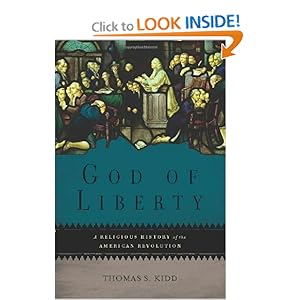
Join Thomas Kidd, author of
God of Liberty: A Religious History of the American Revolution for a live Q&A on HNN's Ning Network at 3 p.m. Eastern on Wednesday, October 13.

Kidd's take on the poll of Americans' religious knowledge, which Chris Jones blogged about here a few days ago, may be found at "
The Founding Fathers Would be Shocked at Our Religious Ignorance." He makes the point that the relatively high degree of religious knowledge evinced by skeptics, noted by the recent pollsters, is not new.

Over at Immanent Frame, a variety of other scholars offer their views on, and take a number of shots, at, the Pew Poll:
Surveying Religious Knowledge. In her contribution, Kathryn Lofton asks, if a person is polled about rock and roll history and is unable to identify Big Mama Thornton, does this make them ignorant of rock and roll history? She continues:

For now, I can only observe that a survey which pits religious groups against one another in a Quiz Bowl, and which imagines that praying Protestants ought to know the authority of Martin Luther, tell me very little about religious knowledge, and tell me even less about what the humanities do to serve such a surveyed public. It may be that we live in a budgetary time that begs for base descriptions of our basic (un)knowing. I would only warn that the minute we believe the answers we offer begin with multiple choice questions is the same minute when we cede our complexity to that formation of ignorance.
Related Posts Plugin for WordPress, Blogger...