Tampilkan postingan dengan label religion and slavery. Tampilkan semua postingan

Minggu, 18 September 2011

Back to the Future: Christianity and the American Founding

I'm looking forward a bit later this semester to using John Fea's Was America Founded as a Christian Nation in my "Theory and Methods of History" class. Aside from the precise subject matter, Fea has much to teach about thinking historically, on any subject. Below is my review of the book published several months ago at Christian Century, which is freely available online so I'll repost here, particularly for those of you who would be interested in using the book next semester or some other time in the future.

Paul Harvey

Was America founded as a Christian nation? No, is John Fea's answer to the question posed in his title. But the answer is yes if we consider how Americans (especially from 1789 to 1865) understood themselves as a Christian nation. And then again, maybe it's just a bad question, Fea concludes, because it arises not from a rich understanding of the past but from present-day polemics. Only when we remove it from that context can we begin to make sense of it.

As chair of the history department at Messiah College, a professing Christian, author of an outstanding book on an 18th-century figure of the "rural Enlightenment" (Philip Vickers Fithian), a frequent public speaker and a tireless blogger at The Way of Improvement Leads Home, Fea is rapidly making a name for himself as a public intellectual who brings the virtues of scholarly humility, patience and objectivity to highly controversial questions of religion and the founding era of American history. This book is a model of scholarly restraint, of patiently working one's way through the sources and of historicizing the questions and terms with which one works.

America was not "founded as a Christian nation," Fea suggests, because its founding documents were those of a fledgling nation-state and not intended as religious statements. The Declaration of Independence was a document of foreign policy aimed at persuading other nations of our independence, and the Constitution was a secular document of governance aimed at shoring up a national government that had proven far too weak during the era of the Articles of Confederation.

Moreover, present-day proponents of the Christian nation thesis (notably self-styled scholars such as David Barton and writers such as Peter Marshall, author of The Light and the Glory) depend heavily on documents that are taken out of context. Fea points out that while some founding fathers (such as John Jay) held recognizably evangelical Christian beliefs, most of the major founders held a range of beliefs that positioned them as either lukewarm high-church Christians who mainly talked about Providence or rational theists such as Thomas Jefferson, who actively rejected and even ridiculed central Christian doctrines such as the resurrection of Christ.

Then again, yes, America was founded as a Christian nation, Fea argues. For example, nearly every individual state (but not Virginia) enacted a state constitution that made it "very clear that they were Christian societies, placing Protestant qualifications on office holding and allowing government to tax citizens for the purpose of promoting the Christian religion." Moreover, Ameri­cans of the founding era, even including those far outside the bounds of Christian orthodoxy, trusted that "religion was necessary in order to sustain an ordered and virtuous republic."

During the Second Great Awakening in the 19th century, when evangelicalism rose to become a dominant form of religious expression, many Americans assumed a Protestant base to American culture. In the words of historian David Sehat, they created an informal but powerful "moral establishment" that in some ways wielded more power than any national legal establishment of religion would have. The religion clauses of the First Amendment ("Congress shall make no law respecting an establishment of religion, or prohibiting the free exercise thereof") ruled out any legal establishment at the national level. But Americans exercised the free-exercise clause freely, inventing a bewildering array of new denominations, missionary societies, publication boards and religions throughout the 19th century, making America a Christian nation in demography if not in law.

Thomas Jefferson had dreamed of a rationalist republic; what he got instead was a Methodist millennium. In many ways, the idea of America as a Christian nation, as put forward by its current proponents, was an invention not of the founding era but of the 19th century. In other words, the phrase Christian nation as used in Fea's title itself has a history, one that underwent significant changes and transformations between the era of Franklin and the era of Falwell.

But most important, Fea suggests, the question "Was America founded as a Christian nation?" is badly posed. The question is ahistorical because it presupposes a stable set of terms (such as nation, founding and Chris­tian) that in fact are historically contingent and must be understood within the context of their own time and place. Fea's most important original intention is to give readers a lesson in historical thinking—a lesson on the strangeness and distantness of the past in relation to our own preconceptions and concerns.

For example, the famous Treaty of Tripoli in 1797 assured the Muslim states of the Barbary Coast that "the Government of the United States of America is not, in any sense, founded on the Christian religion"; no religious differences between the United States and Tripoli would come between a necessary and important trade agreement protecting American ships from piracy. The treaty stated a historical truth about the Constitution. Americans, however, viewed the contest between the United States and the Barbary nations as a holy war, avidly read captivity narratives describing Christians being forced to convert to Islam and characterized Muslims as "children of Ishmael" who threatened Christian civilization. In short, in spite of the secularism of the founding documents, many Americans from the Revolution to the Civil War did understand themselves to be citizens of a Christian nation.

Of course, those same Americans disagreed vehemently on what constituted a Christian nation, hence the denominational splits, religious vituperation and the bloody Armageddon of the Civil War. And since then Amer­icans have continued their disagreements.

Fea tells this story with consummate skill and evenhandedness. However, his evenhandedness sometimes seems to suggest points of controversy where there aren't any (not unlike the Obama "birther controversy"). In the present day, even advocates of the "godless Constitution" viewpoint (such as historians Isaac Kramnick and R. Laurence Moore) fully understand the deep religious base of American history. They suggest not an exclusion of religion from the public square but simply an avoidance of any special privileges for it. The Christian nationalists, by contrast, have some legitimate points (fully credited by Fea), but they also actively and unapologetically use and distort history in precisely the ways that Fea warns against in his introductory chapter, titled "How to Think His­torically."

The Christian nation debate is not really an intellectual contest between legitimate contending viewpoints; it is instead a manufactured controversy akin to the global warming debate. On one side are purveyors of a rich and complex view of the past (including most historians who have written about the founding era). On the other side is a group of ideological cranks who have created an alternate intellectual universe based on a historical fundamentalism. In their drive to create a usable past, they show little respect for how the past is a "foreign country."

Kamis, 04 Agustus 2011

Through the Storm, Through the Night: Now Available!

Paul Harvey

Earlier this summer I blogged about my book Through the Storm, Through the Night: A History of African American Christianity, which was then slated to appear later in the summer (Rowman & Littlefield publishers).

Voila, it's later in the summer, and the book is out, so for that reason, and because my vast portfolio holdings tanked today, seemed like a good day for the time-honored self-promotional post.

Below I'll just repost what I put up earlier about the book, which describes the contents in some more detail, sorry for the repeat but definitely hoping that this book will be useful for any number of classes that some of you regular blog readers teach.

So, without further adieu, a repost. If you have the chance to use it in a class over the next year, let me know how it goes. Yes, it comes in a Kindle edition as well. Paperback version should be out in a year or so I think. For classroom instructors -- the publisher Rowman & Littlefield has an "desk/exam" copy policy here.
__________________________________

Later this summer [it's now out], my new book Through the Storm, Through the Night: A History of African American Christianity, will be out with Rowman & Littlefield. It's part of the "African American History" series put out by Rowman & Littlefield. And it's out just in time for your fall course text assignment!

I'm proud to have it standing there with very recent books by some tremendous historians in the same series, including Chris Waldrep's African Americans Confront Lynching: Strategies of Resistance From the Civil War to the Civil Rights Era, my old friend Burton Peretti's Lift Every Voice: The History of African American Music, and Edward Countryman's forthcoming Enjoy the Same Liberty: African Americans and the Revolutionary Era.

I'm also posting this now because some of you -- and you know who you are! -- are (if you're like me) now facing up to the fact that you've put off your fall book selections (which were due a month or two ago, remember that) long enough, and it's time to pick your texts for the fall. And for a select number of you, maybe this one will be right for you.

The text is short, about 140 pp., and written with the "general reader" and undergraduate reader in mind. I start with the diversity of religious expressions in West and Central Africa in the 14th/15th century, and end with Mama Lola and Kanye West, if that is a far enough chronological reach for you. . . .

In addition, the book comes with a "documents" section, about 60 pages, ranging from Virginia laws on baptism and freedom from the 1660s, to an account of the Stono Rebellion in 1739, to Daniel Payne's famous tour attempting to stamp out "ring shouts" in the 1870s, to Mahalia Jackson's reminiscences of growing up in New Orleans, to John Lewis reflecting on the meaning of non-violence, to Vincent Harding's great essay on the white Christ and Black Power, to Kanye West's "Jesus Walks." There is also a bibliographic essay, broken up by chapter, a Glossary, a Chronology section, and a timeline and some brief footnotes (brief enough not to scare off any freshman reader).

If any of ya'll want to preview it for possible purchase or course use, I'd by happy to send pdfs of the page proofs, or a sample chapter or something if you just want to briefly survey. Just email me, and I'll be there.

Table of contents and more info. below.
_____________________________________

Book description (from book website):

Paul Harvey illustrates how black Christian traditions provided theological, institutional, and personal strategies for cultural survival during bondage and into an era of partial freedom. At the same time, he covers the ongoing tug-of-war between themes of "respectability" versus practices derived from an African heritage; the adoption of Christianity by the majority; and the critique of the adoption of the "white man's religion" from the eighteenth century to the present. The book also covers internal cultural, gendered, and class divisions in churches that attracted congregants of widely disparate educational levels, incomes, and worship styles.

Through the Storm, Through the Night provides a lively overview to the history of African American religion, beginning with the birth of African Christianity amidst the Transatlantic slave trade, and tracing the story through its growth in America. Paul Harvey successfully uses the history of African American religion to portray the complexity and humanity of the African American experience.

Table of Contents:
  • Introduction: Themes in African American Religious History
  • Middle Passage for the Gods: African and African American Religions from the Middle Passage to the Great Awakening
  • The Birth of Afro-Christianity in the Slave Quarters and the Urban North, 1740-1831
  • Through the Night: African Amerian Religion in the Antebellum Era
  • Day of Jubilee: Black Churches from Emancipation to the Era of Jim Crow
  • Jesus on the Mainline: Black Christianity from the Great Migration through World War II
  • Freedom's Main Line: Black Christianity, Civil Rights, and Religious Pluralism
  • Epilogue: Righteous Anger and Visionary Dreams: Contemporary Black Politics, Religion, and Culture
  • Documents Section
  • Glossary
  • Bibliographic Essay
Advance reviews:

"If you teach, study, practice, or care about African American religion, then this is the book for you. Paul Harvey provides an indispensable overview of black Christianity from the age of slavery to the ascendance of Obama. With it, Harvey offers a bevy of fascinating primary documents that range from Nat Turner's righteous rage to Mahalia Jackson's soulful songs. Through the Storm, Through the Night does it all with such clarity that even the most complex concepts make sense."—Edward J. Blum, Author, W. E. B. Du Bois, American Prophet

"Harvey provides an elegant and engaging introduction to the history of African American Christianity that charts the diversity of experience and expression among black Christians and illuminates the complex relationship between religion and race in American life."—Judith Weisenfeld, Princeton University

Kamis, 23 Juni 2011

Catholic Looks at American Culture in the Antebellum Era and the Mid-Twentieth Century: Two New Books


Paul Harvey

Just a brief note on two new books that will be of interest to some readers here, both important pieces of scholarship on the Catholic relationship with American politics and culture.

First, a review from Choice, just below, on Catholics and slavery:

Wallace, W. Jason
. Catholics, slaveholders, and the dilemma of American evangelicalism, 1835-1860. Notre Dame, 2010. 200p index afp ISBN 026804421x pbk, $30.00; ISBN9780268044213 pbk, $30.00. Reviewed in 2011jul CHOICE.
Over the past 40 years, scholars have produced a cornucopia of quality scholarship detailing the importance of religion in the antebellum era and how particular religious ideas shaped competing visions of the American Republic, creating the context for and animating the Civil War. Wallace's fine volume elucidates the challenge Catholicism brought to that discourse. Its traditional theology challenged the individualism in the hermeneutics of northern and southern Protestants. Increasing German and Irish Catholic immigration threatened the English domination of the US. In five crisp chapters, Wallace (history, Samford Univ.) outlines how Catholicism debated the hegemonic discourse of Protestant-based acquisitive capitalism, articulated a traditional accommodation to slavery as a product of human sin, and asserted its own historic and ongoing contribution to the discussion of social morality and the proper sources of the Christian life. In their attempts to explain, Catholic leaders offered a powerful critique of nationalism and religion rooted solely in the authority of individual believers under the Constitution and Scripture, an intellectual impeachment given credence by the outbreak of Civil War. Catholicism offered an alternative vision rooted in tradition, realism, and theology. Summing Up:Recommended. All levels/libraries. -- E. R. Crowther, Adams State College

Next up, a book just received which appears to be a landmark study: Anthony Burke Smith, The Look of Catholics: Portrayals in Popular Culture from the Great Depression to the Cold War, hot off the press from the University Press of Kansas. I've only had the chance to skim through parts, but it looks fascinating, and later this summer Emily will give us a more substantive discussion of the book up here.

A brief bit from the book's webpage:

For much of American history, Catholics’ perceived allegiance to an international church centered in Rome excluded them from full membership in society. Now Anthony Burke Smith shows how the intersection of the mass media and the visually rich culture of Catholicism changed that Protestant perception and, in the process, changed American culture.

Smith examines depictions of and by Catholics in American popular culture during the critical period between the Great Depression and the height of the Cold War. He surveys the popular films, television, and photojournalism of the era that reimagined Catholicism as an important, even attractive, element of American life to reveal the deeply political and social meanings of the Catholic presence in popular culture.

Smith shows that Hollywood played a big part in this midcentury Catholicization of the American imagination. Leo McCarey’s Oscar-winning film Going My Way, starring the soothing (and Catholic) Bing Crosby, turned the Catholic parish into a vehicle for American dreams, while Pat O’Brien and Spencer Tracy portrayed heroic priests who championed the underclass in some of the era’s biggest hits. And even while a filmmaker like John Ford rarely focused on clerics and the Church, Smith reveals how his films gave a distinctly ethnic Catholic accent to his cinematic depictions of American community.

Smith also looks at the efforts of Henry Luce’s influential Life magazine to harness Catholicism to a postwar vision of middle-class prosperity and cultural consensus. And he considers the unexpected success of Bishop Fulton J. Sheen’s prime-time television show Life is Worth Living in the 1950s, which offered a Catholic message that spoke to the anxieties of Cold War audiences.

Revealing images of orthodox belief whose sharpest edges had been softened to suggest tolerance and goodwill, Smith shows how such representations overturned stereotypes of Catholics as un-American. Spanning a time when hot and cold wars challenged Americans’ traditional assumptions about national identity and purpose, his book conveys the visual style, moral confidence, and international character of Catholicism that gave it the cultural authority to represent America.

In short, the book appears to be a cultural history accompaniment to Kevin Schultz's Tri-Faith America, reviewed at the blog here previously by Chris Beneke. The book features extensive discussions of Catholic representations in the movies, going far beyond the usual "Legion of Decency" emphasis that most books about Catholics and the movies cover. There are also chapters on Catholics in Life magazine, on Fulton Sheen and Catholics in television, and on "John Ford's Irish American Century."

Rabu, 01 Juni 2011

Through the Storm, Through the Night: A History of African American Christianity

Paul Harvey

It's a slow news week at the blog -- no Rapture, no David Barton sightings, politics as usual in Washington, the religious left arguing about Jim Wallis, etc. -- and some of you know what that means. Yes, it's time for the time-honored self-promotional post here at RiAH.

Later this summer, August I hope but by September for sure, my new book Through the Storm, Through the Night: A History of African American Christianity, will be out with Rowman & Littlefield. It's part of the "African American History" series put out by Rowman & Littlefield. And it's out just in time for your fall course text assignment!

I'm proud to have it standing there with very recent books by some tremendous historians in the same series, including Chris Waldrep's African Americans Confront Lynching: Strategies of Resistance From the Civil War to the Civil Rights Era, my old friend Burton Peretti's Lift Every Voice: The History of African American Music, and Edward Countryman's forthcoming Enjoy the Same Liberty: African Americans and the Revolutionary Era.

I'm also posting this now because some of you -- and you know who you are! -- are (if you're like me) now facing up to the fact that you've put off your fall book selections (which were due a month or two ago, remember that) long enough, and it's time to pick your texts for the fall. And for a select number of you, maybe this one will be right for you.

The text is short, about 140 pp., and written with the "general reader" and undergraduate reader in mind. I start with the diversity of religious expressions in West and Central Africa in the 14th/15th century, and end with Mama Lola and Kanye West, if that is a far enough chronological reach for you. And trust me, when drafts of this book failed to meet the aim of reaching the general audience and undergraduate reader, the tireless editors for this series, Jacqueline Moore and Nina Mkjagkij, were ever-ready with fierce and sometimes sarcastic pencils, rumbling through my prose like Sherman rumbled through Georgia, leaving a lot of detritus lying around but cleaning up the landscape considerably. Only, unlike Sherman, they rumbled through my landscape four times, Sherman as you recall having only moved through once. Kidding aside, it was a great experience to have a manuscript put through its paces so many times. I'm sure my other books would have been better with a similar full frontal attack on flabby prose.

In addition, the book comes with a "documents" section, about 60 pages, ranging from Virginia laws on baptism and freedom from the 1660s, to an account of the Stono Rebellion in 1739, to Daniel Payne's famous tour attempting to stamp out "ring shouts" in the 1870s, to Mahalia Jackson's reminiscences of growing up in New Orleans, to John Lewis reflecting on the meaning of non-violence, to Vincent Harding's great essay on the white Christ and Black Power, to Kanye West's "Jesus Walks." There is also a bibliographic essay, broken up by chapter, a Glossary, a Chronology section, and a timeline and some brief footnotes (brief enough not to scare off any freshman reader).

If any of ya'll want to preview it for possible purchase or course use, I'd by happy to send pdfs of the page proofs, or a sample chapter or something if you just want to briefly survey. Just email me, and I'll be there.

Table of contents and more info. below. And now after this brief commercial interruption, back to our usual programming. We'll have some blog posts up soon reflecting on the good times coming up at the Religion and American Culture Conference in Indianapolis starting tomorrow evening; I look forward to many great conversations there! Also, my co-blogmeisters Kelly Baker and the ubiquitous Randall Stephens have books coming out very soon, so we'll have some posts up about those soon.

And we won't even mention yet Phillip Luke Sinitiere's work on Joel Osteen, due up next year with NYU Press, and Linford Fisher's astonishing feat of research and analysis, The Indian Great Awakening: Religion and the Shaping of New England Indian Cultures in Early America, out I believe next year with Oxford Univ. Press, and sure to shape the study of colonial American religious encounters for the next generation to come. Of course, all these works will be featured here at RiAH in days and months to come.

But, enough about you, let's talk about me -- more on my book below.
_____________________________________

Book description (from book website):

Paul Harvey illustrates how black Christian traditions provided theological, institutional, and personal strategies for cultural survival during bondage and into an era of partial freedom. At the same time, he covers the ongoing tug-of-war between themes of "respectability" versus practices derived from an African heritage; the adoption of Christianity by the majority; and the critique of the adoption of the "white man's religion" from the eighteenth century to the present. The book also covers internal cultural, gendered, and class divisions in churches that attracted congregants of widely disparate educational levels, incomes, and worship styles.

Through the Storm, Through the Night provides a lively overview to the history of African American religion, beginning with the birth of African Christianity amidst the Transatlantic slave trade, and tracing the story through its growth in America. Paul Harvey successfully uses the history of African American religion to portray the complexity and humanity of the African American experience.

Table of Contents:

  • Introduction: Themes in African American Religious History
  • Middle Passage for the Gods: African and African American Religions from the Middle Passage to the Great Awakening
  • The Birth of Afro-Christianity in the Slave Quarters and the Urban North, 1740-1831
  • Through the Night: African Amerian Religion in the Antebellum Era
  • Day of Jubilee: Black Churches from Emancipation to the Era of Jim Crow
  • Jesus on the Mainline: Black Christianity from the Great Migration through World War II
  • Freedom's Main Line: Black Christianity, Civil Rights, and Religious Pluralism
  • Epilogue: Righteous Anger and Visionary Dreams: Contemporary Black Politics, Religion, and Culture
  • Documents Section
  • Glossary
  • Bibliographic Essay

Advance reviews:

"If you teach, study, practice, or care about African American religion, then this is the book for you. Paul Harvey provides an indispensable overview of black Christianity from the age of slavery to the ascendance of Obama. With it, Harvey offers a bevy of fascinating primary documents that range from Nat Turner's righteous rage to Mahalia Jackson's soulful songs. Through the Storm, Through the Night does it all with such clarity that even the most complex concepts make sense."—Edward J. Blum, Author, W. E. B. Du Bois, American Prophet

"Harvey provides an elegant and engaging introduction to the history of African American Christianity that charts the diversity of experience and expression among black Christians and illuminates the complex relationship between religion and race in American life."—Judith Weisenfeld, Princeton University

Kamis, 05 Mei 2011

Glory Hallelujah: While Barton Marches On, Historians Live to Fight Another Day

Paul Harvey

By popular demand, I feel compelled to post this link to today's New York Times piece about the political influence of self-styled historian David Barton, and to this link to Barton 's appearance on the Jon Stewart show (and for a critique of it, see here). He puts on his best public face for Stewart, but sheds it when throwing out the red meat about the Terrible Oppression Visited on American Christians for his WallBuilders' radio audience and other friendly venues, as discussed here and here among many other places. Perhaps most to the point here, his relentlessly entrepreneurial streak has elevated him from fringe to center, and given him an impressive political power base as the house historian for any number of potential presidential candidates. To which I can only say: that is so not awesome!

Forthcoming soon will be my co-blogmeister Randall Stephens' book The Anointed: Evangelical Truth in a Secular Age (co-authored with Karl Giberson), in which a series of evangelical experts in "history" (Barton), "science" (Ken Ham) and other fields, who collectively constitute one of those mathematically possible alternative universes that the string theorists are always theorizing and talking about, are analyzed and set within context.

But in truth, Barton's ideological entrepreneurialism, and the pointless debates on trivialities that he has provoked (did Washington say so help me God -- who the hell cares, and who knows, maybe Jesus actually said "blessed are the cheesemakers'" as Monty Python speculated, is my answer), has just kind of worn me out, and I'd much rather call attention to real historians working on matters of scholarly/intellectual interest who also have a public voice and cache, and who engage the deepest and most transcendent issues with scholarly substance.

To that end, here's a story about historian and Harvard President Drew Gilpin Faust's Jefferson Lecture, about war and its fascinations from Homer to Bin Laden.

Ms. Faust traced what she called "the seductiveness of war" to its location on the "boundary of the human, the inhuman, and the superhuman," and the possibility it offers of transcending "the gray everyday" of life. "Stories of war are infused with the aura of the consequential," she said in her talk, "Telling War Stories: Reflections of a Civil War Historian."They're also as difficult to tell as they are compelling. She described how writers and soldiers throughout history have tried to describe the experience of war, only to find it slipping away from them. "There remains a fundamental untellability and unintelligibility about war," she said, which only makes it more powerful as a subject.

For American History readers, Faust will be best known most recently for her work This Republic of Suffering: Death and the American Civil War, discussed on our blog and reviewed here. Historian David Blight provides a fuller context for and a wonderful appreciation of Faust's scholarly career here.

Partly my attention to Faust's work came from the immediate political context of the jingoism of the Bin Laden celebrations set alongside the massive death and destruction of the last ten years -- a seemingly inevitable, if unsettling, part of how war stories unfold.

But more of it came from thinking of selecting works for next year's Civil War/Reconstruction class, as we enter the 150th anniversary. Over at Civil War Memory, Kevin Levin reflects on Faust's address, expresses his ambivalent feelings about war re-enactments, and quotes from part of Faust's address:

And yet. Two months from now, we will again witness a reenactment of the Battle of Bull Run. Tens of thousands of participants and spectators are expected, for the enthusiasm to refight the Civil War has only grown in the fifty years since the centennial observances. Most of the costumed soldiers and camp followers will have read extensively about the war; they will wear garments accurate to the last button and stitch; they will use period weapons and canteens and knapsacks, for authenticity is the watchword of the thriving reenactor culture. They will in these myriad details get history just right. But what will they understand of war? Will this reenactment do any more to acknowledge the war’s purposes and politics and their continuing significance than did the reenactments of fifty years ago? Will its celebratory mood and mode acknowledge what Frederick Douglass declared he would never forget: “the difference between those who fought for liberty and those who fought for slavery”? Will the reenactors tell only an old “battle piece” of courage and glory and how sweet and proper it is to die? Will we in this historic sesquicentennial — to be observed at a time when Americans are involved in real conflicts in three sites across the globe— forget what a heavy responsibility rests on those whoseek to tell the stories of war?

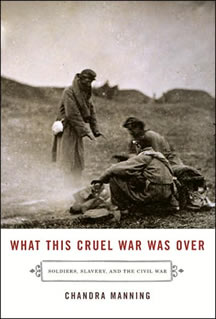
The last time I did this course, I paired Faust's Republic of Suffering with another powerful book, Chandra Manning's What This Cruel War Was Over: Soldiers, Slavery, and the Civil War Kevin Levin usefully reviews it here; a useful contrast is his take on Gary Gallagher's The Union War, posted here); taking the two works together (Manning and Gallagher, I mean) gives one a good rundown on recent debates on how Americans of the time gave meaning to the war.

The result of the pairing of Faust and Manning -- one about the impossibility of a "good death" during the war, and the other about the larger socio-political meanings people gave to the sacrifices on both sides, was some of the most powerfully engaged student discussions I had ever seen, because the works compelled a profound consideration of the question Edward J. Blum raised in his review of Faust: was there ultimately a transcendent meaning in all this death? Was there life that emerged from the death-haunted republic of suffering? Was war a force that gave Civil-War era people meaning, and if so, how does that affect our perceptions of contemporary wars?

Eric Foner raises many of these same questions in his review of Gary Gallagher's new book The Union War in last Sunday's New York Times Book Review. In some contrast to Manning and a number of other contemporary historians, who see a significant shift in soldiers' attitudes through the course of the war, Gallagher argues that emancipation "always 'took a back seat' to the paramount goal of saving the Union. Most Northerners, he says, remained indifferent to the plight of the slaves. They embraced emancipation only when they concluded it had become necessary to win the war. They fought because they regarded the United States as a unique experiment in democracy that guaranteed political liberty and economic opportunity in a world overrun by tyranny." In effect, this was a war about the nation-state, with emancipation a somewhat accidental by-product. Gallagher and Manning both rely on an extensive body of research (including in the regimental newspapers, not often used by other historians) which brings in first-hand evidence from the soldiers (and their homefront supporters). Weighing that evidence, and trying to determine what represents the views of "many" or "most" soldiers, becomes one of the central points of contention here. I'm no expert on any of this, but the discussion raised has been terrific.

Foner challenges Gallagher's view by asking, essentially, what was this cruel war over? He concludes:

Before the war, slavery powerfully affected the concept of self-government. Large numbers of Americans identified democratic citizenship as a privilege of whites alone — a position embraced by the Supreme Court in the Dred Scott decision of 1857. Which is why the transformation wrought by the Civil War was so remarkable. As George William Curtis, the editor of Harper’s Weekly, observed in 1865, the war transformed a government “for white men” into one “for mankind.” That was something worth fighting for.


The "something" that was worth fighting for became the crux of the student discussions in my class (and countless other Civil War classes around the country, of course), and provided some moments of intellectual transcendence (and fierce debate). Barton et al aside, there's hope yet for the public presentation of serious history, including those which which centrally involve religious themes of meaning, purpose, violence, and the sacred.

Selasa, 22 Maret 2011

The "Newness" of the 1830s and 40s

Randall Stephens

Today we'll be discussing Paul E. Johnson and Sean Wilentz's The Kingdom of Matthias (Oxford University Press, 1994) in my Forging of an American Nation (1783-1865) class. As most readers of RiAH know, the authors tell the story of a strange religious group and its even stranger prophet, Matthias. The tale of Matthias's Kingdom--rife with "free-lovism," violence, and mystifying, anti-Finneyite beliefs--became front-page news in the 1830s. Early reports from those in my class who have already dug in are positive. One said it seemed a little like a 19th-century E True Hollywood Story.

I picked up a collection of essays, State of Mind: A Boston Reader (1948), at Commonwealth Books here in town last week. It includes wonderful material from the 17th to the mid 20th century. One selection--"The Newness" by Robert Carter, an essay that appears in the November 1889 issue of the Century Magazine--would be a good primary source item to read alongside The Kingdom of Matthias. Carter's sarcastic romp through the reform decades does not deal directly with the hirsute prophet Matthias, but an oddball cast of other wide-eyed dietary, dress, social, and anti-slavery reformers make an appearance in "The Newness." The essay can be read as a local color, skeptical, post-Civil War remembrance of the failures and naivete of reformism.

I include a few passages here:

By the "Newness" I mean a very singular intellectual and spiritual movement which broke out like an epidemic in New England some forty years ago, and ran its course for about ten years, when it subsided and disappeared almost as suddenly as it arose. I call it the
"Newness," because that was the most distinctive term applied to it, and the one by which it was most frequently designated by those engaged in it, though in fact it had no authentic or universally accepted appellation. By outsiders it was generally called Transcendentalism, and its disciples Transcendentalists, and to some extent and at certain periods those terms were used by the disciples themselves. . . .

I have noticed the influence which Unitarianism, Abolitionism, and the study of German literature had in producing the "Newness," and I have mentioned 1835 as about the date of its manifestation. The republication in this country of Carlyle's Sartor Resartus in 1836, and the appearance in the same year of Emerson's Nature, followed rapidly by his other works in the same vein, may be said to have brought the movement to a head, and it soon culminated in the issue of the magazine called "The Dial," in July, 1840, and, shortly after, in the establishment of the Community or Association of Brook Farm, near Boston. . . .

Brook Farm, however, was not the only community which was founded by the disciples of the " Newness." There was one established in 1843 on a farm called Fruitlands, in the town of Harvard, about forty miles from Boston. This was of a much more ultra and grotesque character than Brook Farm. Here were gathered the men and women who based their hopes of reforming the world, and of making all things new, on dress and on diet. They revived the Pythagorean, the Essenian, and the monkish notions of asceticism, with some variations and improvements peculiarly American. The head of the institution was Bronson Alcott, a very remarkable man, whose singularities of character, conduct, and opinion would alone afford sufficient topics fora long lecture. His friend Emerson defined him to be a philosopher devoted to the science of education, and declared that he had singular gifts for awakening contemplation and aspiration in simple and in cultivated persons. He was self educated, but had acquired a rare mastery of English in speech, though his force and subtlety of expression seemed to fail him when he wrote. His writings, though quaint and thoughtful, are clumsy compared with his conversation, which has been pronounced by the best judges to have been unrivaled in grace and clearness.

Mr. Alcott was one of the foremost leaders of the "Newness." He swung round the circle of schemes very rapidly, and after going through a great variety of phases he maintained, at the time of the foundation of Fruitlands, that the evils of life were not so much social
or political as personal, and that a personal reform only could eradicate them; that self-denial was the road to eternal life, and that property was an evil, and animal food of all kinds an abomination. No animal substance, neither flesh, fish, butter, cheese, eggs, nor milk, was allowed to be used at Fruitlands. They were all denounced as pollution, and as tending to corrupt the body and through that the soul. Tea and coffee, molasses and rice, were also proscribed,— the last two as foreign luxuries,— and only water was used as a beverage.

Mr. Alcott would not allow the land to be manured, which he regarded as a base and corrupting and unjust mode of forcing nature. He made also a distinction between vegetables which aspired or grew into the air, as wheat, apples, and other fruits, and the base products which grew downwards into the earth, such as potatoes, beets, radishes, and the like. These latter he would not allow to be used. The bread of the community he himself made of unbolted flour, and sought to render it palatable by forming the loaves into the shape of animals and other pleasant images. He was very strict, indeed rather despotic, in his rule of the community, and some of the members have told me that they were nearly starved to death there; nay, absolutely would have perished with hunger if they had not furtively gone among the surrounding farmers and begged for food. . . .

Brook Farm exploded in 1847 and Margaret Fuller went to Europe, I think it had very little distinctive existence in New England. The aspiring youth of New England seem now to be contented with making their way in the world very much as other people make it, without seeking for any fundamental change in the established order of society.

Rabu, 02 Februari 2011

Civil War and Emancipation Blogs: First African Baptist and Benjamin Morgan Palmer


Paul Harvey

A note on a new blog of interest to many of you: Civil War Emancipation, established by Donald Shaffer, author of After the Glory: The Struggles of Black Civil War Veterans and other publications. He writes the following of the blog:

The purpose of this blog is: 1) to commemorate important milestones in emancipation in the Civil War as their 150th anniversary arrives in the Sesquicentennial; 2) to discuss noteworthy publications on this subject; 3) to comment on current events related to the Civil War and Emancipation; 4) plus write on whatever else comes to mind that is appropriate. I intend to blog regularly on emancipation throughout the Civil War Sesquicentennial.

A recent post at the new blog discusses and points to the full text to Benjamin Morgan Palmer's famous Thanksgiving Day sermon in Nov. of 1860 in New Orleans, a key text in summarizing the "providential trust" given to southerners to "conserve and to perpetuate the institution of domestic slavery."

The new blog also accompanies the ongoing series going on at the New York Times, Disunion, which is following, in day-by-day format, the sesquicentennial of the secession winter. One entry from Jan. 24th, by Lois Leveen, features an outstanding discussion of the unusual place of the First African Baptist Church of Richmond, the largest black congregation in antebellum America.. The church took shape in the early 1840s and was pastored by a white man appointed to oversee the congregation, Robert Ryland, who (among other things) encouraged slave literacy. The church often rented out its sizable auditorium for citywide political events and entertainments (including minstrel shows). On Jan. 23, 1861, the church opened its doors for white workingmen of Richmond (including a sizable proportion of foreign-born men) to discuss "the alarming state of our beloved country." The meeting adjourned without resolving the sentiments of white locals, who were largely Unionist but starting a slow and agonizing move towards secession.

Normally I teach a course each spring in Civil War/Reconstruction. By happenstance I'm not doing so now, but wish I was so I could take advantage of these exciting new resources, which allow an "in the moment" feeling for the dramatic events of the period. For religious historians, the resources are rich, as well, as evidenced by the extensive discussion linked above to the role of First African Baptist in Richmond.

Congratulations to Prof. Shaffer for his new blog; I look forward to following it.

Selasa, 18 Januari 2011

Cain on the Brain

Emily Clark

Lately, I’ve been thinking a lot about Cain. This certainly is not the most healthy topic to be contemplating – with the violence and family murder – but these things happen when one is in a religion department. Last week in a seminar on religious intolerance, we read René Girard’s Violence and the Sacred, and for this week, we’re reading Regina Schwartz’s The Curse of Cain. But this isn’t the primary manner in which Cain keeps coming across my laptop screen. Rather, his identity and his “mark” are wrapped up in America’s past with African slavery. When it comes to Christian pro-slavery arguments, Ham is typically the star historical player (Sylvester Johnson’s The Myth of Ham provides a great exploration of this). Identifying Noah’s curse as biblically legitimate proof that Africans’ natural state is one of enslavement, nineteenth century American slave-owners stood by their rhetoric through a civil war.

Ham’s bad behavior was not the only piece of Christian scripture southerners lifted from the text. In 1850, the Southern Presbyterian Review printed an article titled “The Mark of Cain and Curse of Ham;” and in it, the author cites both these biblical figures to argue that “the special Providence of God” created “the varieties found existing in the family of man.” Providing religious justification for the racial differences perceived around them, pro-slavery Americans argued for the religious origins and morality of slavery. And this kind of religiously-grounded language translated into other rhetorical realms, such as legislation. In the infamous 1857 Dred Scott case, Chief Justice Taney’s majority opinion explained how African slaves and their descendants were not US citizens. Through his (questionable) reading of the Constitution, Taney wrote that blacks “were never thought of or spoken of except as property” throughout America’s legal history. Even more important for this particular historian, Taney states that “the unhappy black race were separated from the white by indelible marks.” Slavery, racism, and “marks” call to mind a certain Old Testament verse. Though I’m not certain (I’ll get back to you at the end of the semester after writing an anticipated seminar paper), these “indelible marks” referenced by Taney seem related to contemporary readings of Genesis 4:15. After killing his brother Abel, Cain receives a “mark” from God, and some pro-slavery arguments interpreted this mark as darkened skin. Many point out how the American Constitution is literally “godless,” but religion has a sneaky kind of way of infiltrating legal rhetoric. Eric Slauter’s fairly recent cultural history of the Constitution, The State as a Work of Art, identifies how contemporaries to the Constitution understood the rights of man to be sacred, given by a Divine Providence, even if said Deity isn’t directly recognized. Is the Dred Scott decision an instance of religion diffusing from church buildings and into secular parlance? If it is, then it is certainly not alone. Yesterday the country remembered Martin Luther King, Jr., a man well-known for using religion in civil settings to push for legislation.

Sabtu, 08 Januari 2011

The Worst Kind of Slavery: Presbyterian Slave Hiring in the Antebellum South


Paul Harvey

While we're on the theme of religion/slavery/Civil War, the subject of a few posts here lately, just one more recommend for ya'll, which I just read today: Jennifer Oast, " 'The Worst Kind of Slavery': Slave-Owning Presbyterian Churches in Prince Edward County, Virginia," Journal of Southern History LXXVI (November 2010): 867-900. It's not online; you'll need to get it by joining the Southern Historical Association, which is the best deal in town for scholarly societies at just $40, and the annual meetings are fun. The November 2010 issue of the Journal of Southern History is terrific all the way through, featuring articles on mortgaging slave property, on the slave-owning churches as we're discussing here, on fighting contests and masculinity on the plantations, and on the working-class roots of civil rights in Birmingham. All the pieces feature the rigorous research and editing for which the journal is known.

Oast's piece discusses some Presbyterian churches in Prince Edward County which were bequeathed some slaves in the 1760s. By natural increase, the churches tended to an ever-growing extended family of those slaves. The churches hired them out, mostly locally, through the year; Christmas day apparently was the annual hiring season. Because these slaves were "owned by a congregation rather than an individual, they lacked the basic protections that a master's self-interest usually brought." As southerners developed ideas of Christian paternalism to justify slavery, "the slaves of Briery Presbyterian Church had no such paternal identifiable master." The hiring out of the churches' slaves also widened the circle of the beneficiaries of slavery, allowing ordinary whites to enter into the institution at a low cost through the provision of temporary hires. Of course, slave hiring (and mortgaging slaves as collateral to help fund economic expansion) was common, but, as Oast points out, "what made institutional slave hiring different is that all the slaves had to be hired out every year," no matter their age or health; and the records of some of these temporary owners evidenced remarkable brutality. Children of these slaves experienced shockingly high mortality rates, even by the already depressing standards for slaves in that era, and ultimately lacked any patron with a long-term interest in their welfare.

This is a wonderfully researched, compelling, and very sobering piece; hope some of you will check it out, and join the SHA while you're at it.

Constitutional Fundamentalism, Minus Some of the Fundamentals

Paul Harvey

My piece at Religion Dispatches, posted yesterday, reflects on the meaning of "original intent" after the reading of the Constitution in the House of Representatives Thursday. What does it mean to treat the Constitution as "sacred," but skip over the parts in which the original intent of an entirely different era leaves us uncomfortable, not unlike reading passages from any number of other sacred scriptures? Read it here. A short taste here:

No Person held to Service or Labour in one State, under the Laws thereof, escaping into another, shall, in Consequence of any Law or Regulation therein, be discharged from such Service or Labour, but shall be delivered up on Claim of the Party to whom such Service or Labour may be due.

As the 112th Congress convened on Thursday, January 6, 2011, the first order of business was a religious ritual designed to underscore the import of a historic transition of power: a reading of the US Constitution. Or rather, a reading of it without some of its ickier original parts, such as the original fugitive slave provision quoted above. It was constitutional fundamentalism without some of the fundamentals.

Julie Ingersoll's post, also at Religion Dispatches, reflects in a similar fashion on the reading. John Fea weighs in here.

Jumat, 07 Januari 2011

Baptists and the Civil War

Paul Harvey

While we're on the subject of the religious history of the Civil War, here's a new resource of interest. I received an email today from Bruce Gourley, Executive Director of the Baptist History and Heritage Society, on a new site he has constructed on Baptists and the Civil War, featuring an abundance of essays, documents, daily journal entries, and other resources on that subject. He writes:

"Baptists and the American Civil War: In Their Own Words" is a day-by-day journal of the Baptist experience, North and South, during the Civil War. Each day a new journal entry is published, corresponding with that date 150 years earlier.

This digital project began as an outgrowth of research done for my dissertation-turned-upcoming book, Diverging Loyalties: Baptists in Middle Georgia During the Civil War (due in the fall from Mercer University Press).

A quick survey of this website shows it to be a terrific resource for scholars working on all sorts of subjects, as well as those interested in Baptist history of the religious history of the Civil War, in particular. The daily journal features short bits of information and analysis on the events of that day 150 years ago -- this entry from Jan. 2, 1861, for examples, describes the process of voting for secession in Georgia.

Congratulations to Bruce Gourley on making his research and interests available in this wonderfully accessible way, and in incorporating the best scholarship in doing so.

Kamis, 06 Januari 2011

Something More: Secondhand Reflections on George Rable's Religious History of the Civil War

Congratulations to our contributor Ed Blum for the birth of his son Elijah James Blum! What do the birth of his son, some pop music from Secondhand Serenade, and George Rable's religious history of the Civil War have to do with each other? Nothing, you're thinking? Au contraire; read on.

Secondhand Reflections on George Rable’s Religious History of the Civil War
by Edward J. Blum

There’s one and only one book I’m reading closely these days: What to Expect: The First Year. With Elijah James Blum joining our crazy world on December 12, it has been indispensable. Through this bible of all things baby, I’m learning how to feel, how to act, and how to speak a whole new vocabulary: bilirubin; snurgles; meconium are but a few of the words in my new lexicon. For me, fatherhood is a reactive art. My days and nights are mostly encompassed by Elijah acting, Jen responding, and me trying to keep up with the whirlwind.

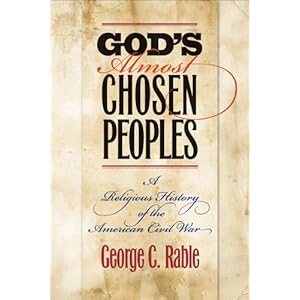
In addition to an album that transformed the music of the Beatles into soothing lullabies, one other album and one history book have become my regular companions. Between feedings, changings, and tummy time, I’ve found a few minutes to soak in Secondhand Serenade’s Something More and George Rable’s God’s Almost Chosen People: A Religious History of the American Civil War. The two may seem worlds apart, but they’ve come together in my rocking-chair imagination, and I think for good reason.

Secondhand Serenade is named for the nature of their music. Songs first written, sung, and experienced in private are transformed into ballads purchased on i-tunes, thrust too quickly into commercials, and discarded in a matter of weeks. We encounter the music secondhand, distanced from original intent and expression. By far, their best song is “Something More” (also the name of the album). It’s a power ballad to rival the finest of Celine Dion’s, and we only need a “king of the world” cinematic scene for it to become part of our national consciousness. Like most power ballads, “Something More” is about love and pain, desire and disgust. The singer is confused, angry, lost, and ashamed: “I lie awake again, my bodies feeling paralyzed / I can’t remember when / I didn’t live through this disguise.” The singer is “paying for his sins” and thinks that no words can “set him free.” He’s at war with another and within himself. He repeatedly admits and asks: “I’m stuck here in this life I didn’t ask for, / There must be something more, / Do we know what we’re fighting for?” The only answer – the only way to live amid his frustration – is to breathe and to believe: “breathe in, breathe out, / breathe in, breathe out. … There must be something more.”

George Rable’s characters from the 1860s had such similar feelings and asked such similar questions. What were Americans fighting for in the Civil War, and why did they continue to fight for so long? What sins were they paying for? And what was the “something more” that they all seemed to believe in, but couldn’t quite nail down? Like Abraham Lincoln in his Second Inaugural Address, the belief in a shared “something more” failed to stop the fighting, and they couldn’t understand why.

By reading thousands of primary and secondary sources, Rable (far and away one of America’s greatest Civil War scholars living or dead) offers the biggest, most comprehensive religious history of the Civil War ever produced. He tackles the North and the South, men and women, Protestants, Catholics, Mormons, and Jews. He travels with chaplains, tents with privates, and eavesdrops on presidents. More descriptive than argumentative, God’s Almost Chosen People considers so many sources that it is almost impossible to provide one or two central arguments. Yet Rable does. He finds that throughout the war, all sorts of Americans turned to providence to explain what was happening around them. The “something more” they knew they were fighting for was only explainable by looking to the heavens and believing that somehow, someway, God truly had the whole world (or at least the United States or Confederate States) in his hands.

The brilliance of Rable’s book – and what differentiates it in many ways from Harry S. Stout’s Bellah-inspired Upon the Altar of the Nation – is its secondhand nature. Although Rable claims in his introduction that religion could be both “wind and weathervane,” he more often than not renders it as weathervane. Battles happen; women and men die; political documents are signed; legal decisions are rendered; slavery is abolished; and then Americans reflect on the events religiously. They seek God’s providence in response to other events, constantly playing catch up just as I play catch up to Elijah’s needs at home. With this approach, Rable is able to show how widely and diversely religion suffused American society in the 1860s. Whatever the problem, whatever the event, whatever the circumstance, Americans turned to God and God’s providence for answers. By rendering religion secondhand, Rable has shown in epic proportion the omnipresence of the supposedly omnipotent.

And for Rable, the secondhand quality of religion emanates from his approach to religion itself – that it can only be studied secondhand. In this way, Rable wonderfully acknowledges the limits of his study. He (and we) cannot know the firsthand experiences of the women who lost loved ones, the privates who accepted new testaments after losing a hand of cards, or the presidents and generals who anguished (or relished) every death. When he analyzes a diary, a fast sermon, or a newspaper story (all of which Rable read in abundance), he recognizes that he interprets from afar. In this way, Rable demonstrates an incredible respect for his subjects and the gravity of the events.

Yet there are other seconds to consider. When W. E. B. Du Bois turned to seconds, he conjured the idea of “second sight.” He claimed that African Americans could see themselves and their surroundings with a sacred vision that whites could not. And Du Bois thought that the religious expressions of those with second sight could reveal the deepest elements of the soul – the “spiritual strivings” of individuals and communities. When Du Bois turned to the slave spirituals, he found not secondhand expressions, but expressions that revealed the most intimate parts of longing, feeling, and expression. This type of religious history of the war – one that approaches religious creation as a prime mover in historical change – could compel other approaches to the war.

That was not Rable’s project, though, and he shouldn’t be criticized for the book he wrote. God’s Almost Chosen Peoples is outstanding. Scholars of American religious history and the Civil War will have to engage it. And I’m glad that it’s so voluminous that I couldn’t lose it amid the diapers and the onesies.

Jumat, 05 November 2010

God's Almost Chosen Peoples

Paul Harvey

Some of you blog readers are probably hanging at the Southern Historical Association meeting today and through the weekend in Charlotte; sorry I'm not there with you, afraid that the AAR maxed out my personal travel/alcohol budget. In the meantime, though, hope you'll drop by the University of North Carolina Press booth and check out George Rable's very promising looking new book, God's Almost Chosen Peoples: A Religious History of the American Civil War. Skip Stout and others have given the lengthy work a hearty endorsement on the book jacket, and I hope to get to it over Christmas break when 600 pp. books seem a little less daunting. Information on the book below, from the UNC Press website.

God's Almost Chosen Peoples

A Religious History of the American Civil War

By George C. Rable


Throughout the Civil War, soldiers and civilians on both sides of the conflict saw the hand of God in the terrible events of the day, but the standard narratives of the period pay scant attention to religion. Now, in God's Almost Chosen Peoples, Lincoln Prize-winning historian George C. Rable offers a groundbreaking account of how Americans of all political and religious persuasions used faith to interpret the course of the war.

Examining a wide range of published and unpublished documents--including sermons, official statements from various churches, denominational papers and periodicals, and letters, diaries, and newspaper articles--Rable illuminates the broad role of religion during the Civil War, giving attention to often-neglected groups such as Mormons, Catholics, blacks, and people from the Trans-Mississippi region. The book underscores religion's presence in the everyday lives of Americans north and south struggling to understand the meaning of the conflict, from the tragedy of individual death to victory and defeat in battle and even the ultimate outcome of the war. Rable shows that themes of providence, sin, and judgment pervaded both public and private writings about the conflict. Perhaps most important, this volume--the only comprehensive religious history of the war--highlights the resilience of religious faith in the face of political and military storms the likes of which Americans had never before endured.

Senin, 18 Oktober 2010

From the Underside of the Millennium: My Take on God in America

Paul Harvey

Today's Religion Dispatches features a few of my thoughts on the God in America series which premiered last week: "The Brutality of the American Eden: From the Underside of the Millennium." As the post makes clear, I enjoyed and appreciated the series, but wanted to raise some questions about freedom and authority in American history:

But I do want to ask what this series would look like if we also understand American religious history to be about coercion and authority? Most of God in America is about the white Protestant majority in American history. In a series on religion and public life, that is fair enough; they have dominated religion and public life. But what if we make coercion,establishment, and repression as central to our narrative as freedom, disestablishment, and expression? What if this is a show in which Americans’ self-understanding as derived from Exodus is more critically examined than celebrated?

Read the full post here, and I'd love to hear your thoughts either at Religion Dispatches or here.

Oh, and while you're at it, catch Matt Sutton's take on the series here, also at Religion Dispatches. Matt defends the series against professorial carping, praises its success in reaching a broader public, and points out how much we all engage in our own forms of condensation and simplifying to get across a few basic points.
Related Posts Plugin for WordPress, Blogger...