Tampilkan postingan dengan label evangelical conservatism. Tampilkan semua postingan

Selasa, 18 Oktober 2011

NY Times Editorial: The Evangelical Rejection of Reason


Kelly Baker

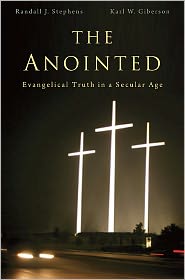
While John Turner aptly describes "dominionists on the loose" and the media brouhaha over the threat of theocracy via Christian dominionism, our own Randall Stephens, writing with Karl W. Giberson, had a New York Times editorial aptly titled, "The Evangelical Rejection of Reason" published yesterday. Coming on the heels of their book, The Annointed Age: Evangelical Truth in a Secular Age (reviewed here by Chris Beneke), they argue convincingly about the war on science as "part of a politically monolithic red-state fundamentalism, textbook evidence of an unyielding ignorance on the part of the religious" as well as map out the anti-intellectualism inherent in these attacks. Randall and Giberson make distinctions between their own evangelicalism and the politicized vision of current Republican nominee hopefuls.

Here's an excerpt:
As one fundamentalist slogan puts it, “The Bible says it, I believe it, that settles it.” But evangelical Christianity need not be defined by the simplistic theology, cultural isolationism and stubborn anti-intellectualism that most of the Republican candidates have embraced....

Fundamentalism appeals to evangelicals who have become convinced that their country has been overrun by a vast secular conspiracy; denial is the simplest and most attractive response to change. They have been scarred by the elimination of prayer in schools; the removal of nativity scenes from public places; the increasing legitimacy of abortion and homosexuality; the persistence of pornography and drug abuse; and acceptance of other religions and of atheism.

In response, many evangelicals created what amounts to a “parallel culture,” nurtured by church, Sunday school, summer camps and colleges, as well as publishing houses, broadcasting networks, music festivals and counseling groups. Among evangelical leaders, Ken Ham, David Barton and James C. Dobson have been particularly effective orchestrators — and beneficiaries — of this subculture. (Continue reading here.)

Editor's note: Also check out John Fea's discussion of the editorial here.

Jumat, 02 September 2011

So, You Think You Can Live "Biblically?"

Darren Grem


That's the question that writer and blogger Rachel Held Evans is trying to answer. The author of a memoir about growing up in conservative evangelical circles (and with one of the best titles ever), Evans is addressing the issues raised in her first book about what it actually means to live fundamentalistically. As this Slate article details, this is not done for the sake of satire. Rather, she's attempting to answer what it actually means to live as a woman "by the book," following as closely as possible Old Testament and New Testament dictates concerning hair, dress, hygiene, and so on.


As the article demonstrates, she's only a month into the experiment and has already caught the attention of theological conservatives and biblical literalists. Though certainly intended to toss down the gauntlet on the "roles" of women in the church, the book will dive into issues of sex and the sacred that evangelicals all down the spectrum continue to debate, especially in and through their cultural and political activism. Regardless, it will hopefully make for a good read for courses on religious life, conservatism, and gender.


Postscript: Seth Dowland will certainly fill in the historical context for all this with his forthcoming book on manhood and womanhood in conservative evangelical politics. So, get your credit cards ready!

Senin, 29 Agustus 2011

Fear This!

by Matt Sutton


I have recently come across two excellent articles that may be of interest
to readers of the blog. While I usually prefer some good Reconstructionist conspiracies mixed with anti-dominionist fear-mongering, both of these pieces (by Ross Douthat and Lisa Miller) are thoughtful and smart. I am sure our friends over at Religion Dispatches will view Miller and Douthat as dupes of Rousas John Rushdoony, but I am much more afraid of the Ralph Reeds and Karl Roves of the GOP than I am of dead Reformed preachers. Of course when Bachmann pushes a proposal through Congress reinstituting Levitical law, the US Supreme Court upholds such legislation as Constitutional, and we start stoning people in the streets, we will all know that I was wrong. But that is about as likely as Harvey fielding a good fantasy football team.

Jumat, 26 Agustus 2011

Radio Free RiAH, Part Two

Kelly Baker


Randall Stephens will be on the Dr. Howard Gluss show tonight from 8 pm-9pm PST. Unlike Paul and myself, he gets the whole hour!


Tune in to listen to Howard and Randall discuss "Right Wing America: Evangelicals, Conservative Christians, and Christian Pyschologists." And hopefully, they'll discuss Randall's forthcoming book with Karl Giberson, The Anointed: Evangelical Truth in a Secular Age (October).


This program provides live streaming on the internet here.


P.S. Yes, we are trying to take over the world. We'll let y'all know how it goes.

Rabu, 24 Agustus 2011

Moral Ambition

Kelly Baker


Last year, I had the pleasure of meeting and hearing Omri Elisha speak about his field work on evangelical Christians and megachurches conducted in Knoxville, Tennessee. Elisha's book, Moral Ambition: Mobilization and Social Outreach in Evangelical Megachurches is now available in paperback and Kindle versions. This book is taunting me from my Kindle as we speak, and I'll blog more about my impressions of the book soon. What was striking to me is Elisha's discussion of social engagement among evangelicals and the tensions that arise in megachurches over how socially involved congregations should be. Socially engaged evangelicals were a small and vocal minority, and Elisha traces the struggles of individuals within megachurches to elicit social change. Marie Griffith describes Elisha as "a wonderfully talented ethnographer—‘empathetic’ in the very best sense: critically engaged, attentive, and clearly committed to forming genuine relationships." The University of California Press describes Moral Ambition in this way:


In this evocative ethnography, Omri Elisha examines the hopes, frustrations, and activist strategies of American evangelical Christians as they engage socially with local communities. Focusing on two Tennessee megachurches, Moral Ambition reaches beyond political controversies over issues such as abortion, same-sex marriage, and public prayer to highlight the ways that evangelicals at the grassroots of the Christian Right promote faith-based causes intended to improve the state of social welfare. The book shows how these ministries both help churchgoers embody religious virtues and create provocative new opportunities for evangelism on a public scale. Elisha challenges conventional views of U.S. evangelicalism as narrowly individualistic, elucidating instead the inherent contradictions that activists face in their efforts to reconcile religious conservatism with a renewed interest in compassion, poverty, racial justice, and urban revivalism.


Additionally, the press includes an excerpt on their site. Here's a sample:

In order to get their messages across despite such hindrances, the socially engaged evangelicals I observed in Knoxville-not unlike Christian social reformers of the nineteenth and early twentieth centuries-always portrayed charitable social outreach as a legitimate and necessary component of evangelism. They demonstrated that ministries of social outreach were basically meant to achieve the same goals as most highly regarded revivalist and missionary enterprises, namely, to spread the Word of God and "make disciples" by religious conversion. The discourse of outreach mobilization was rife with tales of personal, cultural, and spiritual transformation, filled with alluring tropes of faith, compassion, redemption, and sacrifice. The tendency among many conservative Protestants to insist on a firm distinction between humanitarian effort and religious proselytization (privileging the latter) was rejected by those who favored a more integrative, holistic approach, the kind that prioritizes "words and deeds" and regards both as equally crucial for effective evangelism among society's poor, distressed, and marginalized populations. Making the case for holistic evangelism in the evangelical churches of Knoxville-whether this meant arguing for broader conceptions of the church's role in society or simply arguing that, as one pastor put it, "You can't talk to an empty stomach"-was a vital strategy by which the socially engaged evangelicals I observed appealed to their conservative base (Elisha 2008b). Their appeals consistently upheld religious virtues that are commonly valued among conservative evangelicals, drawing on existing cultural repertoires informed by authoritative theological and pastoral discourses within the evangelical movement. Yet the socially engaged evangelicals in my study represented a surprisingly small and frustrated minority relative to the megachurches they belonged to-I encountered barely more than one or two dozen such individuals in each congregation-and the local evangelical community as a whole.

Part of the aim of this book is to explore what happens when religious actors of a certain aspirational persuasion-people like Paul Genero-pursue moral ambitions that are recognized as virtuous by others and simultaneously regarded with ambivalence and aversion. I examine how such moral ambitions are shaped within specific cultural and institutional milieus that define, authorize, and constrain their actual potential. Moreover, I analyze the mobilization strategies employed by those who, in claiming these moral ambitions, seek to inspire others to follow suit. The strategies usually involved identifying and critiquing deficiencies in the faith community, and then proposing socially relevant methods of counteracting those deficiencies. My ethnography works alongside other recent ethnographies in exploring the role of institutionalized narratives, concepts, and motifs in framing religious interventions in the modern world (Coleman 2000; Harding 2000), the ways that everyday religiosity is shaped by disciplines of ethical self-cultivation, especially in urban settings (Deeb 2006; Mahmood 2005; O'Neill 2010), and the significance of religious activism as a form of social action and cultural critique (Coutin 1993; Ginsburg 1989). All told, this book portrays a localized cultural arena where I found conservative evangelicals engaged in modest yet meaningful activities akin to what Sherry Ortner has called "serious games": a concept that helps us think about "the way in which people are defined and constrained by the intersections of culture, power, and history in which they find themselves, and yet at the same time are active players in making (and sometimes remaking) those worlds that have made them" (1999: 35).


For those of you interested in evangelicals, evangelicalism, social reform, and/or megachurches, this book is a must-read.

Senin, 15 Agustus 2011

Big Billy and the South

by Matt Sutton


"Oh, Billy, Billy, Billy. This is a biggie! Don't let me down, Billy!"--Caddyshack


Just in time for the slackers who are scrambling to place their fall book orders at the very last possible minute, Steven P. Miller's Billy Graham and the Rise of the Republican South will be out in paperback any day now. The book has received extremely positive (and well-deserved) reviews:


"Billy Graham and the Rise of the Republican South, a study of the evangelist's relationship to the cause of civil rights on the one hand and the cause of conservatism on the other, does justice to the tensions and complexities involved—for Graham, for the South and for the country."—Ross Douthat, New York Times


"With this book, Steven P. Miller emerges as a significant new voice in the history of evangelical Christianity. . . . The book opens new territory for modern American religious and political history, and for this reason it should be considered essential reading."—Donald T. Critchlow, Reviews in American History


"Wonderfully readable, engrossing . . . . A captivating history and a profound work of scholarship. Miller ably shows how evangelicalism aided the new conservatism long before the Christian Right exploded onto the scene."—Randall J. Stephens, Journal of American History


"Beautifully written, well argued and carefully researched . . . . Thanks to Miller's engaging and provocative book, Billy Graham and modern conservatism will never look the same."—Social History


[The unnamed reviewer on the Penn website writing for Social History is me. I long for the day that I will be as famous as Randall and therefore worth identifying!]


This is a great book for classes on the modern US, religion, and/or conservatism. Buy it! (And assign it along with Paul's Through the Storm).


Selasa, 09 Agustus 2011

Declension, National Salvation, and Other Discontents

Kelly Baker


At the end of June, the Huffington Post’s Tim Suttle queried “Why are evangelicals losing influence?” This claim of decline emerged from a Pew Research Center survey of evangelical leaders globally, in which 82% claimed that evangelicals were losing influence over culture. The blame, of course, landed firmly on the “rising tide of secularism.” Suttle disagrees with the causation, and instead he notes, “If evangelical influence is nose-diving we have no one to blame but ourselves.” The jeremiad of declension remains alive, well, and likely weary, and it seems fly in the face of presence of evangelicals in American culture. Is evangelicalism on the decline? Or it this a method to chastise evangelicals into action as well as reflection?


Declension and its sister narrative secularization ebb and flow in public discourse and historiography with assertions in both that this moment ("no, not that one!") is certainly a moment of decline. The crucial time when religion might not be present in public life but rather avoidable, contained, and private. Declension narratives seem to hinge on the abject hope that certain religious voices will lose presence and popularity (the question of which voices becomes very, very important). Religion is in decline, isn't it? What is meant exactly by religion generally seems to be an association with mainline Christianity. As one might imagine, I am not terribly interested in mapping out this statistically (though the statistics are alluring). Yet the fervor that emerges anytime new survey data suggests decline is a different story. Just this morning, a group of my summer students presented the recent findings of Barna Group study of religious change to discuss the religious character of the American nation. The study reports that 40% of all adults in the U.S. fit the moniker "born again", which is not a self-identification by survey respondents, but rather Barna's label. Does this data suggest decline?


While reading Suttle's article on declining evangelicals, I couldn't help but wonder how political figures like Rick Perry and Michelle Bachmann trouble this self-reported decline. Perry, after all, hosted "The Response" this weekend, and Rolling Stone imaged Bachmann as a Christian crusader (Janine already covered this here). The New Yorker's Ryan Lizza profiled Bachmann's religious roots. Religion Dispatches' Sarah Posner puts Perry and Bachmann head to head in a discussion of who would win the conservative Christian vote. She writes:


Bachmann, in other words, is a product of the religious right's deliberate efforts to "raise up" soldiers to exercise a "dominion mandate;" she is, organically, one of them. Perry's effort Saturday, on the other hand, was a staged attempt to convince them that he is committed to their worldview. It's not clear that he has internalized it like Bachmann has, which may make him more Zelig-like and attractive to non-religious voters in states like New Hampshire, or might make him look like a pandering interloper to everyone.


It is at least possible that Bachmann or Perry could win the Republican nomination for President, and Posner clearly places both in the trajectory of the religious right. So, how might we label both Perry and Bachmann? Are they evangelical? Conservative Christians? Fundamentalists? Born-again? Religious right? Bachmann embraces born again identity and notes that God directed her decision to marry, go to law school, and enter into politics. Perry's The Response invoked Jesus and prayer as solutions to national problems from abortion to the threats of secularism. All of those terms have been applied to them. What do we take this labeling to mean?


Clearly, both identify as Protestant Christian. Perry is a Methodist, who attends a Southern Baptist Church, and Bachmann is an Evangelical Lutheran who now attends a non-denominational church. Their affiliations could be considered mainline, though their current church attendance might tell a different story. Perhaps, they prove to be case studies for the lateral shifting of Protestants from denomination to denomination. Their language and poise "feel" evangelical to me, though Perry's relationship with the American Family Association and Bachmann's signature of the FAMiLY LEADER pledge shift them more into the territory of fundamentalism. The labels start to pile on and obscure more than they help.


To approach this in a different way, I wonder about the popularity of Bachmann and Perry. Why do these candidates appeal? Is it their religious affiliations, their invocations of the divine, or their moralism? Do they "speak Christian"? How/why does the appeal to Christianity mark them as legitimate political candidates? This combination of Protestant Christianity, conservative values, and national salvation is a potent one. Bachmann and Perry speak in a language of clear moral valence, and they offer a Christian solution to national problems. America's salvation becomes a matter of prayer, divine guidance, strong Christian values, and political prowess. God, they claim, is on their side. Declension of national sort serves them well. A nation in peril needs a savior, and Bachmann and Perry both offer themselves up on its altar. Is evangelicalism losing influence? The answer is likely no. The real question is if voters want a candidate with God on his or her side, and what that showcases about decline, declension, and attachments to cultural Christianity and American patriotism.


Senin, 01 Agustus 2011

John Stott vs. Jerry Falwell: Evangelical Diversity and the Conundrum of "Biblicism"

By Brantley Gasaway


The blogosphere is filled with tributes to John Stott, the Anglican minister and international evangelical leader who passed away this past week at the age of 90. There is no need to reinvent the recap of his career on our site: let me recommend this detailed piece at Christianity Today and a brief reflection by Randall Balmer at Religion Dispatches.

But in an op-ed in yesterday's New York Times entitled "Evangelicals Without Blowhards," Nicholas Kristof uses the death of Stott to challenge the popular association of evangelicals with the political conservatism of the Religious Right. Leaders such as Jerry Falwell and Pat Robertson--whom Kristof labels "blowhard scolds"--have caused most liberals to pillory the entire evangelical movement as "reactionary, myopic, anti-intellectual and, if anything, immoral." Yet, Kristof argues,

that casual dismissal is profoundly unfair of the movement as a whole. It reflects a kind of reverse intolerance, sometimes a reverse bigotry, directed at tens of millions of people who have actually become increasingly engaged in issues of global poverty and justice.

As evidence, Kristof points to Stott's long-standing commitments to intellectualism and social justice. In addition to authoring over fifty books, Stott consistently encouraged Christians to fight against poverty, racism, the oppression of women, and apathy toward environmental issues. Indeed, at a pivotal moment in the development of global evangelicalism, Stott gave a keynote address at the 1974 International Congress on World Evangelization in Lausanne, Switzerland that insisted Christians must not neglect active work for social justice in their zeal for evangelism. In addition, Stott lent his considerable credibility to the development of evangelical progressivism in America in that period by endorsing the early career of Jim Wallis and becoming a contributing editor to Sojourners.

Kristof lauds Stott for nurturing this "compassionate strain of evangelicalism," and he praises evangelicals who are frequently the ones on the front lines of global battles against "hunger, malaria, prison rape, obstetric fistula, human trafficking or genocide." Because he "stands in awe" of such work, Kristof concludes, "it sickens me to see that faith mocked at New York cocktail parties."

Like most readers of this blog, I suspect, I am rarely--ok, never--invited to New York cocktail parties where such sophisticated conversations occur. But even in my more humble circles, I still encounter the suspicion that most evangelicals are theocratic minions of Falwell and Robertson. Scholars of American religion recognize this view as a caricature, of course. Not only have progressive evangelical leaders such as Wallis been active since the early 1970s, but also studies of "ordinary evangelicals" by Christian Smith and by John C. Green have shown that only 30 to 40 percent support or identify with the Religious Right.

Thus the political engagement of evangelicals--both in the United States and especially worldwide--is not inherently conservative. Evangelical politics are complex, contested, and confusing--confusing perhaps not only to readers of the New York Times but also to evangelicals themselves. Which evangelical leader offers the correct political agenda: John Stott or Jerry Falwell? Jim Wallis or Pat Robertson?

Because evangelicals regard the Bible as their ultimate authority, they would ostensibly answer the question by assessing whether Stott's or Falwell's (or Wallis's or Robertson's) agenda has the best biblical support. The problem is, however, that these and other evangelical leaders all support their conflicting positions with biblical arguments and interpretations--and there is no objective or obvious method for judging better or worse biblical support, for that would be to introduce an authority beyond the Bible itself. Of course Christians have differed in their understanding of scriptures ever since the apostolic age, but this disagreement is especially problematic for modern evangelicals. How much can one rely upon biblical authority--especially when it is one's sole authority--if apparently sincere people cannot agree on what the Bible means? How would an evangelical know that she should emulate Stott rather than Falwell (assuming, of course, that she was unwilling to acquiesce to the New York Time's magisterium)?


Reflecting on the difference between John Stott and Jerry Falwell brought to mind a new book that I wanted to highlight here: Christian Smith's The Bible Made Impossible: Why Biblicism Is Not a Truly Evangelical Reading of the Bible. One of the country's leading sociologists of religion, Smith analyzes the popular evangelical theory about the Bible, which he labels "biblicism," that "emphasizes together its exclusive authority, infallibility, perspicuity, self-sufficiency, internal consistency, self-evident meaning, and universal applicability.” Because of "pervasive interpretive pluralism"--the fact that the "Bible gives rise to a host of many divergent teachings on important matters--Smith concludes that "it becomes beside the point to assert a text to be solely authoritative or inerrant." While evangelical theologians and historians such as Mark Noll have also identified this problem, Smith's work attempts to offer an accessible, focused critique of biblicism for non-specialists. **

Thus the limits of biblicism represent a conundrum for evangelicals, even for leaders like Stott who embrace a much more complex understanding of biblical authority. "Pervasive interpretive pluralism" guarantees evangelical diversity and division. Evangelical leaders will continue to remain at odds over political, social, and theological issues; laity will often remain confused as they hear competing biblical arguments offered for incompatible positions. Ultimately, the radically different forms of "biblical" public engagement promoted by Stott and Falwell should give all of us--even evangelicals--pause when we hear the Bible invoked to support a particular political stance. After only a minimal search, one can likely find an advocate claiming biblical justification for the exact opposite position.

** Brief note for the interested: Smith does offer a constructive alternative to biblicism that deserves a different post. His own concerns about this issue contributed to his recent conversion to Roman Catholicism, which he describes, not coincidentally, in another newly released work: How to Go from Being a Good Evangelical to a Committed Catholic in Ninety-Five Difficult Steps.

Senin, 11 Juli 2011

Jimmy Carter and Conservatism

Blake Renfro

J. Brooks Flippen’s Jimmy Carter, The Politics of the Family, and the Rise of the Religious Right (University of Georgia Press, 2011) provides another interpretation of how conservative Christians became a vocal part of the body politic. Flippen contends that Jimmy Carter’s presidency inadvertently laid the foundation for the rise of the Religious Right under Ronald Reagan. The book focuses on Carter’s 1976 coalition between southern white evangelicals and traditional Democrats. Such an alliance might seem impossible in today’s political environment, and at the time it was a weak partnership. Historians familiar with the era will not be surprised by the contentious issues, including abortion, debates over secular education, feminism, and gay rights. Some studies of modern American conservatism have stressed the role of grassroots organizations in developing a sophisticated and politically charged rebuttal of liberalism, but Flippen focuses on a more powerful force-the American presidency. He demonstrates how the president’s language on social issues influenced broader political and cultural attitudes. Ultimately, Carter’s political balancing “set the stage for its [the Religious Right] movers and shakers.” It was, Flippen suggest, “a top-down movement” led by Pat Robertson, Jerry Falwell, and an accompanying cast of familiar characters.

Race is an important issue when examining this dramatic change in American politics, and it seems like a new version is published every week. An emerging group of scholars has broadened the story by addressing gender and economics. State and local histories, including those by Joseph Crespino, Darren Dochuck, and Allen Tullos, use place and region as a metaphor for the nation’s political terrain. Flippen’s appraisal of race is not particularly new. Similar to Billy Graham’s efforts to sooth racial animosity, Carter catered to southern white Democrats with Biblical language and a call to cleanse one’s heart of hatred. But, Flippen subtly traces how evolving language about race eventually led to the Reagan Revolution’s “post racial” tropes. We can only expect more dissertations will continue to dissect the topic.

Flippin is particularly helpful in understanding the battle over gay rights. Historians of conservatism have paid little attention to the conversation between gay rights activists and conservative evangelicals. Prior to the 1969 Stonewall Riots, gay activism was almost unheard of in American politics, but Flippen illustrates how it emerged as a national issue during Carter’s bid for the presidency. For the time Carter was surprisingly progressive on the issue. Though he did not support the so-called “homosexual lifestyle,” Carter clearly abhorred the kind of rhetoric voiced by Jerry Falwell and Anita Bryant. When he denounced the Briggs Initiative, which proposed to ban homosexual teachers from California’s public schools, evangelical leaders called him a traitor. The administration was not pioneering on gay rights, but Flippen has done more than any other scholar to illuminate the origins of this ongoing culture war.

Jimmy Carter, The Politics of Family, and the Rise of the Religious Right reminds us how powerful the American Presidency has shaped our political and cultural conversation. As we enter another round of political campaigns, historians will undoubtedly find more ways to demonstrate how the past informs our contemporary political temper.

Selasa, 21 Juni 2011

You Say Evangelical, I Say Evangélico

.
Today's guest post is from Stephen Dove, a graduate student in the history department at the University of Texas at Austin. He currently lives in Guatemala where he is writing his dissertation about the ways Guatemalan Protestants in the early-twentieth century shaped the theologies and practices they received from missionaries. Dove aptly reminds us about the problems with some of the designations we use as scholars of American religion.

Stephen Dove

Summer is here, and for those of us who live in developing countries that means that missionary season has arrived as well. For the next few months, a steady stream of eager, well-intentioned groups in matching T-shirts will offer a visual reminder that U.S. religion—especially evangelical Protestantism—does not stop at the border. Seeing these groups interact with the non-U.S. churches they have helped create also serves as a reminder that our definitions of what are effectively international religious movements can become a little small when viewed exclusively through a U.S. lens.

Take “evangelical,” a label that applies both to most summer missionaries and also to most local churches here in Guatemala. In the U.S., the battle over that term has become increasingly narrow in recent decades as social and political conservatives have essentially elbowed all other Protestants into categories like mainline or liberal. A few outliers like Jim Wallis continue to fight for inclusion under the banner of evangelical, but for the most part, the word has moved closer and closer to being a synonym for conservatism in general. In Latin America, the past century has seen the exact opposite trend occur among evangélicos. This term has become the preferred self-referent for virtually all non-Catholic Christians from Pentecostals to strict dispensationalists to social progressives. This is a diverse bunch, which has led some scholars to caution (correctly) that evangélico does not have the same meaning as evangelical does in the U.S. However, the two groups do share some important foundational beliefs such as an emphasis on the authority of the Bible, a belief that personal conversion is essential, and an imperative to share their faith.

Because of these similarities (and no doubt also because of a love of bigger membership numbers), both U.S. evangelicals and Latin American evangélicos like to consider themselves part of the same team. This weekend, however, I was reminded again just how odd that pairing can sometimes be.

At its Sunday service (attended by at a least one U.S. evangelical mission group), a local church passed out a flyer for a Father’s Day gathering titled “Papás Revolucionarios,” complete with an illustration straight out of Communist propaganda: a woodcut of a stylized worker waving a red, revolutionary flag. This church, which matches theologically with U.S. evangelicals in most ways, was completely comfortable drawing on leftist political imagery to promote its event, and its leaders knew exactly what they were doing. This was not just a convenient clip art graphic or an ironic Jesus-as-Che-Guevara T-shirt worn by an edgy youth pastor. I doubt this particular church has many Communist sympathies, but they could nonetheless imagine the radical social revolutions of their own country’s past as a model for their spirituality. Somehow, I don’t see the same metaphor flying in the average U.S. evangelical congregation. Even left-leaning U.S. evangelicals like Wallis have distanced themselves from such imagery in the current political climate.

At the same time, I have no doubt that this church could turn around next week and draw on imagery from a law-and-order, right-wing political group to make a different point. The reality in Latin America is not that evangélicos are the opposite of their counterparts to the north or even that they can somehow hold people with opposing beliefs together. The truth is that many individuals who identify themselves as evangélico can shift back and forth depending on their context. Their tent is not just bigger; it’s also portable.

Understanding this form of evangelicalism is not just important to the U.S. because of the historical missionary connection. This other evangelicalism is also moving back across the border, not only through immigration but also through reverse missions. Latin American immigration is usually associated with Catholicism when it comes to religion, but in many Central American countries like Guatemala, as much as one-third of the population is evangélico, and the Pew Forum estimated a few years ago that 15 percent of U.S. Latinos are evangélico. The political arena is one place Latino evangélicos have shown their political malleability compared to traditional U.S. evangelicals, with a majority voting for George W. Bush in 2004 but Barack Obama in 2008. In both elections, however, a sizable minority voted the opposite way, again illustrating that this group does not fit easily into political and social categories. This is an important issue in North American religion now, but it is only going to become more so as the evangélico population grows in the U.S. and as Latin American churches build more and stronger relationships with their counterparts in the U.S., forcing both groups to evaluate where their identities merge and where they diverge.

Minggu, 15 Mei 2011

From Bible Belt to Sunbelt, Redux: Part II of Darren Dochuk Interview

Paul Harvey

Below I'm reposting part II of my interview with Darren Dochuk, author of From Bible Belt to Sunbelt: Plain Folk Religion, Grassroots Politics, and the Rise of Evangelical Conservatism. Part I of the interview is here. Part II was posted last week, but Mr. Monster-Blogger program ate it, so let's try this again. Hey, Mr. Blogger Man, play this post for me, I'm not sleepy and there is no place I'm going to.
_____________________________________________

PH: You begin the book with one of the most famous tropes of American religious history -- the errand in the wilderness -- and use it to situate the plain folk from the South/Southwest that you are going to follow through the book. You write: "these white southern evangelicals envisioned themselves as pilgrims carrying out their own errand into the wilderness." Can you describe briefly how they saw that "errand," and more about what kind of world they hoped to create in that "wilderness"?

DD: While reading church newspapers like the California Southern Baptist and the Assemblies of God’s Informant I was struck by the way southern evangelicals approached their new home as if on a mission; pastors, editors, and denominational leaders all spoke of being on an “errand.” This isn’t uncommon among migrant groups, since uprooted-ness tends to encourage notions of exceptionalism, but I thought it was suggestive that southern evangelical migrants approached their move this way. Considering their impressive numbers, southern evangelicalism’s built-in entrepreneurialism, and the freedoms of Los Angeles’ hinterland, it seemed significant that southern evangelicals encountered their new home with a confidence that could affect change. Able to move from the small town south to self-contained suburbs, these sojourners didn’t feel the jarring effects of migration that we see in Steinbeck’s Grapes of Wrath, in which Old Testament motifs of banishment (“exodus” and “exile”) are stressed. This isn’t to discount Steinbeck, or historians like James Gregory, who rightly and beautifully describes the hardships southern migrants faced in California. Still, I think the errand motif is a helpful qualifier, because it stresses the empowerment southern evangelical migrants felt (and were told to feel) when resettling on the West Coast.

And to be honest, I also found it intriguing that these sojourners did what they set out to do—impose their will on their wilderness in order to awaken their people back home. Meant to give hope to an uprooted people, the “errand” motif (as exaggerated or skewed as it may have been) in fact became a blueprint of sorts that these sojourners followed to a tee. In the immediate, they used it as justification to carve out strong, independent churches, ministries, schools, and communities in which they could codify principles of individualism, local autonomy, laissez-faire economics, and family values. In the long-term, they used it to help fashion this amalgam of beliefs into a coherent political strategy—the GOP’s Sunbelt strategy—that would win the hearts and votes of the people they left behind in Oklahoma and Texas, and ultimately win them access to Washington’s halls of power. So, although a neat rhetorical device (another reason why I used it), the errand motif also points us to a real, lived experience that few historians have fully appreciated in the context of post-war religious and political change.

PH: As you know, the role of race within the "silent majority" is a major controversy of the historiography of twentieth-century conservatism. How did the people you write about conceptualize race in their worldview, and to what degree could they be seen as wanting to build communities, consciously or not, that preserved the privileges of whiteness?

Part of the challenge in writing a character driven narrative, as I tried to do, is that it’s tricky to delineate between subtle but important shades of racial views and measure structural forces of exclusion alongside attitudinal ones. It’s difficult to unpack this entire complex; others, like Paul Harvey, David Chappell, Joe Crespino, and Ed Blum, have done a more thorough job of it. That said, my book tries to offer a basic insight or two.

First, I think the racial “backlash” storyline is too simplistic. Other historians have stressed this point, but the sense that evangelical conservatives have acted (and continue to act) out of some sort of race rage remains strong. In terms of attitudes, the southerners I study came west with assumed notions of white privilege, and throughout the 1940s and 1950s they built churches and communities that sought (consciously or not) to protect this privilege. Southern California’s decentralized suburbs made this easy. But there was room within this worldview for preachers and parishioners to reconsider their views in light of California’s multicultural landscape; during the 1960s and 1970s many did, some didn’t, at least initially, and a few took it upon themselves to ensure that their neighborhoods remained white only. What is important, though, is the degree to which California evangelicalism’s moderates rose to the forefront and, through increasingly interracial ministries and interracial alliances (with black Baptist and Latino Pentecostals, for example), forged a post-racial, “color-blind” conservatism that celebrated the virtues of free markets and family values beyond white-nonwhite divided. Part savvy, part sincere, California’s color-blind conservatism certainly had its internal contradictions and limitations, but the point is that it allowed evangelicals and conservatives generally to turn their political attention to other pressing matters, like gender, women’s rights, and sexuality, and form a more centrist Right that could win the nation.

Again, this isn’t to diminish or write race out of the story as much as it is to complicate it a bit. Certainly, in terms of structural forces, my subjects contributed to a much larger system of racial exclusion, one in which their conservatism (either in its Jim Crow form or in its color-blind dispensation) was ill equipped to provide systematic answers. But then again, few Californians, liberal or conservative, Democratic or Republican, could locate or agree on answers at the time. Southern evangelicals didn’t have to teach Southern Californian’s how to be racist, in other words, nor did they alone make Los Angeles the most segregated American city; systemic economic inequities created these divides, and whites of all class and partisan persuasion perpetuated them. To pin too much on evangelical conservatives is to miss a master narrative of prejudice in which everyone is implicated. At the same time, to downplay or lose sight of race and racism in evangelical conservatism’s history is equally dangerous. However explicitly or not, however innocently or not, the people I study made decisions based on a range of social, economic, theological, and political motivations that had lasting, negative consequences for race relations in California and the country, and that legacy is still with us today.

PH: Talk briefly about how much influence the John Birch Society and like minded groups played for the coming together of evangelicalism and conservatism which you trace in the book? Would you agree with Lisa McGirr that, while the Birchers eventually of course got pushed out of mainstream conservatism by politicians such as Reagan when he was governor, that the Birchers nonetheless were central for a certain time in galvanizing people at the grassroots?

Lisa McGirr rightly emphasizes the John Birch Society’s key role in Southern California’s Right. The JBS certainly nurtured a sharper-edged, fundamentalist conservatism that responded well to the “extremism…is no vice” side of Goldwater’s GOP. But what I found so remarkable, when tracking this group, was how “normal” it seemed as a type of social club for average suburbanites. Political ideas mattered to JBS members, and they acted on them with strong conviction, but the society also functioned as a gathering space in which businessmen, engineers, and housewives could debate free market principles and talk about neighborhood issues and current events.

This was just as true (if not more so) among transplanted southerners who worshipped in fundamentalist Baptist churches associated with J. Frank Norris and the Baptist Bible Fellowship—out of which John Birch emerged as a missionary during World War II. Whether they joined the JBS or not, members of BBF churches held John Birch in high regard, and viewed the JBS with respect as a front-line organization fighting the good fight for all patriotic Christians. Such steadfast commitment to the JBS cause, in fact, made JBS leaders nervous. Churches like Tim LaHaye’s in San Diego were so welcoming of JBS members and ideology that they made the JBS redundant; who needed a JBS cell group when megachurches offered the same teachings in a livelier setting? JBS leaders tried to steer their members away from LaHaye and other Baptist churches, but to no avail.

The larger point, though, is that the JBS was critical to California conservatism’s pre-1966 history. Even after Reagan purged JBS members from the GOP—a key step in conservatism’s move from the Goldwater margins to the Reagan center—Southern California’s independent Baptists would remain fiercely loyal to the JBS message. And in a way, their pulpits and pews would become even more important conveyances of this message after the JBS was forced underground.

PH: Your book traces the triumph of your subjects in reorienting the politics and culture of a nation, yet the book's epilogue ends with some of your key characters (such as Oklahoma migrant Jean Vandruff, whose entire life trajectory your follow as emblematic of the broader processes you discuss in the book) wondering about their "community's moral fabric and political future." Do you think the main subjects of your book perceive their "errand in the wilderness" from the New Deal to the present day to have been a successful one?

I begin and end the book with Jean Vandruff because he’s the man who got the project rolling—I started thinking about the southern migration angle soon after interviewing him. It was striking to hear Jean talk about his community’s life story in a rise and fall pattern—as if the errand was achieved by 1980 then lost again. On one hand, this isn’t that unusual—generational change is easily couched in these terms.

But on the other, I thought it was quite suggestive of how evangelicals saw their movement after 1980. When talking to others, I got the sense that the Cold War era was really good for evangelicalism, and that this prosperity crested in the 1970s, but then declined. And it’s true—this decade did see California evangelicalism emerge as a national trendsetter. As I point out in the book, the “born again” phenomenon that swept America was, in many ways, a California creation. And things in Southern California did change dramatically after 1980—the loss of defense contracts and tax bases meant local economies struggled (leaving some communities, like Orange County, bankrupt, and churches struggling to stay afloat), and shifting migration patterns meant that California’s Cold War evangelicalism was no longer primed for the future.

Of course, it’s easy to stress this too much. Evangelicalism has always thrived on the declension narrative—the first generation’s tribulation is always viewed by the next as opportunity calling, and in evangelical circles the “errand” is never done; this, after all, is evangelicalism’s life source. So it’s dangerous to overplay this rise and fall pattern. Moreover, as a religious movement, evangelicalism did adjust its vision—its “errand”—and find new frontiers after the 1970s, in newer suburbs built between Anaheim and San Diego, west towards Riverside, and north towards the Central Valley. By the 1990s it would also find its way back into the city as a movement that new immigrant groups and more diverse communities could revitalize according to their own emphases. As a political movement, evangelicalism continued to extend its grassroots influence into the 1990s and 2000s as an arm of the GOP. It would do so, however, amid the rising influence of other conservative constituents (Catholic and Mormon), and an empowered liberal Democratic opposition.

So, by adopting the language of an errand won then lost, perhaps my book contributes to a slightly skewed outlook. Overstated or not, however, I think Jean Vandruff’s assessment isn’t far from the truth: that the Reagan years (1966-1974) were California evangelicalism’s golden years.
Related Posts Plugin for WordPress, Blogger...