Tampilkan postingan dengan label mainline Protestantism. Tampilkan semua postingan

Senin, 12 Desember 2011

The Mainline Protestant Moment? Or Embattled Ecumenicists?

Paul Harvey

In the previous post about recent scholarship on Mormonism, Elesha wondered, in a facetiously self-interested sort of way, "what it would take to generate a mainline moment in scholarship" (earlier twentieth-century Protestantism being the topic she's working on). A cynic might flippantly say, "well, they had their 'moment,' and it lasted many decades," and I might say that we had a classic product of mainstream Protestantism (the UCC) run for President, and win, in 2008, and it produced not a "moment" but instead hysterical cries about the radical agenda. Can't wait for Round II of that next year.

But Curtis Evans answered more seriously and helpfully in the comments section, by by pointing to some significant moves in that direction, including David Hollinger's OAH Presidential Address, discussed with wonderful insight by David Stowe on our blog here.

And even more seriously, I'm starting to think the moment may be here, albeit focused more on the middle of the century, from the Depression through the Vietnam War, than the earlier part of the century which excellent younger scholars such as Elesha, Curtis, and Matt Hedstrom are investigating.

I was thinking this over as I recently read through Jill Gill's mammoth work of scholarship Embattled Ecumenicism: The National Council of Churches, the Vietnam War, and the Trials of the Protestant Left. Students: if you want to know how to mine the archives effectively, check out the footnotes to this doorstopper.

This is a work that deserves to be called “definitive.” Gill’s comprehensive study of the National Council of Churches and the Vietnam War covers the subject exhaustively. But more than that, the book is a re-examination and, in part, a rehabilitation of mainstream Protestantism in the middle years of the twentieth century. Historians recently have focused attention on close studies of the origins, rise, and politicization of the religious right. Gill’s work counters that trend with a sympathetic, although certainly not uncritical, examination of Protestants who were at once part of “the establishment” but increasingly distanced themselves from it because of the bitter disillusionment of the Vietnam War. Gill also explores the meanings and purposes of “ecumenism,” an ancient Christian ideal that the author finds worthy of a deep reconsideration. The irony is that ecumenism splintered in the face of a conflict where religious leaders managed to unite many mainstream Protestants against the war while serving as “generals without armies” (in the cynical but fairly accurate words of Dean Rusk) and being manipulated first by LBJ and then Nixon. The Vietnam War fractured the Protestant center-left, and helped pave the way for the rise of a resurgent religious right.

In some ways, Gill's book helps explain how we get from John Foster Dulles (a paragon of the mainline Protestant establishment in the 1950s), to the embattled ecumenicists of the 1960s -- in but no longer of the establishment -- to the prophetic but increasingly ignored or irrelevant voices of the 1970s, and the "radical preachers" which Obama-haters promise to resurrect from the dead in 2012, there to play a walk-on part in their war.

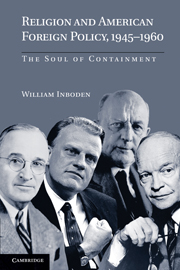
Reinforcing my view of a new generation of rising scholarship on the "mainstream," this evening I flipped through a recent edition of Reviews in American History, containing a really thoughtful exploration of William Inboden's Religion and American Foreign Policy, 1945-1960: The Soul of Containment. Inboden's work is also reviewed nicely, closer to the time of its publication, here.

Pretty much unbeknownst to me, apparently the pages of the journal Diplomatic History and other scholarly venues have been full of debates about the causal links (if any) between "cultural" factors such as religion and foreign policy decision-making. The reviewer asks, "How does one demonstrate conclusively that cultural phenomena do more than merely condition, or provide context for, the actions of foreign policy-makers?" He cites some skeptics of the "cultural turn" in foreign policy studies, asking skeptical questions to that effect. He then suggests that "more adeptly than any other product of the 'cultural turn' in foreign relations history, Inboden's book demonstrates this causative link between religion and diplomacy." The father of containment, George Kennan, wasn't much for any of this, but once it took hold his idea quickly moved far beyond the intentions of its creator, much to his dismay and exasperation.

These are all works about the "mainstream" from the inception of the high period of the Cold War through the trials of the 1960s -- a period when mainstream Protestants (with considerable sprinkling of folks from other parts of "tri-faith America," of course) were, to a sizable degree, the people who ran everything. I might add that I've just skimmed through another recent work, The Spiritual-Industrial Complex: America's Religious Battle Against Communism in the Early Cold War, recently out with Oxford, in which the mainliners are the central actors. We'll have more extensive coverage of this book on the blog a bit down the road; in the meantime, click the link for interesting coverage and analysis of the book. The review linked above begins:

IN A LETTER to the Vatican in 1947, Harry Truman characterized the United States as a “Christian nation.” For Truman this was likely a statement of fact, an obvious description of what America was and would long remain. For Jonathan Herzog, Truman’s phrase explicates an entire epoch in American politics. The title of his book, The Spiritual-Industrial Complex, inverts Dwight Eisenhower’s warning about a military-industrial complex, suggesting instead a fusion of governmental power and religious zeal.

Darren Dochuk's piece for Perspectives, "Searching Out the Sacred in U.S. Political History," summarizes much of what I'm saying here. After a discussion of the plethora of scholarship on evangelicals and fundamentalists, he goes on to add that

But religion was not just for the downtrodden or embattled; at mid-century it still dictated the dreams of the political elite too. Perhaps no other subset of political history has undergone a more profound shift lately than diplomatic history. Rendered too conventional by some in the 2000s, diplomatic history has emerged in the 2010s as a dynamic field revitalized by new interests in gender, NGOs, globalization, "soft power"…and religion. One exemplary byproduct of this renaissance is William Inboden's Religion and American Foreign Power, 1945–1960, which argues that Protestant notions of liberty and freedom informed U.S. officials' efforts to construct a "godly" front against "atheistic Communism." Once Dwight Eisenhower molded them into a more inclusive, civil religion of American exceptionalism, these notions also came to inspire Jews and Catholics around the world in a broad offensive against the Red Menace. Such was the spiritual essence of U.S. containment strategies, and as Inboden, Andrew Preston, Jason Stevens, Mark T. Edwards, and others emphasize, America's most powerful emissaries never took this essence lightly.

In their minds, America's fight against foreign evils was God's fight against foreign evils, rendering any clean distinction between faith and international relations artificial. If public theology was a wedge for American hegemony abroad, it could also be a subversive influence at home, something historians now stress when talking about the civil-rights era. As Joseph Kosek has shown in Acts of Conscience, even while many public intellectuals championed American imperialism, some spoke out against the prevailing orthodoxy. Reconciliation and brotherhood rather than conquest grounded their creed, fusing their interests with a broader crusade for human rights. These same principles enlivened the "prophetic" strand of Protestantism that bound the southern civil rights movement together. Rooted in an Old Testament tradition that roused black and white activists alike, this prophetic theology, David Chappell shows in A Stone of Hope, sacralized self-sacrifice for social justice and paved the way for nonviolent revolt throughout the South. Chappell's conclusions are now being enriched by studies of civil rights activism in the West. Scott Kurashige, Shana Bernstein, and Mark Brilliant have all shown that multiethnic religious agencies in 1940s California helped trigger the assault on American apartheid.Inspired by this state's rich but contested religious pluralism, they helped marshal local resources and resolve for a nationwide war against Jim Crow and all its intolerances, one they would win in the 1960s.

So what say you, Elesha and others -- is there another mainline moment being born? Perhaps the center could not hold, but its few decades of remarkable power and then fragmentation mark mid-twentieth century American history in ways historians are still fruitfully investigating.

Jumat, 21 Oktober 2011

Rethinking White Protestantism and the Long Civil Rights Struggle

Paul Harvey

Several of our bloggers are at the 2011 meeting of the American Studies Association in Baltimore -- where I too would be, except that I am due in Baltimore next week for the 2011 Southern Historical Association meeting, and there's just so many of those cross country flyover things I can do at any given time. Anyway, while we're hoping that Kelly, Mike or someone else might blog about the ASA here, you can follow them realtime at the hashtag #2011ASA.

For those of you going to the Southern, our panel unfortunately got put into the dreaded Sunday morning time slot (figures that the religion panel would go there, right?), but the papers propose new stories and ways of thinking about the civil rights struggle and the place of white Protestants within it, and I'm looking forward to the discussion. Here's the information below -- the "Sunday" referenced is Sunday Oct. 30 in the Sheraton Baltimore City Center.

Sunday, October 30: 9:00-11:00 A.M. Hopkins

62. RETHINKING WHITE PROTESTANTISM AND THE LONG CIVIL
RIGHTS STRUGGLE

PRESIDING: Clive Webb, University of Sussex

―What We Could Not Do Through Ourselves Alone: The Federal Council of Churches
and the Challenge of Social Change
Curtis J. Evans, University of Chicago

―A Prostitution of the Church to Political Purposes‖: The Hattiesburg Ministers’ Project,
White Religion, and the Struggle of Black Equality
Carolyn R. Dupont, Eastern Kentucky University

The Desegregation of Church-Sponsored Colleges and the Roots of ―Colorblind‖
Evangelicalism in South Carolina
J. Russell Hawkins, Indiana Wesleyan University

COMMENTS: Paul Harvey, University of Colorado, Colorado Springs
Clive Web

Rabu, 27 Juli 2011

Summer/Fall issue of Fides et Historia

Randall Stephens

Donald Yerxa and I have taken the editorial reins of Fides et Historia, as editor and associate editor respectively. We look forward to exploring themes that the Conference on Faith and History has long been interested in, and branching out in some new directions as well.

We're putting together the Summer/Fall 2011 issue now, which will be available in November. This includes forums on religious belief and the historian's craft as well as a series of review essays and dozens of book reviews. Future issues will include a roundtable on "Beyond the Protestant Nation: Religion and the Narrative of American History"--organized by Chris Cantwell, with Robert Orsi, Richard Bushman, Catherine Albanese, Wallace Best and Lila Berwin--and another roundtable on bracketing faith and doing history. Fides will also continue to feature research articles and occasional interviews. Back and current issues will now be available through ATLA and EBSCO.

Here's our first table of contents (and the new cover that I designed):

Fides et Historia, Volume 43, No. 2, Summer/Fall 2011

From the Editor
Donald A. Yerxa

Forum: Reconciling the Historian’s
Craft and Religious Commitment

Introduction

Mormon History Inside Out
Richard Lyman Bushman

Historians' Metaphysical Beliefs and the Writing of Confessional Histories
Brad Gregory

Coming to Terms as a Christian Historian with F. H. Bradley
Mark A. Noll

Writing Religious History as a Believer
Anthea Butler

The Wrong Question! Please Change the Subject!
David A. Hollinger

A Response to Bushman, Gregory, and Noll
Bruce Kuklick

Reflections on Reconciling Religious Belief and the Historian’s Craft
Paul E. Kerry

Roundtable: Confessing History

Introduction

Confessing History: In Retrospect
Jay Green

Confessing History: Prospect
Eric Miller

Comment
Rick Kennedy

Comment
Donald A. Yerxa

Review Essays:

Catholic Approaches to Faith and History
Christopher Shannon

War’s Providence
Chris Beneke

Media Review:

God in America (WGBH, American Experience, Frontline)
Maura Jane Farrelly

On Teaching with God in America
Randall J. Stephens

Book Reviews

Jumat, 01 Juli 2011

Ecumenicists, Evangelicals, and the Modern American Encounter with Diversity: Some Personal Reflections on David Hollinger's OAH Address

by David Stowe

Reading David A. Hollinger's OAH presidential address, "After Cloven Tongues of Fire: Ecumenical Protestantism and the Modern American Encounter with Diversity" (just published in the new Journal of American History) puts me in mind of a little family history. The dialectic he analyzes, between liberal ecumenically minded Christians played out in my family exactly as he scripts it.

Raised Nazarene in Iowa, my father discovered the life of the mind while attending a tiny college in Nebraska, finished his BA in history at UCLA, went to seminary, served for a time in China, completed a doctorate in theology. He had gravitated to the social-gospelly Congregationalists--later merged into United Church of Christ--for whom he directed overseas missions in the last stage of his career. His younger brother Gene stayed in the Nazarene fold, became a pastor and eventually ascended to the pinnacle of the church hierarchy: General Superintendent.

Our side of the family grew up in the East, became liberal Democrats, stayed with the UCC. My uncle's family stayed in the West, remained mostly rock-ribbed Republicans and Nazarenes. We read Christian Century, they undoubtedly read Christianity Today (and sent us a subscription to Herald of Holiness). Their menfolk hunted for elk in the Rockies; we trapped (and often released) squirrels to keep them out of our attic. The Boomer offspring had little contact; families didn't fly around a lot in those days. Consequently the cousins remained slightly exotic to each other. How could two brother/fathers turn out so differently while remaining committed Christians?

Hollinger lays out the historical context within which their lives diverged. In the middle decades of the last century, ecumenical Protestants dominated the American Establishment. Beginning well before the Sixties, ecumenicals pursued "diversity-accepting, captive-liberating projects" on behalf of people of color, women, and gays and lesbians--movements that allied them with secular intellectuals, mainly of Jewish descent. In the Sixties, self-interrogating ecumenical intellectuals like Wilfred Cantwell Smith, William Stringfellow, John A. T. Robinson, and most famously Harvey Cox eroded the theological foundations and moral complacency of mainline Christianity.

Evangelicals who had earlier red-baited ecumenicals with mixed success began to overtake their liberal rivals, increasing their cultural capital through savvy media use, outbreeding their mainline rivals and doing a better job holding their kids in the churches. “But just as a substantial portion of the missionaries found that the Hindus and Buddhists they encountered abroad were not quite so much in need of Christian conversion as once assumed, thousands of children of the old Protestant establishment found that Christianity was not so indispensable to the advancement of the values most energetically taught to them by their Methodist and Congregationalist tutors."

Hollinger makes a useful point about avoiding Whiggish assumptions in assessing the impact of a movement like ecumenical Protestantism:

To recognize the historic function of ecumenical Protestantism as a halfway house, if not actually a slippery slope to secularism, is in no way invidious unless one approaches history as a Christian survivalist. Religious affiliations, like other solidarities, are contingent entities, generated, sustained, transformed, diminished, and destroyed by the changing circumstances of history. Those circumstances still render ecumenical Protestantism a vibrant and vital home for many persons. A genuinely historicist approach to the history of religion will not teleologically imply that those committed to that faith today are headed for history's dustbin.

That’s a relief. If Hollinger is correct, my uncle's family won the battle for the soul of American Protestantism, but my father's side may...may... have won the war for the nation's heart and mind. Hollinger sees a powerful analogy between ecumenists and the post-1964 Democratic Party:

The evangelicals gained the upper hand in the struggle for control of Protestantism just as the Republicans gained the upper hand in the struggle for political control of the South.... [J]ust as the nation got something in return for the loss of the South to the Republican party, so, too, did the nation obtain something in return for the loss of Protestantism to the evangelicals: the United states got a more widely dispersed and institutionally enacted acceptance of ethnoracial, sexual, religious, and cultural diversity.... Those impulses and capacities generated a cascade of liberalizing consequences extending well beyond the diminishing domain of mainstream churches, running through the lives and careers of countless post-Protestant Americans distributed across a wide expanse of secular space [no doubt including many in higher education]. Our narrative of modern American religious history will be deficient so long as we suppose that ecumenical Protestantism declined because it had less to the offer the United states than did its evangelical rival. Much of what ecumenical Protestantism offered now lies beyond the churches, and hence we have been slow to see it.

Probably we'll never equal my uncle's kin in elk-hunting prowess, but we can out-squirrel-trap them any time. The (usually) friendly rivalry continues. In lieu of a definitive resolution (mark your calendar for October 21), and given Hollinger's point that American religion has increasingly come to serve as politics by other means, we'll have to await the results of the 2012 elections.

Rabu, 15 Juni 2011

The Future of Religion in America

Please welcome our new contributor Elesha Coffman. Elesha first posted here last week on the Religion and American Culture conference. She is an assistant professor of history at Waynesburg University and soon off to the Center for the Study of Religion at Princeton for a year's fellowship. Elesha's current work is on the Christian Century magazine and its role in establishing mainline Protestant identity and influence during the first half of the twentieth century -- a sort of "prequel" to the much-discussed decline of the mainline. Before graduate school she was a magazine editor, one of the reasons she is interested in print culture and the ways books and magazines create communities of readers. Welcome to Elesha!

The Future of American Religion
Elesha Coffman

“This is a big question,” the Religion and American Culture conference program admitted, “but what is the point of assembling a group like this unless it is to take a step back and ask the big-picture questions from a variety of perspectives?” The last session in Indy delivered on its promise by offering three very different reflections from scholars with very, very different ideas. It wasn’t that the panelists overtly disagreed about anything, as had the panelists and audience members at the previous session on scriptures. Rather, they responded to different versions of the main question regarding the future of religion in America, proving once again that the answer you get depends on the question you ask.

David Daniels, a seminary-based church historian, addressed his remarks to a question that might be posed as, “How will broad cultural trends affect American religion?” He probably came closest among the panelists to what the organizers had in mind, as their program notes queried “How will technology change religion, or be changed by it?” and “How will civil religion relate to traditional religion?” Daniels foresaw an America in which religious believers were more networked, more socially and ecologically conscious, and less bound by ascribed identities.

Mark Silk, a journalist and professor of religion in public life, spoke to the question, “Which religious groups will gain and lose ground in the coming years?” He based his predictions on trends identified by the American Religious Identification Survey, a project with which he is deeply involved. Silk advised his listeners to “short” the Protestant mainline and Roman Catholicism, which he expects to decline to 10 and 20 percent, respectively, of the American public in the next decade or so. He was more bullish on evangelicals and religious “nones,” groups he anticipates will swell to 40 and 20 percent of the population. (Silk did not mention Pentecostals separately, so presumably he counted them among the evangelicals, a decision many self-described Pentecostals and evangelicals would contest.) Those numbers left just 10 percent of Americans to be divided among all “others,” including world religions and new religious movements.

Julie Byrne, a religious studies scholar with interests in ethnography, took a completely different approach, considering, “What could scholarship on American religion look like in the future?” She took her own writing as a case study. Several years ago, she began to research an independent Catholic church, but before she could finish her book, the church fractured. At least one member of the church thought that Byrne’s research contributed to the splintering, as factions clashed, prematurely, over the attendance boom the book was expected to spark. This was the context for Byrne’s proposed “ethnographic uncertainty principle,” the suggestion that a scholar changes what she studies merely by studying it. So much for scholarly detachment. Byrne added to this cautionary tale a call for more creative presentations of scholarship, a call I jotted down in my notes as “Make art, not monographs.”

If it seems, from reading these summaries, that these three panelists were talking past each other rather than to each other, that’s pretty much what it seemed like in the room, too, despite the fact they were actually facing each other around a small, round table. I didn’t think this was a fatal flaw, however. The lack of direct engagement served to clarify some disciplinary distinctions that underlay a number of conversations that arose throughout the conference. As sociologist Rhys Williams had observed the previous morning, during a session that asked whether the secularization thesis still performed any useful work, “It really depends on, what do we want to know and why?”

The three panelists wanted to know different things for different reasons, and on behalf of different audiences. I expect Daniels’s students at McCormick Theological Seminary are very interested in how cultural trends will affect the interests and activities of religious Americans, while Silk’s interlocutors in journalism and the social sciences really want to know which groups are (to use terms that were hotly debated at the conference) winning and losing market share. Byrne’s questions about method are central for ethnographers, and her challenge to rethink the relationship between art and scholarship had implications for every discipline represented at the conference—though I’m still not sure what a “historical uncertainty principle” might look like or how my research into the early years of The Christian Century could be transmuted into art.

The future of American religion surely includes changes in cultural engagement, group affiliation, and scholarship. Ideally, scholars asking questions about those changes would stay in conversation, as they were in Indianapolis, even if they can’t always figure out how to talk to each other directly. Social scientists counting religious adherents need to be reminded how slippery and complicated religious identities can be. The field of religious studies, which tends to pay a lot of attention to outsiders, could benefit from confronting sociologists’ statistics on mainstream, majority groups. And scholars working within religious institutions and those working outside ought to be reminded periodically how the other half thinks. Is that too much to ask?

Rabu, 08 Juni 2011

After Cloven Tongues of Fire, The Nation (Magazine) Gets Religion

Paul Harvey

I think a lot of you are out there are having fun thinking about Elesha's provocative post yesterday Do Religion Scholars Read the Bible, and the conversation about it will continue tomorrow with a follow-up post by Janine -- but in the meantime here are some more items of great interest that passed my way today, and very much related with one another.

First, The Nation magazine has given one of its reviewers, Chris Lehmann, ample space to discuss together Darren Dochuk's From Bible Belt to Sunbelt alongside Matt Sutton's Aimee Semple McPherson and the Resurrection of Christian America (which, as some of you know, was John Updike's alltime favorite book in his New Yorker review). Subscribers can read the review here, and the rest of you will have to track it down somewhere else, but if you're at a subscribing library as I was today it will show up as well.

Lehmann's lengthy discussion is fascinating, and framed in a way I have not seen before; he begins by discussing Golden State high-tech boosterism characteristic of TED conferences, Wired magazine, and the early Whole Earth catalog, and then tries to figure out how religious conservatives previously suspicious of free market orthodoxies (as discussed in Darren's book) came to be in the same camp as the "Californian ideologues" who preached "an anti-statist gospel of hi-tech libertarianism," concluding that "No less contradictory than the gospel truths of the California digerati, the dogmas of West Coast evangelicalism proved instrumental in acculturating an earlier generation of Jeffersonian golden dreams to a life of abundance bolstered by government-driven subsidies and development policies that, over time, they came to despite with a righteous fury."

Anyway, given a few years separation of publication dates, I have not seen Dochuk and Sutton's works considered together elsewhere, but they are here, and very fruitfully. Plus, Lehmann picks out some stories from Sutton's book about McPherson, who of course is an endless fount of fascinating tales, which I had forgotten about. And yes, that "who" pronoun was deliberately ambiguous.

Next semester I'm having my MA students read Sutton's biography of Aimee together with Jennifer Burns's Goddess of the Market: Ayn Rand and the American Right -- a wonderfully engaging book I'm just now finishing. I'm expecting this pairing to lead to a great class discussion -- two of the most self-inventive Americans of the twentieth century, with personal sagas which no fiction writer could make up (indeed, fiction writers of McPherson's time modeled characters after her precisely because they could not make her up), but obviously at opposite ends of the spectrum in their relationship to Christianity. Or maybe not, since Rand's visceral hatred of religion didn't prevent her from creating her own version of a rigid belief system.

The other article to call your attention to is David Hollinger's Presidential Address at the Organization of American Historians meeting in Houston a few months back, which is now published in the Journal of American History:

"Presidential Address: After Cloven Tongues of Fire: Ecumenical Protestantism and the Modern American Encounter with Diversity," by David A. Hollinger

It bears mentioning that Hollinger, who teaches at Berkeley, was the PhD advisor for blog friend and occasional contributor Kevin Schultz, whose book Tri-Faith America has received attention here, as well as of Jennifer Burns, author of the Rand biography just mentioned above. Congratulations to Prof. Hollinger for his OAH presidency and for the outstanding work that his students are doing.

Here's a brief summary of the main point:

In his presidential address to the 2011 Organization of American Historians annual meeting, David A. Hollinger argues that the flourishing of evangelicals and the membership decline of ecumenicals since World War II constitute a single dialectic driven by contrasting dispositions toward ethnoracial, sexual, religious, and cultural difference. More sensitive than their evangelical rivals to the diversity of American society and of the globe, ecumenicals abandoned a series of ideas that were not supportive of diversity, but those same ideas remained popular with the white public that was the chief constituency of Protestantism. Evangelicals then energetically espoused ideas such as the notion of a "Christian America" to appeal to Americans dubious of the accommodations with diversity that ecumenists had enacted with secular liberals. Americans become increasingly comfortable with the liberal ideas espoused by the ecumenical churches, while Protestantism itself became an evangelical stronghold.

What is interesting here -- among many other things -- is that the histories of "mainline" or "mainstream" Protestants have been largely considered separately from the "rise of the evangelicals" historiography, and Hollinger suggests one way to bring them together.

I hope my buddies over at U.S. Intellectual History might take up some of the ideas discussed by Hollinger and weigh in on his argument -- down the road when people have had a chance to read it, of course. In the meantime, if you historians out there haven't joined the OAH, what's wrong with you?

Jumat, 17 Desember 2010

Saving the World? The Changing Terrain of American Protestant Missions, 1910 to the Present

March 24-25, 2011

Duke Divinity School, Durham, NC

The Institute for the Study of American Evangelicals at Wheaton College (IL), with a grant from the Lilly Endowment, is sponsoring a two-day conference at Duke Divinity School to explore the evolving nature of American Protestant missions since the famed Edinburgh Missionary Conference of 1910. Through lectures and panel discussion a number of distinguished scholars will examine the American mission enterprise over the last century while discussing the extent to which America continues to play a role in the shaping of global Christianity.

Participants include: Thomas Kidd (Baylor University), Mark Noll (University of Notre Dame), Robert Priest (Trinity Evangelical Divinity School), Dana Robert (Boston University), Marsha Snulligan-Haney (Interdenominational Theological Center), Brian Stanley (University of Edinburgh), and Grant Wacker (Duke Divinity School)

For more information and to register, please visit isae.wheaton.edu/projects/final-conference.

Rabu, 08 September 2010

Down LDS Lane

by John Turner

One of the joys of developing an interest in Mormon History is that there always seems to be a historic site to visit. AHA in San Diego? The Mormon Battalion. In New England? Joseph Smith's birthplace. And obviously lots to do in western New York, Ohio, Illinois, Missouri, and Utah. For the details, see this list.


With a family, this surfeit can potentially be tricky to navigate, despite the family-friendly nature of the church. I've yet to persuade my wife that driving the length of the Mormon Trail would be a good use of our time and money -- perhaps we can just make a beeline to the Handcart Visitors' Center next summer.


My two-year-old daughter has had a mixed reaction to Mormon Historical Sites. Loved the stairwells at Salt Lake City's Beehive House. Screamed when subjected to a discourse on the history of the church at the Brigham Young summer home. Enjoyed collecting rocks at the site of the Mountain Meadows Massacre (note: a site currently maintained by the church but not a "Mormon Historic Site") (second note: said daughter did not remove any rocks from the monument itself).

I'd long wanted to visit the massacre site, given the attention the massacre has received from historians over the past decade. It was strange to see the bucolic landscape surrounding the site, and it was hard to perceive the macabre given the pleasure of leaving boiling-hot St. George for a cooler and greener spot.


At the end of the summer, we drove from Rochester, NY to visit some friends in Vermont. (No time for Mormon tourism in Palmyra this year, but the Joseph Smith Family Farm and Sacred Grove were good stops last year). Somewhere near the NY-Vermont border on Rt. 4, we sped by the William Miller Chapel. In terms of signage and web presence, the Adventist Heritage Ministry lags way behind Mormon Historical Sites. I didn't think I could divert us for Miller this year. Perhaps next time. (I'd like to get a look at Ascension Rock).


Somewhat disappointed to have missed Miller's Chapel (but disappointment of course is relative in this case), I also regretted that our route to South Royalton, Vermont did not more closely approach Brigham Young's birthplace. However, I had forgotten that Joseph Smith was born in Royalton, Vermont. Our obliging hosts not only informed us of the birthplace and volunteered to take us the next day but also pulled out Hope Nash's 1975 Royalton Vermont.


A choice description from Nash of a religious minority making itself more acceptable to the mainstream:


...the Mormons, after raising the Joseph Smith monument in 1905, built a cottage, a reception center for visitors. In the 1920s they were fitting into the local scene with a dairy herd, sugaring operations, and an apple orchard. They made friends by inviting everyone to picnics, games, dancing, and programs of music and drama (p. 80) [Continued in a footnote on that page] The Mormons made themselves pleasant. They gave parties and pleased the children. When a little girl went up there they had a big box of candy on a high shelf and they lifted her way up so she could look down into it and choose ... In 1970 Mrs. Roland McIntosh said, "Now there is only one person on Dairy Hill who doesn't like the Mormons." She did not say who it was.


I didn't have time to sample contemporary local sentiment vis-á-vis Latter-day Saints.


The JS birthplace was much better marked than the Miller Chapel. One only had to find LDS Lane. All of our children loved the birthplace, so there must be something to Nash's analysis. I did find it a bit ironic that they received miniature American flags from the missionaries.


I think at this point my wife feared that Mormon Historical Sites would haunt her wherever we went. [None in the Southeast, though, at least until Patrick Mason's forthcoming book on anti-Mormon violence in the American South gets the ball rolling].


I did actually spend some time in the archives this summer, but one of the things I appreciate about the field of Mormon History is the passion with which Mormons (as well as ex-Mormons, anti-Mormons, and the curious) engage their history. What other church in the United States would invest so much time and money to promote the study of its past? There are both theological and historical reasons for this, but for outsiders like me, it is encouraging to spend my time studying something that is critically important to so many people.

Of course, the Mormons are not the only group to have cultivated a strong sense of their history. I recently read and reviewed Laurie Maffly-Kipp's recent Setting Down the Sacred Past, in which African American Protestants rejected the belief that they were a people without a history. In the process of discovering and refashioning a collective past, they became African Americans. A short paraphrase of Maffly-Kipp's conclusion:


The knowledge of a glorious past, the example of black and white heroes of the faith, and the anticipation of a millennial future enabled black Protestants to respond to the bitter disappointments of the Civil War's aftermath with efforts to shape a more just society either in the United States or abroad. In their books and speeches, the "point of history is to rise above ourselves and this world to an unmoving vantage point."


After spending another summer studying Mormon History and reading Setting Down the Sacred Past, it struck me that my own denomination (the dwindling PC(USA)) sorely lacks this keen interest in its history. We can't travel around the country visiting historic sites, we don't really have a pantheon of Presbyterian heroes, and most of us probably don't know what the word Reformed means in a Presbyterian context. I think historical forgetfulness impoverishes mainline Protestantism. We're not sure where we came from, and we don't have any idea where we're going. I don't think most mainline Protestants would want "an unmoving vantage point," and Maffly-Kipp doesn't argue that African Americans or other religious groups should re-embrace the historical or theological thought of her subjects. But whether Mormon, mainline or evangelical, white or black, there are distinct advantage to cultivating a sense of a shared sacred past.

Related Posts Plugin for WordPress, Blogger...