Tampilkan postingan dengan label religion and labor. Tampilkan semua postingan

Minggu, 04 September 2011

Adventures in “Christian” Retail

by Charity R. Carney

Disclaimer: This is a teaser. I’m working on a larger piece about experiencing employment at a Christian retail chain this summer. I took on the job because 1) we needed the money and 2) I was curious. I have been documenting my day-to-day life there as a full-time employee and am working up a full-length piece with an academic emphasis and analysis of marketing with religion, the gender politics of the place, as well as how they handle money and workers’ rights. Enjoy.

Update: Part II is of this series is now up here. Part III, the finale, is here. Extended responses informed from his own academic work on capitalism and American Christianity, from Darren Grem, are here and here.

I worked retail this summer. “Christian”-run retail. When I walked into the interview for the position at the local store that is part of a national chain (we’ll call it “Christian Chain” or “CC”), the manager was a bit baffled by the Ph.D. sitting in front of him. “Honestly,” I assured him (and meant it), “I want to work here and my family needs the income.” I (naively) believed that CC, a company that nationally proclaims its Christian values and give generously to conservative Christian causes/movements, would provide a good work environment and would reveal to me how Christian employers manage the workplace. It would give me insight into the world of Christian retail. And it has. Plenty of insight. So here’s a taste of what I witnessed in terms of the corporate model CC follows. The larger piece will include issues of sexism/sexual harassment and employee’s work schedules/worker’s rights but, like I said, teaser.

On money and mythology at CC: This company handles its resources in the most Luddite and inefficient way possible. There is one computer in the store where I worked. It was locked away in the back room and was used only to make/print out weekly schedules. All ordering is done by hand using a pencil and three-ring binders and a complicated system of “base” numbers and “minimum” orders. The poor soul who works in the back room has to then take all of the binders from each department and enter them into the one (aged) computer before a deadline in order for stock to come in.

There are no SKUs--no barcodes--no scanning devices. Thus the hand-written ordering. This is where the mythology comes in. I inquired about the lack of computers in the store and the ancient cash registers that required each item to be manually punched in and discounts to be manually entered as well. I was told that the cash registers WERE NEW. The explanation varied based on who responded to my questions. Some employees (especially those higher up) explained that it was just CC’s way. That it had maintained the same system since its birth (over 20 years ago) and that CC does not change. I found this idea interesting for several reasons. It requires more work from employees, thus costing the business more money. It is a business after all and so shouldn’t it be concerned with profits and losses? But it may also connect to the idea that workers should have sweat on their brow constantly in order to truly earn their wages. The Protestant ethic, so to speak. Work for work’s sake.

Several other (lower-paid) employees told me that the lack of barcodes was CC policy because barcodes represent the mark of the beast. Wha?! I know, this seems far-fetched. But this is a widely held belief amongst employees and thus should not be discounted. Some are dissatisfied with this reasoning but accept it, again, as being CC’s way so it cannot be questioned. (More on this in the longer article.)

Another strongly held belief is that the company does not have barcodes because then it does not have to have uniform pricing. Sales, then, do not have to be reflected at the register unless the customer notices that they are not receiving the discount and asks for it. A few employees see the lack of technology as a ploy for the company to make extra money.

There is an odd dichotomy at work at CC: they are focused on saving money (they are very concerned with hours and wages and do not move an employee to full-time unless they really need them and the employee makes enough demands) but they use a system that ultimately costs them money because it requires employees to work double or triple the hours at a task that in other stores is not nearly as involved and grueling.

Ultimately, what I’d like to consider in a larger format is what does it mean to be a Christian-run corporation in the modern marketplace? CC has held on to antiquated ideas regarding its particular brand of commerce, and the reasoning for that steadfastness varies based on what myth or history an employee chooses to subscribe. Also, the Christian values on which the chain claims to rely are not reflected in its treatment of employees or the employee’s treatment of each other. This begs the question: how much are “Christian” businesses relying on the image of being Christian without truly employing (or even hinting at employing) Christian ethics in their stores. This I will explore in more detail in the article with a discussion of sexual politics at CC and the overextension of employees to the point of completely disregarding their rights. Good times.

Jumat, 12 Agustus 2011

The Gospel of the Working Class: Gellman/Roll Interview, Part III

By Heath Carter


The final installment of my interview with Erik Gellman and Jarod Roll: _________________________

HC: What factors best explain why some were attracted to this radical gospel and others were not? Are there underlying unities within the diverse spectrum of persons that populate your narrative?


EG: Embracing this radical gospel was not the easy path. It meant risking your livelihood and defying the dominant cultural norms of Jim Crow, not to mention class and gender assumptions about who had the right to lead and wield power in America. Many people who embraced this gospel did so during the 1930s when deprivation had become so widespread that people had the ability, as a result of dire circumstances, to radically reorient their cultural identity. Thus, working people and poor people, who often were cast out or dismissed by liberals and middle-class professionals, often listened to this radical gospel. But many people in the working class also listened to Charles Coughlin, Gerald L. K. Smith, and hundreds of other right-wing religious preachers of their day, because their explanations of the injustice in the world had simple solutions. Embracing fascist ideas, including the hatred of other races, was easier than the alternative of interracial and militant organizing against the American mainstream. Meanwhile, others embraced what Whitfield denounced as “sky pilot” and “pie-in-the-sky” type preachers who did not orient them for action but provided them with personal and emotional styles of worship.


JR: One aspect of the research that really stood out was the power both Whitfield and Williams possessed as speakers, the way that the Spirit seemed to move through the words they spoke, at least in the sense that they moved hearts and minds in their direction. They each had a remarkable ability to convince those who heard them preach, whether the hearer was a coal miner, a sharecropper, a factory worker, or a sympathetic liberal. They also did well with those who opposed them, if they could get in earshot. Williams converted a number of Ku Klux Klan members to work alongside blacks, while Whitfield commonly moved secular or nationalist African Americans to his side. The power of their speech, when delivered in person, also impressed a range of more well known people, including Franklin and Eleanor Roosevelt, Ralph Ellison, Pete Seeger, and Woody Guthrie. Some were leery of this ability and likened it to demagoguery, perhaps not without cause. Williams used his oratorical skills to propel the STFU membership to vote to join the CIO against the wishes of some union leaders. Whitfield, on the other hand, could inspire rank-and-file union members to take wildcat action during the war despite the no-strike directives handed down by his bosses in the CIO.


Williams even had this effect on historians who met him in the 1960s. Donald Grubbs, for example, interviewed him in the course of the research that would become his book on the STFU and the New Deal. He was not sure there was any point, since he considered Williams to be an unreliable self-server (a view he got from talking to H. L. Mitchell, the STFU leader, who fell out with Williams in the late 1930s). But during the course of the interview Williams worked his magic on Grubbs, who left with no doubt about the preacher’s religious conviction. Moreover, he came away certain that Williams was far more important than he had ever given him credit for and that historians had to take his view of the southern labor movement seriously if they were to understand it properly.


Sadly no recordings exist of Whitfield and Williams preaching in their prime, so we can’t really know what they sounded like in full flood. There is a recording of Williams talking to civil rights activists in the 1960s, and one can get a sense of the power that the then aged preacher must have had in his heyday.


Both were such impressive writers and speakers that we wanted the book to provide space for each to speak, or at least for the reader to get a good sense of their voices in the pulpit. We decided to do this with two interchapters that each delivers a sermon, one by Williams and one by Whitfield, with as little interjection from us as possible. I think they work really well in the course of the narrative, because they break our biographical story and give the reader direct contact with extended texts as delivered by each preacher, hopefully with some feeling for the historical scene, of what it might have been like to be there. We wanted the reader to have the opportunity to hear the working class gospel straight from its two greatest evangelists.


HC: Your story is centered geographically in the South but also ventures out to Detroit, Chicago, New York, and elsewhere. To what extent is this a southern story versus a national one? Are there elements of it that you take to be more broadly representative?


JR: We’ve framed the story as one of “southern prophets” taking their message into New Deal America. Whitfield and Williams both argued that the nation’s problems originated in the South and had to be addressed there before the US itself could be saved. So, it is both a southern story and a national one. The two preachers came to this political view in part because of their religious training. Williams and his wife Joyce began their careers as Presbyterians who felt called to take the gospel into hostile terrain, to serve as missionaries in their native South. In fact Joyce had studied to be a missionary at Bethel College in Tennessee, where she first met Claude. Whitfield, on the other hand, entered the ministry because of his experience as a student at Okolona Industrial School in Mississippi. Wallace Battle, the leader of the school, trained his students in a spirit of civic service, which bid them to use their privileges as educated southern blacks to lead their families and neighbors to better lives. Whitfield came away from this with a strong sense that God intended for him to serve as a Moses for his people. Whitfield followed this charge when he moved with his family to Arkansas and then to the new lands opening up in Missouri in the early 1920s. There he melded his spirit of service with religious leadership in the Garvey movement. When both Whitfield and Williams joined together to take their gospel to the nation at large, they were both acting in a way consistent with the sense of calling that had brought each of them into the ministry in the first place.


EG: Great question. This story fits with the historiography of many scholars of the twentieth century who make cogent arguments that the South has a huge influence on the rest of America. Also, our book confirms that this era was one of migration from rural enclaves to urban ones. But I would hope our narrative complicates both of those ideas. The workers in this story seem to migrate in circles rather than from North to South, from rural to urban. And while rural cultural traits brought by workers into urban areas help explain why the radical gospel of Williams and Whitfield, based on rural experiences, often succeeded in binding workers together, urban influences – especially CIO locals, radical political parties, and black-led protest groups like the National Negro Congress – fostered new ideas about protest politics. So the literal and ideological movement of urban/rural and North/South cross-pollinated in the 1930s and 1940s more than I had expected.


HC: In your conclusion you say that “the pathogenic, divisive aspects of American life that Williams and Whitefield fought against, at great odds and with terrible risks, are still around us: inequality, poverty, and the reactionary interpretation of evangelical Christianity.” In your assessment, what are the legacies of the radical religious organizing tradition you describe? To what extent is it still alive today?


EG: One reason we wrote the book is to highlight the historic, progressive nature of Americans who had a strong religious faith. This provides a usable past to build upon for our present era when so many Americans, especially in liberal circles, ignore or condemn religious people, especially evangelical Christians, as an inherently conservative and ignorant group whose faith distracts from issues like growing economic inequality. Moreover, middle-class Americans have mocked them for holding irrational beliefs drawn from the Bible. But, drawing on this book’s protagonists as historical examples, we sometimes need pure faith to break through the hegemony of the present, of what appears as the rational status quo. Williams and Whitfield would have made the devoutly religious, whatever their political persuasion, their first priority by attempting to reorient their religious commitment to the radical gospel as their historical inheritance. This gospel, they believed, had the ideological power to break down divisions among the poor and organize them into an aggressive force in American life to expand American democracy and diminish racism, sexism, and especially economic exploitation.


JR: In the sense of explicit legacies, there isn’t much left of what Whitfield and Williams worked on in their lives. A common reaction among historians and other people we talk to about this story is surprise, perhaps mild shock, because most people have never heard about them before. That erasure was the result of several factors, including the Red Scare, but most importantly the surging power of conservative Christians in the last forty years or so. From the perspective of events in the early 1940s, however, it probably would have seemed a surprise that things have come down has they have. Take for example J. Frank Norris, one of the PIAR’s great foes in wartime Detroit. After the riot in the city in 1943, Williams effectively tarred Norris as a supporter of racial division, even violence, as the enemy of working Americans, and more generally as preacher disloyal to the nation in the fight against fascism. At the time it seemed like Williams and the PIAR might win that battle. But if you look for Norris online now, you will find that he’s treated as a respectable, even canonical, theologian in some circles. You will find books and websites devoted to this writings and his ideas. Aside from this book, you will not find similar appraisals of Williams’s work even though his vision of a working-class, Christian majority preempted the conservative Moral Majority by forty years.


If Williams and Whitfield haven’t left an explicit mark on today’s political culture, their influence can certainly be found if you know where to look, or listen. The music of Woody Guthrie and Pete Seeger, for example, were shaped directly by Williams and the PIAR. Williams is in part responsible for the song, “We Shall Overcome,” for instance. Has that been more powerful than Norris’s legacy through Jerry Falwell?


EG: Whitfield’s efforts foreshadowed the tactics of the civil rights movement when he led the 1939 roadside demonstration in Missouri and then trained the younger generation of civil rights activists in St. Louis after the war. Both preachers, and their key allies like Harry Koger, Myles Horton, Winifred Chappell, and William DeBerry authored new methods of organizing workers that historians have come to call civil rights unionism. This form of organizing tapped a working-class culture that reached well beyond the field or factory. And the Williamses remained active into the 1960s and 1970s. He and Joyce made it their mission to open their house in Alabama to young activists for conversations about protest politics and movement organizing, past and present.


While the specific historical record of this cast of characters may have been elided, religious-based progressive activism has not disappeared. I have had the opportunity to know community organizers, unionists, and other activists through specific campaigns in Chicago over the past decade, and have learned that many of them came to these positions based on religious backgrounds, or indeed, an embrace of a gospel of the working class. These religious beliefs are not necessarily conspicuous but often sustain these activists. More explicitly, Kim Bobo and others at Interfaith Worker Justice serve as a prime example of this radical gospel’s legacy, even if their voices might get muted on the national stage in favor of mega-church ministers and televangelists.


JR: The story of Whitfield and Williams, as well as the thousands who rallied to their call, point to the more general conclusion that powerful religious denominations are most vulnerable when they no longer meet the needs of their members, and this tends to happen at a moment when those denominations are basking in worldly power and prestige, when they seem all-conquering. It happened to the Episcopalians, it happened to the Methodists, and it can happen to the Pentecostal and Baptist mega-churches. I came away from this project convinced more than ever before that religious faith is fundamentally radical in its implications for human behavior and action and that it always carries explosive potential—for good and bad, of course. Who knows what rebellions are out there simmering among believers discontented with their religious leaders? Who knows what they might be saying right now, and who knows what they might do? This book project has shown us that we need listen closely to these believers and better understand them as a potential force in American culture.

Kamis, 11 Agustus 2011

The Gospel of the Working Class: Gellman/Roll Interview, Part II

By Heath Carter

__________________


HC: You discuss in one footnote how historians of the New Deal era have “focused on the conservative or reactionary religious thought of preachers like Father Charles Coughlin or Reverend Gerald L. K. Smith.” In what ways and to what extent does the recovery of your cast of characters - the Owen Whitfields and Claude Williams of the world – revise our stories about this period?


EG: The focus on the religious right during the 1930s and 1940s has given the false impression that people during this era who prioritized religion embraced reactionary politics and fascist ideas. Uncovering this cast of progressive characters who fought for the poor and for civil rights shows how faith did not just represent a distraction or diversion from the path of New Deal liberalism or the struggles of Popular Front activists to expand America’s democratic promise. Interestingly, however, the path blazed by Whitfield, Williams and their colleagues also provides a challenging critique to many of the false assumptions New Deal liberals had in terms of class, race, and gender. For example, when Williams dealt with the so-called migrant problem of white and black southerners to Detroit during the World War II era, he analyzed it from a very different angle; Williams saw these migrants much less as the problem than the solution because he believed they had more potential to embrace a radical social gospel than their liberal counterparts who sought primarily to quell riots and preserve the racial status quo.


JR: For me, one of the most important and surprising facets of this story is that Whitfield, Williams and the people who joined them in the People’s Institute of Applied Religion and other groups were part of an extremely volatile and creative intellectual world available to common people in the 1930s and 1940s, particularly, and perhaps paradoxically to some readers, in the South and among southern migrants across America. This intellectual world had progressive, conservative and other strains, often all mixed up, and usually at the radical edge of whatever direction they tended. We already know a lot about the radical and reactionary political movements that operated in this period, but I think those stories are usually delineated in terms of ideas coming in from the outside and from the top down. I think that this book, as well as our other books, Spirit of Rebellion and Death Blow to Jim Crow, shed new light on the ways that ordinary thinkers and activists at the grassroots generated powerful new ideas and put them into action—we both build on the work of Robin Kelley and Paul Harvey, in particular, in doing this.

Telling the story of Whitfield and Williams in the same narrative seemed like a great way to expand on this historiographical project: both came from poor families in the rural South, the kind of upbringing that most histories of the period equate with despondency, backwardness, and intellectual helplessness. Yet, they went on, with the benefit of a little southern schooling, to hone a religious interpretation of America’s plight in the Great Depression that earned them the attention of the White House, the FBI, and the heads of major international labor unions. Along the way they each imbibed and reformulated ideas from Marcus Garvey’s black nationalism, Christian fundamentalism, Booker T. Washington’s Tuskegee model of education, the Social Gospel, communism, inter-racialism, socialism, the ecumenical movement, and Pentecostal and holiness revival, in addition to their own respective Presbyterian and Baptist backgrounds. Crucially, they first encountered each of these various ideas and movements in the context of the rural and small-town South, not in New York or Moscow. What we tried to draw out in this book is how these ideas circulated in relative abundance among ordinary people in cotton fields, backwoods settlements, mining camps, and one-horse towns across the South, among blacks and whites who interpreted and adapted these ideas to suit their needs whatever their religious identification might be. The cast of characters in this book was a remarkable group of what we might call, after Steven Feierman, organic intellectuals, but they were not unique among their peers. I hope that conclusion opens up a number of potential avenues for further inquiry, and encourages historians to reconsider their stock assumptions about southern working-class life, social and intellectual, in this period.


HC: Elaborate on the significance of the book’s title. In what sense was this strain of Protestantism – radical especially on matters of class and race – in fact “the gospel of the working class”? In your estimation, how extensive was its reach amongst ordinary Southerners during this period?


JR: We hoped that the title would pick up on several threads in the book—threads often in tension with one another. Part of the “gospel” is the faith Whitfield and Williams had in the faith of the working-class, as well as their belief that class issues were the fundamental truths that underlay southern and American problems. Whitfield and Williams were faith-driven idealists who believed that the religious devotion of laboring whites and blacks had the power to make the kingdom of heaven on earth—to overturn racism, poverty, and gender discrimination in the United States. They saw these problems, sins really, rooted first and foremost in the South and believed that the bedrock Christian faith of ordinary southerners provided a kind of natural antidote, honed in response to these base evils for generations. Of course they accused mainstream denominational churches of facilitating these evils, mainly because these churches were vested in the established order that thrived on southern iniquities. They wanted to put that grassroots faith into action, through unions, the government, churches, or the individual preachers and prophets who they trained in the PIAR. So, in one respect, their gospel was a faith in class-based politics leavened with what they considered a true Christian conviction. The title also plays on the way Whitfield and Williams preached this “gospel” to the working classes in an effort to get them to realize their moral power, even duty, in an immoral world. They wanted to convert people to their version of the good news. In both senses of the title, this is the “gospel of the working class” from the perspective of the two preachers, and it is not hard to imagine it led to all sorts of interesting twists and turns, innovations and errors, but always propelled by an idealistic faith. That both men risked their lives, their livelihoods, and the well being of their families during several decades of service to that faith gives some indication of the strength of their idealism.


That is not to say that the “gospel of the working class” was solely in the heads of Whitfield and Williams. Thousands of white and black southerners (and other Americans) shared their gospel in this period. Both preachers were from the working class themselves and came to this religious interpretation through many years of grueling spiritual searching for some way to reconcile what they considered to be God’s promise to the righteous with the brutal living and working conditions that crushed their neighbors, their families, and even themselves. That search took them into domestic mission work and a range of political alternatives, all aimed at making their faith powerful and consequential in their lives and the lives of others. I think this aspect of the story points to the importance of biography as a way of mapping this religious search. Christians across the South were on the same quest in these years, looking for grace and salvation in a range of places that included the various political groups that Whitfield and Williams found, as well as Pentecostal and holiness churches, before religiously committed working people joined groups like the Share Croppers’ Union, the STFU, or the CIO. Of course, some poor people found their answers in reactionary groups. For Whitfield and Williams this spiritual search led them to create the PIAR to work independently of all other organizations and to empower a roving band of prophets to attempt to channel the faith of working people into collective action--from cotton fields to cities like Memphis, Winston-Salem, Chicago, and, most famously, Detroit.


In terms of their reception, it is remarkable to me that Whitfield and Williams proved so popular for so long—neither ever had much money or much outside support, but neither of them ever failed to excite people wherever they went. People in the tens of thousands listened to them and acted based on what they said and this more than anything demonstrates for me the extent to which their preaching did tap into something real, whether you call it the gospel of the working class or not. Poor people heard the ring of truth in what these two preachers said, often going against their own upbringing, against the law, against the teaching of their regular church homes, against the secular leaders of their unions, and sometimes against plain good sense to follow Whitfield and Williams. Popular support sustained them, and worried the authorities, often the police, church leaders, or their own superiors in labor unions, all at the same time. They definitely had something that poor people wanted to hear.


EG: One surprise in conducting the research on this book for me was how deeply American workers in the era of the Depression and war felt their religious faith. Many union leaders in the narrative failed to appreciate this faith, but at the grassroots, workers often oriented themselves through their relationship to God. Beginning in the Great Depression, Williams, Whitfield and a host of other working-class preachers came to comprehend and spread a gospel of the working class defined by a focus on healing the earth, showing faith through productive work, and engaging in action when access to work and autonomy for their families disappeared. In so doing, they joined with other workers in a faith that crossed racial, geographic, and gender lines. But that does not imply this gospel was the only working-class one. The religious activists in this book sought to convert working-class people who believed in a faith that oriented them to other-worldly concerns or, in the case of many radical political and union leaders, a lack of faith because they saw it as a diversion from political activism. Second, these preachers came to distrust the institutional church and middle class religious figures that they saw as straying from the work of Jesus as he had lived on earth. Williams and Whitfield believed that working with the poor always came before your church’s financial standing or reputation. This explains why their message reached so many of the disinherited and poor people during the 1930s and 1940s, but also why they eventually had to start their own organization—the People’s Institute of Applied Religion--because the labor movement, political parties, and other civic and civil rights groups came in conflict with their tendency to prioritize a larger people’s religious movement over short term institutional objectives.


HC: Your protagonists talk about the institutional churches in the South as being aligned with “the owning class” and “the bosses.” To what extent did this rhetoric map on to reality in your period? If in fact the region’s religious institutions were in cahoots with capital, how did they manage to maintain such a strong foothold amongst the people?


EG: They came to believe that the institutional church, especially its mainstream denominations, had become morally bankrupt. There’s a great moment in the book where Williams goes to Harry Fosdick’s massive Riverside Church in New York City. Williams, as a young minister, had been profoundly influenced by Fosdick’s writings about how to make Christianity more accessible to modern life. But having been radicalized by his activism in the Southern Tenant Farmers’ Union and other southern protests by the mid-1930s, Williams rebuked what he heard in Fosdick’s church. He condemned the sermon as a liberal pat on the back to parishioners rather than a call for action against the alarming spread of fascism, in the South as much as the rest of the world. As Whitfield comments as a result of his conversion, the true gospel does not send you home happy or content, it sends you home fighting mad.


That said, their readiness to reject the institutional church, especially after the mid-1930s, sometimes hindered their work. In Detroit, for example, one of their allies, Henry D. Jones, got upset at Williams’s radicalism, not for its content, but for his lack of political tact. Just when the PIAR was expanding in the Motor City on the basis of support and alliances with institutional churches and leading ministers, Williams condemned liberals in the church rather than attempting to foster these alliances and slowly bring them along to his more radical mission. Ultimately this anti-institutional stance led to a larger question: how can any group of people build and sustain a movement without building an organization? The leaders of the PIAR confronted this problem in the 1940s and I would say it’s one of the reasons they failed to spread their message farther than they did, or establish it with any permanence in the longer term. If you always privilege action over organizing for the future, you make your movement institutionally unstable. Beginning in the late 1940s, political attacks during the Red Scare period made the PIAR a quick casualty because its leaders had established few institutional resources to fight back. As an independent entity that wasn’t really much of an organized entity, it also proved too easy for allies to abandon when the political winds turned.


JR: In some ways the rhetoric mapped quite closely to the reality of the period. Williams first went to Detroit at the behest of the Presbyterian Church, which wanted him to reach out to southern migrants to the city before they fell under the sway of conservative, right-wing preachers like Gerald L. K. Smith and J. Frank Norris, who started what became the World Baptist Fellowship and was very influential on people like John Birch and Jerry Falwell. In Detroit Williams and the PIAR were battling head-to-head with arch ideological foes, all of them on both sides claiming to be the true Christians. More broadly, both Whitfield and Williams considered the institutional church to be too comfortable with worldly power, whether money, property or prestige. For them, the word of God itself was liberating and anything that stood in the way of the application of the word was obstructing the will of God. It did not matter if it was a preacher or a church polity, it had to be defied. That’s one reason they always gravitated toward Pentecostal, holiness and other breakaway churches. These rebellious groups also despised the power of institutional churches (even though some were busy building their own institutions) because they inhibited the ability of ordinary believers to connect directly with the divine. Whitfield and Williams both came of age alongside this great early twentieth century revolt in American Christianity and both were shaped by it intellectually. It was natural for them to turn to these sets of believers later in their career.


Rabu, 10 Agustus 2011

The Gospel of the Working Class: An Interview with Erik Gellman and Jarod Roll, Part I

By Heath Carter


Today I'm posting the first of three installments of an interview with Erik Gellman and Jarod Roll regarding their new book, The Gospel of the Working Class: Labor's Southern Prophets in New Deal America. Parts two and three will follow tomorrow and Friday, respectively.


Last week Paul Harvey posted some of his thoughts on the book. If his high praise wasn't enough to convince you to pick up your own copy, then maybe Pete Seeger's endorsement will do the trick: "This is the story of heroic people, black and white, who tried to democratize the southeastern states of the USA in the years before Dr. King and the Warren Court." Here's more acclaim from the book's U. of Illinois press site:


"A must read for today: two activists, one black, one white, organize America's laboring poor through a powerful social gospel to confront racism and economic injustice in the Great Depression and World War II era."--Reverend Calvin S. Morris, Executive Director, Community Renewal Society


"This outstanding and impressively researched study reveals the tremendous significance of Claude Williams and Owen Whitfield, two major figures in the efforts to organize southern black and white workers. Erik S. Gellman and Jarod Roll also show the significance of religion in southern working class history. There have been other studies of various religious figures who worked for social justice in the South during this era, but this is the finest one that I have read."--Nan Elizabeth Woodruff, author of American Congo: The African American Freedom Struggle in the Delta


"A remarkable, nuanced account. Gellman and Roll have accessed the lives and learning of these two activists, combining excellent writing and analysis to bring clarity and inspiration to the story. Rarely do historians write with such insight and passion. This is an exciting text for anyone interested in labor, southern, and civil rights history. It ties things together in a way that no other book has done yet."--Michael K. Honey, author of Southern Labor and Black Civil Rights: Organizing Memphis Workers and Going Down Jericho Road: The Memphis Strike, Martin Luther King's Last Campaign


Now, without further delay, on to the interview.

_____________________________

HC: In the acknowledgements you indicate that the book represents “truly a fifty-fifty collaboration.” How did you go about this collaboration? Also, can you shed some light on the nature of your “not infrequent debates over interpretation”?


JR: We began our collaboration as graduate students with a project that resulted in an article on Owen Whitfield in the Journal of Southern History. We had both encountered the work and career of Whitfield in the course of our research on our respective dissertations and thought that we could do something new and important by joining forces. That project proved rewarding, both in terms of our ability to work together and the way the resulting article spoke to a range of historiographical issues. But I think that we both felt that we had to leave so much important research on the cutting-room floor to get the manuscript into the shape of an article that an expanded version of the project seemed like a logical next step. We were very confident in the material, especially since the Whitfield article had received an enthusiastic response just as we were both trying to finish our dissertations, but also felt that the story could do even more in terms of its scholarly and popular impact if we included the career of Claude Williams in the narrative. In the Whitfield article we had worked to craft a story that broke through the scholarly partitions that we felt kept various subfields in modern American history, such as religion, labor, faith, class, rural and urban, distinct and separate in ways that did not reflect the actual history of people like Whitfield. By looking at Whitfield and Williams in tandem we thought we could go further and combine fundamental stories of race and region that are often told separately—white or black, North or South--into a single historical narrative alongside our earlier focus on labor and religion in rural and urban areas. After a couple of years in which we both finished our dissertations and settled into jobs, we decided to try to collaborate on this more ambitious book project, even though neither of us was sure of what a co-authored, joint biography might look like as a historical narrative.


EG: It certainly helped in framing this project that we were both also working at the same time on revising our dissertations into books. Jarod had a vast understanding of the interplay between work and faith in the rural world inhabited by Williams and Whitfield in the early twentieth century, since he was completing what became his award-winning book, Spirit of Rebellion: Labor and Religion in the New Cotton South. Meanwhile, I was finishing a reappraisal of urban protest politics in the 1930s and 1940s, the topic of my forthcoming book on the National Negro Congress, Death Blow to Jim Crow: The National Negro Congress and the Rise of Militant Civil Rights. We decided early on that we wanted as much of the book as possible to truly combine our accounts of the lives of Whitfield and Williams, rather than alternate chapters. In the first chapter, we treat their early lives from the late nineteenth century to the 1920s as separate narratives to parallel the Jim Crow society that kept them apart, and the chapters thereafter present a unified chronological account that focuses mostly on their collaboration in the Southern Tenant Farmers’ Union in the 1930s and in the CIO in the 1940s, particularly their joint effort in the People’s Institute of Applied Religion.


When it came time to write, we divided sections of the chapters according to our research strengths, but by the time we got through passing drafts back and forth, I could no longer discern who wrote what first. Although we did not sit down side-by-side to write it, by the end we had both worked extensively with every line in the book. In practice this meant that we each had the power to cut or rework what the other had written all the way through. Nothing was really off-limits, which required trust to allow for blunt criticism and substantial revision.


As an exception to this process, we did sit down at the very end to finish key parts together. During a final research trip to the Reuther archives at Wayne State University in Detroit, we looked at a few more sources and checked references by day and drafted pieces of the introduction at night in a motel in nearby Dearborn. And on the trip from Detroit back to Chicago, we came up with a few more key points, which Jarod fortunately was able to draft on his laptop while I drove the car.


JR: In terms of our debates over interpretation, I think that’s been one of the most rewarding aspects of this collaboration. When confronted with a vast array of primary sources, the historian often analyzes them not in dialogue with others but in his or her own mind. By making this isolated process into an open, shared one, we forced ourselves to be sharper in the ways we read materials. When I made the case for a particular reading of a historical moment or source, I had to articulate a cogent argument to convince Erik and vice versa. To settle most of our debates we relied in the end on the expertise we each brought to the project, getting back to the importance of trust that Erik mentioned. Making sure that our various interpretations added up to a coherent analysis was harder to do and took several rounds of drafting and revision to get right.


Equally important, I think, was the way we reminded each other throughout to not make the book overly academic, which really meant preventing one another from excessively grinding our favorite historiographical axes. We tried to write a book that an undergraduate student can come away from with a more complex understanding of religious faith and protest politics in Great Depression and World War II-era America, and the ways that story fits into a longer historical trajectory from Reconstruction to the modern Civil Rights Movement.


HC: In the introduction you say, “Historians of labor have traditionally seen religion, and especially religious discontent, as a manifestation of some more tangible set of class relationships.” In contrast, you want to highlight “the dynamic power and centrality of religious ideas in social and political movements.” What direction do you see the field moving on this front? To what extent has your work as well as that of other scholars – including, for example, Elizabeth Fones-Wolf, Ken Fones-Wolf, and Alison Greene – persuaded labor and working-class historians that religion is more than epiphenomenal?


EG: I think we are in a fruitful period of revisionist scholarship when it comes to religious ideology in American history. Over the past two decades, many scholars undertook studies of religion to understand how religious evangelicals have so effectively organized since the 1970s to become one of the most prominent conservative political forces in America. While this work proved essential to understanding late twentieth century American history, it elided the importance of faith in many progressive social movements in the United States, especially during the New Deal and World War II-era where the scholarship privileged class politics, unionism, and political sectarianism as ideologies divorced from religious faith. Even historians of civil rights of the 1960s, who mention this earlier period and the rural church as being important to the black freedom struggle, do so in a sentence or paragraph in a larger study about the black middle-class and urban church as the religious engine of the movement.


JR: There is a vibrant group of scholars working on the relationship between labor and religion, including Elizabeth Fones-Wolf, Ken Fones-Wolf, Richard Callahan, John Hayes, Janine Giordano Drake, Joe Creech, Alison Collis Greene, as well as our esteemed interviewer, Heath Carter, that is producing very exciting ground-breaking work, some of it published recently, some of it on the way. This group actually represents two different, independent historiographical movements approaching similar questions from very different perspectives. In the first group are historians of American religion who are interested broadly in questions of poverty and working-class faith, as well as the role of working-class faith in labor organizations. In the most general sense, scholars like Creech, Hayes, Greene, and Carter are critical of American religious historiography for paying too little attention to the religion of poor people, both in and out of denominational churches. Their research is concerned first and foremost with church communities, denominational bodies, and debates about theological ideas among and between clerics and the laity in relation to questions of class, poverty, and the politics thereof.


The work of this group of scholars is essential to the efforts of the second group in this movement, historians of labor trying to emphasize the religious aspects of working-class politics and action. This group is concerned primarily with historiographical questions surrounding the fates of labor unions and movements, popular organizing traditions, and recovering working-class intellectual worlds. I think that those of us, including me and Erik, in this group probably have the harder hill to climb in terms of shifting the field overall because many labor historians are, usually for ideological reasons, deeply suspicious if not outright hostile to religion and faith as concepts. A lot of this has to do with recent politics, particularly the role of evangelical Christians in conservative movements: religion, the dismissal goes, is the terrain of the Right and a distraction from more important material concerns. That interpretation is obviously too simplistic and too neatly tailored to recent political developments to be the last word. But the work of correcting this tendency in the field has only begun.


What we have tried to do in this book is show how Whitfield, Williams, and their peers found in their Christian faith a powerful means to address the most fundamental American problems of their time: poverty and racism. That they sought to put their faith into action through labor unions and other organizations associated with the political Left is an important part of the story, but it is not the only important part. We did not intend this book to challenge the dictum that evangelical Christianity is conservative by arguing the opposite, that it is progressive. I think we both agree that it is neither conservative nor progressive, politically speaking. What we want to show, rather, is that religious faith was central to the lives of ordinary Americans in this period, that religious belief provided a common ground where men and women, African American and white, rural or urban, could identify with one another in something like common cause. Most of all, we hope the book shows how rich religion is as intellectual history, particular as a realm in which working-class people have accessed, created and developed powerful new ideas that changed the way they lived and acted in the world. The story of Whitfield and Williams is fundamentally about the tremendous power of faith above and beyond institutional church homes. Their faith led them to challenge church authorities (Williams was a Cumberland Presbyterian, Whitfield a Baptist), work together in defiance of the Jim Crow color line, and risk their own lives and the welfare of their families to make the world a little more agreeable to God. In short, we take religious ideas seriously and hope that more of our colleagues in the field of labor history do the same. We don’t think you can credibly emphasize working-class agency and at the same time dismiss the beliefs and faiths of the working class as epiphenomena. It can’t be both ways.

Jumat, 29 April 2011

Commemorating Haymarket

By Heath Carter

2011 is proving to be a challenging year for organized labor in America and yet also a year full of banner anniversaries. Just over a month ago I blogged about the 100th anniversary of the Triangle Shirtwaist Fire. This weekend, meanwhile, Chicagoans will mark the 125th anniversary of the notorious Haymarket Affair, which transpired at Randolph and Des Plaines Streets on 4 May 1886. The tragedy that unfolded that night had dramatic ramifications for the American labor movement, spelling the doom, of course, of the Knights of Labor. It had profound reverberations in the world of the religious elite as well, fueling Protestant nativism and a joint Protestant/Catholic backlash against anything that remotely hinted of radicalism. All this is well-attested in the literature. But we know much less about the religious dimensions of the Great Upheaval. The years prior to 1886 saw not only a dramatic spike in the incidents of strikes but also in working-class criticism of the churches, which wage earners perceived to be moving ever more into solidarity with capital. In late-nineteenth-century Chicago, notably, the working classes' critiques were often framed not in materialistic but rather distinctly Christian categories: Jesus was a carpenter and "the laborer is worthy of his hire" were two frequent refrains. More on this at some point soon, but in the meantime, here's an interesting NY Times article that discusses the anniversary in light of current controversies; and also a list of events that the Illinois Labor History society is sponsoring to commemorate the occasion, including Saturday's reenactment and re-dedication of the Haymarket monument in Forest Park, IL. If you know of other events in your area, please feel free to share in the comments section. Finally, for those who don't know about the excellent teaching resources available via the Chicago History Museum website, both the digital collection and Dramas of Haymarket are well worth a look.

Kamis, 24 Maret 2011

Remembering the Triangle Fire


By Heath Carter

Tomorrow marks the 100th anniversary of NYC's Triangle Shirtwaist Fire, a sweatshop blaze that consumed the lives of nearly 150 women in what still stands as one of the nation's worst industrial disasters. Interest in this solemn occasion has only been intensified by the current controversies involving unionization and collective bargaining, which have been discussed at some length on this blog and around the web.

Many of the women who died were Jewish, and New York's Jewish community has taken a leading role in the public remembering. This Sunday, for example, several groups are sponsoring a procession in which 146 persons, one for each of the victims, will march from the site of the fire to the Eldridge Street Synagogue. For more on that event, you can peruse The Triangle Walk's blog.

If you are interested in reading a brief history of the fire, as well as finding out about some of the other commemorative events happening around the nation this weekend, you might check out WNYC's site as well as the Labor and Working-Class History Association's (you have to scroll down a little ways on the latter).

Jumat, 04 Maret 2011

A Theological Crisis at the Heart of State Budget Crises

by Janine Giordano Drake

In the old days, states would balance their budgets by carefully managing their wealth held in property. Their means of acquiring more wealth was the state militia, and wealth, of course was, control over Indian territory. Indian land seizure could either result in fast money from speculators (usually represented by banks), or a slow, long term income stream garnered by renting to municipalities and land developers. When that was no longer easy, states sold exclusive government contracts to companies that traded with and in the state. What I want to argue here is that raising funds for state projects has never relied very much on taxed assets of the people. Today, however, we all have to decide whether it ought to be.

Only a tiny portion of state spending in this country comes from income taxes. Alaska, Florida, Nevada, South Dakota, Texas, Washington and Wyoming do not levy any state income taxes. New Hampshire and Tennessee tax only tax dividend and interest income. To me, the problem in budget-starving agricultural-heavy states like Wisconsin, Illinois, Indiana, Ohio, New York and California is that states have never established the principle that effective ownership of land and other income-deriving assets requires services of a state to keep the assets in operation. These services include public servants from police forces and firefighters to teachers and municipal workers.

Cash-poor farmers have essentially been contending against urban service workers since the last Gilded Age over who ought to carry the heavier burden for public services. Henry George, who argued that poor people should not be fighting with one another but recognize the common adversary of those who own large amounts of natural resources, would turn over in his grave at the prospect of undermining organized workers' wages without taxing property owners. Together with Eugene Debs and many other land reformers, George worked hard to get poor farmers and farm workers to agree to hold their property in common in order to simulate the First Century Church (or some other equivalent utopia of peace through cooperation) and together reap the fruits of their labor. However, as Randall's recent post reminds us, pretty much all of these experimental communities failed.

Even though many Christian Socialists of the late nineteenth and early twentieth century believed very strongly in George's concept of a single tax on the ownership of natural resources, Christian landowners put up just as big a fight, often by repositioning their theology of God's grace. Land provided to them through Indian conquest was often understood as a gift from God for the sake of Christian stewardship for one's family, not something borrowed from the state for the sake of the public, or, of course, stolen from Indians for the sake of power and hegemony. Landless and socialist Christians often fought back, criticizing landowners time and again for owning something that was ultimately not theirs but everyone's, and really God's. So, in the 1890s, landowning Populists began to talk about the main assets of their occupation as not land at all. Rather than engage in a business that exploited land and labor, these populists argued that they earned their living through the work of rain and sunshine--their bounty, therefore, was a gift from God.

Many farmers today still point to rain and sunshine (rather than land and labor) as the essential raw materials to their financial prosperity. International trade conditions still keep many farmers cash poor and therefore starved by higher state and municipal taxes on land. Farmers' comparatively low incomes (compared to their net worth if they own land) means that they bring in little income tax revenue to the state, compared to the federal and state subsidies that they use.

In many ways carrying out the Populist agenda, farmers and agribusiness have united to call themselves "growers," a maneuverer that accomplishes at least two political goals. First, it constructs the money-making asset of agricultural capitalists as the weather-cooperating-with-fertilizers, rather than ownership of the land in the first place. Secondly, it renders the agricultural labor required to harvest the crop as something apart from the act of farming. Therefore, "growers" have since the Depression received subsidies and tax breaks for providing food for the masses, but the migrant workers and other agricultural farm hands who do the grunt labor of harvest and farm maintenance are not even required to be paid a minimum wage, let alone a living wage with benefits or the dignity of calling oneself a farmer.

Starving states today rely primarily on revenue streams in sales taxes and a la carte fees for use of services (registrations and licenses, court filing fees, college tuition, tobacco taxes, gas taxes, etc)--in addition, of course, to large loans from banks--loans that bankers rarely complain about because states' inability to go bankrupt means banks' loans are virtually no risk.

Tying state revenue streams to general consumption and fees-for-use rather than pooled fruits of production is not only paralyzing state budgets in this new Gilded Age of poverty, wealth, and high unemployment (especially with tax laws to conserve the wealthy). Even more debilitating, it has established a myth that the state can operate independently of taxes on the production of its residents. Wisconsin never, of course, actually had a budget problem until Walker gave away so many tax breaks and contracts to his corporate sponsors. Wisconsin was in that respect an exception to the rule of starving state budgets over the last decade. However, we must admit that in handing out tax breaks and special contracts to growers and businesses, Walker was only doing what most state governors do.

I think Paul Grant is absolutely right when he talks about cooperation and consensus-building as essential cultural heritages of many working class Wisconsinites. This is not only confirmed in my research on Wisconsin socialists but helps me understand something I had been trying to figure out--why the Milwaukee atheist socialists and Christian Socialists I study feuded so terribly but still got along so well. Why, for example, Eugene Debs was not kicked out of leadership in the Social Democratic Party in 1897 when he was clearly in the minority in his belief in the possibility of establishing those Christian cooperative communes. Wisconsin socialists fought with Debs but, remarkably, kept him in charge. As Grant suggests, Scandinavian and German immigrants brought to Wisconsin not only a working class consciousness but a dense network of cultural institutions (gymnasiums, cultural clubs, churches, unions, freethinker clubs, political parties, etc) that served as schools for consensus building that would make such political and economic cooperation comfortable. I think Grant is also absolutely right that the national, conservative trend toward "brinksmanship" that Walker has recently employed in Wisconsin is to a large degree in tension with the cultural fabric of his state.

We all hate to admit it, though, but there are still many Wisconsinites who may believe in consensus building in rhetoric and demeanor but do not believe that public services should be paid for through their own pooled economic resources. Rural landowners around the country still resist tax hikes. This, I would argue, is the legacy of Populist rhetoric from the era of Indian landgrabbing: a belief that one's land is all one's own and not really a wealth-producing asset. It is a gift from God for oneself and one's family. State services, too, should be plentiful, but to Populists these should come from public revenue streams contributed to through fees-per-use and state provision, not state tithes on assets like land and income.

I find especially among evangelical Christians in the midwest a surprising combination of "Christian cooperativeness" in demeanor and rhetoric but real resistance to understanding one's income as anything but entirely one's own (and perhaps the Church's). Bethany Moreton's To Serve God and Walmart articulates and historicizes this tension so well.

To me, the referendum in all these state budget crises today is about where state revenue should come from when seizure and sale of state-contraband-territory is no longer as viable an option. Will we continue to find assets in the state's possession to exploit anew--like mines, quarries, aquifers and, err, government buildings, public parks, and guilds of municipal employees--or will we agree to issue higher state income taxes and property taxes, especially on those who can afford to pay more?

Furthermore, Madison is one of the hippest places for left-wing evangelical Christians to find each other. Will our present moment's resurgence of the virtues of communalism, the dangers of environmental destruction, and the violent legacy of settler colonialism stir a rebirth of nineteenth century Christian Socialist theologies? I think this Wisconsin battle may serve as a laboratory for American Christians reconsidering the difference between gifts provided to them and gifts provided in common.

Kamis, 03 Maret 2011

Religion, Consensus, and Conflict in Wisconsin

Paul Harvey

A number of good pieces have analyzed the conflict over public unions and collective bargaining in Wisconsin from religious history perspectives. Some, such as Kim Bobo over at Religion Dispatches, have reproduced mainstream Protestant liberal and Catholic support for the workers, while our own Heath Carter has weighed in here more skeptically on the same issue. From the other side of the divide, Julie Ingersoll has investigated the justifications in Christian Reconstructionism for union-busting, and Diane Butler Bass explains Governor Scott Walker's evangelical surety (you Cheeseheads have Colorado Springs to thank for that, apparently, yet another gift we've given to the world). Over at Immanent Frame, John Boy's "The Cross and the Cheeseheads" summarizes much of this discussion and provides some other links as well.

But here is what I think is the best short piece on the religious angle of the story I have read on this: Paul Grant, "Neighbor Against Neighbor in Wisconsin," a succinct and eloquent essay on the passion about public order and public works that underlies this conflict (hat tip to Janine Giordano Drake and Seth Dowland for calling my attention to it). Just a brief excerpt:

In the 1870s, waves of Scandinavians and Germans came, motivated this time by poverty. These were the builders, the people who brought their Northern European instincts for consensus-building and cooperation to bear on their projects. It is because of them that Wisconsin is stacked with credit unions, farmers markets, co-ops of every variety, native grass seed exchanges, strong public libraries, and impressive music departments in tiny rural high schools. Largely Lutheran and Catholic, the bedrock Wisconsin way of doing culture is to blur the boundaries between public and private . . .

Why does this matter? It helps explain the anger of the moment. We are seeing a collision of distinct traditions of political conversation—one grounded in mainstream American traditions of brinkmanship, and another drawing on midwestern traditions of consensus-building. It is not insignificant that Governor Walker was born in Colorado Springs to a Baptist minister: he represents national political cultures.

It's often pointed out that Wisconsin gave us both Robert LaFollette and Joseph McCarthy, so this "brinksmanship" is certainly not entirely new; and of course serious labor conflict in Wisconsin and elsewhere is not new either. Nonetheless, Grant's piece helped me understand something of the way this movement has combined passion and order, and also something more about the religious motivations undergirding Governor Walker and his supporters.

Update: Janine Giordano is working on her own piece on the Wisconsin issue as well as a response to Grant, so with any luck that will be up here soon!

Rabu, 23 Februari 2011

Religion and Labor Protest in Wisconsin

By Heath Carter

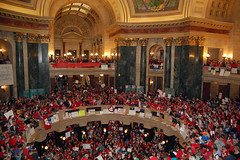
For those who have been following the labor situation in Wisconsin, there's an interesting report in today's Guardian entitled, "Finding Faith with Wisconsin's Pro-Worker Protesters." The author, Becky Garrison, cites a number of key religious leaders who have come out in vocal support of public-sector unions and goes on to cite a Reuter's report that the Tea Party contingent in the streets pales in comparison to the pro-labor forces. She concludes, "the visible lack of support for the Freedom Rally held on Saturday, 19 February in support of Walker sent a strong signal that the Tea Party may indeed be all sound and fury. But in the end, they signify nothing."

There is certainly some evidence to support Garrison's view. The Archbishop of Milwaukee, Jerome E Listecki, has issued a statement of opposition to the pending legislation. And so have a broad spectrum of other religious leaders in Madison, including for example the Church Council at First United Methodist, the Senior Minister at First Congregational UCC in Madison, and the Rabbi at Temple Beth El.

The diverse array of religious leaders that have mobilized against Governor Scott Walker's attempt to end public-sector collective bargaining in Wisconsin bespeaks a sea change in the relationship between religion and labor since the era that I spend much of my time in, 1865-1914. My research on this earlier period suggests that, to the extent there has been attitudinal transformation, we can attribute it in part to the agitation of Gilded Age and Progressive Era workers. Their movement was political in the broadest sense - encompassing not only fights for just wages and hours but also campaigns to reform religious authorities and institutions that allied themselves with capital.

All this being said, I think Garrison's Guardian piece far too sunny. She cites but too quickly moves on from Julie Ingersoll's sobering post over at Religion Dispatches. Moreover, in so breezily downplaying the Tea Party's reach Garrison seems to forget that, just three months ago, the state of Wisconsin elected Scott Walker to be its governor.

To have a fuller sense of the relationship between religion and labor in present-day Wisconsin one would need to pay close attention to the rhetoric that everyday people are using on both sides of the debate - who is marshaling religious language and arguments to support their view, and to what effect? (It would be interesting, for example, to study the language on signs that demonstrators on both sides are carrying). In addition, one would need to know more about what happens this weekend, in synagogues and churches around the state: will rabbis, priests, and ministers broach the labor dispute, and if so, what notes will they strike? Most interesting to me - and most difficult to recover - are the conversations that will happen over meals following those religious services: in the restaurants and kitchens where ordinary people will debate the meaning of religion for economic life. It is in those places and amongst those people that lasting change begins.

Senin, 06 September 2010

Labor in the Pulpit

Paul Harvey

For this Labor Day, here's a whole host of links, pdf printouts, reprinted statements, and aids to "Labor in the Pulpit," from our friends at Interfaith Worker Justice. Included, for example, is the link to this piece by Jennifer Butler at the Washington Post's "On Faith" site, which provides this helpful set of followups:

Along with the Catholic Church's centuries-old commitment to labor rights, many faith-based social justice groups are leading the fight for fair wages and corporate accountability across the country. Interfaith Worker Justice, a Chicago-based national advocacy organization, has played an indispensable role drawing attention to wage theft - the illegal underpayment or non-payment of workers. Each year, wage theft affects millions of workers, often forcing them to choose between paying rent and putting food on the table. Since 1996, through a Labor in the Pulpits program, thousands of congregations across the country have focused their Labor Day weekend services on the injustices faced by low-wage workers. Groups such as the Jewish Council for Public Affairs and Jewish Funds for Justice support local organizations that empower workers and advocate for policies that protect working families. PICO National Network, a national network of faith-based community organizations, plays an important role mobilizing people of faith to pressure financial institutions to end predatory lending and strengthen low-income neighborhoods through sound economic development. And unlike today's Tea Party movement and other anti-government zealots, faith groups affirm the essential role government has in serving the common good and protecting those who are most vulnerable to market downturns.

Here's an announcement and statement about the day by Interfaith Worker Justice:|

Lifting up Workers on Labor Day Weekend

Religious and Labor Leaders Voice Shared Concerns through Labor in the Pulpits

In the richest country in the world, more than two million full-time workers live below the poverty line, struggling to pay for necessities like food, housing, healthcare, transportation, and childcare. In the face of this scandal, Interfaith Worker Justice provides a prophetic voice.

Labor Day is a time for the religious community and the labor movement not only to celebrate working people and their contributions to society but to remember the struggles that workers endured to achieve the many benefits we now enjoy but take for granted: the eight-hour day, workers’ compensation, overtime pay, pensions, health and safety laws, Social Security, Medicare, vacation days, unemployment compensation, family medical leave, a restriction on child labor, a minimum wage and the right to organize for collective bargaining. These benefits helped to humanize the workplace and to provide a safety net for millions.

For the last 15 years, thousands of congregations have focused their Labor Day weekend services on the injustices facing low-wage workers and the religious community's efforts to support those workers' struggles for living wages and family-sustaining benefits.

This Labor Day weekend, over 1,000 Labor in the Pulpits/on the Bimah/in the Minbar services will be held across the country.

“Labor in the Pulpits expresses in a very clear way the bonds between religion and labor,” says IWJ Executive Director Kim Bobo. Those bonds are even stronger this year, says Bobo, “as we stand poised to bring about real change in our country, from reforming health care to stopping wage theft and making our workplaces more democratic.”

Labor in the Pulpits offers a series of litanies, responsive readings, reflections, and interfaith prayer service guides. New materials added this year include a Muslim worship aid, a Jewish reflection, prayers and readings on the rights of workers.
Related Posts Plugin for WordPress, Blogger...