Tampilkan postingan dengan label professional opportunities. Tampilkan semua postingan

Senin, 02 Januari 2012

Teaching, Playing, and Praying: Evangelical Networking and Community Building in Modern America

Paul Harvey

One more AHA/ASCH session for you all to consider, especially for those of you interested in contemporary evangelical subcultures, home schoolers, and prayer warriors:


Teaching, Playing, and Praying: Evangelical Networking and Community Building in Modern America

AHA Session 48
Friday, January 6, 2012: 9:30 AM-11:30 AM
Chicago Ballroom D (Chicago Marriott Downtown)
Chair:
Matthew Avery Sutton, Washington State University
Papers:
Comment:
Randall Balmer, Barnard College, Columbia University
Session Abstract
Violence in public schools, anonymous neighborhoods that lack a sense of community, and legalized abortion all represent social, economic, spatial, and demographic changes that threatened the evangelical ideal of Christian schools, Christian neighborhoods, and Christian nation in the late twentieth century. Rather than attacking these problems head-on, many evangelicals built dynamic networks in an effort to realize their ideals outside the mainstream. In this effort evangelicals participated in a paradoxically mainstream American tradition of self-identifying as “outsiders” while endeavoring to create utopias. This panel addresses three such networks in the form of homeschooling, megachurches, and prayer marches. Yet even as evangelicals’ attempts to construct ideal communities are part of a longstanding American tradition, the three papers presented here also reveal the innovative ways in which evangelicals are building networks and communities today.    
            First, Rachel Coleman’s study of Christian homeschoolers in Delaware County, Indiana, demonstrates the successes and challenges of local evangelical networking in an era of technology. While Coleman’s homeschool subjects, eager to protect their children from ungodly influences, originally created a “homeschool community” that shut out non-Christian homeschoolers, the Internet soon served to decentralize and democratize homeschooling, offering greater opportunities but less social control. By focusing on the mechanics of this local network’s evolution, Coleman reveals a pattern that sheds light on national homeschooling’s creative solution to the isolation of the digital age.
            Second, and in contrast to the democratizing forces at work in Coleman’s homeschoolers, Lauren Beaupre’s study of Bellevue Baptist Church reveals the increasingly insular communities of modern megachurches. Replacing intimate neighborhoods with religious centers that provided education, recreation, and entertainment, Bellevue and other megachurches holistically attended to a dispersed Christian community. In response to large-scale reorganizations of metropolitan space, community became a religious product for sale in enormous religious complexes that were more like small towns than traditional parishes.  Buying into the product was easy, but Beaupre also reveals the challenges created by one-stop shopping for the broader local community.
            Finally, where Coleman sees a Christian alternative to public education and Beaupre highlights a Christian alternative to restoring residential neighborhoods, David McConeghy shows how prayer became a Christian alternative to public policy or legislation. Prayer was both a weapon to be wielded in the “culture war” against secularism and the olive branch shared among divided Christian churches. American communities could be redeemed if they could either be purged of sin or united by revival, and new spatial and geographic prayer techniques emerged to facilitate God’s intercession for spiritual breakthroughs on secular obstacles.
            The three networks examined here affirm the creativity and resourcefulness of evangelicals in attempting to recreate their ideal of Christian schools, Christian neighborhoods, and Christian nation. Yet while education, church, and prayer had long been important to evangelicals, the alternative communities they formed in the late twentieth century differed from previous efforts in their use of communications technologies, economies of scale, and critical geographies. Together these networks show evangelicals adeptly balancing the past and present in order to save American communities.

AHA/ASCH Sessions of Interest

Paul Harvey

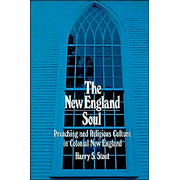
2012 LogoIn addition to our session "Reassessing the Significance of Religion in the Twentieth Century United States"  this Saturday afternoon at the American Historical Association, which I blogged about previously, here are a few more sessions for you to consider, ranging from a reconsideration of Harry Stout's New England Soul to papers on religious networks in the early modern Atlantic world. See some of you in Chicago! If you have a session that you particularly want to promote here, contact me and we should be able to put it up.

Also, and by the way, if you need something to do Saturday morning but you figure going to our session Saturday afternoon will suffice for your religious history needs, here's a cool session on digital history (follow the link for info), featuring some of the leading lights in presenting history in new ways, including Philip Ethington (who will be talking about geo-historical visualization), Katrina Gulliver (who will discuss her podcasts "Cities in History"), and Jennifer Serventi from the National Endowment for the Humanities.

New England Soul: Preaching and Religious Cultures in Colonial New England  -             By: Harry S. Stout    Harry Stout’s The New England Soul after 25 Years

American Society of Church History 9
Friday, January 6, 2012: 9:30 AM-11:30 AM
Promenade Ballroom A (Westin Chicago River North)
Chair:
Mark A. Noll, University of Notre Dame
Catherine A. Brekus, University of Chicago , James Byrd, Vanderbilt University , Thomas Kidd,Baylor University and Kenneth P. Minkema, Yale University

Comment: Harry S. Stout, Yale University
_______________________________________________
A Place for Grace: Religion and Contests of Identity in theMississippi River Valley, 1812–45

American Society ofChurch History 13
Friday, January 6,2012: 2:30 PM-4:30 PM
Jackson Park Room (Westin Chicago River North)
Chair:
Amanda Porterfield, FloridaState University
Papers:
Comment:
Comment: Amanda Porterfield, Florida StateUniversity
___________________________________________________________

Religious Networks, Alliances, and Friendship in the EarlyModern Atlantic World
AHA Session 109
Saturday, January 7,2012: 9:00 AM-11:00 AM
Los Angeles Room (Chicago Marriott Downtown)
Chair:
Ned C. Landsman, StonyBrook University
Papers:
"A Part ofOne's Soul": Spiritual Friendship and Evangelical Networks in EarlyAmerica
Janet M. Lindman, Rowan University

Comment: John Fea, Messiah College

Kamis, 29 Desember 2011

Literature and Secularization: At MLA and in Print


by Everett Hamner

For any of you blog readers who might be at MLA (program is linked here) rather than AHA in a few days(gasp!), there's a session you won't want to miss. Several of the mostprovocative, insightful scholars at the intersection of religion and literaturewill be participating on a panel entitled "Literature andSecularization" (Friday, 3:30-4:45, WSCC 617). Facilitated by SusannahBrietz Monta (Notre Dame, and editor of Religionand Literature), this roundtable will feature Lori Branch (Iowa, author of Rituals of Spontaneity); John Cox (HopeCollege, Seeming Knowledge: Shakespeareand Skeptical Faith); Tracy Fessenden (Arizona State, Culture and Redemption); William Franke (Vanderbilt, Poetry and Apocalypse); Colin Lovell Jager(Rutgers, New Brunswick, The Book of God);and Michael W. Kaufmann (Temple, coordinator of recent Religion and Literature forum, "Locating thePostsecular").

While I'm in advertising mode, many of you--religious studies and history typesincluded--might well enjoy Amy Hungerford's PostmodernBelief: American Literature and Religion Since 1960 (Princeton, 2010). Ireviewed this for Religion and Literaturerecently (43.1, Spring 2011), and here's the opening paragraph:

Atfirst glance, Amy Hungerford’s second book might seem literary criticism’sanswer to Robert Wuthnow’s After Heaven:Spirituality in America Since the 1950s, which shows how Americans havedrifted away from institutional religious commitments and toward more informal,syncretistic spiritualities. However, Hungerford reveals not just a looseningand recombination of doctrines and practices, but the return of a “belief inmeaninglessness” (xiii) rooted in transcendentalism and Romanticism. Postmodern Belief is an examination offaith without content, trust in the nonsemantic, belief as itself a form ofritual, all as discerned primarily through the work of writers rarelyidentified as religious themselves, but who still “live in oblique relation tothe structures and discourses of institutional religion” (xvi). Rather thanconcerning herself with these authors’ theologies, Hungerford investigatestheir convictions about literature. In fact, “their literary beliefs areultimately best understood as a species of religious thought, and theirliterary practice as a species of religious practice” (xvi).

Senin, 26 Desember 2011

Reappraising the Significance of Religion in the Modern U.S.: 2012 AHA Session

Paul Harvey

Some of you blog readers may be getting ready for the 2012 American Historical Association meeting in sunny Chicago Jan. 5-8 2012. Because the AHA meets in conjunction with the American Society of Church History and the Catholic Historical Association, there are really too many sessions on American religion to list usefully. So instead I'll feature a few sessions of interest that particularly catch my eye in the coming days here, and invite the rest of you to promote sessions of interest to you, either in the comments section or by sending me a guest post.

To start with, here's hoping you'll drop by our session, pasted in below, on "The Evangelical Century: Reappraising the Significance of Religion in the Modern United States." Details below.


Saturday, January 7,2012: 2:30 PM-4:30 PM
Kansas City Room (Chicago Marriott Downtown)
Chair:
Anthea Butler, Universityof Pennsylvania
Papers:
World War II andthe Birth of Modern American Evangelicalism
Matthew Avery Sutton, Washington State University
Comment:
Paul W. Harvey, Universityof Colorado Colorado Springs
Session Abstract
The twentieth century United States, according to the standardnarratives, was defined by growing secularism and pluralism. Heavy immigrationof Jews and Catholics in the progressive era, and of Hindus, Buddhists, andMuslims since the 1960s, created what scholar Diana Eck calls “a new religiousAmerica,” one in which no single group has a monopoly on power. The members ofthis panel are not so sure. While there is no doubt that the United States isfar more diverse today than it was in 1900, American evangelicals havenevertheless managed to shape the nation’s trajectory in important ways in thelast one hundred years. Building on new archival research, these papers seek toreappraise the significance of American evangelicalism in the modern UnitedStates.

Alison Greene focuses on an important shift that began in the1930s. Until the Great Depression, the nation’s established churches were on anupward trajectory in both numbers and influence. But the Great Depressioncrippled the Protestant establishment. At the same time, the economic crisismade room for evangelical and pentecostal churches that emphasized individualsalvation and authentic religious experience. While the established churchesstruggled to maintain programming and participation, upstart evangelicals andpentecostals employed creative techniques and a core of committed volunteers tokeep church operations afloat and expand membership. While it would be decadesbefore evangelicals and pentecostals rivaled their established counterparts in numbersand national influence, the Great Depression marked the beginning of a gradualtransition of power from the mainline to its upstart rivals.

Matthew Sutton's paper (revised since the original proposal) discusses the reaction of fundamentalists to World War One, tracing that era as one of the creation of a religious movement that grew to be hyper-patriotic and suspicious of government at the same time.

Steven Miller examines more recent expressions of evangelism. Heargues that the growing prominence of Reagan-era evangelicalism produced twometaphors that profoundly informed subsequent discussions of faith and publiclife: Richard John Neuhaus’ “naked public square” and James Davison Hunter’s“culture war.” Neuhaus argued that secular elites had “systemically excludedfrom policy consideration the operative values of the American people, valuesthat are overwhelmingly grounded in religious belief,” while Hunter described aconflict between “progressive” and “orthodox” forces in American society. Inthe end, neither metaphor could transcend a defining characteristic of latetwentieth-century America: the complex, often ironic influences ofevangelicalism on U.S. politics and culture.

Jumat, 23 Desember 2011

Revival of Religion and American Culture Book Series from University of Alabama Press

Paul Harvey

Over the last few months, my friends Charles Israel (Auburn University) and John Giggie (University of Alabama) have been making plans to revive the Religion and American Culture series of books published by the University of Alabama Press -- in years past luminaries such as Wayne Flynt, Ed Harrell, and Edith Blumhofer edited this series. You senior scholars and graduate mentors out there, please keep them in mind to send promising dissertations-soon-to-be-book-manuscripts their way.

I received the following email from John recently, and got his permission to repost it here, as an advertisement for this series and as a call for those of you, junior and senior scholars alike, with book manuscripts that you're shopping around to contact the editors, who are aggressively recruiting authors for the series. Here's a bit more information; use the links above to contact Charles and/or John if you have a manuscript or a book project idea for them that you want to discuss:

I wanted to thank you again for agreeing to serve on the editorial advisory board for the new incarnation of the "Religion and American Culture" book series that is sponsored by the University of Alabama Press.
As you may remember, I am co-editing the series with Charles Israel and we are in the process of aggressively recruiting new work for publication in the series. We are preparing to formally announce the series launch in late 2012 and want to be able to make a splash with some very strong first titles. We're asking now for your guidance and help. If you know of any scholars who are working on promising projects that you believe we should consider, or of scholars both junior and senior who are looking for a home for their work, please be so good as to let us know. We're happy to follow up with them by email, phone, or otherwise to extend an open invitation to submit their work for publication consideration.

I want to emphasize that we have every assurance from the editor-in-chief at the University of Alabama Press, who sponsors the series, that we can offer contractual terms that are every bit as competitive as any other press in the country, both for first-time authors submitting revised dissertations and for senior scholars, accordingly. We're also in the favorable position of being able to offer advance publication contracts
when appropriate or necessary.

Kamis, 15 Desember 2011

WW II and Religion: CFP

The Institute on World War II and the Human Experience and the Department of Religion
Florida State University


“World War II and Religion”

November 30-December 1, 2012

Call for Papers

The Institute on World War II and the Human Experience and the Department of Religion of Florida State University seek paper proposals for a two-day conference in Tallahassee, Florida focusing on Religion and World War II. Conference organizers G. Kurt Piehler and John Corrigan seek papers that touch on the institutional, theological, and human impact of religion in World War II. We are interested in the global dimension of this conflict and encourage scholars whose work focuses on Africa, Asia, Latin America, Middle East, and the Soviet Union, as well as Europe and North America.

We are interested in addressing the ways that combatants and civilians drew upon religious ideals and institutions to sustain them in an age of total war, and especially how soldiers, sailors, and aviators behaved religiously in the course of their service. Additionally we solicit papers that consider the roles religious organizations and values played in fostering ethical conduct during the war, providing humanitarian relief, and protecting non-combatants and conscientious objectors, as well as analyses of various kinds of religious justifications for violence, including genocide. Among the questions we seek to address: did religious leaders and institutions foster a climate that encouraged rather than retarded the drift to total war? Are there really no atheists in foxholes? What was the legacy of the war for religious institutions and ideals, especially in the defeated Axis Powers? How did religious institutions discredited by their support of the Axis Powers seek to regain their legitimacy? What kinds of compromises did persons negotiate with their religious beliefs in wartime? In what way was pre-existent religious rhetoric deployed to characterize enemies as evil? How did the war diminish and exacerbate the perception of religious differences?

We encourage contributions from a variety of disciplinary perspectives. The conference organizers hope to provide travel funding to graduate students and junior scholars to encourage their participation. Plans call for the publication of an anthology drawn from the conference proceedings edited by John Corrigan and G. Kurt Piehler.

Those seeking to participate in the conference should submit a 750 word abstract along with a short 3-5 page c.v. via Microsoft word attachment or PDF File to G. Kurt Piehler at kpiehler@fsu.edu by March 15, 2012. For further information about the conference, please contact John Corrigan at jcorrigan@fsu.edu or G. Kurt Piehler at kpiehler@fsu.edu

Sabtu, 12 November 2011

Spatial Humanities and Religion in America: An NEH Summer Institute

Summer 2012 NEH Institute for Advanced Topics in the Digital Humanities


Spatial Narrative and Deep Maps: Explorations in the Spatial Humanities

June 18-29, 2012


Call for Proposals: Applications due Friday, February 3, 2012


The Virtual Center for Spatial Humanities (VCSH), a multidisciplinary collaboration among Indiana University-Purdue University, Indianapolis (IUPUI), Florida State University, and West Virginia University, is pleased to announce an NEH Advanced Institute for summer 2012 designed to advance exploration of key topics in the spatial humanities. The institute will offer scholars the opportunity to discover the benefits of a spatial-analytical approach to humanities scholarship and to explore how to bend geo-spatial technologies, including GIS and Web 2.0 tools, to the needs of the humanities. Two areas of emphasis will be spatial narratives and deep maps. Fellows participating in the program will learn both by engaging with a variety of existing projects as well as through the production of a prototype project in collaboration with the VCSH team. Fellows also will have an opportunity to present their own work and to contribute to scholarly and Web products that result from the institute.


The institute will meet in Indianapolis from June 18 to 29, 2012 and will be administered by IUPUI’s Polis Center. It will draw upon a multidisciplinary faculty from the three collaborating institutions, as well as leading scholars in the field of spatial humanities from the US and UK, and will be supported technically by the advanced technology group of the Polis Center. The institute schedule will allow time for fellows to interact with the staff and to seek advice for their own projects or project ideas, but the primary focus will be on how to use geo-spatial technologies to enhance the narrative and analytical traditions of the humanities. The fellows will work with project staff to develop a prototype deep map to support multi-scalar and contingent analysis of problems of interests to humanists. To focus this work, the institute will explore the spatial contexts of American religion, using the Digital Atlas of American Religion, an NEH-supported project of VCSH, and the multi-faceted evidence from the Polis Center’s six-year study of the intersection of religion and urban culture in a mid-sized American city.


About the fellowships:
Up to 12 fellowships will be awarded to individuals or teams who demonstrate serious interest in the application of geo-spatial technologies to problems in the humanities. While scholars in all humanities disciplines are eligible to apply, we are especially interested in collaborating with those who have experience in one or more geo-spatial technologies as well as scholars who have thought about the spatial dimensions of American religion.


During the institute, fellows will explore central issues in the spatial humanities, including such topics as database structures and information architectures, interactive design, and collaborative research, while situating these concerns within the fields of American history and religious studies. Guest lecturers during the summer include Ian Gregory (historical GIS and digital humanities, Lancaster University), Anne Knowles (historical geography, Middlebury College), Katy Börner (informatics and advanced visualization, Indiana University), and Art Farnsley (sociology of religion, IUPUI), among others. Institute leaders are David Bodenhamer (history, IUPUI), John Corrigan (religious studies, Florida State), and Trevor Harris (geography, West Virginia University).


All fellows will participate in a two-week residency June 18-29 at IUPUI. The residency will include colloquia and working sessions in which participants collectively will develop project foundations and address relevant issues in spatial humanities. Fellows also will be provided the opportunity to present their own projects. Applicants need not be proficient with geo-spatial technologies but must demonstrate some level of engagement with them as well as with spatial questions and analyses. Evidence of the capacity for successful collaboration and for scholarly innovation is required. Fellowship awards will include a stipend of $3,000 for each participant, as well as a travel allowance. Accommodation and meal costs will be the responsibility of each fellow, but the institute will seek to arrange low-cost housing for participants. We welcome scholars from all career levels, from advanced graduate student to full professor.


About the proposals:


Proposals should include the following:


Two to three-page statement of how participation in the institute will fit the scholarly and professional goals of the applicant.


One-page description of the applicant’s experience with geo-spatial technologies and spatial analysis.


Brief CV (maximum of three pages)


Letter of support from department chair for non-tenured faculty or from dissertation advisor for doctoral candidates.

Projects that articulate a clear understanding of the potential of spatial humanities and the problems associated with the use of geo-spatial technologies in humanities scholarship will be regarded favorably.

Electronic applications are required. Submit applications and questions to ddearthatiupuidotedu.

Deadline for applications: Friday, February 3, 2012. Fellowship recipients will be notified in mid April, 2012.

Jumat, 04 November 2011

Evangelicals in the Electorate: Public Lecture and Forum

by Paul Harvey

Here's an opportunity for those of you especially in the Boston area to hear my co-blogmeister and other prominent scholars in action, next Thursday:

Evangelicals in the Electorate: A Public Lecture and Forum
Thursday, November 10, 6:30 - 8:00 P.M., Suffolk University

Although some dismiss Evangelical Christians as zealots with uncommon social politics and little regard for science, this powerful voting bloc is a force to be reckoned with in our democracy, and likely misunderstood. Dr. John C. Green, Senior Research Advisor at the Pew Forum on Religion and Public Life, presents empirical data on what evangelicals actually believe based on surveys of clergy and parishioners. Authors of The Anointed, Dr. Karl Giberson and Dr. Randall Stephens, provide an analysis of intellectual authority within this group and examine themes ranging from Creationism to messaging. Ford Hall Forum Board member and former religion reporter for the Boston Herald Eric Convey converses with these sociological researchers to predict how Evangelical Christians’ true values will translate into civic action.

Drs. Randall Stephens and Karl Giberson will be selling and signing
copies of their book, “The Anointed: Evangelical Truth in a Secular Age” at the end of the event.

Thursday, November 10, 6:30 p.m. to 8:00 p.m.
C. Walsh Theatre, Suffolk Universit
y

Jumat, 21 Oktober 2011

Rethinking White Protestantism and the Long Civil Rights Struggle

Paul Harvey

Several of our bloggers are at the 2011 meeting of the American Studies Association in Baltimore -- where I too would be, except that I am due in Baltimore next week for the 2011 Southern Historical Association meeting, and there's just so many of those cross country flyover things I can do at any given time. Anyway, while we're hoping that Kelly, Mike or someone else might blog about the ASA here, you can follow them realtime at the hashtag #2011ASA.

For those of you going to the Southern, our panel unfortunately got put into the dreaded Sunday morning time slot (figures that the religion panel would go there, right?), but the papers propose new stories and ways of thinking about the civil rights struggle and the place of white Protestants within it, and I'm looking forward to the discussion. Here's the information below -- the "Sunday" referenced is Sunday Oct. 30 in the Sheraton Baltimore City Center.

Sunday, October 30: 9:00-11:00 A.M. Hopkins

62. RETHINKING WHITE PROTESTANTISM AND THE LONG CIVIL
RIGHTS STRUGGLE

PRESIDING: Clive Webb, University of Sussex

―What We Could Not Do Through Ourselves Alone: The Federal Council of Churches
and the Challenge of Social Change
Curtis J. Evans, University of Chicago

―A Prostitution of the Church to Political Purposes‖: The Hattiesburg Ministers’ Project,
White Religion, and the Struggle of Black Equality
Carolyn R. Dupont, Eastern Kentucky University

The Desegregation of Church-Sponsored Colleges and the Roots of ―Colorblind‖
Evangelicalism in South Carolina
J. Russell Hawkins, Indiana Wesleyan University

COMMENTS: Paul Harvey, University of Colorado, Colorado Springs
Clive Web

Kamis, 20 Oktober 2011

East Asian History Position

Paul Harvey

Excuse me, fellow bloggers, while I steal this blog space for a second to
advertise for a new position in my department, made possible courtesy of an anonymous donor who has endowed a junior position. The position is in East Asian History, and am posting here in the hopes that a few of you out there might forward it to relevant colleagues, graduate students in the field, or to Asian history blogs that you might follow such as Frog in a Well, including Frog in a Well: China. The advertisement, which appears on H-Net and in AHA Perspectives, is below. We'll be meeting in December to first discuss the applications, so plenty of time to apply yet. Applications must go through our CU jobs site: https://www.jobsatcu.com, position # 815014.

The Department of History at the University of Colorado Colorado Springs (UCCS) invites applications for a tenure-track position, at the assistant professor level, in East Asian History, with a specialty in China and/or Japan. Teaching requirements will include survey courses in Chinese and Japanese history, and specialized upper-division courses. Job duties also include research and scholarly activity in the applicant's field of specialization, and appropriate academic service. PhD is required at the time of the appointment. The successful candidate must be able to teach graduate courses in East Asian history and to participate in a multi-disciplinary Humanities program. Please go to https://www.jobsatcu.com position number 815014

Sorry for the interruption -- now back to our regularly scheduled programming.

Sabtu, 08 Oktober 2011

CFP, Mormon History Association 2012 (Updated with Extended Deadline)

Call for Papers (Updated with Extended Deadline)

2012 Mormon History Association Conference

Calgary, Alberta, Canada

“Mormonism In Its Expanding Global Context: Invitations to New Interpretations and Understanding

The 47th annual conference of the Mormon History Association will be held a month later than usual – June 28-July1, 2012 at the MacEwan Conference and Events Centre at the University of Calgary. The year 2012 marks the 125th anniversary of the establishment of the first Mormon settlement on Lee’s Creek (later Cardston) in southern Alberta by Charles Ora Card. Furthermore, July 1, 2012 will mark the 145th anniversary of the Canadian Confederation. Originally established in 1875 as Fort Calgary by the Northwest Mounted Police, Calgary has become a thriving metropolitan center to many of Canada’s most successful oil, gas and transportation businesses. So come celebrate with us!

Building upon last year’s theme of global transformations, we intend to capitalize on Calgary’s dynamic setting to invite papers that interpret the Restoration Movement in fresh, new ways. Canada is a richly diverse and cosmopolitan nation and as such beckons the immigration of new viewpoints on Mormon history. International studies of the Mormon experience and comparative studies with other faiths and their environments are encouraged; we also invite research that considers changing perspectives. For instance, how have media and the new era of electronic digitalization influenced the print culture of Mormon history and historical research? What influence has internationalization had on church structures and local memberships as well as interpreting our histories? To what extent has U.S. politics defined the internal understanding of Mormonism? How might various disciplinary lenses such as lived religion, theology, praxis, gender, race and ethnicity shape and reshape our understanding of the Mormon past? Beyond the standard North American perspective, how have local cultures, challenging economics, and national politics affected our interpretations?

The intersection of Canadian and Mormon history also begs scholarly inquiry. For example, how did the completion of the Canadian Pacific Railway in 1881 impact Mormon migration to Alberta? What unique legal and social challenges did Mormon polygamy encounter in Canada? How does the current debate in the Supreme Court of Canada over plural marriage challenge historical interpretations? How have the Restoration Movements developed in Canada? What of the challenges of secularization?

While we encourage presentations related to the conference theme, we also welcome high-quality proposals related to any and all aspects of Mormon/Restoration history. As a Program Committee we invite proposals for panels as well as individual papers. Innovative formats will also be considered. Please send an abstract of each paper (no more than 300 words) plus a short CV (no longer than two pages) as well as suggestions for session chairs and respondents. Previously published papers will not be considered. Young scholars are especially encouraged to participate. Generous donors have offered to pay travel expenses for some undergraduate and graduate students whose proposals are accepted. Student proposals should include estimated expenses if applying for a travel grant.

The deadline for proposals has been extended to November 1, 2011. Proposals should be sent by email to mhacalgary2012@gmail.com. If necessary, hard copies of proposals can be sent to Richard Bennett, 370D Joseph Smith Building, Brigham Young University, Provo, UT 84602. Notification of acceptance or rejection will be made by December 31, 2011. Additional instructions and information are available on the MHA website at http://www.mhahome.org.

Senin, 08 Agustus 2011

Shall the Historians Win, Part II: More Fundamentalist Roundup

Paul Harvey


For those of you who happen to be in the Pacific Northwest or planning on attending the Pacific Coast Branch meeting of the AHA in Seattle coming up this Fri-Sat., come on by and visit this panel on Friday afternoon, 3:30 - 5, in the Seattle Renaissance hotel (before you go to our panel, make sure to go visit the Seattle Public Library first, a really wonderfully cool architectural landmark in downtown SEA a few blocks from the hotel):


Rethinking American Religion during the Interwar Period


Chair and Comment: Paul Harvey, University of Colorado at Colorado Springs


Papers:
“What does Fundamentalism Have to Do with Class?: The New York Labor Temple, 1920-
1926” -- Janine Giordano Drake, University of Illinois, Urbana-Champaign


“The Great Depression and the Elasticity of Fundamentalism”
Christopher Schlect, Washington State University


“Evangelical Methodists and Postwar Conservatism”
W. Andrew Tooley, Wheaton College


The papers collectively represent excellent empirical work in the complications regarding the term "fundamentalism" during its originary years earlier in the twentieth century, and Janine's work suggests much about the ways in which working-class socialist Christianity got "read out" of acceptability around the end of World War I. Christopher's paper shows how various Presbyterian ministers nationwide who were identified as "fundamentalists" in fact disagreed substantially on any number of issues.


While these papers considerably complicate the meaning and definitions given to "fundamentalism," one person that no one would dispute fits the label, however the label is defined, is John R. Rice, longtime editor of the important periodical The Sword of the Lord.


Rice's grandson, Andrew Himes, moved from the fundamentalism of his family background to another form of fundamentalism, Maoist leftism, in the 1970s. He has emerged from that wrenching experience to author a book at once poignant and informative, juxtaposing anecdotes from his own life together with a hefty "long history" of fundamentalism, culminating in extensive sections on his grandfather John R. Rice.


As it happens, after you enjoy the excellent papers mentioned above at the PCB-AHA panel, you have the opportunity to meet Andrew Himes and hear him read from his work The Sword of the Lord: The Roots of Fundamentalism in an American Family (with a foreword by Parker J. Palmer). Himes will be reading from his work at a great independent bookseller, Elliott Bay Books in Seattle, on Friday evening at 7:00 p.m. Here's a description from the author's own site:


My new book was released on May 15, and ever since then I have been eagerly awaiting my gig at Elliot Bay Bookstore. Ever since I moved to Seattle in 1985 I've been a fan of Elliot Bay -- perhaps the best independent bookstore in the world. Elliot Bay has a passionate, articulate, engaged staff, a wide selection of great books, and a fantastic cafe with some of the best coffe, pastries, sandwiches and soups in Seattle. Elliot Bay also has a well-stocked calendar of author readings in the basement, and I have been to many over the years -- reading performances and talks by some of the funniest, smartest, best story tellers and writers I've heard or read. So it makes me really happy to be invited to speak/read/perform, at Elliot Bay Bookstore on Friday, August 12th at 7:00 PM. If you are in Seattle, I dearly hope you come to this event to support Elliot Bay and have a great time giving me a hard time with challenging questions. Then you can hang out with me in the cafe and talk 'til all hours!


More about the book next!

Rabu, 29 Juni 2011

Emotion and Christianity: Call for Papers from Editors of Church History

The following special journal CFP comes to us from John Corrigan, one of the editors of the journal Church History: Studies in Christianity and Culture, published by the American Society of Church History:

The editors of Church History: Studies in Christianity and Culture invite submissions for a special issue on the topic: “Emotion and Christianity: Feelings Toward and About Jesus and the Saints.” Papers may focus on any historical period and any geographical region. Please send queries or complete manuscripts to: Ms. Tammy Heise, Senior Assistant, Church History, Church-History@admin.fsu.edu.

Minggu, 12 Juni 2011

Simple Things You See are All Complicated: Random Reflections on the 2nd Biennial Conference on Religion and American Culture

Paul Harvey

The simple things you see are all complicated
I look pretty young, but I'm just back-dated, yeah
The Who, "Substitute"

If it's a lie, then we fight, on that lie. But we gotta fight.
Slim Charles in The Wire

Elesha, Janine, and Kelly have initiated a vigorous conversation arising from one particular session at the 2nd Biennial Conference on Religion and American Culture which concluded just over a week ago. Because I had to leave just before this particular session, I don’t have much to add to it in particular, but I had a few stray thoughts on other parts of the meeting to throw up here. Today’s post will be lighter, more observations about some key phrases and indelible memories that I’ll carry from the conference. Tomorrow I hope to develop a few more serious thoughts about one session in particular, the one involving a discussion about the "bracketing" of religious belief in religious studies -- its rationale, its benefits, and its costs.

Before continuing, the last session was on "The Future of American Religion," but I was unable to be there, so am really hoping that one of ya'll out there will post on the discussion that went on there.

The first thought: a shout out to my partner in crime Philip Goff for organizing the conference in the first place, a huge undertaking of fundraising and organization. I don’ t know whether Phil got thanked at the end, but having lunch with him just before I left, he told myself and someone else present about his death struggle with the J.W. Marriott (the conference hotel) to get them to do what they had in fact been contracted to do (such as set up our room chairs in a circular pattern, put us in the room agreed to, etc.). Conference attendees don’t normally think about stuff like that, but suffice to say after threatening to call in his university lawyers and engaging in numerous conversations with the Marriott staff, the hotel at last came through with what they were contracted to come through with. That was a lot of work they had to go to just so we could sit around and talk.

All went smoothly, but not without a lot of background fighting leading up to the event. Anyway, since scholars tend to bitch and find fault with individual sessions or presenters or anything else, a shout out for those (Phil and his assistant Becky Vasko in particular) who make these things possible.

Second, I have no doubt that long after some of the substantive intellectual discussions have been forgotten, I’ll still remember some of the shorter or even “throwaway “ observations, conversations, and barroom late night jesting. Here are a few that stick with me (I had some others at the time, but they disappeared after the third martini).

One presenter, Su’ad Abdul Khabeer, discussing her research on the styles and head scarves of inner-city Muslim women, related that the women she studies refer to their scarf styles as “hood-jabs.” Her entire discussion of the phenomenon of "Muslim Cool" was the single most interesting ethnographic description I've heard in a good while, and a reminder of the tireless vitality of American religious cultures. She might have been the only person there from the discipline of Anthropology (maybe there were others, but I didn't see any), and as someone who did a minor field in Cultural Anthropology lo so many years ago I still enjoy hearing work from that perspective.

At the session on religion and market models, James Hudnut-Beumler, a scholar of religion and economics, author recently of In Pursuit of the Almighty's Dollar: A History of Money and American Protestantism, and Dean of the Div. School at Vanderbilt, related a conversation he had once with Ben Bernanke at some kind of conference or meeting. Bernanke asked him what he studied, and he replied “religion.” Bernanke answered back, “I can explain that.” Bernanke was being a little facetious, but only a little, for he went on to give an economic analysis, based on rational choice theory, on why women historically would predominate in many types of religious organizations (basically, their “wages” from this participation were equal to or greater than the discriminatory wages they would have faced – and would still face – in the secular marketplace and workplace). The idea here was both to suggest what we can learn from approaches drawn from market models of religion, as well as why we resist the hegemony of those models – the irritation we feel at the “I can explain that,” even when meant only half-seriously, is an irritation at a reductionism run amok.

And yet, reductionism is a tool that leads to significant insights (like, what's causing that e coli outbreak? and why are there more religious "nones" now than there used to be?), so it never hurts when humanists get exposed to social science scholars who use the word "data" a lot. There will always be a fair amount of cross-disciplinary carping at these kinds of conferences, a small price to pay for crossdisciplinary conversations.

At the very first session, we had a great “ethnographic moment,” in an impromptu discussion between Robert Orsi and Jan Shipps, renowned scholars both but slightly separated generationally, concerning whether we can “bracket out” religious belief in our studies. In reflecting on her pioneering studies of Mormonism, Shipps noted how she always said (or implied) “for them,” as in “for them, these visions were real.” Orsi replied that the problem with the “for them” bracketing was that it could easily lead to “for them, these visions were real – and they are crazy.”

I hope to develop a fuller post on this conversation early this week, as it was the session that ultimately interested me the most, but just this brief conversation between the two raised the same kinds of issues and back-and-forth responses which Orsi and Richard Bushman discussed recently in the journal Dialogue (see Chris Jones’s post on that), and which Orsi and Stephen Prothero batted back-and-forth several years ago in a discussion that is still frequently referenced – click here for a useful summary of that. I have noted recently that a lot of folks are assigning that discussion to students in classes, because it really gets to the heart of the matter of how scholars conceive of themselves and their work in religion.

Is the “whoosh” that we get from sporting events (or from some other mass group activity that induces emotional excitement in individuals) the same as the “whoosh,” the rapid firing of neurons and physiological response, that “we” get from religion? If so, is religion some sort of minor subdiscipline of cognitive psychology and neuro-biology? This became the theme of a lively discussion between Ann Taves (whose recent work has been done in collaboration, so I gather, with neuro-psychologists and other scientists) and Tracy Fessenden, who spoke eloquently of her resistance to adopting the scientific model of study as a means of accessing the huge money and prestige that scientists win at universities, in comparison to the perpetually impoverished and denigrated state of the humanities at many (most?) institutions nowadays – especially state institutions where “productivity” is measured in grant dollars raised. I don't mean to suggest that Taves was leading that direction -- certainly not true for the President of the AAR! But we are entering a new era of discussion (beyond the "two cultures" model) of sciences and the humanities, and there's an awful lot at stake in those discussions.

Rachel Wheeler concluded one session by noting how our generation of scholars always ends up saying, in effect, “it’s complicated.” That is certainly my classroom mode, and the message one would end up with at a conference like this. Yet others in the room, especially those in the social sciences, bring more concrete questions (and therefore answers) to the table, as when Roger Finke discussed some of the findings that can be gleaned from sociological studies of religious behavior such as he has conducted in some of his well-known studies. That brings us back to the discussion that Hudnut-Beumler and Ben Bernanke had about “I can explain that.” The humanists in the room stiffen their backbones against any explanation that does not invoke complexity and some degree of unknowability; some (not all) of the social scientists naturally are drawn to projects that focus on concrete questions and answers – has religious/philanthropic giving risen or fallen over time as a percentage of people’s incomes? Has the pay of clergy risen or fallen relative to other professions over the longue duree (answer: fallen, but you already knew that)? And so on.

As a humanist at heart, naturally I gravitate towards “It’s complicated” as my answer for most important questions. For the smaller questions, we can find answers, but for the bigger questions that drew me into academic studies in the first place, our answers will be tentative at best. Therefore, my classroom pedagogy tends to be deconstructively Socratic, in the sense of proposing questions, letting students pose hypotheses, poking holes/finding problems with those hypotheses, and then commanding them to “go and research some more” at the end of the period (they probably go to toga parties instead, but at least I want to leave them with the idea of the beautiful confusion of historical research). Is that, ultimately, where I want to leave it? I don’t think that will leave the assessment committee at my university very happy, since we are supposed to be assessing concrete bits of student learning.

But that leads to a final irony: I am chair of our departmental assessment committee (that's a committee of one -- but full of self-doubt as I am, reaching consensus is surprisingly difficult), so I get to develop the instruments to test exactly what bytes of data students "learn." Since I developed them, our instruments, therefore, essentially capture the degree to which students "get" the concept "it's complicated."

Is “boring from within” the way to beat a bureaucratic system that inevitably beats down individuals? On the other hand, as a lover and scholar of The Wire, I also know that, ultimately, the institution always wins, so we shall see whether, like Slim Charles, I "fight on that lie," just because we have to fight, or whether "boring from within" is simply carving a hole in my own academic soul.

Ultimately, in this age of the privatization of public goods such as education, the game does change, while it also just gets more fierce -- as Kathryn Lofton and Sylvester Johnson reminded us in their presentations on/critiques of (respectively) neoliberalism and its influence in market models of religion, and the relationship of American religion to the American imperial state. Reflecting further on the privatization of the public good of education (as in Colorado, where state funding now represents less than 8% of the CU budget) threw some cold water on the neural "whoosh" that conferences such as this, at their best, provide. (And if, like Janine, you live in Illinois, then that water bath is even colder.)

Minggu, 29 Mei 2011

2nd Biennial Conference on Religion and Am. Culture -- Calling all Guest Bloggers

Paul Harvey

By now, I assume those attending the 2nd Biennial Conference on Religion and American Culture this coming Thurs. - Saturday in Indianapolis have made their plans, but just in case some more information posted below. The conference features an all-star lineup and is going to be good times for sure.

Kelly Baker and I will post thoughts here on the conference after it's over, or even during it depending on how much the J. W. Marriott in Indy charges for its internet connection (i.e., if it's not free, then it's not for me).

But, this post is really to invite anyone else who is going to be there, and has any thoughts on any of the sessions, to send those along to me (pharvey AT uccs DOT edu) and I'll put them up as a guest post. I'm especially interested in the latter session of the conference, including the finale on "The Future of American Religion," because thanks to American Airlines I have to leave Sat. afternoon and miss the last couple of sessions. So, consider this an open invitation to send along your thoughts. And that goes for those unknown to me presently as well as our contributors who are conference participants, as well as other contributors not on the program but attending (yeah I'm looking at you Janine, Heath, and perhaps some others).

Here's the schedule. See some of you there, and looking forward to making the acquaintance of a few others. Party on!

Rabu, 25 Mei 2011

Graduate School Opportunities at the University of Virginia

The following comes to us from Matt Hedstrom, at the Department of Religious Studies, University of Virginia:

The Department of Religious Studies at the University of Virginia is pleased to announce a newly redesigned graduate curriculum in American Religions, offering the MA and PhD degrees. The program focuses on the religious cultures of the United States and the Americas in both historical and contemporary contexts. As such, the program is interdisciplinary in its methodology, incorporating historical, theological, literary, and anthropological approaches, and draws on the expertise of the department's large faculty across traditions and methods. Students in this subfield are encouraged to work with faculty in various other departments at the University of Virginia, including Anthropology, Art and Architectural History, English, History, Media Studies, Politics, and Sociology. Students may also draw upon the resources of interdisciplinary programs such as the Carter G. Woodson Center for African American and African Studies, the Program in American Studies, the Program in Jewish Studies, and Studies in Women and Gender (SWAG).

For more information, please go here.

Senin, 09 Mei 2011

Randall Stephens: The Lion in a Norway Winter

Paul Harvey

I'm a little posted out today, so just a brief Monday detour to throw a shout out to co-blogmeister Randall Stephens, who will be traipsing around Norway next year on a Fulbright "Roving Scholars" fellowship. Here's a story about it in the Boston Globe, with Randall at the lectern in fine form (so tempting to post that photo here, but I'll just let you click to see Prof. Stephens in his element). Congratulations, Randall, hope you can teach those Euros a thing or two about the wacky world of American religious history. From an excerpt in the article, sounds like that's the plan:

“It’s quite an honor,” Stephens said. “It’s the only country in the world that has this particular program. It’s the only one that has a Fulbright program like this sponsored by the host country, so the Norwegian government pays for it as well.”

From American immigration to post-World War II pop culture; from civil rights to the Civil War, Stephen’s talks will range the full expanse of 19-20th century cultural and religious history.

“[It’s about] how Americans make sense of their history,” Stephens said. “It’s a nice coincidence that it’s the 150th anniversary of the Civil War, and how we still fight about this history that dates back 150 years or more … there is a great interest in Europe about these ideological battles that have raged throughout history.”

Jumat, 29 April 2011

Second Biennial Conference on Religion and American Culture

Paul Harvey

Here's the announcement for the 2nd Biennial Conference on Religion and American Culture in Indianapolis, June 2-4, sponsored by the Center for the Study of Religion and American Culture. The full program is here; it features luminaries in the field such as Robert Orsi, Ann Taves, Kathryn Lofton, Tracy Fessenden, Gerardo Marti, and many more. Blogmeister Kelly J. Baker will be there blogging away, as will I; the first of these biennial conferences got some blog play here courtesy of Linford Fisher, and the full proceedings from that conference, in 2009, can be freely downloaded here.

Announcement below; click here for registration, which includes 1/2 price rates ($75) at the new J. W. Marriott in downtown Indy.

CSRAC Hosts Second Biennial Conference on Religion and American Culture

The Second Biennial Conference on Religion and American Culture is slated for June 2-5, 2011, at the new JW Marriott Hotel in downtown Indianapolis.

Sponsored by the Center and by Religion & American Culture: A Journal of Interpretation, the purpose of the biennial conference series is to combine the insights of those working from different perspectives to help create new and better understandings of religion’s role in American life. The first Conference on Religion and American Culture, held in Indianapolis June 4-7, 2009, laid the foundation for the series, with a focus on recognizing disciplinary boundaries and exploring how scholars within those disciplines might learn from each other. Proceedings of those sessions are available for free on this website.

The overarching theme of this second conference will be “change.” Changing understandings of both religion and culture, as well as the effects these changes have on ways of thinking about religion’s role in American culture, will be the focus. “Most crucial is the change over the past few decades toward thinking about religion as it is expressed in everyday life, religion as lived experience,” said Philip Goff, Executive Director of the CSRAC.

“The conference will have three parts,” continued Goff. “Two opening sessions on changing definitions of religion and what this means for its study, four topical sessions where we play out this question in specific research areas, and then two sessions on what the future holds (or may hold). The 2009 conference was primarily about bringing together senior people from different disciplines to discuss the field broadly, and we succeeded. The meeting in 2011 is about bringing a similarly strong group together with much greater attention to what religion is coming to mean in America, and how this affects any effort to understand it.”

The conference will open June 2 with a reception in Osteria Pronto at the JW Marriott. The hotel, which opened in February, is Indianapolis’s newest and largest, with 1005 guest rooms in 34 stories and 104,000 square feet of meeting, banquet, and exhibit space. A special conference rate of $74.50 has been made available for a block of rooms, thanks to a grant from Lilly Endowment. Once that block of rooms is sold out, the rate will be $149 per night. (Please note that you will be asked for a credit card to guarantee your reservation. The rate of $74.50 is available to registered conference participants only, one discounted room per participant, and will not be applied until you check in at the hotel. This is so whether you make your reservation online or by phone.)

Conference registration before May 5 is recommended; registration fees increase from $85 professional and $45 student to $110 professional and $65 student after May 5. Onsite registration will be $130 professional and $80 student.

Register for the conference.

Jumat, 25 Maret 2011

3 Year Position at Hampden-Sydney College

This post comes from our contributor Mike Utzinger, who has been named Associate Dean of the Faculty at Hampden-Sydney College; this job is a 3-year replacement for Mike. See full details below.

Colleagues,

I thought I would pass this ad for a position in the department of religion from my own institution. It is currently posted in the AAR Job Openings at aarweb.org. Please pass it on to anyone who might be interested in applying. The department and College values and supports excellence in classroom teaching and a successful program of professional development and scholarship.

Hampden-Sydney College

European or American Religious History

HAMPDEN-SYDNEY COLLEGE invites applications for a three year, non-tenure track, position in Religion at the Visiting Assistant Professor level, commencing in August 2011, with primary specialization in European or American Religious History. Ph.D. or Th.D. required; previous teaching experience preferred. Candidates should be qualified to teach introductory courses in Religion, courses beyond the introductory level in European or American Religious History, and courses in an interdisciplinary College-wide program in Western Culture. Teaching responsibilities include seven sections per academic year. Hampden-Sydney College is a selective private liberal arts college for men located in south-central Virginia and enrolling about 1050 students. (College website: www.hsc.edu) Hampden-Sydney expects and supports excellence in classroom teaching and a successful program of professional development and scholarship. Send letter of application, vita, and three letters of recommendation to Dr. Robert G. Hall (bhall@hsc.edu), Chair, Department of Religion, Hampden-Sydney College, Hampden-Sydney VA 23943. Review of applications will begin April 10, 2011. Hampden-Sydney College is an equal opportunity employer.

Related Posts Plugin for WordPress, Blogger...