Tampilkan postingan dengan label religious biography. Tampilkan semua postingan

Minggu, 01 Januari 2012

Roger Williams and the Creation of the American Soul

Paul Harvey

Roger Williams and the Creation of the American Soul: Church, State, and the Birth of LibertySome of you may have seen reviewed in the New York Times Book Review today (or in the Wall Street Journal, less insightfully, yesterday) John Barry's new book Roger Williams and the Creation of the American Soul: Church, State, and the Birth of Liberty. Barry has been best known for hugely popular works of twentieth-century history, including my favorite Rising Tide: The Great Mississippi Flood of 1927 and How It Changed America. Evidently, according to the introduction to this new book, he had set out to write another work on early twentieth-century religion, but he kept pressing backwards to get to the origins of what he was studying, and he ended up at Roger Williams.

Down the road a bit Linford Fisher will be discussing this work in more detail at our blog, along with some thoughts on the founding of what is now his home state (Rhode Island). Until then, for those interested in this work, Barry has an extensive piece up at the Smithsonian magazine, which serves as something as a precis for this work. A brief excerpt:

Williams believed thatpreventing error in religion was impossible, for it required people tointerpret God’s law, and people would inevitably err. He therefore concludedthat government must remove itself from anything that touched upon humanbeings’ relationship with God. A society built on the principles Massachusettsespoused would lead at best to hypocrisy, because forced worship, he wrote,“stincks in God’s nostrils.” At worst, such a society would lead to a foulcorruption—not of the state, which was already corrupt, but of the church.

The dispute definedfor the first time two fault lines that have run through American history eversince. The first, of course, is over the proper relation between government andwhat man has made of God—the church. The second is over the relation between afree individual and government authority—the shape of liberty.

In her New York Times Book Review piece on the book, Joyce Chaplin notes the contrast between the "visions of America" of Williams in Rhode Island and Father Serra in California (and one could easily come up with numerous other examples here):

Consider the 18th-century Catholic missionary, FatherJunípero Serra. He assumed that Spaniards had the right to take up land inCalifornia and that the church had the duty to reorganize Indians intoChristian settlements, by force if necessary. Three thousand miles fromProvidence, at a rest stop on Interstate 280 in Northern California, alarger-than-life image of Serra faces the Pacific. Its back is turned againstWilliams’s far-off statue, as if also against his radical example of what NewWorld societies might represent.

The United States is part Serra,part Williams. A “hedge or wall of Separation” between church and state wasaffirmed by the Constitution; rights for Indians were not. Williams would haveconsidered it a battle half-won. He did not think an “American soul” needed tobe created — such souls already existed within Indians. By largely confiningWilliams’s story to the establishment of liberties for America’s adoptedpopulations, without equal attention to the defense of its indigenousinhabitants, Barry has perhaps underestimated his remarkable subject.

On that subject, as a side note/interview to the Smithsonian piece, Barry has some further thoughts on precisely this issue, posted in interview format.

We'll look forward to Lin's more expert thoughts on this subject and Barry's book in the near future.  

Senin, 12 Desember 2011

The Mormon Moment in Scholarship

Paul Harvey

Everyone is discussing the "Mormon moment" thanks to Romney and national politics, and Max Mueller's piece for Religion Dispatches discusses why non-expert pontificators feel free to pontificate on Mormonism's "weirdness" where they would do no such thing about other religious traditions. Don't miss his article.

But it may actually be more the Mormon moment in the scholarly world than anywhere else. Our own John Turner's biography of Brigham Young will be out in a little over a year or so (and scroll down for John's recent post on Joseph Smith's Journals), with Harvard University Press, and the big biography of Parley Pratt by Terryl Givens and Matthew Grow will be reviewed here at the blog in just a little while. And don't forget Patrick Mason's The Mormon Menace, reviewed here at the blog a while back. The world awaits J. Spencer Fluhman's forthcoming study of nineteenth-century anti-Mormon rhetoric, coming out next fall with the University of North Carolina Press; the parts I've seen represent scholarship at its best.

The efflorescence of scholarship in the field is pretty astonishing, keeping up with it impossible. For a little assistance in the latter, I recommend Ben Park's "2011 in Retrospect: A Look at Important Books and Articles in Mormon History," over at Juvenile Instructor. Here are Ben's personal award winners for the year, but go over to his post for a much fuller and more extensive discussion of the variety of recent scholarship in the field.

My picks for a handful of MHA’s awards are as follows. (Drumroll please…)

  • Best Book: Sam Brown, In Heaven as it Is on Earth
  • Best Biography: Terryl Givens and Matthew Grow, Parley P. Pratt
  • Best First Book: Patrick Mason, The Mormon Menace
  • Best Article: Stapley and Wright, “Female Ritual Healing in Mormonism” (Stapley also gets recognition for “Adoption Sealing Ritual,” which is equally deserving of the award)
  • Awards of Excellence (2 Articles): Patrick Mason, “God and the People”; Chris Jones, “The Power and Form of Godliness”
  • Silver Award for Women’s History: Catherine Brekus, “Mormon Women and the Problem of Historical Agency”

Senin, 24 Oktober 2011

Race and Religion at the American Studies Association: Ed's Reflections

by Edward J. Blum

I only went to two ASA panels in Baltimore, and both were fantastic. One was on “performative black Christianity” and it had papers on the sacred and the sonic in James Baldwin’s novel Just Above My Head by Ashon T. Crawley, on sexuality, sensuality, and virginity in the preaching and performance of Juanita Bynum by Terrion L. Williamson, and on Tyler Perry’s “guardian” masculinity by Ronald Neal. Fred Moten, the author of In the Break: The Aesthetics of the Black Radical Tradition, of Duke University commented, and Daphne Brooks of Princeton chaired. Her book Bodies in Dissent should be known by more in American religious history. Her emphasis on corporeal spectactularity in performances of race and freedom is a rich and innovative (such as Henry “Box” Brown using his body – its presence and absence – to dramatize his freedom narrative, and how demonstrations of race and freedom resonated with other cultural performances of “magic” and “spiritualism”). As I heard the terrific papers and the outstanding comments, I kept reflecting on Anthony Pinn’s work on how we make sense of spaces where silence and sound collide and where bodies and no-bodies stand side-by-side. Whether in Terror and Triumph,Why Lord? or in Embodiment and the New Shape of Black Theological Thought, Pinn examines historically and tries to make sense theologically of the complexities of sounds, spaces, and bodies.

The other panel I attended was on race and religion during the 1920s and 1930s. It was an all-star gang of Stephen Tuck, the author of two amazing books on the “long civil rights movement”, Suzanne Smith, also the author of two wonderful monographs – one on Motown, one on funerals and funeral directors … try explaining that one to family and friends who wonder what it is we scholars do (and if Phil Sinitiere is listening, I’d love to see an interview with Smith and with Tuck on their latest books from Harvard) …, and the final one by Alison Collis Greene, whose

dissertation on how Delta southerners made spiritual sense of the Great Depression and New Deal will certainly be blogged about here in the future when it becomes a monograph. The papers dealt with black unbelief (where Stephen Tuck showed how religious wars raged in the 1920s and 1930s among African American church and civil rights leaders), on so-called new religious movements (where Suzanne Smith discussed the life and work of pastor and radio phenomenon Elder Lightfoot Solomon Michaux) and on generational disagreements among African Americans in the Great Depression Delta (where Alison Greene discussed some of the fantastic interviews from black sociologists of young people during the 1930s). Carolyn Dupont of Eastern Kentucky University and I offered comments, which were primarily of the “thank you for writing such great essays and we can’t wait to seemore” variety. Kelly Baker asked some wonderful questions despite our 8 a.m. time slot. We had a great time. Now I’ve got time for some grading and then it’s back to Baltimore for the Southern Historical Association annual meeting.
Rabu, 05 Oktober 2011

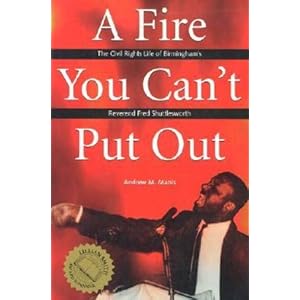
Fred Shuttlesworth: A Fire You Can't Put out

Paul Harvey

Rest in peace, Fred Shuttlesworth, who led an amazing career as an Alabamian, a Baptist minister, a civil rights activist in Birmingham long before the the Southern Christian Leadership Conference arrived there in 1963. His career is given a brief and appreciative overview here, and here. But this would be a good time to remind everyone of one of the classics of civil rights history, one that in my opinion remains underappreciated: Andrew Manis, A Fire You Can't Put Out: The Civil Rights Life of Birmingham's Reverend Fred Shuttlesworth (University of Alabama Press, 2001). There's a lot that could be said of Andy's work, which I continue to consult frequently, but one of the most striking things in the volume is the heavy personal price Shuttlesworth paid -- not just in the beatings and bombings he endured, but in family turmoil and personal conflicts. It's a reminder of what it meant for him to count the cost.

When he tried to enroll his children in an all-white school in 1957, Klansmen attacked him with bicycle chains and brass knuckles. When a doctor treating his head wounds marveled that he had not suffered a concussion, Mr. Shuttlesworth famously replied, “Doctor, the Lord knew I lived in a hard town, so he gave me a hard head.”

Rabu, 06 Oktober 2010

Glenn Beck, Methodism, and "Black Founders"

by Christopher Jones

Glenn Beck initially drew my interest because of his Mormonism—I sensed in Beck’s conspiratorial approach to politics something reminiscent of an earlier generation of Mormon public figures. The pervading fear of socialist subversion, combined with the particularly Mormon interpretations and understandings of human agency, the methods and aims of satanic opposition, and the divinely-inspired nature of America’s Founding documents, were reminders both that the influence of Cleon Skousen and Ezra Taft Benson’s religio-political views still loomed large among a certain segment of the Mormon population and that in them lay a narrative that had the power to appeal to not only conservative Mormons but other embittered Americans as well, suspicious of the government and intent on rescuing the nation from secularism and immorality (and make no mistake,
perceived secularism and immorality are as central to Beck’s movement as is some vague libertarian notion of fiscal responsibility). These topics have been discussed, analyzed, and reanalyzed at least a hundred times over by now (though some commentators rehash them anew and claim such discoveries for their own, all while butchering the identities of key people and ideas in Mormon history), and to be honest, I’ve grown weary of thinking about Beck, his Mormonism, and his agenda in general. In fact, I’d sworn off posting anything more on Beck here or at the Juvenile Instructor.

But one of Beck’s more recent forays into early American history has forced me to reconsider. It touched a nerve not because of Beck’s subtle invocation of Mormon themes, but rather because they addressed the subject of my current research—early American Methodism. Sandwiched in between Beck’s recent assertion that race relations in America were (with the exception of some unidentified “racists”) fairly harmonious before the years immediately preceding the Civil War and that provisions for Revolutionary War soldiers and veterans operated on a sort of colorblind basis is an intriguing discussion of what Beck oddly refers to as “the first real megachurch … a white and black megachurch.” The "megachurch" in question (which goes unidentified) is St. George's Methodist Episcopal Church in Philadelphia and the central figure is Richard Allen, eventual founder of the AME Church.

“Richard Allen,” Beck explains, “was a preacher at a white church—a megachurch. … And Richard Allen, this megapreacher, he tried to segregate.” Beck’s go-to guy for all matter historical, David Barton, chimes in, noting that “In the 1790s [Allen] proposed having a black denomination. And both whites and blacks said, ‘we don’t want that. We want the integrated stuff. We don’t want separate denominations.’ There was finally an overt act of racism in one church that kind of gave him the impetus to go ahead and start a black denomination. But for years, neither blacks nor whites wanted a separate denomination ‘cause they worshipped together in those churches, in Philadelphia and elsewhere.”

Rather than focusing on each of the several problematic points raised (the insightful scholarship of Albert Raboteau, Dee Andrews, and Richard Newman is recommended for those interested), I’d like to ruminate on the meanings and implications of two particular points.

First, I was struck by Beck and Barton omitting entirely any mention of Methodism. Richard Allen is simply “a black preacher” and St. George’s is simply a generic “megachurch.” Considering that Methodist theology and worship were so central to Allen’s identity as a Christian (and as a black man), and that his "black denomination" remained within Methodist Episcopal tradition, this seems as especially odd omission. This not only simplifies and distorts the history of St. George’s (and Methodism more generally) by ignoring the complex dynamics of early American religion, but also serves as a useful means of locating this supposed bastion of interracial harmony within the tradition so many of Beck’s listeners and viewers claim as there own today—conservative evangelical Christianity. This rhetorical maneuver, then, allows these conservatives to co-opt the legacy of interracial evangelicalism in early America (in much the same way that Beck has co-opted the legacy of Martin Luther King, Jr. and the Civil Rights Movement of the twentieth century).

Second, this conversation between Beck and Barton took place during a recurring segment of Beck’s show called “Founder’s Friday.” This particular episode was devoted to “Black Heroes in American History,” and was part of Beck’s stated effort to “spend more time learning about our black founders, and restoring this part of history” (a worthwhile effort, no doubt—at least theoretically). I was immediately reminded of Richard Newman’s biography of Richard Allen, Freedom’s Prophet, in which Newman sought to place Allen squarely within the tradition of America’s Founding Fathers. Echoing others, Newman reinforced the notion that Allen was a black founder, but moved beyond previous assessment by declaring that Allen was deserving of such a title not only because he founded black institutions but also because he “was essentially the forerunner of modern civil rights activists” and because “his belief in nonviolent but confrontational reform offered lessons for virtually every black leader who followed in his wake” (p. 4). As Alan Taylor summarized in his review of the book, “Allen was a Founder for all Americans. He emphasized a prophetic vision of America as a multi-racial democracy of equal rights and equal opportunity. His egalitarian vision was far more daring than anything considered by the more famous white Founders.”

In Beck’s vision of “black founders,” however, Richard Allen in cast as a foil to the interracial harmony he earlier enjoyed as a “mega-preacher” to “2,000 whites” by promoting “segregation.” Tellingly, then, what Beck sees as antithetical to his imagined ideal of American society, Newman see as admirable and daring. The implication of Beck’s narrative—that this “black preacher” and the black church he pioneered, are mere distractions to the real story of this Christian nation—serves as an interesting contrast to those who “seek a sense of authenticity” in black institutions and raises important questions about the place of the black church in the conservative white mind today.

Related Posts Plugin for WordPress, Blogger...