Tampilkan postingan dengan label religion and civil rights. Tampilkan semua postingan

Jumat, 02 Desember 2011

The Anointed, the Cross, and the Lynching Tree

by Edward J. Blum

When W. E. B. Du Bois remembered his time as a student at Harvard University in the late nineteenth century, he recalled an unsettled feeling toward science. It was there than he “began to face scientific race dogma” in the form of “evolution and the ‘Survival of the Fittest.’” Beyond the classroom, he walked into a museum and stood before a demonstration of humankind’s supposed development. He witnessed, “a series of skeletons arranged from a little monkey to a tall well-developed white man, with a Negro barely outranking a chimpanzee.” Needless to say, Du Bois wasn’t happy with what he saw. He spent the rest of his career trying to undermine the “scientific” evidence that placed people of color below whites, and Du Bois saw it as his religion to destroy white supremacy.

I was reminded of Du Bois’s museum experience at the American Academy of Religion. On the way there and then home, I read two new books on the power and place of religion in twentieth and twenty-first century America, beginning with The Anointed: Evangelical Truth in a Secular Age by Randall J. Stephens and Karl W. Giberson. Although for very different reasons, the characters studied here shared Du Bois’s displeasure with modern science and especially its focus on evolution. Evangelical experts hate The Anointed, even though many of them haven’t even read the book yet. Some who did thought Stephens and Giberson should have published with another press, one that evangelicals would pay attention to and respect. Liberals seem to love it, even though many of them acknowledge having only read the New York Times piece on it and not the entire book.

Having actually read each page, I can say that this is a terrific book of American religious history. Stephens and Giberson take the reader through the “parallel culture” of many contemporary evangelicals. We tour Ken Ham’s creation museum in Kentucky; we read primary sources with David Barton as he searches for any and all connections between the founding generation and Christianity. We struggle with James Dobson on how to raise children in a multicultural, pluralistic, media-driven world that seems to accept homosexuality as never before. And we rambunctiously and anxiously await Christ’s return with Hal Lindsey and Tim La Haye. We search with Paul Miller, an earnest Christian in New England, to find the right kind of ideas to satisfy evangelical souls.

Sure, evangelical readers won’t like the tone of the book. Stephens and Giberson don’t pull punches. They think Creation Science is “weak science”; they think David Barton is an “amateur.” They think Dobson is “strangely obsessed with homosexuality.” And they wonder about the credibility of some Christian colleges. It strikes me that there is a problem with the tone of the book, but not for the same reason that evangelicals dislike it.

I think the tone issue could have been transformed by a more sophisticated analysis. Stephens and Giberson seem so intent to pull the curtain back from these so-called experts that they miss when and where their expertise becomes a civic problem: their parallel cultures are fine, interesting, indeed even fascinating, until they run into the public, civic, and legal spheres of classrooms and courtrooms. If Stephens and Giberson had clarified when and where “experts” become social problems, then perhaps the authors could have embraced the ingenuity of many of these “evangelical entrepreneurs” or "holy mavericks" (as Shayne Lee and Phil Sinitiere refer to some other leading evangelicals) on their own terms but then challenged them when the issue became the “common good.”

Let me give one farcical example, but other, more realistic ones, are easily imaginable. As scholars, we can think deeply about the meaning of bumper stickers that read: “In case of rapture, this car will be unmanned.” On one hand, this is an inventive commodification of theology; it is a humorous display of one’s faith – a kind of missionary effort that subtly cajoles others to consider that at any moment Jesus could come back. This theology becomes a problem, though, if this individual is so certain of his end times theology that he doesn’t pay taxes, that he refuses to vaccinate his child yet sends her to public schools, or that he refuses to wear a condom when having sex with an individual and hides his knowledge that he has a sexually transmitted disease. At this point, his claim, “trust me, the end is near” is a major problem. It directly impacts the lives and well beings of others. It would have been nice if Stephens and Giberson worked out how and why the distinct contexts where “expertise” is deployed matter.

The Anointed may not convince a lot of evangelicals to abandon their experts, but I fully expect it to work well in US religious history classrooms. Each chapter could be the focus of a particular historical theme: David Barton could be used to discuss how historians have characterized the place of religion and the role of God; Ken Ham could be used to discuss the intersections of religion and science that would include the Scopes trial; James Dobson could get a class into religion, family, and sexuality; and Hal Lindsey can bring us into notions of prophecy, millennialism, and the end times. I imagine teaching this book by developing historical narratives to get to each chapter’s character, have students locate documents in the genre, and then debate the histories, what students found, and what they think of the folks Stephens and Giberson discuss. I think it will lead to a vigorous dialogue, where hopefully no evangelical in the class would feel threatened or discriminated.

After a wonderful time at the AAR, which each year should commission a team of ethnographers to detail the enigmatic people, events, and performances that make it the New Orleans of conferences, I flew home with a treasure in hand: James Cone’s The Cross and the Lynching Tree. It’s a book I’ve been long waiting for, since Professor Cone and I had many e-conversations about how to consider lynching as a fundamental religious problem in American history. The book is simply marvelous. Part autobiography, part history, and all cutting theology, The Cross and the Lynching Tree argues that in the United States neither the cross, nor the lynching tree can be understood independent of one another. Individual chapters detail the centrality of lynching to the spiritual core of black American faiths, the failure of Reinhold Niebuhr and his Christian realism to deal with lynching and racial violence, the brilliance of King’s theological vision for his ability to live his theology of the cross, the creative renderings from African American writers and artists of black lynch victims as Christ figures, and some particular ways black women have grappled spiritually with racial violence. Cone concludes that the lynching tree “is the window that best reveals the religious meaning of the cross in our land.”

The Cross and the Lynching Tree is terrific book. Readable, short, and to the point, it re-paints our thinking about race, religion, violence, and theology in the twentieth century. When it came to racial violence, Reinhold Niebuhr stands out neither as ideologically prophetic nor as intellectually powerful. He stood by as his former church in Detroit refused to integrate; he wallowed in self and group pity when African Americans died. Black writers and artists, in contrast, take on the “wild beast” of white supremacy and “fight it” with poetry, paintings, and prose. I couldn’t agree more with the wonderful theologian Shawn Copeland’s endorsement of the book: “At the heart of Cone’s critique lies a passionate quest and challenge for the beloved community. James Cone teaches us still. Will we finally learn?”

After finishing Cone’s wonderful book, I felt grateful that I had learned so much from him over the years. And then I looked back at The Anointed and I thought about all the fuss and fury it has and will evoke. I thought about the earnest Paul Miller and his search for a “secular” friend. I wondered if he had any African American friends. I thought about evangelicals pouring millions of dollars into a Creation Museum, but bristling at any reference to reparations for past wrongs. I thought about end-times theology and how it so often justified white “realism." Billy Graham responded to Martin Luther King Jr.’s “I Have a Dream” speech by saying that only after Jesus returned would white and black children play together. Almost a century earlier, Dwight Moody told revival stories of African Americans knowing that their “freedom” and “liberty” would only be true in heaven. Given the other forces evangelicals have been willing to fight with fiery speeches, bloody battles, and billions of dollars – Communism, secular humanism, abortion – why they were so unwilling to put power and military might to work against racism makes them sound either as cowards or as liars.

The white evangelicals in The Anointed and those who so militantly attack Stephens and Giberson for analyzing them without kid gloves may be blind to the world Cone discusses and the work race does. Evangelicals can obsess over issues of museums, child-rearing manuals, and the Founders relationship to religion because they have not and do not suffer as African Americans have or as gays, lesbians, and transgendered individuals have. All individuals suffer – to be alive is to suffer at some point. But white evangelicals don’t suffer from structures; they don’t suffer from systems. They may not like certain venues in American society, but no water fountains have been designated “liberal only” and no evangelical has been murdered in the United States because he or she was evangelical. Cone ends where white evangelicals refuse to begin, the places where they never have to go: racial realities of everyday life.

Where is “the gospel of Jesus’ cross revealed today”? Cone asks at the end of his work. His answer is specific and off the radar of the anointed evangelicals: “the criminal justice system where nearly 1/3 of black men between ages of 18 and 28 are in prisons, jails, on parole, or waiting for their day in court.” If one really believes that the age of the dinosaurs, or the private letters of the founders, or the possibility of their sons coming out as gay, or the possibility that Obama may be the Antichrist, are the most pressing moral problems of our age, then a bunch of black men in prison will concern them about as much as the history of enslavement, the plethora of violated land treaties, the brutal past and present of American colonialism, and the lynching of black America. They probably won’t read Cone’s book, but we can wonder. Why do they cry so loudly about The Anointed when they could sob softly and humbly about The Cross and the Lynching Tree?
Jumat, 21 Oktober 2011

Rethinking White Protestantism and the Long Civil Rights Struggle

Paul Harvey

Several of our bloggers are at the 2011 meeting of the American Studies Association in Baltimore -- where I too would be, except that I am due in Baltimore next week for the 2011 Southern Historical Association meeting, and there's just so many of those cross country flyover things I can do at any given time. Anyway, while we're hoping that Kelly, Mike or someone else might blog about the ASA here, you can follow them realtime at the hashtag #2011ASA.

For those of you going to the Southern, our panel unfortunately got put into the dreaded Sunday morning time slot (figures that the religion panel would go there, right?), but the papers propose new stories and ways of thinking about the civil rights struggle and the place of white Protestants within it, and I'm looking forward to the discussion. Here's the information below -- the "Sunday" referenced is Sunday Oct. 30 in the Sheraton Baltimore City Center.

Sunday, October 30: 9:00-11:00 A.M. Hopkins

62. RETHINKING WHITE PROTESTANTISM AND THE LONG CIVIL
RIGHTS STRUGGLE

PRESIDING: Clive Webb, University of Sussex

―What We Could Not Do Through Ourselves Alone: The Federal Council of Churches
and the Challenge of Social Change
Curtis J. Evans, University of Chicago

―A Prostitution of the Church to Political Purposes‖: The Hattiesburg Ministers’ Project,
White Religion, and the Struggle of Black Equality
Carolyn R. Dupont, Eastern Kentucky University

The Desegregation of Church-Sponsored Colleges and the Roots of ―Colorblind‖
Evangelicalism in South Carolina
J. Russell Hawkins, Indiana Wesleyan University

COMMENTS: Paul Harvey, University of Colorado, Colorado Springs
Clive Web

Rabu, 05 Oktober 2011

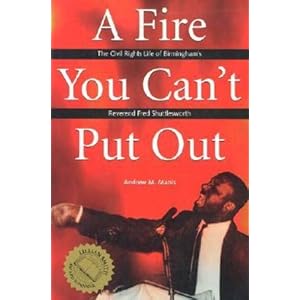
Fred Shuttlesworth: A Fire You Can't Put out

Paul Harvey

Rest in peace, Fred Shuttlesworth, who led an amazing career as an Alabamian, a Baptist minister, a civil rights activist in Birmingham long before the the Southern Christian Leadership Conference arrived there in 1963. His career is given a brief and appreciative overview here, and here. But this would be a good time to remind everyone of one of the classics of civil rights history, one that in my opinion remains underappreciated: Andrew Manis, A Fire You Can't Put Out: The Civil Rights Life of Birmingham's Reverend Fred Shuttlesworth (University of Alabama Press, 2001). There's a lot that could be said of Andy's work, which I continue to consult frequently, but one of the most striking things in the volume is the heavy personal price Shuttlesworth paid -- not just in the beatings and bombings he endured, but in family turmoil and personal conflicts. It's a reminder of what it meant for him to count the cost.

When he tried to enroll his children in an all-white school in 1957, Klansmen attacked him with bicycle chains and brass knuckles. When a doctor treating his head wounds marveled that he had not suffered a concussion, Mr. Shuttlesworth famously replied, “Doctor, the Lord knew I lived in a hard town, so he gave me a hard head.”

Senin, 12 September 2011

CFP: Religion and American Culture Caucus (ASA) Best Paper Prize

Call for Papers

The Religion and American Culture Caucus of the American Studies Association is pleased to announce its 8th annual best paper prize competition. Any paper presented at the 2011 ASA meeting in Baltimore, Maryland is eligible for consideration. The prize will be awarded to the paper that makes the most significant and creative contribution to the study of religion (broadly construed) and American culture.

For consideration, please submit your paper to Kelly Baker at kbaker27 (at) utk (dot) edu by Friday, October 7.

The winner will be selected by a national jury of scholars in the field, and announced at the Caucus business meeting at the ASA.

Minggu, 21 Agustus 2011

Paperback Writers: Just Out in Paper For Your Courses (With One Glaring Exception)

Paul Harvey


Some of our favorite books of the last couple of years which we've featured here at RiAH are coming out in paper now, just in time for use in your school year courses (not yet true of my newest Through the Storm, but your students will treasure the volume so much that they won't mind buying it in hard cover).


First, and Matt Sutton has already covered this, Steven Miller's outstanding biography/analysis Billy Graham and the Rise of the Republican South is out in paper. Any book liked this much by both Ross Douthat and Randall Stephens is sure to have wide appeal -- that's like appealing to John McCain and Andy Warhol fans at the same time. Steven's book is perfect for modern U.S. history courses, expertly covering issues in religious, social, and political history all at once, and engaging students with a figure that they might assume they know well, but will know much better after reading the book.


Next, Kip Kosek's award-winning Acts of Conscience: Christian
Nonviolence and Modern American Democracy is just out in paper with Columbia Univ. Press. It's been a while since we've discussed the book here, so let me just call you back to my lengthy post/discussion of the book here, right when it first came out. A brief excerpt from that previous post:


The savviest of the individuals in this book understood that a principle could become a spectacle, and indeed that it must become a spectacle if it was to draw sufficient public attention to make a difference. It was all well and good to tie in nonviolence with challenges to “capitalism, imperialism, racism, and war”; it was another, and something more effective to make Christian nonviolence a complex strategy as well as a religious conviction.” (50) Long before the kinds of people covered in recent texts, the radicals in this book understood race in global rather than national terms, and understood racial violence as a sub-species of the problem of violence more generally. The racial problem was, for them, “contiguous with the problem of violence.”


Just one more to mention, and this one isn't quite "newly" in paper, but recent enough: Chris Beneke's Beyond Toleration: The Religious Origins of American Pluralism, a work that made me rethink the entire periodization and conceptualization of pluralism. In "Beyond Toleration, and Beyond Those Yellowed Classroom Notes," I reflected at length on Chris's book and its challenge to my presentation of this material in the classroom.


And finally, I want to yell a little bit at one of my normally favorite presses, Harvard University Press, which has done such a great job with Randall Stephens's The Fire Spreads and Matt Sutton's Aimee Semple McPherson and the Resurrection of Christian America, both handsomely done up in paperback, very classroom-usable form. So, to Harvard Press, what is UP with no paperback classroom-usable volume of Emma Anderson's magnificently moving book The Betrayal of Faith: The Tragic Story of a Colonial Native Convert. Shortly after its publication I published an extensive interview with the author, and I expected that the book could become a classroom staple of colonial history. But as long as it's in hardcover at $51, that is not likely to happen. Please, Harvard Press, set the book free -- put it out in paper! Allez! Allez!

Kamis, 04 Agustus 2011

Through the Storm, Through the Night: Now Available!

Paul Harvey

Earlier this summer I blogged about my book Through the Storm, Through the Night: A History of African American Christianity, which was then slated to appear later in the summer (Rowman & Littlefield publishers).

Voila, it's later in the summer, and the book is out, so for that reason, and because my vast portfolio holdings tanked today, seemed like a good day for the time-honored self-promotional post.

Below I'll just repost what I put up earlier about the book, which describes the contents in some more detail, sorry for the repeat but definitely hoping that this book will be useful for any number of classes that some of you regular blog readers teach.

So, without further adieu, a repost. If you have the chance to use it in a class over the next year, let me know how it goes. Yes, it comes in a Kindle edition as well. Paperback version should be out in a year or so I think. For classroom instructors -- the publisher Rowman & Littlefield has an "desk/exam" copy policy here.
__________________________________

Later this summer [it's now out], my new book Through the Storm, Through the Night: A History of African American Christianity, will be out with Rowman & Littlefield. It's part of the "African American History" series put out by Rowman & Littlefield. And it's out just in time for your fall course text assignment!

I'm proud to have it standing there with very recent books by some tremendous historians in the same series, including Chris Waldrep's African Americans Confront Lynching: Strategies of Resistance From the Civil War to the Civil Rights Era, my old friend Burton Peretti's Lift Every Voice: The History of African American Music, and Edward Countryman's forthcoming Enjoy the Same Liberty: African Americans and the Revolutionary Era.

I'm also posting this now because some of you -- and you know who you are! -- are (if you're like me) now facing up to the fact that you've put off your fall book selections (which were due a month or two ago, remember that) long enough, and it's time to pick your texts for the fall. And for a select number of you, maybe this one will be right for you.

The text is short, about 140 pp., and written with the "general reader" and undergraduate reader in mind. I start with the diversity of religious expressions in West and Central Africa in the 14th/15th century, and end with Mama Lola and Kanye West, if that is a far enough chronological reach for you. . . .

In addition, the book comes with a "documents" section, about 60 pages, ranging from Virginia laws on baptism and freedom from the 1660s, to an account of the Stono Rebellion in 1739, to Daniel Payne's famous tour attempting to stamp out "ring shouts" in the 1870s, to Mahalia Jackson's reminiscences of growing up in New Orleans, to John Lewis reflecting on the meaning of non-violence, to Vincent Harding's great essay on the white Christ and Black Power, to Kanye West's "Jesus Walks." There is also a bibliographic essay, broken up by chapter, a Glossary, a Chronology section, and a timeline and some brief footnotes (brief enough not to scare off any freshman reader).

If any of ya'll want to preview it for possible purchase or course use, I'd by happy to send pdfs of the page proofs, or a sample chapter or something if you just want to briefly survey. Just email me, and I'll be there.

Table of contents and more info. below.
_____________________________________

Book description (from book website):

Paul Harvey illustrates how black Christian traditions provided theological, institutional, and personal strategies for cultural survival during bondage and into an era of partial freedom. At the same time, he covers the ongoing tug-of-war between themes of "respectability" versus practices derived from an African heritage; the adoption of Christianity by the majority; and the critique of the adoption of the "white man's religion" from the eighteenth century to the present. The book also covers internal cultural, gendered, and class divisions in churches that attracted congregants of widely disparate educational levels, incomes, and worship styles.

Through the Storm, Through the Night provides a lively overview to the history of African American religion, beginning with the birth of African Christianity amidst the Transatlantic slave trade, and tracing the story through its growth in America. Paul Harvey successfully uses the history of African American religion to portray the complexity and humanity of the African American experience.

Table of Contents:
  • Introduction: Themes in African American Religious History
  • Middle Passage for the Gods: African and African American Religions from the Middle Passage to the Great Awakening
  • The Birth of Afro-Christianity in the Slave Quarters and the Urban North, 1740-1831
  • Through the Night: African Amerian Religion in the Antebellum Era
  • Day of Jubilee: Black Churches from Emancipation to the Era of Jim Crow
  • Jesus on the Mainline: Black Christianity from the Great Migration through World War II
  • Freedom's Main Line: Black Christianity, Civil Rights, and Religious Pluralism
  • Epilogue: Righteous Anger and Visionary Dreams: Contemporary Black Politics, Religion, and Culture
  • Documents Section
  • Glossary
  • Bibliographic Essay
Advance reviews:

"If you teach, study, practice, or care about African American religion, then this is the book for you. Paul Harvey provides an indispensable overview of black Christianity from the age of slavery to the ascendance of Obama. With it, Harvey offers a bevy of fascinating primary documents that range from Nat Turner's righteous rage to Mahalia Jackson's soulful songs. Through the Storm, Through the Night does it all with such clarity that even the most complex concepts make sense."—Edward J. Blum, Author, W. E. B. Du Bois, American Prophet

"Harvey provides an elegant and engaging introduction to the history of African American Christianity that charts the diversity of experience and expression among black Christians and illuminates the complex relationship between religion and race in American life."—Judith Weisenfeld, Princeton University

Jumat, 01 Juli 2011

Ecumenicists, Evangelicals, and the Modern American Encounter with Diversity: Some Personal Reflections on David Hollinger's OAH Address

by David Stowe

Reading David A. Hollinger's OAH presidential address, "After Cloven Tongues of Fire: Ecumenical Protestantism and the Modern American Encounter with Diversity" (just published in the new Journal of American History) puts me in mind of a little family history. The dialectic he analyzes, between liberal ecumenically minded Christians played out in my family exactly as he scripts it.

Raised Nazarene in Iowa, my father discovered the life of the mind while attending a tiny college in Nebraska, finished his BA in history at UCLA, went to seminary, served for a time in China, completed a doctorate in theology. He had gravitated to the social-gospelly Congregationalists--later merged into United Church of Christ--for whom he directed overseas missions in the last stage of his career. His younger brother Gene stayed in the Nazarene fold, became a pastor and eventually ascended to the pinnacle of the church hierarchy: General Superintendent.

Our side of the family grew up in the East, became liberal Democrats, stayed with the UCC. My uncle's family stayed in the West, remained mostly rock-ribbed Republicans and Nazarenes. We read Christian Century, they undoubtedly read Christianity Today (and sent us a subscription to Herald of Holiness). Their menfolk hunted for elk in the Rockies; we trapped (and often released) squirrels to keep them out of our attic. The Boomer offspring had little contact; families didn't fly around a lot in those days. Consequently the cousins remained slightly exotic to each other. How could two brother/fathers turn out so differently while remaining committed Christians?

Hollinger lays out the historical context within which their lives diverged. In the middle decades of the last century, ecumenical Protestants dominated the American Establishment. Beginning well before the Sixties, ecumenicals pursued "diversity-accepting, captive-liberating projects" on behalf of people of color, women, and gays and lesbians--movements that allied them with secular intellectuals, mainly of Jewish descent. In the Sixties, self-interrogating ecumenical intellectuals like Wilfred Cantwell Smith, William Stringfellow, John A. T. Robinson, and most famously Harvey Cox eroded the theological foundations and moral complacency of mainline Christianity.

Evangelicals who had earlier red-baited ecumenicals with mixed success began to overtake their liberal rivals, increasing their cultural capital through savvy media use, outbreeding their mainline rivals and doing a better job holding their kids in the churches. “But just as a substantial portion of the missionaries found that the Hindus and Buddhists they encountered abroad were not quite so much in need of Christian conversion as once assumed, thousands of children of the old Protestant establishment found that Christianity was not so indispensable to the advancement of the values most energetically taught to them by their Methodist and Congregationalist tutors."

Hollinger makes a useful point about avoiding Whiggish assumptions in assessing the impact of a movement like ecumenical Protestantism:

To recognize the historic function of ecumenical Protestantism as a halfway house, if not actually a slippery slope to secularism, is in no way invidious unless one approaches history as a Christian survivalist. Religious affiliations, like other solidarities, are contingent entities, generated, sustained, transformed, diminished, and destroyed by the changing circumstances of history. Those circumstances still render ecumenical Protestantism a vibrant and vital home for many persons. A genuinely historicist approach to the history of religion will not teleologically imply that those committed to that faith today are headed for history's dustbin.

That’s a relief. If Hollinger is correct, my uncle's family won the battle for the soul of American Protestantism, but my father's side may...may... have won the war for the nation's heart and mind. Hollinger sees a powerful analogy between ecumenists and the post-1964 Democratic Party:

The evangelicals gained the upper hand in the struggle for control of Protestantism just as the Republicans gained the upper hand in the struggle for political control of the South.... [J]ust as the nation got something in return for the loss of the South to the Republican party, so, too, did the nation obtain something in return for the loss of Protestantism to the evangelicals: the United states got a more widely dispersed and institutionally enacted acceptance of ethnoracial, sexual, religious, and cultural diversity.... Those impulses and capacities generated a cascade of liberalizing consequences extending well beyond the diminishing domain of mainstream churches, running through the lives and careers of countless post-Protestant Americans distributed across a wide expanse of secular space [no doubt including many in higher education]. Our narrative of modern American religious history will be deficient so long as we suppose that ecumenical Protestantism declined because it had less to the offer the United states than did its evangelical rival. Much of what ecumenical Protestantism offered now lies beyond the churches, and hence we have been slow to see it.

Probably we'll never equal my uncle's kin in elk-hunting prowess, but we can out-squirrel-trap them any time. The (usually) friendly rivalry continues. In lieu of a definitive resolution (mark your calendar for October 21), and given Hollinger's point that American religion has increasingly come to serve as politics by other means, we'll have to await the results of the 2012 elections.

Rabu, 01 Juni 2011

Through the Storm, Through the Night: A History of African American Christianity

Paul Harvey

It's a slow news week at the blog -- no Rapture, no David Barton sightings, politics as usual in Washington, the religious left arguing about Jim Wallis, etc. -- and some of you know what that means. Yes, it's time for the time-honored self-promotional post here at RiAH.

Later this summer, August I hope but by September for sure, my new book Through the Storm, Through the Night: A History of African American Christianity, will be out with Rowman & Littlefield. It's part of the "African American History" series put out by Rowman & Littlefield. And it's out just in time for your fall course text assignment!

I'm proud to have it standing there with very recent books by some tremendous historians in the same series, including Chris Waldrep's African Americans Confront Lynching: Strategies of Resistance From the Civil War to the Civil Rights Era, my old friend Burton Peretti's Lift Every Voice: The History of African American Music, and Edward Countryman's forthcoming Enjoy the Same Liberty: African Americans and the Revolutionary Era.

I'm also posting this now because some of you -- and you know who you are! -- are (if you're like me) now facing up to the fact that you've put off your fall book selections (which were due a month or two ago, remember that) long enough, and it's time to pick your texts for the fall. And for a select number of you, maybe this one will be right for you.

The text is short, about 140 pp., and written with the "general reader" and undergraduate reader in mind. I start with the diversity of religious expressions in West and Central Africa in the 14th/15th century, and end with Mama Lola and Kanye West, if that is a far enough chronological reach for you. And trust me, when drafts of this book failed to meet the aim of reaching the general audience and undergraduate reader, the tireless editors for this series, Jacqueline Moore and Nina Mkjagkij, were ever-ready with fierce and sometimes sarcastic pencils, rumbling through my prose like Sherman rumbled through Georgia, leaving a lot of detritus lying around but cleaning up the landscape considerably. Only, unlike Sherman, they rumbled through my landscape four times, Sherman as you recall having only moved through once. Kidding aside, it was a great experience to have a manuscript put through its paces so many times. I'm sure my other books would have been better with a similar full frontal attack on flabby prose.

In addition, the book comes with a "documents" section, about 60 pages, ranging from Virginia laws on baptism and freedom from the 1660s, to an account of the Stono Rebellion in 1739, to Daniel Payne's famous tour attempting to stamp out "ring shouts" in the 1870s, to Mahalia Jackson's reminiscences of growing up in New Orleans, to John Lewis reflecting on the meaning of non-violence, to Vincent Harding's great essay on the white Christ and Black Power, to Kanye West's "Jesus Walks." There is also a bibliographic essay, broken up by chapter, a Glossary, a Chronology section, and a timeline and some brief footnotes (brief enough not to scare off any freshman reader).

If any of ya'll want to preview it for possible purchase or course use, I'd by happy to send pdfs of the page proofs, or a sample chapter or something if you just want to briefly survey. Just email me, and I'll be there.

Table of contents and more info. below. And now after this brief commercial interruption, back to our usual programming. We'll have some blog posts up soon reflecting on the good times coming up at the Religion and American Culture Conference in Indianapolis starting tomorrow evening; I look forward to many great conversations there! Also, my co-blogmeisters Kelly Baker and the ubiquitous Randall Stephens have books coming out very soon, so we'll have some posts up about those soon.

And we won't even mention yet Phillip Luke Sinitiere's work on Joel Osteen, due up next year with NYU Press, and Linford Fisher's astonishing feat of research and analysis, The Indian Great Awakening: Religion and the Shaping of New England Indian Cultures in Early America, out I believe next year with Oxford Univ. Press, and sure to shape the study of colonial American religious encounters for the next generation to come. Of course, all these works will be featured here at RiAH in days and months to come.

But, enough about you, let's talk about me -- more on my book below.
_____________________________________

Book description (from book website):

Paul Harvey illustrates how black Christian traditions provided theological, institutional, and personal strategies for cultural survival during bondage and into an era of partial freedom. At the same time, he covers the ongoing tug-of-war between themes of "respectability" versus practices derived from an African heritage; the adoption of Christianity by the majority; and the critique of the adoption of the "white man's religion" from the eighteenth century to the present. The book also covers internal cultural, gendered, and class divisions in churches that attracted congregants of widely disparate educational levels, incomes, and worship styles.

Through the Storm, Through the Night provides a lively overview to the history of African American religion, beginning with the birth of African Christianity amidst the Transatlantic slave trade, and tracing the story through its growth in America. Paul Harvey successfully uses the history of African American religion to portray the complexity and humanity of the African American experience.

Table of Contents:

  • Introduction: Themes in African American Religious History
  • Middle Passage for the Gods: African and African American Religions from the Middle Passage to the Great Awakening
  • The Birth of Afro-Christianity in the Slave Quarters and the Urban North, 1740-1831
  • Through the Night: African Amerian Religion in the Antebellum Era
  • Day of Jubilee: Black Churches from Emancipation to the Era of Jim Crow
  • Jesus on the Mainline: Black Christianity from the Great Migration through World War II
  • Freedom's Main Line: Black Christianity, Civil Rights, and Religious Pluralism
  • Epilogue: Righteous Anger and Visionary Dreams: Contemporary Black Politics, Religion, and Culture
  • Documents Section
  • Glossary
  • Bibliographic Essay

Advance reviews:

"If you teach, study, practice, or care about African American religion, then this is the book for you. Paul Harvey provides an indispensable overview of black Christianity from the age of slavery to the ascendance of Obama. With it, Harvey offers a bevy of fascinating primary documents that range from Nat Turner's righteous rage to Mahalia Jackson's soulful songs. Through the Storm, Through the Night does it all with such clarity that even the most complex concepts make sense."—Edward J. Blum, Author, W. E. B. Du Bois, American Prophet

"Harvey provides an elegant and engaging introduction to the history of African American Christianity that charts the diversity of experience and expression among black Christians and illuminates the complex relationship between religion and race in American life."—Judith Weisenfeld, Princeton University

Minggu, 10 April 2011

ASCH Spring Meeting Wrap-Up

By Heath Carter

While considerably smaller than the ASCH's joint meeting with the American Historical Association, this year's spring meeting in Grand Rapids nevertheless showcased a lot of exciting work, some from senior practitioners in the guild but much of it from up-and-coming scholars. The two panels that I attended on Saturday exemplified the trend.

The first was entitled "Religion, Class, and American Elites." Peter Williams, Distinguished Professor of Comparative Religion and American Studies at Miami University (Ohio), kicked things off with a learned paper on Episcopalianism and the "gospel of art" in the Progressive Era. Then followed two presentations by recent graduates of the history department at Notre Dame. Thomas Rzeznik, now an assistant professor at Seton Hall, revisited the Scott Nearing case, arguing that the economist's infamous confrontation with the trustees of the University of Pennsylvania in 1915 was about far more than academic freedom. The trustees dispensed with Nearing, Rzeznik contended, because his radical ideas challenged the moral and religious framework that helped elite Americans - including U Penn's benefactors - justify their disproportionate wealth. Finally, Timothy Gloege looked at how Henry Parsons Crowell, head of Quaker Oats, became not only a major player within the Moody Bible Institute at the turn of the century but also a key agent in the production of the Fundamentals. Gloege is now revising a fascinating dissertation on fundamentalism's early years, in which he highlights connections to big business, casting the movement not as an anti-modern backlash but instead as the theological handmaiden of emergent consumer capitalism. Overall, the panel left me wondering - as has my own work on Chicago - whether standard histories of this period overstate the significance and reach of the social gospel. More on that in a future post.

The second panel was entitled "Race, Religion, and Civil Rights." David Komline, one of my current colleagues at Notre Dame, delivered a paper examining the work of a German Jesuit who traveled through the United States in the immediate postbellum years, encouraging Germans and African Americans alike to establish their own parishes. Komline went on to complicate white-black binaries by considering the role that concerns about ethnicity played in the emergence of segregated Catholic churches. Karen Johnson, a PhD candidate at the University of Illinois (Chicago), then gave a very compelling talk on Arthur Falls and the roots of Catholic inter-racialism in Depression-era Chicago. I heard Johnson give a paper back in autumn, based on another chapter of what is shaping up to be a very impressive dissertation: her account underscores the power of the hierarchy with respect to racial questions but also highlights extensive and often countervailing activity on the ground throughout the long Civil Rights Movement.

All-in-all, then, a great meeting. The cherry on top: the 80 degree weather that made for a beautiful, windows-down ride back to Chicago on Sunday.

Minggu, 13 Maret 2011

A Nation of Outsiders

Paul Harvey

Sometimes I like to take note of books here which don’t fall into the category of American religious history in some formal sense, but which address religious/cultural themes in ways that are fresh and innovative. Today we have such a text, just published with Oxford: Grace Hale’s A Nation of Outsiders: How the White Middle Class Fell in Love with Rebellion in Postwar America. Kaye Hymowitz reviews it here for the Wall Street Journal, and the Washington Post discusses it here.

The author has been at work on this book a long time, and it’s worth the wait (I read a previous rough draft of the book manuscript a couple of years ago and am going off that; I think nothing drastically changed between then and its publication this year). I admit I preferred the original title of this manuscript before it got changed for the book. Originally it was titled Rebel, Rebel: Outsiders in Twentieth Century America. I loved the multiple signifiers of Rebel there. Oh well, it looks like the publishers wanted one of those “how” subtitles that so many books have now.

More important are the wide-ranging connections Grace Hale draws between romanticism, a sense of alienation and outsiderism, and cultural politics through the twentieth century. The “New Left” and the “New Right” (both very old now) both receive extensive attention, as do writers ranging from Norman Mailer and Elizabeth Bishop to Bob Dylan to William F. Buckley. Hale writes compellingly of the central role musical desires for “authenticity” played in shaping 1960s culture. “Romanticism and a sense of social justice were inseparable,” Hale says, and that romanticism came not just from some sense of alienation from conformist 1950s America, but from much older roots in the Romantic period. As Hymowitz writes in the review:

The new rebels looked to the country's outsiders to clarify their own feelings of alienation. In this respect, postwar rebellion had roots in 19-century romanticism. In their "Lyrical Ballads," Wordsworth and Coleridge had tried to locate hidden human truths in the experience of "people on the margins," Ms. Hale argues—children, peddlers, miners, even the insane. Kerouac wrote in the same vein though with less literary art: "The only people for me are the mad ones," announces the hero of "On the Road," "the ones who are mad to live, mad to talk . . . desirous of everything at the same time." Other rebels, including folk singers like Pete Seeger and, soon enough, back-to-the-land hippies, believed that they spied in rural America the rootedness and authenticity that was being devoured by suburbia and mass culture.

Of great relevance for this blog are the last two chapters, one on the Christian right generally (with a broad conceptual map of what constitutes Christian right there, including William F. Buckley, Jerry Falwell, Jesus People, and others from all over the spectrum), and another more specifically on Operation Rescue.

Book description from Oxford:

At mid-century, Americans increasingly fell in love with characters like Holden Caulfield in Catcher in the Rye and Marlon Brando's Johnny in The Wild One , musicians like Elvis Presley and Bob Dylan, and activists like the members of the Student Nonviolent Coordinating Committee. These emotions enabled some middle-class whites to cut free of their own histories and identify with those who, while lacking economic, political, or social privilege, seemed to possess instead vital cultural resources and a depth of feeling not found in "grey flannel" America.

In this wide-ranging and vividly written cultural history, Grace Elizabeth Hale sheds light on why so many white middle-class Americans chose to re-imagine themselves as outsiders in the second half of the twentieth century and explains how this unprecedented shift changed American culture and society. Love for outsiders launched the politics of both the New Left and the New Right. From the mid-sixties through the eighties, it flourished in the hippie counterculture, the back-to-the-land movement, the Jesus People movement, and among fundamentalist and Pentecostal Christians working to position their traditional isolation and separatism as strengths. It changed the very meaning of "authenticity" and "community."

Ultimately, the romance of the outsider provided a creative resolution to an intractable mid-century cultural and political conflict-the struggle between the desire for self-determination and autonomy and the desire for a morally meaningful and authentic life.

Table of Contents:

Introduction: Outsiders and Rebels
Part I: Learning to Love Outsiders
Chapter 1: Lost Children of Plenty: Growing Up as Rebellion
Chapter 2: Rebel Music: Minstrelsy, Rock and Roll, and Beat Writing
Chapter 3: Black as Folk: The Folk Music Revival, the Civil Rights Movement, and Bob Dylan
Chapter 4: Rebels on the Right: Conservatives as Outsiders in Liberal America
Part II: Romance in Action
Chapter 5: The New White Negroes in Action: Students for a Democratic Society, the Economic Research and Action Project, and Freedom Summer
Chapter 6: Too Much Love: Black Power and the Search for Other Outsiders
Chapter 7: The Making of Christian Countercultures: God's Outsiders from the Jesus People to Jerry Falwell and the Moral Majority
Chapter 8: Rescue: Christian Outsiders in Action in the Pro-Life Movement
Conclusion: The Cost of Rebellion

Rabu, 17 November 2010

Daily Demonstrators

Paul Harvey

Here's an unexpected and interesting new work that came to my attention lately: Tobin Miller Shearer, Daily Demonstrators: The Civil Rights Movement in Mennonite Homes and Sanctuaries (Johns Hopkins University Press, 2010).

The civil rights movement, as Shearer shows in minute detail in this volume, took place not just on the streets of the well-known campaigns, but in homes and church sanctuaries, where Mennonite “daily demonstrators” “strode through sanctuaries and loped through living rooms.” A series of narrative chapters cover topics as diverse as Mennonite “fresh air” programs to provide experiences in the countryside to black kids, interracial marriages among black-white Mennonite couples and the trials they faced from suspicious co-religionists, attempts to create interracial Mennonite congregations and the struggles those churches encountered, and the work of the well-known black historian Vincent Harding, a Mennonite convert who sought to guide the church towards more worldly “engagement” and less separation from sin so as to confront apartheid in America directly (but who eventually moved out of the Mennonite church in frustration). Throughout the book, the author usefully explores the paradox of separation and nonconformity to the world, which made some churchpeople unwilling to confront discrimination in their own religious world while pushing others to confront discrimination directly and forcefully. Mennonite separation thus had a “conflicted history,” explored in loving detail in this book. Overall, the work provides a most compelling look at how this particular Anabaptist tradition confronted the most central moral issue of American history within its own confines and traditions but at the same time engaging, tentatively and times and robustly at other times, the larger social world. The civil rights movement for Mennonites was defined by "inside agitators," and the struggles within homes and sanctuaries should take as central a place as those outside of them, Shearer concludes.

Here's some more on the book from the JHU website:

The Mennonites, with their long tradition of peaceful protest and commitment to equality, were castigated by the Reverend Martin Luther King Jr. for not showing up on the streets to support the civil rights movement. Daily Demonstrators shows how the civil rights movement played out in Mennonite homes and churches from the 1940s through the 1960s.

In the first book to bring together Mennonite religious history and civil rights movement history, Tobin Miller Shearer discusses how the civil rights movement challenged Mennonites to explore whether they, within their own church, were truly as committed to racial tolerance and equality as they might like to believe. Shearer shows the surprising role of children in overcoming the racial stereotypes of white adults. Reflecting the transformation taking place in the nation as a whole, Mennonites had to go through their own civil rights struggle before they came to accept interracial marriages and integrated congregations.

Based on oral history interviews, photographs, letters, minutes, diaries, and journals of white and African—American Mennonites, this fascinating book further illuminates the role of race in modern American religion
.

Selasa, 31 Agustus 2010

Me the People: A Roundup on the Rally

Paul Harvey

Our contributor and uber-blogger over at The Way of Improvement Leads Home, John Fea, has a great op-ed piece in today's New York Daily News. He concludes:

What we saw on Saturday was a group of anti-big government Tea Party libertarians trying to reclaim the civil rights movement - an initiative whose success ultimately required one of the most forceful and moral acts of federal power in American history.

In the On Faith section of the Washington Post, a reporter analyzes the varied reactions to Beck from conservative Christians. Richard Land, the well-known conservative Southern Baptist leader and (evidently) an enthusiastic participant in the picnic on the Mall (even though he finds Beck's Mormonism to be, at best, a "fourth Abrahamic faith" rather than Christianity), gives some interesting commentary on this issue in an interview on NPR.

Finally, Joanna Brooks synthesizes all the commentary on Beck and the march and concludes that Beck is America's first Mormon televangelist, while Alex McNeill's " 'Me' the People" gives his very charitable and sympathetic impressions after wandering among the crowd at the Mall Saturday, and analyzes how and why the individualism of the "me" became defined as Christian (just as Richard Land does in his NPR interview) while the "we" is somehow defined outside the fold.

After all this, Colbert had it right from the start: this was all about restoring the civil rights movement to its white, conservative roots.

Minggu, 29 Agustus 2010

Martin Luther King on Barry Goldwater: Surprising or Otherwise Interesting Primary Sources, Part IX

Randall Stephens

Martin Luther King, Jr., reflected on the career and influence of Barry Goldwater several years after LBJ's landslide victory. (With all the media attention to King's legacy and uses of the past, a look at King's own views might shed some much needed light.)

King observed the rightward turn of the Republican Party in 1964, the intense anti-government polices of Goldwater, and the Radical Right presence at the GOP convention. "It was both unfortunate and disastrous that the Republican Party nominated Barry Goldwater as its candidate for President of the United States," lamented King. "In foreign policy Mr. Goldwater advocated a narrow nationalism, a crippling isolationism, and a trigger-happy attitude that could plunge the whole world into the dark abyss of annihilation."

But what bothered King more was Goldwater's domestic policies. He offered a stinging critique of what he considered the Arizona Senator's antiquated, out-of-touch ideology:

On social and economic issues, Mr. Goldwater represented an unrealistic conservatism that was totally out of touch with the realities of the twentieth century. The issue of poverty compelled the attention of all citizens of our country. Senator Goldwater had neither the concern nor the comprehension necessary to grapple with this problem of poverty in the fashion that the historical moment dictated. On the urgent issue of civil rights, Senator Goldwater represented a philosophy that was morally indefensible and socially suicidal. While not himself a racist, Mr. Goldwater articulated a philosophy which gave aid and comfort to the racist. His candidacy and philosophy would serve as an umbrella under which extremists of all stripes would stand. In the light of these facts and because of my love for America, I had no alternative but to urge every Negro and white person of goodwill to vote against Mr. Goldwater and to withdraw support from any Republican candidate that did not publicly disassociate himself from Senator Goldwater and his philosophy.*

*From The Autobiography of Martin Luther King, ed., Clayborne Carson (Time Warner, 1998), 247. See also, Martin Luther King Jr., Where Do We Go from Here: Chaos or Community? (Harper & Row, 1967).
Related Posts Plugin for WordPress, Blogger...