Tampilkan postingan dengan label obituaries. Tampilkan semua postingan

Selasa, 29 November 2011

Sarah Ruth Hammond, 1977-2011

Note: The following sad news came to me today via Linn Tonstad, Professor of Christian Theology at Southern Methodist University, concerning the passing of her friend Sarah Ruth Hammond, a recent PhD. from Yale University who was teaching most recently at William & Mary.

Update: the New York Times religion writer Mark Oppenheimer has posted his memorial tribute on his blog, here. At Religion Dispatches, Sarah Morice-Brubaker reflects on her meeting Sarah as a freshman in college and knowing her as recently as rooming together just a week and a half ago at the AAR.
An official announcement and memorial from the Provost at William & Mary is here.

Sarah Ruth Hammond
by Linn Tonstad

Sarah Ruth Hammond, a brilliant young scholar of American religious history, died this weekend. At the time, she was working as a visiting assistant professor at the College of William & Mary. Sarah received her PhD from Yale’s Religious Studies department in 2010, for a dissertation entitled, “‘God’s Business Men’: Entrepreneurial Evangelicals in Depression and War.” Sarah received numerous fellowships during graduate study, including a Mellon fellowship, a Franke fellowship, and a Lake Fellowship from the Center for the Study of Philanthropy at Indiana University. Sarah received her BA from Yale University in 1999. Her first book was under contract with the University of Chicago Press, and her article, “‘God Is My Partner’: An Evangelical Business Man Confronts Depression and War,” had recently been published in Church History (September 2011). Sarah was 34 years old when she died.

Others will be better qualified than I to assess the loss her death represents for the future of American religious history. I do know that Sarah was one of the smartest and most vivacious people I’ve ever known, and that there is little question that, had she lived, she would have been a central figure in the next generation of American religious historians. I first met Sarah at the orientation for incoming PhD students in religious studies at Yale in the fall of 2003. We quickly became close, and accompanied one another through many of the vagaries of graduate study, romantic entanglements and disentanglements, and other various challenges of spending significant portions of your twenties and thirties training to read and interpret texts rather than people. Sarah loved music, and (remember, we met in 2003) she would bring stacks of CDs over to my apartment and we would spend hours talking while exchanging albums from Steve Earle and Warren Zevon, and obsessing over the excellence of the band Pulp. (We heard Jarvis Cocker play a concert in New York once, at which he did not indulge us with a single song from Pulp days, yet all was wonderful anyway.) Sarah was a passionate runner and an activist for many Democratic and progressive causes, overcoming her natural shyness to canvass door to door and work in phone banks when issues were particularly exigent. Her devotion to excellence at Scrabble was legendary, extending to the point of photographically recording the board after games. Her cats, Gandalf and Thea, assisted greatly in the writing of her dissertation by destroying staplers, knocking over stacks of research, and disappearing at the whisper of a stranger’s entrance.

Kamis, 06 Oktober 2011

Steve Jobs and High-Tech Spirituality

Delighted to host today a guest post by Kip Kosek, author of the just-released-in-paperback Acts of Conscience: Christian Nonviolence and American Democracy. Kip contributes to a thriving conversation about the influence of alternative spirituality on the architects of the iconic products of our age, including those from Apple. For more on this topic and on Steve Jobs and religion, check Elizabeth Drescher's post at Religion Dispatches.

by Kip Kosek

What does Steve Jobs, who died on October 5 at the age of 56, have to do with American religion? Of course, there’s the robust “cult of Mac” that venerates each new Apple product as a sacred gift sent from the divine land of Cupertino. Yet Jobs was more than the architect of an obsessively loyal customer base. He was also part of a creative nexus that brought together the alternative spiritualities of the counterculture and the advanced technologies of the personal computer.

As Fred Turner explains in his illuminating book From Counterculture to Cyberculture, hippies and hackers had a lot in common. The counterculture’s preoccupation with energy fields, aliens, and Eastern religions resonated with the invisible networks and virtual reality imagined by early personal computer developers. The Whole Earth Catalog, an eclectic resource of ideas and products for back-to-the-land types, was an inspiration for the Internet, “sort of like Google in paperback form,” as Jobs later put it. In the mid-1970s, Jobs traveled to India and declared himself a Buddhist. From a certain perspective, Apple’s design principles embody a Buddhist aesthetic of simplicity, even nothingness. The iPod wheel as the Wheel of Life.

Jobs was not the only trendsetter whose search for transcendence dovetailed with his faith in technology. Kevin Kelly, an editor of the Whole Earth Catalog and later a founder of Wired, has produced several provocative speculations about the spiritual consequences of high-tech. A Christian, but an unorthodox one, he believes that artificial intelligence will produce a revolution in religion. His essay “Nerd Theology” suggests that “as we make other minds, these minds will change our mind about God.”

In his spiritual outlook, Kelly is an anomaly, as was Jobs. Relatively few Americans have embraced Buddhism or pondered the theological implications of Watson. Nonetheless, the extraordinary innovations that shape our technological lives are inseparable from the computer pioneers’ participation in the American religious fringe. They thought different. Now we all do.

Rabu, 05 Oktober 2011

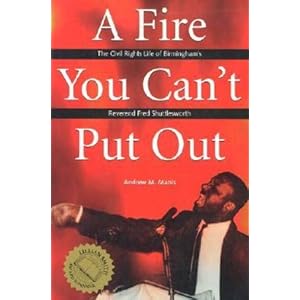
Fred Shuttlesworth: A Fire You Can't Put out

Paul Harvey

Rest in peace, Fred Shuttlesworth, who led an amazing career as an Alabamian, a Baptist minister, a civil rights activist in Birmingham long before the the Southern Christian Leadership Conference arrived there in 1963. His career is given a brief and appreciative overview here, and here. But this would be a good time to remind everyone of one of the classics of civil rights history, one that in my opinion remains underappreciated: Andrew Manis, A Fire You Can't Put Out: The Civil Rights Life of Birmingham's Reverend Fred Shuttlesworth (University of Alabama Press, 2001). There's a lot that could be said of Andy's work, which I continue to consult frequently, but one of the most striking things in the volume is the heavy personal price Shuttlesworth paid -- not just in the beatings and bombings he endured, but in family turmoil and personal conflicts. It's a reminder of what it meant for him to count the cost.

When he tried to enroll his children in an all-white school in 1957, Klansmen attacked him with bicycle chains and brass knuckles. When a doctor treating his head wounds marveled that he had not suffered a concussion, Mr. Shuttlesworth famously replied, “Doctor, the Lord knew I lived in a hard town, so he gave me a hard head.”

Minggu, 05 Juni 2011

The Beautiful Mind and Life of Jen Lindell

by Edward J. Blum

You’ve never heard of her, but you would have. She had earned a doctoral fellowship to the Religious Studies department at the University of Pennsylvania and in the fall would have begun her apprenticeship under Anthea Butler and Sarah Barringer Gordon. She had just finished a Master’s Thesis on Mormon-Indian interactions beginning with the initial publication of the Book of Mormon in 1830 and ending with the Mountain Meadow Massacre of 1857. She was my star student who taught me so much about race and religion, helped with my own projects even amid her own routine trips to the hospital, and died far too earlier

.Jen Lindell wrote a Master’s Thesis that easily could have been expanded into an award-winning dissertation. Her broad interest was in the dynamic ways religion influenced the lives of everyday people and on how religious ideas influenced racial perceptions and vise-versa. She fixated on early Mormons and their conceptions of and interactions with Native Americans. She wanted to understand how white people who weren’t considered white by others (in large part because of their distinct faith) at first reached out to non-white people (Native Americans) as potential brothers and sisters, but then years later treated those people with disdain and violence. Lindell refused to take a “top down” approach – which would focus principally on Joseph Smith and Bringham Young – and instead looked to the laity. Reading deeply and widely through diaries, letters, memoirs, and local newspapers, she found epic encounters and love and betrayal, missions and murder, friendship and violence.

Soon, Lindell’s thesis will be deposited in the San Diego State University library and will be available online. I hope scholars interested in Mormonism and race will check it out. She’s got some rich material and fascinating insights. Even more, anyone who reads it will get to know in a small way the brilliant mind that I had the pleasure of learning from for a season. We miss you, Jen, and we’re so glad we got to be a part of your beautiful life.

Rabu, 13 April 2011

Nancy Hardesty (1941-2011) and Biblical Feminism


Paul Harvey

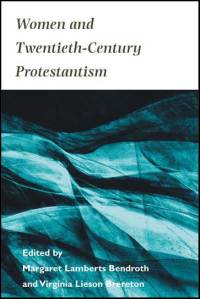
Julie Ingersoll has posted a very warm tribute to Nancy Hardesty (1941-2011), Founding Mother of Biblical Feminist Movement, at Religion Dispatches. Thank you, Julie; and thank you, Nancy, for a life of scholarship and activism. I did not know Nancy personally except for a few brief exchanges, but I'll always remember Nancy's wry look during an encounter I had at a conference years ago with Dorothy Patterson, the famously flamboyant Southern Baptist conservative and author of the statement about family roles and gracious submission in the Baptist Faith and Message Statement, who spent a few minutes at the Women and Twentieth-Century Protestantism conference in Chicago in 199? (can't remember the year now) berating my scholarly research and credentials to write about Southern Baptists (some of you regular blog readers were there, not to name any names Judith). Nancy got to spend a lot of time being berated by biblical anti-feminists, and she countered them both with her scholarship and with her everyday work. You may find a bibliography of her work here.

Senin, 04 April 2011

Edwin Gaustad, 1923-2011

Paul Harvey

It's a sad week for American history scholars, with the passing of Manning Marable just on the verge of the publication of his magnum opus, and now of Edwin Gaustad, an eminence grise of and prolific scholar in American religious history. The New York Times has his obituary here. A brief excerpt:

Although his principal field was colonial religious history, Professor Gaustad ranged far and wide as a scholar. He explored the contested territory of religious liberty, pluralism and dissent in colonial America, but he also wrote general histories that carried the story forward to the present day and published a series of atlases, frequently updated, that gave a geographical picture of religious belief in the United States. His first book, “The Great Awakening in New England” (1957), made the case that the religious revival fanned by preachers like Jonathan Edwards and George Whitefield had more than religious importance, profoundly affecting political and intellectual life in America. He also challenged the revisionist view that the movement was really an economic and class insurgency, arguing that it enjoyed support among all classes.

Minggu, 03 April 2011

Manning Marable, Dies at 60, Before His Time and Before His New Book

Emily Clark

Friday evening, I read the saddening news that Columbia professor Manning Marable passed away in Manhattan. His new biography of Malcolm X, Malcolm X: A Life of Reinvention, a project he began in 1987, is set to hit the shelves tomorrow. Marable's new biography will contest many parts of Alex Haley's collaborative work The Autobiography of Malcolm X, and this is one of the main reasons I have been looking forward to his book. Marable questions the accuracy of The Autobiography after uncovering details on the Haley-Malcolm collaboration and never published "missing chapters" from the final Haley text. Marable also consulted with archival sources not yet tapped by other historians of Malcolm X, including a selection of personal letters, transcriptions of certain speeches, and FBI files. Clicking around the website for his Columbia based Malcolm X Project is a great homework assignment for undergrads - not to mention a wonderful resource for anyone interested in Malcolm X. The project's site has government documents, interviews with Marable about his book, footage from some of Malcolm's speeches, and interviews with former acquaintances of Malcolm's. Marable was deeply invested in this project, and it is sad that he won't see the reception of this book.

Particularly since reading Marable's essay, "Rediscovering Malcolm's Life: A Historian's Adventures in Living History," in his recent 2009 co-edited volume Black Routes to Islam, in which Marable discusses the new biography project, I have been excited about this book. The essay discusses the "Americanization of Malcolm X," beginning with the 1965 printing of The Autobiography, which made Malcolm's story the "quintessential story about the ordeal of being black in America." Another significant moment in this "Americanization" process was Spike Lee's 1992 film with Malcolm X doppelganger/actor Denzel Washington. After this film, "X" was everywhere - even on President Clinton's jogging hat. As Marable so well put it, "One of America's sharpest and most unrelenting critics was now being praised and honored by the same government that had once carried out illegal harassment and surveillance against him." Malcolm had become a kind of specter, able to be appropriated by many. This ambiguity about the meaning of Malcolm and unknowns about his own life allow him to become malleable to popular culture. Marable's project aimed to find answers to the unanswered questions about Malcolm's life, his work, his theology, his politics, his appeal, and his death.

Malcolm's "Americanization" and appropriations by various groups and persons is one of the reasons why he is so fascinating to me. In his book Lives of Indian Images, Richard Davis tells the afterlives of various Indian images as they move from site of darsan in a Hindu temple to status symbol in an English colonial home to educational artifact in an American museum. For Davis, the identities and meanings of the images are not fixed, but are rather "repeatedly made and remade through interactions with humans." Malcolm's identity is like these former temple images - something than changes due to its environment and "ownership." His identity is something that has a biography of its own after his death (check out Igor Kopytoff's essay "The Cultural Biography of Things: Commoditization as a Process" for more). Malcolm is not alone in this camp. Tecumseh, Shawnee leader and brother to prophet Tenskwatawa, has held different meanings for different groups at different times. He has been a source of pride and often exalted, and the Shawnee, Creek, and Cherokee all claim him as their own.

Complex leaders like Tecumseh and Malcolm X in socially unstable times can take on new, dynamic identities after their death. They can become more like myth than human, which is where scholars like Marable come in. Once the semester is over, I look forward to reading Malcolm X: A Life of Reinvention on the Florida beach.

Selasa, 01 Maret 2011

Peter Gomes, Harvard Minister and Theologian, Dies at 68

Randall Stephens

This obituary for Peter Gomes appeared in the Boston Globe this morning. Gomes was a wonderful preacher and author. The sermons I heard him deliver at the Harvard Memorial Chapel were always as memorable as the were filled with meaning.

The Rev. Peter J. Gomes, who was known internationally as Harvard's pastor and was just as pleased to call himself a son of Plymouth, died Monday night at Massachusetts General Hospital. He had suffered a stroke in early December and his death was confirmed by a hospital spokeswoman.

He was 68 and had divided his time and identity between a 1799 house in his hometown and Sparks House, the 19th-century residence reserved for the leader of Memorial Church in Harvard Yard. . . .

Seamus Heaney, the Irish poet and Nobel Laureate, told The New Yorker that the Rev. Gomes's "style is full of cadence, roguery, and scampishness, which is redemptive. With Gomes there is always an element of masquerade as he tempts his audience into complicity."


The man who during four decades at Memorial Church would become known as the conscience and soul of Harvard, was the grandson of a Baptist preacher and was baptized a Catholic.
>>>
Related Posts Plugin for WordPress, Blogger...