Tampilkan postingan dengan label civil religion. Tampilkan semua postingan

Sabtu, 06 Agustus 2011

From Muscular Christianity to Tim Tebow

Paul Harvey

Just a quick note to a post by our contributor Art Remillard, whose book Southern Civil Religions: Imagining the Good Society in the Post-Reconstruction Era will be out this December with the University of Georgia Press.

Art's has posted here many times before on his current research interests in religion and sports (no, Sutton, fantasy football does not count). Over at the Historical Society blog, Art has reflected on "Building Bridges from 'Muscular Christianity' to 'The Tebow Thing,'" which stems in part from his current research and work in religion and sports in the South from the Civil War to World War II. A little excerpt, and then click the link for all of it:

So on "opening day," I invite students to cross a bridge from their hometown YMCA to "muscular Christianity." I cite Luther Gulick, his efforts to institute athletics at the Y, and his lifelong quest to understand "the relation of good bodies and good morals." I then turn to his colleague, James Naismith. On January 20, 1892, the Presbyterian minister gathered eighteen young men at a YMCA gym in Springfield, Massachusetts, to play his newly invented game called "basketball." Practically, Naismith hoped that basketball would give restless young men a suitable indoor activity for the long winter months. More importantly, as theologian Michael Novak summarizes, "The idea behind the game was moral, Christian, and hygienic: active clean living through vigorous exercise." Right from the gun, then, students discover the religious roots of a familiar game. Later in the course, drawing mostly from Bill Baker's Playing With God, I locate Gulick, Naismith, and other "muscular Christians" within the social gospel tradition, and discuss how they sought to Christianize all corners of society, from the schoolhouse to the gymnasium.

Jumat, 05 Agustus 2011

Prayer Rally Roundup: If You're Ever in Houston, You Better Do the Right

Paul Harvey

Civil religious prayers, fast days, proclamations of thanksgiving and/or humbling, and organized mass praying events have a long history in America from the Puritans to the present. So does the long history of politicians trying to capitalize on group piety -- sometimes much to their own detriment, as John Adams speculated about his own participation in one such effort. He might tell the participants:

If you're ever in Houston, well you better do the right,
You better not gamble, you better not fight

The latest -- and surely one of the most egregiously sectarian and transparently partisan -- is Rick Perry's Prayer Rally, called The Response, scheduled tomorrow for Houston. The Miami Herald gives some background on Perry and the rally here, and one of its main sponsors, a rapture-ready prayer warrior group called the "International House of Prayer," here. Our local friend James Dobson, an "honorary chairman" for the event, advertises it as follows: "We believe that America is in crisis -- not just politically, financially, or morally, but because our nation has not honored God in its sucesses or humbly called on Him in its struggles." Compared to the statements of many of the other sponsors, that is positively pluralistic, or at least stays within the usual vein of rhetoric surrounding historic fast days, jeremiad sermons, and the like.

Mark Silk examines the ways in which this particular event transgresses the usual norms of civil religious events. The Response's website announces: "As a nation we must come together and call upon Jesus to guide us through unprecedented struggles, and thank Him for the blessings of freedom we so richly enjoy." So much for Protestant-Catholic-Jew!.

Beyond that, I say "egregious" above because of its sponsorship, in part, by the American Family Association, a Tupelo, Mississippi-based group with a long and disturbing history of connections with white supremacists, theocrats, and various other disreputable characters from the fringe far right, as well as a pattern of abusive relations directed towards some of its employees.

The New York Times briefly covers the history of the AFA here, but much more effective and searching is Sarah Posner's detailed expose here, a must read in understanding the deeper background of this event. My favorite: The AFA's radio host Bryan Fischer's analysis of the origins of the Nazi Party among a group of "homosexual thugs." Beyond that bit of historical amusement, however, comes some far more disturbing sentiments:

Fischer admits that he shares with Breivik that disdain for "multiculturalism" and "politically correct elites" who are ruining our culture -- for Breivik, it's a "pure" European or Nordic culture; for Fischer, it's "Judeo-Christian" American culture.

I'm assuming that the event will mostly consist of the usual mixture of patriotism and piety, and likely will be largely unremarkable in that regard. But the openly proselytizing nature of the proceedings, and the notably central presence of so many from the far-right fringe, makes it remarkable in its own way. Perhaps it's also why almost every national politician is keeping his/her distance from it. You know, those inconvenient scheduling conflicts, and all that. Me? I'm unable to attend because I need more time to spend with my family. Isn't that right, Omar? (He just meowed in response).

Jumat, 17 Juni 2011

The Future of American Religious History Monographs

by Edward J. Blum

If you take a quick glance at Paul Harvey’s vita, you’ll see that he plans to dominate the publishing world of the next 12-24 months (from my sociological skills, I count that he has 4 books that will probably be published in that window).

But there are other books that look pretty exciting too – both of which I’ve checked out in dissertation form. As mentioned a few times on this blog, Kelly Baker’s Gospel According to the Klan: The KKK's Appeal to Protestant America, 1915-1930 should be available in September. David Morgan – by far one of my favorite historians, writes of it: “An original and sobering work. In the present age, when we may no longer pretend that the lines between violent fanaticism and religious fervor are clearly discernible, this book makes a timely and urgent intervention. Hatred may have more to do with religion than we care to acknowledge.”

Her title alone reminds me of a little section in Matt Sutton’s book on Sister Aimee where on a church survey form, one congregant wrote down for occupation: “Chief Klansman.” Way to go, Kelly, and what a striking cover!

Then Art Remillard’s Southern Civil Religions: Imagining the Good Society in the Post-Reconstruction Era should be out by December. Not only a blogger, Art is an editor at the terrific online Journal of Southern Religion. Doyen of southern religious history Charles Reagan Wilson claims of Art’s book, “anyone wanting to understand how a variety of people in the South have understood its spiritual and moral meanings will like this book.” I think he’s right, and my guess is that reviewers will read it in comparison with Paul Gaston’s New South Creed and John David Smith’s terrific Old Creed for the New South. Art’s book may also be read as a kind of prequel to Andrew Manis’s Southern Civil Religions in Conflict: Civil Rights and the Culture Wars (2002).

Speaking of J. D. Smith … he’s blurbed another forthcoming book that looks fascinating: W. Scott Poole’s Monsters in America: Our Historical Obsession with the Hideous and the Haunting (out in October). Smith writes, "Poole brings to life American horror stories by framing them within folk belief, religion, and popular culture, broadly unraveling the idea of the monster. Thanks to Poole's insights we see the ubiquity of the monster lurking in and around us." Scott is one of my favorite historians of religion and culture – whether we’re talking South Carolina during Reconstruction or Satan in comic books. This is sure to be another path-breaking book.

And look out early Americanists. Amanda Porterfield’s study of religion and politics in the early Republic – Doubt – should be published soon too, and I think given her work and David Sehat’s Myth of American Religious Freedom we’re going to have to rethink Nathan Hatch’s democratization thesis pretty seriously.

Congratulations to Kelly, Art, Scott, and Amanda.

Kamis, 28 April 2011

Joe Price's Anthem Tour

Art Remillard

"When baseball functions as a civil religion," observes Joe Price in Rounding the Bases, "its true believers--the passionate fans and players who shape their worldviews and daily routines around their devotion to the game--experience a kind of sacramental rejuvenation in the game itself." Joe makes it no secret that he is a "true believer." The book concludes with a thoughtful recollection of his own baseball "conversion" narrative. And this summer, as research for his next book, Joe will sing the national anthem at over 100 minor league baseball parks across the nation.

If you're interested in following along, check out his website , Facebook page, and blog. Joe's wife is also coming along for the ride (they're traveling in an RV), blogging on her side of the story.

Here's one of Joe's dispatches from Florida...


At St. Lucie, a twin pillared sculpture made from remnant steel at Ground Zero graces the entry to the ballpark and pays tribute to the victims of the Twin Towers’ attack. Created by Patrick Cochrane, the piece was donated by retired New York City firefighters who live in the St. Lucie area.

As I entered the ballpark to sing for Florida's Mets, the relic reminded me of the consummate performance of the national anthem by Daniel Rodriguez, then a New York City policeman, at Yankee Stadium shortly after the 9/11 tragedies.

While the crowd’s response to my anthem rendition in St. Lucie was enthusiastic, the most expressive gestures and comments came from Mets players and a vendor.
As I walked the gauntlet past the Mets dugout right after I had sung, manager Pedro Lopez gave me thumbs up and said “Good job,” followed by third-baseman Richard Lucas reaching over the dugout railing to shake hands with me. A short time later, the vendor who was roasting pretzels over a charcoal fire near the backstop breezeway expressed great appreciation for the anthem itself. He offered that his wife, Laura Mercado, had auditioned a couple of days earlier to sing for the Mets and hopes to sing soon for one of the games.

A similar connection took place the following day in Jupiter while I was eating a delectable lunch at Le Metro in the Abacoa Town Center. Tiara, the waitress, recommended the broth-based mushroom soup and, as an entrĂ©e, grilled scallops, presented over tabouli, sliced tomatoes, and a fan of avocado slices dressed with an herbed balsamic vinegarette. I still savor that meal. When she asked what business had brought me to town, I indicated that I’d be singing for the Hammerheads a few hours later. “Wow!” she exclaimed and then recounted how some years ago when she had been living in Newport Beach, California, her daughter Nicole Gero had sung the national anthem for the Freedom Bowl game.

It’s quite simple: Anthem performances bring people together.

Kamis, 10 Februari 2011

More on Rable, God's Almost Chosen Peoples

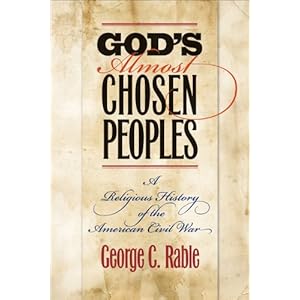
The outstanding Civil War Book Review, which has been a bellwether of scholarship on the topic for more than a decade, just posted their new issue for Winter 2011. Readers of this blog will be especially interested to read (or listen to) an interview conducted by editor Nathan Buman with George Rable about his new book, God's Almost Chosen Peoples: A Religious History of the American Civil War.

Following Paul and Ed, who have already given the book some attention here on the blog—and in good RiAH self-promotional style—I'll also draw reader's attention to my own review of Rable's book, just published in Civil War Book Review.

Here is an excerpt:


One of Rable’s major themes concerns the overwhelming significance of civil-religious providential understandings of the course of conflict. For his subjects the hand God was seemingly everywhere, guiding and shaping events in accordance with his will. All too frequently, that providential outlook was conflated—in ways consistent with patterns throughout American religious history to that time—with southern and northern nationalist aspirations. Perhaps this idea was stated most clearly in language approved by one northern Methodist conference in 1862: “Patriotism is a Christian virtue” (153).

Because of deep commitments to providentialism in the Civil War era, “religious faith could be both wind and weathervane,” where success or failure in battles showed adherents the ways in which they had met or fallen short of divine expectations, thus incurring God’s favor or wrath (7). Throughout the war, Union and Confederate officials, as well as local leaders and ministers, called routinely for days of fasting and thanksgiving in an attempt to make sure the public properly aligned itself with God’s will. Furthermore, despite innumerable difficulties, Rable contends that belief in providence maintained a remarkable resiliency. Not only did the religious “line between ‘loyalty’ and ‘disloyalty’” grow “ever-sharper” as the war dragged on, but after Appomattox, believers in the Union continued to understand their cause sanctioned by God (354). In the same way, defeated Confederates did not give up the belief in the righteousness of the cause lost.

Given the impressive amount of research displayed, the single most curious thing about God’s Almost Chosen Peoples is its self-professed lack of an overarching argument—in Rable’s words, it “is not a thesis-driven work” (6). Instead, he opts for a “broad narrative” that shows the centrality of religious belief for nineteenth-century Americans who needed to make sense out of the warring world they found themselves in (6). Rable’s choice will no doubt leave some readers grasping to impose coherence on an unwieldy and intimidating subject. However, because religious values were by no means uniform or monolithic in the Civil War era, and because Rable intends to cover the sweep of religious engagement with the myriad dilemmas that the sectional conflict raised, his broad narrative approach leads to a remarkable inclusivity with regard to topics and subjects.

Jumat, 05 November 2010

God's Almost Chosen Peoples

Paul Harvey

Some of you blog readers are probably hanging at the Southern Historical Association meeting today and through the weekend in Charlotte; sorry I'm not there with you, afraid that the AAR maxed out my personal travel/alcohol budget. In the meantime, though, hope you'll drop by the University of North Carolina Press booth and check out George Rable's very promising looking new book, God's Almost Chosen Peoples: A Religious History of the American Civil War. Skip Stout and others have given the lengthy work a hearty endorsement on the book jacket, and I hope to get to it over Christmas break when 600 pp. books seem a little less daunting. Information on the book below, from the UNC Press website.

God's Almost Chosen Peoples

A Religious History of the American Civil War

By George C. Rable


Throughout the Civil War, soldiers and civilians on both sides of the conflict saw the hand of God in the terrible events of the day, but the standard narratives of the period pay scant attention to religion. Now, in God's Almost Chosen Peoples, Lincoln Prize-winning historian George C. Rable offers a groundbreaking account of how Americans of all political and religious persuasions used faith to interpret the course of the war.

Examining a wide range of published and unpublished documents--including sermons, official statements from various churches, denominational papers and periodicals, and letters, diaries, and newspaper articles--Rable illuminates the broad role of religion during the Civil War, giving attention to often-neglected groups such as Mormons, Catholics, blacks, and people from the Trans-Mississippi region. The book underscores religion's presence in the everyday lives of Americans north and south struggling to understand the meaning of the conflict, from the tragedy of individual death to victory and defeat in battle and even the ultimate outcome of the war. Rable shows that themes of providence, sin, and judgment pervaded both public and private writings about the conflict. Perhaps most important, this volume--the only comprehensive religious history of the war--highlights the resilience of religious faith in the face of political and military storms the likes of which Americans had never before endured.

Related Posts Plugin for WordPress, Blogger...