Tampilkan postingan dengan label lived religion. Tampilkan semua postingan

Selasa, 09 Agustus 2011

Declension, National Salvation, and Other Discontents

Kelly Baker


At the end of June, the Huffington Post’s Tim Suttle queried “Why are evangelicals losing influence?” This claim of decline emerged from a Pew Research Center survey of evangelical leaders globally, in which 82% claimed that evangelicals were losing influence over culture. The blame, of course, landed firmly on the “rising tide of secularism.” Suttle disagrees with the causation, and instead he notes, “If evangelical influence is nose-diving we have no one to blame but ourselves.” The jeremiad of declension remains alive, well, and likely weary, and it seems fly in the face of presence of evangelicals in American culture. Is evangelicalism on the decline? Or it this a method to chastise evangelicals into action as well as reflection?


Declension and its sister narrative secularization ebb and flow in public discourse and historiography with assertions in both that this moment ("no, not that one!") is certainly a moment of decline. The crucial time when religion might not be present in public life but rather avoidable, contained, and private. Declension narratives seem to hinge on the abject hope that certain religious voices will lose presence and popularity (the question of which voices becomes very, very important). Religion is in decline, isn't it? What is meant exactly by religion generally seems to be an association with mainline Christianity. As one might imagine, I am not terribly interested in mapping out this statistically (though the statistics are alluring). Yet the fervor that emerges anytime new survey data suggests decline is a different story. Just this morning, a group of my summer students presented the recent findings of Barna Group study of religious change to discuss the religious character of the American nation. The study reports that 40% of all adults in the U.S. fit the moniker "born again", which is not a self-identification by survey respondents, but rather Barna's label. Does this data suggest decline?


While reading Suttle's article on declining evangelicals, I couldn't help but wonder how political figures like Rick Perry and Michelle Bachmann trouble this self-reported decline. Perry, after all, hosted "The Response" this weekend, and Rolling Stone imaged Bachmann as a Christian crusader (Janine already covered this here). The New Yorker's Ryan Lizza profiled Bachmann's religious roots. Religion Dispatches' Sarah Posner puts Perry and Bachmann head to head in a discussion of who would win the conservative Christian vote. She writes:


Bachmann, in other words, is a product of the religious right's deliberate efforts to "raise up" soldiers to exercise a "dominion mandate;" she is, organically, one of them. Perry's effort Saturday, on the other hand, was a staged attempt to convince them that he is committed to their worldview. It's not clear that he has internalized it like Bachmann has, which may make him more Zelig-like and attractive to non-religious voters in states like New Hampshire, or might make him look like a pandering interloper to everyone.


It is at least possible that Bachmann or Perry could win the Republican nomination for President, and Posner clearly places both in the trajectory of the religious right. So, how might we label both Perry and Bachmann? Are they evangelical? Conservative Christians? Fundamentalists? Born-again? Religious right? Bachmann embraces born again identity and notes that God directed her decision to marry, go to law school, and enter into politics. Perry's The Response invoked Jesus and prayer as solutions to national problems from abortion to the threats of secularism. All of those terms have been applied to them. What do we take this labeling to mean?


Clearly, both identify as Protestant Christian. Perry is a Methodist, who attends a Southern Baptist Church, and Bachmann is an Evangelical Lutheran who now attends a non-denominational church. Their affiliations could be considered mainline, though their current church attendance might tell a different story. Perhaps, they prove to be case studies for the lateral shifting of Protestants from denomination to denomination. Their language and poise "feel" evangelical to me, though Perry's relationship with the American Family Association and Bachmann's signature of the FAMiLY LEADER pledge shift them more into the territory of fundamentalism. The labels start to pile on and obscure more than they help.


To approach this in a different way, I wonder about the popularity of Bachmann and Perry. Why do these candidates appeal? Is it their religious affiliations, their invocations of the divine, or their moralism? Do they "speak Christian"? How/why does the appeal to Christianity mark them as legitimate political candidates? This combination of Protestant Christianity, conservative values, and national salvation is a potent one. Bachmann and Perry speak in a language of clear moral valence, and they offer a Christian solution to national problems. America's salvation becomes a matter of prayer, divine guidance, strong Christian values, and political prowess. God, they claim, is on their side. Declension of national sort serves them well. A nation in peril needs a savior, and Bachmann and Perry both offer themselves up on its altar. Is evangelicalism losing influence? The answer is likely no. The real question is if voters want a candidate with God on his or her side, and what that showcases about decline, declension, and attachments to cultural Christianity and American patriotism.



Sabtu, 04 Juni 2011

Richard Bushman, Robert Orsi, and Mormonism's "Abundant History"

Christopher Jones

(cross-posted at Juvenile Instructor)

Over at the website for Dialogue: A Journal of Mormon Thought, the editors have posted a discussion (moderated by Susanna Morrill, associate professor of religious studies at Lewis and Clark College) between noted historians and scholars of religion Richard Lyman Bushman and Robert Orsi. Bushman and Orsi reflect on the potential Orsi's approach to "supernatural presence" and "abundant events" in modern Catholicism holds for scholars of Mormonism.

The conversation between these two seasoned scholars, which touches on the relationship between the scholar and her subjects, how to make sense of revelatory visions and the writing of the Book of Mormon, and the vocabulary used to describe such occurrences, deserves to be read in its entirety, but I'm including a brief excerpt below:

Richard: You also speak of the routes of influence radiating from such events. That’s a nice way of putting it; the word “routes” suggests an approach to what happens in consequence. Where do the abundant events lead? But it occurs to me that some of the responses of the Marian groups, which taken together could be thought of as a morphology of an abundant event, take a different form in the case of Joseph Smith. Rather than the abundant event dissolving the boundaries of subjectivity and establishing intimacies, in Joseph Smith’s case it leads to structure and organization. The people who are converted take on priesthood offices and go on missions; they have council meetings. As the influence radiates still further, you get minutes of the meetings and letters and all the paraphernalia of organization. I thought it would be interesting to talk about how events that are so similar at the core lead in different directions in the aftermath.

Robert: I appreciate the difference. I was thinking about that concept as I read the very powerful final chapter of Rough Stone Rolling, in which the people left behind at Nauvoo after Joseph’s murder continued to work on building the temple, though they knew they weren’t going to be using it after it was done because they would be leaving Nauvoo. It seemed to me that we needed some word to get at what happens between Max Weber’s idea of initial charismatic leadership of a new religion and its eventual institutionalization. It seems as if something else is going on there, almost as if the stones themselves were charismatic–the stones of this sacred building that would otherwise signify the routinization of Mormonism. So I take your point. It does lead in different directions, which might have to do with the specific peculiarities of modern Catholicism and modern Mormonism. I was struck by–as you want to put it–the radiation outwards of Joseph’s spirit and his vision through the organization.
Go here to read the rest of the interview.

Rabu, 18 Mei 2011

Witchcraft in Early North America

Paul Harvey

Some of you may be looking for a good classroom resource for teaching about popular religion or witchcraft in early America. If so, this might be the book for you, so I'll reprint the Choice review below of Alison Games, Witchcraft in Early North America, put out as a pretty short classroom-usable volume by Rowman & Littlefield in their "American Controversies" series, edited by excellent historian Douglas Egerton. These volumes come with primary document selections, chronologies, and other pedagogical helps. (I have a volume coming out in late summer or so in the Rowman & Littlefield African American History series, entitled Through the Storm, Through the Night: A History of African American Christianity -- more on that as the pub. date gets closer, but the experience of the close editing of that book, with an eye towards readability for a general non-expert audience, gives me confidence in these other volumes that R & L is putting out).

Anyway, here's more on this volume, and check the book's website here for table of contents and more info. What particularly attracts me here is the clear effort to provide a broader context for popular religious beliefs in the supernatural throughout 17th century America, and including Natives and African peoples as well as British North Americans. In other words, this isn't your father's Buick, the usual Salem-centric story of witchcraft in the colonies.
________________________________________

Games, Alison. Witchcraft in early North America. Rowman & Littlefield, 2010. 216p index afp; ISBN 9781442203570, $36.95. Reviewed in 2011jun CHOICE. Games (history, Georgetown Univ.) makes a vital contribution to the pedagogical resources on early American witchcraft. With its introductory essay and interdependent collection of primary materials, the book demonstrates how accusations of witchcraft mediated colonial encounters between mutually illegible cultures: characterized by flagrant "coercion and cruelty," such conflicts demanded justification and frequently provoked resistance, and therefore lent themselves to prevailing supernatural explanations and persecution. Games's historical introduction broadens the scope of witchcraft study beyond New England to incorporate less familiar outbreaks in New France and New Spain. The author traces as well the conflicting beliefs European, Native, and African peoples brought to these encounters. A modest selection of Salem materials are among the 29 brief primary documents, which include legal documents, reports of first encounters, and possession narratives from across the continent. Games's premise is that the historical record tells the story slant; accordingly, this volume represents a necessary and ethical, albeit brief, attempt to counter the Anglo-centrism that has characterized witchcraft historiography. The author resituates episodes of witchcraft in the context of cultural contact and conflict in which they occurred, incorporating them into larger scholarly trends in the study of early America as a space of contact zones. Summing Up: Recommended. All readers. -- A. T. Hale, University of Puget Sound

Selasa, 17 Mei 2011

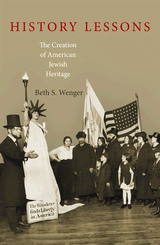
History Lessons: Creation of American Jewish Heritage

Paul Harvey

A bit later today or early tomorrow Chris Beneke will be posting his thoughts on Kevin Schultz's new and very important book Tri-Faith America. Before we get there, I thought I would call your attention to this new work on American Jewish history from Beth Wenger, reviewed in this month's Choice: History Lessons: The Creation of American Jewish Heritage. This book is about the creation of history and meaning in American Judaism, about how "memory" becomes "history" and "heritage" within this religious community, and about how history creates identity. I'll post a brief bit from the book's website first, and then the review from Choice.

From the book's website:

Most American Jews today will probably tell you that Judaism is inherently democratic and that Jewish and American cultures share the same core beliefs and values. But in fact, Jewish tradition and American culture did not converge seamlessly. Rather, it was American Jews themselves who consciously created this idea of an American Jewish heritage and cemented it in the popular imagination during the late nineteenth and mid-twentieth centuries. History Lessons is the first book to examine how Jews in the United States collectively wove themselves into the narratives of the nation, and came to view the American Jewish experience as a unique chapter in Jewish history.

Beth Wenger shows how American Jews celebrated civic holidays like Thanksgiving and the Fourth of July in synagogues and Jewish community organizations, and how they sought to commemorate Jewish cultural contributions and patriotism, often tracing their roots to the nation's founding. She looks at Jewish children's literature used to teach lessons about American Jewish heritage and values, which portrayed--and sometimes embellished--the accomplishments of heroic figures in American Jewish history. Wenger also traces how Jews often disagreed about how properly to represent these figures, focusing on the struggle over the legacy of the Jewish Revolutionary hero Haym Salomon.

History Lessons demonstrates how American Jews fashioned a collective heritage that fused their Jewish past with their American present and future


And now, the review from Choice:

Wenger, Beth S. History lessons: the creation of American Jewish heritage. Princeton, 2010. 282p bibl index afp ISBN0-691-14752-3, $35.00; ISBN 9780691147529, $35.00. Reviewed in 2011jun CHOICE.
American Jews created narratives about Jews in US history in order to establish a collective heritage. Wenger (Pennsylvania) demonstrates that these stories related a Jewish past to US histories in ways that were sometimes celebratory and sometimes critical, but they always sought to establish a place for Jews within US myths and thereby the US present. Wenger analyzes a "dual agenda" in which Jews both "wrote themselves into the narratives of American history" and narrated their own lives as hopeful endings to the "long history of the Jewish people." In exploring these narratives and counternarratives, Wenger provides fascinating primary sources, from didactic Yiddish poetry to letters hotly contesting the erection of a statue. The volume includes examinations of the particular political and cultural facets of US life that allowed Jews to "create" their own heritage and identity; the representation of US Jewish soldiers; children's literature; efforts at memorializing the Revolutionary financier Haym Solomon; and a standout chapter on Jews' relationships to US national holidays. Although Wenger's conclusions may not be surprising for those familiar with US Jewish history, her readings are subtle and compelling. Summing Up: Recommended. All academic levels/libraries. -- S. E. Imhoff, Indiana University / Bloomington

Kamis, 17 Februari 2011

Native Americans, Christianity, and the Reshaping of the American Religious Landscape

Paul Harvey

Here's a review from Choice of a new anthology/essay collection of tremendous value to those interested in the relationship of Native Americans and Christianity. Below the review I'm pasting in a table of contents, as well; as you will see, a number of the top scholars in this field -- Joanna Brooks, Hilary Wyss, Emma Anderson, Rachel Wheeler, Michael McNally, Steven Hackel, and others -- are represented here. So, first the brief review, and then more detail below that; the link below in the title takes you to the book's website at UNC Press. For those not as familiar with this topic, this is a great way to introduce yourself, in bite-sized portions, to some of the best recent scholarship.

Native Americans, Christianity, and the reshaping of the American religious landscape, ed. by Joel W. Martin and Mark A. Nicholas. North Carolina, 2010. 325p index afp; ISBN 9780807834060, $75.00; ISBN 9780807871454 pbk, $27.95. Reviewed in 2011mar CHOICE.

Martin and Nicholas's valuable essay collection addressing Native American interactions with European/European-American Christianity during the Colonial period and into the 19th century incorporates multiple disciplines, including history, religious studies, Native American studies, anthropology, and literary studies. Collectively, the authors illustrate Native agency in interactions with non-Native Christians. Rather than presenting Native experiences from a Eurocentric perspective, the authors show how Natives embraced Christian symbols and ideas, using them in ways that benefitted themselves and their fellow Natives and showing that, for those who chose to embrace Christian faiths, it was possible to be both Native and Christian. The essays also show that even when interaction with non-Natives brought Native communities hardship, Native peoples shaped Christianity in such a way as to benefit themselves and their communities. Each essay is well researched, eloquently written, and significant to the understanding of Native experiences in and with Christianity. An important contribution to a variety of disciplines, most importantly US Christianity, Native peoples, and US history. Summing Up: Highly recommended. Upper-division undergraduates and above


Table of Contents:

Hard feelings : Samson Occom contemplates his Christian mentors / Joanna Brooks -- Eager partners in reform : Indians and Frederick Baylies in Southern New England, 1780-1840 / Daniel Mandell -- Crisscrossing Projects of Sovereignty and conversion : Cherokee Christians and New England missionaries during the 1820s / Joel W. Martin -- Native American popular religion in New England's Old Colony, 1670-1770 / Douglas L. Winiarski -- Blood, fire, and "baptism" : three perspectives on the death of Jean de Brébeuf, seventeenth-century Jesuit "martyr" / Emma Anderson -- The Catholic rosary, gendered practice, and female power in French-Indian spiritual encounters / Tracy Neal Leavelle -- The souls of Highlanders, the salvation of Indians : Scottish mission and eighteenth-century British empire / Laura M. Stevens -- Print culture and the power of native literacy in California and New England Missions / Steven W. Hackel and Hilary E. Wyss -- Hendrick Aupaumut : Christian-Mahican prophet / Rachel Wheeler -- To become a chosen people : the missionary work and missionary spirit of the Brotherton and Stockbridge Indians, 1775-1835 / David J. Silverman -- Conclusion : turns and common grounds / Mark A. Nicholas -- Coda : naming the legacy of native Christian missionary encounters / Michael D. McNally

Minggu, 06 Februari 2011

Religious Tolerance and Intolerance in Early America

Paul Harvey

Congratulations to our contributor Chris Beneke, and to Christopher S. Grenda, whose edited anthology has just come out: The First Prejudice: Religious Tolerance and Intolerance in Early America (Univ. Pennsylvania Press, 2011).

(Incidentally, a shout out to U. Penn Press, which has been putting out great stuff in American religious history over the last several years, ranging from this book to Janet Lindman's Bodies of Belief to Ed's religious biography of Du Bois to Steven Miller's study of Billy Graham).

Chris has posted here before on some recent scholarly discussions on religious tolerance and intolerance generally in the early modern world, a subject that has produced a number of landmark scholarly works in the last few years. And quite a long time ago we blogged about this particular book, then in its "forthcoming" state (click on the link for the table of contents), and blogged also about Chris's seminal text Beyond Toleration: The Religious Origins of American Pluralism.

With this new edited anthology, featuring twelve essays from many of the top scholars of this subject, the conversation continues. I'll have more to say about this volume later after I have time to digest all of it, but suffice for now to say that it provides just the kind of first-class scholarly analysis that one would hope for, and will be an absolutely essential text for university libraries. Perhaps most importantly, the editors don't try to elide or explain away the differing arguments put forth by the various authors, but include a sterling introduction which explains and sets in context some of the major debates in this field. The editors propose a "co-existence" framework, one that was neither "tolerant" nor "intolerant" per se, and then suggest a research agenda that should warm the hearts of historians: get thee to the archives!

If this volume can bring mainstream religious history and its focus on identity and practice into a fuller dialogue with the traditional concerns of church-state history and its focus on ideology and law, it may become possible for teachers and scholars to communicate more confidently about the history of tolerance and intolerance in early America. There is hard work ahead. To understand how religious differences were lived in early America, we may need to resuscitate a long neglected tradition in American religious historiography: town and parish studies. That would mean renewed attention to local records . . . It would also entail investigations of the many sites where inter-religious interaction took place, including the unlikely places that recent cultural and social history has equipped us to probe such as homes, shops, taverns, and the streets.

In short: playing around on Google Books is no substitute for the hard historical research required in exploring this topic.

The editors are self-consciously bringing together two disparate forms of inquiry which have been pursued simultaneously but without a lot of dialogue in recent years: the social history of religion in early America (including lived religion), and the intellectual/constitutional studies of church and state, primarily concerned with ideas rather than everyday behavior. The editors explain that the authors of the chapters in the anthology "depart from both recent scholarship on the history of religious culture and the venerable study of church-state relations by their willingness to relate changes in law and rhetoric to the social experience of religious differences across British America and the early United States. They gaze broadly across the vast expanse of tolerance and intolerance in America, at the many varieties of persecution and the various manifestations of toleration, at the groups that were immediately affected by constitutional guarantees of religious liberty, and those that were not." The intent is to help "identify intersection points where the tangle of regulations, rhetoric, and customs that governed relations between early American faiths can be addressed without reflexively defaulting to the languages of toleration, religious freedom, or church and state."

Any number of recent works, including David Sehat's Myth of American Religious Freedom and the edited primary source anthology Religious Intolerance in America, have documented the substantial history of religious intolerance/repression in American history, while much older scholarship and newer works such as Chris's Beyond Toleration have explored the history of relative freedom and toleration. The dialogue continues renewed and afresh in this terrific new anthology. For my own research interests, I especially appreciate the inclusions of essays by Jon Sensbach and Richard Pointer on what "toleration" meant for Natives and African Americans. The last two essays, by Chris Beneke and Christopher Grasso, provide wonderfully contrasting examples of "America's moderate religious revolution," on the one hand, and the "boundaries of toleration and tolerance" experienced by religious skeptics and "infidels," on the other.

Selasa, 07 Desember 2010

Fathers on the Frontier

By Kelly Baker

Leslie Tentler reviews our contributor (and my dear friend and fellow FSU alum) Mike Pasquier's Fathers on the Frontier: French Missionaries and the Roman Catholic Priesthood in the United States, 1789-1870 (Oxford 2009), in the current issue of American Catholic Studies Newsletter (from the Cushwa Center at Notre Dame).

Tentler's lovely review situates Pasquier's work as on the cutting edge of Catholic history because Fathers on the Frontier examines seriously and thoughtfully the lived religion of Catholic priests. Tentler explains that her generation of historians focused upon the laity and some times actively attacked 'clerical history.' She notes:
Candid discussions of priestly life, however--its tensions, rewards, and material particulars--were extremely rare. Priests in this literature seemed to float not just above history but above the needs, drives, and psychological conflicts that bedevil the lives of lesser mortals (10).

She further continues that Pasquier focuses upon the "lived experience of the priesthood helps us to grasp the complexities of the system--the contingent nature of episcopal authority, for example, or the cultural capital enjoyed by the laity, even in times of plentiful priestly vocations" (11).

In his examination of priests as both father and brothers, Pasquier demonstrates the messiness of their relationships with one another and their parishes. Priests walked between the worlds of the sacred and profane, official authority and personal relationships, faith and doubt. Tentler reveals that Pasquier's examination of 'clerical thought and emotion' provides "psychologically rich territory--so rich, indeed, that one wonders why historians of my generation, intrigued as many of us by counter-cultural phenomena, have been reluctant to venture there" (11). She concludes, "Happily for all concerned, Pasquier has provided an excellent model for our imitation" (13).

For the review in entirety, click here (pages 10-13), and Chuck Lippy weighs in at the Journal of Southern Religion, too.

Jumat, 17 September 2010

Suffer the Little Children

Chris Cantwell

This guest post comes to us from Chris Cantwell, a graduate student studying 19th- and 20th -century religious history with Derek Chang and Nick Salvatore at Cornell University. He was also just named the Assistant Director of the Dr. William M. Scholl Center for American History and Culture at the Newberry Library in Chicago. His work focuses on the relationship between people’s devotional practices and political engagements. His dissertation, “The Bible Class Teacher: Piety and Politics in the Age of Fundamentalism” examines the history of the Adult Bible Class Movement through a microhistory of an unknown, relatively unimportant, but amazingly well-documented Bible class teacher and his Bible class on Chicago’s West Side. Here he looks into the fascinating world of the American child preacher and asks some provocative questions about the practice and meaning of this phenomenon.

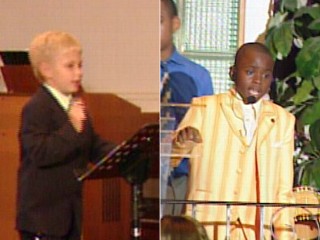
You see them and you initially laugh. The grainy footage and shaky camera work suggest what you’re watching may very well be an entry for America’s Funniest Home Videos, so of course it’s not serious. But then the clip plays on. And on. You’re now laughing with a little less fervor as bewilderment slowly pushes humor to the side. You even have a serious look on your face. As the clip passes the two or three minute mark, you suddenly realize that while the YouTube user who posted the clip may have meant it as a joke, the individuals who originally produced the video did not. This is for real. You’re no longer laughing, but focusing; watching the diminutive figure pace and pound and shout with rage far beyond his—and it usually is his—age. But the kicker is not even the video’s main character. It’s his audience. By the time you’ve come to the conclusion that this six-year-old child is, indeed, preaching, you’re confronted with the cheering, clapping, supportive adults who surround the child and encourage not only his message but also his wild performance. It’s like a grade school play, but with fire and brimstone. And no one’s acting.

Child preachers are often the wacky sideshows of American religious history, confined to the fringes of American religious life. They purportedly stand outside the devotional lives of most “ordinary” believers. Indeed, the history of childhood has been around for some time now and has shown that the Sunday school movement, the Y’s, the Boy Scouts and, of course, Horace Bushnell did not exactly clamor to have children practice homiletics. Rather, as the brunt of the scholarship suggests, the motives behind the founding of these organizations were to shelter children from the vices and traumas of the adult world of work, prolong their innocence, and thereby delay their maturation. “This is exactly what the Young People’s Society of Christian Endeavor seeks to do for everyone of its members,” wrote the Reverend Francis Clark in 1902, the founder of that ubiquitous organization of American Protestant childhoods. “It sets them about doing things and thus tides them over the critical period of adolescence, the years of storm and stress and doubt.”

Absent from this narrative of American Protestant youth, however, are not just child preachers but children generally. Children as agents with their own ambitions, anxieties and religious imaginations are often as scarce in the history of American religion as child preachers are in American history. Of course, this lacuna is largely the result of a dearth of sources. Children often did not scribble down, much less understand, their own religious worldviews. Even if they did, such artifacts typically ended up on the family refrigerator and never made it to the archives. But sometimes kids do leave traces. In a 2007 Church History article (favorably mentioned on this blog), E. Brooks Holifield found in a number of antebellum children’s diaries that kids paid surprisingly close attention to their ministers, reflected on their teachings and, in some instances, emulated ministers. In my own research on a number of Sunday school workers at the turn of the twentieth century who were lifelong church members but never rose above laymen, I’ve been impressed by how many of them had aspirations to take to the pulpit in their youth, some as young as six. According to their recollections in later years—admittedly a less reliable source—most willingly and eagerly mounted the stage in the late nineteenth century to give sermon-like addresses before Baptist, Presbyterians, and Methodist congregations. But what has really surprised me in charting the childhoods of these women and men is just how many opportunities local churches provided for children to preach. Sabbath school anniversaries, holiday celebrations, decision days, rallies, monthly Sunday school concerts, quarterly temperance lessons, and especially Children’s Days all demanded spiritual performances from children in ways that mimicked adult worships practices. As much as we’ve interpreted Protestant ideologies of childhood to inflate the innocence of children to Precious Moments-like proportions, there was also a strand of local church culture and evangelical parenting practices that expected, or at least promoted, a kind of spiritual precocity in children.

I’m curious if the religious lives of children have similarly haunted the research of other readers. In a recent query on H-AmRel from BlogMeister Randall Stephens on the denominational acceptance of child preachers, listserv members offered a lengthy list of diverse figures from Bob Jones to C. L. Franklin who both literally and figuratively cut their teeth behind the pulpit. The lived religion of childhood certainly wasn’t something I was expecting to focus on when I began my dissertation, but it has become a central component to many of the arguments I try to formulate. Perhaps by better situating children and their interpretive imaginations in our studies we can deepen our understanding of generational change and stability in America’s religious communities. Taking children and their spiritual aspirations seriously may also help contextualize child preachers and the bemused contempt they perhaps unjustly receive. For when longtime Sunday school worker Asa Bullard worried as early as 1876 that the plethora of church events that forced kids to speak or recite Bible verses threatened to “make an exhibition of the children,” one has to wonder just how much the difference between child preachers and other Protestant children was one of degree rather than kind. Just ask any Protestant who, as a youngster, earnestly, but ultimately unwillingly, performed in church musicals throughout much of their childhood. That, however, would require a very different kind of blog post.

Related Posts Plugin for WordPress, Blogger...