Tampilkan postingan dengan label fundamentalism. Tampilkan semua postingan

Senin, 26 Desember 2011

Reappraising the Significance of Religion in the Modern U.S.: 2012 AHA Session

Paul Harvey

Some of you blog readers may be getting ready for the 2012 American Historical Association meeting in sunny Chicago Jan. 5-8 2012. Because the AHA meets in conjunction with the American Society of Church History and the Catholic Historical Association, there are really too many sessions on American religion to list usefully. So instead I'll feature a few sessions of interest that particularly catch my eye in the coming days here, and invite the rest of you to promote sessions of interest to you, either in the comments section or by sending me a guest post.

To start with, here's hoping you'll drop by our session, pasted in below, on "The Evangelical Century: Reappraising the Significance of Religion in the Modern United States." Details below.


Saturday, January 7,2012: 2:30 PM-4:30 PM
Kansas City Room (Chicago Marriott Downtown)
Chair:
Anthea Butler, Universityof Pennsylvania
Papers:
World War II andthe Birth of Modern American Evangelicalism
Matthew Avery Sutton, Washington State University
Comment:
Paul W. Harvey, Universityof Colorado Colorado Springs
Session Abstract
The twentieth century United States, according to the standardnarratives, was defined by growing secularism and pluralism. Heavy immigrationof Jews and Catholics in the progressive era, and of Hindus, Buddhists, andMuslims since the 1960s, created what scholar Diana Eck calls “a new religiousAmerica,” one in which no single group has a monopoly on power. The members ofthis panel are not so sure. While there is no doubt that the United States isfar more diverse today than it was in 1900, American evangelicals havenevertheless managed to shape the nation’s trajectory in important ways in thelast one hundred years. Building on new archival research, these papers seek toreappraise the significance of American evangelicalism in the modern UnitedStates.

Alison Greene focuses on an important shift that began in the1930s. Until the Great Depression, the nation’s established churches were on anupward trajectory in both numbers and influence. But the Great Depressioncrippled the Protestant establishment. At the same time, the economic crisismade room for evangelical and pentecostal churches that emphasized individualsalvation and authentic religious experience. While the established churchesstruggled to maintain programming and participation, upstart evangelicals andpentecostals employed creative techniques and a core of committed volunteers tokeep church operations afloat and expand membership. While it would be decadesbefore evangelicals and pentecostals rivaled their established counterparts in numbersand national influence, the Great Depression marked the beginning of a gradualtransition of power from the mainline to its upstart rivals.

Matthew Sutton's paper (revised since the original proposal) discusses the reaction of fundamentalists to World War One, tracing that era as one of the creation of a religious movement that grew to be hyper-patriotic and suspicious of government at the same time.

Steven Miller examines more recent expressions of evangelism. Heargues that the growing prominence of Reagan-era evangelicalism produced twometaphors that profoundly informed subsequent discussions of faith and publiclife: Richard John Neuhaus’ “naked public square” and James Davison Hunter’s“culture war.” Neuhaus argued that secular elites had “systemically excludedfrom policy consideration the operative values of the American people, valuesthat are overwhelmingly grounded in religious belief,” while Hunter described aconflict between “progressive” and “orthodox” forces in American society. Inthe end, neither metaphor could transcend a defining characteristic of latetwentieth-century America: the complex, often ironic influences ofevangelicalism on U.S. politics and culture.

Rabu, 09 November 2011

Reviewing the Anointed

by Matt Sutton

Part I: Anointing the Anointed

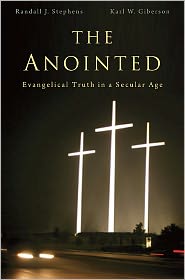
Randall Stephens and Karl Giberson’s book The Anointed has officially been out for two weeks. As reviews begin to appear, it is clear that this is one of the most important—and controversial—books on religion in modern America to appear in some time.

Booklist summarized, “[Stephens and Giberson] rise triumphantly to the challenge of explaining the leaders and the culture of the religious Right without rancor or condescension.”

The ever present Kevin Schultz wrote a smart review for the Wilson Quarterly concluding, “One of the principal virtues of The Anointed is that it represents an effort to demonstrate that the evangelical community is not a monolith of the unthinking.” He did, however, include a caveat. “Yet if that were as true as the authors hope, they probably would have felt less pressed to write this book.”

The Weekly Standard also wrestled with Stephens and Giberson’s arguments. But rather than praise their work, the review admitted half-heartedly that the authors were “not wrong.” I guess that’s as far as the Standard can go in praising a book that does not line up with the magazine’s politics. Nevertheless, “not wrong” is certainly better than being “not right.”

On the Huffington Post, Mark Pinsky used The Anointed to discuss the relationship between evangelical Zionism and the 2012 campaign.

Finally, my review of the book is in the current Christian Century. I conclude,

“The Anointed is one of the best and most important books on religion published this year. It is a well-written, well-argued study that penetrates to the heart of modern evangelical culture. Stephens and Giberson have done an excellent job of critiquing what Mark Noll previously called the ‘scandal of the evangelical mind’ (the scandal is that there is no evangelical mind) while also empathetically explaining why so many evangelicals are smitten by dubious experts. This book deserves a wide reading, which it is certain to have. Evangelicals who take the intellect seriously as well as outsiders struggling to understand the evangelical subculture will benefit from the hard work and keen insights of Stephens and Giberson.”

Part II: Annoyed by the Anointed

But it is not all butterflies and sunshine for Giberson and Stephens. They have managed to offend a few of the most influential (or at least a couple of the loudest) voices in evangelicalism.

First, as Randall has explained, Ken Ham has been complaining about this book, inferring that the authors might be wolves in sheep’s clothing. In fact, the title of one of his blog post was the none-too-subtle “Beware of Wolves.”

Then Al Mohler jumped in. In a blog with the equally none-too-subtle title “Total Capitulation: The Evangelical Surrender of Truth,” Mohler too questions the faith of the authors—not the argument of the book, but the faith of the authors. He writes, “Giberson and Stephens are far outside of the evangelical mainstream, and they know it.”

Apparently he gets to decide what is and is not the evangelical mainstream (which also means that Eastern Nazarene’s administration and tenure committees are not as capable of determining what counts as an evangelical as is this Southern Baptist).

The response of Mohler and Ham is predictable. They are afraid to let their audiences think for themselves. They simply want to teach them what to think. So when a book comes along that challenges what they teach and believe, they react by questioning the faith of its authors. Rather than trusting that their followers are smart enough to analyze critically a book like The Anointed, they choose instead to scare their disciples into not reading at all. It’s easier that way. If their followers don’t read, they won’t ask questions.

In 1940 fundamentalist leader and Moody Bible Institute president Will Houghton lamented to Wheaton College president J. Oliver Buswell, “it takes very little to start a fight with some fundamentalists.” Because fundamentalism by that time had developed such negative and combative characteristics, men like Houghton and Buswell began calling themselves evangelicals.

Seventy years later, the evangelicalism of Ham and Mohler suffers from the same problem as old time fundamentalism. Rather than celebrate the fact that two Christian professors from a Nazarene school have published a wonderful—although not perfect—book with one of the most prestigious academic presses in the world, they insinuate that the authors’ faith is suspect. I guess we shouldn’t be surprised. Houghton certainly would not be. Fundamentalism is still alive and well as Stephens and Giberson so carefully document.

Selasa, 18 Oktober 2011

NY Times Editorial: The Evangelical Rejection of Reason


Kelly Baker

While John Turner aptly describes "dominionists on the loose" and the media brouhaha over the threat of theocracy via Christian dominionism, our own Randall Stephens, writing with Karl W. Giberson, had a New York Times editorial aptly titled, "The Evangelical Rejection of Reason" published yesterday. Coming on the heels of their book, The Annointed Age: Evangelical Truth in a Secular Age (reviewed here by Chris Beneke), they argue convincingly about the war on science as "part of a politically monolithic red-state fundamentalism, textbook evidence of an unyielding ignorance on the part of the religious" as well as map out the anti-intellectualism inherent in these attacks. Randall and Giberson make distinctions between their own evangelicalism and the politicized vision of current Republican nominee hopefuls.

Here's an excerpt:
As one fundamentalist slogan puts it, “The Bible says it, I believe it, that settles it.” But evangelical Christianity need not be defined by the simplistic theology, cultural isolationism and stubborn anti-intellectualism that most of the Republican candidates have embraced....

Fundamentalism appeals to evangelicals who have become convinced that their country has been overrun by a vast secular conspiracy; denial is the simplest and most attractive response to change. They have been scarred by the elimination of prayer in schools; the removal of nativity scenes from public places; the increasing legitimacy of abortion and homosexuality; the persistence of pornography and drug abuse; and acceptance of other religions and of atheism.

In response, many evangelicals created what amounts to a “parallel culture,” nurtured by church, Sunday school, summer camps and colleges, as well as publishing houses, broadcasting networks, music festivals and counseling groups. Among evangelical leaders, Ken Ham, David Barton and James C. Dobson have been particularly effective orchestrators — and beneficiaries — of this subculture. (Continue reading here.)

Editor's note: Also check out John Fea's discussion of the editorial here.

Sabtu, 08 Oktober 2011

All the World in One Cartoon: Or, A Picture Contradicts a Thousand Words

Randall Stephens

On Wednesday Chris Beneke posted a review on this blog of The Anointed: Evangelical Truth in a Secular Age, a book I coauthored with Karl Giberson. I especially liked Beneke's response to a populist, misguided review that appeared on the Creationist Answers in Genesis site. (The reviewers whipped up readers by claiming that Giberson and I are snoots who look down our noses on salt-of-the earthers who don't have PhDs.) "Credentials aren't irrelevant," Beneke writes, "but they aren't the real issue here (see: Herberg, Will). Rather, it's the misuse or wholesale neglect of critical facts that distinguishes rigorous, honest scholarship from the work of self-anointed experts such as Ham."

One of the things that struck me most about the Answers in Genesis review was a short paragraph in which the two reviewers claim we misrepresented Ham and his organization's mission.

They write:

The authors also asserted that ICR [Institute for Creation Research] and AiG argue that evolution is “responsible for much of what’s wrong with the world” (p. 36). Answers in Genesis has never stated or implied this. We have both—in countless articles and even in the 2008 online debate between Ham and Dr. Giberson—declared instead that the teaching of evolution has caused many to doubt or disbelieve the Bible.*

It made me wonder if they've spent much time reading what's on their own website. Ham and company do repeatedly "imply" that evolution leads to all sorts of horrors. That's plastered all over the Answers in Genesis site. (See here, here, here, here, here . . . I could go on.) How could these Answers in Genesis reps write that "Answers in Genesis has never stated or implied this." Are their pants on fire?

But my favorite example of Answers in Genesis and Ken Ham's view of
evolution being “responsible for much of what’s wrong with the world" is this wonderful, ubiquitous cartoon that is still up on the AiG website. This picture has been teaching children about the real issues that are at stake for over a decade now.

Rabu, 05 Oktober 2011

Wolves in Sheep's Clothing; or, Knowing Them by Their Fruits

Chris Beneke

You might have anticipated that Randall Stephens and Karl Giberson's new book, The Anointed, would cause a stir. Just two weeks after arriving on shelves, it already has. Yesterday, Ken Ham, co-founder of the Creation Museum in Petersburg, Kentucky and CEO/President of Answers in Genesis (AiG) USA suggested on his blog that the authors were like wolves intent on destroying God's flock. (by the way, there's another interesting passage on wolves in Mat 7:15)

Meanwhile, at the affiliated AiG blog, Georgia Purdom and Mark Looy observed flatly that: "[Stephens and Giberson] argued that when Bible-believing Christians engage the culture in controversial areas like creation vs. evolution, believers should trust a highly educated PhD theistic evolutionist and evangelical like Dr. Francis Collins over someone like Ham (who has the Australian equivalent of a master’s degree)." I suspect that Stephens and Giberson would respond that credentials aren't irrelevant, but they aren't the real issue here (see: Herberg, Will). Rather, it's the misuse or wholesale neglect of critical facts that distinguishes rigorous, honest scholarship from the work of self-anointed experts such as Ham.

The Anointed is itself an example of how the preponderance of evidence can be mustered to make a well-supported and coherent argument. The first four chapters feature trenchant accounts of fundamentalist-leaning authorities--Ham, whose Creation Museum draws tens of thousands of visitors every year; David Barton, whose highly selective readings of early America have captivated multitudes of believers, including Michelle Bachman and Glenn Beck; James Dobson, founder and former president of Focus on the Family whose influence on understandings of gender roles and child-rearing rivals Dr. (Benjamin) Spock; and Tim LaHaye whose bestselling Left Behind novels foretell the imminence of the rapture and the dismal fate of unbelievers.

Ham, Barton, Dobson, and LaHaye are leading intellectuals in what Stephens and Giberson refer to as an evangelical "parallel culture," which also includes Christian "publishing houses, music labels, and colleges." Chapter Five offers a revealing glimpse of a young male evangelical, Paul Miller, who grew up ensconced in this devotedly non-secular world. Chapter Six details the ascendancy of three figures that even regular readers of Salon would recognize: Oral Roberts, Jerry Falwell, and Pat Robertson.

Part history and part ethnography, The Anointed reveals the authors' serious and sympathetic engagement with the challenges confronted by evangelical thinkers. Indeed, at critical moments, the book defers to accomplished and believing scholars (especially Francis Collins and Mark Noll) who work tirelessly to reconcile their faith with modern science, history, and biblical interpretation. And that leads to the question: If there are legitimate evangelical contenders for intellectual influence, how did gross abusers of facts such as Ken Ham and David Barton end up wielding so much influence?

As with so much else that we experience as mere mortals, the explanation is neither simple nor certain. For starters, Stephens and Giberson suggest, there is the Anointed's alluring confidence that their work reflects God's will. This same characteristic helps account for their tendency to personal hubris and their aversion to generally accepted information about the world. Stephens and Giberson also credit a longstanding “common-sense populist hermeneutic” that is by no means confined to evangelicalism, but certainly buttresses the Anointed's case against mainstream scholarly authorities. The best explanation for their preeminence may simply be that they are really just attempting to engage a religious group in a theological enterprise, rather than social science, natural science, or history. By repeatedly and skillfully asserting the seamless connection between their own interpretation of scripture and their misbegotten understanding of the facts, they never really have to demonstrate any of it. With help from Stephens and Giberson, more people may come to know them by their true scholarly fruits.


Rabu, 28 September 2011

Aimee and Apocalypticism; or The 3 Days of the Sutton

Paul Harvey

Send lawyers, guns, and money,
The s*** has hit the fan
(Warren Zevon)

Warhol had his 15 minutes (leading one wag recently to opine that in the future everyone would be anonymous for 15 minutes), The Condor had three days, but this week our friend and contributor Matt Sutton has had his three days -- with some more to come. Call it the 3 Days of the Sutton.

First there was the New York Times editorial in Monday's paper, which we blogged about here. Then there was the appearance on the Lawrence O'Donnell show (and the usual hate mailers afterward). Then an hour later after the show, as if to personify the point (much more literally than Matt ever meant it), there was a heckler yelling at President Obama about how he was the anti-Christ. Then there was the inevitable commentary about how the heckler was a "plant." Yada yada blah blah.

(Here I digress just for a moment to quote from @MartyVanBuren, some very funny historian tweeting from "The Great White House in the Sky" as President Martin Van Buren: Obama heckled at campaign stop as the 'Antichrist.' Been there. Some folks just don't understand us Masons.)

Then there was Lawrence O'Donnell commenting on the previous evening's segment with Matt, replaying the heckler and Matt's comments and inserting his own measured commentary on the basic point here, which is the way the extreme has become part of the mainstream in political rhetoric (Ponzi schemes and Bachmann's fact-free speculations about vaccinations being some recent cases in point). Then there was Matt's appearance on the Michael Medved show, where he made some points that apparently left the conservative radio host apoplectic. I don't know if there's a link, but here is Matt's summary:

Just did the Medved show . . . I ended up comparing evangelicals to Muslims -- the vast majority are good people:-) He was not pleased.

I'll see if I can find a clip of that to link here.

Then there are the proliferating internet commentaries on the editorial and O'Donnell segment, by which point the subtler points of Matt's analysis have long since been muffled in the media noise.

And this doesn't even get to Matt's other career -- as an advisor for the musical Saving Aimee, premiering soon in Seattle with the hope of getting it to Broadway. Matt recently met with Kathie Lee Gifford, who is involved closely with this production in some way that I can't remember offhand, and maybe one of these days he will blog about that. In the meantime, here is a wonderful segment from Seattle Channel Video recorded in August; the first 10 minutes or so features Matt talking about Sister Aimee's life, the rest features various producers and actors from the musical talking about their roles.

You can also go here for a podcast of an interview with Matt by Ian Masters, where Matt talks about the conspiracy theories floating around the loonier sections of the media about the timing of that heckler (some have accused Matt of paying the heckler -- no way a university professor can afford that! And never mind that the New York Times piece was submitted about a month ago and delayed several times since then).

Finally, you should also check out his piece at the Harvard University Press website, "The Resurrections of Aimee Semple McPherson," which concludes with a comparison of Aimee's failed attempt to star on Broadway in the 1930s, but the hopeful success of the current theatrical revival of her life:

McPherson’s continuous reappearances in pop culture illustrate that the issues raised by her life were not simply about Los Angeles in the 1920s. Rather they illustrate how the mix of religion, sexuality, and mass media that she represented cut to the heart of modern American culture—then and now. In crafting a powerful, culturally engaged, theologically conservative movement in an era saturated with controversy over the roles of women in society and the relationship of fundamentalism to American culture, she garnered a lot of attention.

Although Aimee tried—and failed—to star on Broadway in the 1930s, she may yet get her chance. The new musical, Saving Aimee, will once again revisit her compelling, complicated life. With Aimee as the subject, it is bound to be an excellent show.

On a more serious side, there have been some excellent discussions of Matt's points, which ultimately are about the role of apocalypticism in American political discourse through the 20th century. Sarah Posner discusses Matt's piece together with Michael Kazin's consideration "Whatever Happened to the American Left" in Sunday's Times (short answer: the right has organized, the left has not; Diane Winston challenges that view here).

Aimee and apocalypticism represent different forms of religious theater that ultimately play towards ideas of the resurrection of Christian America. Michele Bachmann has mastered this point, as evidenced in her speech before Liberty University's students, which "found the precise sweet spot where testimony and Christian American exceptionalism mythology intersect" (the link takes you to a C-SPAN video of the talk). Bachmann's campaign is faltering and she'll be out of the picture soon enough, but she's made an impact with this kind of galvanizing rhetoric, bringing certain strands of apocalyptic themes into mainstream discourse through her own form of theatricality. God help us.

P.S. Forgot to mention the most startling thing of all: Sutton's fantasy football team is now 2-1, and he's a threat to make the playoffs. Truly the time of tribulation is upon us.


Senin, 26 September 2011

Why the AntiChrist Matters in Politics

by J. Michael Utzinger

Matthew Sutton's reflections on the antichrist and American politics can be found in today's New York Times under the title "Why the Antichrist matters in Politics." There is some great food for thought here including how dispensational premillennialism (Sutton wisely didn't use this term in an op-ed) feeds anti-government sentiment. He also suggests that a power vacuum among politically oriented evangelicals have allowed libertarians and Tea Party activists (like Bachmann, Perry, and Paul) to exploit evangelical energies without the type of religious leadership (previously seen in individuals like Billy Graham and Jerry Falwell) who tempered the tendency toward apocalyptic excess. Perhaps a throw-away line, but I appreciated the analogy with Marxism to explain apparent tensions within the evangelical between expectation and action. After all, to those of us who study apocalypticism historically, it is easy to see Marxism as a secularized form of Christian apocalypticism (albeit a this-worldly type). The whole piece can be found here.

Update from Paul: Matt is going appear this evening on MSNBC's "The Last Word" with Lawrence O'Donnell, via satellite. Check your local listings!

Update from Kelly: Here's the clip!

Senin, 12 September 2011

Bland is Beautiful: In Defense of Religious Moderation

Paul Harvey

I'm pleased today to host a guest post from Professor William Egginton, who is Andrew Mellon Professor of the Humanities at The Johns Hopkins University, where he also chairs the Department of German and Romance Languages and Literature. Egginton's new book is In Defense of Religious Moderation: click on the link for a brief summary of the book's major thesis. Egginton's post may be read profitably in conjunction with David Hollinger's discussion of Robert Putnam's and David Campbell's massive sociological study American Grace: How Religion Divides and Unites Us, posted today at Immanent Frame. Hollinger finds particularly compelling the "demonstrable tension between intensity of belief and pluralistic tolerance," where the "beauty of blandness becomes visible." Egginton provides a philosophical exploration of the kind of religious (and secular) moderation which questions the existence of a "master code" which provides the source of all human knowledge. I would also remind you of David Stowe's wonderful post about David Hollinger's OAH presidential address, in which David talks about the two religious sides of his family, one more conservative and one more mainstream or liberal, and how his family's experience suggests much about the American debate between ecumenicists and evangelicals, and more broadly between religious Americans and secular Americans.

Egginton's work was just published this summer by Columbia University Press, and his post is particularly timely here after the events in Norway and yesterday's commemoration of 9/11, both of which suggest that the ancient ideal of moderation still has an awful lot going for it. The excerpt below comes from chapter three of In Defense of Religious Moderation, published this summer with Columbia University Press -- the press which will also very soon, in just a few months, be publishing our rather thick new reference volume The Columbia Guide to Religion in American History, co-edited by myself and Edward J. Blum.
___________________________________________________________

How Religions Become Fundamentalist
by William Egginton


A conclusion from what I have argued so far would seem to be that fundamentalist thinking, whether religious or otherwise, has always existed, even while it has been accompanied by ways of thinking that undermine it or criticize it from within. This conclusion, however, contradicts some recent work in the history of religions that suggests that fundamentalism, contrary to how it is often perceived in popular culture and the media, is a profoundly modern phenomenon. Karen Armstrong has made this argument by distinguishing between two kinds of knowledge, which she expresses with the Greek terms mythos and logos.

Whereas mythos refers to a holistic knowledge that is metaphoric at heart, logos designates a focused, pragmatic kind of knowledge best exemplified by specific problem solving. Whereas mythos forms the basis of our cultures and their self-understandings, their sense of right and wrong, of what is heroic or abhorrent, what to be admired and what to be ashamed of, it makes no pretension of describing physical objects and their functioning. Logos, in contrast, is the kind of knowledge that tells us a lot about the physical world we inhabit; it comes from observation and experimentation and permits us to intervene in highly successful ways in our environments.

For Armstrong, both kinds of knowledge have their respective places in any society. A society that tries to solve practical problems through the application of mythos, however, is bound to run into serious problems. Likewise, the use of logos to regulate every aspect of human cultural, spiritual, or psychic life has the potential to do great harm. In this light, she goes on to claim, modernity can be seen in some ways as the ascendancy of logos over mythos; where Western and other cultures had traditionally valued both forms of knowledge, the creative, metaphoric, all-encompassing weltanschauung of mythos and the pragmatic, problem-oriented, representational thinking of logos, modernity and the success of the scientific revolution led to an almost total suppression of mythos from the realm of “serious” intellectual endeavor. Rather than valued as another realm and way of articulating beliefs, mythos came to signify a childlike and obsolete attempt to explain the world, an endeavor now pursued to far greater effect by the scientific method.

As the Western logocentric worldview grew in power and influence during the scientific revolution, areas of social and personal life that used to be approached under the aegis of mythos were dealt with as if they were objects to be manipulated. The assumption began to dominate intellectual circles that every aspect of existence, including cultural practices and human desires and beliefs, could be explained through objectively discoverable physical laws. While this assumption did indeed lead to some breakthroughs in medicine, psychology, and economics, it also produced its own excesses. As I point out in the next chapter, a society that denies that humans have a cultural and psychical existence that is not reducible to physical causes risks alienating aspects of existence that humans cling most desperately to. Arguably some of the worst political atrocities of the last century, specifically those stemming from certain interpretations of Marxist “scientific materialism,” were direct results of this kind of thinking.

The other effect of an excess of logocentric thinking has to do with what happens to the sorts of beliefs usually contained in mythos when mythos is denied as a valid category of experience. This, according to Armstrong, is the origin of the specifically modern phenomenon of religious fundamentalism. Faced with a uniformly logocentric standard for truth claims, defenders of religious faith begin to interpret religious texts and teachings in a way that had never been normal practice before, namely, literally. Already in the seventeenth century Sir Isaac Newton, perhaps the greatest scientific mind before Einstein but also a religious fanatic, had become obsessed with purging Christianity of mythical doctrines. Since Newton could understand doctrines like that of the Holy Trinity only in literal terms, he could make no sense whatsoever of them, unlike the earlier Gregory of Nyssa, who found in the Trinity an image he could use to express “the unnameable and unspeakable.”

Such a backlash, in fact, is at the origin of the term fundamentalism, which was coined by U.S. Protestants in the early years of the twentieth century as a rallying call against mainstream theological tendencies such as the so-called higher criticism, which had been emphasizing a return to more nuanced and metaphorical interpretations of the liturgies since the late nineteenth century. Already in the 1880s, Dwight Moody had founded the Moody Bible Institute in Chicago in an effort to defend against the higher criticism. And between 1910 and 1915, the oil millionaires Lyman and Milton Stewart funded the publication of twelve paperbacks called The Fundamentals, which sold some 3 million copies. Fundamentalism was born.

Whether Christian or of other faiths, the movements we call religious fundamentalism are always the result of a perceived attack on a given community of faith. This is one reason why the attempt to regulate or restrict religious practice, what the new atheists are in essence calling for, has always resulted in and can only result in more fervently held beliefs, often in the form of fundamentalist backlash. In other words, when secularists criticize all religion, the unintended consequence of their actions is strengthening exactly that aspect of religious belief and practice that is ultimately at odds with modern, democratic values.

This dynamic can be seen in Europe today as modern, secular states like France grapple with the Islamic practice of veiling women. Far from successfully inculcating a sense of equality between men and women of all faiths, attempts to restrict public demonstrations of religious affiliation like the veil have led to backlashes, such that many women who wear it today in Western countries like France are doing so as a sign of cultural identity and anticolonial sentiment. Likewise, we tend to view the famous Scopes “Monkey Trial,” which was eternalized in the 1955 play and 1960 film Inherit the Wind, as having revealed the depths of belief in creation science already present in fundamentalist communities. But as Armstrong has argued, before the Scopes trial few fundamentalists actually believed in creation science or thought it particularly important to do so. Creation science became a hot-button item for the fundamentalist movement only after William Jennings Bryan’s defeat in court by Clarence Darrow was ridiculed by the journalist and essayist H. L Mencken, who wrote in an obituary for Bryan that he “lived too long, and descended too deeply into the mud, to be taken seriously hereafter by fully literate men, even of the kind who write school-books.” In the face of such humiliating condescension, groups tend to close ranks around tenets and practices that define them as different from the outside world. . . As with the Christian case, Islamic fundamentalist movements have emerged largely as a backlash against enforced modernization and perceived humiliation, with the added aspect of violent political repression not present in the Christian case. . . .

For Karen Armstrong, the fundamentalist backlash in religions since the dawn of modernity has constituted a kind of perversion of the original essence of these faiths. She claims that most if not all the faiths that are widely practiced today originated in what she calls following Karl Jaspers the axial age, the time between more or less 900 and 200 b.c.e. when the major tenets of all the world’s principal systems of thought emerged, albeit in different parts of the world. She includes in this list Confucianism and Taoism in China; Hinduism, Buddhism, and Jainism in India; monotheism in Israel; and philosophical rationalism in Greece. Many of the ethical insights of these different traditions are the same. They all, for example, produced some version of the golden rule, which was designed to eradicate the egotism that had brought societies at the time into crisis and which is still at the heart of just about every religious and ethical system in existence today. In their religious manifestation, axial faiths therefore all require kenosis, or the self-emptying essantial to some theological interpretations of Christian love.

Another axial principle is that of the ultimate transcendence of the universe, whether conceived of in material or spiritual terms. In other words, the axial traditions agreed that, however we conceive of the world, no human can ever be understood as having the last word; knowledge is an infinite process. At their core, then, the world’s religions were never about doctrine or the literal interpretation of the divine will but about generosity and tolerance for others. When they have degenerated into dogma, they have betrayed that original purpose.

As religions have developed and evolved they have also stagnated and grown sedimented layers of dogma. In the face of social conflict they have become fortresses of group identity and been deployed to measure purity of commitment and foster intolerance for others. But despite these changes religions carry with them the core of their original purpose. I have mentioned how the Judaic and Christian theological traditions emphasize the ineffability of God’s ultimate knowledge, but the Koran too insists that God communicates through symbols because thought cannot contain him, and no revelation can be definitive. Furthermore, the Koran also holds other faiths to be authentic, and Muhammad told his followers to pray toward Jerusalem because the God they prayed to was also the Jewish and Christian God.. . .

As mentioned, popular culture and the media tend to think of religious fundamentalism as a kind of embarrassing leftover from a less-informed, less-educated past. As Nicholas Kristof, a columnist whom I deeply admire, wrote in a recent column about the increase of troops in Afghanistan, “It breaks my heart that we don’t invest in schools as much as medieval, misogynist extremists.” I certainly understand Kristof’s point, but while the Taliban are indeed misogynist extremists, there is nothing medieval about them. Prior to the onset of modernity in the sixteenth century, and especially prior to the expulsion of the Jews and later the Moors from Christian Spain, European thought benefited immeasurably from the intermingling of Islamic, Jewish, and Christian intellectual and theological traditions. While religious intolerance was no doubt also an issue during the Middle Ages, it is a gross mistake to associate religious fundamentalism with bygone times.

. . . At the core of all fundamentalist thought is the belief that the world exists as a kind of knowledge, that it can be known as it is in itself if only we learn to read the code. While this belief has existed in many cultures at many times, one of the functions of the axial religions was to undermine that conviction, to teach people that the transcendent nature of ultimate reality was such that no human could ever, in principle, come to know the ultimate truth. What is crucial to grasp is that this core principle simultaneously sustains the existence of mythos and logos as two separate but equal domains of knowledge; for if the ultimate, all-encompassing questions are by nature infinite, if human knowledge in principle cannot grasp everything, then practical, objectifying logos is simply not relevant to such discussions, and the holistic, metaphoric standards of mythos have their place. Likewise, to the extent that modernity has allowed mythos to be pushed aside by the practical successes of the scientific method, the axial principle of the transcendence of ultimate knowledge has been weakened. But it is this principle that more than any other works to defend humanity from the dangers of its own certainty. It is for this reason that modernity’s privileging of logos over mythos, in Armstrong’s terminology, has paved the road for a specifically religious fundamentalism, namely, by weakening that aspect of religious traditions that have been the most effective critical weapon they have against the fundamentalist impulse: moderate belief.

Selasa, 09 Agustus 2011

Declension, National Salvation, and Other Discontents

Kelly Baker


At the end of June, the Huffington Post’s Tim Suttle queried “Why are evangelicals losing influence?” This claim of decline emerged from a Pew Research Center survey of evangelical leaders globally, in which 82% claimed that evangelicals were losing influence over culture. The blame, of course, landed firmly on the “rising tide of secularism.” Suttle disagrees with the causation, and instead he notes, “If evangelical influence is nose-diving we have no one to blame but ourselves.” The jeremiad of declension remains alive, well, and likely weary, and it seems fly in the face of presence of evangelicals in American culture. Is evangelicalism on the decline? Or it this a method to chastise evangelicals into action as well as reflection?


Declension and its sister narrative secularization ebb and flow in public discourse and historiography with assertions in both that this moment ("no, not that one!") is certainly a moment of decline. The crucial time when religion might not be present in public life but rather avoidable, contained, and private. Declension narratives seem to hinge on the abject hope that certain religious voices will lose presence and popularity (the question of which voices becomes very, very important). Religion is in decline, isn't it? What is meant exactly by religion generally seems to be an association with mainline Christianity. As one might imagine, I am not terribly interested in mapping out this statistically (though the statistics are alluring). Yet the fervor that emerges anytime new survey data suggests decline is a different story. Just this morning, a group of my summer students presented the recent findings of Barna Group study of religious change to discuss the religious character of the American nation. The study reports that 40% of all adults in the U.S. fit the moniker "born again", which is not a self-identification by survey respondents, but rather Barna's label. Does this data suggest decline?


While reading Suttle's article on declining evangelicals, I couldn't help but wonder how political figures like Rick Perry and Michelle Bachmann trouble this self-reported decline. Perry, after all, hosted "The Response" this weekend, and Rolling Stone imaged Bachmann as a Christian crusader (Janine already covered this here). The New Yorker's Ryan Lizza profiled Bachmann's religious roots. Religion Dispatches' Sarah Posner puts Perry and Bachmann head to head in a discussion of who would win the conservative Christian vote. She writes:


Bachmann, in other words, is a product of the religious right's deliberate efforts to "raise up" soldiers to exercise a "dominion mandate;" she is, organically, one of them. Perry's effort Saturday, on the other hand, was a staged attempt to convince them that he is committed to their worldview. It's not clear that he has internalized it like Bachmann has, which may make him more Zelig-like and attractive to non-religious voters in states like New Hampshire, or might make him look like a pandering interloper to everyone.


It is at least possible that Bachmann or Perry could win the Republican nomination for President, and Posner clearly places both in the trajectory of the religious right. So, how might we label both Perry and Bachmann? Are they evangelical? Conservative Christians? Fundamentalists? Born-again? Religious right? Bachmann embraces born again identity and notes that God directed her decision to marry, go to law school, and enter into politics. Perry's The Response invoked Jesus and prayer as solutions to national problems from abortion to the threats of secularism. All of those terms have been applied to them. What do we take this labeling to mean?


Clearly, both identify as Protestant Christian. Perry is a Methodist, who attends a Southern Baptist Church, and Bachmann is an Evangelical Lutheran who now attends a non-denominational church. Their affiliations could be considered mainline, though their current church attendance might tell a different story. Perhaps, they prove to be case studies for the lateral shifting of Protestants from denomination to denomination. Their language and poise "feel" evangelical to me, though Perry's relationship with the American Family Association and Bachmann's signature of the FAMiLY LEADER pledge shift them more into the territory of fundamentalism. The labels start to pile on and obscure more than they help.


To approach this in a different way, I wonder about the popularity of Bachmann and Perry. Why do these candidates appeal? Is it their religious affiliations, their invocations of the divine, or their moralism? Do they "speak Christian"? How/why does the appeal to Christianity mark them as legitimate political candidates? This combination of Protestant Christianity, conservative values, and national salvation is a potent one. Bachmann and Perry speak in a language of clear moral valence, and they offer a Christian solution to national problems. America's salvation becomes a matter of prayer, divine guidance, strong Christian values, and political prowess. God, they claim, is on their side. Declension of national sort serves them well. A nation in peril needs a savior, and Bachmann and Perry both offer themselves up on its altar. Is evangelicalism losing influence? The answer is likely no. The real question is if voters want a candidate with God on his or her side, and what that showcases about decline, declension, and attachments to cultural Christianity and American patriotism.


Senin, 08 Agustus 2011

Shall the Historians Win, Part III: The Roots of Fundamentalism in an American Family


Paul Harvey


To continue with our theme for the day, I'm pleased to recommend to you a fascinating book, part memoir, part historical analysis, part family history, part personal meditation: Andrew Himes's The Sword of the Lord: The Roots of Fundamentalism in An American Family (the facebook fan page of the book is here).


As mentioned in the last post, this book arose from Himes's own struggles with his own family legacy as the grandson of the legendary fundamentalist leader John R. Rice. Historians love Rice; he's an endless source of colorful quotations from his paper The Sword of the Lord and from his various books, most especially his Bobbed Hair, Bossy Wives, and Women Preachers -- thesis of which is that he didn't like any of them. You can't heave an egg out of a Toyota Prius window without hitting a historian of 20th century evangelicalism who has referenced that book somewhere in his/her work. This 1941 book is short but really all you need to do is read the lengthy table of contents, one of those great table of contents that books used to have in the 19th century and are the historian's best friend -- check it out at google books here.


Seeking to understand his own family's history, Himes goes long, examining the long history of Scots-Irish immigration to America and the rise of a particular style of southern evangelical Calvinism in the 19th century. He examines the Rice family in post-Civil War Texas, a surefire training ground for a hardened religious view, and then makes his way to the more familiar (to historians) story of the creation of what became known as "fundamentalism" in the early twentieth century.


For me, the highlight of the book is the opportunity to get to know John R. Rice and his family in intimate detail, a kind of thing I've never seen elsewhere before. Himes mines the family archives beautifully, and the end result is exactly what one hopes for in history, a much fuller and richer understanding of a person who elsewhere almost always appears as a virtual self-parody of fundamentalist rigidity. We also get close accounts of Rice' s interactions with almost everyone on the fundamentalist all-star team -- Billy Sunday, J. Frank Norris (whom Rice worked closely with in Texas before discovering what a narcissistic psycho Norris was), Mordecai Ham, William Bell Riley, and pretty much everyone involved with Billy Graham (whom he admired but with whom he eventually broke, as Graham was too broadly evangelical for Rice's tastes). That's not to say that Himes shies away from the uglier parts of that history, including the very active participation of his great grandfather (Rice's father) in the Texas Klan, Rice's own racist predilections, and so on. But he treats all this with historical understanding, and feels connected always to Rice through Rice's wife, his grandmother, who stayed in contact and continued to love the author even after he had broken from much of his family.


Rice's heyday was in the 1930s and 1940s, when his Sword of the Lord was central to knitting together fundamentalists nationwide during their years "in the wilderness" after Scopes and before more recent resurgences of religious-political conservatives. He kept going strong, however, after the war and into the 1960s, including the years when Himes found his way to the University of Wisconsin, Madison, during the high point of the student movement (he tells the story in the book of meeting Fannie Lou Hamer in Racine, Wisconsin in 1967, and feeling moved by her religiosity right at the very moment that he was rejecting his own family's religiosity). Rice mellowed somewhat as he grew older, and was somewhat less inclined to preach sermons like this one, reprinted in The Sword of the Lord in 1940:


Preach on booze. Preach on the scarlet sin, adultery. Some cheeks will turn red with sahem, and some won't like it, but it will bring people to repentance. Preach on the dance, tell people it is rotten as sin. Tell people they dance because they enjoy the lust. . . Preach on the movies made by vile, lewd people, holding up rotten moral standards, breaking down respect for marriage, pure love, hard work . . . Preach against the Masonic Lodges. Preach against evolution, and false cults. Preach on death, sin Hell, judgment!


This is a different sort of text than the academic volumes we normally focus on here, and this book might not have come to my attention except for my own connection (through friends of my Oklahoma family) with people related to the author. For those familiar with the topic, the details of the birth and rise of fundamentalism will be reasonably familiar, but all of this is given with a personal twist and poignancy that sheds new light on the topic. I learned an awful lot about the history of fundamentalism and some of the individuals associated with it, and recommend the book to all.

Shall the Historians Win, Part II: More Fundamentalist Roundup

Paul Harvey


For those of you who happen to be in the Pacific Northwest or planning on attending the Pacific Coast Branch meeting of the AHA in Seattle coming up this Fri-Sat., come on by and visit this panel on Friday afternoon, 3:30 - 5, in the Seattle Renaissance hotel (before you go to our panel, make sure to go visit the Seattle Public Library first, a really wonderfully cool architectural landmark in downtown SEA a few blocks from the hotel):


Rethinking American Religion during the Interwar Period


Chair and Comment: Paul Harvey, University of Colorado at Colorado Springs


Papers:
“What does Fundamentalism Have to Do with Class?: The New York Labor Temple, 1920-
1926” -- Janine Giordano Drake, University of Illinois, Urbana-Champaign


“The Great Depression and the Elasticity of Fundamentalism”
Christopher Schlect, Washington State University


“Evangelical Methodists and Postwar Conservatism”
W. Andrew Tooley, Wheaton College


The papers collectively represent excellent empirical work in the complications regarding the term "fundamentalism" during its originary years earlier in the twentieth century, and Janine's work suggests much about the ways in which working-class socialist Christianity got "read out" of acceptability around the end of World War I. Christopher's paper shows how various Presbyterian ministers nationwide who were identified as "fundamentalists" in fact disagreed substantially on any number of issues.


While these papers considerably complicate the meaning and definitions given to "fundamentalism," one person that no one would dispute fits the label, however the label is defined, is John R. Rice, longtime editor of the important periodical The Sword of the Lord.


Rice's grandson, Andrew Himes, moved from the fundamentalism of his family background to another form of fundamentalism, Maoist leftism, in the 1970s. He has emerged from that wrenching experience to author a book at once poignant and informative, juxtaposing anecdotes from his own life together with a hefty "long history" of fundamentalism, culminating in extensive sections on his grandfather John R. Rice.


As it happens, after you enjoy the excellent papers mentioned above at the PCB-AHA panel, you have the opportunity to meet Andrew Himes and hear him read from his work The Sword of the Lord: The Roots of Fundamentalism in an American Family (with a foreword by Parker J. Palmer). Himes will be reading from his work at a great independent bookseller, Elliott Bay Books in Seattle, on Friday evening at 7:00 p.m. Here's a description from the author's own site:


My new book was released on May 15, and ever since then I have been eagerly awaiting my gig at Elliot Bay Bookstore. Ever since I moved to Seattle in 1985 I've been a fan of Elliot Bay -- perhaps the best independent bookstore in the world. Elliot Bay has a passionate, articulate, engaged staff, a wide selection of great books, and a fantastic cafe with some of the best coffe, pastries, sandwiches and soups in Seattle. Elliot Bay also has a well-stocked calendar of author readings in the basement, and I have been to many over the years -- reading performances and talks by some of the funniest, smartest, best story tellers and writers I've heard or read. So it makes me really happy to be invited to speak/read/perform, at Elliot Bay Bookstore on Friday, August 12th at 7:00 PM. If you are in Seattle, I dearly hope you come to this event to support Elliot Bay and have a great time giving me a hard time with challenging questions. Then you can hang out with me in the cafe and talk 'til all hours!


More about the book next!

Shall the Historians Win? Fundamentalist Roundup

Paul Harvey


As a quick followup to the Houston Prayer rally, make sure and read this firsthand reportage/account from Sarah Posner, as well as this analysis piece from Paul Horwitz, a law professor, in the New York Times, which concludes as follows:


Some people think we would be better off without religion in public life. In the long run, however, we would lose much more than we gain. Our debates may be more contentious if we allow religion in, but they will also be more committed and honest. Just as the Constitution allows Mr. Perry to stake his political future on “The Response,” it allows the rest of us to answer back.


Perry is set to enter the race soon, and doubtless will be competing for some of the same market share in a certain sector of the Republican primary market with Michele Bachmann, discussed by Posner at length here ("surely," she writes, "he wants to suck all of the air out of Michele Bachmann's air-conditioned tent"). Sarah's piece also links to, amends, and mildly critiques this week's New Yorker analysis of Michele Bachmann's ascent, religiosity and worldview. The author, Ryan Lizza, writes:


Liberty is the concept—or at least the word—most resonant with the Republican Party’s Tea Party faction, which Bachmann’s Presidential aspirations depend upon. It is a peculiarity of the current political moment that a politician with a history of pushing sectarian religious beliefs in government has become a hero to a libertarian movement. But Bachmann’s merger of these two strands of ideology is not unique. In fact, the Pew Research Center, in its recent quadrennial study of the American electorate, noted that “the most visible shift in the political landscape” since 2005 “is the emergence of a single bloc of across-the-board conservatives. The long-standing divide between economic, pro-business conservatives and social conservatives has blurred.”


The article also examines material from Bachmann's past campaigns, and concludes (among other things) that her supposed "gaffe" about slavery was in fact entirely consistent with the neo-Confederate literature that she had listed on her "reading list" recommended for others.


Bachmann also has some connections with our local evangelical doyen David Noebel, of Summit Ministries, maybe the most important evangelical leader that no one has ever heard of. Sarah Posner examines that history here and here, and also Bachmann's training at Oral Roberts University here.


Discussion continues in the next post with more on an interesting new book on the history of fundamentalism in one very important family in its history.

Senin, 30 Mei 2011

IT is Happening Here (Re-reading The Handmaid’s Tale)


by Steven P. Miller

Recently, I have been thinking about how the rise of the evangelical right influenced late twentieth-century American liberalism. My inquiry led me to take another look at Margaret Atwood’s dystopian classic, The Handmaid’s Tale (1985). I first encountered the novel during my high school days in the mid-1990s. Reading it—or at least knowing about it—was something of a rite of passage for aspiring members of the new class. (I never went through an Ayn Rand phase, thankfully, and hence never aspired to join the productive class.) The Handmaid’s Tale may or may not have inspired some of its readers to spray paint X’s across the ubiquitous Oliver North for Senate signs in Harrisonburg, Virginia.

The Handmaid’s Tale is a riveting story driven by the alternately righteous and resigned, but always ironical, narrative voice of “Offred.” She is the handmaid of Commander Fred; which is to say, she exists to bear his seed; which is to say, the Republic of Gilead (nee New England) is a nightmarish patriarchy. In fact, the “early Gilead era” is the conflation of all things right-wing; not merely patriarchal, it is also theocratic, nativist, racist, and belligerent. The only thing missing is capitalist, although Offred’s Commander does have a background in market research. The regime is a composite of past models: the predictable Stalinist USSR-Nazi Germany template (Born of a coup, Gilead is in a continuous state of mobilization; the state police force is known as the Eyes), antebellum slavery (The handmaids are breeders subject to the whims of Commanders and the spite of Commanders’ wives), and Puritan Massachusetts (The book is dedicated to convicted witch Mary Webster, an ancestor of Atwood’s). More striking are the contemporaneous analogues: apartheid South Africa, Khomeini’s Iran, Ceausescu’s Romania . . . and, most importantly, the religious right’s looming Christian America, which in the novel is firmly in place by the 1990s. Thus, fundamentalism—a category then in the process of being conceptually stretched from Dayton, TN, all the way to Tehran—was the new “it” (more like an IT) that can happen here (or there, for the Canadian Atwood), specifically, in a city not unlike Cambridge, Mass. (not too far from Canada, when you think about it).

If Gilead’s complementarian view of oppression is a little too convenient, its religious politics are downright incoherent. (Why exactly does Gilead war against the Baptists down South? Are they the Socialist-Revolutionary Party to Gilead’s Bolsheviks?) Theo-ideological consistency was not really the point, though, in this unabashedly political novel. Fundamentalists, after all, are not averse to making up some rules as they go along; they’d rather play Geneva than wait for the promised new Jerusalem. Gilead’s basis for legitimacy is the law-and-order God of the Old Testament. But the basis could just as well have been some other IT rooted in some other reactionary resource, so long as IT provided an alternative to a sexual revolution that, by late 1970s and early 1980s, had created an opening for counter-revolution. As Norman Lear said during the early days of People for the American Way, “every generation must deal with its own Infallibles.” For Atwood, the more historically distinctive thing was the target: sexual freedom and, by extension, women’s bodies, and by further extension, women’s humanity. (Here, Atwood’s own targets included feminist anti-porn activists as well as anti-feminist female dupes.)

So much for my very impressionistic re-reading of Atwood. Has this novel served any serious political significance—other than to scare the hell out of impressionable readers? Atwood’s attitude toward the Christian Right is that of the distant literalist; fear trumps contingency as a heuristic device. Thus, the book offers little in the way of counter-intelligence. It tells us next to nothing about the Christian Right’s appeal, save to point out its ironic—in the novel, tragic—overlap with feminist moralism. While gallows humor spills forth from the oppressed, the villains remain predictable in their two-dimensionality: The Commander is a traditionalist who makes an exception for himself; his wife, a former televangelist (“Serena Joy”) who now chafes at her separate sphere.

Still, The Handmaid’s Tale undoubtedly reminded many readers of what they had to lose. Perhaps Colorado Springs was the Salem of our time, and the Republican National Convention the new Munich. At the very least, the novel gave young liberals such as myself a handy foil during the mid and late 1990s—a time when, amid my mistaken belief that Michael Kelly’s The New Republic really was a liberal publication, it was not always easy to gauge the stakes of political discourse (Boy, did Michael Kelly hate Bill Clinton). Opposing the Christian Right seemed a clearer vantage point; if liberalism was anything, it was not fundamentalism. In an age of presumed backlash, it seemed more pressing to be libertarian than liberationist on social issues; the best way to celebrate freedoms was to defend them. But what about religion? If The Handmaid’s Tale was to be believed, then religion was an inherently destabilizing force in politics. But didn’t such talk play into the hands of the opposition? Wise figures on the right long had warned (with a wink) that, should the decadent tide fail to ebb, the back-lashing masses would find recourse in authoritarianism.

Then came “W.” A decade later, I teach this stuff. So many of my students interpret religion-in-general through the lens of politically-conservative-religion-in-particular. They may have read The Handmaid’s Tale (I will take a poll next semester), or perhaps they have just absorbed its echoes.

Jumat, 21 Januari 2011

Going Straight to Hell on a Crazy Train

By Michael J. Altman

Combining Paul's post of a Sarah Palin version of a classic song and Kelly's post about zombies, I bring you the best parody of Ozzy Osbourne ever. This comes courtesy of Westboro Baptist Church, the church that loves Jesus but probably hates you:


That's right, WBC is protesting Ozzy Osborne--a few decades late, if you ask me--making it official: "God hates Ozzy Osborne!"

Senin, 20 Desember 2010

Fundamentalism and Education in the Scopes Era

Paul Harvey

Now on to the 2nd review from this month's Choice. Haven't seen it yet, but I bet this book draws a lot of interest:

Fundamentalism and Education in the Scopes Era: God, Darwin, and the Roots of America's Culture Wars, by Adam Laats

Laats, Adam. Fundamentalism and education in the Scopes era: God, Darwin, and the roots of America's culture wars. Palgrave Macmillan, 2010. 258p index; ISBN9780230623729, $85.00. Reviewed in 2011jan CHOICE.

Laats (education, Binghamton Univ., SUNY) argues that a significant transformation in US religion and culture can be traced to the 1920s and the Scopes trial. Fundamentalists began the decade aggressively defending their majority conservative Protestant domination of public schools not only against Darwin, but also for prayer and Bible reading. They ended the decade a vocal minority, sometimes embracing and sometimes rejecting the pejorative stereotypes that the trial and media coverage created. Chronological chapters trace the rise, then fracturing, of fundamentalism, focusing on a handful of major figures and charting their responses to educational issues through their publications. State legislative battles trace the little-known advances of fundamentalist school reform in the years after Scopes and before the 1960s court decisions that reversed them. Laats pays little attention to the content of textbooks, curricula, and classrooms. The legacy of the era, he argues, was the creation of a separate system of education in the growth first of seminaries and Christian colleges--such as Dallas Theological Seminary, Bob Jones University, and Wheaton College in Illinois--and later of conservative Christian private schools founded to preserve biblical authority as much as racial segregation. Extensive notes. Summing Up: Recommended. Upper-division undergraduates and above. -- K. Gedge, West Chester University of Pennsylvania

Sabtu, 11 Desember 2010

Premillennialists and Their Charts

Randall Stephens

It's hard to narrate the history of millennialism to a general audience without losing the plot in a thicket of obscure Bible verses, dispensational disorientation, and premill fatigue. Sure, there's a rage to explain. But how many paragraphs should a historian of American millennialism devote to "Armageddon," "tribulation," "Gog," "Magog," "Mark of the Beast"? (Paul Boyer navigated this well in his classic When Time Shall Be No More. That's a wonderful guide.)

What better illustration of the Babel of premill confusion than the charts, diagrams, and cartoons premill experts used. The gleeful focus on minutiae, sidetracks, and the like dominates so much premill writing from the 19th and 20th centuries. It must not have been too difficult for a superfan of Star Trek to have turned his/her attention to the second advent in the 1970s or 80s.

So, I paste here some of my favorite confusing charts and illustrations. Try explaining any one of these to a room full of the uninitiated. It would be easier to wax eloquent about the distinguishing characteristics of the Klingons, Romulans, Ferengi, Vulcans, and Cardassians.

From William E. Blackstone's wildly popular Jesus Is Coming (1878). Degree of difficulty: 6 out of 10.


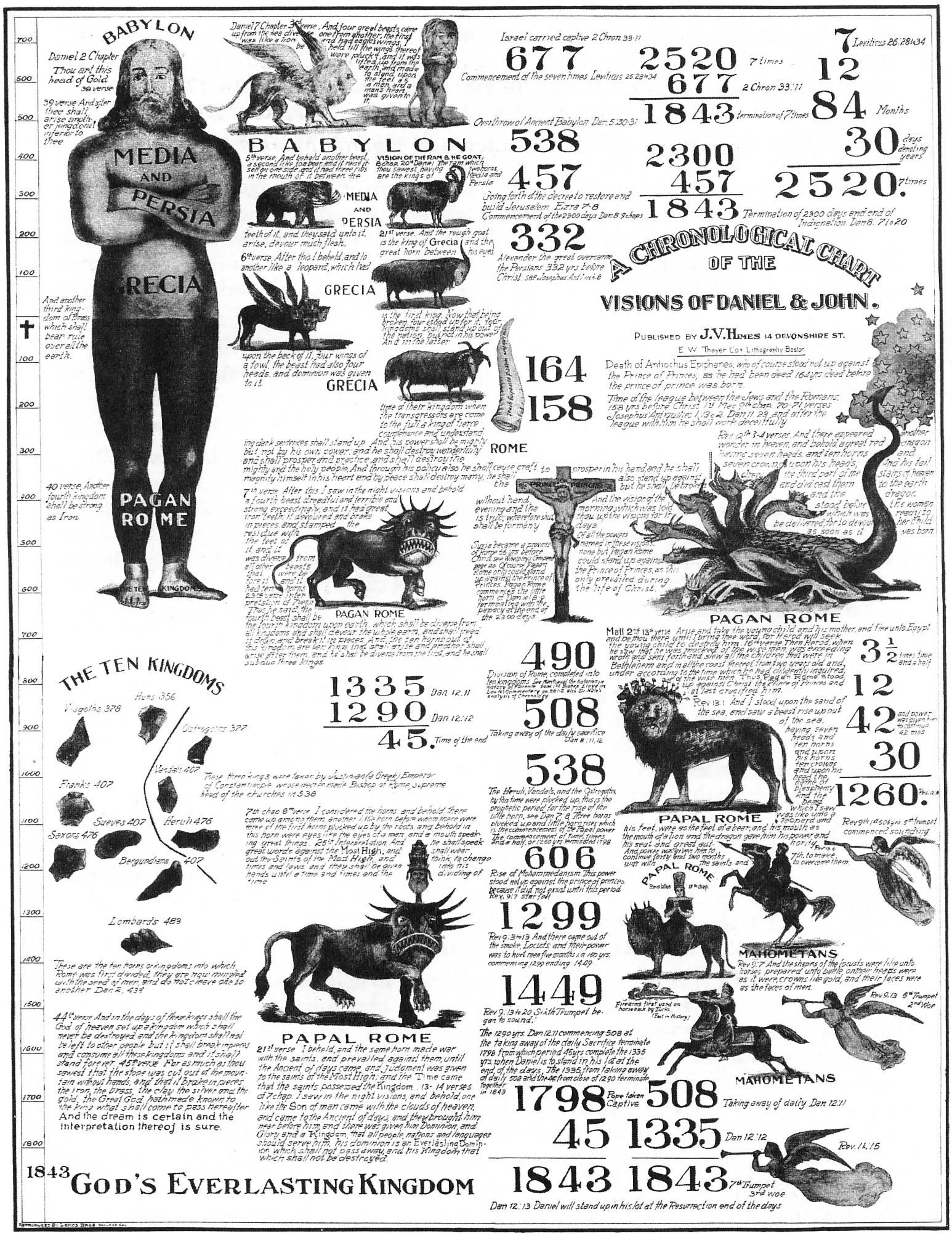
Click to enlarge this iconic Millerite poster from 1843, which deciphers prophetic math from Daniel and Revelation. Would like to see a black light version of it. Degree of difficulty: 9 out of 10.


From Isaac Cummings Wellcome, History of the Second Advent Message and Mission, Doctrine and People (1874). Degree of difficulty: 7 out of 10.


And finally, this one from a copy I picked up back in seminary days, Clarence Larkin, The Dispensational Truth: God's Plan and Purpose in the Ages (1920). This handsome text has some real mind-blowing charts in it. Degree of difficulty: 8 out of 10.


Related Posts Plugin for WordPress, Blogger...