Tampilkan postingan dengan label Randall Stephens. Tampilkan semua postingan

Jumat, 02 Desember 2011

The Anointed, the Cross, and the Lynching Tree

by Edward J. Blum

When W. E. B. Du Bois remembered his time as a student at Harvard University in the late nineteenth century, he recalled an unsettled feeling toward science. It was there than he “began to face scientific race dogma” in the form of “evolution and the ‘Survival of the Fittest.’” Beyond the classroom, he walked into a museum and stood before a demonstration of humankind’s supposed development. He witnessed, “a series of skeletons arranged from a little monkey to a tall well-developed white man, with a Negro barely outranking a chimpanzee.” Needless to say, Du Bois wasn’t happy with what he saw. He spent the rest of his career trying to undermine the “scientific” evidence that placed people of color below whites, and Du Bois saw it as his religion to destroy white supremacy.

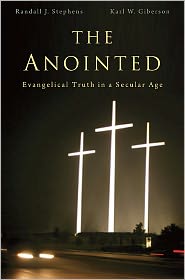
I was reminded of Du Bois’s museum experience at the American Academy of Religion. On the way there and then home, I read two new books on the power and place of religion in twentieth and twenty-first century America, beginning with The Anointed: Evangelical Truth in a Secular Age by Randall J. Stephens and Karl W. Giberson. Although for very different reasons, the characters studied here shared Du Bois’s displeasure with modern science and especially its focus on evolution. Evangelical experts hate The Anointed, even though many of them haven’t even read the book yet. Some who did thought Stephens and Giberson should have published with another press, one that evangelicals would pay attention to and respect. Liberals seem to love it, even though many of them acknowledge having only read the New York Times piece on it and not the entire book.

Having actually read each page, I can say that this is a terrific book of American religious history. Stephens and Giberson take the reader through the “parallel culture” of many contemporary evangelicals. We tour Ken Ham’s creation museum in Kentucky; we read primary sources with David Barton as he searches for any and all connections between the founding generation and Christianity. We struggle with James Dobson on how to raise children in a multicultural, pluralistic, media-driven world that seems to accept homosexuality as never before. And we rambunctiously and anxiously await Christ’s return with Hal Lindsey and Tim La Haye. We search with Paul Miller, an earnest Christian in New England, to find the right kind of ideas to satisfy evangelical souls.

Sure, evangelical readers won’t like the tone of the book. Stephens and Giberson don’t pull punches. They think Creation Science is “weak science”; they think David Barton is an “amateur.” They think Dobson is “strangely obsessed with homosexuality.” And they wonder about the credibility of some Christian colleges. It strikes me that there is a problem with the tone of the book, but not for the same reason that evangelicals dislike it.

I think the tone issue could have been transformed by a more sophisticated analysis. Stephens and Giberson seem so intent to pull the curtain back from these so-called experts that they miss when and where their expertise becomes a civic problem: their parallel cultures are fine, interesting, indeed even fascinating, until they run into the public, civic, and legal spheres of classrooms and courtrooms. If Stephens and Giberson had clarified when and where “experts” become social problems, then perhaps the authors could have embraced the ingenuity of many of these “evangelical entrepreneurs” or "holy mavericks" (as Shayne Lee and Phil Sinitiere refer to some other leading evangelicals) on their own terms but then challenged them when the issue became the “common good.”

Let me give one farcical example, but other, more realistic ones, are easily imaginable. As scholars, we can think deeply about the meaning of bumper stickers that read: “In case of rapture, this car will be unmanned.” On one hand, this is an inventive commodification of theology; it is a humorous display of one’s faith – a kind of missionary effort that subtly cajoles others to consider that at any moment Jesus could come back. This theology becomes a problem, though, if this individual is so certain of his end times theology that he doesn’t pay taxes, that he refuses to vaccinate his child yet sends her to public schools, or that he refuses to wear a condom when having sex with an individual and hides his knowledge that he has a sexually transmitted disease. At this point, his claim, “trust me, the end is near” is a major problem. It directly impacts the lives and well beings of others. It would have been nice if Stephens and Giberson worked out how and why the distinct contexts where “expertise” is deployed matter.

The Anointed may not convince a lot of evangelicals to abandon their experts, but I fully expect it to work well in US religious history classrooms. Each chapter could be the focus of a particular historical theme: David Barton could be used to discuss how historians have characterized the place of religion and the role of God; Ken Ham could be used to discuss the intersections of religion and science that would include the Scopes trial; James Dobson could get a class into religion, family, and sexuality; and Hal Lindsey can bring us into notions of prophecy, millennialism, and the end times. I imagine teaching this book by developing historical narratives to get to each chapter’s character, have students locate documents in the genre, and then debate the histories, what students found, and what they think of the folks Stephens and Giberson discuss. I think it will lead to a vigorous dialogue, where hopefully no evangelical in the class would feel threatened or discriminated.

After a wonderful time at the AAR, which each year should commission a team of ethnographers to detail the enigmatic people, events, and performances that make it the New Orleans of conferences, I flew home with a treasure in hand: James Cone’s The Cross and the Lynching Tree. It’s a book I’ve been long waiting for, since Professor Cone and I had many e-conversations about how to consider lynching as a fundamental religious problem in American history. The book is simply marvelous. Part autobiography, part history, and all cutting theology, The Cross and the Lynching Tree argues that in the United States neither the cross, nor the lynching tree can be understood independent of one another. Individual chapters detail the centrality of lynching to the spiritual core of black American faiths, the failure of Reinhold Niebuhr and his Christian realism to deal with lynching and racial violence, the brilliance of King’s theological vision for his ability to live his theology of the cross, the creative renderings from African American writers and artists of black lynch victims as Christ figures, and some particular ways black women have grappled spiritually with racial violence. Cone concludes that the lynching tree “is the window that best reveals the religious meaning of the cross in our land.”

The Cross and the Lynching Tree is terrific book. Readable, short, and to the point, it re-paints our thinking about race, religion, violence, and theology in the twentieth century. When it came to racial violence, Reinhold Niebuhr stands out neither as ideologically prophetic nor as intellectually powerful. He stood by as his former church in Detroit refused to integrate; he wallowed in self and group pity when African Americans died. Black writers and artists, in contrast, take on the “wild beast” of white supremacy and “fight it” with poetry, paintings, and prose. I couldn’t agree more with the wonderful theologian Shawn Copeland’s endorsement of the book: “At the heart of Cone’s critique lies a passionate quest and challenge for the beloved community. James Cone teaches us still. Will we finally learn?”

After finishing Cone’s wonderful book, I felt grateful that I had learned so much from him over the years. And then I looked back at The Anointed and I thought about all the fuss and fury it has and will evoke. I thought about the earnest Paul Miller and his search for a “secular” friend. I wondered if he had any African American friends. I thought about evangelicals pouring millions of dollars into a Creation Museum, but bristling at any reference to reparations for past wrongs. I thought about end-times theology and how it so often justified white “realism." Billy Graham responded to Martin Luther King Jr.’s “I Have a Dream” speech by saying that only after Jesus returned would white and black children play together. Almost a century earlier, Dwight Moody told revival stories of African Americans knowing that their “freedom” and “liberty” would only be true in heaven. Given the other forces evangelicals have been willing to fight with fiery speeches, bloody battles, and billions of dollars – Communism, secular humanism, abortion – why they were so unwilling to put power and military might to work against racism makes them sound either as cowards or as liars.

The white evangelicals in The Anointed and those who so militantly attack Stephens and Giberson for analyzing them without kid gloves may be blind to the world Cone discusses and the work race does. Evangelicals can obsess over issues of museums, child-rearing manuals, and the Founders relationship to religion because they have not and do not suffer as African Americans have or as gays, lesbians, and transgendered individuals have. All individuals suffer – to be alive is to suffer at some point. But white evangelicals don’t suffer from structures; they don’t suffer from systems. They may not like certain venues in American society, but no water fountains have been designated “liberal only” and no evangelical has been murdered in the United States because he or she was evangelical. Cone ends where white evangelicals refuse to begin, the places where they never have to go: racial realities of everyday life.

Where is “the gospel of Jesus’ cross revealed today”? Cone asks at the end of his work. His answer is specific and off the radar of the anointed evangelicals: “the criminal justice system where nearly 1/3 of black men between ages of 18 and 28 are in prisons, jails, on parole, or waiting for their day in court.” If one really believes that the age of the dinosaurs, or the private letters of the founders, or the possibility of their sons coming out as gay, or the possibility that Obama may be the Antichrist, are the most pressing moral problems of our age, then a bunch of black men in prison will concern them about as much as the history of enslavement, the plethora of violated land treaties, the brutal past and present of American colonialism, and the lynching of black America. They probably won’t read Cone’s book, but we can wonder. Why do they cry so loudly about The Anointed when they could sob softly and humbly about The Cross and the Lynching Tree?

Rabu, 23 November 2011

Opening of the Evangelical Mind?

Paul Harvey

My co-blogmeister and most excellent historian Randall Stephens and his co-author Karl Giberson have recently been called (among other things), wolves in sheep's clothing, dangerous menaces to evangelicalism, and, best of all, unethical attack-dog researchers and writers -- the later from famed ethicist Charles Colson, in a matchless self-parody of old-time fundamentalist fury. As John Turner noted here recently, after Randall and Karl's book The Anointed, some have felt there is no hope left for America. (It bears mentioning that most of the above noted did not actually read the book but scanned, and that inaccurately, Randall and Karl's New York Times editorial). As a writer for the always thoughtful and temperate National Review opined, "once left-wing values enter the evangelical bloodstream, there is almost no hope for America."

You might have noticed that some of these initial reactions are an eensy-weensy bit overwrought. Fortunately, we have a good antidote today in Scott McLemee's Inside Higher Ed column. As McLemee points out, "Neither an expose nor a screed, The Anointed is the work of educated evangelical Christians who reject the kitsch and anti-intellectualism that outsiders tend to equate with faith itself." Read the rest here.

Rabu, 09 November 2011

Reviewing the Anointed

by Matt Sutton

Part I: Anointing the Anointed

Randall Stephens and Karl Giberson’s book The Anointed has officially been out for two weeks. As reviews begin to appear, it is clear that this is one of the most important—and controversial—books on religion in modern America to appear in some time.

Booklist summarized, “[Stephens and Giberson] rise triumphantly to the challenge of explaining the leaders and the culture of the religious Right without rancor or condescension.”

The ever present Kevin Schultz wrote a smart review for the Wilson Quarterly concluding, “One of the principal virtues of The Anointed is that it represents an effort to demonstrate that the evangelical community is not a monolith of the unthinking.” He did, however, include a caveat. “Yet if that were as true as the authors hope, they probably would have felt less pressed to write this book.”

The Weekly Standard also wrestled with Stephens and Giberson’s arguments. But rather than praise their work, the review admitted half-heartedly that the authors were “not wrong.” I guess that’s as far as the Standard can go in praising a book that does not line up with the magazine’s politics. Nevertheless, “not wrong” is certainly better than being “not right.”

On the Huffington Post, Mark Pinsky used The Anointed to discuss the relationship between evangelical Zionism and the 2012 campaign.

Finally, my review of the book is in the current Christian Century. I conclude,

“The Anointed is one of the best and most important books on religion published this year. It is a well-written, well-argued study that penetrates to the heart of modern evangelical culture. Stephens and Giberson have done an excellent job of critiquing what Mark Noll previously called the ‘scandal of the evangelical mind’ (the scandal is that there is no evangelical mind) while also empathetically explaining why so many evangelicals are smitten by dubious experts. This book deserves a wide reading, which it is certain to have. Evangelicals who take the intellect seriously as well as outsiders struggling to understand the evangelical subculture will benefit from the hard work and keen insights of Stephens and Giberson.”

Part II: Annoyed by the Anointed

But it is not all butterflies and sunshine for Giberson and Stephens. They have managed to offend a few of the most influential (or at least a couple of the loudest) voices in evangelicalism.

First, as Randall has explained, Ken Ham has been complaining about this book, inferring that the authors might be wolves in sheep’s clothing. In fact, the title of one of his blog post was the none-too-subtle “Beware of Wolves.”

Then Al Mohler jumped in. In a blog with the equally none-too-subtle title “Total Capitulation: The Evangelical Surrender of Truth,” Mohler too questions the faith of the authors—not the argument of the book, but the faith of the authors. He writes, “Giberson and Stephens are far outside of the evangelical mainstream, and they know it.”

Apparently he gets to decide what is and is not the evangelical mainstream (which also means that Eastern Nazarene’s administration and tenure committees are not as capable of determining what counts as an evangelical as is this Southern Baptist).

The response of Mohler and Ham is predictable. They are afraid to let their audiences think for themselves. They simply want to teach them what to think. So when a book comes along that challenges what they teach and believe, they react by questioning the faith of its authors. Rather than trusting that their followers are smart enough to analyze critically a book like The Anointed, they choose instead to scare their disciples into not reading at all. It’s easier that way. If their followers don’t read, they won’t ask questions.

In 1940 fundamentalist leader and Moody Bible Institute president Will Houghton lamented to Wheaton College president J. Oliver Buswell, “it takes very little to start a fight with some fundamentalists.” Because fundamentalism by that time had developed such negative and combative characteristics, men like Houghton and Buswell began calling themselves evangelicals.

Seventy years later, the evangelicalism of Ham and Mohler suffers from the same problem as old time fundamentalism. Rather than celebrate the fact that two Christian professors from a Nazarene school have published a wonderful—although not perfect—book with one of the most prestigious academic presses in the world, they insinuate that the authors’ faith is suspect. I guess we shouldn’t be surprised. Houghton certainly would not be. Fundamentalism is still alive and well as Stephens and Giberson so carefully document.

Jumat, 04 November 2011

Evangelicals in the Electorate: Public Lecture and Forum

by Paul Harvey

Here's an opportunity for those of you especially in the Boston area to hear my co-blogmeister and other prominent scholars in action, next Thursday:

Evangelicals in the Electorate: A Public Lecture and Forum
Thursday, November 10, 6:30 - 8:00 P.M., Suffolk University

Although some dismiss Evangelical Christians as zealots with uncommon social politics and little regard for science, this powerful voting bloc is a force to be reckoned with in our democracy, and likely misunderstood. Dr. John C. Green, Senior Research Advisor at the Pew Forum on Religion and Public Life, presents empirical data on what evangelicals actually believe based on surveys of clergy and parishioners. Authors of The Anointed, Dr. Karl Giberson and Dr. Randall Stephens, provide an analysis of intellectual authority within this group and examine themes ranging from Creationism to messaging. Ford Hall Forum Board member and former religion reporter for the Boston Herald Eric Convey converses with these sociological researchers to predict how Evangelical Christians’ true values will translate into civic action.

Drs. Randall Stephens and Karl Giberson will be selling and signing
copies of their book, “The Anointed: Evangelical Truth in a Secular Age” at the end of the event.

Thursday, November 10, 6:30 p.m. to 8:00 p.m.
C. Walsh Theatre, Suffolk Universit
y

Selasa, 25 Oktober 2011

No More Hope for America

by John G. Turner

Last week's NYT op-ed by Karl Giberson and our own Randall Stephens has generated plenty of attention.

Such controversy continues today at National Review Online, where Dennis Prager concludes:

If these professors typify the views of Eastern Nazarene, which is officially listed as a Christian university, it is reason for despair. Once left-wing values enter the evangelical bloodstream, there is almost no hope for America.

I suppose the "almost" means that there is still a slim, glimmer of hope left. Thanks goodness.

Selasa, 18 Oktober 2011

NY Times Editorial: The Evangelical Rejection of Reason


Kelly Baker

While John Turner aptly describes "dominionists on the loose" and the media brouhaha over the threat of theocracy via Christian dominionism, our own Randall Stephens, writing with Karl W. Giberson, had a New York Times editorial aptly titled, "The Evangelical Rejection of Reason" published yesterday. Coming on the heels of their book, The Annointed Age: Evangelical Truth in a Secular Age (reviewed here by Chris Beneke), they argue convincingly about the war on science as "part of a politically monolithic red-state fundamentalism, textbook evidence of an unyielding ignorance on the part of the religious" as well as map out the anti-intellectualism inherent in these attacks. Randall and Giberson make distinctions between their own evangelicalism and the politicized vision of current Republican nominee hopefuls.

Here's an excerpt:
As one fundamentalist slogan puts it, “The Bible says it, I believe it, that settles it.” But evangelical Christianity need not be defined by the simplistic theology, cultural isolationism and stubborn anti-intellectualism that most of the Republican candidates have embraced....

Fundamentalism appeals to evangelicals who have become convinced that their country has been overrun by a vast secular conspiracy; denial is the simplest and most attractive response to change. They have been scarred by the elimination of prayer in schools; the removal of nativity scenes from public places; the increasing legitimacy of abortion and homosexuality; the persistence of pornography and drug abuse; and acceptance of other religions and of atheism.

In response, many evangelicals created what amounts to a “parallel culture,” nurtured by church, Sunday school, summer camps and colleges, as well as publishing houses, broadcasting networks, music festivals and counseling groups. Among evangelical leaders, Ken Ham, David Barton and James C. Dobson have been particularly effective orchestrators — and beneficiaries — of this subculture. (Continue reading here.)

Editor's note: Also check out John Fea's discussion of the editorial here.

Rabu, 05 Oktober 2011

Wolves in Sheep's Clothing; or, Knowing Them by Their Fruits

Chris Beneke

You might have anticipated that Randall Stephens and Karl Giberson's new book, The Anointed, would cause a stir. Just two weeks after arriving on shelves, it already has. Yesterday, Ken Ham, co-founder of the Creation Museum in Petersburg, Kentucky and CEO/President of Answers in Genesis (AiG) USA suggested on his blog that the authors were like wolves intent on destroying God's flock. (by the way, there's another interesting passage on wolves in Mat 7:15)

Meanwhile, at the affiliated AiG blog, Georgia Purdom and Mark Looy observed flatly that: "[Stephens and Giberson] argued that when Bible-believing Christians engage the culture in controversial areas like creation vs. evolution, believers should trust a highly educated PhD theistic evolutionist and evangelical like Dr. Francis Collins over someone like Ham (who has the Australian equivalent of a master’s degree)." I suspect that Stephens and Giberson would respond that credentials aren't irrelevant, but they aren't the real issue here (see: Herberg, Will). Rather, it's the misuse or wholesale neglect of critical facts that distinguishes rigorous, honest scholarship from the work of self-anointed experts such as Ham.

The Anointed is itself an example of how the preponderance of evidence can be mustered to make a well-supported and coherent argument. The first four chapters feature trenchant accounts of fundamentalist-leaning authorities--Ham, whose Creation Museum draws tens of thousands of visitors every year; David Barton, whose highly selective readings of early America have captivated multitudes of believers, including Michelle Bachman and Glenn Beck; James Dobson, founder and former president of Focus on the Family whose influence on understandings of gender roles and child-rearing rivals Dr. (Benjamin) Spock; and Tim LaHaye whose bestselling Left Behind novels foretell the imminence of the rapture and the dismal fate of unbelievers.

Ham, Barton, Dobson, and LaHaye are leading intellectuals in what Stephens and Giberson refer to as an evangelical "parallel culture," which also includes Christian "publishing houses, music labels, and colleges." Chapter Five offers a revealing glimpse of a young male evangelical, Paul Miller, who grew up ensconced in this devotedly non-secular world. Chapter Six details the ascendancy of three figures that even regular readers of Salon would recognize: Oral Roberts, Jerry Falwell, and Pat Robertson.

Part history and part ethnography, The Anointed reveals the authors' serious and sympathetic engagement with the challenges confronted by evangelical thinkers. Indeed, at critical moments, the book defers to accomplished and believing scholars (especially Francis Collins and Mark Noll) who work tirelessly to reconcile their faith with modern science, history, and biblical interpretation. And that leads to the question: If there are legitimate evangelical contenders for intellectual influence, how did gross abusers of facts such as Ken Ham and David Barton end up wielding so much influence?

As with so much else that we experience as mere mortals, the explanation is neither simple nor certain. For starters, Stephens and Giberson suggest, there is the Anointed's alluring confidence that their work reflects God's will. This same characteristic helps account for their tendency to personal hubris and their aversion to generally accepted information about the world. Stephens and Giberson also credit a longstanding “common-sense populist hermeneutic” that is by no means confined to evangelicalism, but certainly buttresses the Anointed's case against mainstream scholarly authorities. The best explanation for their preeminence may simply be that they are really just attempting to engage a religious group in a theological enterprise, rather than social science, natural science, or history. By repeatedly and skillfully asserting the seamless connection between their own interpretation of scripture and their misbegotten understanding of the facts, they never really have to demonstrate any of it. With help from Stephens and Giberson, more people may come to know them by their true scholarly fruits.


Related Posts Plugin for WordPress, Blogger...