Tampilkan postingan dengan label religion and foreign policy. Tampilkan semua postingan

Sabtu, 17 Desember 2011

An Interview with Owen Stanwood on The Empire Reformed: English America in the Age of the Glorious Revolution

Randall Stephens

Owen Stanwood is an assistant professor of history at Boston College and a scholar of early America and the British Atlantic world. He has published in the Journal of British Studies, the Proceedings of the American Antiquarian Society, the Virginia Magazine of History and Biography, French Colonial History. His wonderfully readable first book, The Empire Reformed: English America in the Age of the Glorious Revolution (University of Pennsylvania Press, 2011) looks at "how fears of Catholicism galvanized and transformed Anglo-American political culture during the last decades of the seventeenth century."*

In the interview below I ask Stanwood about his research and writing on antipopery, the intersection of politics and religion in the 17th and 18th centuries, the workings of empire, and the state of the field.

Randall Stephens: You write about the significance of English antipopery in the 17th century. What impact did antipopery have on the political and social order of the age?

Owen Stanwood: Early modern antipopery was above all a language, a form of discourse. Protestants considered "popery" to be a binary opposition to their own, true religion, and thus used conversations about the nature of popery to define the contours and boundaries of their own faith. In the English context, this had both theological and political effects. In the church, different kinds of English Protestants, whether high church Episcopalians or Puritans, critiqued the other side by pointing out their similarities to Catholicism. These same debates often carried over into politics, since many people believed that the theology of popery usually coincided with tyranny and absolutism. So on a number of occasions, most notably the English Revolutions of the 1640s and 1680s, people justified overthrowing their kings by claiming that the monarchs intended to overthrow the true Protestant church. These charges, of course, were usually false, but they had great rhetorical power.

Stephens: Fears of Indian and Catholic plots in the late 17th century, you observe, fueled colonial anxieties. Did New England colonists see those as combined forces?

Stanwood: For most of the 17th century, they did not. Even as late as King Philip's War in the 1670s, most New Englanders saw Indians and Catholics as distinct threats. From the 1670s through the 1690s, an important transition took place. American colonists gradually began to conflate these dangers; they started to believe that Indians were not independent actors, but simply shock troops used by French papists to carry out their bloody schemes. This was important for a number of reasons. For one thing, it represented a molding of the European anti-Catholic tradition to fit conditions in America. And it ended up changing the way colonists perceived Indians. If they had earlier been targets for conversion, and possible allies against Catholic enemies, now they appeared to many English as unconvertible enemies debauched by Catholic superstition. In my mind, this led to new, even more poisoned relations between whites and Indians in the 18th century—and provided a key context for the political transformation that lies at the heart of my book.

Stephens: Could you say something about how militant Protestantism shaped the founding of the American colonies?

Stanwood: Militant Protestantism affected the colonies from the very beginning. First off, English overseas endeavors had a Protestant purpose from the early days of colonization, in that the English, along with the Dutch and French Protestants, wanted to provide a Calvinist counterweight to the Spanish and Portuguese, who dominated the New World. In time the English state stepped back from these religious motivations, but during the seventeenth century the American colonies became favorite refuges for any number of English and European radicals. The Puritans and Quakers are the most well known of these groups, but by the 1680s the colonies from New England to the Caribbean abounded with all kinds of Protestant rebels, from Scottish Covenanters to English Baptists to French Huguenots. Many of these people fled what they considered Antichristian tyranny in Europe, and made it their imperative to keep America Protestant. This is important to remember when we try to understand how imperial politics developed.

Stephens: You write that the “story of the making of empire must necessarily be both intensely local and transatlantic in scope.” How did the aims of London officials and the goals of New World colonists come into conflict? From your reading of the sources, how did empire “work” in the late 17th century?

Stanwood: During the 1670s and 80s officials and colonists feuded for a number of reasons. Essentially, the crown wanted to create a more streamlined, centralized empire to replace the hodgepodge of local arrangements that characterized the 17th-century empire. This reform stepped on a lot of toes, as many of those who had the most power in the colonies found themselves out of favor. It only became a popular movement, however, when ordinary people began to see imperial reform as something that threatened them. Many people started to see imperial reform as part of a massive Catholic plot—mainly because the main proponent of these reforms, King James II, was Catholic, and because people associated centralized power with the pope and Catholic rulers like France's Louis XIV. As people became more frightened and distrustful of their leaders, the empire hardly worked at all; in fact, it was laughably dysfunctional. What all of this suggests is the importance of political rhetoric in running an empire. During the 1680s, rulers were not speaking the same language as the people, and this doomed the first plans for imperial reform.

Stephens: Would you say something about how political unrest in London reverberated across the Atlantic?

Stanwood: The political unrest that most concerns me is the "Glorious Revolution" of 1688-89, when James II lost his kingdom to a popular rebellion led by the king's daughter Mary and her Dutch husband William of Orange. The effects of this revolution in the colonies were manifold. Many of James II's colonial governors were hard at work reforming the empire, and once colonists heard that the king had fled England for France, they believed that their leaders intended to betray them to the enemy. A series of outrageous rumors circulated from Barbados to Boston, telling of a coordinated design by the French, Indians, Irish servants, and James II's cronies to replace the English system with "popery and tyranny." False though they were, these rumors led to popular rebellions in three colonies, and also provided a language—that of paranoid antipopery—that future imperial leaders could use to keep the empire together.

Stephens: How do you think historians’ understanding of the religio-political milieu of early America has changed in the last 30 years?

Stanwood: There have been two very important transformations, both of which have influenced my research. First, historians of early American religion, like early Americanists generally, have moved away from a national narrative and turned toward a transatlantic one. They now understand that phenomena like Puritanism or early evangelicalism cannot be understood as purely American, but as global movements. In a linked development, historians of religion have turned much more toward popular or "lived" religion, an understanding of how the beliefs of ordinary folks had an impact on history. My book builds on both of these traditions, in that I show how the religious beliefs of ordinary people—in this case, regarding the evils of Catholicism—led to important political changes that altered the face of global politics.
Senin, 12 Desember 2011

The Mainline Protestant Moment? Or Embattled Ecumenicists?

Paul Harvey

In the previous post about recent scholarship on Mormonism, Elesha wondered, in a facetiously self-interested sort of way, "what it would take to generate a mainline moment in scholarship" (earlier twentieth-century Protestantism being the topic she's working on). A cynic might flippantly say, "well, they had their 'moment,' and it lasted many decades," and I might say that we had a classic product of mainstream Protestantism (the UCC) run for President, and win, in 2008, and it produced not a "moment" but instead hysterical cries about the radical agenda. Can't wait for Round II of that next year.

But Curtis Evans answered more seriously and helpfully in the comments section, by by pointing to some significant moves in that direction, including David Hollinger's OAH Presidential Address, discussed with wonderful insight by David Stowe on our blog here.

And even more seriously, I'm starting to think the moment may be here, albeit focused more on the middle of the century, from the Depression through the Vietnam War, than the earlier part of the century which excellent younger scholars such as Elesha, Curtis, and Matt Hedstrom are investigating.

I was thinking this over as I recently read through Jill Gill's mammoth work of scholarship Embattled Ecumenicism: The National Council of Churches, the Vietnam War, and the Trials of the Protestant Left. Students: if you want to know how to mine the archives effectively, check out the footnotes to this doorstopper.

This is a work that deserves to be called “definitive.” Gill’s comprehensive study of the National Council of Churches and the Vietnam War covers the subject exhaustively. But more than that, the book is a re-examination and, in part, a rehabilitation of mainstream Protestantism in the middle years of the twentieth century. Historians recently have focused attention on close studies of the origins, rise, and politicization of the religious right. Gill’s work counters that trend with a sympathetic, although certainly not uncritical, examination of Protestants who were at once part of “the establishment” but increasingly distanced themselves from it because of the bitter disillusionment of the Vietnam War. Gill also explores the meanings and purposes of “ecumenism,” an ancient Christian ideal that the author finds worthy of a deep reconsideration. The irony is that ecumenism splintered in the face of a conflict where religious leaders managed to unite many mainstream Protestants against the war while serving as “generals without armies” (in the cynical but fairly accurate words of Dean Rusk) and being manipulated first by LBJ and then Nixon. The Vietnam War fractured the Protestant center-left, and helped pave the way for the rise of a resurgent religious right.

In some ways, Gill's book helps explain how we get from John Foster Dulles (a paragon of the mainline Protestant establishment in the 1950s), to the embattled ecumenicists of the 1960s -- in but no longer of the establishment -- to the prophetic but increasingly ignored or irrelevant voices of the 1970s, and the "radical preachers" which Obama-haters promise to resurrect from the dead in 2012, there to play a walk-on part in their war.

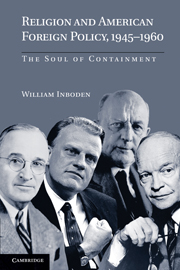
Reinforcing my view of a new generation of rising scholarship on the "mainstream," this evening I flipped through a recent edition of Reviews in American History, containing a really thoughtful exploration of William Inboden's Religion and American Foreign Policy, 1945-1960: The Soul of Containment. Inboden's work is also reviewed nicely, closer to the time of its publication, here.

Pretty much unbeknownst to me, apparently the pages of the journal Diplomatic History and other scholarly venues have been full of debates about the causal links (if any) between "cultural" factors such as religion and foreign policy decision-making. The reviewer asks, "How does one demonstrate conclusively that cultural phenomena do more than merely condition, or provide context for, the actions of foreign policy-makers?" He cites some skeptics of the "cultural turn" in foreign policy studies, asking skeptical questions to that effect. He then suggests that "more adeptly than any other product of the 'cultural turn' in foreign relations history, Inboden's book demonstrates this causative link between religion and diplomacy." The father of containment, George Kennan, wasn't much for any of this, but once it took hold his idea quickly moved far beyond the intentions of its creator, much to his dismay and exasperation.

These are all works about the "mainstream" from the inception of the high period of the Cold War through the trials of the 1960s -- a period when mainstream Protestants (with considerable sprinkling of folks from other parts of "tri-faith America," of course) were, to a sizable degree, the people who ran everything. I might add that I've just skimmed through another recent work, The Spiritual-Industrial Complex: America's Religious Battle Against Communism in the Early Cold War, recently out with Oxford, in which the mainliners are the central actors. We'll have more extensive coverage of this book on the blog a bit down the road; in the meantime, click the link for interesting coverage and analysis of the book. The review linked above begins:

IN A LETTER to the Vatican in 1947, Harry Truman characterized the United States as a “Christian nation.” For Truman this was likely a statement of fact, an obvious description of what America was and would long remain. For Jonathan Herzog, Truman’s phrase explicates an entire epoch in American politics. The title of his book, The Spiritual-Industrial Complex, inverts Dwight Eisenhower’s warning about a military-industrial complex, suggesting instead a fusion of governmental power and religious zeal.

Darren Dochuk's piece for Perspectives, "Searching Out the Sacred in U.S. Political History," summarizes much of what I'm saying here. After a discussion of the plethora of scholarship on evangelicals and fundamentalists, he goes on to add that

But religion was not just for the downtrodden or embattled; at mid-century it still dictated the dreams of the political elite too. Perhaps no other subset of political history has undergone a more profound shift lately than diplomatic history. Rendered too conventional by some in the 2000s, diplomatic history has emerged in the 2010s as a dynamic field revitalized by new interests in gender, NGOs, globalization, "soft power"…and religion. One exemplary byproduct of this renaissance is William Inboden's Religion and American Foreign Power, 1945–1960, which argues that Protestant notions of liberty and freedom informed U.S. officials' efforts to construct a "godly" front against "atheistic Communism." Once Dwight Eisenhower molded them into a more inclusive, civil religion of American exceptionalism, these notions also came to inspire Jews and Catholics around the world in a broad offensive against the Red Menace. Such was the spiritual essence of U.S. containment strategies, and as Inboden, Andrew Preston, Jason Stevens, Mark T. Edwards, and others emphasize, America's most powerful emissaries never took this essence lightly.

In their minds, America's fight against foreign evils was God's fight against foreign evils, rendering any clean distinction between faith and international relations artificial. If public theology was a wedge for American hegemony abroad, it could also be a subversive influence at home, something historians now stress when talking about the civil-rights era. As Joseph Kosek has shown in Acts of Conscience, even while many public intellectuals championed American imperialism, some spoke out against the prevailing orthodoxy. Reconciliation and brotherhood rather than conquest grounded their creed, fusing their interests with a broader crusade for human rights. These same principles enlivened the "prophetic" strand of Protestantism that bound the southern civil rights movement together. Rooted in an Old Testament tradition that roused black and white activists alike, this prophetic theology, David Chappell shows in A Stone of Hope, sacralized self-sacrifice for social justice and paved the way for nonviolent revolt throughout the South. Chappell's conclusions are now being enriched by studies of civil rights activism in the West. Scott Kurashige, Shana Bernstein, and Mark Brilliant have all shown that multiethnic religious agencies in 1940s California helped trigger the assault on American apartheid.Inspired by this state's rich but contested religious pluralism, they helped marshal local resources and resolve for a nationwide war against Jim Crow and all its intolerances, one they would win in the 1960s.

So what say you, Elesha and others -- is there another mainline moment being born? Perhaps the center could not hold, but its few decades of remarkable power and then fragmentation mark mid-twentieth century American history in ways historians are still fruitfully investigating.

Minggu, 27 Februari 2011

Tues, March 1 Symposium on Religion and Politics in DC

Religion in American Politics and Society: A Model for Other Countries?

Tuesday, March 1, 2011 at 9:00 AM, Copley Formal Lounge, Georgetown University, Lunch will be served.

Keynote address by Roman Catholic Archbishop Charles Chaput of Denver

Featured panelists include Imam Feisal Rauf, Rabbi David Saperstein, Jim Wallis, and John Witte

These and other panelists will discuss the Jewish, Muslim, and Christian perspective in three sessions.

Is the dominant American approach to religion, society, and the state worthy of emulation in other countries? The question is not only academic, but it has policy implications both for the American future and for U.S. efforts to promote religious freedom and democracy worldwide. It intersects with global controversies about international norms, national self-determination, proselytism, and the rights of religious communities. On March 1, 2011, Georgetown University will bring together leading scholars and practitioners to discuss these issues. Three panels will examine these questions from the perspective of Judaism, Islam, and Christianity, respectively. Archbishop Charles Chaput of Denver will deliver a lunchtime keynote address. The symposium is sponsored by Georgetown's Berkley Center for Religion, Peace, and World Affairs and Edmund A. Walsh School of Foreign Service, and is made possible through the generous support of the Henry Luce Foundation.

For additional information including the day-long agenda, please see the event website.
Related Posts Plugin for WordPress, Blogger...