Tampilkan postingan dengan label 19th Century. Tampilkan semua postingan

Rabu, 02 Maret 2011

Interview with Jennifer Graber

Randall Stephens

[I crosspost here a selection from a short interview with Jenn Graber. The full interview is at the HS blog.]

"Americans incarcerate," writes Jennifer Graber in her new engaging book The Furnace of Affliction: Prisons and Religion in Antebellum America (University of North Carolina Press, 2011). "Though the United States has less than 5 percent of the world's population," she writes, "it has almost a quarter of its prisoners." Such facts make the long history of American prisons and their maintenance all the more interesting. Graber, an assistant professor in the department of religious studies at the College of Wooster, analyzes the "intersection of Christianity and politics in the American penitentiary system."* Her interesting account also looks at the religious dimensions of discipline and the ideas that undergirded punishment from the 1790s to the 1950s.

Randall Stephens: You write that antebellum Americans disagreed on much when it came to prisons, but most “affirmed religion's central importance” to prisons and reform. How was criminal justice “religious” in this era?

Jennifer Graber: If you were concerned about criminal punishment in the early republic, there were lots of things to fight about. Once the states began to build prisons, the big debate was between a discipline out of Pennsylvania that featured total solitary confinement and one out of New York that combined labor in workshops during the day with solitary confinement at night. Partisans for these two systems called the other side un-American and un-Christian. Beyond the rival disciplines, people debated the best way to reform inmates. They argued about what was more important: a good Sunday School teacher in Sing Sing or clean water and decent food in Sing Sing? Without fail, everyone interested in the debate claimed that “religion”—and they used the word “religion” even though they meant variations of evangelical Protestantism—was central to inmate reformation and the overall health of American prisons as strong institutions. What they didn't realize is that their common evocation of “religion” masked significant differences. For instance, they all thought that prison chaplains were necessary, but disagreed—sometimes violently—over the role these ministers should play inside institutions. Or, they all assumed that God ordained the civil authorities to punish lawbreakers, but varied on the question of that punishment’s severity.

Stephens: What kinds of problems did evangelicals target in the prison system? What can we learn about them by the sort of reforms they pursued?

Graber: Their first target was colonial-era punishments, whether it was steep fines, corporal punishments such as whipping or branding, or the gallows. They joined a trans-Atlantic movement to reform punishment and were active in the construction and administration of the first prisons. Protestant evangelicals—and I include many Quakers in this group, which might ruffle some historians’ feathers—envisioned the prison as an ideal site for prompting criminals’ conversion and reformation.>>>

Kamis, 10 Februari 2011

More on Rable, God's Almost Chosen Peoples

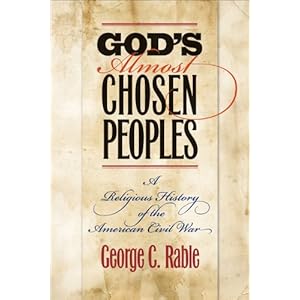
The outstanding Civil War Book Review, which has been a bellwether of scholarship on the topic for more than a decade, just posted their new issue for Winter 2011. Readers of this blog will be especially interested to read (or listen to) an interview conducted by editor Nathan Buman with George Rable about his new book, God's Almost Chosen Peoples: A Religious History of the American Civil War.

Following Paul and Ed, who have already given the book some attention here on the blog—and in good RiAH self-promotional style—I'll also draw reader's attention to my own review of Rable's book, just published in Civil War Book Review.

Here is an excerpt:


One of Rable’s major themes concerns the overwhelming significance of civil-religious providential understandings of the course of conflict. For his subjects the hand God was seemingly everywhere, guiding and shaping events in accordance with his will. All too frequently, that providential outlook was conflated—in ways consistent with patterns throughout American religious history to that time—with southern and northern nationalist aspirations. Perhaps this idea was stated most clearly in language approved by one northern Methodist conference in 1862: “Patriotism is a Christian virtue” (153).

Because of deep commitments to providentialism in the Civil War era, “religious faith could be both wind and weathervane,” where success or failure in battles showed adherents the ways in which they had met or fallen short of divine expectations, thus incurring God’s favor or wrath (7). Throughout the war, Union and Confederate officials, as well as local leaders and ministers, called routinely for days of fasting and thanksgiving in an attempt to make sure the public properly aligned itself with God’s will. Furthermore, despite innumerable difficulties, Rable contends that belief in providence maintained a remarkable resiliency. Not only did the religious “line between ‘loyalty’ and ‘disloyalty’” grow “ever-sharper” as the war dragged on, but after Appomattox, believers in the Union continued to understand their cause sanctioned by God (354). In the same way, defeated Confederates did not give up the belief in the righteousness of the cause lost.

Given the impressive amount of research displayed, the single most curious thing about God’s Almost Chosen Peoples is its self-professed lack of an overarching argument—in Rable’s words, it “is not a thesis-driven work” (6). Instead, he opts for a “broad narrative” that shows the centrality of religious belief for nineteenth-century Americans who needed to make sense out of the warring world they found themselves in (6). Rable’s choice will no doubt leave some readers grasping to impose coherence on an unwieldy and intimidating subject. However, because religious values were by no means uniform or monolithic in the Civil War era, and because Rable intends to cover the sweep of religious engagement with the myriad dilemmas that the sectional conflict raised, his broad narrative approach leads to a remarkable inclusivity with regard to topics and subjects.

Selasa, 25 Januari 2011

The Myth of American Religious Freedom: Interview with David Sehat

Paul Harvey

In the tradition of this blog of posting author interviews from recently published important works in our field (when we're not thinking about zombies, or finding paeans to Sarah Palin on YouTube), I'm pleased today and tomorrow to post a two-part interview with David Sehat, author of the new book The Myth of American Religious Freedom, just out with Oxford.

We've blogged about the book in pre-release before, and I made some false promises to put up a post about Sehat's book together with Sally Gordon's The Spirit of the Law. Sadly, that post will have to wait until the tsunami of the semester calms down a bit, but I believe putting those two books together provides a most stimulating narrative (complementary on some points, contrasting on others) of the intellectual (Sehat) and social (Gordon) history of the concept of religious freedom. In the meantime, here is part one of our interview with David Sehat. You may follow more of his thoughts from his book over at U.S. Intellectual History, where he is a contributor and has recently posted great stuff based on the book, and also check out his recent entry at the Huffington Post, which contains an extensive summary of some of the major themes of the book.
__________________________________________________________

Interview with David Sehat, Part I

Paul Harvey (PH): David, the central phrase in your book is "moral establishment," and you argue that for much of American history we have had a "moral establishment that connected religion and the state." Can you briefly define what you mean by this term for our readers, and why you have chosen to make it central to your book?

David Sehat (DS): Paul, thanks for reading the book and for interviewing me.


When I began researching this book, I was reading the letters and writings of a nineteenth-century agnostic named Robert Ingersoll. My intention was to write a book about American freethought or American agnosticism as a way of showing the informal power of Protestant Christianity. But as I read Ingersoll’s papers, I came across a case (he was a lawyer) that puzzled me. In 1886, he unsuccessfully defended a man named Charles B. Reynolds, who was being tried on two counts of blasphemy. I was stumped: How could a man be convicted of blasphemy nearly one hundred years after the passage of the First Amendment? As I went deeper into the case, my confusion grew. I discovered that blasphemy law existed for much of the nineteenth century, even if its enforcement was erratic. According to its proponents, criticizing Christianity or any elements of Christianity undermined the public foundation for morals. I also discovered that blasphemy was similar to many other kinds of law in that Protestant Christian ideas received the formal protection of law, which was a surprise to me. In other words, the judgments in this case, and many others, only made sense if Christianity was something like an official religion that relied upon the protection of the law.


To make sense of what was going on, I borrowed the idea of a “moral establishment” from the legal scholar John Witte Jr. Taking Witte’s concept further than he might have intended (and probably not in a way that he would agree with), I claim that the moral establishment involves the use of law to perpetuate Christian morals in society. The more I researched, the more I saw that this moral establishment was one of the chief mechanisms throughout American history by which Protestant Christian partisans maintained religious power over society in often illiberal ways.


PH
: You spend a good amount of time criticizing positions on the left and on the right of our current politics, in terms of how they employ religious history to make their favored points about religion/state issues (and moral issues generally). What do you think each side gets basically wrong about history, and if you were anointed Historical King, what would you tell your subjects about how to use history properly in framing arguments about present-day concerns?


DS
: I see both the Left and the Right as misguided in their understanding of the past. Both regard American religious history as a history of freedom that is threatened by the policies of the other side. But I don’t see U.S. history as a history of religious freedom. Instead, I see U.S. history as predominantly one in which Protestant Christians used law and politics to maintain religious power. That is evident in the case of blasphemy laws, but also in a host of other laws and practices that survived for much of U.S. history. It was only in the mid-twentieth century that the Supreme Court began dismantling this connection between religion and the state in order to mitigate religious power and to protect the individual. The Court’s actions caused religious conservatives to mobilize for the restoration of their past power, thus beginning the culture wars of the last fifty years.


So my problem with much of the political debate over the role of religion in public life, especially when that debate invokes history, is that the various parties are simply enacting the culture wars rather than using history to frame their arguments in a meaningful way. As a result, the history is bad on all sides. Liberals are too tendentious when they claim a separation of church and state in the past. To them, I say that Christianity was so thoroughly entwined with law and government that Protestant Christianity had significant power through its connection with the state. And I have to say that when conservatives claim that the United States was a Christian nation in the past, in a certain sense they are right. But I also have a problem with religious conservatives, because the past was not the Christian utopia that some of them claim. Christians relied upon law to protect their religion. And what law involves, above all else, is the coercive capacities of the state. So if we say that the United States was a Christian nation in the past, we must also say that it was a coercively Christian nation.


At bottom, I think all discussions about religion in public life have to acknowledge this past of religious coercion so that, while addressing present day concerns, we can be sure that we do not go back to that coercive past.


PH
: I have often used the phrase "de facto establishment," or "de facto Protestant establishment," in classes, to suggest something of the informal Protestant establishment of the 19th century (the phrase you use in the book is "informal religious establishment," which you then go on to critique as wrong). In effect, your book suggests that my phrasing is wrong, because it fails to capture the legally coercive nature of the moral establishment. So, can you tell me how, in classroom setting, I should explain to students how and why we had effectively a legal establishment even after the First Amendment said we couldn't have one?


DS
: Perhaps we can introduce more concepts than just “legal establishment.” First, we have to explain to students that the religion clauses of the First Amendment did not apply to the states until 1940. The Bill of Rights, for much of American history, applied only to the federal government: at the time when the First Amendment was ratified, six states still paid churches out of the public treasury and continued to be free to do so under the Frist Amendment. To put it most clearly: students need to understand that the First Amendment is really beside the point when we are talking about religious establishments and religious power prior to 1940.


Second, we can explain to students what exactly we mean by an “establishment.” As I mentioned earlier, I rely on John Witte Jr., who argues that there are three components of the American religious establishment: institutional, ceremonial, and moral. Institutional establishment is when states pay churches with public funds. Ceremonial establishment is when states incorporate an homage to God as part of their public ritual ceremonies (like swearing on a Bible or saying “So Help Me God” in the oath of office). And moral establishment is when states draw upon the moral ideas of Christianity (or Protestant Christianity) to craft their laws. When states finally decided to stop paying churches—in other words, when they did away with institutional establishment—there were still two other components of the American religious establishment in place.


I think the moral establishment is the most important because it enabled Protestant Christians to use the idea of morality to establish a special place for their religion in law. As a result, Catholics, Jews, Mormons, and freethinkers, along with a host of others who purportedly failed to demonstrate proper moral norms, faced an active and state-sponsored discrimination that grew out of Protestant legal control.


PH
: The American Missionary Association (AMA) was one of the primary institutional expressions in the nineteenth century of what you call the "moral establishment." Yet its vision for southern blacks after the Civil War, "education for citizenship," eventually gave way to what you call the "white Southern vision of the moral establishment . . . in which maintaining moral order, in this case with a decidedly racial cast, overcame the black argument for individual and equal rights." Do you see this as a case where the center of the moral establishment could not hold? Or I'll put the question another way, paraphrasing Randolph Bourne's famous question to John Dewey about the support of progressive liberals for World War I: if the moral establishment was so dominant, and so (as you frequently suggest) coercive, then how was it so weak as to not be able to prevent the coming of the Civil War, or do anything about the horrific carnage of the Civil War (except to give it religious meaning)?


DS
: This is a great question, thanks for asking it. I don’t want to claim that the moral establishment was all-powerful or even powerful enough to stop the Civil War. I want to make the opposite case: the issue of slavery split the moral establishment, with southern proponents claiming that slavery was an institution for the perpetuation of Christian society and northern proponents seeing slavery as a state-sponsored concession to evil and, therefore, not within the moral establishment. This split allowed for a host of dissenters, mainly radical abolitionists such as William Lloyd Garrison and women’s rights proponents such as Elizabeth Cady Stanton, to challenge the moral establishment by rejecting the idea that religious sensibilities should have a central place in public policy debates.


My narrative here tries to answer the same question that many other writers have sought to answer: why did this moment of liberalism and individual rights during Reconstruction prove so evanescent? I suggest that this liberal moment came into being through the division of the moral establishment over the issue of slavery, a division that gave proponents of individual rights the upper hand. The AMA, the dominant organization of the northern moral establishment after the Civil War, did in certain respects favor individual rights but, ultimately, its low view of black racial capacity meshed with that of the southern moral establishment. The moral establishment came back together after the Civil War around their desire for denominational harmony and their suspicion of black rights—in other words, around a shared distrust of individual rights. This allowed establishment proponents to again maintain their collective (and, in this case, racist) moral norms and undermined the Reconstruction moment of liberal individualism.


[2nd half of interview will be posted tomorrow; stay tuned!]

Minggu, 23 Januari 2011

A Wanton Woman

Paul Harvey

We've blogged here before about Leigh Schmidt's new biography of Ida Craddock; yesterday's All Things Considered on NPR features the book, and an interview with Schmidt -- and there's a review of it featured here. Here's a little excerpt from the written material accompanying the story:

Schmidt deals sentences just as lapidary as his subtitle (The Unpredictable Life of Ida C. Craddock, American Mystic, Scholar, Sexologist, Martyr, and Madwoman) leads us to expect. "Since the end of the eighteenth century," he writes, "a good number of freethinkers had seen such fertility symbolism as a rich lode to mine for anticlerical nuggets, but no woman had ever joined this particular fraternity of gentlemanly dilettantes and antiquarians." And later: "The pile of unpublished manuscripts that [Craddock] produced (on everything from lunar mythology to heavenly bridegrooms to animal rites) left little doubt about the extent of her egghead dedication."

You can read an excerpt from the book here, and our previous blogging on the book here. Also, Religion Dispatches has an interview with Schmidt here, in which the author talks about his scholarly "superegoes" that hovered over him as he was writing about this unconventional and somewhat scandalous topic.

Minggu, 16 Januari 2011

Woman in the Wilderness: Letters of Harriet Wood Wheeler

Paul Harvey

Here's a very nice primary source book for your collection or for your university library, that adds much to the literature on nineteenth-century missionaries, especially female missionaries, and white-Native interactions: Nancy Bunge, ed., Woman in the Wilderness: Letters of Harriet Wood Wheeler, Missionary Wife, 1832-1892.

In this volume, Bunge has collected the most significant letters and writings of a missionary and her family, who worked among the Ojibwe from the 1840s through the 1860s, including during the period of the removal of the Ojibwe from their lands in northern Wisconsin; the collection also includes a newspaper article from Julia Wheeler in 1862 which condemns government policy for leading to the 1862 Sioux uprising in Minnesota, which culminated in the hangings of 38 Sioux in December 1862. In this volume, Wheeler begins with fairly conventional Protestant attitudes from her home area near Lowell, Massachusetts, but during her years as a "missionary wife" becomes an advocate for her subjects.

The editor, Michigan State University professor Nancy Bunge, discusses the process of collecting the material for this compilation here. The result of her work is a letter collection that allows the reader to watch the evolution of the subject over a quarter century or more, and to understand in a more intimate way the lives and interactions of white and natives on the midwestern frontier.

Kamis, 06 Januari 2011

Something More: Secondhand Reflections on George Rable's Religious History of the Civil War

Congratulations to our contributor Ed Blum for the birth of his son Elijah James Blum! What do the birth of his son, some pop music from Secondhand Serenade, and George Rable's religious history of the Civil War have to do with each other? Nothing, you're thinking? Au contraire; read on.

Secondhand Reflections on George Rable’s Religious History of the Civil War
by Edward J. Blum

There’s one and only one book I’m reading closely these days: What to Expect: The First Year. With Elijah James Blum joining our crazy world on December 12, it has been indispensable. Through this bible of all things baby, I’m learning how to feel, how to act, and how to speak a whole new vocabulary: bilirubin; snurgles; meconium are but a few of the words in my new lexicon. For me, fatherhood is a reactive art. My days and nights are mostly encompassed by Elijah acting, Jen responding, and me trying to keep up with the whirlwind.

In addition to an album that transformed the music of the Beatles into soothing lullabies, one other album and one history book have become my regular companions. Between feedings, changings, and tummy time, I’ve found a few minutes to soak in Secondhand Serenade’s Something More and George Rable’s God’s Almost Chosen People: A Religious History of the American Civil War. The two may seem worlds apart, but they’ve come together in my rocking-chair imagination, and I think for good reason.

Secondhand Serenade is named for the nature of their music. Songs first written, sung, and experienced in private are transformed into ballads purchased on i-tunes, thrust too quickly into commercials, and discarded in a matter of weeks. We encounter the music secondhand, distanced from original intent and expression. By far, their best song is “Something More” (also the name of the album). It’s a power ballad to rival the finest of Celine Dion’s, and we only need a “king of the world” cinematic scene for it to become part of our national consciousness. Like most power ballads, “Something More” is about love and pain, desire and disgust. The singer is confused, angry, lost, and ashamed: “I lie awake again, my bodies feeling paralyzed / I can’t remember when / I didn’t live through this disguise.” The singer is “paying for his sins” and thinks that no words can “set him free.” He’s at war with another and within himself. He repeatedly admits and asks: “I’m stuck here in this life I didn’t ask for, / There must be something more, / Do we know what we’re fighting for?” The only answer – the only way to live amid his frustration – is to breathe and to believe: “breathe in, breathe out, / breathe in, breathe out. … There must be something more.”

George Rable’s characters from the 1860s had such similar feelings and asked such similar questions. What were Americans fighting for in the Civil War, and why did they continue to fight for so long? What sins were they paying for? And what was the “something more” that they all seemed to believe in, but couldn’t quite nail down? Like Abraham Lincoln in his Second Inaugural Address, the belief in a shared “something more” failed to stop the fighting, and they couldn’t understand why.

By reading thousands of primary and secondary sources, Rable (far and away one of America’s greatest Civil War scholars living or dead) offers the biggest, most comprehensive religious history of the Civil War ever produced. He tackles the North and the South, men and women, Protestants, Catholics, Mormons, and Jews. He travels with chaplains, tents with privates, and eavesdrops on presidents. More descriptive than argumentative, God’s Almost Chosen People considers so many sources that it is almost impossible to provide one or two central arguments. Yet Rable does. He finds that throughout the war, all sorts of Americans turned to providence to explain what was happening around them. The “something more” they knew they were fighting for was only explainable by looking to the heavens and believing that somehow, someway, God truly had the whole world (or at least the United States or Confederate States) in his hands.

The brilliance of Rable’s book – and what differentiates it in many ways from Harry S. Stout’s Bellah-inspired Upon the Altar of the Nation – is its secondhand nature. Although Rable claims in his introduction that religion could be both “wind and weathervane,” he more often than not renders it as weathervane. Battles happen; women and men die; political documents are signed; legal decisions are rendered; slavery is abolished; and then Americans reflect on the events religiously. They seek God’s providence in response to other events, constantly playing catch up just as I play catch up to Elijah’s needs at home. With this approach, Rable is able to show how widely and diversely religion suffused American society in the 1860s. Whatever the problem, whatever the event, whatever the circumstance, Americans turned to God and God’s providence for answers. By rendering religion secondhand, Rable has shown in epic proportion the omnipresence of the supposedly omnipotent.

And for Rable, the secondhand quality of religion emanates from his approach to religion itself – that it can only be studied secondhand. In this way, Rable wonderfully acknowledges the limits of his study. He (and we) cannot know the firsthand experiences of the women who lost loved ones, the privates who accepted new testaments after losing a hand of cards, or the presidents and generals who anguished (or relished) every death. When he analyzes a diary, a fast sermon, or a newspaper story (all of which Rable read in abundance), he recognizes that he interprets from afar. In this way, Rable demonstrates an incredible respect for his subjects and the gravity of the events.

Yet there are other seconds to consider. When W. E. B. Du Bois turned to seconds, he conjured the idea of “second sight.” He claimed that African Americans could see themselves and their surroundings with a sacred vision that whites could not. And Du Bois thought that the religious expressions of those with second sight could reveal the deepest elements of the soul – the “spiritual strivings” of individuals and communities. When Du Bois turned to the slave spirituals, he found not secondhand expressions, but expressions that revealed the most intimate parts of longing, feeling, and expression. This type of religious history of the war – one that approaches religious creation as a prime mover in historical change – could compel other approaches to the war.

That was not Rable’s project, though, and he shouldn’t be criticized for the book he wrote. God’s Almost Chosen Peoples is outstanding. Scholars of American religious history and the Civil War will have to engage it. And I’m glad that it’s so voluminous that I couldn’t lose it amid the diapers and the onesies.

Senin, 27 Desember 2010

Citizens of a Christian Nation, Redux

Paul Harvey

Several months ago Ed Blum posted his thoughts on Derek Chang's Citizens of a Christian Nation: Evangelical Missions and the Problem of Race in the Nineteenth Century (and some other books dealing with religion and war) here. My review of Chang's fine book has just come out in the Journal of American History, and I'm posting it in below.
________________________________________

White northern Baptists in post-Civil War America perceived themselves as “emissaries of the Christian nation.” They carried the gospel of Christ and of American civilization to the freedpeople of the South and to Chinese immigrants in the West. They sought to create a “conduit for the inclusion of alien populations into the brotherhood of Christianity and the nation.” For them, this was part of the new birth of freedom. In doing so, however, they also produced “discourse of difference that made that inclusion yet more difficult.” In seeking to “uplift” African Americans and Chinese, they perpetuated “racial difference through culture and religion” (68-69). The heathen black and the heathen Chinese could be transformed, but they also had to be transformed. In return, the African American and Chinese immigrant subjects turned the language and institutions of uplift and nationalism to their own benefit. Especially by working to establish independent institutions and find leadership roles within them, “their example undermined a significant part of the ideological foundation on which white evangelical uplift was based” (125).

So Derek Chang argues in this engaging study of the work of the American Baptist Home Mission Society in North Carolina (mostly in Raleigh, focused on the building of what became Shaw University) and in Portland among the Chinese community there. Chang gives the evangelicals their due. In the face of Klan violence in the South and anti-Chinese hooliganism in the Northwest, American Baptists worked to develop institutions that would incorporate the freedpeople and the Chinese into a Christian brotherhood.

Ultimately, neither the well-intentioned evangelicals nor their freedom-seeking African American and Chinese subjects fulfilled their dreams and goals as they wished, for “acts of racial terror limited the radical hopes of the home mission project and frustrated the attempts of evangelicals, blacks, and Chinese to fashion an inclusive nation through such interracial enterprises” (157). In the end, while the white Baptists took refuge in a “strain of evangelical nationalism that emphasized orderly hierarchy and stability over redemptive quality and democracy,” African Americans and Chinese “continued to fight for the transformation they desired, using mission resources to “position themselves in the larger battle over their place in the civic order” (158).

Focusing on freedpeople in and around Raleigh, North Carolina and Chinese immigrants in Portland Oregon, Chang’s comparative research and theoretical reflections shed fresh light on the subject of post-war religious reconstruction. Specialists will enjoy the endnotes, where Chang dialogues at length with fellow scholars. More general readers likely will be surprised by the efforts of white elites in Portland to restrain anti-Chinese violence. Despite being “permanent aliens,” for a time the Chinese in the Northwest enjoyed a degree of social inclusion never experienced by African Americans, who theoretically were included in the nation through the postwar constitutional amendments. In the end, both groups suffered at the hands of the virulent racial terrorism of the last two decades of the nineteenth century. Their American century would have to wait.

Selasa, 07 Desember 2010

Fathers on the Frontier

By Kelly Baker

Leslie Tentler reviews our contributor (and my dear friend and fellow FSU alum) Mike Pasquier's Fathers on the Frontier: French Missionaries and the Roman Catholic Priesthood in the United States, 1789-1870 (Oxford 2009), in the current issue of American Catholic Studies Newsletter (from the Cushwa Center at Notre Dame).

Tentler's lovely review situates Pasquier's work as on the cutting edge of Catholic history because Fathers on the Frontier examines seriously and thoughtfully the lived religion of Catholic priests. Tentler explains that her generation of historians focused upon the laity and some times actively attacked 'clerical history.' She notes:
Candid discussions of priestly life, however--its tensions, rewards, and material particulars--were extremely rare. Priests in this literature seemed to float not just above history but above the needs, drives, and psychological conflicts that bedevil the lives of lesser mortals (10).

She further continues that Pasquier focuses upon the "lived experience of the priesthood helps us to grasp the complexities of the system--the contingent nature of episcopal authority, for example, or the cultural capital enjoyed by the laity, even in times of plentiful priestly vocations" (11).

In his examination of priests as both father and brothers, Pasquier demonstrates the messiness of their relationships with one another and their parishes. Priests walked between the worlds of the sacred and profane, official authority and personal relationships, faith and doubt. Tentler reveals that Pasquier's examination of 'clerical thought and emotion' provides "psychologically rich territory--so rich, indeed, that one wonders why historians of my generation, intrigued as many of us by counter-cultural phenomena, have been reluctant to venture there" (11). She concludes, "Happily for all concerned, Pasquier has provided an excellent model for our imitation" (13).

For the review in entirety, click here (pages 10-13), and Chuck Lippy weighs in at the Journal of Southern Religion, too.

Jumat, 17 September 2010

Suffer the Little Children

Chris Cantwell

This guest post comes to us from Chris Cantwell, a graduate student studying 19th- and 20th -century religious history with Derek Chang and Nick Salvatore at Cornell University. He was also just named the Assistant Director of the Dr. William M. Scholl Center for American History and Culture at the Newberry Library in Chicago. His work focuses on the relationship between people’s devotional practices and political engagements. His dissertation, “The Bible Class Teacher: Piety and Politics in the Age of Fundamentalism” examines the history of the Adult Bible Class Movement through a microhistory of an unknown, relatively unimportant, but amazingly well-documented Bible class teacher and his Bible class on Chicago’s West Side. Here he looks into the fascinating world of the American child preacher and asks some provocative questions about the practice and meaning of this phenomenon.

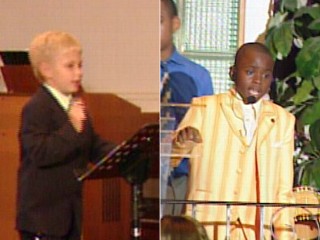
You see them and you initially laugh. The grainy footage and shaky camera work suggest what you’re watching may very well be an entry for America’s Funniest Home Videos, so of course it’s not serious. But then the clip plays on. And on. You’re now laughing with a little less fervor as bewilderment slowly pushes humor to the side. You even have a serious look on your face. As the clip passes the two or three minute mark, you suddenly realize that while the YouTube user who posted the clip may have meant it as a joke, the individuals who originally produced the video did not. This is for real. You’re no longer laughing, but focusing; watching the diminutive figure pace and pound and shout with rage far beyond his—and it usually is his—age. But the kicker is not even the video’s main character. It’s his audience. By the time you’ve come to the conclusion that this six-year-old child is, indeed, preaching, you’re confronted with the cheering, clapping, supportive adults who surround the child and encourage not only his message but also his wild performance. It’s like a grade school play, but with fire and brimstone. And no one’s acting.

Child preachers are often the wacky sideshows of American religious history, confined to the fringes of American religious life. They purportedly stand outside the devotional lives of most “ordinary” believers. Indeed, the history of childhood has been around for some time now and has shown that the Sunday school movement, the Y’s, the Boy Scouts and, of course, Horace Bushnell did not exactly clamor to have children practice homiletics. Rather, as the brunt of the scholarship suggests, the motives behind the founding of these organizations were to shelter children from the vices and traumas of the adult world of work, prolong their innocence, and thereby delay their maturation. “This is exactly what the Young People’s Society of Christian Endeavor seeks to do for everyone of its members,” wrote the Reverend Francis Clark in 1902, the founder of that ubiquitous organization of American Protestant childhoods. “It sets them about doing things and thus tides them over the critical period of adolescence, the years of storm and stress and doubt.”

Absent from this narrative of American Protestant youth, however, are not just child preachers but children generally. Children as agents with their own ambitions, anxieties and religious imaginations are often as scarce in the history of American religion as child preachers are in American history. Of course, this lacuna is largely the result of a dearth of sources. Children often did not scribble down, much less understand, their own religious worldviews. Even if they did, such artifacts typically ended up on the family refrigerator and never made it to the archives. But sometimes kids do leave traces. In a 2007 Church History article (favorably mentioned on this blog), E. Brooks Holifield found in a number of antebellum children’s diaries that kids paid surprisingly close attention to their ministers, reflected on their teachings and, in some instances, emulated ministers. In my own research on a number of Sunday school workers at the turn of the twentieth century who were lifelong church members but never rose above laymen, I’ve been impressed by how many of them had aspirations to take to the pulpit in their youth, some as young as six. According to their recollections in later years—admittedly a less reliable source—most willingly and eagerly mounted the stage in the late nineteenth century to give sermon-like addresses before Baptist, Presbyterians, and Methodist congregations. But what has really surprised me in charting the childhoods of these women and men is just how many opportunities local churches provided for children to preach. Sabbath school anniversaries, holiday celebrations, decision days, rallies, monthly Sunday school concerts, quarterly temperance lessons, and especially Children’s Days all demanded spiritual performances from children in ways that mimicked adult worships practices. As much as we’ve interpreted Protestant ideologies of childhood to inflate the innocence of children to Precious Moments-like proportions, there was also a strand of local church culture and evangelical parenting practices that expected, or at least promoted, a kind of spiritual precocity in children.

I’m curious if the religious lives of children have similarly haunted the research of other readers. In a recent query on H-AmRel from BlogMeister Randall Stephens on the denominational acceptance of child preachers, listserv members offered a lengthy list of diverse figures from Bob Jones to C. L. Franklin who both literally and figuratively cut their teeth behind the pulpit. The lived religion of childhood certainly wasn’t something I was expecting to focus on when I began my dissertation, but it has become a central component to many of the arguments I try to formulate. Perhaps by better situating children and their interpretive imaginations in our studies we can deepen our understanding of generational change and stability in America’s religious communities. Taking children and their spiritual aspirations seriously may also help contextualize child preachers and the bemused contempt they perhaps unjustly receive. For when longtime Sunday school worker Asa Bullard worried as early as 1876 that the plethora of church events that forced kids to speak or recite Bible verses threatened to “make an exhibition of the children,” one has to wonder just how much the difference between child preachers and other Protestant children was one of degree rather than kind. Just ask any Protestant who, as a youngster, earnestly, but ultimately unwillingly, performed in church musicals throughout much of their childhood. That, however, would require a very different kind of blog post.

Sabtu, 28 Agustus 2010

Non-Papists

By Chris Beneke

A Friday post on the New York Review of Books site by the distinguished Notre Dame scholars John T. McGreevy and R. Scott Appleby looks at the "Ground Zero mosque" controversy through the lens of American Catholic history. The duo offer several important insights. Among them: "the American acceptance and encouragement of Catholic parishes and schools once seen as threatening reshaped an international religious institution [the Catholic Church]" and that "if the Catholic experience in the United States holds any lesson it is that becoming American also means asserting one's constitutional rights, fully and forcefully, even if that assertion is occasionally taken to be insulting." McGreevy and Appleby concede that the analogy between nineteenth-century Catholics and modern Muslims is imperfect. Nonetheless, it is illuminating, and should inspire at least a glimmer of hope.

At least four additional points might be added to McGreevy and Appleby's analysis:

1) Muslims (particularly Sunnis) lack the centralized direction that bound nineteenth-century Catholic clergy and laity to a non-democratic foreign agenda--American Muslims are not constrained by the pronouncements of distant authorities, and certainly not by al Qaeda.

2) American Muslims are supported by a large constituency of civil rights advocates. More importantly, they are protected by a federal government with much broader powers than its nineteenth-century counterpart (nor should we forget the support and protections offered by the mayor, the Governor, and state and local law.) Nineteenth-century Catholics had many allies and sympathizers among Protestants. They also benefited from an already vibrant tradition of religious liberty and mutual respect. Still, their position vis-a-vis both state authority and public opinion was probably more precarious than that of modern Muslims.

3) American Catholics arrived in massive numbers during the mid-nineteenth century. Today, U.S. Muslim population growth is robust, but it pales in relative terms to the hundreds of thousands of Irish Catholics who landed in U.S. cities during the 1840s and 1850s. As much as the growing Muslim community will contribute to American society, its social and political footprint is likely to be less conspicuous than the one left by mid-nineteenth-century Irish Catholics.

4) Particularly in the last decades,the United State has prided itself on a tradition of religious diversity and religious inclusion. We have also gained a sharper appreciation for our previous failings in this regard. Appleby and McGreevy are not just champions of this formidable tradition; they are illustrations of it.

In sum, our history--especially our recent history--bodes well for our future. We have seen the same sort of reaction before, and it passed. Hackles were raised, distant authorities were cited, and brutal violence was invoked, yet our better natures prevailed and our tradition of equal rights was enriched. There will have to be accommodation and there will have to be time for healing. But if we take history as our guide, there is reason for optimism.

Related Posts Plugin for WordPress, Blogger...