| . A reforming people: Puritanism and the transformation of public life in New England. Knopf, 2011. 255p index ISBN 0-679-44117-4, $29.95; ISBN9780679441175, $29.95. Reviewed in 2011dec CHOICE. | ||
 Whenever Harvard Divinity School professor Hall, one of the premier scholars of American Puritanism, writes books and articles, those interested in early American history and culture should pay heed. This lucidly written, clearly organized work on New England "social practices and the workings of politics" from 1630 to 1650 argues convincingly that the members of New England's founding generation "brought into being churches, civil governments, and a code of laws that collectively marked them as the most advanced reformers of the Anglo-colonial world." The chief comparison is with English puritan reform efforts during the same era, concluding that the American Puritans nearly succeeded in implementing the Leveller program for transforming society and politics, hence the subtitle. The argument develops by describing the application of such concepts as participation, consent, and equity to practical questions of land distribution, legal procedures, church governance, and political action. Hall considers all New England colonies and uses Cambridge, Massachusetts, as a local illustration of both successes and tensions. This nuanced analysis of the Puritan reform impulse avoids both liberal and authoritarian stereotypes of Puritanism. As expected, a fine book. Summing Up: Essential. All academic levels/libraries. Whenever Harvard Divinity School professor Hall, one of the premier scholars of American Puritanism, writes books and articles, those interested in early American history and culture should pay heed. This lucidly written, clearly organized work on New England "social practices and the workings of politics" from 1630 to 1650 argues convincingly that the members of New England's founding generation "brought into being churches, civil governments, and a code of laws that collectively marked them as the most advanced reformers of the Anglo-colonial world." The chief comparison is with English puritan reform efforts during the same era, concluding that the American Puritans nearly succeeded in implementing the Leveller program for transforming society and politics, hence the subtitle. The argument develops by describing the application of such concepts as participation, consent, and equity to practical questions of land distribution, legal procedures, church governance, and political action. Hall considers all New England colonies and uses Cambridge, Massachusetts, as a local illustration of both successes and tensions. This nuanced analysis of the Puritan reform impulse avoids both liberal and authoritarian stereotypes of Puritanism. As expected, a fine book. Summing Up: Essential. All academic levels/libraries. |
Tampilkan postingan dengan label Puritans. Tampilkan semua postingan
Tampilkan postingan dengan label Puritans. Tampilkan semua postingan
Selasa, 22 November 2011
A Reforming People: Puritanism and Public Life in New England
Minggu, 09 Oktober 2011
Race, Redemption, and the Red Sox: Making and Marking Communities in Books by Ira Berlin and Richard Bailey

by Edward J. Blum
And, of course, it led me to reflect on two relatively new books that deal with making and marking communities. Conveniently enough, they were the ones I read on the journey. One was by the distinguished scholar Ira Berlin, and the other came from the pen of a much younger historian Richard A. Bailey. Both examine how communities make meaning of themselves, experience those meanings amid good and hard times, and mark their communities through ideas, actions, and commodities.
 Ira Berlin is known to all U.S. historians. He’s the genius author of the magisterial book Many Thousands Gone, a beautiful and comprehensive history of the North American slave trade. Now in The Making of African America, Berlin examines how four great migrations – and the subsequent place-making between the movements – created and re-created black America. The Middle Passage transformed African ethnic and national groups into Africans in America. Then the internal slave trade to the Deep South drove a huge number of African Americans inland and created the “Cotton Belt” or “Black Belt.” The Great Migration of the early and mid-twentieth century shifted black America from southern and rural to northern and urban. And finally, the fourth migration of new immigrants from the Caribbean and Africa in the past thirty-five years brought in new groups of black Americans.
After each migration, black Americans made claims to space and place. They built families and homes; they formed coalitions and defined the land. They built churches, businesses, and cemeteries. Music reflected the moods of “routes and roots” – whether in spirituals, gospel hymns, the blues, or hip-hop.

And this is where Richard A. Bailey’s interesting book on race and puritans comes into play. In Race and Redemption in Puritan New England , Bailey moves historiographically in two contrary ways: first, when looking at slavery in early America, he examines the New England (not the South); second, when examining puritans, he highlights race (and not just faith). The contrary combination produces striking results. Bailey argues that as New England puritans tried to bring order to their new world of Native Americans, Africans, and slave labor practices, they built from their theological contradictions and paradoxes. The outcomes were new perspectives of race, redemption, and social order. Basically, Bailey argues that to reconcile their own theological problems amid a new form of society, puritans linked race and redemption.
Sabtu, 27 November 2010
Pilgrims and the Political Agenda
Today's guest post comes from Jeremy Bangs, a leading expert on 17th-century history, the Pilgrims, and the Plymouth Colony. Bangs follows up a lively discussion in the comments section of an earlier post with more on the 17th-century historical context.
Jeremy Bangs
In our exchange in the comments section Tom van Dyke expresses annoyance at “scholars with a political agenda.” He “found no attempt anywhere to simply tell the story.” But he “did manage to get to Bradford's account ...”
The problem is that William Bradford is the first of the scholars with a political agenda writing about the topic of the Pilgrims’ early experiments with land distribution. Simply telling the story requires a little analysis of the context beyond a mere repetition of the text(s).

The background information about the financial circumstances of the Pilgrims’ colonial enterprise consists of descriptions by Bradford and Edward Winslow, together with business correspondence and contracts incorporated in Bradford’s memoir. From this we know that for the first seven years the colony was mortgaged to the company of investors. All the assets and increase of the colony were to be liquidated at the end of seven years, when the contracted debt was to be paid and the surplus distributed to the investors. Every colonist was counted as having at least one share in the venture because of the colonist’s labor. Some colonists also invested money and thus owned more than one share. Some investors of money did not become colonists but remained in London (and elsewhere). This arrangement meant that in Plymouth Colony there was no private property (not even property in personal labor) until 1627. All property belonged in common to the investors, but as investors the colonists also were co-owners proportional to their shares. This was capitalism, not communalism, and in no way socialism. The Pilgrims had wanted a different arrangement that would have granted them two days per week for private labor, whose profits were to be personal. But in the end their contract did not grant them even this amount of individualism. In setting up the colony people needed to find a way to conform to the total mortgage of their contract. In the first couple of years, rotating land assignments were made, following a medieval custom then practiced in the region from which the leaders came (northern Nottinghamshire and adjacent parts of Lincolnshire and Yorkshire). Dissatisfaction with this system (unfamiliar to some of the colonists) led to the decision to make unchanging assignments of field use after 1623, so that farmers could expect to use the same land from one year to the next; but this did not involve any property in the land, all of which was still to be liquidated at the end of the seven-year term. Thus scholars who identify the early system as a form of capitalist incorporation are correct, and no political agenda is implied by making this observation. Further, the early reports by Winslow and Bradford mention a bounteous harvest the first year. Scarcity the second year was the result of the arrival of thirty-five more colonists who came without supplies – not the result of poor harvests. This plenteousness is also reported in a letter by a visitor to the colony writing in 1621 (William Hilton). Winslow wrote that wheat and Indian corn had grown well, barley not very well, and peas not worth gathering. Bradford comments on a “great store of wild Turkeys, of whih they took many, besides venison, etc.”
Writing around a quarter century later, Bradford gave a different story – the anti-communalist version that has attracted the attention of Libertarians and others who fantasize about the Pilgrims’ discovering capitalism after experimenting with communalism. Tom quotes from that description. What is Bradford’s agenda, that inspired him to misrepresent the economic circumstances of the past? (As I have commented in my article, “A Level Look at Land Allotments, 1623”) Bradford wrote that part while confronting the social unrest arising from the actions of Samuel Gorton, John Lilburne, and the Levellers. Gorton had been troublesome in Plymouth before causing serious unrest in Rhode Island, where his opposition to taking oaths in court or as part of legal business contracts was abhorrent to representatives of established government. Gorton in New England and the Levellers in England preached a far-reaching equality that was thought to threaten society's stability by abolishing what Bradford and many others thought were divinely ordained differences of social standing and responsibility expressed in wise government. In the mid-1640's, Bradford used his recollection of this administrative shift (regarding land use) as the base upon which he could construct a propagandistic comment aimed at the social circumstances of the later period. In 1646 it was important to oppose Gorton and the Levellers' threat from England, important to consider that practical experience of human nature had disproved idealistic theory — "the vanity of that conceit of Plato and other ancients, applauded by some of later times; — that the taking away of property, and bringing in community into a common wealth, would make them happy and flourishing, as if they were wiser than God." Bradford ends his memoirs by noting that Edward Winslow had been sent to England in 1646 to defend New England against complaints of mistreatment lodged in London by Samuel Gorton.
Recent writers who emphasize the year 1623 rather than 1621 when writing about the Pilgrims’ thanksgiving have made a choice that is obviously driven by a political agenda. And simply telling the story is not what concerns them.
Jeremy Bangs
In our exchange in the comments section Tom van Dyke expresses annoyance at “scholars with a political agenda.” He “found no attempt anywhere to simply tell the story.” But he “did manage to get to Bradford's account ...”
The problem is that William Bradford is the first of the scholars with a political agenda writing about the topic of the Pilgrims’ early experiments with land distribution. Simply telling the story requires a little analysis of the context beyond a mere repetition of the text(s).

The background information about the financial circumstances of the Pilgrims’ colonial enterprise consists of descriptions by Bradford and Edward Winslow, together with business correspondence and contracts incorporated in Bradford’s memoir. From this we know that for the first seven years the colony was mortgaged to the company of investors. All the assets and increase of the colony were to be liquidated at the end of seven years, when the contracted debt was to be paid and the surplus distributed to the investors. Every colonist was counted as having at least one share in the venture because of the colonist’s labor. Some colonists also invested money and thus owned more than one share. Some investors of money did not become colonists but remained in London (and elsewhere). This arrangement meant that in Plymouth Colony there was no private property (not even property in personal labor) until 1627. All property belonged in common to the investors, but as investors the colonists also were co-owners proportional to their shares. This was capitalism, not communalism, and in no way socialism. The Pilgrims had wanted a different arrangement that would have granted them two days per week for private labor, whose profits were to be personal. But in the end their contract did not grant them even this amount of individualism. In setting up the colony people needed to find a way to conform to the total mortgage of their contract. In the first couple of years, rotating land assignments were made, following a medieval custom then practiced in the region from which the leaders came (northern Nottinghamshire and adjacent parts of Lincolnshire and Yorkshire). Dissatisfaction with this system (unfamiliar to some of the colonists) led to the decision to make unchanging assignments of field use after 1623, so that farmers could expect to use the same land from one year to the next; but this did not involve any property in the land, all of which was still to be liquidated at the end of the seven-year term. Thus scholars who identify the early system as a form of capitalist incorporation are correct, and no political agenda is implied by making this observation. Further, the early reports by Winslow and Bradford mention a bounteous harvest the first year. Scarcity the second year was the result of the arrival of thirty-five more colonists who came without supplies – not the result of poor harvests. This plenteousness is also reported in a letter by a visitor to the colony writing in 1621 (William Hilton). Winslow wrote that wheat and Indian corn had grown well, barley not very well, and peas not worth gathering. Bradford comments on a “great store of wild Turkeys, of whih they took many, besides venison, etc.”
Writing around a quarter century later, Bradford gave a different story – the anti-communalist version that has attracted the attention of Libertarians and others who fantasize about the Pilgrims’ discovering capitalism after experimenting with communalism. Tom quotes from that description. What is Bradford’s agenda, that inspired him to misrepresent the economic circumstances of the past? (As I have commented in my article, “A Level Look at Land Allotments, 1623”) Bradford wrote that part while confronting the social unrest arising from the actions of Samuel Gorton, John Lilburne, and the Levellers. Gorton had been troublesome in Plymouth before causing serious unrest in Rhode Island, where his opposition to taking oaths in court or as part of legal business contracts was abhorrent to representatives of established government. Gorton in New England and the Levellers in England preached a far-reaching equality that was thought to threaten society's stability by abolishing what Bradford and many others thought were divinely ordained differences of social standing and responsibility expressed in wise government. In the mid-1640's, Bradford used his recollection of this administrative shift (regarding land use) as the base upon which he could construct a propagandistic comment aimed at the social circumstances of the later period. In 1646 it was important to oppose Gorton and the Levellers' threat from England, important to consider that practical experience of human nature had disproved idealistic theory — "the vanity of that conceit of Plato and other ancients, applauded by some of later times; — that the taking away of property, and bringing in community into a common wealth, would make them happy and flourishing, as if they were wiser than God." Bradford ends his memoirs by noting that Edward Winslow had been sent to England in 1646 to defend New England against complaints of mistreatment lodged in London by Samuel Gorton.
Recent writers who emphasize the year 1623 rather than 1621 when writing about the Pilgrims’ thanksgiving have made a choice that is obviously driven by a political agenda. And simply telling the story is not what concerns them.
Rabu, 24 November 2010
Commie Pinko Pilgrims and Peaceful (?) Puritans
Paul Harvey

A little Thanksgiving history blogging for you. I hadn't quite realized how much of a cottage industry peddling the anachronistic "Socialist Pilgrims" thesis had become, but this piece from the New York Times explores the spread of this myth. I was shocked -- SHOCKED -- to learn how much of a role Glenn Beck and his historical henchman W. Cleon Skousen have played in marketing this story, My favorite part: the time when Rush Limbaugh added in the bit about how they grew organic vegetables, after they had learned that capitalism worked and produced an abundance which they could share with the Indians.
In "Peace, Love, and Puritanism," David Hall, of Harvard Divinity School, defends the Puritans against generations of Hawthornian and Menckenian scorn (and adds that, yes, wild turkeys probably appeared on the original menu). He writes:
Why does it matter whether we get the Puritans right or not? The simple answer is that it matters because our civil society depends, as theirs did, on linking an ethics of the common good with the uses of power. In our society, liberty has become deeply problematic: more a matter of entitlement than of obligation to the whole. Everywhere, we see power abused, the common good scanted. Getting the Puritans right won’t change what we eat on Thanksgiving, but it might change what we can be thankful for and how we imagine a better America.
Historiann has no problem with Hall's conclusion, but points out some of the darker underside to the history of feasting and fasting in America -- in particular, its long connection to war and tribalism:
Both fasts and feasts were opportunities to reaffirm tribalism, of a world view of us versus them. The history of fasting and feasting in the English communities of New England in the seventeenth and eighteenth centuries should be written in blood–both blood in the sense of kinship ties, and in the sense of the shedding of outsiders’ blood in war.
The history of fasting and feasting is "more complicated and much darker than Americans would like to remember," she reminds us. Reading the many pages on this subject in George C. Rable's God's Almost Chosen Peoples: A Religious History of the American Civil War, reinforces this point. About every five pages, it seems, someone from North or South is calling for a fast day, or preaching a fast day sermon. There was a lot of ostensible bowing, scraping, and humility, but ultimately it was all about killing. With all these fast days during the war, it's a wonder anyone ever ate.
John Fea reflects on what he would teach about the original Thanksgiving here, at his new column over at Patheos, and what it meant for the Pilgrims and the Wampanoag, who both had been through some brutal times, to share a brief celebration together. I hope your celebration goes well.
Jumat, 19 November 2010
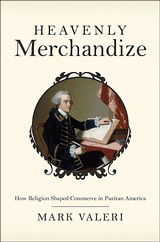
Heavenly Merchandize
Paul Harvey
Earlier we have blogged about Mark Valeri's Heavenly Merchandize: How Religion Shaped Commerce in Puritan America. Below I'm reprinting a review from Choice on this book, which should interest a number of you. Below the review is a snip from the book's website, which has some more information on the contents.
Earlier we have blogged about Mark Valeri's Heavenly Merchandize: How Religion Shaped Commerce in Puritan America. Below I'm reprinting a review from Choice on this book, which should interest a number of you. Below the review is a snip from the book's website, which has some more information on the contents.
| . Heavenly merchandize: how religion shaped commerce in Puritan America. Princeton, 2010. 337p index afp; ISBN 9780691143590, $35.00. Reviewed in 2010dec CHOICE. | ||
| Historians surveying the first century of Massachusetts Bay's settlement often describe how colonists in 1630 understood themselves as part of a gemeinschaft, or community based on personal relationships where commitment to the larger social good outweighed individual self-interest. By 1730, the gemeinshaft had become a gesellschaft, or society where rational self-interest trumped communal commitments; relationships, based on the impersonal forces of a market system, were more distant. Valeri (Union Theological Seminary/Presbyterian School of Christian Education in Virginia) avoids such oversimplification, but his exhaustively researched, densely structured book provides a marvelously thick description of just such a transition. Against the conventional assumption that commitment to market values came at the expense of religion, however, Valeri argues that religion actively fostered that commitment. Concentrating on Boston, he demonstrates how prominent preachers provided a vocabulary--drawn largely from British economic theorists--that allowed successful merchants to understand their pursuit of profit, and eventually even the trade in slaves, as a moral imperative. A "postpuritan religiosity" "preceded, and therefore helped to make possible, the full fruition of a market order in early America." Students of early New England will find this indispensable; it should also appeal to anyone interested in the relationship between religion and the larger culture. Summing Up: Highly recommended. Upper-level undergraduates through faculty/researchers. -- L. B. Tipson Jr., Washington College ________________________________________________________ (from the book's website): Heavenly Merchandize offers a critical reexamination of religion's role in the creation of a market economy in early America. Focusing on the economic culture of New England, it views commerce through the eyes of four generations of Boston merchants, drawing upon their personal letters, diaries, business records, and sermon notes to reveal how merchants built a modern form of exchange out of profound transitions in the puritan understanding of discipline, providence, and the meaning of New England. Mark Valeri traces the careers of men like Robert Keayne, a London immigrant punished by his church for aggressive business practices; John Hull, a silversmith-turned-trader who helped to establish commercial networks in the West Indies; and Hugh Hall, one of New England's first slave traders. He explores how Boston ministers reconstituted their moral languages over the course of a century, from a scriptural discourse against many market practices to a providential worldview that justified England's commercial hegemony and legitimated the market as a divine construct. Valeri moves beyond simplistic readings that reduce commercial activity to secular mind-sets, and refutes the popular notion of an inherent affinity between puritanism and capitalism. He shows how changing ideas about what it meant to be pious and puritan informed the business practices of Boston's merchants, who filled their private notebooks with meditations on scripture and the natural order, founded and led churches, and inscribed spiritual reflections in their letters and diaries. Unprecedented in scope and rich with insights, Heavenly Merchandize illuminates the history behind the continuing American dilemma over morality and the marketplace. |
Selasa, 12 Oktober 2010
God In America, Part One: An Exercise in the Evangelical Whig View of Early American Religious History
By John Fea
Cross-posted at The Way of Improvement Leads Home
I just got done watching Part 1 of the PBS series "God in America." I know I am behind (Part 2 aired tonight), but such is the life of a blogger, professor, and a new department chair.
The series begins with the Franciscan attempts to convert the Pueblo Indians to Christianity in the 17th century. This, of course, is a sad chapter in American history. The Spanish friars were militant. Their evangelistic zeal led to the destruction of Pueblo sacred sites and all sorts of brutality. The high point of this story is the Pueblo revolt of 1680, the Indian rebellion that put an end to the Spanish presence in the west and proved that Christianity would not come to America unchanged.
This is a nice way to begin, but it has absolutely no connection to the rest of Part One's narrative. One gets the impression that this was just tacked on to the beginning of the program because SOMETHING needed to be said about native Americans. The story line of the native Americans, and the Spanish for that matter, are quickly dropped in favor of what I call in the title of this post the "evangelical Whig view" of American history. This script could have been written by George Bancroft.
And where is slave religion? (Let's hope it is discussed later in the series).
The Puritans are next. Steven Prothero of Boston University establishes himself as our guide through this history, but we also hear from a star-studded lineup of historians that include Michael Winship, Frank Lambert, Mary Beth Norton, Stephen Marini
Much time is spent on Anne Hutchinson. Too much time. Prothero is very good at showing the Protestant individualism of the Puritans and how Hutchinson, in some ways, seemed more Protestant than the Puritans. Hutchinson is clearly the star. There is more time spent on her story than on the Puritans who removed her from the colony. Was the Hutchinson trial really the most important moment in 17th century New England history? Would the people living in Puritan New England have seen it this way? Absolutely not. The Halfway Covenant, King Philips War, the Salem Witch Trials, and a host of other events would have been more important to the Puritan "city on a hill," but these events do not fit easily into the Whig narrative.
The portrayal of the Hutchinson trial is well-acted and the trial transcript is used as the script. Winship claims that during this trial Hutchinson "rips him (John Winthrop) to shreds." Norton celebrates the rebellious spirit of Hutchinson. Prothero concludes that Hutchinson is the future of America--she represents liberty of conscience and religious freedom.
The documentary then jumps to George Whitefield. Marini stresses the individualism of evangelical religion. (By the way, I would love to take a class with Marini--so much passion and energy!) Harry Stout mentions Whitefield's appeal to the emotions and the imagination. Lambert connects Whitefield's evangelical, individualistic Protestantism to that of Hutchinson. A clear intellectual and spiritual genealogy is developing here.
The discussion of the First Great Awakening does a great job of explaining evangelicalism as a real and powerful religious movement that impacted people's lives. The documentary uses a host of quotes from the diaries of Whitefield converts to make this point. Very well done.
But overall the treatment of the Great Awakening is blatantly Whig. One is left with the impression that the Great Awakening was more of a political movement than it was a religious movement. Stout talks about the way Whitefield's evangelicalism challenged "the old aristocratic order" and even suggests that the Great Awakening led to the popular idea that "we are the people." Then Daniel Driesbach talks about the way that the Great Awakening brought the colonies together. One clearly gets the impression that these historians are setting us up for the American Revolution. I tell my students that the Great Awakening created a transatlantic religious network that made the colonies more British and Protestant. "God in America" would prefer to see it as the seedbed of individual liberty, revolution, and American identity.
And then, in the last three minutes of Part One, we get the triumph of the evangelical Whig narrative or, what Jon Butler has called "Born Again History."
The narrator states that people began to insist that it was their right to worship in the church of their choice. Evangelical religion is said to have provided the American Revolution with a sense of "moral" urgency. Prothero says that following the First Great Awakening, the Revolution was "inevitable" and "perfectly logical."
In the end, the story of "God in America"--at least early America-- is best told by following a direct line between Hutchinson and Whitefield, culminating in the American Revolution. At times I thought I was sitting in a lecture at Glenn Beck University.
Cross-posted at The Way of Improvement Leads Home
I just got done watching Part 1 of the PBS series "God in America." I know I am behind (Part 2 aired tonight), but such is the life of a blogger, professor, and a new department chair.
The series begins with the Franciscan attempts to convert the Pueblo Indians to Christianity in the 17th century. This, of course, is a sad chapter in American history. The Spanish friars were militant. Their evangelistic zeal led to the destruction of Pueblo sacred sites and all sorts of brutality. The high point of this story is the Pueblo revolt of 1680, the Indian rebellion that put an end to the Spanish presence in the west and proved that Christianity would not come to America unchanged.
This is a nice way to begin, but it has absolutely no connection to the rest of Part One's narrative. One gets the impression that this was just tacked on to the beginning of the program because SOMETHING needed to be said about native Americans. The story line of the native Americans, and the Spanish for that matter, are quickly dropped in favor of what I call in the title of this post the "evangelical Whig view" of American history. This script could have been written by George Bancroft.
And where is slave religion? (Let's hope it is discussed later in the series).
The Puritans are next. Steven Prothero of Boston University establishes himself as our guide through this history, but we also hear from a star-studded lineup of historians that include Michael Winship, Frank Lambert, Mary Beth Norton, Stephen Marini
Much time is spent on Anne Hutchinson. Too much time. Prothero is very good at showing the Protestant individualism of the Puritans and how Hutchinson, in some ways, seemed more Protestant than the Puritans. Hutchinson is clearly the star. There is more time spent on her story than on the Puritans who removed her from the colony. Was the Hutchinson trial really the most important moment in 17th century New England history? Would the people living in Puritan New England have seen it this way? Absolutely not. The Halfway Covenant, King Philips War, the Salem Witch Trials, and a host of other events would have been more important to the Puritan "city on a hill," but these events do not fit easily into the Whig narrative.
The portrayal of the Hutchinson trial is well-acted and the trial transcript is used as the script. Winship claims that during this trial Hutchinson "rips him (John Winthrop) to shreds." Norton celebrates the rebellious spirit of Hutchinson. Prothero concludes that Hutchinson is the future of America--she represents liberty of conscience and religious freedom.
The documentary then jumps to George Whitefield. Marini stresses the individualism of evangelical religion. (By the way, I would love to take a class with Marini--so much passion and energy!) Harry Stout mentions Whitefield's appeal to the emotions and the imagination. Lambert connects Whitefield's evangelical, individualistic Protestantism to that of Hutchinson. A clear intellectual and spiritual genealogy is developing here.
The discussion of the First Great Awakening does a great job of explaining evangelicalism as a real and powerful religious movement that impacted people's lives. The documentary uses a host of quotes from the diaries of Whitefield converts to make this point. Very well done.
But overall the treatment of the Great Awakening is blatantly Whig. One is left with the impression that the Great Awakening was more of a political movement than it was a religious movement. Stout talks about the way Whitefield's evangelicalism challenged "the old aristocratic order" and even suggests that the Great Awakening led to the popular idea that "we are the people." Then Daniel Driesbach talks about the way that the Great Awakening brought the colonies together. One clearly gets the impression that these historians are setting us up for the American Revolution. I tell my students that the Great Awakening created a transatlantic religious network that made the colonies more British and Protestant. "God in America" would prefer to see it as the seedbed of individual liberty, revolution, and American identity.
And then, in the last three minutes of Part One, we get the triumph of the evangelical Whig narrative or, what Jon Butler has called "Born Again History."
The narrator states that people began to insist that it was their right to worship in the church of their choice. Evangelical religion is said to have provided the American Revolution with a sense of "moral" urgency. Prothero says that following the First Great Awakening, the Revolution was "inevitable" and "perfectly logical."
In the end, the story of "God in America"--at least early America-- is best told by following a direct line between Hutchinson and Whitefield, culminating in the American Revolution. At times I thought I was sitting in a lecture at Glenn Beck University.
Langganan:
Postingan (Atom)
