Tampilkan postingan dengan label christian america. Tampilkan semua postingan

Sabtu, 07 Mei 2011

Not into History

Randall Stephens

We've been having a lively discussion on this blog, thanks to Paul's post, and there have been other discussion raging in the blogosphere about David Barton and the uses and abuses of history. The selective use of anecdotes, prooftexts, and the decontextualized way of doing history are closely connected. And, thanks to David Barton and his recent headline grabbing, we have a case in point.

Suppose an amateur Bible scholar said "I know everything there is to know about the Old Testament books of Genesis and I and II Chronicles." Then imagine you asked him/her about what he/she knew about Bronze and Iron Age religion and society, or the development of monotheism in the ancient Near East, or the Epic of Gilgamesh, or the original languages, or the extensive secondary literature written by thousands upon thousands of scholars who know way more about the subject. Then suppose he/she replies "no" on every count. Now, how is it again that this person really knows something important about Genesis and I and II Chronicles? This is a Theron Ware situation if there ever was one. Ignorance of context sometimes gives people remarkable confidence!

Barton does not recognized the idea that the past is like a foreign country. Instead Barton tends to flatten out time and space and make it almost seem as if the Founders are our contemporaries, motivated by the same concerns that motivate us now. Yet people in the past--whether we're talking about leaders of Bronze Age tribes or bewigged 18th century nabobs who tinkered on their mansions, read Montaigne in their spare time, or enjoyed arm-chair speculation about nature and providence--are not the same as us. This seems like a kindergarten point, but it's apparently lost on David Barton. (See his famous and repeated misuse of the word "seminary," in which he makes no effort to explain how that word meant something markedly different in the 18th century.)

At the Way of Improvement Leads Home John Fea makes an excellent, related point about context and Barton's ignoring an avalanche of inconvenient information:

I challenge you to go to Wallbuilders website and find much of anything about the fact that the many of the most important founding fathers rejected orthodox Christian doctrines such as the Trinity and the resurrection of Jesus. Good luck finding any sustained discussion about Thomas Jefferson and James Madison's successful attempt to separate church and state in colonial Virginia or the fact that their efforts were supported by evangelical Baptists with a theology similar to Barton's. These facts of history do not help Barton promote his ideological agenda, so why bother with them?

Right on.

Nearly any trained historian worth his or her salt who takes a close look at Barton and his hyper-politicized work will see glaring gaps in what he writes and talks about. He dresses his founders in 21st-century garb. He's not interested in knowing much about the history of colonial America or the US in the early republic. Why? Because he's using history to craft a very specific, anti-statist, Christian nationalist, evangelical-victimization argument in the present. (Remember the many unconfirmed quotations Barton used in the 1990s? He did so because, first and foremost, he was trying to make a political point.)

In history circles this is what we call "bad history."
Kamis, 30 Desember 2010

Beyond the Protestant Nation: Religion and the Narrative of American History

Paul Harvey

We hadn't yet posted notes on the Saturday and (dreaded) Sunday morning sessions at the AHA in Boston, more on that forthcoming. But we definitely want to highlight one session of huge significance, which unfortunately got stuck in the no-man's-land of the Sunday morning (Jan. 9) at 8:30 a.m. slot at the AHA. Despite the unfortunate time placement, the panel "Beyond the Protestant Nation" ought to be one of the most interesting of the whole conference, and certainly of great interest for American religious history/studies scholars. I'm pasting in the abstract below, with the following note from panel organizer Chris Cantwell of Cornell University:

"The round table grew out of a conversation Orsi and I repeatedly return to, where it seems that scholars who work on Protestants are able to make far bigger claims about American history than historians who work on other religious traditions. The protestant work ethic, for example, tells us about the foundations of America's capitalist ethos. Catholic street feste, however, tell us about immigrants; not about America. Out of this conversation Bob and I put together a round table that features scholars who do not work on traditionally defined Protestantism to ask how would the American historical narrative change if we gave the questions and concerns of non-Protestant religions the same interpretive strength as Protestantism receives."

Here's the abstract:

Beyond the Protestant Nation: Religion and the Narrative of American History

American historians, like their counterparts in other fields of historical inquiry, have become increasingly interested in integrating religion into our historical narratives. Prominent religious figures now appear in survey courses; we see theological ideas contributing to the formation of political philosophies and programs; and we use popular ritual practices to convey the culture of an era. But in studying the most religiously diverse country in the world historians have implicitly perpetuated an interpretive hierarchy of American religious life that inflates the illuminating power of certain religious communities and circumscribes or even ignores the historical (and historiographical) contributions of others. For instance, exploring the contours of the Protestant work ethic or evangelical conceptions of the state tell us, scholars argue, about the foundation of America’s capitalist ethos or our core political values. Catholic street feste to particular saints or changes within Reformed Judaism, however, are about urban culture or the immigrant experience—about Catholics and Jews, not about “America.”

This roundtable seeks to bring the deeply rooted Protestant and religious presuppositions of American historiography to light to challenge its assertions. Historians who insist on the historical primacy of Protestantism (singular) are not describing the past; they are implicitly reproducing a particular nationalist ideology that has long equated the identity and wellbeing of the United States with “Protestantism.” “Protestant,” moreover, entails assumptions about the kind of religiosity that has been consequential in American history. Embedded in the enduring and unchallenged identification of America as “Protestant” is an implicit argument about religion and modernity that endorses specific ways of being religious. Jewish orthodoxy, Mormon revelation, Catholic devotionalism, spiritualist meetings, Pentecostal tongue speaking, and other ways of being religious are excluded or defined as historically marginal.

This roundtable proposes to invert this interpretative hierarchy to ask how the American historical narrative change if the historiographical questions and concerns of non-Protestant religious groups were given national significance. What questions would rise in importance? What questions would decline? How would our periodizations change? In short, the round table seeks to ask what it would mean to re-imagine the American historical narrative from a more robustly plural religious perspective—not to include other religious idioms in our stories, but to rethink the narrative itself from a post-“Protestant” perspective? The round table convenes a number of scholars who work on religious traditions other than “Protestant” to explore this question of a post-Protestant historiography. Lila Berman considers the consequences of Protestant paradigms in Jewish studies, where authors have contorted Jewish beliefs to underline their seamlessness with America’s “Protestant” values. Wallace Best argues that assumptions about the Protestant nature of African-American religiosity have obscured the spiritual beliefs of admittedly secular and non-believing black activists. Robert Orsi suggests that the way Catholics have been “American” demands revisions of the idea of a singular American modern. Catherine Albanese asserts that though loosely organized and poorly defined, metaphysical religiosities have been a potent “third force” in American history that has inflected and shaped much of what we see as purely mainline and evangelical Protestantism. Richard Bushman highlights the distinctive perspectives Mormons brought to many phases of American history and how these have engaged and shaped the contours of the nation.

Though each participant brings a particular insight to the panel, the roundtable hopes to put these perspectives in conversation with the audience to explore the possibilities of a post-Protestant historiography as a field.

Minggu, 05 Desember 2010

Jewish Consumer Rites: Tracing Hanukkah's Roots to Cincinnati and Charleston

Paul Harvey

There is nearly no record of people celebrating Hanukkah just a couple of centuries ago. But it began to be an important Jewish holiday in the second half of the 19th century when two rabbis in Cincinnati noticed their Jewish children didn't have much connection to the synagogue.

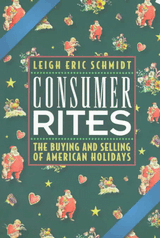
This story from NPR talks about the 19th-century American roots of large Hanukkah celebrations, featuring the religious studies scholar Diane Ashton, and connects the rise of the holiday to the development of elaborate home-based holiday celebrations in Victorian America. It's the time of the year when it's good to pull down Leigh Schmidt's Consumer Rites: The Buying and Selling of American Holidays (Princeton U. Press, 1997 paperback), which shows how "commercial appropriations" of the holidays, especially Christmas, were tied into religion, becoming times of "devout consumption."

So
uth of Cincy, Jewish southerners have developed their own traditions around Hanukkah and food, discussed further by Marci Cohen Ferris in her fun book Matzoh Ball Gumbo: Culinary Tales of the Jewish South. Read/hear more about it here, and also more here. A brief taste:

Oh, sure, this is a great holiday for Jewish Southerners because it celebrates oil, perfect, 'cause we use a lot of it. You know, there's a strong tradition of frying here. And anything with a cast iron pan you got to love, if you're a Southerner. But I'll tell you what we have, and this is actually a traditional menu that my mother always made. Very traditional to have brisket for Hanukah. It's a winter meal. And not everybody barbecued their brisket and served it in kind of that style, but that's how we made ours
.

Sabtu, 23 Oktober 2010

Religion and Foreign Policy Event

.
"A Conversation on Religion and U.S. Foreign Policy with Andrew Bacevich and Stephen Prothero"

Join bestselling authors and Boston University professors Andrew Bacevich and Stephen Prothero for a discussion on the role played by religious ideas in U.S. public policy today, from the wars in Iraq and Afghanistan to the “Ground Zero Mosque” debate. This interactive event will be moderated by Dean of Students Kenneth Elmore, and will be streamed live online.

Date: Wednesday, October 27, 2010
Time: 7 to 8pm
Location: George Sherman Union, 775 Commonwealth Avenue
(George Sherman Union Conference Auditorium, 2nd floor)

Reserve Your Seat

The professors will also discuss their most recent books–Bacevich’s Washington Rules: America’s Path to Permanent War, and Prothero’s God is Not One: The Eight Rival Religions That Run the World–available for purchase and signing at the event.

Jumat, 22 Oktober 2010

God's Country

Randall Stephens

A new Purdue University study shows that as America becomes more religiously diverse, views of America as a Christian Nation gain in strength as well. According to the Purdue University News Service: "[Jeremy Brooke] Straughn and co-author Scott L. Feld, a professor of sociology, looked at two waves of public opinion data from the General Social Survey, which was collected by the National Opinion Research Center. They found that between 1996 and 2004 the percentage of people who said Christian faith was a very important attribute of being 'truly American' rose by more than 11 percentage points, from about 38 percent to 50 percent. The findings are published in the current issue of the journal Sociology of Religion."

This shift in thinking has gone hand-in-hand with a rise in religious diversity. Christians make up 78% of the population, though the number of Protestants has steadily decreased. I'd like to know more about what accounts for the rise in the "Christian Nation" view. Readers: Any thoughts about that?

Here's the paper's abstract:

"America as a 'Christian Nation?' Understanding Religious Boundaries of National Identity in the United States"

Jeremy Brooke Straughn and Scott L. Feld

Though predominantly Christian since the time of its founding, the United States has become more religiously diverse in recent decades. Yet since the mid-1990s, the proportion of Americans who see their country as a "Christian nation" has reportedly increased. Though initially paradoxical, these trends are less mysterious if the idea of a "Christian America" (CA) is understood, not as a description of religious demography, but as a discursive practice that seeks to align the symbolic boundaries of national belonging with the boundaries of the dominant faith community. Using data from 1996 and 2004 General Social Survey, it is shown that the growing prevalence of CA was restricted to Americans of Christian faith, thereby widening an existing religious divide over the meaning of American identity.

All that I can say is . . . I'm happy to plug this in to my current co-authored book project!

Sabtu, 02 Oktober 2010

"Pre-History" of Protestant Debates About Abortion

This guest post comes from my colleague and fellow University of Tennessee American religious historian, Mark Hulsether. Mark's work focuses upon the intersection of religion, culture and politics post-1945 in the U.S., and his most recent book, Religion, Culture, and Politics in the Twentieth-Century United States considers the new religious right, religious aspects of ethnic and sexual diversity, and the impact of media on popular religion. Hopefully, we will see more from Mark in the future.

A Comment on the “Pre-History” of Protestant Debates About Abortion Before Roe V. Wade

Mark Hulsether

Reading the thread below about Dan Williams’ new book, God’s Own Party, I was interested in the discussion about abortion—that is, about rethinking how much the issue of abortion was important for traditions of politicized evangelicals prior to the mid-1970s. When I wrote on this issue years ago, I drew on Robert Booth Fowler’s book, A New Engagement, which was based largely on a content analysis of Christianity Today (CT) from 1966 to 1976. Abortion doesn’t stand out there all that much—although it is in the mix—and in Fowler’s brief section about it, most of the citations are from 1973 forward.

But I’ve done little primary research on this and I look forward to being instructed by Williams.

The reason I am writing is to mention a possible similar dynamic—if we hypothesize that evangelicals presupposed opposition to abortion before the 1970s and simply didn’t talk about it too much until after 1973—on the leftward side of the coin constituted by Protestant right on one side, in dialog with Protestant left-liberals on the other.

In my book on Christianity and Crisis magazine (C&C), I have a section about its evolving views on abortion, along with its exceedingly bitter debate about Roe V. Wade and successor policies. If you like vivid and intense conflict in your reading material, this section has it, for example one scholar who said that his colleague’s work was like “giving dum-dum bullets to the Mafia.”

Anyway, C&C (which I’m using as a rough-and-ready barometer of left-liberal debates, somewhat like Fowler used CT) said little about abortion before 1973, although there was a dust-up in 1967.

What the debate after Roe V. Wade did was in large part to bring to the surface fault lines and submerged disagreements that had been there for some time, although evolving in complicated ways by the 1970s.

The pattern at C&C about LGBT rights has interesting family resemblances, too.

So I’m saying that it might be useful to learn from the patterns and to think about trends on both “sides of the coin” in explicit or implicit dialog with each other.


Jumat, 24 September 2010

God’s Own Party, cont.

by Steven P. Miller

In Dan Williams’ God’s Own Party: The Making of the Christian Right, we now have a go-to narrative analysis of the roots, rise, and resilience of the Christian Right. While Williams builds on earlier scholarship—especially William Martin’s memorable and anecdote-rich With God on Our Side—his book is an exceedingly original contribution based on deep (and I mean deep) research leavened by the wisdom of almost a decade’s worth of reflection. Williams writes with grace and clarity.

Williams describes a “ninety-year quest” (9), which started with the culture wars of the 1920s and intensified with the surprisingly (and overly) confident evangelical activism of the late 1940s and 1950s. (The early National Association of Evangelicals comes across as a proto-Moral Majority—something that those of us with our heads stuck in that Seventies decade should keep in mind.) After authoritatively covering the somewhat more familiar territory of the 1960s, 70s, and 80s, Williams, to his great credit, follows through with a deft ordering of the recent past. The power, glory, and spectacle of the George W. Bush years yielded to the uncertain trumpet of 2008 (which, in turn, was complicated by the blaring trumpet that is Sarah Palin).

Below are a few preliminary—and somewhat random—thoughts on how God’s Own Party informs what might be called the new evangelical history. (Later, I hope to do the same for Darren Dochuk’s no less eagerly awaited From Bible Belt to Sunbelt, which will appear in December.)

First, I affirm the use of “Christian Right” (as opposed to Religious Right) to describe an evangelical Protestant movement that, largely for strategic reasons, has included a broader range of actors. That said, a lot remains to be learned about the relationship between the Christian Right and the Catholic right. On this and other topics, Williams offers intriguing leads for future researchers (Attn. graduate students).

Williams gives “fundamentalist” vs. “evangelical” quite a bit of analytical heft, noting (echoing John’s study of Campus Crusade for Christ) that those identities were well defined only by the late 1950s before showing (my interpretation here) how they became less relevant by the 1980s, as the Reagan coalition took shape. Irenic Billy Graham and surly Bob Jones, Jr., had more than a few overlapping friends and positions, but Williams is very clear about their differences, especially concerning civil rights issues. He argues that “fundamentalists became ‘conservatives’ in opposition to the Kennedy administration” (59)—that is, well before New Right activists sidled up to Jerry Falwell, et al.

It’s hard to know just what to make of “Nixon’s evangelical strategy” (89), as Williams aptly calls it. His Nixon was an ambitious, but superficial manipulator of evangelical politics who went so far as to try to install his man (Veterans Administration official Fred Rhodes) as president of the Southern Baptist Convention. H. R. Haldeman and the once-born version of Charles Colson were equal parts ruthless and bumbling. Yet, as Williams notes, the salad days of the “silent majority” came after the fall, when Christian Right activists embraced its populist tone (“moral majority”). That’s “Nixonland” for you, I guess.

I sense an emerging scholarly consensus that abortion was a driving force behind the growth of the Christian Right from a very early date, even if W. A. Criswell tacitly endorsed Roe v. Wade and even if Jerry Falwell initially said little about the matter. Most such expressions of moderation occurred before the phrase “abortion on demand” became established, first as a concept, then as a statistic. To be sure, one might interpret that “concept” as a “rhetorical device.” But I think Williams is wise to avoid a cynical interpretation of evangelical pro-life politics. (For Francis Schaeffer, to cite one example, Reaganism was a proxy for opposition to abortion—not the other way around.)

Williams’ work is a story of (to quote an earlier version of the title) “Republican faith,” and it becomes clear in this book that, as early as the Eisenhower years, the GOP was the logical vessel through which to pursue conservative evangelical politics. This reality, as I read Williams, points to the overall pragmatism and patience of the Christian Right, not to its naivete or lust for power (as is sometimes suggested). If the Christian Right endures, as Williams believes it will, it will do so in large part because it made itself into a major wing of a major party.
Related Posts Plugin for WordPress, Blogger...