Tampilkan postingan dengan label american judaism. Tampilkan semua postingan

Jumat, 21 Oktober 2011

History Now Features Colonial American Religion

Paul Harvey

The below is taken from an entry on John Fea's blog, featuring a new issue of History Now that is devoted to religion in colonial America; it should be of interest to many, so I'll repost here.
____________________________________________

"History Now" Explores Religion in Colonial America
The current issue of History Now, the online journal of the Gilder-Lehrman Institute of American History, is featuring articles, lesson plans, and activities related to religion in the colonial world. The articles include:

The Puritans and Dissent: The Cases of Roger Williams and Anne Hutchinson by Francis J. Bremer

Early America’s Jewish Settlers by Eli Faber

The Origins and Legacy of the Pennsylvania Quakers by Barry Levy

Thomas Jefferson and Deism by Peter S. Onuf

The issue also includes a very cool interactive map tracing the concentrations of various religious groups in different parts of the British colonies.

Jumat, 23 September 2011

The Synagogue in America

Paul Harvey

And here's the second of the two promised-posts on topics too much neglected at our blog. This one is a history of synagogues in America, from the Jewish history scholar Marc Lee Raphael. Oh, and by the way, if you want a great short historiographic essay on Judaism in America, covering the basics but also in a few short pages covering more advanced topics and debates in the field of study, check out Alan Levenson's short essay "Judaism in America" shortly to come out in our work The Columbia Guide to Religion in American History, which will be out in a few short months. Yes, it's expensive, but your univ. library can purchase it.

And further, while we're at it, I'd love to have Jewish history scholars who would be interested in posting here at the blog. If you feel you have something to contribute in that area, please let us know!

Anyway, without further adieu:

Raphael, Marc Lee. The synagogue in America: a short history. New York University, 2011. 247p bibl index afp; ISBN 9780814775820, $35.00. Reviewed in 2011oct CHOICE.

Raphael (William and Mary) offers an insightful, scholarly, and comprehensive overview of the evolution and changing role of the American synagogue, spanning three centuries and incorporating the denominational movements of Reform, Conservative, Reconstructionist, and Orthodox Judaism. The book's historical perspective draws on economic, cultural, political, and sociological methodologies; and on archival records from 125 congregations, including bulletins, newsletters, sermons, unpublished papers, minutes, and more. The author looks at denominational differences across epochs in architecture, forms of worship, rabbinic life, and fund-raising, and at the impact of feminism. Chronologically arranged, the volume addresses a number of subthemes within each broad time period, taking care to acknowledge differences as they evolved among the major branches of Judaism. Raphael also notes recent trends with the shift of Orthodoxy to the right. Among topics addressed is classical Reform Judaism's emphasis on social ethical action over ritual, e.g., marshalling youth to work in soup kitchens for the homeless, care for the elderly, and protest against bigotry and discrimination. The discussion includes, among other topics, 19th-century abolitionist David Einhorn's opposition of slavery, and Reform and Conservative Judaism's involvement with the civil rights movement. Useful for all libraries, including American and Jewish history collections. Summing Up: Recommended. Lower-level undergraduates and above; general readers. -- D. B. Levy, Touro College, Lander College for Women

Rabu, 31 Agustus 2011

Kevin Schultz's Tri-Faith America at Religion Dispatches

Paul Harvey


Kevin Schultz's new book Tri-Faith America has received extensive attention here before, including a review by Chris Beneke. Over at Religion Dispatches, Ed Blum has just posted a lengthy and excellent discussion of Kevin's book, beginning with the immortal lines: "I was David Barton once." I was tempted to say, "yes, and I was Wilt Chamberlain once," but read the rest of his intro and you'll see what he means. Here's another little excerpt, and then follow the rest at the break:


Kevin Schultz’s new book, Tri-Faith America: How Catholics and Jews Held Postwar America to Its Protestant Promise, explains my story and so much more. This tremendous study examines how the belief that Protestantism, Catholicism, and Judaism defined the United States and defeated the nativist vision of America as a “Christian nation,” how the concept of “Judeo-Christian values” were created to express the tri-faith belief, how tri-faith became standard operating procedure during World War II as the nation battled European totalitarianism and Nazi genocide, how it created new struggles in America’s suburbs, fraternal organizations, schools, and courts, and how it created a rhetoric for both the Civil Rights Movement and the rise of the new religious right. Through it all, Schultz brilliantly shows that between the labor-capital divide of the 1930s and the racial divide of the 1960s was an ideological contest over the religious composition of the nation.


Continue reading here . . .


Senin, 22 Agustus 2011

On Jews and Black Baseball: An Interview With Rebecca Alpert

Art Remillard
I can't say enough good things about Rebecca Alpert's new book, Out of Left Field: Jews and Black Baseball (OUP, 2011).  I'll be reviewing it soon for a local radio program.  You can read Professor Alpert's thoughts on the book over at Religion Dispatches, along with an interview.  And then there's my conversation with her below.  Enjoy!

-----------------------------  

AR: Please begin by giving us some background on this project, and particularly how this is both a continuation of your previous scholarship and a new direction.

RA: I have been interested in twentieth century American Jewish history I wrote my dissertation on American reform rabbis from that era many decades ago. Later in my career I became interested in the intersection of sport and religion, and began to write about Jews and baseball. Writing about racial identity and secular Jewish concerns are the newest parts of the puzzle, and these interests all coalesced around I began to discover about the role Jews played in black baseball.

AR: Your book is as much about race and religion as it is about baseball. Would you discuss how you balanced writing about the game and addressing these broader issues?

RA: An historian friend who read the manuscript in draft complained that there was too little baseball in it. Although I do enjoy the game, I was really interested in how Jews related to the world of black baseball mostly from the perspectives of business and entertainment, so I probably erred on the side of focusing on broader issues.

AR: With a topic like this, I imagine that it was difficult locating sources. Was this the case? And could you talk generally about your experiences in the archives and sorting through newspapers?

RA: I began with secondary materials that would mention the tensions between black and Jewish Negro League owners and the role of the communist sportswriters but didn’t go into detail. I was lucky to meet Rabbi Curtis Caldwell who introduced me to the Belleville Grays, the black Jewish team run by his community. From there, I began to read the African American press. Access to digitized versions of Black Historical Newspapers (rather than the dizzying and eye straining microfilm versions) through my university library made all the difference in the world in terms of being able to do this project. I relied heavily on the observations of the many fine newspapermen in the black press who were writing social commentary on the sports pages. Archives that I consulted proved spottier, but there were gems tucked away in many places; not uncommon in archival research. I also cannot overstate the kindness (and curiosity) of the sundry librarians and archivists who came to my aid, either via email or in person.

AR: Complimenting your impressive assortment of primary sources are your interviews with former Negro League players. How do you feel your book benefited from these interviews? Do you have advice for anyone planning to do interviews for their own projects?

RA: While I loved talking to many of the former players (and reading the oral histories other researchers compiled), I found that the players were mostly reluctant to talk about the Jewish owners I was interested in. There are many possible reasons for that reluctance, but I didn’t really want to speculate about that.

As far as advice is concerned, the website of the Oral History Association is very useful in getting started. It’s really important to do your homework--know as much as you can about the person you want to talk to before contacting them. That will help you craft interesting questions which make good answers possible.

AR: You talk extensively about the Jewish entrepreneurs of black baseball, such as Ed Gottlieb, Syd Pollock, and Abe Saperstein. I felt like their motivations were difficult to pigeonhole. Sometimes they seemed to have noble intentions. Other times, profit won the day. Is this accurate? And what conclusions did you reach about the motives of these businessmen of black baseball?

RA: I think that when good intentions and profit were in sync the entrepreneurs were quite noble. But I also tried hard not to impose the ideas about race and racism that we hold today on them anachronistically.

AR: In contrast, it seemed like the Jewish communists writing for The Daily Worker were much more ideologically driven. That is, they drew from both their Jewish and political rhetorical toolboxes to devise arguments favoring baseball’s integration. Is this accurate? And were these writers coming to the conversation from an entirely different place than the businessmen? Or did they share some common ground?

RA: The communists and the businessmen lived in different worlds. I like to think that it was the communists who were expressing Jewish values rather than the businessmen, but both groups’ behaviors were the product of the experience of second generation immigrants. They just expressed different dimensions of that social situation.

AR: I have always admired Hank Greenberg, but do now even more after reading about his relationship with Jackie Robinson, which began after a collision in 1947. Did you gain a deeper appreciation of any particular person? Similarly, was there anyone who you found to be utterly dislikable?

RA: In the course of this work I became fascinated by the life and career of Buster Haywood, who seemed to crop up in all the stories I was telling. He played both for the Belleville Grays (the team of Hebrew Israelites) and the Indianapolis Clowns (owned by Syd Pollock) and was friends with Jackie Robinson. I felt like he accompanied me through the research and writing process, and I ended up writing a separate article about him. Through Buster Haywood I was able to gain some perspective on the difficulties and joys in the life of an ordinary African American player in the era of segregation.

Although the Jewish entrepreneurs often behaved in ways I didn’t always appreciate, I actually found them rather sympathetic characters. I think it’s important not to demonize (or idolize) people you’re writing about.

AR: If I had a time travel machine, I’d go back to 1926 and watch the game between the “Hebrew All-Star Nine” and the Ku Klux Klan that you mention. Are there any games that you wished you could have witnessed too?

RA: I would love to have been at an East-West All-Star game. These games took place in Chicago each summer from the 1930s through the 1950s and featured all of the outstanding Negro League players that I came to admire as I was doing this research. I would have appreciated seeing them in action and also being among the fans who gave them the accolades they deserved.

AR: What do you hope that general readers (i.e., John and Jane Q. Sports Fan) will take away from this book? Likewise, what should American religious historians take from your book?

RA: I hope general readers appreciate the complex role Jews played in segregated baseball. I hope American religious historians see the value of using baseball as a way to understand the intertwining of race and religion in twentieth century America.

Selasa, 17 Mei 2011

Judeo-Catholic-Protestant America

Chris Beneke

Kevin Schultz’s Tri-Faith America begins with the story of a priest, a rabbi and two Protestant ministers. It might be the first line of a joke, but it's deadly serious. The four chaplains were aboard the U.S.S. Dorchester when it was sunk by a German torpedo in February 1943. They all went down with the ship, prayerfully, arm-in-arm after having given their life jackets to sailors who lacked them.

The sacrifice of the Four Chaplains represented something of a landmark in the history of American religious comity. These men were "celebrated ... as emblems of the new tri-faith nation." Yet, as Schultz shows, Americans were already prepared to appreciate the larger significance of their heroism because of the ecumenical groundwork that had been laid over the previous decade by the anti-prejudice proselytizing of the National Conference of Christians and Jews (NCCJ), which confronted a revitalized Ku Klux Klan and a swelling, virulent strain of Western antisemitism in the 1920s and 30s.

Schultz's assiduous research demonstrates that the NCCJ wasn'tmerely engaged in a half-ass exercise of holier-than-thou idealism. During WWII alone, the organization sponsored traveling "tolerance trios"--consisting of a rotating roster of priests, rabbis, and Protestant ministers--who visited nearly 800 military installations and addressed 9 million Americans. This was missionary work on a par with the massive evangelizing and Bible distribution efforts undertaken by American Protestants during the Civil War.

In the early postwar period, such everyday features of American culture as films, manners, and educational programming were shaped by the tri-faith model that the NCCJ had so carefully cultivated. Postwar liberalism was in turn infused with the mostly tolerant and religiously derived moral imperative that went by the name of the "Judeo-Christian tradition."

Upon this somewhat narrow foundation, postwar Americans would adopt broader conceptions of tolerance that included a larger range of religious groups. Religious bigotry and discrimination certainly didn't disappear, but they were largely driven from public life by the early 1960s. Though groups such as the NCCJ proved slow to promote civil rights for African Americans, the trope of inclusion that they popularized resonated throughout the 1960s. Meanwhile, before the Judeo-Christian tradition was appropriated by the Religious Right in the 1970s, it was employed by Martin Luther King and other civil rights leaders to discredit racist institutions and policies in the 1950s and 60s.

There were deep, intangible costs accompanying the triumph of the tri-faith ideal, which Schultz details. Among them was the loss of communal identity by Jews, Catholics, and Protestants. Also endangered were some of the vibrant, distinctive traditions within each of these larger faith categories. Prophecy withered as ecumenism bloomed.

Still, Schultz provides us with an unapologetically progressive account. He makes clear how profoundly important religious differences were to early twentieth-century Americans and how tirelessly some worked to transcend, or at least mediate, them. Tri-Faith America gives religious tolerance its due as a crucial component of postwar liberalism. In this, it represents a sharp rebuke to the fashionable idea that American religious freedom and religious tolerance have been little more than subtle exercises in coercion

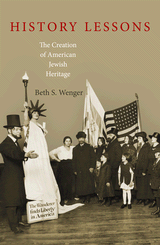
History Lessons: Creation of American Jewish Heritage

Paul Harvey

A bit later today or early tomorrow Chris Beneke will be posting his thoughts on Kevin Schultz's new and very important book Tri-Faith America. Before we get there, I thought I would call your attention to this new work on American Jewish history from Beth Wenger, reviewed in this month's Choice: History Lessons: The Creation of American Jewish Heritage. This book is about the creation of history and meaning in American Judaism, about how "memory" becomes "history" and "heritage" within this religious community, and about how history creates identity. I'll post a brief bit from the book's website first, and then the review from Choice.

From the book's website:

Most American Jews today will probably tell you that Judaism is inherently democratic and that Jewish and American cultures share the same core beliefs and values. But in fact, Jewish tradition and American culture did not converge seamlessly. Rather, it was American Jews themselves who consciously created this idea of an American Jewish heritage and cemented it in the popular imagination during the late nineteenth and mid-twentieth centuries. History Lessons is the first book to examine how Jews in the United States collectively wove themselves into the narratives of the nation, and came to view the American Jewish experience as a unique chapter in Jewish history.

Beth Wenger shows how American Jews celebrated civic holidays like Thanksgiving and the Fourth of July in synagogues and Jewish community organizations, and how they sought to commemorate Jewish cultural contributions and patriotism, often tracing their roots to the nation's founding. She looks at Jewish children's literature used to teach lessons about American Jewish heritage and values, which portrayed--and sometimes embellished--the accomplishments of heroic figures in American Jewish history. Wenger also traces how Jews often disagreed about how properly to represent these figures, focusing on the struggle over the legacy of the Jewish Revolutionary hero Haym Salomon.

History Lessons demonstrates how American Jews fashioned a collective heritage that fused their Jewish past with their American present and future


And now, the review from Choice:

Wenger, Beth S. History lessons: the creation of American Jewish heritage. Princeton, 2010. 282p bibl index afp ISBN0-691-14752-3, $35.00; ISBN 9780691147529, $35.00. Reviewed in 2011jun CHOICE.
American Jews created narratives about Jews in US history in order to establish a collective heritage. Wenger (Pennsylvania) demonstrates that these stories related a Jewish past to US histories in ways that were sometimes celebratory and sometimes critical, but they always sought to establish a place for Jews within US myths and thereby the US present. Wenger analyzes a "dual agenda" in which Jews both "wrote themselves into the narratives of American history" and narrated their own lives as hopeful endings to the "long history of the Jewish people." In exploring these narratives and counternarratives, Wenger provides fascinating primary sources, from didactic Yiddish poetry to letters hotly contesting the erection of a statue. The volume includes examinations of the particular political and cultural facets of US life that allowed Jews to "create" their own heritage and identity; the representation of US Jewish soldiers; children's literature; efforts at memorializing the Revolutionary financier Haym Solomon; and a standout chapter on Jews' relationships to US national holidays. Although Wenger's conclusions may not be surprising for those familiar with US Jewish history, her readings are subtle and compelling. Summing Up: Recommended. All academic levels/libraries. -- S. E. Imhoff, Indiana University / Bloomington

Senin, 09 Mei 2011

Jewish World in Transformation: An Interview with Dana Evan Kaplan

Paul Harvey

A while back, we posted an extensive interview with Dana Evan Kaplan, author of what was then the brand new book Contemporary American Judaism: Transformation and Renewal. In the interview, he said that

Individualized spirituality threatens institutional religion because if people can find spiritual meaning on their own, then they don't need organized religion. American Judaism is particularly vulnerable because Judaism is so interconnected with Jewish peoplehood and also because Judaism is such a small religious group in terms of numbers. If every American Jew went on their spiritual search without regard to ancestral tradition or community influence, that would mark the end of organized Jewish religion in the United States. But that has not happened.

Just a quick update: Religion Dispatches has a new interview just up with the author, whose book has just been released in paperback, reflecting again on the book: see "Tattoos, Cremation, Personal Spirituality: The Jewish World In Transformation." A brief excerpt:

I am trying to write a reasonably comprehensive current history of contemporary Judaism. But there are so many things happening so it is clearly impossible to cover everything. I am also making a series of arguments, particularly relating to the impact that the concept of personal spirituality has had on organized American Judaism. Americans today feel much freer to explore ceremonial and ritual practices that intrigue them regardless of what their community thinks of those particular ideas. This has allowed Jews to move in a number of different directions, including seemingly contradictory ones.

I found some of these contradictory impulses fascinating. For example, there have been a lot more young Jewish people getting tattoos, including many who choose Jewish symbols or Hebrew letters. Now of course the halacha prohibits getting a tattoo, and in earlier generations, a Jew who got a tattoo was in open rebellion against the tradition. That is not so obviously the case anymore.

Another such example that I write about in my book was of a woman in northern California who asks to be cremated after her body is ritually purified and most of the traditional Hebrew prayers have been recited. Again, this is behavior that would have been inexplicable to a traditional Jew from a previous generation. I am hoping that my readers will find these internal contradictions as fascinating as I did and want to explore the changing contours of American Judaism through my book. I do like to be controversial, as long as my criticisms are based on a solid footing.

Selasa, 12 April 2011

Tri-Faith America

Paul Harvey

Very happy to announce that blog friend and occasional guest contributor Kevin Schultz's book is now out, with Oxford Univ. Press: Tri-Faith America: How Catholics and Jews Held Postwar America to Its Protestant Promise. A bit down the road we'll have a fuller exposition on the book and also an interview with the author; in the meantime, Kevin has a very short summary of some of his points, in "The Return of 'Christian America,'" up at the Huffington Post.

For a more substantively lengthy discussion of the material in his book, though, I would recommend also Kevin's article in the Journal of American History: "Religion as Identity in Postwar America: The Story of the Last SErious Attempt to Put a Question on Religion in the U.S. Census," Journal of American History(September 2006): 359-84. And, as blog readers may remember, Kevin and I had an article surveying the "state of the field" of American religious history, in last year's Journal of the American Academy of Religion, which I blogged about here. In the meantime, Kevin's short piece on "The Return of 'Christian America'" looks at the history of that idea, and in particular the ways Jews and Catholics interacted with that idea in the course of inserting themselves into the postwar tri-faith America.

Senin, 28 Maret 2011

Pluralism and Education: Testing the Limits of Liberal Democracy

Paul Harvey

My apologies to blog readers for being relatively absent here. Finishing up two big writing projects here is keeping me busy 24/7, and will continue doing so until next week. Fortunately, no one to date has yet noticed my absence since Kelly and the other contributors have filled up the page with great posts. Following all of Kelly's gender history and historians series should keep you busy for a while anyway. We've got much on the plate coming up -- some new contributors, a blog interview with Darren Dochuk, and, but wait, there's much, much more!

I wasn't even able to post anything about the many sessions at the Organization of American Historians meeting in Houston two weeks ago, primarily because I was stuck nearly the entire time there in lengthy committee meetings. Fortunately, History News Network followed the conference. I want to recommend especially the Day 2 Report from the OAH, which features a lengthy description of a session entitled "Pluralism and Education: Testing the Limits of Liberal Democracy." The session featured blog friend Kevin Schultz and others exploring the topic. Here's an excerpt from the description at HNN:

Remalian Cocar, a PhD student at Emory University, presented a paper on “released time,” the first paper of its kind since Jonathan Zimmerman wrote a chapter on the subject (“I think maybe five people read it,” he joked). Released time refers to a once-common practice of releasing students from school into the care of local religious organizations. It was voluntary but there was a hidden element of coercion in the practice, especially in smaller and more homogenous communities. Released time started as a Protestant program at the beginning of the twentieth century, but Catholics and to a much lesser extent Jews participated. In fact, Catholics outnumbered Protestants in release time programs in public schools in Chicago by the 1920s and in New York by the 1940s.

In 1948, the Supreme Court ruled released time a violation of the First and Fourteenth Amendments in McCollum v. Board of Education, but the Court partially reversed itself in 1952 inZorach v. Clauson, which held that schools could release students for religious instruction provided that the sessions took place off of school property.

Corcar made emphasized that, at least initially, released time was a mainline Protestant practice, but one which was adopted by Catholics and later by evangelicals. For the former, it allowed an inroad into an overwhelmingly Protestant public school system (it was for this reason, Corcar reminded his audience, that Catholics wanted their own parochial schools). But both Catholic and mainline Protestant organizations mainly stuck to either religious or progressive social lesions, whereas by the 1980s evangelical groups were teaching biblical creationism, a matter foreseen by Felix Frankfurter, the author of the McCollum decision, when he predicted evangelicals would roast him over the fire.But how will evangelicals react, Corcar wondered, if and when other religions, specifically Muslims, requested their released time?

Kevin Schultz, who teaches at the University of Illinois at Chicago, then discussed the critique of secularism expounded by William F. Buckley, deeply rooted in Catholic critiques of Protestant domination of education but utilized by both Catholics and Protestants. Both groups argued (and continue to argue) that a secular education provides an incomplete education, as it omits the importance of God, religion, and tradition in a child’s upbringing.

Earlier remarks had been made by Claremont McKenna’s Diana Selig, who analyzed the successes and failures of the Springfield model of liberal education. Springfield, MA, hosted a comprehensive liberal education program, sparked by national interest in intercultural education and implemented by progressive Protestant, Catholic, and Jewish leaders, along with faculty from Columbia’s Teachers College; ">It was not a unique program in its broad contours, but differed from others in its systemic, as opposed to superficial, prescriptions. Curriculum committees were set up with input from teachers, principals, the community, and students. This entailed interaction between entire black and white families, and, less remarkably, similar religious exchanges.

The program, however, was not a panacea—it was implemented in a city with a very small black population, and a few black teachers and students were unthreatening to white residents and the white power structure. As the town became increasingly diverse, the Springfield model began to fracture.

Jonathan Zimmerman made a few broad remarks at the end, raising questions about how much critical thinking, centered around the notion of critique, took place as a result of the Springfield project (were there some claims, like the inherent equality of the races, that progressive educators left uncontested?) and wondered if released time was at heart a pluralist impulse rooted in the needs of the various Protestant and Catholic religious communities. On the other hand, John Dewey was a fierce critic of released time because he felt it undermined democracy. One wonders, said Zimmerman, what he’d say about the heavy evangelical presence in released time today.

Kamis, 24 Maret 2011

Remembering the Triangle Fire


By Heath Carter

Tomorrow marks the 100th anniversary of NYC's Triangle Shirtwaist Fire, a sweatshop blaze that consumed the lives of nearly 150 women in what still stands as one of the nation's worst industrial disasters. Interest in this solemn occasion has only been intensified by the current controversies involving unionization and collective bargaining, which have been discussed at some length on this blog and around the web.

Many of the women who died were Jewish, and New York's Jewish community has taken a leading role in the public remembering. This Sunday, for example, several groups are sponsoring a procession in which 146 persons, one for each of the victims, will march from the site of the fire to the Eldridge Street Synagogue. For more on that event, you can peruse The Triangle Walk's blog.

If you are interested in reading a brief history of the fire, as well as finding out about some of the other commemorative events happening around the nation this weekend, you might check out WNYC's site as well as the Labor and Working-Class History Association's (you have to scroll down a little ways on the latter).

Minggu, 09 Januari 2011

A Guide to Boston's Religiously Significant Sites

Paul Harvey

Wish I had seen this before, rather than after, the AHA, but going to post because it might help fill out some of your itineraries (including my own) on trips to Boston:

Meaghan Dwyer-Ryan, A Guide to Boston's Religiously Significant Sites, from the published supplement to the just-concluded AHA meeting in Boston. The author includes short descriptions and histories not only of the usual suspects (Old North Church, etc.), but also to major Catholic and Jewish congregational destinations. Put this one in your bookmarks.

Here's one I didn't know about, just for a little taste:

German and Polish immigrants established Congregation Ohabei Shalom, Boston’s first Jewish congregation, in 1842 in the South End, and the first Jewish cemetery in East Boston in 1849. In 1852, the congregation constructed a synagogue on Warren Street, modeled after Newport’s Touro Synagogue. Increasing membership prompted further moves: in 1863, to the Warrenton Street Universalist Church (now the Charles Playhouse) and in 1886, to the Union Park Street Church (now a Greek Orthodox Church) in the South End. In 1928, the congregation built its current temple center on Beacon Street in Brookline (1187 Beacon St., 617-277-6610).

Kamis, 30 Desember 2010

Beyond the Protestant Nation: Religion and the Narrative of American History

Paul Harvey

We hadn't yet posted notes on the Saturday and (dreaded) Sunday morning sessions at the AHA in Boston, more on that forthcoming. But we definitely want to highlight one session of huge significance, which unfortunately got stuck in the no-man's-land of the Sunday morning (Jan. 9) at 8:30 a.m. slot at the AHA. Despite the unfortunate time placement, the panel "Beyond the Protestant Nation" ought to be one of the most interesting of the whole conference, and certainly of great interest for American religious history/studies scholars. I'm pasting in the abstract below, with the following note from panel organizer Chris Cantwell of Cornell University:

"The round table grew out of a conversation Orsi and I repeatedly return to, where it seems that scholars who work on Protestants are able to make far bigger claims about American history than historians who work on other religious traditions. The protestant work ethic, for example, tells us about the foundations of America's capitalist ethos. Catholic street feste, however, tell us about immigrants; not about America. Out of this conversation Bob and I put together a round table that features scholars who do not work on traditionally defined Protestantism to ask how would the American historical narrative change if we gave the questions and concerns of non-Protestant religions the same interpretive strength as Protestantism receives."

Here's the abstract:

Beyond the Protestant Nation: Religion and the Narrative of American History

American historians, like their counterparts in other fields of historical inquiry, have become increasingly interested in integrating religion into our historical narratives. Prominent religious figures now appear in survey courses; we see theological ideas contributing to the formation of political philosophies and programs; and we use popular ritual practices to convey the culture of an era. But in studying the most religiously diverse country in the world historians have implicitly perpetuated an interpretive hierarchy of American religious life that inflates the illuminating power of certain religious communities and circumscribes or even ignores the historical (and historiographical) contributions of others. For instance, exploring the contours of the Protestant work ethic or evangelical conceptions of the state tell us, scholars argue, about the foundation of America’s capitalist ethos or our core political values. Catholic street feste to particular saints or changes within Reformed Judaism, however, are about urban culture or the immigrant experience—about Catholics and Jews, not about “America.”

This roundtable seeks to bring the deeply rooted Protestant and religious presuppositions of American historiography to light to challenge its assertions. Historians who insist on the historical primacy of Protestantism (singular) are not describing the past; they are implicitly reproducing a particular nationalist ideology that has long equated the identity and wellbeing of the United States with “Protestantism.” “Protestant,” moreover, entails assumptions about the kind of religiosity that has been consequential in American history. Embedded in the enduring and unchallenged identification of America as “Protestant” is an implicit argument about religion and modernity that endorses specific ways of being religious. Jewish orthodoxy, Mormon revelation, Catholic devotionalism, spiritualist meetings, Pentecostal tongue speaking, and other ways of being religious are excluded or defined as historically marginal.

This roundtable proposes to invert this interpretative hierarchy to ask how the American historical narrative change if the historiographical questions and concerns of non-Protestant religious groups were given national significance. What questions would rise in importance? What questions would decline? How would our periodizations change? In short, the round table seeks to ask what it would mean to re-imagine the American historical narrative from a more robustly plural religious perspective—not to include other religious idioms in our stories, but to rethink the narrative itself from a post-“Protestant” perspective? The round table convenes a number of scholars who work on religious traditions other than “Protestant” to explore this question of a post-Protestant historiography. Lila Berman considers the consequences of Protestant paradigms in Jewish studies, where authors have contorted Jewish beliefs to underline their seamlessness with America’s “Protestant” values. Wallace Best argues that assumptions about the Protestant nature of African-American religiosity have obscured the spiritual beliefs of admittedly secular and non-believing black activists. Robert Orsi suggests that the way Catholics have been “American” demands revisions of the idea of a singular American modern. Catherine Albanese asserts that though loosely organized and poorly defined, metaphysical religiosities have been a potent “third force” in American history that has inflected and shaped much of what we see as purely mainline and evangelical Protestantism. Richard Bushman highlights the distinctive perspectives Mormons brought to many phases of American history and how these have engaged and shaped the contours of the nation.

Though each participant brings a particular insight to the panel, the roundtable hopes to put these perspectives in conversation with the audience to explore the possibilities of a post-Protestant historiography as a field.

Rabu, 08 Desember 2010

Spiritual Envy: Religion on NPR

Paul Harvey

More about the excellent religion programming on NPR (and why it enrages our local conservative congressman), which I blogged about previously, in my article on Religion Dispatches today. Public television, I think, does not do so good a job on this (just an impression; I'm happy to be proven wrong on that point).

And while you're checking at this piece, also check out Lisa Webster's companion interview, "Michael Krasny's Agnostic Quest," also at Religion Dispatches. The long-time host of KQED's (in San Franciso) Forum, which I used to listen to while avoiding writing my dissertation, Krasny talks about his new book Spiritual Envy, how Judaism tends to be tied into agnosticism, and what he's learned from years of interviewing thousands of people on a million different subjects.

Minggu, 05 Desember 2010

Jewish Consumer Rites: Tracing Hanukkah's Roots to Cincinnati and Charleston

Paul Harvey

There is nearly no record of people celebrating Hanukkah just a couple of centuries ago. But it began to be an important Jewish holiday in the second half of the 19th century when two rabbis in Cincinnati noticed their Jewish children didn't have much connection to the synagogue.

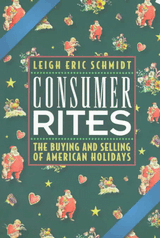
This story from NPR talks about the 19th-century American roots of large Hanukkah celebrations, featuring the religious studies scholar Diane Ashton, and connects the rise of the holiday to the development of elaborate home-based holiday celebrations in Victorian America. It's the time of the year when it's good to pull down Leigh Schmidt's Consumer Rites: The Buying and Selling of American Holidays (Princeton U. Press, 1997 paperback), which shows how "commercial appropriations" of the holidays, especially Christmas, were tied into religion, becoming times of "devout consumption."

So
uth of Cincy, Jewish southerners have developed their own traditions around Hanukkah and food, discussed further by Marci Cohen Ferris in her fun book Matzoh Ball Gumbo: Culinary Tales of the Jewish South. Read/hear more about it here, and also more here. A brief taste:

Oh, sure, this is a great holiday for Jewish Southerners because it celebrates oil, perfect, 'cause we use a lot of it. You know, there's a strong tradition of frying here. And anything with a cast iron pan you got to love, if you're a Southerner. But I'll tell you what we have, and this is actually a traditional menu that my mother always made. Very traditional to have brisket for Hanukah. It's a winter meal. And not everybody barbecued their brisket and served it in kind of that style, but that's how we made ours
.

Jumat, 26 November 2010

Catskills, History, Jewish Food, and Circumcision

.
For those who missed it . . . Joseph Berger, "No Need to Kvetch, Yiddish Lives On in Catskills," NYT, November 25 2010.

KERHONKSON, N.Y. — In a chilled and snow-shrouded Catskills landscape, hundreds of people get together every December to try to breathe some warmth into a dying culture.

For almost a week at a hotel here, organizers immerse the group, which calls itself KlezKamp, in Yiddish and the folkways of the Eastern Europeans who spoke that language until Hitler extinguished their communities. Classes are offered in Yiddish conversation, humor and literature; in klezmer — the sometimes plaintive, sometimes mischievous folk music that has experienced an astonishing comeback — and in the snaking, coiling, hand-clapping dances animated by those melodies.>>>

See also:

Barney Zwartz, "Website a 'treasure chest' of Yiddish migrant history," The Age, November 22, 2010.

Linda Morel, "Schmaltzy history: A Nostalgic Look at Fats for Frying Latkes," Jewish Times of South Jersey, November 26, 2010.

"Battle of the Bris: A Move to Outlaw Circumcision in San Francisco," TIME, November 22, 2010.

Minggu, 21 November 2010

We're No. 1! Colorado Springs Leads in Religion (or Not) and in Defunding NPR Nazis

Paul Harvey

Men's Health magazine, noted for its scholarship in American religious studies, recently rated the top 100 "holiest cities in America." Result: Colorado Springs rated first on the list. I'm very glad to be first in something. Here's a brief excerpt:

While it's true that Colorado, at 5,980 feet above sea level, is closer to heaven than even the Mile High City, we used a different set of numbers to divine our findings. We scoured the U.S. Census and the yellow pages (Yellow.com) for places of worship per capita. Then we tallied up religious organizations (U.S. Census) and the number of volunteers who support these groups . . . Finally, we considered the amount of money donated to religious organizations . . . and spent on religious books.

Most religious

1. Colorado Springs, CO
2. Greensboro, NC
3. Oklahoma City, OK4. Wichita, KS
5. Indianapolis, IN
6. Jacksonville, FL7. Portland, OR
8. Birmingham, AL9. Charlotte, NC
10. Little Rock, AR

The fact that Portland appeared at #7, even though Oregon consistently appears down towards the bottom of most professional surveys conducted by ARIS and others, immediately made me question the methodology here. And in doing so, here's a counter-survey that I found, from our own local paper (based on figures from 2000, admittedly, but still):

A quick run through the data seems to contradict the idea that El Paso County is a highly religious place. The 2000 survey found El Paso County was home to 222,490 people who claim an affiliation with some religion. That was 43 percent of the population. The rate in Denver, meanwhile, is 64 percent.

So, either we're No. 1, or we don't even hold a candle to Denver. Take your pick.

One area where we indisputably lead the nation is in the great national jihad to defund the "Nazis" at National Public Radio ("Nazis" being the term Roger Ailes of Fox News, evidencing its usual fair and balanced presentation, used to refer to NPR; Ailes is President of Fox News).
Leading the great national jihad is our local representative Douglas Lamborn, previously unknown to the public at large but known locally for protecting every piece of military spending pork, no matter how many Defense Secretaries insist that they be cut, and vowing to protect Medicare against the encroaching monstrosity of "socialized medicine" and "Obamacare" -- and etc. You get the idea.
Here's a hilarious cartoon about Lamborn's jihad, from Denver's Westword.

For years Lamborn has sponsored bill to defund completely National Public Radio; the combination of the Juan Williams incident and the recent elections have given this bill a very good chance of approval next year. Our local paper the Colorado Springs Independent covers the story here.

How ironic I should come upon this story, or combination of stories, after listening to a really thoughtful and intelligent program on my local public radio station KRCC this morning featuring a panel discussion from various locals (the religion reporter at the Colorado Springs Gazette, a college chaplain, and some others) on the influence of evangelicalism in Colorado Springs. Besides the panel discussion, the program also features a reporter visiting a local mosque here in the Springs, and another report from the tough lives experienced by those who feel called to the little town of Crestone, Colorado, in an area which houses a striking diversity of religious communities from a Carmelite Monastery to various Zen Buddhist groups. Ethereal spirituality, as the piece makes clear, is a challenge when you're trying to make it through the bitter winters and swarms of spring mosquitoes in that remote corner of SW Colorado.

I was thinking about the particular recent attacks on NPR further tonight in relationship to this commentary by Guy Raz at the end of today's All Things Considered -- a short, arrestingly beautiful piece that showed NPR at its best. Here's hoping the piece goes viral.

Raz was reflecting on Roger Ailes, the Fox News executive who recently said the following:

"They are, of course, Nazis," Ailes said of NPR. "They have a kind of Nazi attitude. They are the left wing of Nazism. These guys don't want any other point of view."

[Yes, Ailes since issued the ritual obligatory apology. So what; it's obvious he meant what he said in the first place].

Let's leave aside the complete historical malapropism of the idiocracy here ("left wing of Nazism," etc.). What moved me was Raz's short oral essay "inspired" (or whatever the term should be) by Ailes's grotesque comments. Raz began by reflecting on his great-grandfather Abraham Reiss, who didn't make it out of Europe before the real Nazis got to him, and then further on what it meant for him to hear "Nazi" used in reference to his network.

That word, Nazi, means something. We are all free to use it as we please. It's our right, of course. But when its use is stripped of any of its real meaning, I just ask you to remember the story of Abraham Reiss.

Colorado Springs -- whether we're first or not in religious adherence,you can thank us for taking the lead in the great national jihad to defund the left-wing Nazis at NPR.


P.S.: While you're at it, check out the piece right before Raz's essay, which is about the growing number and influence of Israeli jazz musicians in New York. I heard one of them, the fantastic bassist Omer Avital, about 10 years ago, and still smile when I think of him ferociously attacking his instrument all night at Small's, with the Jason Lindner band. One of the most astonishing nights of music I've heard in my life; and, for me, a spiritual experience. So here's to you, Omer. My local public radio station, the great and wonderful KRCC, plays your music on occasion, and I heard a tune of yours one time, quite unexpectedly, on the tiny station KZRA in Alamosa, Colorado, one of many rural public stations which have taken root thanks to indispensable public subsidies to bring one-of-a-kind programming to the hinterlands of places such as SW Colorado and NW New Mexico. Congressman Lamborn, check it out sometime, you might like it.

Rabu, 17 November 2010

National Museum of American Jewish History

Randall Stephens

David O'Reilly has an interesting piece on the opening exhibit at the National Museum of American Jewish History: "Chronicling Lives More than Religion," Philadelphia Inquirer, November 14, 2010. (The new museum is open to the public on Nov 28.) O'Reilly interviews deputy curator Josh Perelman and describes some of the highlights ranging from the 17th to the 20th century.

. . . After entering on Market Street, visitors are invited to start their tour on the fourth floor, in the year 1654, and descend through time, floor by floor, to the present, inspecting more than a thousand artifacts along the way.

A great majority of the items are secular - immigration documents from Ellis Island, a sewing machine, the upright piano at which the Russian-born, agnostic, but ethnically Jewish Berlin penned such tunes as "White Christmas," "Easter Parade," and "God Bless America."

But here, too, are examples of the Torah scrolls, bibles, prayer books, menus, candlesticks, kiddush cups, bat mitzvah dresses, and yarmulkes that have helped sustain Judaism in America for three and a half centuries.

"I think we did a pretty good job," said Perelman.

The tour begins with artifacts of Jewish life in the colonies. Here, behind glass, is a 1737 Torah from Savannah, Georgia; a plain, bronze menorah, or liturgical candelabrum; a circumcision kit; the wooden top of a Torah ark from Lancaster County; the bible of the Gomez family - New York mill owners who had fled the Spanish Inquisition; and the handwritten "subscription list" of donors who, in 1728, created America's first synagogue, Shearith Israel, in New York City.>>>
Related Posts Plugin for WordPress, Blogger...