Tampilkan postingan dengan label popular religion. Tampilkan semua postingan

Senin, 17 Oktober 2011

Fracturing the Apocalypse and Gaining my Religion: Some Crossposts for a Monday

Paul Harvey

We've had a good run here for a few weeks on the blog, but may be slow for a little while as the reality of scrambling to keep up with classes, grading, and everything else hits all of us. Anyway, while we wait for the new round of inspiration, here are a few links of note to keep you busy this week.

HNN interviews Matt Sutton about the apocalypse, the furor over his New York Times editorial, and his research in this area here; don't forget our summary of much of this here as well. A little excerpt from an interesting exchange in the interview:


It sounds like there’s a natural political alliance between apocalyptic evangelicals and libertarians. Their objection to Roosevelt, Johnson, and Obama seems to have been ambitious social programs that increase the power of the state because it fits with their apocalyptic narrative.


I think that such an alliance does exist, though I’ve gotten a bunch of angry emails from libertarians this week for lumping them together with evangelical Christians, so they’re not necessarily happy about it. But certainly the anti-statism of libertarianism resonates with the anti-statism of evangelicals, and there are a number of journalists who have been doing work on this recently, looking for links between fundamentalists and the Tea Party.

And there have been stories showing that there are indeed strong connections and strong parallels, though libertarians and evangelicals differ in a lot of things (marijuana, abortion, gay marriage). In terms of anti-statism, though, they have a lot in common, and this is exemplified by candidates like Michelle Bachmann or Rick Perry, who preach anti-statism to both libertarians and evangelicals.


On a different part of the political spectrum, the #occupy (or #ows) movement has generated a great post for us by Janine here (generating a huge number of hits for us thanks to it being picked up by Andrew Sullivan), and more recently a roundup of views and commentary here, by the likes of Nathan Schneider, Anthea Butler, Elizabeth Drescher, and others. On a different albeit related subject, Anthea has posted a wonderful remembrance and appreciation of the Rev. Fred Shuttlesworth here, and Charles Marsh has done the same here.

By the way, as many people have noted, recently Don't Ask Don't Tell came to an end, and lo and behold, the Republic has not crumbled and the military has not disintegrated. On a related unfounded predictions note, the mislabeled "Ground Zero Mosque" has opened, at least on a small scale, and America somehow has not yet succumbed to sharia law. Still awaiting apology from Newt Gingrich and the whole mob of usual-suspect-Islamaphobes for wasting our time with their hysterical culture wars bullshit. Going to be waiting a long time for that one. Maybe it came to their attention how effectively they were skewered in Amy Waldman's novel The Submission. Or not.

Finally, for something completely different, I meant to blog on this when it came out but just didn't get to it. The new documentary film "Hype," a 20th-anniversary retrospective on "grunge" in general and Nirvana in particular, is sitting in my Netflix queue, but in the meantime a few weeks ago Raymond Haberski put up a wonderful post juxtaposing Nirvana to Daniel Rogers' new massive work of intellectual history The Age of Fracture. Going to graduate school in a college town set in rural Ohio, he concludes:

The undergrads had on two even three shirts tied fashionably around their waists and layered in ways that coordinated colors and patterns. I couldn’t really be against them, I thought; after all they probably like the Seattle sound. And yet, these future masters of commercial culture stood in stark contrast to their neighbors in towns such as Chauncey and Nelsonville, places that had been overlooked and underemployed for decades. Those folks, not the ones wearing the new hip uniform, had much in common with that most famous of Nirvana’s refrains, tragic and fitting as it is: “oh well, so what, nevermind.”

It's hard to summarize the post, so just click on the link and read it, it's more than worth the short time it will take. And while we're on the subject of popular music, here is a reflection on how the recently-deceased group R.E.M. helped one person "lose religion and live a life of faith"'; and here's another, reflecting on how "R.E. M. hung in there and showed what it might mean to stand up to an accelerating debasement of our national culture without giving in to cynicism."

Rabu, 25 Mei 2011

How Oprah Became a Messiah: Prophet and Profit

Paul Harvey

As Oprah departs, to much media coverage, let us turn once more to our contributor Kathryn Lofton for a summing up of "What is Oprah"?

K. Lofton's book Oprah: Gospel of an Icon, has engendered a lengthy, multi-part, fascinating set of responses from numerous other scholars at Immanent Frame, and on the occasion of Oprah's departure from the network airwaves, Lofton's reflections on her career and meaning in the context of American religious history can be found at CNN Belief Blog, in the Los Angeles Times, in the New York Daily News, and in the Washington Post. Over at Killing the Buddha, Nathan Schneider also provides these links as well as a link to his own interview with Lofton, and gives his own thoughts, here.

Perhaps the easiest place to connect in to all this discussion is at the piece at the CNN Belief Blog, where our valued colleague writes:

As she departs from her ritual slot, there will be a vacuum for some. Yet if history has taught us anything, it is that the void will not be left gaping for long. “The false messiah is as old as the hope for the true Messiah,” wrote Jewish theologian Franz Rosenzweig. “He is the changing form of this changeless hope.”

Oprah represented humanity’s ceaseless interest in spiritual responses to personal problems. We now live in her world: one of first-person confessions, required makeovers, and spiritual consumption.

The measure of her consequence will be not in whether or not she mattered to you, but whether the world you occupy looks more like hers than you know.

Senin, 23 Mei 2011

Women, Vatican II, and the Remaking of American Catholicism


I'm very happy today to post this guest contribution from Julie Ingersoll, well known for her contributions to Religion Dispatches, where lately she's been following the doings of Christian Reconstructionists and Tea Party Patriots (and the connection between the two). Julie is the author of Evangelical Christian Women: War Stories in the Gender Battles, and is currently writing a book on Christian Reconstructionism.

But today's post is about something very different. Below, Julie gives some thoughts on Colleen McDannell's new book The Spirit of Vatican II: A History of Catholic Reform in America. Colleen will be well known to many blog readers here for previous works such as Material Christianity: Religion and Popular Culture in America, and Picturing Faith: Photography and the Great Depression. Colleen's new book is both an academic as well as a very personal reflection on the role of Vatican II in the lives of American Catholics. Also, for some other reflections on the book (and interviews with the author), see here, here, and (from the Salt Lake Tribune paper) here. A bit down the road on the blog, our contributor Kathleen Sprows Cummings will give us her thoughts on the book as well, but for now, thanks to Julie for these reflections.
_______________________________________________________

Women, Vatican II and the remaking of American Catholicism
by Julie Ingersoll

“Where are the people?”

That’s the question historian Colleen McDannell always asks. In her new book, The Spirit of Vatican II: A History of Catholic Reform in America, (Basic Books, 2011) she gives us a distinctly new view of those reforms to America’s largest denomination. Part institutional history, part social history, part family memoir—and in places strikingly funny-- McDannell’s story has a very special person at its center: her mom, Margaret.

Instead of a traditional “church history” that explores the history of doctrine and the conflicts and negotiations among church leaders --all of them male—McDannell traces the impact of Vatican II on the people in the pews. This shift in focus gives us a glimpse into the religious lives of laypeople, especially women.

McDannell begins with the daily life of Catholics under Vatican I with Margaret’s immigrant grandmother who came to the U.S. in the late 1800s. Margaret herself grew up during the rise of the parochial school system intended to keep Catholic children separated from Protestantism. The practice of Catholicism was formal and stiff; ordained men were in charge and laypeople rarely questioned them. The Mass was said on behalf of the people, in Latin, by a priest with his back to the congregation.

Women’s roles were so limited they were even prohibited from participation in the choir that sang during mass. Of course, no women were part of the Vatican Council’s deliberations (toward the end some women were permitted to listen). McDannell writes:

None of the reporters who covered the opening of the Council noted the irony of the crowd of over two thousand men dressed in lace and silk solemnly striding into St. Peter’s on the feast day of the Maternity of the Virgin Mary without being accompanied by a single woman.

Vatican II brought an emphasis on lay leadership; the priest now faces the congregation; the Mass, in the US, is said in English. Women serve as lay leaders and the roles permitted to lay leaders, whether male or female, are greatly expanded. Traditional hymns are now often replaced with contemporary music and church architecture represents these changes materially.

With this shift in authority toward laypeople, Vatican II empowered women and created in them a sense of the significance of their own voices in terms of parish life, religious practice, and even political issues. While remaining conservative, Margaret’s views on issues like the anti war movement and the civil rights movement were tempered by her church life. Catholics came to see themselves, as McDannell describes them, as “deciding people” even on official church positions on issues such as birth control:

“As father Bill was finishing up Mass with a list of announcements, he looked out at his uncomfortable flock. “Well…regarding…and then came a pause and a big smile; “Big Daddy says no!”

Nancy (one of McDannells’ interviewees) never forgot the moment. “The place roared and everyone clapped and laughed,” she reported. Pope John Paul VI had just announced that artificial birth control would remain off limits. “that was the sign of the times,” Nancy observed, that so few at St. Jude’s took the pontiff’s conclusion seriously that day.”

This is a great book on the impact of Vatican II in the daily lives of American Catholics’ as well as changes in the Catholic influence on American culture and politics (there’s so much more than what I can include here).

McDannell also raises important questions about what counts as “religion.” We often privilege the ideas of leaders without even realizing that those make up the religion of only a few. And religious leaders are all too happy for us to consider them the sole authorities on what counts in their traditions. But, in de-centering religion to examine the cultures, practices and material dimensions, McDannell gives a much more complete picture—a picture that includes real life Catholicism.

Rabu, 18 Mei 2011

Witchcraft in Early North America

Paul Harvey

Some of you may be looking for a good classroom resource for teaching about popular religion or witchcraft in early America. If so, this might be the book for you, so I'll reprint the Choice review below of Alison Games, Witchcraft in Early North America, put out as a pretty short classroom-usable volume by Rowman & Littlefield in their "American Controversies" series, edited by excellent historian Douglas Egerton. These volumes come with primary document selections, chronologies, and other pedagogical helps. (I have a volume coming out in late summer or so in the Rowman & Littlefield African American History series, entitled Through the Storm, Through the Night: A History of African American Christianity -- more on that as the pub. date gets closer, but the experience of the close editing of that book, with an eye towards readability for a general non-expert audience, gives me confidence in these other volumes that R & L is putting out).

Anyway, here's more on this volume, and check the book's website here for table of contents and more info. What particularly attracts me here is the clear effort to provide a broader context for popular religious beliefs in the supernatural throughout 17th century America, and including Natives and African peoples as well as British North Americans. In other words, this isn't your father's Buick, the usual Salem-centric story of witchcraft in the colonies.
________________________________________

Games, Alison. Witchcraft in early North America. Rowman & Littlefield, 2010. 216p index afp; ISBN 9781442203570, $36.95. Reviewed in 2011jun CHOICE. Games (history, Georgetown Univ.) makes a vital contribution to the pedagogical resources on early American witchcraft. With its introductory essay and interdependent collection of primary materials, the book demonstrates how accusations of witchcraft mediated colonial encounters between mutually illegible cultures: characterized by flagrant "coercion and cruelty," such conflicts demanded justification and frequently provoked resistance, and therefore lent themselves to prevailing supernatural explanations and persecution. Games's historical introduction broadens the scope of witchcraft study beyond New England to incorporate less familiar outbreaks in New France and New Spain. The author traces as well the conflicting beliefs European, Native, and African peoples brought to these encounters. A modest selection of Salem materials are among the 29 brief primary documents, which include legal documents, reports of first encounters, and possession narratives from across the continent. Games's premise is that the historical record tells the story slant; accordingly, this volume represents a necessary and ethical, albeit brief, attempt to counter the Anglo-centrism that has characterized witchcraft historiography. The author resituates episodes of witchcraft in the context of cultural contact and conflict in which they occurred, incorporating them into larger scholarly trends in the study of early America as a space of contact zones. Summing Up: Recommended. All readers. -- A. T. Hale, University of Puget Sound

Sabtu, 11 Desember 2010

Premillennialists and Their Charts

Randall Stephens

It's hard to narrate the history of millennialism to a general audience without losing the plot in a thicket of obscure Bible verses, dispensational disorientation, and premill fatigue. Sure, there's a rage to explain. But how many paragraphs should a historian of American millennialism devote to "Armageddon," "tribulation," "Gog," "Magog," "Mark of the Beast"? (Paul Boyer navigated this well in his classic When Time Shall Be No More. That's a wonderful guide.)

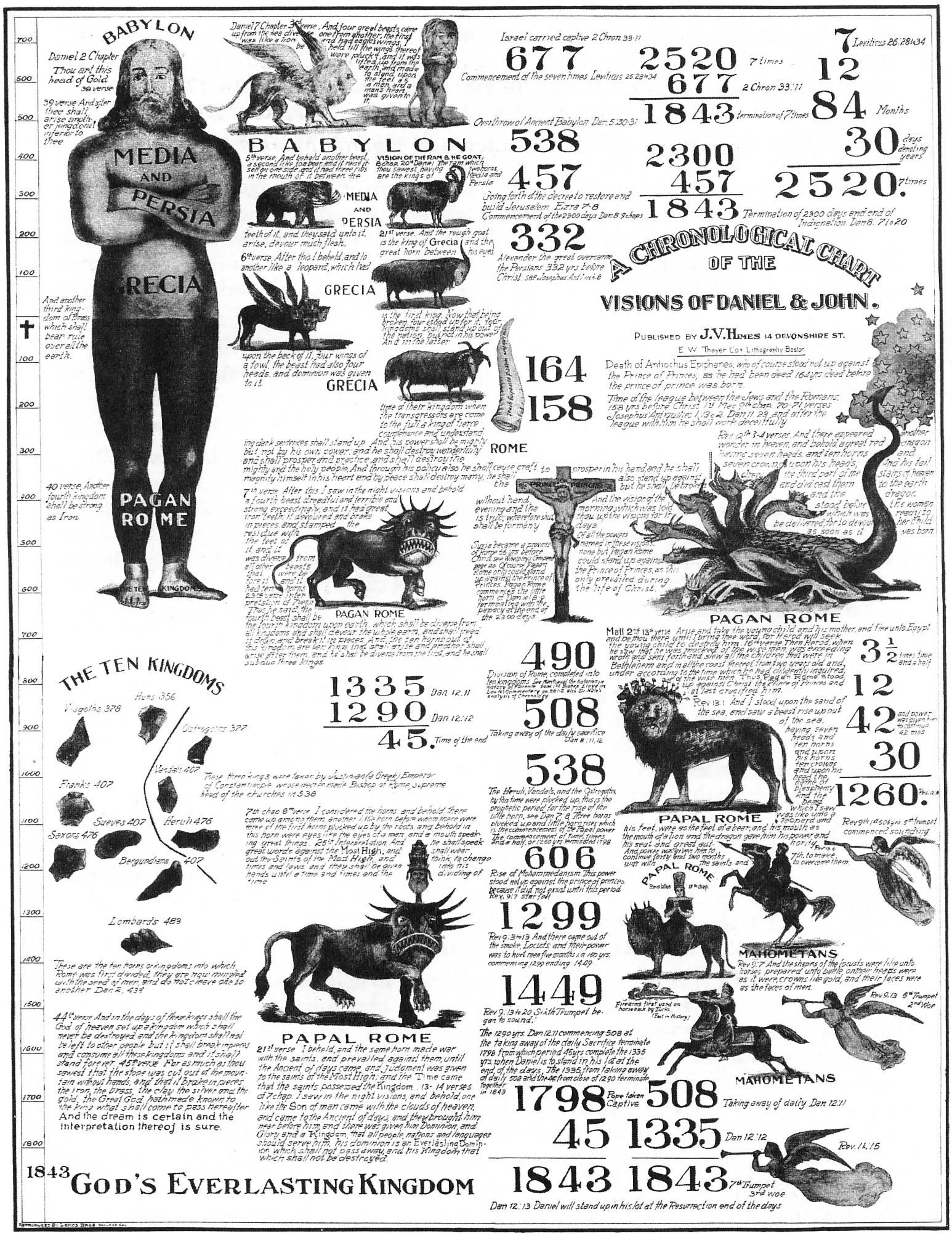
What better illustration of the Babel of premill confusion than the charts, diagrams, and cartoons premill experts used. The gleeful focus on minutiae, sidetracks, and the like dominates so much premill writing from the 19th and 20th centuries. It must not have been too difficult for a superfan of Star Trek to have turned his/her attention to the second advent in the 1970s or 80s.

So, I paste here some of my favorite confusing charts and illustrations. Try explaining any one of these to a room full of the uninitiated. It would be easier to wax eloquent about the distinguishing characteristics of the Klingons, Romulans, Ferengi, Vulcans, and Cardassians.

From William E. Blackstone's wildly popular Jesus Is Coming (1878). Degree of difficulty: 6 out of 10.


Click to enlarge this iconic Millerite poster from 1843, which deciphers prophetic math from Daniel and Revelation. Would like to see a black light version of it. Degree of difficulty: 9 out of 10.


From Isaac Cummings Wellcome, History of the Second Advent Message and Mission, Doctrine and People (1874). Degree of difficulty: 7 out of 10.


And finally, this one from a copy I picked up back in seminary days, Clarence Larkin, The Dispensational Truth: God's Plan and Purpose in the Ages (1920). This handsome text has some real mind-blowing charts in it. Degree of difficulty: 8 out of 10.


Senin, 08 November 2010

Country Music Minus the Culture Wars

Paul Harvey

My piece reflecting on Ricky Skaggs' new recording Mosaic, and more generally on white southern country music's relationship with politics, is just up at Religion Dispatches. (For those interested, here is Ken Tucker's review of the record, from Fresh Air).

A brief excerpt of my piece is below, and then read the rest here:

On his newest record, Mosaic, Skaggs has taken a step back into themes familiar in the religious history of the South, and away from the culture wars. As the opening epigraph suggests, he hasn’t gone soft on his religious belief, and the apocalyptic message drawn from the book of Elijah on Mosaic suggests that premillennial imagery still exerts a hold.

But the message is fundamentally personal, not political. And that’s a good thing.

. . . {T]he more recent culture wars tie between country, religious fundamentalism, and a Tea Party civil religion is an invented tradition. Historically, it lacks any deep roots in the white Southern tradition of musical expression. . . . Historically, Southern music at its best—the bluesmen, the Carter family, Charlie Poole, and the corpus of the old, weird America—simply could not be tied down to any particular political message or program. This music was about a world beyond one’s control. Its occasional bromides or homilies were not nearly as convincing as its unforgettable portrayals of the darker difficulties of survival in a harsh and uncertain world.

Related Posts Plugin for WordPress, Blogger...