Paul Harvey Pardon the self-promotion interruption, but you're used to it. Now and then I post reviews from the helpful library periodical Choice of books of interest in our field. Today I'm going to seize the blog to post this review of my new book Through the Storm, Through the Night, especially for those of you contemplating your book choices for next semester's classes. Harvey, Paul. Through the storm, through the night: a history of African American Christianity. Rowman & Littlefield, 2011. 217p bibl index afp; ISBN 9780742564732, $35.00; ISBN 9780742564756 e-book, $34.99. Reviewed in 2012jan CHOICE. |
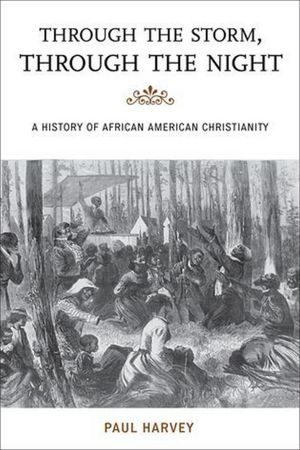 Books abound on the African American religious experience in the US, but Harvey's work is a welcome addition and succinct summary of its 400-year history. Typically in such short monographs, detail is sacrificed for brevity, but Harvey (history, Univ. of Colorado, Colorado Springs) packs great substance through insightful biographies and aptly summarized historical events. He argues against any uniform African American church or religious experience, as African Americans experienced varied contacts with Christianity and often mixed traditional African spiritualism and animistic beliefs. Unquestionably, religious beliefs infused the African American community with hope as they struggled through slavery, Jim Crow legislation, segregation, race-oriented violence, and the civil rights movement. Harvey concludes that though the church is still relevant and Christian denominations are still predominant in the African American community, 21st-century immigrants continue to challenge this narrative, as the Orisha traditions of West and Central Africans, Cuban Santería, Haitian Catholicism and Voodoo, Ethiopian Eastern Orthodoxy, and Islamic influences further heighten diversity. The author notes that clannish and local community traditions among these immigrants overshadow any presumed unity based on skin color. In summary, Harvey creates a broad panoramic of the African American religious experience and challenges future scholars to increase scholarly attention to this field. Summing Up: Highly recommended. All levels/libraries. -- M. S. Hill, Gordon College Books abound on the African American religious experience in the US, but Harvey's work is a welcome addition and succinct summary of its 400-year history. Typically in such short monographs, detail is sacrificed for brevity, but Harvey (history, Univ. of Colorado, Colorado Springs) packs great substance through insightful biographies and aptly summarized historical events. He argues against any uniform African American church or religious experience, as African Americans experienced varied contacts with Christianity and often mixed traditional African spiritualism and animistic beliefs. Unquestionably, religious beliefs infused the African American community with hope as they struggled through slavery, Jim Crow legislation, segregation, race-oriented violence, and the civil rights movement. Harvey concludes that though the church is still relevant and Christian denominations are still predominant in the African American community, 21st-century immigrants continue to challenge this narrative, as the Orisha traditions of West and Central Africans, Cuban Santería, Haitian Catholicism and Voodoo, Ethiopian Eastern Orthodoxy, and Islamic influences further heighten diversity. The author notes that clannish and local community traditions among these immigrants overshadow any presumed unity based on skin color. In summary, Harvey creates a broad panoramic of the African American religious experience and challenges future scholars to increase scholarly attention to this field. Summing Up: Highly recommended. All levels/libraries. -- M. S. Hill, Gordon College |
Tampilkan postingan dengan label self-promotion. Tampilkan semua postingan
Tampilkan postingan dengan label self-promotion. Tampilkan semua postingan
Selasa, 20 Desember 2011
Choice Reviews Through the Storm, Through the Night
Senin, 21 November 2011
The AAR Left Its Heart in San Francisco
 Paul Harvey
So many friends and colleagues gathered in San Francisco this weekend for the American Academy of Religion meeting, highlighted by a reunion dinner yesterday evening for those lucky enough to be part of the Young Scholars in American Religion program.
As you will have seen already from Kelly's roundup post last week, the conference was full of intellectual fare. Our bloggers here were on panels discussing everything from twentieth-century fundamentalism, to religion and the AIDS crisis, to the famous self-taught artist and street evangelist Sister Gertrude Morgan (hope you'll blog about that here, Emily!), to subjects in Mormon studies, to "narrativity" in the construction of our American religious history courses and survey writings-- and much more besides. You can survey a lot of reactions/experiences at panels at the twitter hashtag #sblaar.

My friends and colleagues took care of cogitating over these important subjects. As for myself, I spent more time re-indulging the delights of Korean tacos and kimchee fried rice from the Namu food cart at Ferry Point Plaza at the Saturday farmer's market, which surely ranks as one of the best 2 or 3 places in the United States (especially for foodies). On a chilly and rainy weekend, nothing conjures up a pre-Thanksgiving weekend of food and intellectual fun like kimchee fried rice.
Blogging will resume tomorrow, I hope, sorry for the silence, and thanks to many at AAR who said kind things to me about the blog. And finally, congratulations to RAndall, who is very soon, in just a couple of weeks, off to Norway for 6 months as a visiting lecturer/scholar as a Fulbright Fellow in Norway!
Senin, 14 November 2011
Frequencies at the AAR
by Kathryn Lofton
Please consider joining us this upcoming Sunday for an additional meeting at the American Academy of Religion (additional meeting means we aren't in the official book, yet are, like spirituality itself, haunting the event). Click on the poster below for more details.

If you haven't had a chance to check out Frequencies lately, be sure to check it out; we're on entry 53/100. We've had fantastic contributions from many fabulous scholars of American religions such as Courtney Bender, Julie Byrne, John Corrigan, Finbarr Curtis, Joshua Dubler, Gary Laderman, Sally Promey, Leigh Eric Schmidt, Judith Weisenfeld, and Diane Winston. This is just a sampler of the strange and delightful replies John Modern and I received to this prompt. We welcome all feedback -- online or in San Francisco!
p.s. If you're feeling a bit like today is a slow-news day, consider this: the site of the first celebrity wedding in America may have been found. I just hope this doesn't crowd Kim-and-Kris out of their coverage.
Please consider joining us this upcoming Sunday for an additional meeting at the American Academy of Religion (additional meeting means we aren't in the official book, yet are, like spirituality itself, haunting the event). Click on the poster below for more details.

If you haven't had a chance to check out Frequencies lately, be sure to check it out; we're on entry 53/100. We've had fantastic contributions from many fabulous scholars of American religions such as Courtney Bender, Julie Byrne, John Corrigan, Finbarr Curtis, Joshua Dubler, Gary Laderman, Sally Promey, Leigh Eric Schmidt, Judith Weisenfeld, and Diane Winston. This is just a sampler of the strange and delightful replies John Modern and I received to this prompt. We welcome all feedback -- online or in San Francisco!
p.s. If you're feeling a bit like today is a slow-news day, consider this: the site of the first celebrity wedding in America may have been found. I just hope this doesn't crowd Kim-and-Kris out of their coverage.
Jumat, 14 Oktober 2011
More on "The Tebow Thing"
Art Remillard
Isn't Friday a perfect day for some shameless self-promotion? I think so.
A while back, I blogged about my "Religion and Sports" course and mentioned Tim Tebow--the quintessential "Sportian" and "superhuman" cult of personality. Somehow this caught the eye of Sean Gregory, a sportswriter at Time. So the other evening we had a delightful conversation, and here's the result...
 ...while some guys wear religion on their sleeves, Tebow literally covers his body with faith. He writes out bible verses on his eye-black [the face paint athletes wear to reduce glare]. Tebow is an unabashed believer, who views the world in black and white. He once told a group of prisoners: "If you have Jesus Christ in your heart, you are going to spend eternity in heaven. If you don’t, you’re going to spend eternity in hell."
Before the 2010 Super Bowl, Tebow threw himself, headlong, into one of the country’s most divisive and deeply personal debates — abortion — by appearing in a pro-life Super Bowl ad for Focus on the Family, the prominent Evangelical organization. (One touchstone of Tebow lore: his mother, Pam, suffered from pregnancy complications with Tim, and a doctor told her that an abortion might save her life. The devout Pam gave birth to Tim anyway, and many of Tebow’s supporters view his success as a message from God.)
Tebow seems to have crossed a line that most athletes have respected. They’ll celebrate their own faith, but won’t challenge yours. “This is a sticking point,” says Arthur Remillard, a religious studies professor at St. Francis College in Loretto, Pa., who teaches a course on sports and religion, and starts it off with a Tebow discussion. “It’s one thing for an athlete to say 'Thank you, Jesus,' on a Sunday afternoon. It’s another for him to make what amounts to a declaration that ‘I am morally superior to you.’ There’s a segment of the fan base that’s not too keen on hearing that.” Continue . . .
Isn't Friday a perfect day for some shameless self-promotion? I think so.
A while back, I blogged about my "Religion and Sports" course and mentioned Tim Tebow--the quintessential "Sportian" and "superhuman" cult of personality. Somehow this caught the eye of Sean Gregory, a sportswriter at Time. So the other evening we had a delightful conversation, and here's the result...
Before the 2010 Super Bowl, Tebow threw himself, headlong, into one of the country’s most divisive and deeply personal debates — abortion — by appearing in a pro-life Super Bowl ad for Focus on the Family, the prominent Evangelical organization. (One touchstone of Tebow lore: his mother, Pam, suffered from pregnancy complications with Tim, and a doctor told her that an abortion might save her life. The devout Pam gave birth to Tim anyway, and many of Tebow’s supporters view his success as a message from God.)
Tebow seems to have crossed a line that most athletes have respected. They’ll celebrate their own faith, but won’t challenge yours. “This is a sticking point,” says Arthur Remillard, a religious studies professor at St. Francis College in Loretto, Pa., who teaches a course on sports and religion, and starts it off with a Tebow discussion. “It’s one thing for an athlete to say 'Thank you, Jesus,' on a Sunday afternoon. It’s another for him to make what amounts to a declaration that ‘I am morally superior to you.’ There’s a segment of the fan base that’s not too keen on hearing that.” Continue . . .
Selasa, 13 September 2011
#REL100: Tweets, Blogs, and You
By Michael J. Altman
 The best thing about teaching your own course as a graduate student is the freedom to experiment. There's great faculty to get advice from, you're only teaching one section (at least in my case), and you have the solace of knowing that whatever horrible course reviews you get will not show up in your tenure file. So, with that in mind, I decided to try and open up my REL 100 Introduction to Religion: Christian and Hindu Traditions to the outside world through the power of social media. Our class of roughly thirty five students is running a blog on religion and culture and also using twitter to conduct class discussion open to anyone who cares to pay attention.
Readers of this blog might find our class blog and our Twitter discussion (#rel100) interesting as half of the course (the Christian half) comes from monographs in American religious history. We'll be starting with Marie Griffith's Born Again Bodies at the end of this week and then go on to read Robert Orsi's Thank You St. Jude and Wallace Best's Passionately Human, No Less Divine. Each of these three texts will be paired with a book on Hinduism in India or the diaspora on similar themes. (You can find the whole syllabus here.)
So, this is my formal invitation to RiAH readers and contributors to please stop by our blog and leave comments or, if you do the whole Twitter thing (I'm looking at you @pharvey61 and @kelly_j_baker), keep an eye on our stream. I have told the students that we will be writing for a public audience and engaging in the discussion of religion in the public sphere. To do this successfully we need a public. So, please, be our public.
Ed Blum and Kevin Schultz have done a great job of opening up the "back of the house" in their U.S. history survey by blogging about their syllabai and lectures. I think of this class as doing the reverse and opening up the "front of the house." It's also one giant experiment in pedagogy and social media. As an experiment it has already had its ups and downs but, nonetheless, we'd love for you to join us.

Readers of this blog might find our class blog and our Twitter discussion (#rel100) interesting as half of the course (the Christian half) comes from monographs in American religious history. We'll be starting with Marie Griffith's Born Again Bodies at the end of this week and then go on to read Robert Orsi's Thank You St. Jude and Wallace Best's Passionately Human, No Less Divine. Each of these three texts will be paired with a book on Hinduism in India or the diaspora on similar themes. (You can find the whole syllabus here.)
So, this is my formal invitation to RiAH readers and contributors to please stop by our blog and leave comments or, if you do the whole Twitter thing (I'm looking at you @pharvey61 and @kelly_j_baker), keep an eye on our stream. I have told the students that we will be writing for a public audience and engaging in the discussion of religion in the public sphere. To do this successfully we need a public. So, please, be our public.
Ed Blum and Kevin Schultz have done a great job of opening up the "back of the house" in their U.S. history survey by blogging about their syllabai and lectures. I think of this class as doing the reverse and opening up the "front of the house." It's also one giant experiment in pedagogy and social media. As an experiment it has already had its ups and downs but, nonetheless, we'd love for you to join us.
Selasa, 06 September 2011
'Scuse Me While I Kiss This Blog

Paul Harvey
Excuse the interruption, but I'd doing a little crowdsource experiment and am interested in getting any comments you have.
We are busy doing some "updates" to my home department, the History Department at the University of Colorado at Colorado Springs. Like a lot of departments, we're trying to figure out how best to communicate with our students. In our case, it's more difficult than it might be in some others, as we have students ranging in age from 18 to 70, most of whom work a lot (a large number full time). Some of them take classes in the daytime, some in the evening, some on Saturdays. We also have nearly 300 history majors, a lot for a busy regular faculty of 8 members to keep up with. We have some students living on campus, but the majority of our students, I believe, are commuters. Even the students living on campus spend a lot of time away from school working.
I've created a blog for my Department, and am very interested especially in hearing from anybody who has used blogs/FB/twitter or whatever to communicate with students in your history/religious studies/American Studies/English/whatever departments. My thought was this would take the place of a departmental "newsletter," or maybe be in addition to that.
But truthfully I'm not sure how much students read blogs at all, never mind when it's not assigned reading. John Fea, whose history department at Messiah College has a nice blog of its own, already has told me that nearly all of his students "get" the blog through their facebook feeds. I don't doubt some of our students would do that, but a lot of our older students don't use facebook.
Anyway, feel free to give the UCCS History Department blog experiment a quick look, and let me know if you have any reactions or what your experiences have been using any kind of social media in your own departmental setting.
Now, with apologies for the interruption, back to our regularly scheduled programming.
Jumat, 26 Agustus 2011
Radio Free RiAH, Part Two
 Kelly Baker
Randall Stephens will be on the Dr. Howard Gluss show tonight from 8 pm-9pm PST. Unlike Paul and myself, he gets the whole hour!
Tune in to listen to Howard and Randall discuss "Right Wing America: Evangelicals, Conservative Christians, and Christian Pyschologists." And hopefully, they'll discuss Randall's forthcoming book with Karl Giberson, The Anointed: Evangelical Truth in a Secular Age (October).
This program provides live streaming on the internet here.
P.S. Yes, we are trying to take over the world. We'll let y'all know how it goes.
Kamis, 18 Agustus 2011
Radio Free RiAH
Paul Harvey
Update: Randall will be appearing on the show August 26th! Part of RiAH's plan for world domination.
My partner-in-crime Kelly (follow her on Twitter) and I (@pharvey61 for you tweeps) will be appearing tomorrow evening 8-9 p.m. Pacific time (that's like 9:00 a.m. for our vast followership in Mumbai) on the radio program "Life with Dr. Gluss." Kelly will be on from 8-8:30 PST, talking about her new book Gospel According to the Klan; I'll be on from 8:30 - 9, talking about, umm, not quite sure what, but generally about religion in American history, and doubtless religion and contemporary politics and psychology. This program streams live on the internet here. The show's host can be found here. Tune in for Kelly's part for sure, and then go do something useful with your life instead of wasting a perfectly good half hour on my segment.
Update: Randall will be appearing on the show August 26th! Part of RiAH's plan for world domination.
Kamis, 04 Agustus 2011
Through the Storm, Through the Night: Now Available!
 Paul Harvey
Earlier this summer I blogged about my book Through the Storm, Through the Night: A History of African American Christianity, which was then slated to appear later in the summer (Rowman & Littlefield publishers).
Voila, it's later in the summer, and the book is out, so for that reason, and because my vast portfolio holdings tanked today, seemed like a good day for the time-honored self-promotional post.
Below I'll just repost what I put up earlier about the book, which describes the contents in some more detail, sorry for the repeat but definitely hoping that this book will be useful for any number of classes that some of you regular blog readers teach.
So, without further adieu, a repost. If you have the chance to use it in a class over the next year, let me know how it goes. Yes, it comes in a Kindle edition as well. Paperback version should be out in a year or so I think. For classroom instructors -- the publisher Rowman & Littlefield has an "desk/exam" copy policy here.
__________________________________
Later this summer [it's now out], my new book Through the Storm, Through the Night: A History of African American Christianity, will be out with Rowman & Littlefield. It's part of the "African American History" series put out by Rowman & Littlefield. And it's out just in time for your fall course text assignment!
I'm proud to have it standing there with very recent books by some tremendous historians in the same series, including Chris Waldrep's African Americans Confront Lynching: Strategies of Resistance From the Civil War to the Civil Rights Era, my old friend Burton Peretti's Lift Every Voice: The History of African American Music, and Edward Countryman's forthcoming Enjoy the Same Liberty: African Americans and the Revolutionary Era.
I'm also posting this now because some of you -- and you know who you are! -- are (if you're like me) now facing up to the fact that you've put off your fall book selections (which were due a month or two ago, remember that) long enough, and it's time to pick your texts for the fall. And for a select number of you, maybe this one will be right for you.
The text is short, about 140 pp., and written with the "general reader" and undergraduate reader in mind. I start with the diversity of religious expressions in West and Central Africa in the 14th/15th century, and end with Mama Lola and Kanye West, if that is a far enough chronological reach for you. . . .
In addition, the book comes with a "documents" section, about 60 pages, ranging from Virginia laws on baptism and freedom from the 1660s, to an account of the Stono Rebellion in 1739, to Daniel Payne's famous tour attempting to stamp out "ring shouts" in the 1870s, to Mahalia Jackson's reminiscences of growing up in New Orleans, to John Lewis reflecting on the meaning of non-violence, to Vincent Harding's great essay on the white Christ and Black Power, to Kanye West's "Jesus Walks." There is also a bibliographic essay, broken up by chapter, a Glossary, a Chronology section, and a timeline and some brief footnotes (brief enough not to scare off any freshman reader).
If any of ya'll want to preview it for possible purchase or course use, I'd by happy to send pdfs of the page proofs, or a sample chapter or something if you just want to briefly survey. Just email me, and I'll be there.
Table of contents and more info. below.
_____________________________________
Book description (from book website):
Paul Harvey illustrates how black Christian traditions provided theological, institutional, and personal strategies for cultural survival during bondage and into an era of partial freedom. At the same time, he covers the ongoing tug-of-war between themes of "respectability" versus practices derived from an African heritage; the adoption of Christianity by the majority; and the critique of the adoption of the "white man's religion" from the eighteenth century to the present. The book also covers internal cultural, gendered, and class divisions in churches that attracted congregants of widely disparate educational levels, incomes, and worship styles.
Through the Storm, Through the Night provides a lively overview to the history of African American religion, beginning with the birth of African Christianity amidst the Transatlantic slave trade, and tracing the story through its growth in America. Paul Harvey successfully uses the history of African American religion to portray the complexity and humanity of the African American experience.
Through the Storm, Through the Night provides a lively overview to the history of African American religion, beginning with the birth of African Christianity amidst the Transatlantic slave trade, and tracing the story through its growth in America. Paul Harvey successfully uses the history of African American religion to portray the complexity and humanity of the African American experience.
Table of Contents:
- Introduction: Themes in African American Religious History
- Middle Passage for the Gods: African and African American Religions from the Middle Passage to the Great Awakening
- The Birth of Afro-Christianity in the Slave Quarters and the Urban North, 1740-1831
- Through the Night: African Amerian Religion in the Antebellum Era
- Day of Jubilee: Black Churches from Emancipation to the Era of Jim Crow
- Jesus on the Mainline: Black Christianity from the Great Migration through World War II
- Freedom's Main Line: Black Christianity, Civil Rights, and Religious Pluralism
- Epilogue: Righteous Anger and Visionary Dreams: Contemporary Black Politics, Religion, and Culture
- Documents Section
- Glossary
- Bibliographic Essay
Advance reviews:
"If you teach, study, practice, or care about African American religion, then this is the book for you. Paul Harvey provides an indispensable overview of black Christianity from the age of slavery to the ascendance of Obama. With it, Harvey offers a bevy of fascinating primary documents that range from Nat Turner's righteous rage to Mahalia Jackson's soulful songs. Through the Storm, Through the Night does it all with such clarity that even the most complex concepts make sense."—Edward J. Blum, Author, W. E. B. Du Bois, American Prophet
"Harvey provides an elegant and engaging introduction to the history of African American Christianity that charts the diversity of experience and expression among black Christians and illuminates the complex relationship between religion and race in American life."—Judith Weisenfeld, Princeton University
"Harvey provides an elegant and engaging introduction to the history of African American Christianity that charts the diversity of experience and expression among black Christians and illuminates the complex relationship between religion and race in American life."—Judith Weisenfeld, Princeton University
Kamis, 28 Juli 2011
Jesus, the Ramones, and Michele Bachmann Send me 29th Birthday Greetings!
Paul Harvey
In a few hours I'm turning 29 (give or take a little, like 21 years), and better blog now before, rather than after, decanting the birthday present.
It's so nice to get birthday greetings already first from Jesus, about whom Ed Blum and I have recently written a book, culminating, as it had to, with Jesus and the Devil duking it out in the ring in an episode of South Park. And The Ramones also checked in with a wonderful birthday greeting for me (we'll go out on that below).
Almost as exciting, Michele Bachmann called in to offer me free reparative therapy (for my blog addiction, that is); Grover Norquist checked in and said for my birthday he already had given me his long-wanted present of drowning effective governance in the bathtub; Speaker Boehner already called to say he'll send me some additional revenue in exchange for my vote; and Rick Perry called to give me a special invitation to his big Prayer Rally (sponsored by the American Family Association, in Houston on August 6th! I sent my regrets, told him I was "needing to spend more time with my family," and assured him I would be sending Historianess in my stead.
Anyway, turning off all media for a few days, so see you all next week on the other side of a mid-life crisis! Until then, let's go out with some Ramones -- after a week in the news like the last one, we all wanna be sedated.
Selasa, 21 Juni 2011
Four More Years! Happy Birthday to Us
 Paul Harvey
Our blog turns 4 today. In our 3s we had all the temper tantrums, self-promotional outbursts, and screaming fits that one would expect for that age. Expect more of the same in the year to come!

Actually, we got plenty of good stuff coming up for you faithful readers. Soon we'll have up an interview with Jarod Roll and Erik Gellman, authors of the terrific new book The Gospel of the Working Class, out next month with Illinois. John Fea will be discussing for us a new work on "enlightened evangelicalism" in the eighteenth century, Mike Pasquier has us covered on Notre Dame and the Civil War, and Art Remillard will be looking at a new text on Jews and black baseball. Heath Carter will be finishing his dissertation, courtesy of the prestigious Newcombe fellowship, and Elesha Coffman will be enjoying a year in paradise at Princeton. And, of course, Randall Stephens will continue to conquer the world, in the spring semester from his new Fulbright base in Norway. And if Kelly Baker has anything to do with it, we'll have some posts from zombies up here soon. Meanwhile, Matt Sutton will continue to send up intercessory prayers that there will be a fantasy football season this fall, and if there is praying twice as hard that his team will shock the world by finishing over .500 (that is, when he's not using his NEH year-long fellowship to work on his much-anticipated book for Harvard University Press, American Evangelicals and the Politics of Apocalypse, and touch up his article for the Journal of American History).
If you're not on our facebook page, then "like" us there. If you tweet, follow us there. Tell your friends, and your "friends," about us, and let's see if we can get to 1,000 fans and 200 twitter "followers" soon. Those of you who want to contribute, let me know and we'll get you involved. To you publishers: keep your cards and books coming, we'll do our best to cover them.
For now, do not ask for whom the vuvuzela blows. Instead, party on!
Minggu, 12 Juni 2011
Simple Things You See are All Complicated: Random Reflections on the 2nd Biennial Conference on Religion and American Culture
Paul Harvey
The simple things you see are all complicated
I look pretty young, but I'm just back-dated, yeah
The Who, "Substitute"
If it's a lie, then we fight, on that lie. But we gotta fight.
Slim Charles in The Wire
Elesha, Janine, and Kelly have initiated a vigorous conversation arising from one particular session at the 2nd Biennial Conference on Religion and American Culture which concluded just over a week ago. Because I had to leave just before this particular session, I don’t have much to add to it in particular, but I had a few stray thoughts on other parts of the meeting to throw up here. Today’s post will be lighter, more observations about some key phrases and indelible memories that I’ll carry from the conference. Tomorrow I hope to develop a few more serious thoughts about one session in particular, the one involving a discussion about the "bracketing" of religious belief in religious studies -- its rationale, its benefits, and its costs.
Before continuing, the last session was on "The Future of American Religion," but I was unable to be there, so am really hoping that one of ya'll out there will post on the discussion that went on there.

The first thought: a shout out to my partner in crime Philip Goff for organizing the conference in the first place, a huge undertaking of fundraising and organization. I don’ t know whether Phil got thanked at the end, but having lunch with him just before I left, he told myself and someone else present about his death struggle with the J.W. Marriott (the conference hotel) to get them to do what they had in fact been contracted to do (such as set up our room chairs in a circular pattern, put us in the room agreed to, etc.). Conference attendees don’t normally think about stuff like that, but suffice to say after threatening to call in his university lawyers and engaging in numerous conversations with the Marriott staff, the hotel at last came through with what they were contracted to come through with. That was a lot of work they had to go to just so we could sit around and talk.
All went smoothly, but not without a lot of background fighting leading up to the event. Anyway, since scholars tend to bitch and find fault with individual sessions or presenters or anything else, a shout out for those (Phil and his assistant Becky Vasko in particular) who make these things possible.
Second, I have no doubt that long after some of the substantive intellectual discussions have been forgotten, I’ll still remember some of the shorter or even “throwaway “ observations, conversations, and barroom late night jesting. Here are a few that stick with me (I had some others at the time, but they disappeared after the third martini).
One presenter, Su’ad Abdul Khabeer, discussing her research on the styles and head scarves of inner-city Muslim women, related that the women she studies refer to their scarf styles as “hood-jabs.” Her entire discussion of the phenomenon of "Muslim Cool" was the single most interesting ethnographic description I've heard in a good while, and a reminder of the tireless vitality of American religious cultures. She might have been the only person there from the discipline of Anthropology (maybe there were others, but I didn't see any), and as someone who did a minor field in Cultural Anthropology lo so many years ago I still enjoy hearing work from that perspective.
At the session on religion and market models, James Hudnut-Beumler, a scholar of religion and economics, author recently of In Pursuit of the Almighty's Dollar: A History of Money and American Protestantism, and Dean of the Div. School at Vanderbilt, related a conversation he had once with Ben Bernanke at some kind of conference or meeting. Bernanke asked him what he studied, and he replied “religion.” Bernanke answered back, “I can explain that.” Bernanke was being a little facetious, but only a little, for he went on to give an economic analysis, based on rational choice theory, on why women historically would predominate in many types of religious organizations (basically, their “wages” from this participation were equal to or greater than the discriminatory wages they would have faced – and would still face – in the secular marketplace and workplace). The idea here was both to suggest what we can learn from approaches drawn from market models of religion, as well as why we resist the hegemony of those models – the irritation we feel at the “I can explain that,” even when meant only half-seriously, is an irritation at a reductionism run amok.
And yet, reductionism is a tool that leads to significant insights (like, what's causing that e coli outbreak? and why are there more religious "nones" now than there used to be?), so it never hurts when humanists get exposed to social science scholars who use the word "data" a lot. There will always be a fair amount of cross-disciplinary carping at these kinds of conferences, a small price to pay for crossdisciplinary conversations.
At the very first session, we had a great “ethnographic moment,” in an impromptu discussion between Robert Orsi and Jan Shipps, renowned scholars both but slightly separated generationally, concerning whether we can “bracket out” religious belief in our studies. In reflecting on her pioneering studies of Mormonism, Shipps noted how she always said (or implied) “for them,” as in “for them, these visions were real.” Orsi replied that the problem with the “for them” bracketing was that it could easily lead to “for them, these visions were real – and they are crazy.”
I hope to develop a fuller post on this conversation early this week, as it was the session that ultimately interested me the most, but just this brief conversation between the two raised the same kinds of issues and back-and-forth responses which Orsi and Richard Bushman discussed recently in the journal Dialogue (see Chris Jones’s post on that), and which Orsi and Stephen Prothero batted back-and-forth several years ago in a discussion that is still frequently referenced – click here for a useful summary of that. I have noted recently that a lot of folks are assigning that discussion to students in classes, because it really gets to the heart of the matter of how scholars conceive of themselves and their work in religion.
Is the “whoosh” that we get from sporting events (or from some other mass group activity that induces emotional excitement in individuals) the same as the “whoosh,” the rapid firing of neurons and physiological response, that “we” get from religion? If so, is religion some sort of minor subdiscipline of cognitive psychology and neuro-biology? This became the theme of a lively discussion between Ann Taves (whose recent work has been done in collaboration, so I gather, with neuro-psychologists and other scientists) and Tracy Fessenden, who spoke eloquently of her resistance to adopting the scientific model of study as a means of accessing the huge money and prestige that scientists win at universities, in comparison to the perpetually impoverished and denigrated state of the humanities at many (most?) institutions nowadays – especially state institutions where “productivity” is measured in grant dollars raised. I don't mean to suggest that Taves was leading that direction -- certainly not true for the President of the AAR! But we are entering a new era of discussion (beyond the "two cultures" model) of sciences and the humanities, and there's an awful lot at stake in those discussions.
Rachel Wheeler concluded one session by noting how our generation of scholars always ends up saying, in effect, “it’s complicated.” That is certainly my classroom mode, and the message one would end up with at a conference like this. Yet others in the room, especially those in the social sciences, bring more concrete questions (and therefore answers) to the table, as when Roger Finke discussed some of the findings that can be gleaned from sociological studies of religious behavior such as he has conducted in some of his well-known studies. That brings us back to the discussion that Hudnut-Beumler and Ben Bernanke had about “I can explain that.” The humanists in the room stiffen their backbones against any explanation that does not invoke complexity and some degree of unknowability; some (not all) of the social scientists naturally are drawn to projects that focus on concrete questions and answers – has religious/philanthropic giving risen or fallen over time as a percentage of people’s incomes? Has the pay of clergy risen or fallen relative to other professions over the longue duree (answer: fallen, but you already knew that)? And so on.
As a humanist at heart, naturally I gravitate towards “It’s complicated” as my answer for most important questions. For the smaller questions, we can find answers, but for the bigger questions that drew me into academic studies in the first place, our answers will be tentative at best. Therefore, my classroom pedagogy tends to be deconstructively Socratic, in the sense of proposing questions, letting students pose hypotheses, poking holes/finding problems with those hypotheses, and then commanding them to “go and research some more” at the end of the period (they probably go to toga parties instead, but at least I want to leave them with the idea of the beautiful confusion of historical research). Is that, ultimately, where I want to leave it? I don’t think that will leave the assessment committee at my university very happy, since we are supposed to be assessing concrete bits of student learning.
But that leads to a final irony: I am chair of our departmental assessment committee (that's a committee of one -- but full of self-doubt as I am, reaching consensus is surprisingly difficult), so I get to develop the instruments to test exactly what bytes of data students "learn." Since I developed them, our instruments, therefore, essentially capture the degree to which students "get" the concept "it's complicated."
Is “boring from within” the way to beat a bureaucratic system that inevitably beats down individuals? On the other hand, as a lover and scholar of The Wire, I also know that, ultimately, the institution always wins, so we shall see whether, like Slim Charles, I "fight on that lie," just because we have to fight, or whether "boring from within" is simply carving a hole in my own academic soul.
Ultimately, in this age of the privatization of public goods such as education, the game does change, while it also just gets more fierce -- as Kathryn Lofton and Sylvester Johnson reminded us in their presentations on/critiques of (respectively) neoliberalism and its influence in market models of religion, and the relationship of American religion to the American imperial state. Reflecting further on the privatization of the public good of education (as in Colorado, where state funding now represents less than 8% of the CU budget) threw some cold water on the neural "whoosh" that conferences such as this, at their best, provide. (And if, like Janine, you live in Illinois, then that water bath is even colder.)
Rabu, 01 Juni 2011
Through the Storm, Through the Night: A History of African American Christianity
Paul HarveyIt's a slow news week at the blog -- no Rapture, no David Barton sightings, politics as usual in Washington, the religious left arguing about Jim Wallis, etc. -- and some of you know what that means. Yes, it's time for the time-honored self-promotional post here at RiAH.
Later this summer, August I hope but by September for sure, my new book Through the Storm, Through the Night: A History of African American Christianity, will be out with Rowman & Littlefield. It's part of the "African American History" series put out by Rowman & Littlefield. And it's out just in time for your fall course text assignment!
I'm proud to have it standing there with very recent books by some tremendous historians in the same series, including Chris Waldrep's African Americans Confront Lynching: Strategies of Resistance From the Civil War to the Civil Rights Era, my old friend Burton Peretti's Lift Every Voice: The History of African American Music, and Edward Countryman's forthcoming Enjoy the Same Liberty: African Americans and the Revolutionary Era.
I'm also posting this now because some of you -- and you know who you are! -- are (if you're like me) now facing up to the fact that you've put off your fall book selections (which were due a month or two ago, remember that) long enough, and it's time to pick your texts for the fall. And for a select number of you, maybe this one will be right for you.
The text is short, about 140 pp., and written with the "general reader" and undergraduate reader in mind. I start with the diversity of religious expressions in West and Central Africa in the 14th/15th century, and end with Mama Lola and Kanye West, if that is a far enough chronological reach for you. And trust me, when drafts of this book failed to meet the aim of reaching the general audience and undergraduate reader, the tireless editors for this series, Jacqueline Moore and Nina Mkjagkij, were ever-ready with fierce and sometimes sarcastic pencils, rumbling through my prose like Sherman rumbled through Georgia, leaving a lot of detritus lying around but cleaning up the landscape considerably. Only, unlike Sherman, they rumbled through my landscape four times, Sherman as you recall having only moved through once. Kidding aside, it was a great experience to have a manuscript put through its paces so many times. I'm sure my other books would have been better with a similar full frontal attack on flabby prose.
In addition, the book comes with a "documents" section, about 60 pages, ranging from Virginia laws on baptism and freedom from the 1660s, to an account of the Stono Rebellion in 1739, to Daniel Payne's famous tour attempting to stamp out "ring shouts" in the 1870s, to Mahalia Jackson's reminiscences of growing up in New Orleans, to John Lewis reflecting on the meaning of non-violence, to Vincent Harding's great essay on the white Christ and Black Power, to Kanye West's "Jesus Walks." There is also a bibliographic essay, broken up by chapter, a Glossary, a Chronology section, and a timeline and some brief footnotes (brief enough not to scare off any freshman reader).
If any of ya'll want to preview it for possible purchase or course use, I'd by happy to send pdfs of the page proofs, or a sample chapter or something if you just want to briefly survey. Just email me, and I'll be there.
Table of contents and more info. below. And now after this brief commercial interruption, back to our usual programming. We'll have some blog posts up soon reflecting on the good times coming up at the Religion and American Culture Conference in Indianapolis starting tomorrow evening; I look forward to many great conversations there! Also, my co-blogmeisters Kelly Baker and the ubiquitous Randall Stephens have books coming out very soon, so we'll have some posts up about those soon.
And we won't even mention yet Phillip Luke Sinitiere's work on Joel Osteen, due up next year with NYU Press, and Linford Fisher's astonishing feat of research and analysis, The Indian Great Awakening: Religion and the Shaping of New England Indian Cultures in Early America, out I believe next year with Oxford Univ. Press, and sure to shape the study of colonial American religious encounters for the next generation to come. Of course, all these works will be featured here at RiAH in days and months to come.
But, enough about you, let's talk about me -- more on my book below.
_____________________________________
Book description (from book website):
Paul Harvey illustrates how black Christian traditions provided theological, institutional, and personal strategies for cultural survival during bondage and into an era of partial freedom. At the same time, he covers the ongoing tug-of-war between themes of "respectability" versus practices derived from an African heritage; the adoption of Christianity by the majority; and the critique of the adoption of the "white man's religion" from the eighteenth century to the present. The book also covers internal cultural, gendered, and class divisions in churches that attracted congregants of widely disparate educational levels, incomes, and worship styles.
Through the Storm, Through the Night provides a lively overview to the history of African American religion, beginning with the birth of African Christianity amidst the Transatlantic slave trade, and tracing the story through its growth in America. Paul Harvey successfully uses the history of African American religion to portray the complexity and humanity of the African American experience.
Through the Storm, Through the Night provides a lively overview to the history of African American religion, beginning with the birth of African Christianity amidst the Transatlantic slave trade, and tracing the story through its growth in America. Paul Harvey successfully uses the history of African American religion to portray the complexity and humanity of the African American experience.
Table of Contents:
- Introduction: Themes in African American Religious History
- Middle Passage for the Gods: African and African American Religions from the Middle Passage to the Great Awakening
- The Birth of Afro-Christianity in the Slave Quarters and the Urban North, 1740-1831
- Through the Night: African Amerian Religion in the Antebellum Era
- Day of Jubilee: Black Churches from Emancipation to the Era of Jim Crow
- Jesus on the Mainline: Black Christianity from the Great Migration through World War II
- Freedom's Main Line: Black Christianity, Civil Rights, and Religious Pluralism
- Epilogue: Righteous Anger and Visionary Dreams: Contemporary Black Politics, Religion, and Culture
- Documents Section
- Glossary
- Bibliographic Essay
Advance reviews:
"If you teach, study, practice, or care about African American religion, then this is the book for you. Paul Harvey provides an indispensable overview of black Christianity from the age of slavery to the ascendance of Obama. With it, Harvey offers a bevy of fascinating primary documents that range from Nat Turner's righteous rage to Mahalia Jackson's soulful songs. Through the Storm, Through the Night does it all with such clarity that even the most complex concepts make sense."—Edward J. Blum, Author, W. E. B. Du Bois, American Prophet
"Harvey provides an elegant and engaging introduction to the history of African American Christianity that charts the diversity of experience and expression among black Christians and illuminates the complex relationship between religion and race in American life."—Judith Weisenfeld, Princeton University
"Harvey provides an elegant and engaging introduction to the history of African American Christianity that charts the diversity of experience and expression among black Christians and illuminates the complex relationship between religion and race in American life."—Judith Weisenfeld, Princeton University
Senin, 04 April 2011
Columbia Guide to Religion in American History Book Cover

Paul Harvey
As you longtime blog readers know, we are very slow and reluctant to engage in any form of self-promotion here at RiAH, but every once in a blue moon will give in to the temptation to feature a book, out or forthcoming, from one of our contributors, or heck, even myself and a contributor.
Last year we celebrated the completion of the manuscript for the Columbia Guide to Religion in American History, and now it's into production and we have the launch of the book cover. This is going to be one of those very expensive reference works that are meant for libraries, so I hope some of you can alert your librarians at the appropriate time. Of course, if you feel like shelling out $75 or whatever it is for the book, go right ahead, but if you don't, I'll understand. Just make your univ. library do so.
Last year we celebrated the completion of the manuscript for the Columbia Guide to Religion in American History, and now it's into production and we have the launch of the book cover. This is going to be one of those very expensive reference works that are meant for libraries, so I hope some of you can alert your librarians at the appropriate time. Of course, if you feel like shelling out $75 or whatever it is for the book, go right ahead, but if you don't, I'll understand. Just make your univ. library do so.
Also, quite a few contributors to and longtime readers of this blog wrote pieces for this book (Lin Fisher, for example, opens the volume with a great piece on "Colonial Encounters," and Jane Smith of Harvard Divinity School, whom I interviewed previously on the blog, closes the main portion of the book with an essay on Islam in America), and I'm especially proud of a very lengthy and substantive introduction that Ed Blum and I produced for the volume, which features an exploration of ten major paradoxes of American religious history. The book also features some excellent bibliographic work produced by co-blogmeister Randall Stephens, including a filmography, discography, and list of electronic resources, as well as an extensive A-Z glossary of Am. religious history.
Rabu, 16 Februari 2011
More on Arcade Fire and the Suburban Soul (and Self-Promotion)
 Paul Harvey
Monday I posted briefly about the Grammys, including surprise winner for Best Album, Arcade Fire. In (as Luke Harlow would say) the best self-promotional RiAH tradition, I draw your attention to Religion Dispatches today, where I develop those thoughts on Arcade Fire at greater length, with a piece about their current record The Suburbs and previous efforts Funeral and Neon Bible. A little excerpt below, and then you can follow the link from there:
Has there been a major pop group more concerned with exploring personal anxieties, aspirations, and narratives through music defined so fundamentally by religious themes? The turmoil and paranoia of the last decade—wars, attacks, economic crashes, myriad color-coded fears—run through Arcade Fire’s three full-length records: Funeral, Neon Bible, and The Suburbs. The newest effort induces a tour of previous decades, when suburbia seemed (but only seemed) to offer placidity and refuge from the wilderness downtown.
Selasa, 18 Januari 2011
Research on Religion
by Matt Sutton
Normally I would not recommend anything associated with the University of Washington. However, they have an excellent political scientist who is moonlighting in the virtual world at Baylor University’s Institute for Studies of Religion. Anthony Gill has begun a wonderful new podcast series entitled Research on Religion, which features in-depth discussions about religion with both practitioners and academics. Past episodes include Philip Jenkins and the ubiquitous Thomas Kidd, and this month Tony interviewed me about my work on Aimee Semple McPherson. Go Cougs!
Normally I would not recommend anything associated with the
 University of Washington. However, they have an excellent political scientist who is moonlighting in the virtual world at Baylor University’s Institute for Studies of Religion. Anthony Gill has begun a wonderful new podcast series entitled Research on Religion, which features in-depth discussions about religion with both practitioners and academics. Past episodes include Philip Jenkins and the ubiquitous Thomas Kidd, and this month Tony interviewed me about my work on Aimee Semple McPherson. Go Cougs!
Kamis, 13 Januari 2011
My Notes from the 2011 AHA and ASCH meetings
By Michael J. Altman
I've seen more snow at home in Atlanta than I did up in Boston. Weird. I spent a whirlwind two days up in Boston for the meetings of the American Historical Association and its smaller, more religious cousin, the American Society of Church History. There was plenty of religious history goodness to be had, but alas, I was on a time crunch. I flew in early Friday, stayed the night and flew back late Saturday. Here are my random thoughts, observations, and notes from the various panels I attended and things I found to occupy my time drawn from scattered marginalia in my conference book.

Friday afternoon's panel on cosmopolitanism and the religious left at the turn of the 20th century was very good. John Pettegrew (Lehigh University) offered an interesting argument for Mark Twain as a religious liberal and for Twain's belief in empathy as a force that bound humanity together. For Twain, argued Pettegrew, empathy was war's opposite and it allowed for a universal humanity. Emily Mace's paper (Princeton) analyzed some intriguing ritual festivals in the life of New York's Ethical Culture School. These festivals organized around civic values of democracy and equality, as respondent Leigh Eric Schmidt pointed out, were anything but Durkheimian collective effervesance. Nonetheless, Mace's point that we must not neglect ritual in the study of liberal religions is well founded. Finally, my favorite paper--if only because it was closest to my own research--was that of Ann Marie Kittelstrom (Sonoma State University). Kittlestrom traced the history of the National Federation of Religious Liberals in the wake of the 1893 World's Parliament of Religion. In the NFRL and its successors, Kittlestrom sees the beginning of a real cosmopolitan pluralism that appreciated differences while still holding onto shared universals. Leigh Eric Schmidt (Harvard University) responded to all three papers in turn but for me his big take away was the importance of sympathy--in contrast to Pettegrew's empathy. Sympathy, according to Schmidt, was a rich moral/social sentiment for bridging differences and imaging a cosmopolitan sensibility in the 19th century among religious liberals. Sympathy could be found in the subjects of all three of the papers presented
I've seen more snow at home in Atlanta than I did up in Boston. Weird. I spent a whirlwind two days up in Boston for the meetings of the American Historical Association and its smaller, more religious cousin, the American Society of Church History. There was plenty of religious history goodness to be had, but alas, I was on a time crunch. I flew in early Friday, stayed the night and flew back late Saturday. Here are my random thoughts, observations, and notes from the various panels I attended and things I found to occupy my time drawn from scattered marginalia in my conference book.
.jpg)
Friday afternoon's panel on cosmopolitanism and the religious left at the turn of the 20th century was very good. John Pettegrew (Lehigh University) offered an interesting argument for Mark Twain as a religious liberal and for Twain's belief in empathy as a force that bound humanity together. For Twain, argued Pettegrew, empathy was war's opposite and it allowed for a universal humanity. Emily Mace's paper (Princeton) analyzed some intriguing ritual festivals in the life of New York's Ethical Culture School. These festivals organized around civic values of democracy and equality, as respondent Leigh Eric Schmidt pointed out, were anything but Durkheimian collective effervesance. Nonetheless, Mace's point that we must not neglect ritual in the study of liberal religions is well founded. Finally, my favorite paper--if only because it was closest to my own research--was that of Ann Marie Kittelstrom (Sonoma State University). Kittlestrom traced the history of the National Federation of Religious Liberals in the wake of the 1893 World's Parliament of Religion. In the NFRL and its successors, Kittlestrom sees the beginning of a real cosmopolitan pluralism that appreciated differences while still holding onto shared universals. Leigh Eric Schmidt (Harvard University) responded to all three papers in turn but for me his big take away was the importance of sympathy--in contrast to Pettegrew's empathy. Sympathy, according to Schmidt, was a rich moral/social sentiment for bridging differences and imaging a cosmopolitan sensibility in the 19th century among religious liberals. Sympathy could be found in the subjects of all three of the papers presented
Friday night the American Society of Church History held a reception for graduate students at the Congregational Library on Beacon Hill. It is a beautiful library and it was a nice chance to talk to colleagues also along the graduate school path. Kudos to the ASCH for doing this! What was even better was that the ASCH arranged for a small group of graduate students to have lunch or dinner with some great historians on Friday and Saturday--for free! So, after the reception at the library a few of us went to dinner with the great historian of Mormonism Jan Shipps. We had a wonderful dinner and Jan was truly delightful to spend time with. She can tell some amazing stories. On Saturday lunch was arranged with Charles Lippy and dinner with Keith Francis. Again, kudos to the ASCH for setting up these meals. I wasn't able to take part in any of them on Saturday but they were great opportunities and only available within a smaller society like the ASCH.
By the way, I do love the smaller and more intimate setting of the ASCH in the midst of the glitz and glamor of the AHA. It's really the best of both worlds. Sort of like Mayberry and Manhattan at the same time.
Saturday morning, I got up and headed to a roundtable chaired by our very own Randall Stephens on "Bracketing Faith and Historical Practice." The panel featured Randall Balmer, Margaret Bendroth from the Congregational Library, Jon Roberts, Grant Wacker, and Lauren Winner. I won't say much in case Randall wants to post something later. The main question the panelists addressed was whether or not (or even if) historians should bracket their religious beliefs when practicing their craft. Balmer and Winner seemed confused that this was even a question. For them, it was impossible not to bracket one's faith and so historians should be upfront about where they are coming from. Roberts disagreed and argued for "norms" that guide the practice of history and call for objective "historical natuarlism." Grant Wacker offered what I thought was the best argument. Wacker pointed out that there is no hard and fast rule and that various political and social situations will guide a historians decisions about what to disclose and what to use in their interpretation of historical events and agents. Randall Stephens did a good job as chair in relating the various comments and furthering the conversation but I kept getting the sneaking feeling that Roberts and Balmer/Winner were just talking past one another and really arguing about the value of reflexive methodology and not the role of belief in history writing. It was a good conversation, however, and one that will hopefully continue.
After the roundtable I rushed over to the Westin, where the ASCH panels were meeting. It was my turn. I was part of a panel on Methodist Media. The panel began with a paper from Erika K. R. Hirsch (Boston University) who analyzed the role of worship in early Methodism. Hirsch argued that the personal experiences afforded in hymn singing and corporate prayer provided authentication of genuine piety. She tied this desire for authenticity to an early modern emphasis on empirism and verification by the senses. My take away from Hirsch was that we need to pay more attention to the role of practice in British and American Methodism. Elizabeth Georgian (University of Delaware) also emphasized the role of practice in Methodism in her paper on Methodist print culture in the early nineteenth century. Georgian argued that practice, not theology, was the source of debates between Methodists and Presbyterians in their respective periodicals. David Scott (Boston University) brought in a transnational element with his paper on Methodist educational missions in Asia during the nineteenth century. Scott argued that Methodist missions focused on education overseas because they were so focused on education already on the home front. Educational missions were a key part of Methodist identity at home and abroad. Finally, I kept the missionary theme going with my own paper on the Methodist Christian Advocate. I argued that the Christian Advocate allowed Methodist readers to map out the distant land of India, make contact with Indian Hindus (especially women), and travel to the mission field alongside missionaries. The full paper is available here. Russell Richey dispensed with the usual "5th paper" style response, as he put it, and instead posed some refining questions to each paper. Overall, I thought the panel went well but it's always hard to tell when you're the one up there.
After my panel I ate lunch at California Pizza Kitchen and headed to airport. A few final thoughts on the overall conference. As Tenured Radical has noted, it was weird going to a conference in a mall. There was also a ridiculous number of Starbucks shops within the bounds of the conference. I also struggled to find WiFi all weekend, but that could have been my own ineptitude. In the end, it was a fun trip that involved little sleep and a lot of running around in glass walled skywalks.
Senin, 20 September 2010
Moses, Jesus, and the Trickster at OBU
Paul Harvey

The Department of Anthropology, History and Political Science presents

From our Department of Self-Promotion, an announcement below which may be of interest to any blog readers we have in the great state of Oklahoma. I don't know for a fact that we have any, but just in case . . .
Celebrating Oklahoma Baptist University's Centennial
The Department of Anthropology, History and Political Science presents
Paul Harvey
1983 OBU Graduate
Professor of History, University of Colorado at Colorado Springs
Professor Harvey is a nationally recognized historian of Baptists and evangelicals in the South and commentator on present-day American religion and politics.
Tuesday, September 28
Tuesday, September 28
9:30-10:45 a.m. “Baptists and the American South” (Public Presentation; GC 220)
How have Baptists dealt with racial differences and other issues important in the South? Join Professor Harvey to reflect on this major problem in the American experience.
Noon-1:30 p.m. “History, Faith, and the Academy” (Open Lunch; GC 222)
Grab your lunch in the cafeteria and come to GC 222 for a rich
conversation! Cosponsored by the Faith and Disciplines Committee.
7-9 p.m. “Moses, Jesus, and the Trickster in the Evangelical South”
(Public Lecture; Bailey Business Building, Tulsa Royalties Aud.)
How do we explain the co-existence of the piously sacred and the violently
profane in the history of the American South? Through history, literature, music,
and film, this lecture explores four major archetypes of southern religious culture
from the 18th century to the present: Moses, Jesus, the Trickster, and Absalom.
Literary figures, cultural archetypes, and musical explorations have added layers
of complexity to what other wise might be seen as a solid South of evangelicalism.
Langganan:
Postingan (Atom)
