Congratulations to our contributor Ed Blum for the birth of his son Elijah James Blum! What do the birth of his son, some pop music from Secondhand Serenade, and George Rable's religious history of the Civil War have to do with each other? Nothing, you're thinking? Au contraire; read on.
Secondhand Reflections on George Rable’s Religious History of the Civil War
by Edward J. BlumThere’s one and only one book I’m reading closely these days: What to Expect: The First Year. With Elijah James Blum joining our crazy world on December 12, it has been indispensable. Through this bible of all things baby, I’m learning how to feel, how to act, and how to speak a whole new vocabulary: bilirubin; snurgles; meconium are but a few of the words in my new lexicon. For me, fatherhood is a reactive art. My days and nights are mostly encompassed by Elijah acting, Jen responding, and me trying to keep up with the whirlwind.

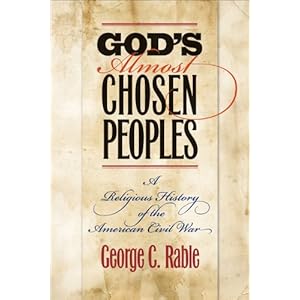
In addition to an album that transformed the music of the Beatles into soothing lullabies, one other album and one history book have become my regular companions. Between feedings, changings, and tummy time, I’ve found a few minutes to soak in Secondhand Serenade’s Something More and George Rable’s God’s Almost Chosen People: A Religious History of the American Civil War. The two may seem worlds apart, but they’ve come together in my rocking-chair imagination, and I think for good reason.
Secondhand Serenade is named for the nature of their music. Songs first written, sung, and experienced in private are transformed into ballads purchased on i-tunes, thrust too quickly into commercials, and discarded in a matter of weeks. We encounter the music secondhand, distanced from original intent and expression. By far, their best song is “Something More” (also the name of the album). It’s a power ballad to rival the finest of Celine Dion’s, and we only need a “king of the world” cinematic scene for it to become part of our national consciousness. Like most power ballads, “Something More” is about love and pain, desire and disgust. The singer is confused, angry, lost, and ashamed: “I lie awake again, my bodies feeling paralyzed / I can’t remember when / I didn’t live through this disguise.” The singer is “paying for his sins” and thinks that no words can “set him free.” He’s at war with another and within himself. He repeatedly admits and asks: “I’m stuck here in this life I didn’t ask for, / There must be something more, / Do we know what we’re fighting for?” The only answer – the only way to live amid his frustration – is to breathe and to believe: “breathe in, breathe out, / breathe in, breathe out. … There must be something more.”
George Rable’s characters from the 1860s had such similar feelings and asked such similar questions. What were Americans fighting for in the Civil War, and why did they continue to fight for so long? What sins were they paying for? And what was the “something more” that they all seemed to believe in, but couldn’t quite nail down? Like Abraham Lincoln in his Second Inaugural Address, the belief in a shared “something more” failed to stop the fighting, and they couldn’t understand why.

By reading thousands of primary and secondary sources, Rable (far and away one of America’s greatest Civil War scholars living or dead) offers the biggest, most comprehensive religious history of the Civil War ever produced. He tackles the North and the South, men and women, Protestants, Catholics, Mormons, and Jews. He travels with chaplains, tents with privates, and eavesdrops on presidents. More descriptive than argumentative, God’s Almost Chosen People considers so many sources that it is almost impossible to provide one or two central arguments. Yet Rable does. He finds that throughout the war, all sorts of Americans turned to providence to explain what was happening around them. The “something more” they knew they were fighting for was only explainable by looking to the heavens and believing that somehow, someway, God truly had the whole world (or at least the United States or Confederate States) in his hands.
The brilliance of Rable’s book – and what differentiates it in many ways from Harry S. Stout’s Bellah-inspired Upon the Altar of the Nation – is its secondhand nature. Although Rable claims in his introduction that religion could be both “wind and weathervane,” he more often than not renders it as weathervane. Battles happen; women and men die; political documents are signed; legal decisions are rendered; slavery is abolished; and then Americans reflect on the events religiously. They seek God’s providence in response to other events, constantly playing catch up just as I play catch up to Elijah’s needs at home. With this approach, Rable is able to show how widely and diversely religion suffused American society in the 1860s. Whatever the problem, whatever the event, whatever the circumstance, Americans turned to God and God’s providence for answers. By rendering religion secondhand, Rable has shown in epic proportion the omnipresence of the supposedly omnipotent.
And for Rable, the secondhand quality of religion emanates from his approach to religion itself – that it can only be studied secondhand. In this way, Rable wonderfully acknowledges the limits of his study. He (and we) cannot know the firsthand experiences of the women who lost loved ones, the privates who accepted new testaments after losing a hand of cards, or the presidents and generals who anguished (or relished) every death. When he analyzes a diary, a fast sermon, or a newspaper story (all of which Rable read in abundance), he recognizes that he interprets from afar. In this way, Rable demonstrates an incredible respect for his subjects and the gravity of the events.
Yet there are other seconds to consider. When W. E. B. Du Bois turned to seconds, he conjured the idea of “second sight.” He claimed that African Americans could see themselves and their surroundings with a sacred vision that whites could not. And Du Bois thought that the religious expressions of those with second sight could reveal the deepest elements of the soul – the “spiritual strivings” of individuals and communities. When Du Bois turned to the slave spirituals, he found not secondhand expressions, but expressions that revealed the most intimate parts of longing, feeling, and expression. This type of religious history of the war – one that approaches religious creation as a prime mover in historical change – could compel other approaches to the war.
That was not Rable’s project, though, and he shouldn’t be criticized for the book he wrote. God’s Almost Chosen Peoples is outstanding. Scholars of American religious history and the Civil War will have to engage it. And I’m glad that it’s so voluminous that I couldn’t lose it amid the diapers and the onesies.
 Paul Harvey