Jumat, 19 November 2010

Heavenly Merchandize

Paul Harvey

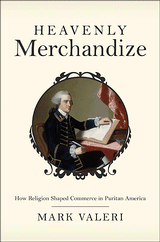
Earlier we have blogged about Mark Valeri's Heavenly Merchandize: How Religion Shaped Commerce in Puritan America. Below I'm reprinting a review from Choice on this book, which should interest a number of you. Below the review is a snip from the book's website, which has some more information on the contents.

Valeri, Mark
. Heavenly merchandize: how religion shaped commerce in Puritan America. Princeton, 2010. 337p index afp; ISBN 9780691143590, $35.00. Reviewed in 2010dec CHOICE.
Historians surveying the first century of Massachusetts Bay's settlement often describe how colonists in 1630 understood themselves as part of a gemeinschaft, or community based on personal relationships where commitment to the larger social good outweighed individual self-interest. By 1730, the gemeinshaft had become a gesellschaft, or society where rational self-interest trumped communal commitments; relationships, based on the impersonal forces of a market system, were more distant. Valeri (Union Theological Seminary/Presbyterian School of Christian Education in Virginia) avoids such oversimplification, but his exhaustively researched, densely structured book provides a marvelously thick description of just such a transition. Against the conventional assumption that commitment to market values came at the expense of religion, however, Valeri argues that religion actively fostered that commitment. Concentrating on Boston, he demonstrates how prominent preachers provided a vocabulary--drawn largely from British economic theorists--that allowed successful merchants to understand their pursuit of profit, and eventually even the trade in slaves, as a moral imperative. A "postpuritan religiosity" "preceded, and therefore helped to make possible, the full fruition of a market order in early America." Students of early New England will find this indispensable; it should also appeal to anyone interested in the relationship between religion and the larger culture. Summing Up: Highly recommended. Upper-level undergraduates through faculty/researchers. -- L. B. Tipson Jr., Washington College
________________________________________________________
(
from the book's website):

Heavenly Merchandize offers a critical reexamination of religion's role in the creation of a market economy in early America. Focusing on the economic culture of New England, it views commerce through the eyes of four generations of Boston merchants, drawing upon their personal letters, diaries, business records, and sermon notes to reveal how merchants built a modern form of exchange out of profound transitions in the puritan understanding of discipline, providence, and the meaning of New England.

Mark Valeri traces the careers of men like Robert Keayne, a London immigrant punished by his church for aggressive business practices; John Hull, a silversmith-turned-trader who helped to establish commercial networks in the West Indies; and Hugh Hall, one of New England's first slave traders. He explores how Boston ministers reconstituted their moral languages over the course of a century, from a scriptural discourse against many market practices to a providential worldview that justified England's commercial hegemony and legitimated the market as a divine construct. Valeri moves beyond simplistic readings that reduce commercial activity to secular mind-sets, and refutes the popular notion of an inherent affinity between puritanism and capitalism. He shows how changing ideas about what it meant to be pious and puritan informed the business practices of Boston's merchants, who filled their private notebooks with meditations on scripture and the natural order, founded and led churches, and inscribed spiritual reflections in their letters and diaries.

Unprecedented in scope and rich with insights, Heavenly Merchandize illuminates the history behind the continuing American dilemma over morality and the marketplace.

Kamis, 18 November 2010

CFP: The King James Bible and the World It Made

.
Baylor Institute for Studies of Religion

Invites you to a conference celebrating the

The King James Bible and the World It Made, 1611-2011

April 7-9, 2011

Baylor University

Click Here for Call for Papers, due December 31, 2010 (this has been extended from the original November 15th deadline)

King James 2011

In 1611, England issued its official translation of the complete Bible, a masterful work that laid the foundation for an emerging Christian culture in the English-speaking world. At the time, it was not obvious that the new translation would have the impact that it did, but it was soon clear that the King James Bible would overcome its competitors, as it provided a magnificent new standard by which all later works would be judged. It would indelibly mark the literature and culture of England, America, and all regions across the globe touched by Britain’s empire. From small rural churches to great halls of power, the ideas and words of the King James Version helped form a new culture rooted in the Bible: the modern culture of the English-speaking world.

To celebrate and reflect upon the incomparable influence of the King James Bible, Baylor University will host “The King James Bible and the World It Made, 1611-2011,” on April 7-9, 2011. Organized by Baylor’s Institute for Click for Call for Papers due December 31, 2010 (this has been extended from the original November 15th deadline)
Call for Papers King James 2011

The year 2011 marks the four hundredth anniversary of one of the landmark events in the history of Christianity: the publication of the King James Bible.

Studies of Religion, this conference will be one of the preeminent international events recognizing this auspicious moment in the history of Anglo-American and world Christianity. It will assemble distinguished scholars from around the globe to consider the history and ramifications of the Bible in English.

Major conference themes will include the way that the King James Bible created a common literary and religious culture in the English-speaking world; the significance of vernacular translation for Christian growth and development; and the challenges posed by recent declines in biblical literacy and the end of the King James’s dominance as the Bible translation for English-speaking Christians.

Confirmed Speakers Include:

Robert Alter (University of California, Berkeley)

David Bebbington (University of Stirling)

Philip Jenkins (Baylor Institute for Studies of Religion)

Laura Knoppers (Penn State University)

Alister E. McGrath (Kings College, London)

Mark Noll (University of Notre Dame)

Lamin Sanneh (Yale University)

N.T. Wright (University of St. Andrews)

Rabu, 17 November 2010

Look Back in Anger: The 1960s and Evangelical Conservatives

Paul Harvey

I meant earlier (but neglected to) call your attention to this piece by my fellow blogmeister Randall Stephens: "Look Back in Anger: The 1960s and Evangelical Conservatives," posted over at the blog of the Historical Society. Head over and check it out; here's a short bit:

In the late 1960s and early 1970s, Christianity Today, the chief magazine of American evangelicalism, published article after article on the terrors of the Left and the end of Christian civilization. Their world, so it seemed, was crumbling around them. (See Darren Dochuk's From Bible Belt to Sunbelt and Dan Williams recent God's Own Party for excellent insight into these and earlier developments.) The 1970s bestselling work of nonfiction, Hal Lindsey's Late Great Planet Earth, wove an evangelical end-times drama out of the explosive issues of the age. (Though Jesus People wore beads and Roman sandals and grew their hair "all long and shaggy," as Merle Haggard put it. . . ).

Continue reading here.
Related Posts Plugin for WordPress, Blogger...