Jumat, 05 November 2010

Heidelberg Center for American Studies Spring Academy

Paul Harvey

I've been asked by Hilde, our Senior Norwegian Correspondent, to forward along information on this unique opportunity for finishing graduate students, to present their work with fellow American and European colleagues in Heidelberg. Hilde writes: "I attended the Spring Academy last year, and it was a wonderful experience! It's a great mix of students from Europe and the USA, covers many disciplines, and has a supportive and safe atmosphere to present your material." Hilde, any chance the Oslo Soul Children will be a warm-up act at the conference?

More information below:
__________________________________________________
HCA Spring Academy:

American History, Culture & Politics

Gruppenbild WebHCA Spring Academy on American History, Culture & Politics is an annual, one-week interdisciplinary conference for Ph.D. candidates working in different fields of American studies.

Every year twenty outstanding Ph.D. students from European and American universities come to Heidelberg to present their dissertation projects. All presentations are thematically arranged into ten panels. Participants are requested to prepare a twenty-minute presentation of their research projects which is followed by a forty-minute discussion session. Four experts are invited for afternoon workshops that elaborate on topics discussed during the conference.
Uni1Possible topics for discussion are American literature and culture, U.S. history, domestic and foreign policy, as well as the economy and aspects of jurisprudence. Race, class, and gender are frequently employed analytical categories. This diversity of disciplines and approaches enables students from different academic backgrounds to become part of a unique international intellectual network which has been successfully established and broadened by the HCA in the last six years.

God's Almost Chosen Peoples

Paul Harvey

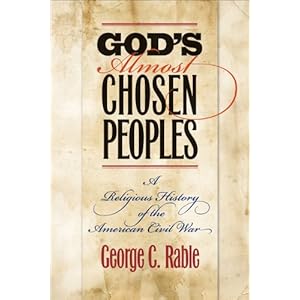
Some of you blog readers are probably hanging at the Southern Historical Association meeting today and through the weekend in Charlotte; sorry I'm not there with you, afraid that the AAR maxed out my personal travel/alcohol budget. In the meantime, though, hope you'll drop by the University of North Carolina Press booth and check out George Rable's very promising looking new book, God's Almost Chosen Peoples: A Religious History of the American Civil War. Skip Stout and others have given the lengthy work a hearty endorsement on the book jacket, and I hope to get to it over Christmas break when 600 pp. books seem a little less daunting. Information on the book below, from the UNC Press website.

God's Almost Chosen Peoples

A Religious History of the American Civil War

By George C. Rable


Throughout the Civil War, soldiers and civilians on both sides of the conflict saw the hand of God in the terrible events of the day, but the standard narratives of the period pay scant attention to religion. Now, in God's Almost Chosen Peoples, Lincoln Prize-winning historian George C. Rable offers a groundbreaking account of how Americans of all political and religious persuasions used faith to interpret the course of the war.

Examining a wide range of published and unpublished documents--including sermons, official statements from various churches, denominational papers and periodicals, and letters, diaries, and newspaper articles--Rable illuminates the broad role of religion during the Civil War, giving attention to often-neglected groups such as Mormons, Catholics, blacks, and people from the Trans-Mississippi region. The book underscores religion's presence in the everyday lives of Americans north and south struggling to understand the meaning of the conflict, from the tragedy of individual death to victory and defeat in battle and even the ultimate outcome of the war. Rable shows that themes of providence, sin, and judgment pervaded both public and private writings about the conflict. Perhaps most important, this volume--the only comprehensive religious history of the war--highlights the resilience of religious faith in the face of political and military storms the likes of which Americans had never before endured.

Kamis, 04 November 2010

What to Do With God in America

Paul Harvey

While we're in catch-up blogging mode, I meant to link to this piece earlier, "What to Do with God in America," over at A Lively Experiment, David McConeghy's blog. McConeghy summarizes and provides links to various of the summaries/reviews/academic critiques of the PBS series, and then proposes an elaborate classroom exercise over a period of week in which students would examine the narrative of the film on their own, and get involved in making a proposed film of their own.

With all the discussion about PBS’ God in America series, it occurred to me that it might be possible to use the series as the basis for a course that privileges deconstruction of the (maligned) narrative that PBS built and therefore employ remixes as a way for students to create counter-narratives that explicitly engage the primary source. Perhaps the documentary would provide a shortcut allowing us to manage both content and technical mastery.

We had some discussion here earlier about the pros/cons of blogging, especially for younger scholars and graduate students. This kind of post certainly fits in the "pro" category, as it provides the kind of reflection on teaching and innovative proposal on classroom work that should be impressive to any search committee.
Related Posts Plugin for WordPress, Blogger...