Rabu, 04 Januari 2012

Guest Review of Seitz's No Closure and an Invitation

Today's guest review is from Matthew J. Cressler, a doctoral candidate in Religious Studies at Northwestern University. His work combines African American and Catholic histories as they intersect with conceptions of the American nation. Matt is also the recipient of the American Catholic Historical Association's fourteenth annual John Tracy Ellis Dissertation Award. Please join Matt and his colleagues at the round table on Seitz's book at AHA this Saturday, January 7, 9:00 a.m. – 11:00 a.m, Scandal, Resistance, and Practice: A Roundtable on John Seitz’s No Closure, ROUNDTABLE, Chicago Marriott Downtown, Purdue Room.

A Review of John Seitz’s No Closure (2011) and an Invitation to Join the Conversation
Matthew J. Cressler

In May 2004, the Archdiocese of Boston announced that a number of parishes would be closed across the city. The decision to shutdown nearly eighty parishes across the Boston area was a consequence of the immense financial burden of the Catholic sex abuse crisis, as well as longstanding shifts in urban demographics and church attendance. However, by August, it became clear that some groups of Catholics refused to accept the process of parish shutdown. Parishioners across Boston moved into their closed churches and occupied them in “perpetual vigil” – “with their physical and, they repeatedly insisted, 'prayerful' presence they were going to keep the church open despite the decree against it" (10). John Seitz's No Closure: Catholic Practice and Boston's Parish Shutdowns is an ethnographic study of those resisting communities that sets out to answer two fundamental questions: why did Catholics resist the closure of their parishes and what does this resistance tell us about contemporary American Catholicism? In the course of answering these questions, Seitz illustrates the contours of what many resistors experienced as a “spiritual abuse” that followed, and was a continuation of, the sexual abuse of the Church. Resisting Catholics were forced to reexamine the lines and limits of their engagement with the Church, to reconsider the Catholic past and its meanings in their lives, and to take up the responsibilities of everyday church management and theology.

But if No Closure is specifically about this small community of Boston Catholics resisting church shutdowns in the wake of scandal, I’m much more interested in how it also serves as an incisive exploration into American Catholicism at the turn of the 21st century. Though the decision to occupy parishes certainly wasn't the norm amidst parish shutdowns, religious life in the liminal space of occupied churches sheds light on contemporary American Catholic life in ways oftentimes invisible to scholars. To name just two of the broader theoretical interventions of Seitz’s work, No Closure examines the particularity of the Catholic parish in American religious history and the problem of modernity in the narratives of American Catholic history.
By considering what happens when a diocese takes away a parish – effectively an exploration of the unmaking of sacred space – Seitz illuminates the peculiar relationship Catholics have with religious places. The pain felt by parishioners at the loss of their spiritual home indicates the distinctive significance of the parish in American religious history, wherein the parish served as a site for the creation of a particular kind of American religious subject with a particular orientation toward places and the sacred presences that populate them. Calling attention to the habituation of the ways Catholics experience sacred spaces and presences – he talks about the ways Catholics “practice” the parish and presence – Seitz powerfully argues that “inherited and internalized narratives of sacred presence, not simply unreflective attachment, kept these Catholics in their parishes” (160).

Though narratives of American Catholic history often assume that Catholics progressively modernized over the course of the twentieth century, moving more and more toward a lay-led democratic style of congregational Catholicism, Seitz suggests an alternative model of American Catholic modernity. Far from having shed their attachments to specific sacred spaces and the real presence of the supernatural – things presumed passé to the modern religious subject – resisting Catholics struggled over the sacredness of their own parish spaces against an institutional Church that argued churches were merely brick and mortar. Resistors adopted the postconciliar image of themselves as the "living stones" of the Church at the same time that they defended the physicality of the sacred contained in the stone walls of their parish. No Closure thus breaks down the binary map of American Catholicism after Vatican II, demonstrating that many Catholics continued to experience the upheavals of the conciliar era and developed their own interpretations of the Catholic past that do not map neatly onto the postconciliar liberal-conservative map.

Early on in the book Seitz says "this book is not the end of a conversation, but the opening of one" (20). In the spirit of this invitation, I want to invite everyone interested not only to read this compelling book, but also to literally join the conversation this January. Those of you planning on attending the American Historical Association’s winter meeting this January in Chicago, or any of the various related groups like the American Society of Church History or the American Catholic Historical Association, are invited to “Scandal, Resistance, and Practice: A Roundtable on John Seitz’s No Closure.” John McGreevy, Kristy Nabhan-Warren, John Seitz, and my fellow Northwestern doctoral candidate Brian Clites, will join me in a discussion that will use Seitz’s book to open a conversation on themes such as power dynamics between laity and clergy, the construction of Catholic identities, the sacralization of place, and the many ways Catholics have related to their own past at the turn of the twenty-first century.


God and Country in the Iowa Caucuses

Randall Stephens

So the close vote in the Iowa Caucus was unprecedented. See Darren Grem's early morning summary here. (He was probably up before I was here in Oslo!)

I found a couple of the candidates' quotes interesting for the purposes of this blog. What does it mean when GOP frontrunners speak of taking back America and comment on America's godly heritage? Would that rhetoric have meaning if Mitt Romney or, perhaps in an alternate universe, Rick Santorum were president? Put another way . . . would these comments have practical applications?

Mitt Romney on Tues, Jan 3:

I think President Obama wants to make us a European style welfare state, where instead of being a merit society, we're an entitlement society, where government's role is to take from some and give to others. What I know is if they do that, they'll substitute envy for ambition, and they'll poison the very spirit of America and keep us from being one nation under God.*

Rick Santorum on Tues, Jan 3:

God has given us this great country to allow his people to be free. I offer a public thanks to God. . . . You have taken the first step toward taking back this country.*

Selasa, 03 Januari 2012

Who Has a Religion? Baker and Wenger on Definitions of Religion in the 1920s


by Edward J. Blum

“Get anything good for Christmas?” a friend nonchalantlyasked several days after J.C.’s birthday. My enthusiastic response, “Oh yeah, abook on the Klan; was actually reading it Sunday morning listening to acousticsunrise,” was met with irritation in the form of disinterest. The friend didn’treally care what I had received, and he didn’t really want to entertain aconversation about the Klan. He shot back, “weird.” I, of course, was blind tohis hopes for distance and pressed in. “It’s really neat, the author takesseriously the religious ideas of the Klan – from their white robes to theirsense of American history and exceptionalism.” Sadly, the conversation went theway most of mine go with non-academics. The harder I tried for him to see how fascinatingthis was, he just didn’t care, and once again retorted, “yeah, just soundsweird.” At this point, I got it and turned the conversation to a religiousinterest everyone seemed to share: Tim Tebow and the magical run of the DenverBroncos.
Book cover image 
I’ve had enough conversations with non-academics who seem togo into snooze mode when I invade their worlds with the past, but I still feltsad that my pal would rather talk about a mediocre quarterback for a mediocreteam than about heritages of hate and what they mean for our nation. But evenmore, I was bummed that my friend did not want to understand that what we thinkabout “religion” influences even stories like that of young man Tebow.

Of course, the book I was trying to tell my friend about wasKelly Baker’s Gospel According to theKlan: The KKK’s Appeal to Protestant America, 1915-1930. I don’t want torehearse its main arguments here – how GospelAccording to the Klan looks not just at what the Klan was against, but alsoat what they were for, how it showcases the ways in which their whiteProtestant nationalism pervaded their sense of manliness, femininity, andhistory, or how the Klan’s print culture was so crucial to their sense ofidentity and imagination. Those are all excellently fleshed out in the book andshown so nicely through the Klan’s public writings.

CoverWhat I would like to draw our attention to is how ProfessorBaker’s study and a slightly older book, Tisa Wenger’s fantastic We Have a Religion: The 1920s Pueblo Indian Dance Controversy and American Religious Freedom (2009), provide anotherlayer of religious division and redefinition during the 1920s. Wenger showsthat the 1920s conflicts over Pueblo dances became moments when notions of“religion” collided. For the United States government, religion was somethingdistinct and somewhat separable from other spheres of life, but many Pueblo hadno sense of that division. As white modernists who were sympathetic to thePueblo rallied to their side, they helped create the idea that the Indian danceswere “religious” and hence should be protected against federal legislation bythe First Amendment. Yet by forcing American governmental approaches toreligion upon the issue and by defining one aspect of Pueblo behavior asreligious, they helped sever the totality of Pueblo life into supposedlydiscreet parts (religion, land, politics, society, etc.) Thereafter, Nativeclaims to land, remains, or treaty recognitions have been battled on the legaland religious terrain established by the American government.

We all know the 1920s as a time of religious dissension anddebate. Modernists and Fundamentalists raged against one another; Bryan andDarrow battled at the “trial of the century” in a small Tennessee town; SisterAimee Semple McPherson polarized the West with flappers and Pentecostals on oneside and liberals and the mainline on the other. Together, Baker and Wenger addanother layer – the layer of religion itself. In both cases, the verydefinition of “religion” was up for grabs. In Baker’s case, contemporaries ofthe Klan tried to demolish them as non-Christian or as makers of a false faith.The Klan tried hard to create a viable religious worldview, and for an“Invisible Empire,” they sure made it visible in their print culture and publicperformances. For Wenger’s folks, Native American life had to be atomized sothat certain elements could be construed as religious. By obtaining a“religion,” the Pueblo had to give up some of their definitional control.

So to my friend who would rather talk Tebow than Klan robes,I understand. It is less mentally strenuous to debate the case of Tim Tebow –whether accuracy is as important as admiration, whether completion percentagesmatter more than charismatic personhood, or whether we should privilegecomebacks over Christian being. But if we want to get to the core of Tebow orany other fascination rendered “religious” in America, we can get a little helpfrom our friends Kelly Baker and Tisa Wenger. See you all in Chicago.

Senin, 02 Januari 2012

Teaching, Playing, and Praying: Evangelical Networking and Community Building in Modern America

Paul Harvey

One more AHA/ASCH session for you all to consider, especially for those of you interested in contemporary evangelical subcultures, home schoolers, and prayer warriors:


Teaching, Playing, and Praying: Evangelical Networking and Community Building in Modern America

AHA Session 48
Friday, January 6, 2012: 9:30 AM-11:30 AM
Chicago Ballroom D (Chicago Marriott Downtown)
Chair:
Matthew Avery Sutton, Washington State University
Papers:
Comment:
Randall Balmer, Barnard College, Columbia University
Session Abstract
Violence in public schools, anonymous neighborhoods that lack a sense of community, and legalized abortion all represent social, economic, spatial, and demographic changes that threatened the evangelical ideal of Christian schools, Christian neighborhoods, and Christian nation in the late twentieth century. Rather than attacking these problems head-on, many evangelicals built dynamic networks in an effort to realize their ideals outside the mainstream. In this effort evangelicals participated in a paradoxically mainstream American tradition of self-identifying as “outsiders” while endeavoring to create utopias. This panel addresses three such networks in the form of homeschooling, megachurches, and prayer marches. Yet even as evangelicals’ attempts to construct ideal communities are part of a longstanding American tradition, the three papers presented here also reveal the innovative ways in which evangelicals are building networks and communities today.    
            First, Rachel Coleman’s study of Christian homeschoolers in Delaware County, Indiana, demonstrates the successes and challenges of local evangelical networking in an era of technology. While Coleman’s homeschool subjects, eager to protect their children from ungodly influences, originally created a “homeschool community” that shut out non-Christian homeschoolers, the Internet soon served to decentralize and democratize homeschooling, offering greater opportunities but less social control. By focusing on the mechanics of this local network’s evolution, Coleman reveals a pattern that sheds light on national homeschooling’s creative solution to the isolation of the digital age.
            Second, and in contrast to the democratizing forces at work in Coleman’s homeschoolers, Lauren Beaupre’s study of Bellevue Baptist Church reveals the increasingly insular communities of modern megachurches. Replacing intimate neighborhoods with religious centers that provided education, recreation, and entertainment, Bellevue and other megachurches holistically attended to a dispersed Christian community. In response to large-scale reorganizations of metropolitan space, community became a religious product for sale in enormous religious complexes that were more like small towns than traditional parishes.  Buying into the product was easy, but Beaupre also reveals the challenges created by one-stop shopping for the broader local community.
            Finally, where Coleman sees a Christian alternative to public education and Beaupre highlights a Christian alternative to restoring residential neighborhoods, David McConeghy shows how prayer became a Christian alternative to public policy or legislation. Prayer was both a weapon to be wielded in the “culture war” against secularism and the olive branch shared among divided Christian churches. American communities could be redeemed if they could either be purged of sin or united by revival, and new spatial and geographic prayer techniques emerged to facilitate God’s intercession for spiritual breakthroughs on secular obstacles.
            The three networks examined here affirm the creativity and resourcefulness of evangelicals in attempting to recreate their ideal of Christian schools, Christian neighborhoods, and Christian nation. Yet while education, church, and prayer had long been important to evangelicals, the alternative communities they formed in the late twentieth century differed from previous efforts in their use of communications technologies, economies of scale, and critical geographies. Together these networks show evangelicals adeptly balancing the past and present in order to save American communities.

AHA/ASCH Sessions of Interest

Paul Harvey

2012 LogoIn addition to our session "Reassessing the Significance of Religion in the Twentieth Century United States"  this Saturday afternoon at the American Historical Association, which I blogged about previously, here are a few more sessions for you to consider, ranging from a reconsideration of Harry Stout's New England Soul to papers on religious networks in the early modern Atlantic world. See some of you in Chicago! If you have a session that you particularly want to promote here, contact me and we should be able to put it up.

Also, and by the way, if you need something to do Saturday morning but you figure going to our session Saturday afternoon will suffice for your religious history needs, here's a cool session on digital history (follow the link for info), featuring some of the leading lights in presenting history in new ways, including Philip Ethington (who will be talking about geo-historical visualization), Katrina Gulliver (who will discuss her podcasts "Cities in History"), and Jennifer Serventi from the National Endowment for the Humanities.

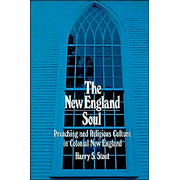
New England Soul: Preaching and Religious Cultures in Colonial New England  -             By: Harry S. Stout    Harry Stout’s The New England Soul after 25 Years

American Society of Church History 9
Friday, January 6, 2012: 9:30 AM-11:30 AM
Promenade Ballroom A (Westin Chicago River North)
Chair:
Mark A. Noll, University of Notre Dame
Catherine A. Brekus, University of Chicago , James Byrd, Vanderbilt University , Thomas Kidd,Baylor University and Kenneth P. Minkema, Yale University

Comment: Harry S. Stout, Yale University
_______________________________________________
A Place for Grace: Religion and Contests of Identity in theMississippi River Valley, 1812–45

American Society ofChurch History 13
Friday, January 6,2012: 2:30 PM-4:30 PM
Jackson Park Room (Westin Chicago River North)
Chair:
Amanda Porterfield, FloridaState University
Papers:
Comment:
Comment: Amanda Porterfield, Florida StateUniversity
___________________________________________________________

Religious Networks, Alliances, and Friendship in the EarlyModern Atlantic World
AHA Session 109
Saturday, January 7,2012: 9:00 AM-11:00 AM
Los Angeles Room (Chicago Marriott Downtown)
Chair:
Ned C. Landsman, StonyBrook University
Papers:
"A Part ofOne's Soul": Spiritual Friendship and Evangelical Networks in EarlyAmerica
Janet M. Lindman, Rowan University

Comment: John Fea, Messiah College

Minggu, 01 Januari 2012

Roger Williams and the Creation of the American Soul

Paul Harvey

Roger Williams and the Creation of the American Soul: Church, State, and the Birth of LibertySome of you may have seen reviewed in the New York Times Book Review today (or in the Wall Street Journal, less insightfully, yesterday) John Barry's new book Roger Williams and the Creation of the American Soul: Church, State, and the Birth of Liberty. Barry has been best known for hugely popular works of twentieth-century history, including my favorite Rising Tide: The Great Mississippi Flood of 1927 and How It Changed America. Evidently, according to the introduction to this new book, he had set out to write another work on early twentieth-century religion, but he kept pressing backwards to get to the origins of what he was studying, and he ended up at Roger Williams.

Down the road a bit Linford Fisher will be discussing this work in more detail at our blog, along with some thoughts on the founding of what is now his home state (Rhode Island). Until then, for those interested in this work, Barry has an extensive piece up at the Smithsonian magazine, which serves as something as a precis for this work. A brief excerpt:

Williams believed thatpreventing error in religion was impossible, for it required people tointerpret God’s law, and people would inevitably err. He therefore concludedthat government must remove itself from anything that touched upon humanbeings’ relationship with God. A society built on the principles Massachusettsespoused would lead at best to hypocrisy, because forced worship, he wrote,“stincks in God’s nostrils.” At worst, such a society would lead to a foulcorruption—not of the state, which was already corrupt, but of the church.

The dispute definedfor the first time two fault lines that have run through American history eversince. The first, of course, is over the proper relation between government andwhat man has made of God—the church. The second is over the relation between afree individual and government authority—the shape of liberty.

In her New York Times Book Review piece on the book, Joyce Chaplin notes the contrast between the "visions of America" of Williams in Rhode Island and Father Serra in California (and one could easily come up with numerous other examples here):

Consider the 18th-century Catholic missionary, FatherJunípero Serra. He assumed that Spaniards had the right to take up land inCalifornia and that the church had the duty to reorganize Indians intoChristian settlements, by force if necessary. Three thousand miles fromProvidence, at a rest stop on Interstate 280 in Northern California, alarger-than-life image of Serra faces the Pacific. Its back is turned againstWilliams’s far-off statue, as if also against his radical example of what NewWorld societies might represent.

The United States is part Serra,part Williams. A “hedge or wall of Separation” between church and state wasaffirmed by the Constitution; rights for Indians were not. Williams would haveconsidered it a battle half-won. He did not think an “American soul” needed tobe created — such souls already existed within Indians. By largely confiningWilliams’s story to the establishment of liberties for America’s adoptedpopulations, without equal attention to the defense of its indigenousinhabitants, Barry has perhaps underestimated his remarkable subject.

On that subject, as a side note/interview to the Smithsonian piece, Barry has some further thoughts on precisely this issue, posted in interview format.

We'll look forward to Lin's more expert thoughts on this subject and Barry's book in the near future.  

Jumat, 30 Desember 2011

Fake Titles 3.0

Randall Stephens

You can never come up with enough fake titles. Someone has even created a fake title generator. (Here's what I got from the site: Oppressing, Representing, Protesting: Sexuality in George Orwell and the Cultural Ego of Relic in Animal Farm.) So, once again, here are a few fake titles in religious studies and American religious history. (I like to get some ideas from journal titles found on Project Muse.)

White Elephant Gifts of the Spirit: TV Preachers in the 1990s

The Prevangelicals: Pietists, Preachers, and Divinity
Pedlars in the Early Modern West

Local Weathermen and the Pornotropics of Doppler Iconography in Cleveland, Ohio, 1997-1999

"Broadminded is spelled s-i-n": The Theology of the Louvin Brothers

Stand Up and Shout It: Bible Quizzing, Performativity, the Politics of Affective Agency, and {Em}bodiment

Whorehouse Faith: The Lived Religion of the Painted Ladies of Chicago's Little Hell, 1880-1906

On the Road Again: Hobo Graphotheologies from Bangor, Maine, to Cave Creek, Arizona, 1929-1950

Raise Your Paws and Praise Him: Dogs at Worship and in Community

The Legend of the Great Salt Lake Mormon Merman, 1890-1902

Planet of the Apes, the Twilight of Scientism, and Dystopian Premillennial Predilections

Tinseltown Preacher Cowboys, Shirtless Suburban Gurus, and Hippie Pretindians of the Southwest: Baby Boomers working off Script during their Religious Quests, 1966-1973

Kamis, 29 Desember 2011

Literature and Secularization: At MLA and in Print


by Everett Hamner

For any of you blog readers who might be at MLA (program is linked here) rather than AHA in a few days(gasp!), there's a session you won't want to miss. Several of the mostprovocative, insightful scholars at the intersection of religion and literaturewill be participating on a panel entitled "Literature andSecularization" (Friday, 3:30-4:45, WSCC 617). Facilitated by SusannahBrietz Monta (Notre Dame, and editor of Religionand Literature), this roundtable will feature Lori Branch (Iowa, author of Rituals of Spontaneity); John Cox (HopeCollege, Seeming Knowledge: Shakespeareand Skeptical Faith); Tracy Fessenden (Arizona State, Culture and Redemption); William Franke (Vanderbilt, Poetry and Apocalypse); Colin Lovell Jager(Rutgers, New Brunswick, The Book of God);and Michael W. Kaufmann (Temple, coordinator of recent Religion and Literature forum, "Locating thePostsecular").

While I'm in advertising mode, many of you--religious studies and history typesincluded--might well enjoy Amy Hungerford's PostmodernBelief: American Literature and Religion Since 1960 (Princeton, 2010). Ireviewed this for Religion and Literaturerecently (43.1, Spring 2011), and here's the opening paragraph:

Atfirst glance, Amy Hungerford’s second book might seem literary criticism’sanswer to Robert Wuthnow’s After Heaven:Spirituality in America Since the 1950s, which shows how Americans havedrifted away from institutional religious commitments and toward more informal,syncretistic spiritualities. However, Hungerford reveals not just a looseningand recombination of doctrines and practices, but the return of a “belief inmeaninglessness” (xiii) rooted in transcendentalism and Romanticism. Postmodern Belief is an examination offaith without content, trust in the nonsemantic, belief as itself a form ofritual, all as discerned primarily through the work of writers rarelyidentified as religious themselves, but who still “live in oblique relation tothe structures and discourses of institutional religion” (xvi). Rather thanconcerning herself with these authors’ theologies, Hungerford investigatestheir convictions about literature. In fact, “their literary beliefs areultimately best understood as a species of religious thought, and theirliterary practice as a species of religious practice” (xvi).

Rabu, 28 Desember 2011

The Genesis of Jesus Rock: An Interview with David W. Stowe

Randall Stephens

David W. Stowe is a professor of American Studies and Religious Studies at Michigan State University. He has written on jazz history, hymns, and rock music. Stowe is the author of a wide range of books and articles, including Swing Changes: Big-Band Jazz in New Deal America (Harvard University Press, 1996); How Sweet the Sound: Music in the Spiritual Lives of Americans (Harvard University Press, 2004); and, most recently, No Sympathy for the Devil: Christian Pop Music and the Transformation of American Evangelicalism (University of North Carolina Press, 2011). Below I interview Stowe about his excellent new book and his insights into Jesus rock and the culture of conservative evangelicalism.

Randall Stephens: What drew you to the topic of the roots of Christian rock?

David W. Stowe: I was intrigued by the historical moment of the early Seventies—1971 to be exact—when it seemed popular music and youth culture were saturated in allusions to Jesus Christ: Godspell, Jesus Christ Superstar, several Top 40 songs with Jesus in their titles or verses. Why had the Son of God seemingly taken over U.S. popular culture at just that moment—when the countercultural energies of the Sixties were metamorphosing into something new? And did this music play some role in reshaping American culture during the Age of Reagan and beyond?

These struck me as questions worth trying to answer. There was a personal angle as well. I came of age during the Seventies and have always been fascinated by that decade, which I remember now as if it were some kind of dream. So Christian pop music—of which I was completely oblivious until about 15 years ago—was a lens through which to make sense of that strange interlude between Kent State and the Reagan Revolution.

Stephens: Why did a Christian analogue to rock music develop when and where it did?

Stowe: Like many forms of the Sixties counterculture, Christian rock first emerged in California. More precisely Orange County, the epicenter of what was dubbed the Jesus Movement. It was at Calvary Chapel in Costa Mesa where Chuck Smith famously teamed up with über-Jesus freak Lonnie Frisbee. Larry Norman came out of the Bay Area and had a major impact as well. But it’s important to note that the West Coast didn’t have a monopoly on Jesus music. The Rez Band (still in business) originated in
Milwaukee and made a very successful debut run across the Upper Peninsula of Michigan. CCM guitar hero Phil Keaggy did a stint at Love Inn in upstate New York. [Check out the McCartney, Ram-esque Keaggy song in the youtube clip here.] So this Jesus Movement—and the music that went with it—was a national phenomenon.

Stephens: You focus quite a bit of attention on apocalypticism. How did end-times views shape Christian rock and, even, politics?

Stowe: Apocalyptic themes had bounced around in American pop music since early Dylan—“A Hard Rain’s A-Gonna Fall”—and Barry McGuire’s surprise number-one hit of 1965, “Eve of Destruction.” A sense of living in end times tinged the late Sixties counterculture—a certain Cold War fatalism permeated American society for decades--so it made sense that an apocalyptic mindset would filter into the Jesus Movement. Among other things, it makes a catchy theme for a lyric. Witness Larry Norman’s most famous song: “Children died, the days grew cold/A piece of bread could buy a bag of gold/I wish we’d all been ready. . . .”

It didn’t hurt that these messages were being reinforced by the best-selling book of the seventies, Hal Lindsey’s Late Great Planet Earth. Politically, end-times prophecy tends to work against social and political movements, reformist or revolutionary. What’s the point of transforming the world if God is going to bring the curtain down on the whole sorry human enterprise? So most of the Jesus Freaks—and the musicians they listened to—focused on saving as many souls as they could before the Rapture.

Stephens: By concentrating on artists who were crossover, or more mainstream performers—like Al Green, Bob Dylan, and Aretha Franklin—you extend what most people might think of as Christian music or Christian rock. I wonder if you might say something about the tensions that existed between those who reached a larger, mainstream market and those who were fairly fixed within the Christian genre.

Stowe: This tension was one of the most intriguing aspects of the Christian pop phenomenon. On the one hand, the Jesus Movement tried to cast a wide net and welcome as diverse a following as possible. On the other hand, its theology was quite orthodox. There was a deep suspicion of alternate spiritualities of the kind that were floating around pop music especially after the Beatles went off to the Maharishi’s ashram at Rishikesh. Many of the decade’s most successful artists, whose music invoked religious and Christian themes—the ones you’ve mentioned, but also Marvin Gaye, Earth Wind & Fire, Stevie Wonder, even Johnny Cash—weren’t embraced by the Jesus Movement. Jesus freaks pretty much ignored them. From a broader historical perspective, though, it was important to make sense of their relation to the baby boom evangelicals who were cutting their spiritual teeth in those years.

Stephens: Could you describe how you think Christian rock has changed since its early days in the late 1960s and early 1970s?

Stowe: It’s become both much more commercially slick and much more musically diverse. In the early days, Christian rock was mostly folk-rock, or just plain folk. Even hard rock was a bit of a stretch. Now one can find every genre of pop music represented in CCM: hardcore, hip-hop, punk, Goth, Norwegian death metal. CCM is now a very large and profitable market genre—outselling jazz and classical combined—so the promotion and production value of the music has gone way up. It’s theology tends to be much more eclectic as well. As I argued in the New York Times last spring, the innocently promiscuous mixing of Christian language in “secular” music doesn’t happen as it did during the early years of Christian rock; the secular/sacred divide seems to have hardened. Although, as is always the case when generalizing about a huge diverse culture form like popular music, important exceptions can be found.

Stephens: What projects are you currently working on?

Stowe: A short book on the varied forms Psalm 137 has taken in North America. That’s the one that begins, “By the rivers of Babylon, there we sat down, yea, we wept, when we remembered Zion. . . . How shall we sing the Lord’s song in a strange land?” I call it American’s longest-running protest song. Its history stretches from the earliest Pilgrim psalters through adaptation to the American Revolution, abolitionist movement, Harlem Renaissance, civil rights movement, and the widely covered reggae version, “Rivers of Babylon.” It’s a good lens for thinking about the varied social and political uses to which a thirteen-verse Hebrew poem can be put, and the endless inventiveness of music to wrap itself around ideology.

Selasa, 27 Desember 2011

Food and Spirituality in the South: Chick-fil-A and Bessinger Bros. BBQ

By Michael J. Altman
[Cross-posted at michaeljaltman.net]

A couple delicious articles crossed my plate just before the Christmas weekend and I didn't want the connections between them to sneak by. Over at the wonderfully put together museum of religion and spirituality with a hipster aftertaste, Frequencies, Darren "DEG" Grem has written a piece that dives into the spirituality of the Chick-fil-A sandwich. Meanwhile, in the [web]pages of New York Times Magazine I came across a piece from Jack Hitt on the barbecue feud that has torn apart the Bessinger  family of South Carolina in the past two decades. I have spent my whole life in the South. I've spent the past four years in Atlanta, where you can't throw a rock without hitting a white Styrofoam cup of Chik-fil-A lemonande, and before that I spent six years in different parts of the mustard based barbecue region of South Carolina. Reading Grem and Hitt reminded me of the ways food in the South partakes of the sacred, the political, and the domestic. Not that it doesn't do these things in other places, but in the South I can speak from the privileged place of an insider with experience.

That spirituality in the marketplace, or in the chicken sandwich, is both real and illusory at the same time--that it is always already revealing and obscuring--is Grem's strongest point. He writes:
We can’t take Chick-fil-A’s claims about its sandwich at face value because we lose something in the process. We lose the connection between spirituality and the people who make up the marketplace and the networks and chains that support contemporary capitalism. But we also can’t just dismiss these claims about the spirituality of work, of goods, of companies, of people—or stop with investigative exposés of how it has or has not filtered down to the bottom or up to the top of the corporate triangle. That doesn’t really dive into the messy endeavor to explain spirituality in the marketplace, either as a complicated and layered phenomenon or as an organized but diverse and divided movement.
Indeed, spirituality is messy. It is material. It is juicy and topped with pickles. And sometimes it  pays for bowl games. Grem challenges those trying to trace the role of spirituality in the market and the market in spirituality to go further than simply following the money, or the prayers, or the products. Where that leads I'm not completely sure and Grem doesn't completely reveal but I think the Lowcountry of South Carolina offers us up a case study.

Jack Hitt's article on the Bessinger brothers various chains of mustard sauced barbecue in the Lowcountry of South Carolina is worth a full read and, for me, served as a reminder of the shock I experienced when I first encountered yellow barbecue. Having grown up in North Carolina my tongue was trained on vinegar and I could never accept the Gospel of the mustard seed. Then in college I gave up pork altogether and so I took my place on the sidelines of the great barbecue debate--though I don't think that dry stuff  from down in Alabama ever stood a chance.

Hitt's article focuses on the fallout between the four Bessinger brothers, each of whom are in the BBQ business, in the wake of Maruice Bessinger's decision to raise the confederate battle flag over each of his Maurice's BBQ restaurants. This was Bessinger's response to the decision by the South Carolina legislature to remove the flag from the roof of the capitol building. (It has since been moved to a gilded pole in on the capitol grounds, a spot more visible than it ever was way up on the roof.) Maurice's older brother Melvin, who owns Melvin's BBQ in Charleston, avoided politics and has seen his fortunes improve as his brother's neoconfederate ideology continues to hinder his business. In some ways the whole story is a Cain and Able narrative but everyone has the meat in their offering.

What jumped out to me in the article and why it connected to Grem's piece was the following:
Maybe 200 people turned out at the post-rally barbecue at Maurice's bottling plant. He had set up a giant shed to seat 500, so the gathering looked like a failure. The machines were walled off by pallets of Maurice's boxes, each stamped with the word ''Kosher.'' Maurice, a lay preacher, began the long afternoon of speeches.

''This is our only hope,'' Maurice explained, pointing to the giant Confederate flag behind him. ''As the government gets more and more tyrannical, they will hand over more power to a world government. And then the Antichrist will just come in and say, 'Thank you very much.'''

Maurice is comfortable weaving religion with barbecue: there is a weekly Bible-study session at each of his pits. Later on, in the privacy of his office, he let slip a secret of his sauce. ''The recipe,'' he said, ''is in the Bible.''

''Does it start with Jesus' parable of the mustard seed?'' I joked. Maurice's eyes flared, as if I had correctly guessed that his middle name was Rumpelstiltskin, and he refused to discuss it further.

''You can just say that my Carolina Gold is a heavenly sauce,'' he said. ''I believe that after the rapture there will be a big barbecue, and I hope the Lord will let me cook.''
Hitt was tantalizingly close to getting at the spirituality of the barbecue. But he made the mistake about which Grem warns. He got flippant. He thought he could see through the Bible study to what was "really going on." And Bessinger clammed up. Neoconfederate ideology, conservative Protestantism, pork infused apocalypticism, and the faith of a mustard seed; how do these add up? I really want to know. The mess that Grem prods us towards has been quickly yanked back from Hitt. The connections between the spiritual and the material, and even the political, are there. But what are they?

What does the sacred taste like? Who brings the potato salad to Jesus's mustard based glory? What makes those chicken sandwiches so God blessed delicious? (And DEG, you forgot about he biscuits.) To find these answers we must resist the urge to make jokes. We must remain humble and quite. We must listen. Then maybe we'll find out what it will be like when Christ returns to bless the righteous and smite the tomato and the vinegar based.

Oh, and if you are looking for barbecue in South Carolina, I recommend Shealy's in Batesburg-Leesville. If you can't find it just ask anyone you meet west of Columbia.

Senin, 26 Desember 2011

Reappraising the Significance of Religion in the Modern U.S.: 2012 AHA Session

Paul Harvey

Some of you blog readers may be getting ready for the 2012 American Historical Association meeting in sunny Chicago Jan. 5-8 2012. Because the AHA meets in conjunction with the American Society of Church History and the Catholic Historical Association, there are really too many sessions on American religion to list usefully. So instead I'll feature a few sessions of interest that particularly catch my eye in the coming days here, and invite the rest of you to promote sessions of interest to you, either in the comments section or by sending me a guest post.

To start with, here's hoping you'll drop by our session, pasted in below, on "The Evangelical Century: Reappraising the Significance of Religion in the Modern United States." Details below.


Saturday, January 7,2012: 2:30 PM-4:30 PM
Kansas City Room (Chicago Marriott Downtown)
Chair:
Anthea Butler, Universityof Pennsylvania
Papers:
World War II andthe Birth of Modern American Evangelicalism
Matthew Avery Sutton, Washington State University
Comment:
Paul W. Harvey, Universityof Colorado Colorado Springs
Session Abstract
The twentieth century United States, according to the standardnarratives, was defined by growing secularism and pluralism. Heavy immigrationof Jews and Catholics in the progressive era, and of Hindus, Buddhists, andMuslims since the 1960s, created what scholar Diana Eck calls “a new religiousAmerica,” one in which no single group has a monopoly on power. The members ofthis panel are not so sure. While there is no doubt that the United States isfar more diverse today than it was in 1900, American evangelicals havenevertheless managed to shape the nation’s trajectory in important ways in thelast one hundred years. Building on new archival research, these papers seek toreappraise the significance of American evangelicalism in the modern UnitedStates.

Alison Greene focuses on an important shift that began in the1930s. Until the Great Depression, the nation’s established churches were on anupward trajectory in both numbers and influence. But the Great Depressioncrippled the Protestant establishment. At the same time, the economic crisismade room for evangelical and pentecostal churches that emphasized individualsalvation and authentic religious experience. While the established churchesstruggled to maintain programming and participation, upstart evangelicals andpentecostals employed creative techniques and a core of committed volunteers tokeep church operations afloat and expand membership. While it would be decadesbefore evangelicals and pentecostals rivaled their established counterparts in numbersand national influence, the Great Depression marked the beginning of a gradualtransition of power from the mainline to its upstart rivals.

Matthew Sutton's paper (revised since the original proposal) discusses the reaction of fundamentalists to World War One, tracing that era as one of the creation of a religious movement that grew to be hyper-patriotic and suspicious of government at the same time.

Steven Miller examines more recent expressions of evangelism. Heargues that the growing prominence of Reagan-era evangelicalism produced twometaphors that profoundly informed subsequent discussions of faith and publiclife: Richard John Neuhaus’ “naked public square” and James Davison Hunter’s“culture war.” Neuhaus argued that secular elites had “systemically excludedfrom policy consideration the operative values of the American people, valuesthat are overwhelmingly grounded in religious belief,” while Hunter described aconflict between “progressive” and “orthodox” forces in American society. Inthe end, neither metaphor could transcend a defining characteristic of latetwentieth-century America: the complex, often ironic influences ofevangelicalism on U.S. politics and culture.

Jumat, 23 Desember 2011

Revival of Religion and American Culture Book Series from University of Alabama Press

Paul Harvey

Over the last few months, my friends Charles Israel (Auburn University) and John Giggie (University of Alabama) have been making plans to revive the Religion and American Culture series of books published by the University of Alabama Press -- in years past luminaries such as Wayne Flynt, Ed Harrell, and Edith Blumhofer edited this series. You senior scholars and graduate mentors out there, please keep them in mind to send promising dissertations-soon-to-be-book-manuscripts their way.

I received the following email from John recently, and got his permission to repost it here, as an advertisement for this series and as a call for those of you, junior and senior scholars alike, with book manuscripts that you're shopping around to contact the editors, who are aggressively recruiting authors for the series. Here's a bit more information; use the links above to contact Charles and/or John if you have a manuscript or a book project idea for them that you want to discuss:

I wanted to thank you again for agreeing to serve on the editorial advisory board for the new incarnation of the "Religion and American Culture" book series that is sponsored by the University of Alabama Press.
As you may remember, I am co-editing the series with Charles Israel and we are in the process of aggressively recruiting new work for publication in the series. We are preparing to formally announce the series launch in late 2012 and want to be able to make a splash with some very strong first titles. We're asking now for your guidance and help. If you know of any scholars who are working on promising projects that you believe we should consider, or of scholars both junior and senior who are looking for a home for their work, please be so good as to let us know. We're happy to follow up with them by email, phone, or otherwise to extend an open invitation to submit their work for publication consideration.

I want to emphasize that we have every assurance from the editor-in-chief at the University of Alabama Press, who sponsors the series, that we can offer contractual terms that are every bit as competitive as any other press in the country, both for first-time authors submitting revised dissertations and for senior scholars, accordingly. We're also in the favorable position of being able to offer advance publication contracts
when appropriate or necessary.

Kamis, 22 Desember 2011

Announcing Coursekit

Darren Grem

Undoubtedly, most of y'all have put down your red pens and taken off your "instructor" hats for the winter break.  But if I could have your attention (Harvey! You! Yes, you! No fantasy football until I'm done talking!) for just one second, I'd like to invite you to take a look at Coursekit, the newest little teaching engine to come down the line.  I'm sure it's been talked about in other spaces, but since I don't remember it being talked about here, I figured I'd give it some free publicity.

Here's a take on where it came from, what it's about, and where it's planning to go:

A couple years ago, I sat in on a "Technology in the Classroom" course. We spent the early part of the day talking about new tools that were available. The discussion turned into a litany of complaints: IT policies that prevented the installation of new software, draconian site-blocking measures, thimble-sized storage allowances. At every turn, each new tool that a teacher wanted to try out would require a fight with administration. The frustration was palpable. "Why are the IT people making pedagogical decisions?" lamented one teacher, "Why do they get the final say about what does and does not happen in my classroom?"

Joseph Cohen, cofounder and CEO of Coursekit agrees. The problem, he says, is that most educational software is bought and sold at the enterprise level. The people deciding what to acquire are not the people using it and that disconnect has allowed unusable software to flourish. . . . [Thus,] On the product design side of things, Coursekit is focused on a user experience that is as simple and elegant as possible. This means that all the basics are there: a calendar, file sharing, submitting assignments, and grading work, but in ways that are stripped down to what Coursekit's user testing has shown them to be the essentials.


The "essentials" are teacher profile, syllabus, posting/comments module (similar to FB), assignments dropbox, and grading platform.  If you use Twitter or Wordpress in the classroom, then this streamlines that for you.  Additionally, it's 100% free since they've taken a"set up the site, monetize it later" business model.

Like all tools, it has its ups and downs.   If you want a more user-friendly interface (unlike BB), then it also seems to be worth considering.  I'm not sure if they're going to enhance the personalization of Coursekit soon by making it open to template modification (like Wordpress) or beef up some of the grading and watchdog tools (like Turnitin) that's a part of its competitors.  We'll also have to wait and see how it hooks up with other turns in the digital instruction world, such as the move toward digital textbooks, and the still-under-consideration move to see how smartphone apps and iPads might replace those big, gazillion-dollar "smart classrooms" some of the more money-flush colleges installed a few years back.  In any case, do know that there's another kid on the block for y'all to consider, especially if you've found (like myself) you're bombarding students with different digital platforms to use in class or for class projects.

Rabu, 21 Desember 2011

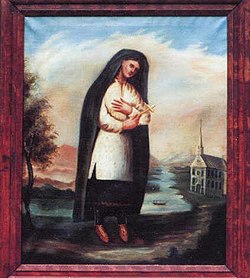
The Lily of the Mohawks and the Boom in American Sainthood

by Kathy Cummings

When a friend of Flannery O'Connor's complained of sexism in theCatholic Church in the 1950s, the novelist dismissed the accusation, pointingout that "the Church would just as soon canonize a woman as aman."  A keen observer ofCatholicism, O'Connor was uncharacteristically off the mark in this instance,as women make up only about one-fourth of the Church's canonized saints. Thismakes yesterday's announcement all the more remarkable: in authenticating asecond miracle for Kateri Tekakwitha and for Mother Marianne Cope, PopeBenedict has essentially added two more female U.S. saints to the Catholiccanon (a papal bull of canonization will almost certainly be forthcoming, mostlikely within a year).  At present thereare nine canonized saints who lived in the United States or territory thatlater became part of the United States; five of them are women. The imminentaddition of Tekakwitha and Cope tilts the balance of power heavily in women'sfavor, a phenomenon not often witnessed in Catholic circles.

            As Linford Fisherdiscussed in this space Monday, Tekakwitha has long been considered a patronsaint of Native Americans and will be the first of their number canonized bythe Catholic Church. She will also be the first American saint who was not amember of a religious community.  In thisrespect American saints do correspond with universal patterns. Men and women religious are overrepresented in thecanon of the saints for good reason; religious congregations have thepersonnel, the funding and the institutional memory to sustain a cause forcanonization through the decades or even centuries it takes for a cause tosucceed.

            U.S. Catholicsbegan lobbying for a saint of their own in the 1880s.  Half a century later, the Catholic Churchcanonized the North American martyrs, eight Jesuit missionaries who were killedin New France in the seventeenth century. Two of those had died in territorythat later became part of upstate New York, and thus they technically countedas U.S. saints. But most American Catholics held off from celebrating until1946, when Frances Cabrini became the first U.S. citizen to be canonized. Thefirst native-born saint, Elizabeth Ann Seton, was canonized in 1975, followedtwo years later by the the canonization of John Neumann, a Bohemian-bornRedemptorist missionary and bishop of Philadelphia. Since then pace ofcanonizations has increased dramatically, with the canonization of Mother RosePhilippine Duchesne (1988) Mother Katharine Drexel (2000), Mother TheodoreGuerin (2006) and Father Damien de Veuster (2009), who like Marianne Cope,served a leper community in Molokai.

            We can expect thatTekakwitha and Cope represent the beginning of an even more dramatic uptick inthe total number of American saints. There are over fifty American causes atvarious stages in the process, and many of them made significant progressduring the pontificate of John Paul II. He canonized more people than all of his predecessors combined, in partby streamlining the complicated process. John Paul II was in particularcommitted to canonizing people from among national and ethnic groups that werewithout patron saints. This explains, in part, his decision to waive therequired miracle for Kateri Tekakwitha, which paved the way for her 1980beatification. John Paul II also made a concerted effort to canonize more laypeople.  And while he is not oftenregarded as a hero to Catholic feminists, it is worth pointing out that roughlyone-third of the 482 saints he canonized were women, lending, belatedly and perhapsfleetingly, a certain credence to Flannery O'Connor's observation. 

Selasa, 20 Desember 2011

Choice Reviews Through the Storm, Through the Night


Paul Harvey

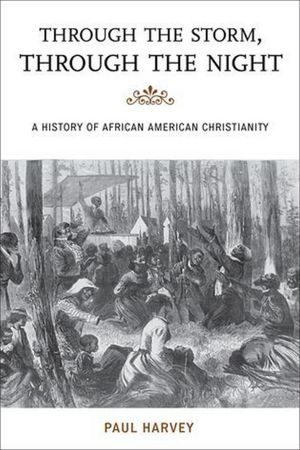
Pardon the self-promotion interruption, but you're used to it. Now and then I post reviews from the helpful library periodical Choice of books of interest in our field. Today I'm going to seize the blog to post this review of my new book Through the Storm, Through the Night, especially for those of you contemplating your book choices for next semester's classes. 

Harvey, Paul.  Through the storm, through the night: a history of African American Christianity.  Rowman & Littlefield, 2011.  217p bibl index afp; ISBN 9780742564732, $35.00; ISBN 9780742564756 e-book, $34.99. Reviewed in 2012jan CHOICE.

Books abound on the African American religious experience in the US, but Harvey's work is a welcome addition and succinct summary of its 400-year history. Typically in such short monographs, detail is sacrificed for brevity, but Harvey (history, Univ. of Colorado, Colorado Springs) packs great substance through insightful biographies and aptly summarized historical events. He argues against any uniform African American church or religious experience, as African Americans experienced varied contacts with Christianity and often mixed traditional African spiritualism and animistic beliefs. Unquestionably, religious beliefs infused the African American community with hope as they struggled through slavery, Jim Crow legislation, segregation, race-oriented violence, and the civil rights movement. Harvey concludes that though the church is still relevant and Christian denominations are still predominant in the African American community, 21st-century immigrants continue to challenge this narrative, as the Orisha traditions of West and Central Africans, Cuban Santería, Haitian Catholicism and Voodoo, Ethiopian Eastern Orthodoxy, and Islamic influences further heighten diversity. The author notes that clannish and local community traditions among these immigrants overshadow any presumed unity based on skin color. In summary, Harvey creates a broad panoramic of the African American religious experience and challenges future scholars to increase scholarly attention to this field. Summing Up: Highly recommended. All levels/libraries. -- M. S. Hill, Gordon College

New Pew Report

Darren Grem

Quick post to draw your attention to the newly released stats from the Pew folks on "global Christianity."  The big takeaway:

A comprehensive demographic study of more than 200 countries finds that there are 2.18 billion Christians of all ages around the world, representing nearly a third of the estimated 2010 global population of 6.9 billion. Christians are also geographically widespread – so far-flung, in fact, that no single continent or region can indisputably claim to be the center of global Christianity.

In addition to a quiz that might be of use in the classroom, lots of handy tables and maps are available for teaching and reflection on historical trends, including this one:


Related Posts Plugin for WordPress, Blogger...