Late breaking news -- I heard *rumor* at the Southern Hist. Association meeting that our friend Darren Dochuk had won yet another award for his book From Bible Belt to Sunbelt -- and remember we did an extensive interview with the author here and here.
Rumor was right: Darren has been awarded the Dunning Prize of the American Historical Association, named every other year for "the best book on any subject pertaining to the history of the United States." Wow!
Previous winners make a list of "hall of famers" for recent historians -- including Daniel Usner, Laurel Thatcher Ulrich, Nick Salvatore, Peggy Pascoe, and others. You historians out there will recognize that as an all-star lineup for real.
Between the Dunning Prize and our contributor Deg winning the C. Vann Woodward award from the SHA, it's been a good week for contributors and friends of the blog. I was fortunate to get to hang out with Deg a bit at the SHA (happily for him, while watching UGA beat Florida), and hope to do the same soon with Darren at the AHA in January. Congratulations to all! I might mention that Dochuk was a Lilly Fellow at Valparaiso in 2006--07, following an august lineup of historians who made good use of the same postdoc, including John McGreevy, John Fea, and Mike Utzinger. Of course, I held the fellowship 1993-95, but enough time has passed that the ignominy caused by my time there has passed, and Fea, Dochuk, Utzinger, and others have restored honor to the program.
Here's the second part of our conversation: "What does American Studies reveal to us about religion in America?" Today, Mike and I pick up with discussions of the secular, American studies and religion, and why you all should be going to ASA in the future. Enjoy!
Kelly Baker (KB): Another point that I would like your opinion, Mike, is the emphasis on the secular and its relationship to religion. What do you make of these encounters with this loaded term?
Mike Altman (MA): I found an interesting discussion of secularism in Matt Hedstrom's (University of Virginia) paper analyzing the constitutional reform movement following the Civil War and its work to put God into the Constitution. Hedstrom pointed out that religious liberals stood on the front lines of the fight to keep the Constitution secular and further argued that the dispute over the secularism of the Constitution was actually a theological battle between conservatives and liberals and not a debate between the religious and irreligious. On that same panel Joseph Haker (University of Minnesota) presented a paper on postwar Ten Commandments monuments. Haker argued that these monuments were not religious like their contemporary Christian Right cousins, but instead were symbols for the American Way of Life, in a Protestant-Catholic-Jew sense. He claimed they were secular symbols. Here again we see the limits of contemporary discourse about secularism and its religious/irreligious dyad. In one case religious liberals and conservatives debated the necessity of a secular Constitution to the maintenance of religious freedom and in the other a religious symbol is deployed in the name of nationalism and a secular way of life.
Haker’s presentation included some great photographs of the monuments and the rabbis, pastors, and priests involved in installing them. These photographs pointed out what linked together these 19th and mid 20th century debates about secularism with today--whiteness. Here’s where I asked your “whiteness question” and what came to the fore for me was the ways the debates about seularism are largely white debates due in large part to the long Enlightenment, Protestant, and post-Protestant history of the argument. Talal Asad has pointed this out already but these two papers gave me new images and examples for thinking about it.
Related to this is a paper from another panel on religion and space in America from Nicolas Howe (Williams College). Howe told the story of Native American opposition to developments on the San Francisco Peaks because the peaks were considered sacred to various Native American nations. Specifically, native groups opposed the use of reclaimed sewage water to make snow for a ski area on one of the peaks. They argued that this would desecrate their sacred space. In a smart move, Howe argued that their arguments about desecration of sacred space mirrored secularist arguments about the ways various religious performances or materials “desecrate” secular public spaces. Howe further argues that the law has generally had problems dealing with both of these arguments because of their similar use of ideas of desecration or contamination.
So to answer you question, coming out of the weekend I’ve seen that the usual framing of secularity as secular vs. religious misses the multiple ways that these two discourses overlap, intertwine, and ape one another. They are not just two sides of the same coin. They are, in fact, the whole coin. (KB: yes, yes, they are!)
So, one final question for you: what difference does it make to approach religion in America from American studies instead of from religious studies or history? KB: This is a good question too. For better (or possibly worse), I attend ASA and AAR as my major conferences each year. At ASA, sometimes I feel like I have to cajole folks into paying attention to religion as a major component of American life. This seems like a silly thing to say, but religion often only pops up at predictable moments in ASA panels on topics like Civil Rights and suspiciously absent at other times. There was a panel a couple years ago at ASA, in which an audience member worried about using religion as a category of study because this might make religion “real.” As a fellow audience member, I wanted to respond that this was the wrong approach rather we should be paying attention to the reality of religion in the lives of Americans rather than getting trapped in this unending debate about autheniticity or reality. It struck me that American studies folks should be talking to religious studies folks more, and vice versa.
The theoretical and multi-disciplinary approach of American studies makes it an excellent pairing with the study of religion in American life, as you can probably tell from all the panels we’ve mentioned. Where else could you find panels like the ones we’ve discussed? The panels that I attended not only presented ethnographic case studies or historical studies but sought to make historiographical interventions and to renarrate religion in public life, past and present. These were bold, smart panels that really interrogated how we understand religion as embodied, artifactual, textual, ideological, and historical. Objects spoke in panels from Ben Brazil’s (Emory) “hippie vans” to Heather Curtis’s (Tufts) visual culture of pain. Fundamentalists were fictional for both myself and Tara McCellan (Mississipppi State) and historical, successful businessmen for our own Darren Grem (Emory).
And there’s an embrace of cultural analysis at ASA that leads to big questions about place of not only religion, but race, gender, sexuality, imperialism, and class (to name only a few) in modern life. What I like about ASA is the embrace of big questions as well as a theoretical eclecticism that I find useful and refreshing. Additionally, it is a nice space for anyone who works as an Americanist because it puts you in contact with other Americanists in fields beyond history and religious studies.
None of this should surprise you since my book is in an American studies series. American studies, and the ASA in particular, offered me the ability to negotiate some thorny issues with religious studies and history about method and a scholar’s positionality in a truly mutli-disciplinary way as I was beginning my work on the Klan (and as I finished it). Additionally, I find American studies very helpful as I begin new projects of cultural and religious history that involve unconventional source material (zombies, anyone?) because of the embrace of pop culture as evidence and plurality of methods.
Now, I wonder what your read on this is: how do you think American studies can benefit those of us working on religion in America?
MA: This was my first time at the ASA meeting whereas I have been to the AAR a handful of times in my graduate career and I have to say that I left the ASA much more motivated to get back to work than I have the AAR. That is not to say I don’t love the AAR, because I do, and but I think the difference comes down to the central categories of each organization and how they regard these categories.. The central category of the AAR is, unsurprisingly, religion, and so the folks at that conference appreciate religion in a very unique way. There are also those at the AAR who seem a bit protective of “religion” either in terms of disciplinary turf or its status as a sui generis category (whatever that may mean). The ASA’s central category is “American” and it seems that it is a bit tougher on the “American” than AAR is on the “religious.” What counts as American is constantly being pushed, stretched, questioned, and even beaten up on a bit. In a senese, “America” gets a lot less deference from research at the ASA than “religion” gets at the AAR. The reasons for this can obviously be found in divergent disciplinary histories.
I say all of that to point out that the ASA was refreshingly irreverent to religion--in a good way. Yes, there were two people in the audience who asked silly “why are American evangelicals so crazy?” questions and yes there are people who have read little in religious studies beyond Marx or Freud, but I’ll take that handful of people in exchange for some of the soft-pedaling that goes on within the AAR (KB: I second that too!). There are some great people at the AAR who are probing race, class, gender, bodies, sexuality, empire, power and all of those other wonderful categories with refreshing irreverence and the kid gloves firmly removed but there were more of them at the ASA--or at least a greater percentage of them among the religion panels this past weekend.
I left the ASA really motivated to get home and get back to work on my own project. The research on religion in America presented at the conference was innovative and inspiring. It made me say “I can do something like that!” I haven’t felt that way after an AAR for whatever reason. I love the AAR because it is a place where religion matters and that is extremely important. But sometimes it’s nice to be somewhere where religion isn’t quite so special.
KB: Ditto everything you said here. I finished my panel on Sunday and thought now I can go turn this into an article, and like you, the conversations I had and the panels I attended were re-energizing because there aren’t “turf wars” you describe over what counts as religion or not. It is nice to sometimes avoid those discussions all together. Perhaps, religion studies folk at ASA find the atmosphere more conducive to this kind of interrogation and pushing boundaries than we might at AAR because the stakes do seem higher. The joy you describe is a feeling I come home with ever year after ASA, and I am glad you found a good space at this conference. Now, if only we can convince Paul Harvey to attend.
Today's post is a conversation between Mike Altman and me (Kelly) about the place of religion at the American Studies Association meeting last week in Baltimore, Maryland. We reflect on the types of panels at ASA on religion as well as the lingering questions from these panels including issues like embodiment, race, science, and the secular. I'll post part two tomorrow.
What does American Studies reveal to us about religion in America?
Kelly Baker (KB): As a long time ASA attendee, I am still struck by the sheer interdisciplinarity of panels: literature, material culture, religious studies, history, media studies, critical race and gender theory, sociology, legal studies, and psychology. This means that discussions of religion in America occurs across a variety of disciplines, so that a term like “fundamentalism” gets analyzed and deployed differently depending on whether a scholar studying literature, history or someone like me trained in religious studies uses it. This variety leads to discussions that I might not be having at AAR.
I attended panels ranging from the production of conservative religious documentaries to discussions of religion and American nationalism to religious visual and material cultures to religion and consumer products to re-evaluation historiographies of race and religion to negotiations and case studies of terms like global religion. What was most striking was the attention to science, embodiment, race, and the “secular,” which emerged again and again in each panel. Sandra Garner (Miami University, Ohio), Rita Trimble (Ohio State University), and John-Charles Duffy (University of North Carolina, Chapel Hill) showcased how participation in scientific and social scientific discourse allowed conservative Mormon documentarians to present data about population stagnation, previous “lost” peoples in the Americas, and uplifting of traditional families. Participating in secularizing language became a way to legitimate one’s religious position, a mode of verification. Science authenticated religion, which is not often how this relationship is described.
Mike Altman (MA): So, I’ll pick up on a couple of the themes you mentioned because they jumped out to me too. First, the body. All weekend we were drawn back to bodies and while the question "where's the body in your project?" can seem like a theoretical gotcha (or a form of academic snarkenfreuden), nonetheless, bodies were central to much of the research presented on American religions. Our own Emily Clark (Florida State) offered an excellent paper on Moorish Science Temple teas and tonics meant to purify the body, a purity that paralleled the need for racial and religious purity. Jordan Wade (University of Kansas), who appeared on a panel with me focused around “global religions” in America and took us into the world of Bikram Yoga with her ethnography of a yoga center in Lawrence, Kansas. In Wade's telling, yoga emerges as a form of bodily discipline, rather than spa relaxation technique, tied up in a transnational network that spans Europe, India, and America.
All of the focus on the body in some papers prompted me to wonder where the body was in other papers. When we discuss Moorish Science or yoga it seems that we notice the body but in Friday's panel "Getting the Nation Right with God: American Politics in the Conservative Christian Imagination" I realized that we don't tend to think about Christian Right bodies--at least not in the contemporary discourse scholars and journalists are producing. We especially don't tend to think of politician’s bodies--well, unless you pick cover photos at Newsweek. The presentations on this panel from Sarah Posner, Eoin Cannon, and Karen Seat were all very well done but, for me, they highlighted an overarching problem with the way the Christian Right is imagined both in the media and by scholars. It's always about ideas. The GOP candidates are constantly trying to disembody themselves and represent themselves as pure ideology. How can we force them back into bodies? How can we take Christian Right ideas about the body and think through Christian Right bodies? Marie Griffith has offered us some glimpses of Protestant bodies but we need more on contemporary political religions.
KB: Mike, yes! I couldn’t agree more. Ideas become the fundamental evidence of religiosity for some groups, and bodies become the evidence in others. This division of ideas and bodies proves superficial and unhelpful (at least I think so) to our scholarship. Critical analysis of both race and gender necessarily lends itself to discussions of embodiment, so discussions of race and religion like Ed’s panel at 8 am on Thursday interrogate and engage embodiness, the bodily, and practice as well as the ideological and theological ramifications. Much like Emily and Jordan engaged both in their presentations to make clearly how the bodily impacts the more ephemeral renderings of spirit and purity.What becomes telling is where embodiness appears as a legitimate method of describing, documenting, or analyzing religious peoples, movements, and ideas and where embodiment is somehow not considered.
What I liked about Jason Bivins’ (North Carolina Sate) response to the Getting Right with God panel was his attempt to bring up embodiment as a legitimate method to interrogate the Christian Right and other politicitizations of religion. Why don’t we problematize, or heck, even engage, the bodies attached to these ideologies? I think it deeply matters that white male bodies are ignored in favor of their ideas and their rhetoric. They become soley progenitors of words, somehow absent from the fleshy reality that plagues the rest of us (even though there is attention, not analysis, of physical appearances). Embodiment matters, and I want to know why there is still hesitance to press bodily analysis on certain, dominant religious groups. Griffith does lead the way on this, and I think Martha Finch’s work, gets us closer to this kind of analysis. Why aren’t we analyzing white Christian bodies? Is it an assumption of invisibility and dominance? Or is there something more subtle and possibly insidious going on here?
I asked a variation of this question at quite a few panels to get at the question of the invisibility of whiteness as a racial classification. Didn’t you even call it my “whiteness question?” Judith Weisenfeld (Princeton University) pointed out the need for more analysis of assumptions of whiteness in her response to the conservative documentaries panel. By the end of the weekend, I felt a bit like a broken record. We need to think more about race as more than marked by difference but also unmarked categories too.
Here's a new and intriguing work that's is already making quite a splash: Nancy Schultz, Mrs. Mattingly's Miracle: and the Cure that Shocked Washington City, recently published by Yale University Press. A brief description, from the book's website:
In the spring of 1824 in the young capital city of Washington, D.C., Ann Carbery Mattingly, widowed sister of the city's mayor, was miraculously cured of a ravaging cancer. Just days, or perhaps even hours, from her predicted demise, she arose from her sickbed freed from agonizing pain and able to enjoy an additional thirty-one years of life. The Mattingly miracle purportedly came through the intervention of a charismatic German cleric, Prince Alexander Hohenlohe, who was credited already with hundreds of cures across Europe and Great Britain. Though nearly forgotten today, Mattingly's astonishing healing became a polarizing event. It heralded a rising tide of anti-Catholicism in the United States that would culminate in violence over the next two decades.
Working from sources in Europe and America, Nancy Lusignan Schultz deftly weaves analysis of this significant episode in American social and religious history together with the astonishing personal stories of both Ann Mattingly and the healer Prince Hohenlohe, around whom a cult was arising in Europe. Mrs. Mattingly's Miracle has the dramatic intensity of a novel and brings to light an early episode in the battle between faith and reason in the United States-a battle that continues to inspire debate in American culture to this day.
The author previously published a really fine study Fire and Roses: The Burning of the Charlestown Convent, 1834, and has made her name as someone who brings to life the social history of antebellum Catholicism, and anti-Catholicism. The new book is akin to Paul Johnson and Sean Wilentz's classic The Kingdom of Matthias, in that it takes an unusual, idiosyncratic story and uses it as a lens to explore broad themes of American religious and cultural life in a particular time period. The book has received a really wonderful review by the Washington Post; here's a little snippet:
Nancy Lusignan Schultz, a professor of English at Salem State University, brings an impressive depth of scholarship to this odd, forgotten chapter of America’s early social history. She presents a gripping account of the controversy that erupted over Mattingly’s sudden and inexplicable return to health and explores the lasting debate it provoked “between reason and emotion, between science and religion, and between sectarianism and ecumenism.”
All of these tensions, she explains, were distilled in the person of Prince Hohenlohe, the mysterious “thaumaturgus,” or miracle worker, whose apparent ability to cure blindness and other infirmities had already made him a sensation in Europe. The 18th son of an Austrian crown prince, Hohenlohe drew crowds wherever he went, combining the “benign accessibility of a parish priest with the awe-striking cachet of a thousand-year-old name.” He also attracted powerful enemies. One official denounced him as a “deeply dissipated man, who seduces girls,” and even his staunchest defenders were forced to admit that he made “an unlikely candidate for Catholic sainthood.” As Hohenlohe’s fame spread, Pope Pius VII himself urged moderation, “so that the holiness will not become a subject of curiosity and mockery.”
The Vatican’s fears were amply borne out in America, where the news of Mattingly’s “distance healing” created an immediate stir. The young nation was moved, wrote one cleric, “as Jerusalem formerly was at the arrival of the three wise men.” Perhaps wisely, Schultz does not attempt to answer the divisive question of whether Mattingly’s return to health was a genuine miracle or not. “I believe that something extraordinary did happen in Washington City nearly two centuries ago,” she explains. “How this happened, though, and whether the explanation is natural or supernatural, pushes deep into the realm of faith. This book does not try to guide you there.
Instead, Schultz focuses on the cultural impact of the drama. As the initial enthusiasm gave way to skepticism and concern, she demonstrates, the Mattingly episode exposed tensions within the American church and raised fears that foreign religious figures wished to tamper with the new republic’s hard-won freedoms. The result was a climate of “spectral paranoia” that fueled a wave of anti-Catholic violence, including the burning of an Ursuline convent in Charlestown, Mass., in 1834 — which, perhaps not surprisingly, forms the subject of one of Schultz’s previous books.
The result is a gripping slice of history with fresh, often unsettling resonances for the modern reader. “This miracle has caused a great deal of trouble,” as one beleaguered priest remarked at the time, “happy thing they do not occur often.”
You can also access lot of other reviews and reflections on the book here.
One of the links in the page just mentioned is to a piece by the author in the Chronicle of Higher Education, something that should warm the heart of every historian although written by an English professor! The author reflects on the "serendipity" of the archive, and how that can never be replaced fully by digitized material. In the course of researching Fire and Roses, she stumbled on the inspiration and story for this book. Reflecting on leading her students through the archive at the college where she teaches, she concludes, "My students now understand that most rare archival material . . . will never be scanned and digitized. And even if much of this material is digitized, its virtual presence is no substitute for the tactile and sensory experience of being in an archive." The serendipitous discoveries she made in researching this book on antebellum miracles, she concludes, were themselves small miracles.
On my way soon to the Southern Historical Association this coming weekend in Baltimore, where I will have the distinct pleasure (if my plane isn't delayed, if God wills it) of giving a tremendous award to one of our blog contributors, Darren Grem (Deg), who has been named one of the co-winners of this year's C. Vann Woodward Dissertation Prize, given to the best dissertation in Southern History in any given year. Deg's dissertation is entitled "The Blessings of Business: Corporate America and the Rise of Conservative Evangelicalism." As one of the judges for this year's contest, I had the rare opportunity to survey a large number of dissertations in the field that came out in 2010 (and you wonder where my summer went), and was happy to see southern history in such great shape. There were a LOT of deserving contenders and any number of them could have been named winners -- indeed, I anticipate many will win prizes given out by other professional associations.
A description of Deg's dissertation may be found here. Since most folks reading this won't be at the awards ceremony Friday, here's part of what I will read on behalf of the selection committee:
Dr. Grem’s dissertation “follows the money” of American evangelicalism through the twentieth century, focusing on the relationship between corporate capitalism, southern entrepreneurs, and the rise of evangelical institutions. Individual chapters trace the innovations in funding and Christian entrepreneurship from figures as diverse as Billy Graham, R. G. LeTourneau, the founder of Chic-Fil-A and Hobby Lobby, and evangelists such as Billy Graham and the Wycliffe Bible Translators. The result is a rich and complex analysis which places corporate capitalism squarely within the world of southern evangelicals through the twentieth century, much like C. Vann Woodward himself did with the world of the “Redeemers” and the New South movement. It’s one of the finest and most important works in American religious, intellectual, and economic history that I’ve read in a considerable time, and the fact that it combines all three of those fields I’m sure is one of the things that made it so attractive to Oxford University Press.
Just a couple of other notes here. First, congratulations to blog friend Alison Greene, whose dissertation "No Depression in Heaven: Religion and Economic Crisis in Memphis and the Delta, 1929-1941," was one of the three finalists for the prize, and her work will soon be an oustanding book.
And, I might add, if you survey the list of recent winners of the C. Vann Woodward dissertation prize, you'll find the makings of some of the most important works in southern history published in recent years. Three in particular I'll note. The 2003 winner was our blog contributor and my co-author and co-editor Edward J. Blum, whose dissertation became the landmark work Reforging the White Republic: Race, Religion, and American Nationalism. In 2004 the selection committee picked Chandra Manning's dissertation, which a few years later became a book that has become a staple of my classroom, What This Cruel War Was Over: Soldiers, Slavery, and the Civil War. Then in 2007, Bethany Moreton won the prize for her groundbreaking work that has since become the book To Serve God and Wal-Mart: The Makings of Christian Free Enterprise (Bethany then went on to be one of Deg's mentors at UGA, so the baton has been passed). In short, the C. Vann Woodward prize, both for the recipients as well as for the remarkable list of works that have been named as finalists for the award, has served to bring attention to books that have fundamentally shaped the field of southern history -- and it's no coincidence that religion has been central to a sizable number of the finalists and winners of the award since its establishment.
Just a quite note of irony, as befits the modern founder of the field and the author of The Irony of Southern History: C. Vann Woodward was, of course, one of the greatest historians of the 20th century, and all students of American history will be familiar with landmark works such as Origins of the New South and The Strange Career of Jim Crow. Woodward's focus, as was true of his generation more largely, was usually economic and political history; no one will ever best his scathing portrayal of the "Redeemers" in Origins. Woodward knew little, and probably (as far as I know) cared less for religious history, which is given a reasonable but somewhat perfunctory treatment in Origins. That makes it ironic in many ways how many of the recent winners of the award named after him feature religion centrally in their work; it speaks also to a larger transformation of the field of American history too, I think.
And the same note of congratulations for my partner in crime Philip Goff, whose Center for the Study of Religion and American Culture at IUPUI remains central to the enterprise of American religious history in so many ways. Phil's Center has just received a sizable grant from the Lilly Endowment for a three-year project on "The Bible in American Life," which has many aspects to it and will culminate in a national conference in 2014. Read all about it here. So shout out to Phil for yet another success for the Center.
If these professors typify the views of Eastern Nazarene, which is officially listed as a Christian university, it is reason for despair. Once left-wing values enter the evangelical bloodstream, there is almost no hope for America.
I suppose the "almost" means that there is still a slim, glimmer of hope left. Thanks goodness.
I only went to two ASA panels in Baltimore, and both were fantastic. One was on “performative black Christianity” and it had papers on the sacred and the sonic in James Baldwin’s novel Just Above My Head by Ashon T. Crawley, on sexuality, sensuality, and virginity in the preaching and performance of Juanita Bynum by Terrion L. Williamson, and on Tyler Perry’s “guardian” masculinity by Ronald Neal. Fred Moten, the author of In the Break: The Aesthetics of the Black Radical Tradition, of Duke University commented, and Daphne Brooks of Princeton chaired. Her book Bodies in Dissentshould be known by more in American religious history. Her emphasis on corporeal spectactularity in performances of race and freedom is a rich and innovative (such as Henry “Box” Brown using his body – its presence and absence – to dramatize his freedom narrative, and how demonstrations of race and freedom resonated with other cultural performances of “magic” and “spiritualism”). As I heard the terrific papers and the outstanding comments, I kept reflecting on Anthony Pinn’s work on how we make sense of spaces where silence and sound collide and where bodies and no-bodies stand side-by-side. Whether in Terror and Triumph,Why Lord? or in Embodiment and the New Shape of Black Theological Thought, Pinn examines historically and tries to make sense theologically of the complexities of sounds, spaces, and bodies.
The other panel I attended was on race and religion during the 1920s and 1930s. It was an all-star gang of Stephen Tuck, the author of two amazing books on the “long civil rights movement”, Suzanne Smith, also the author of two wonderful monographs – one on Motown, one on funerals and funeral directors … try explaining that one to family and friends who wonder what it is we scholars do (and if Phil Sinitiere is listening, I’d love to see an interview with Smith and with Tuck on their latest books from Harvard) …, and the final one by Alison Collis Greene, whose
dissertation on how Delta southerners made spiritual sense of the Great Depression and New Deal will certainly be blogged about here in the future when it becomes a monograph. The papers dealt with black unbelief (where Stephen Tuck showed how religious wars raged in the 1920s and 1930s among African American church and civil rights leaders), on so-called new religious movements (where Suzanne Smith discussed the life and work of pastor and radio phenomenon Elder Lightfoot Solomon Michaux) and on generational disagreements among African Americans in the Great Depression Delta (where Alison Greene discussed some of the fantastic interviews from black sociologists of young people during the 1930s). Carolyn Dupont of Eastern Kentucky University and I offered comments, which were primarily of the “thank you for writing such great essays and we can’t wait to seemore” variety. Kelly Baker asked some wonderful questions despite our 8 a.m. time slot. We had a great time. Now I’ve got time for some grading and then it’s back to Baltimore for the Southern Historical Association annual meeting.
The guest post today is from FSU graduate student Charlie McCrary on the anniversary of Stryper's To Hell with the Devil, a controversial Christian metal band. Charlie's most recent post for us reflected on Ron Bell and emergent theology.
Mosh if You Love Jesus: An Introduction to Christian Metal
Charlie McCrary
This October 24th marks the 25th anniversary of the release of Christian glam-metal band Stryper’sTo Hell with the Devil, an album that sold over one-million copies and controversially toed the line between Jesus’ and the devil’s music.A quarter-century later, aided by the Internet and the rising popularity of heavy music, the Christian hardcore/metal scene has exploded.For young people across the United States and the world, hardcore dancing, screaming, and moshing are considered genuine forms of worship.But what does the Christian metal scene look like—and what can it tell us about American evangelical youth culture?A brief survey of today’s Christian metal scene will bring us to at least one conclusion: it’s come a long way from yellow Spandex.
Metal is intense.Nothing about the music or the environment is relaxed. Members of heavy music scenes subscribe disproportionately to extreme lifestyle choices, such as straight-edge or veganism.Oddly enough, this atmosphere of extremism is ripe for evangelical fervor.The type of Christianity preached at Christian metal shows is not of the “lukewarm” variety.Enthusiastic, emotional, radical conversions and rededications are encouraged.A “Spirit-filled” circle pit isn’t entirely unlike, say, Cane Ridge.The evangelical hotbed that is the Christian metal scene subverts some stylistic tendencies of conservative evangelicals yet zealously champions familiar theological, practical, and ideological foundations.
Militarism, violence, and apocalypticism all have their place in American evangelical communities, perhaps nowhere more so than in the Christian metal scene.While apocalyptic themes are standard fare in metal lyrics in general, many Christian metal bands practically sound theseventh trumpet before every breakdown.Along with this focus on the apocalypse—which may be emphasized for the aesthetic qualities of the violent imagery of battle—comes the urgency to repent, accept Jesus as one’s savior, and not be left behind.Thus, because the end is immanent, evangelic efforts are aggressive and exigent, and bands like For Today not only fervently seek conversions, but then also set up Bible study networks in each tour city to ensure that newly-“saved” people can maintain Christian practice and “stay strong.” This battle imagery applies not just to the end times or apocalypse
For the Christian metal scene, as for many evangelicals, the entire world is understood in dichotomous relationships—between spirit and flesh, God and the devil, the “things of God” and “the world.”Many lyrics employ the sense that life itself is a sort of battle to be won or lost.See, for example, Haste the Day’s“When Everything Falls” (“I will stand when everything falls away.I will fight this war forever or until I die”), War of Ages’“Battle On” (“Now that our time is near we hold our own until the end/Fight with every breath without doubt and don't look back/We fight for the Truth”), or For Today’s “Infantry” (“This world will do anything to release its demons at all costs.We'll fight back with all we have, making a difference for our God”).Battles and struggles are constant within the lyrics and messages of Christian metal.Though the battles referred to are often the real, cosmic battles that will in fact take place someday at the end of the world, just as often, they are the everyday struggles commonly experienced and discussed by evangelicals.From struggles with lust (see For Today’s “Redemption”) to the difficulty of fully trusting God (see A Plea for Purging’s“The New Born Wonder”), these lyrics express common evangelical frustrations and problems with typical evangelical language.
Christian metal also falls into line with conservative evangelicalism in its biblicism.Bible verses are frequently quoted in lyrics, and biblical themes and characters are often evoked as a way of meaning-making as well as legitimizing authority.Consider a few brief, fascinating examples.For Today’s 2009 album Portraits features a “portrait” of a biblical character in each song—such as Joel (The Watchman) or Ezekiel (The Visionary)—which serves not only as a Bible lesson but as a way of connecting the evangelical goals and mission of the band with biblical justifications and/or imperatives.In this same way, the now-defunct band Blessed is He drew authority from biblical sources, explicitly making this connection in the song, whose title comes from 1 Corinthians, “I Become One to Win One” with these lyrics: “I have become all things to all people—like Paul said—that I may by all means save some.”In doing so, they relate their sense of purpose while simultaneously silencing via proof-text evangelical doubters who may consider their lifestyle or appearance incongruent with Christianity.
The experience of a Christian metal show is in many ways just like that of any other metal or hardcore show: mosh pits, hardcore dancing, stage dives, headbanging, etc.It is violent, sweaty, intense, and male-dominated, yet at the same time fosters a sense of community and trust (see this video).Metal shows encourage audience participation, so much so that the audience becomes part of the performance.This is exactly the function of many rituals in typically “religious” settings.An atmosphere of solidarity is often created, which lends itself brilliantly not only to audience participating (moshing as a form of worship) but also to receptivity to preaching.Many bands, operative as sweaty, tattooed versions of Billy Graham, devote the final minutes of their set to a passionate plea for their audience to “know Christ.”The metal stage can transform to a pulpit, providing a platform for everything from sermons on manhood to personal testimonies to calls to action to corporate prayer.Some bands even blend Contemporary Christian Music and “praise and worship” genres into their set, as demonstrated in this live performance by Sleeping Giant.
As the idea of metal and hardcore as “acceptable” styles of Christian music (or even worship) becomes more widely affirmed, the Christian metal scene will likely continue to grow.Christian metal has been successful because of its fidelity both to the metal scene and to conservative evangelical principles.In doing so, it provides an outlet for evangelical youths who are drawn to metal but seek a “positive” environment.Additionally—and, in the minds of all involved, more importantly—Christian metal functions as an evangelistic tool, an inroad into a somewhat “unreached” community and an opportunity to “shine light” into the “darkest corners” of American youth culture.
Several of our bloggers are at the 2011 meeting of the American Studies Association in Baltimore -- where I too would be, except that I am due in Baltimore next week for the 2011 Southern Historical Association meeting, and there's just so many of those cross country flyover things I can do at any given time. Anyway, while we're hoping that Kelly, Mike or someone else might blog about the ASA here, you can follow them realtime at the hashtag #2011ASA.
For those of you going to the Southern, our panel unfortunately got put into the dreaded Sunday morning time slot (figures that the religion panel would go there, right?), but the papers propose new stories and ways of thinking about the civil rights struggle and the place of white Protestants within it, and I'm looking forward to the discussion. Here's the information below -- the "Sunday" referenced is Sunday Oct. 30 in the Sheraton Baltimore City Center.
Sunday, October 30: 9:00-11:00 A.M. Hopkins
62. RETHINKING WHITE PROTESTANTISM AND THE LONG CIVIL
RIGHTS STRUGGLE
PRESIDING: Clive Webb, University of Sussex
―What We Could Not Do Through Ourselves Alone: The Federal Council of Churches
and the Challenge of Social Change
Curtis J. Evans, University of Chicago
―A Prostitution of the Church to Political Purposes‖: The Hattiesburg Ministers’ Project,
White Religion, and the Struggle of Black Equality
Carolyn R. Dupont, Eastern Kentucky University
The Desegregation of Church-Sponsored Colleges and the Roots of ―Colorblind‖
Evangelicalism in South Carolina
J. Russell Hawkins, Indiana Wesleyan University
COMMENTS: Paul Harvey, University of Colorado, Colorado Springs
The below is taken from an entry on John Fea's blog, featuring a new issue of History Now that is devoted to religion in colonial America; it should be of interest to many, so I'll repost here. ____________________________________________
Several times on this blog we've discussed and reviewed John Fea's Was America Founded as a Christian Nation: A Historical Introduction. I'm presently using this in a class, to excellent results, as the students are very engaged with the material (and curious about the author!). Ed Blum's post on using the book in his Historiography course produced a series of blog comments which suggests that he must have had a vigorous class discussion coming out of the work.
Here's a very new primary source volume which should serve many as an eminently usable accompaniment for those wanting to dig into this era further or do a "compare the historian's work to the original sources" kind of exercise: Thomas Kidd and Matthew Harris, eds., The Founding Fathers and the Debate Over Religion in Revolutionary America, just published with Oxford. Click on the link and it will take you to the Amazon page for the book, where you can go through the table of contents and see if the work is right for your class.
Even better might be combining this collection of documents with students searching out those from the kinds of revolutionary Americans discussed by Gary Nash in The Unknown American Revolution or some similar text which incorporates voices reaching beyond "the founders." Ed's students discuss precisely this point in their comments on his post (linked above).
The editors include a number of the old standbys on the subject (Jefferson's Danbury letter, the Treaty of Tripoli, various fast day proclamations, and some of the Founders' musings on the subject) as well as some other material less frequently invoked (some state constitutions, the Northwest Ordinance, and some others). Below is a bit more about the book from its website; it looks like a good bet to be a classroom staple for those who teach in this era, much as is Kidd's volume with Bedford books The Great Awakening: A Brief History with Documents, which I used to excellent results last summer in leading a group of K-12 educators in a Teaching American History program in thinking about how to integrate religion in their American history lesson plans.
Whether America was founded as a Christian nation or as a secular republic is one of the most fiercely debated questions in American history. Historians Matthew Harris and Thomas Kidd offer an authoritative examination of the essential documents needed to understand this debate. The texts included in this volume - writings and speeches from both well-known and obscure early American thinkers - show that religion played a prominent yet fractious role in the era of the American Revolution.
In their personal beliefs, the Founders ranged from profound skeptics like Thomas Paine to traditional Christians like Patrick Henry. Nevertheless, most of the Founding Fathers rallied around certain crucial religious principles, including the idea that people were "created" equal, the belief that religious freedom required the disestablishment of state-backed denominations, the necessity of virtue in a republic, and the role of Providence in guiding the affairs of nations. Harris and Kidd show that through the struggles of war and the framing of the Constitution, Americans sought to reconcile their dedication to religious vitality with their commitment to religious freedom.
Excuse me, fellow bloggers, while I steal this blog space for a second to
advertise for a new position in my department, made possible courtesy of an anonymous donor who has endowed a junior position. The position is in East Asian History, and am posting here in the hopes that a few of you out there might forward it to relevant colleagues, graduate students in the field, or to Asian history blogs that you might follow such as Frog in a Well, including Frog in a Well: China. The advertisement, which appears on H-Net and in AHA Perspectives, is below. We'll be meeting in December to first discuss the applications, so plenty of time to apply yet. Applications must go through our CU jobs site: https://www.jobsatcu.com, position # 815014.
The Department of History at the University of Colorado Colorado Springs (UCCS) invites applications for a tenure-track position, at the assistant professor level, in East Asian History, with a specialty in China and/or Japan. Teaching requirements will include survey courses in Chinese and Japanese history, and specialized upper-division courses. Job duties also include research and scholarly activity in the applicant's field of specialization, and appropriate academic service. PhD is required at the time of the appointment. The successful candidate must be able to teach graduate courses in East Asian history and to participate in a multi-disciplinary Humanities program. Please go to https://www.jobsatcu.composition number 815014
Sorry for the interruption -- now back to our regularly scheduled programming.
While pundits and theologians continue the seemingly endless debate over whether or not Mormonism is Christian/Mormons are Christians/a Mormon can be a Christian, over at Slate, browbeat writer David Haglund weighs in on the Mormon church's latest advertising campaign (the "I'm a Mormon" campaign) and the recent participation of The Killers frontman and international rockstar Brandon Flowers in that effort:
The video hews closely to the campaign's usual formula: Flowers talks about himself, then about his values, and then he connects those values to his Mormon faith. Near the end, Flowers talks a bit about his public persona. "A lot of people love to come up to me and tell me they were raised in the church," Flowers says, "and they expect there to be this camaraderie of, oh, we've outgrown it now, we're smart enough now not to be in it." One can understand why this would happen: In 2004, Spin identified Flowers as an ex-Mormon, and he has been candid in the past about his drinking and smoking, activities forbidden for devout members of the Mormon church.
But as the existence of this video suggests, Flowers doesn't see himself as an ex-Mormon, at least not anymore. (If he did, he could have participated in a different video campaign.) What's interesting about this is the way Flowers frames his re-affirmed faith: "I was raised in it," he says, "and I still... it's..." He chuckles. "There's still a fire burning in there." That's the last thing he says before the more standard send-off: "I'm a father, and I'm a husband, and I'm a Mormon."
For those, like myself, interested in Mormon conversion narratives (as well as unexpectedly Mormon musicians), there's a lot to unpack here; I'm especially intrigued by the centrality to his faith of his roles as husband and father. (As an aside, the entire corpus of videos available at mormon.org as part of the ad campaign presents a wealth of primary source material for researchers interested in the lives and stories of everyday Mormons today. They strike me as a 21st century equivalent to the personal narratives and life stories of committed Christians that populated the pages of denominational periodicals of yesteryear).
But Flowers's recent offering at mormon.org is not an isolated example of him speaking out about his faith. In addition to the numerous interviews and articles in which he's affirmed his Mormonism over the years, his music has long been heavy on religious themes---from the redemptive pleadings and catchy chorus ("I've got soul but I'm not a soldier") of "All These Things that I've Done" to "When You Were Young," which Flowers once explained was "about growing up in a religion where Jesus is considered a saviour and also realising people can be saviours, too, whether they be your wife, your best friend or your next-door neighbour. He can come in other human forms." Perhaps the most striking nod to his Mormonism, though, comes in the music video for the second single released on his debut solo album, Flamingo---"Only the Young." Filmed in a darkened and otherwise empty theater in Las Vegas, Flowers performs on stage, surrounded by angelic figures descending from a bright light overhead. To anyone familiar with Joseph Smith's first vision, in which Smith recalled being visited by God the Father and Jesus Christ accompanied by "many angels," the imagery is obvious. But just in case it was missed, Flowers then mimics the pose often portrayed in illustrations of Smith as the divine light descends upon him (all while singing about the innocence and potential of youth to "break away" and discover the Sun, which will surely "shine again").
Flowers's story immediately brought to my mind another Mormon rockstar---coincidentally nicknamed "Killer"---Arthur Kane, the now deceased bassist of the 1970s glam rock and proto-punk band, the New York Dolls, whose post-rockstar career, conversion to Mormonism, and brief reunion with his former bandmates was chronicled in the excellent 2005 documentary, New York Doll. Comparing the two personal narratives provides occasional contrasts---whereas Flowers explains that his renewed commitment to Mormonism means that his faith and family has now "surpassed the music now, for me" in importance, Kane's faith famously found expression in his continual prayers asking for God's help in reuniting the estranged New York Dolls one final time. Yet in other respects, the two resemble one another, particularly in their visual invocation of Mormonism's founding prophet. For the Dolls' 2004 reunion show in London, Kane insisted on wearing "a white ruffly shirt and black leather pants." While such a wardrobe might bring to mind Jerry Seinfeld before anyone else, in Kane's mind it was intended to "convey a Joseph Smith kind of image."
I'm not entirely sure what conclusions can be drawn from these parallel examples, but I doubt Mormonism's musician par-excellence of the 19th century, W.W. Phelps, had anything like this in mind when he eulogized the deceased Mormon prophet by prophesying in verse that "millions shall know Brother Joseph again!"
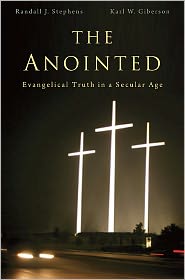
While John Turner aptly describes "dominionists on the loose"and the media brouhaha over the threat of theocracy via Christian dominionism, our own Randall Stephens, writing with Karl W. Giberson, had a New York Times editorial aptly titled, "The Evangelical Rejection of Reason" published yesterday. Coming on the heels of their book, The Annointed Age: Evangelical Truth in a Secular Age(reviewed here by Chris Beneke), they argue convincingly about the war on science as "part of a politically monolithic red-state fundamentalism, textbook evidence of an unyielding ignorance on the part of the religious" as well as map out the anti-intellectualism inherent in these attacks. Randall and Giberson make distinctions between their own evangelicalism and the politicized vision of current Republican nominee hopefuls.
Here's an excerpt:
As one fundamentalist slogan puts it, “The Bible says it, I believe it, that settles it.” But evangelical Christianity need not be defined by the simplistic theology, cultural isolationism and stubborn anti-intellectualism that most of the Republican candidates have embraced....
Fundamentalism appeals to evangelicals who have become convinced that their country has been overrun by a vast secular conspiracy; denial is the simplest and most attractive response to change. They have been scarred by the elimination of prayer in schools; the removal of nativity scenes from public places; the increasing legitimacy of abortion and homosexuality; the persistence of pornography and drug abuse; and acceptance of other religions and of atheism.
In response, many evangelicals created what amounts to a “parallel culture,” nurtured by church, Sunday school, summer camps and colleges, as well as publishing houses, broadcasting networks, music festivals and counseling groups. Among evangelical leaders, Ken Ham, David Barton and James C. Dobson have been particularly effective orchestrators — and beneficiaries — of this subculture. (Continue reading here.)
Editor's note: Also check out John Fea's discussion of the editorial here.
Many news websites are running a wonderful piece by the Associated Press's Rachel Zoll about a segment of American evangelicalism / Pentecostalism. It features the commentary of our own Randall Stephens and also incorporates analysis from Anthea Butler and C. Peter Wagner. Among the article's observations:
These preachers believe demons have taken hold of specific geographic areas, including the nation's capital. They also promote a philosophy of public engagement known as the "seven mountains," which urges Christians to gain influence in business, government, family, church, education, media and the arts as a way to spread righteousness and bring about God's kingdom on earth. The language seems close to dominionism, the belief that Christians have a God-given mandate to run the world.
This is the sort of thing that apparently keeps journalists and some secular Americans up at night. Nothing like fear of the theocrats. One could frighten many residents of Boston or New York this Halloween by dressing up as Michelle Bachman. Heck, they'd probably run away from Joel Osteen, seeing some sort of sinister plot in Osteen's "Every Day a Friday" slogan. Actually, that terrifies me as well to a certain extent. I haven't read Osteen's book, but I have sometimes found value in other days of the week, not to mention the weekend. Osteen is most likely targeting fans of casual office wear with his latest offering.
Zoll, with the help of Stephens and Butler, mostly dismisses the recent furor over dominionism:
Randall Stephens, a professor at Eastern Nazarene College in Quincy, Mass., who researches Pentecostals and politics, called warnings of a conservative Christian plot an overreaction. "I think this is a rabbit hole people fall down and it has a whiff of conspiracy," Stephens said.
I agree. While there are some theocrats out there, I doubt Bachman or Rick Perry is one. When in Boston in August, I noticed that the Globe, rather desperate in its efforts to feed the fears of its readers, carefully noted that Bachman had hugged an Obama birther at a campaign event. Likewise, Rick Perry has shared the stage with some crazy religious nuts. That doesn't make him one. But if he can't rip Mitt Romney to shreds on the issue of health care, he probably doesn't stand much chance of imposing a theocracy on the United States anyway.
It's always good reading when journalists discover whiffs of dominionism on the campaign trail every few years, but this is very old news. Bill Bright and many other evangelicals talked about "capturing" or "retaking" government, the entertainment industry, and higher education back in the 1970s. These spheres of American life were not yet mountains. Such evangelicals were alarmists, but most were not theocrats. If anything, I think most evangelicals are much less self-confident about the potential for their political influence today than three decades.
The 2012 GOP race has been good for our blog thus far. If only Herman Cain had decided to go with a 6-6-6 tax reform plan.
 Paul Harvey




 dissertation on how Delta southerners made spiritual sense of the Great Depression and New Deal will certainly be blogged about here in the future when it becomes a monograph. The papers dealt with black unbelief (where Stephen Tuck showed how religious wars raged in the 1920s and 1930s among African American church and civil rights leaders), on so-called new religious movements (where Suzanne Smith discussed the life and work of pastor and radio phenomenon